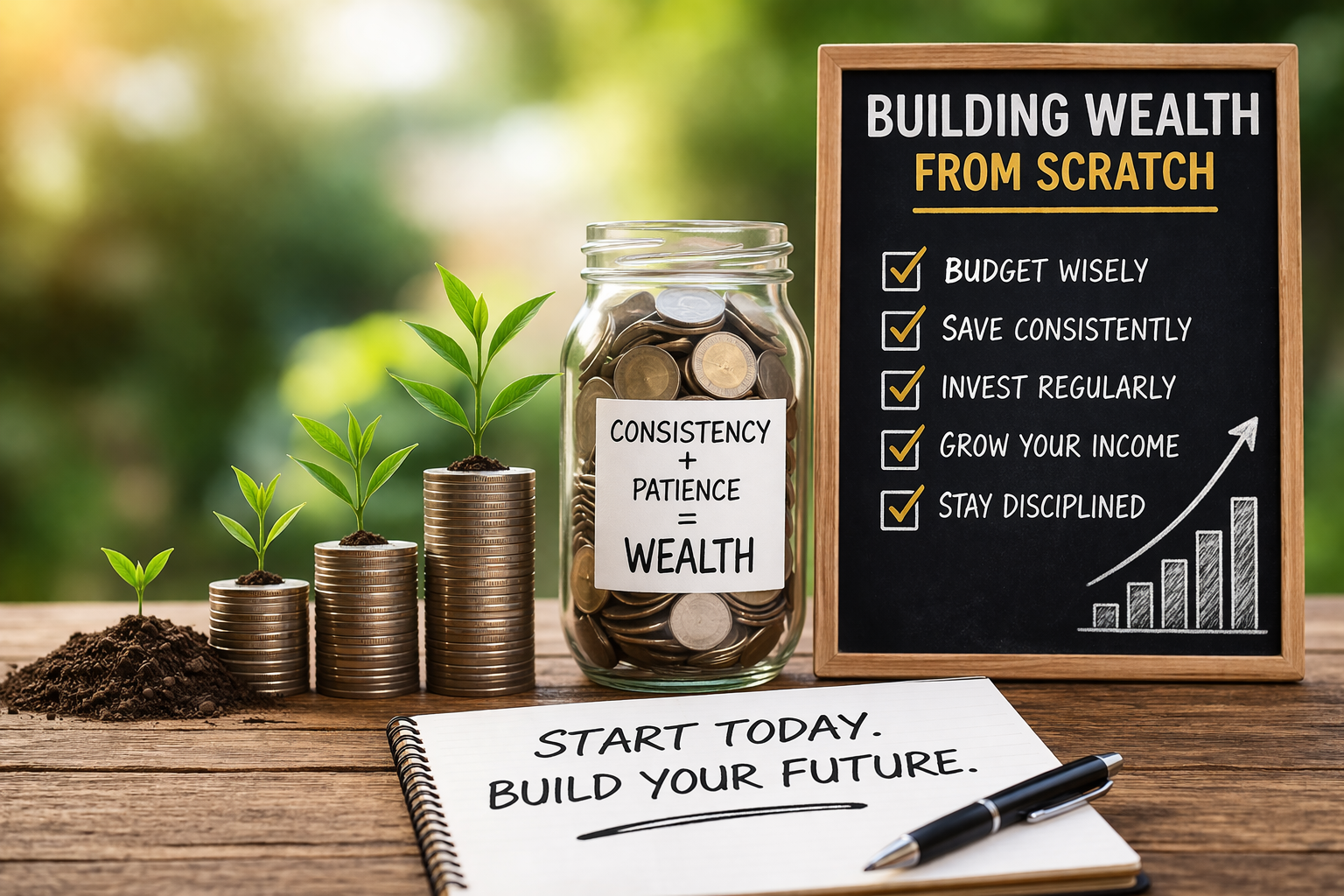
Building Wealth From Scratch: A Practical Blueprint
Introduction
Most people think wealth starts with a big salary. It rarely does. It starts with simple choices repeated for years.
Building wealth from scratch can feel unfair. You may have bills, debt, or family duties. You may feel late or behind.
This guide gives you a clear blueprint. You will learn how to stabilize money, save fast, invest wisely, and grow income. You will also learn how to avoid common traps.
Build Your Foundation First
Wealth grows best on stable ground. If your money leaks, investing will feel pointless. Start with control, clarity, and consistency.
Know What “Wealth” Means
Wealth is not your paycheck. Wealth is what you keep. It is your assets minus your debts.
A simple definition helps you focus. Track these two numbers:
Net worth: assets minus liabilities
Savings rate: savings divided by income
Your goal is steady improvement. Small gains compound over time.
Set One Clear Target
Goals reduce stress. They also guide decisions. Pick one target for the next 90 days.
Good early targets include:
Save $500 or $1,000
Pay off one small debt
Build a one-month emergency fund
Invest your first $100
Keep the target specific. Make it measurable. Write a date.
Track Your Money for 14 Days
Most budgets fail due to guessing. Guessing hides problems. Tracking reveals patterns fast.
For 14 days, track everything:
Food and drinks
Transport Subscriptions
Transfers to friends or family
Small cash spending
Use notes, a spreadsheet, or an app. The tool does not matter. The truth matters.
After 14 days, label each expense:
Needed Helpful Optional
This creates your first plan. It also builds awareness.
Create a Budget That You Can Keep
A budget is a plan for your next dollars. It is not punishment. It is permission with limits.
Use a Simple Budget Framework
Start with a structure you can remember. Try the 50/30/20 as a baseline:
50% needs 30% wants
20% saving and investing
If money is tight, adjust it. Many people start with 70/20/10:
70% needs
20% debt payoff and saving
10% wants
The exact split is not the point. The point is a plan you follow.
Pay Yourself First
Saving last often means saving never. Flip the order. Save first, then spend.
Automate these if possible:
A fixed amount to savings
A fixed amount to investing
Minimum debt payments
Automation removes daily decisions. It also reduces temptation.
Build a “Real Life” Category
Many budgets break on surprises. But surprises are predictable. Life always happens.
Add a category for:
Repairs Gifts
Medical costs
School needs
Travel for family events
Even $20 per week helps. This stops you from using debt.
Kill High-Interest Debt Without Burning Out
Debt can block wealth building. High-interest debt is the worst. It grows faster than most investments.
Know Which Debt Matters Most
Not all debt is equal. Focus on interest rate and risk.
Prioritize:
Credit cards and payday loans
High-interest personal loans
Anything with fees and penalties
Low-interest debt is different. It may be manageable while investing. But only after stability.
Choose a Payoff Method
Two methods work well. Pick one and commit.
1) Debt snowball
Pay the smallest balance first. You gain fast motivation.
2) Debt avalanche
Pay the highest interest first. You save more money long term.
Both require the same core move. Pay more than the minimum.
Use a Simple Debt Attack Plan
Follow this checklist:
List all debts and minimum payments
Stop adding new debt today
Cut one expense and redirect it
Add a small side income if possible
Pay extra on one target debt monthly
Even $25 extra matters. Consistency beats intensity.
Build an Emergency Fund That Protects You
An emergency fund is not an investment. It is insurance for your plan. It stops panic decisions.
Start Small and Win Quickly
If you have debt, start with a mini fund. Aim for $500 to $1,000. Keep it in a separate account.
This fund covers small shocks:
A broken phone
A medical bill
A missed work day
A car repair
Without it, you use debt. Debt then slows your progress.
Grow It to 3 to 6 Months
After high-interest debt is controlled, expand. Your target depends on stability:
3 months for steady income
6 months for variable income
9 months for high uncertainty
This fund buys you time. Time is power. It helps you make calm choices.
Keep It Safe and Accessible
Emergency money should not swing in value. Avoid risky assets here. Choose a safe option with easy access.
The goal is reliability. Not high returns.
Increase Your Income in a Sustainable Way
Saving matters a lot. But income growth changes everything. It speeds up every goal.
Focus on “High-Leverage” Skills
Some skills raise income faster. They also transfer across industries.
Examples include:
Sales and negotiation
Writing and communication
Data and analysis
Coding and automation
Project management
Design and marketing
Pick one skill track. Spend 30 minutes a day learning. Build small projects to prove ability.
Use the Three-Lane Income Model
You can grow income through three lanes. Use one lane now. Add others later.
Lane 1: Earn more at your main job
Ask for clear targets
Document results
Request a review with evidence
Lane 2: Side income
Freelance a skill
Tutor or coach
Offer local services
Sell digital products
Lane 3: Investment income
Dividends and interest
Rental income
Business ownership
Most people start with lane one. Side income often comes next. Investments then scale it.
A Practical Side Income Start
Start simple. Start with what you can do now.
Try this process:
List five things you can do well
Pick one that people pay for
Offer it to three people this week
Improve based on feedback
Raise prices after five happy clients
Keep your costs low. Avoid buying equipment early. Use what you already have.
Invest Early, Even With Small Amounts
Investing is not only for the rich. It is how regular people become wealthy. Time does most of the work.
Learn the Core Idea: Compounding
Compounding means gains can earn gains. It rewards patience and consistency. It punishes delays.
A simple example helps: If you invest $200 per month for years, it adds up. The earlier you start, the easier it gets.
Know the Basic Investment Options
You do not need complex products. Understand the main categories:
Cash equivalents: stable, low return
Bonds: steadier, moderate return
Stocks: higher volatility, higher potential return
Index funds: diversified stock baskets
Real estate: can provide income and growth
Diversification reduces risk. It also improves consistency.
Use a Beginner-Friendly Approach
For many beginners, simple beats fancy. A diversified index fund approach is common. It reduces single-stock risk.
A basic rule set:
Invest monthly, not randomly
Diversify across many companies
Keep fees low when possible
Avoid trying to time markets
Stay invested through bad months
Focus on process. Not predictions.
Invest Based on Your Time Horizon
Match your money to your timeline. This reduces stress.
Under 3 years: safer options
3 to 10 years: balanced approach
10+ years: growth focused approach
Longer horizons can handle volatility. Short horizons need stability.
Protect Yourself From Common Investment Traps
Many people lose money the same way. They chase excitement. They ignore risk.
Avoid these traps:
“Guaranteed returns” promises
Pressure to invest today
Unclear business models
No proof of ownership
Influencer hype and rumors
If you do not understand it, skip it. There will always be other opportunities.
Build Wealth With Systems, Not Willpower
Willpower fades. Systems keep going. Wealth is a system game.
Automate Your Financial Life
Automation reduces mistakes. It also saves mental energy.
Automate these steps:
Bills and minimum debt payments
Monthly investing
Weekly savings transfer
A small transfer to “future expenses”
Set it and review monthly. Do not overmanage daily.
Use a Monthly Money Meeting
Pick one day each month. Spend 30 minutes reviewing.
Check these items:
Income and expenses
Debt balance changes
Savings progress
Investment contributions
Next month’s known costs
Money meetings reduce fear. They turn money into a simple dashboard.
Track Net Worth Every 90 Days
Net worth is a long-term measure. Check it quarterly, not daily. Daily checks create stress.
A simple net worth sheet includes:
Cash and savings
Investments
Property value estimates
Debts and loans
Your goal is direction. Upward over years is the win.
Master the Money Mindset That Keeps You Growing
Mindset affects behavior. Behavior creates results. Results create confidence.
Stop Trying to “Look Rich”
Looking rich is expensive. Real wealth is often quiet. It is built in private.
Common “look rich” traps:
Upgrading cars too early
Lifestyle inflation after a raise
Buying status items on credit
Frequent expensive outings
You can enjoy life. Just avoid buying approval.
Adopt a “Builder” Identity
Builders think long-term. They choose growth over comfort. They value skills and ownership.
Ask yourself weekly:
What skill am I building? What asset am I building? What habit am I building?
Small progress creates momentum. Momentum creates belief.
Surround Yourself With Better Norms
Your environment shapes choices. If everyone spends, you will spend. If friends invest, you will learn.
You can change your inputs:
Follow educators, not hype
Join communities that build skills
Talk money with trustworthy people
Read one finance book per month
Better inputs create better defaults.
A Step-by-Step Wealth Plan You Can Start Today
This section ties it together. Use it like a checklist. Start where you are.
Phase 1: Stabilize (Weeks 1 to 4)
Track spending for 14 days
Create a simple budget
Stop new high-interest debt
Save $500 to $1,000 emergency cash
Pay all minimums on time
Your goal is control. Not perfection.
Phase 2: Clear the Blockers (Months 2 to 6)
Choose snowball or avalanche
Pay extra on one target debt
Cut one recurring expense
Build emergency fund to one month
Start learning one income skill
Your goal is momentum. Small wins matter.
Phase 3: Invest and Grow (Months 6 to 24)
Invest a fixed amount monthly
Grow emergency fund to 3 to 6 months
Increase income through one lane
Raise savings rate after raises
Review net worth every 90 days
Your goal is compounding. Both money and skills compound.
Phase 4: Expand Ownership (Year 3 and Beyond)
Increase investment contributions steadily
Diversify income sources
Consider business or property cautiously
Protect assets with basic insurance
Create long-term goals for freedom
Your goal is resilience. You want options in any economy.
Common Questions People Ask When Starting From Zero
“Should I save or invest first?”
Do both in the right order. Start with a mini emergency fund. Then control high-interest debt.
After that, invest monthly. Even small amounts count. Keep growing over time.
“What if my income is very low?”
Start with expense control and stability. Then focus on income skills fast. Income growth is your main lever.
Keep your plan simple. Do not try fancy strategies.
“How long does it take to build wealth?”
It depends on your choices and income. But the pattern is consistent. Stability first, then compounding.
Aim for progress each quarter. Years matter more than weeks.
Conclusion
Building wealth from scratch is possible. It requires structure, patience, and a few key habits. You do not need perfect timing.
Here are the core takeaways:
Control cash flow with a simple budget. Kill high-interest debt and stop new debt. Build an emergency fund for stability. Invest monthly and stay diversified. Grow income through skills and ownership.
CTA: Pick one step from Phase 1 and start today. Write it down, set a date, and follow through.