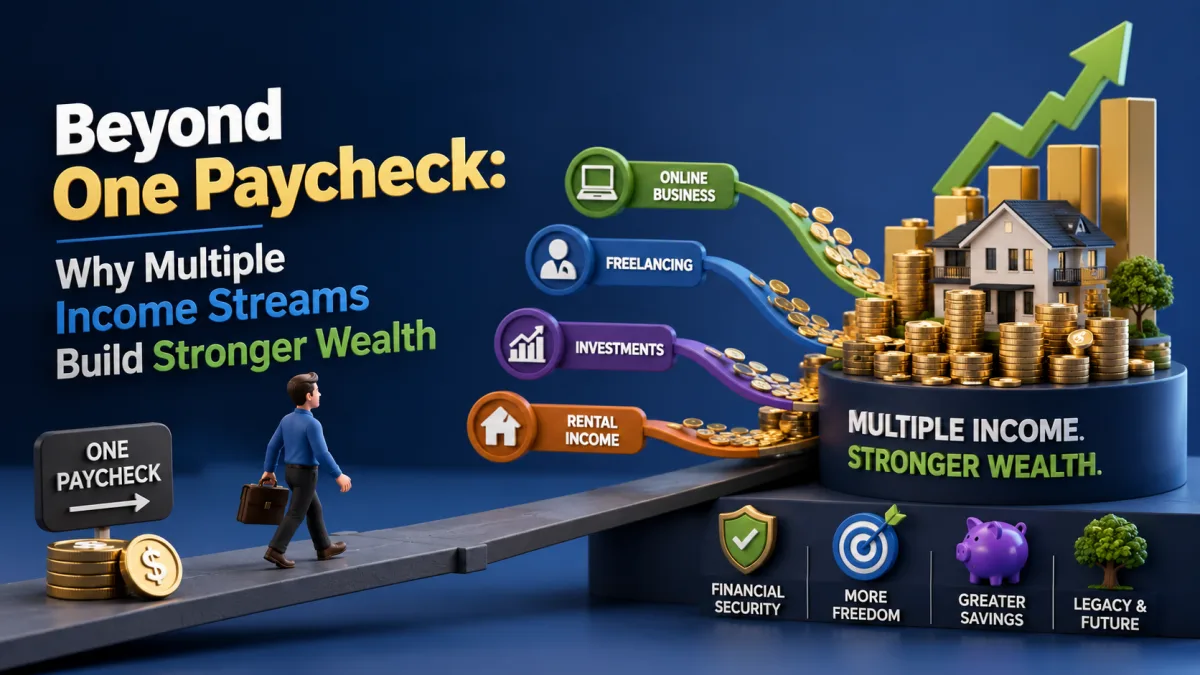
Beyond One Paycheck: Why Multiple Income Streams Build Stronger Wealth
One income source can feel stable until it is not.
A paycheck arrives every two weeks. A business brings in regular customers. A major client keeps renewing. A single investment produces cash flow. For months or years, the arrangement may appear dependable. Bills are paid. Savings grow slowly. Life moves forward.
Then something changes.
A company restructures. A client leaves. A recession weakens demand. A business model becomes outdated. A health issue interrupts work. A rental property sits vacant. A platform changes its rules. A market declines. Suddenly, the income source that looked reliable begins to look fragile.
This is the risk of financial dependence. When all income flows through one channel, the household’s financial life becomes exposed to one point of failure. That does not mean one income source is always bad. Most people begin with one paycheck, one job, or one business. But over time, building wealth requires more than earning money. It requires building resilience.
Multiple streams of income create that resilience. They allow money to flow from different sources at the same time: work, investments, businesses, real estate, digital assets, royalties, dividends, interest, and other productive systems. The goal is not to become busy in every direction. The goal is to reduce dependence on any single source of cash flow.
Wealthy people understand this principle clearly. They may begin with active income, but they rarely stop there. They use income to buy assets. They use assets to create more income. They reinvest profits into additional ownership. Over time, their financial life becomes layered. If one stream weakens, others may continue. If one opportunity slows, another may grow. If active work becomes difficult, assets can help carry some of the burden.
That is the power of income diversification. One income stream may pay the bills. Multiple income streams can build wealth.
Why One Income Source Creates Financial Vulnerability
Most households rely heavily on one primary source of income. For employees, it is usually a paycheck. For freelancers, it may be one major client. For entrepreneurs, it may be one business. For investors, it may be one asset class or one property. This dependence often feels normal because it is common. But common does not mean safe.
A single income source creates concentration risk. In investing, concentration risk means too much money is exposed to one asset, company, sector, or outcome. The same idea applies to personal income. When one source provides most or all cash flow, the household’s financial stability depends on that source remaining strong.
The danger is that income can stop faster than expenses. Rent or mortgage payments continue. Groceries still cost money. Insurance premiums remain due. Debt payments do not disappear. Children still need support. Transportation, utilities, healthcare, school fees, and daily living costs continue even if income is interrupted.
This mismatch is what creates financial pressure. Income may be uncertain, but expenses are often fixed. A household with only one income source may be forced to use savings, borrow money, sell assets, or cut essential spending when that income is disrupted. If the emergency lasts long enough, financial stress can compound quickly.
Multiple income streams reduce this pressure. They do not remove all risk, but they spread it. A person who loses a job but has investment income, freelance income, rental income, or a small business may still face difficulty, but they are not starting from zero. A business owner who loses one customer but has several products or recurring revenue streams has more room to adjust. An investor with diversified assets is less dependent on one source performing well at all times.
The principle is simple: financial strength improves when income does not depend on one fragile channel.
What Multiple Streams of Income Really Mean
Multiple streams of income mean earning money from different sources simultaneously. These sources can be active, passive, portfolio-based, business-based, or asset-based. They may require different levels of time, capital, skill, and risk.
Examples include salary income, freelance income, consulting income, business profits, dividends, rental income, interest, royalties, digital product sales, online content revenue, licensing income, affiliate income, investment distributions, and capital gains.
The purpose is diversification. Just as investors diversify portfolios to avoid depending too heavily on one investment, households can diversify income to avoid depending too heavily on one paycheck, one employer, one customer, or one business model.
Multiple income streams do not mean chasing every possible opportunity. That is one of the biggest misunderstandings. A person does not become financially stronger by scattering effort across ten weak ideas. Income diversification should be built strategically, not frantically.
The best approach usually starts with one strong foundation. For many people, that foundation is active income from a job or profession. For others, it may be a business. Once that foundation becomes stable, the next step is to direct surplus cash or surplus skill into additional income-producing assets and systems.
This gradual approach matters because every income stream requires something. Some require capital. Some require time. Some require knowledge. Some require management. Some require patience before they produce meaningful results. The goal is not to create complexity. The goal is to build a stronger financial structure.
The Difference Between Earning More and Becoming Wealthier
Earning more money is helpful, but it is not the same as building wealth. A person can have several income streams and still remain financially fragile if all the money is spent. More income only matters if it is managed wisely.
This is why wealth building depends on conversion. Income must be converted into savings, investments, business equity, debt reduction, and productive assets. Without conversion, additional income becomes additional consumption.
A person who earns extra money from freelancing but spends it all on lifestyle upgrades may feel busier without becoming wealthier. A business owner who increases revenue but never improves profit may appear successful while remaining cash-flow poor. An investor who receives dividends but spends every payment may enjoy income but miss the power of reinvestment.
Self-made wealth is usually built when surplus income is redirected into ownership. A raise becomes investment capital. A side hustle funds an emergency account. Business profits buy equipment, systems, or new assets. Rental income pays down debt or funds another property. Dividends buy more shares. Royalties finance the next product.
Multiple income streams are powerful because they can increase the amount of money available for wealth creation. But discipline determines whether that money becomes assets or disappears into spending.
The Three Main Types of Income
Understanding income streams begins with understanding the types of income. Not all income behaves the same way. Some income requires direct work. Some comes from assets. Some comes from investments. Each type plays a different role in a wealth-building plan.
Active Income
Active income is money earned from direct work. It includes salaries, wages, commissions, freelance payments, consulting fees, professional services, and service-based business income.
Active income is usually the starting point for wealth building. It provides the cash flow needed to pay expenses, save money, reduce debt, and invest. Without active income, many people would have no capital to begin building other streams.
The strength of active income is control. A person can improve skills, work more strategically, negotiate compensation, change employers, start a side business, or increase professional value. Active income is often the easiest income stream to influence directly.
The weakness is that it is tied to time and effort. If the work stops, the income often stops. A salary depends on employment. Freelancing depends on clients. Consulting depends on billable work. A service business may depend heavily on the owner’s availability.
For this reason, active income should be viewed as the starting engine, not the only engine. It is the income that funds the creation of other streams.
Passive Income
Passive income is money earned from assets or systems with limited ongoing effort after the asset has been built or acquired. Examples include dividends, rental income, royalties, online content income, licensing fees, automated digital products, and distributions from certain investments or businesses.
Passive income is valuable because it separates income from daily labor. It allows money, assets, or systems to produce cash flow even when the owner is not actively working every hour.
But passive income is rarely passive at the beginning. A rental property must be researched, purchased, financed, maintained, and managed. A digital product must be created, marketed, and improved. A dividend portfolio must be funded and monitored. A royalty-producing asset must first be written, recorded, invented, designed, or licensed.
The early stage often requires effort. The later stage may create leverage. That is why passive income should not be seen as effortless money. It is better understood as delayed reward from ownership.
Portfolio Income
Portfolio income is generated through investments. It may include dividends, interest, bond payments, capital gains, distributions from funds, and appreciation from stocks or other securities.
Portfolio income helps build wealth because it allows investors to own pieces of productive assets without personally operating them. A diversified fund may hold hundreds or thousands of companies. A bond fund may provide income from lending arrangements. A dividend portfolio may distribute corporate profits to shareholders.
The strength of portfolio income is scalability. Investors can add capital over time, reinvest distributions, and benefit from compounding. The weakness is volatility. Markets rise and fall. Dividends can be reduced. Interest rates change. Asset prices fluctuate.
Portfolio income works best as part of a long-term plan. The investor’s job is not to react emotionally to every market movement, but to build a diversified asset base that can grow and produce income over time.
The Wealth Strategy Behind Multiple Income Streams
Most wealthy people do not build income streams randomly. They build layers. The process often follows a pattern.
First, they create or improve active income. This may come from a career, profession, trade, business, or specialized skill. Active income provides the financial foundation.
Second, they control expenses. They understand that income alone does not create wealth. Without spending discipline, even high income can disappear. Living below one’s means creates the surplus needed to invest.
Third, they build emergency savings. Cash reserves protect the plan. Without reserves, a temporary disruption can force someone to borrow at high interest, sell investments at a bad time, or abandon long-term goals.
Fourth, they invest consistently. They use surplus income to buy assets such as index funds, dividend stocks, retirement investments, real estate, businesses, or other productive holdings.
Fifth, they create additional income streams. These may begin small: a freelance service, a small online product, a first rental property, a dividend portfolio, a business partnership, or a content platform.
Sixth, they reinvest profits. This is where the system becomes powerful. Extra income is not immediately consumed. It is used to acquire more assets, improve systems, reduce debt, or expand income-producing capacity.
This process strengthens wealth because each step supports the next. Active income funds savings. Savings reduce risk. Investments build ownership. Ownership creates income. Income funds more ownership. Over time, the household becomes less dependent on labor alone.
Why Multiple Income Streams Create Financial Security
Financial security is not simply having money today. It is having the ability to withstand uncertainty tomorrow. Multiple income streams improve security because they create backup systems.
A household with only one paycheck may be stable as long as the job continues. But if the job disappears, stability can disappear with it. A household with a paycheck, emergency savings, investment income, a small business, and manageable expenses has more flexibility.
That flexibility can be practical and emotional. Practical flexibility means bills can still be paid, investments can remain untouched, and decisions can be made calmly. Emotional flexibility means less fear. When income comes from more than one source, a person may feel less trapped by one employer, one client, or one business outcome.
Multiple income streams can also reduce dependence on debt. People often borrow when income is insufficient or interrupted. Extra income streams can help build reserves, cover unexpected expenses, and reduce the need for high-interest borrowing.
Security also improves when income streams are not closely connected. For example, someone whose job, side business, and investments all depend on the same industry may still be highly concentrated. A downturn in that industry could affect everything at once. Strong diversification includes variety across sources, industries, customers, and asset types.
The strongest financial structures are not built on one pillar. They are supported by several.
Why Multiple Income Streams Increase Investing Power
One of the greatest advantages of additional income is increased investing capacity. A household can only invest what it does not spend. When extra income is managed wisely, it creates more capital for assets.
Consider a person who earns a salary and covers living expenses from that salary. If they develop a freelance income stream, they can direct much of that extra money toward investments. If they later build dividend income, those dividends can be reinvested. If they start a small digital business, profits can fund retirement accounts or real estate savings. Each income stream increases the amount of capital available for wealth building.
This is how income diversification and compounding work together. More income creates more investment capital. More investment capital buys more assets. More assets can create more income. The cycle becomes stronger with time.
The key is avoiding lifestyle inflation. Extra income can easily disappear into nicer cars, larger homes, luxury goods, frequent entertainment, and unplanned spending. There is nothing wrong with enjoying life, but if every new income stream becomes a new spending stream, wealth does not grow.
Self-made wealth builders often assign income streams specific jobs. A salary may cover living expenses. Freelance income may fund investments. Rental income may pay down property debt. Dividends may be reinvested. Business profits may be divided between reserves, taxes, owner pay, and growth. Clear rules help prevent extra income from being absorbed unconsciously.
How to Build Additional Income Streams
Building multiple income streams does not require starting with a large amount of money. It requires strategy. Some income streams are capital-intensive. Others are skill-intensive. Some are time-intensive. The best starting point depends on the person’s resources.
Learn High-Income Skills
Skills are often the most practical starting point because they increase earning potential. A person who develops valuable skills can earn more through employment, freelancing, consulting, entrepreneurship, or digital products.
High-income skills include sales, marketing, copywriting, programming, data analysis, artificial intelligence tools, design, financial analysis, project management, content creation, negotiation, leadership, and communication. These skills are valuable because they help businesses grow revenue, reduce costs, solve problems, or reach customers.
Skill development can produce multiple benefits. It may lead to a higher salary. It may create freelance opportunities. It may support a side business. It may improve investing judgment. It may help a person build digital products or consulting services.
Skills are also portable. Unlike a job title, a skill can move across companies, industries, and economic cycles. A person who can sell, write, code, analyze, teach, manage, or communicate effectively has more options than someone dependent only on one employer’s role.
Start Small
Many successful income streams begin as small experiments. A freelance project. A weekend consulting offer. A simple digital download. A small e-commerce store. A short online course. A local service business. A newsletter. A content channel. A first investment account.
Starting small reduces risk. It allows a person to test demand, learn from customers, understand pricing, improve delivery, and build confidence without risking too much capital. Small experiments also reveal whether an idea fits the person’s strengths and lifestyle.
The mistake many people make is waiting for a perfect idea. In practice, ideas improve through action. A first product may be rough. A first client offer may need adjustment. A first investment strategy may need refinement. The learning process is part of the asset-building process.
Small does not mean insignificant. A side income stream that begins with a few hundred dollars a month can become meaningful if reinvested. It can fund an emergency account, pay off debt, or buy investments. Over years, small consistent income can have large effects.
Invest Consistently
Investing is one of the most accessible ways to build additional income over time. Even small monthly investments can matter when made consistently and held for the long term.
Investing allows money to participate in the growth and income of assets. A diversified portfolio may produce dividends, interest, and capital appreciation. Retirement accounts may compound over decades. Dividend stocks may create rising income. Bond funds may provide interest. Real estate investment trusts may distribute property income.
The important word is consistency. Investors who wait for perfect timing often delay too long. Markets are uncertain by nature. A disciplined plan helps reduce emotional decision-making.
For many people, automated investing is useful because it turns intention into habit. Money is invested before it can be spent. Over time, the habit becomes part of the household’s financial system.
Build a Side Business
A side business can become a powerful second income stream because it combines skill, ownership, and scalability. It may begin as freelance work, consulting, tutoring, design, writing, online education, e-commerce, software, local services, or content creation.
The advantage of a side business is control. Unlike many investments, a business can be improved through effort. The owner can adjust pricing, improve marketing, serve customers better, create systems, and expand offerings.
The challenge is that business income is uncertain. Customers must be earned. Products must provide value. Operations must be managed. Taxes must be handled. Time must be protected. A side business should be built carefully, especially when the person still depends on a primary job.
The most sustainable side businesses solve real problems. They are not built only around what the owner wants to sell, but around what customers are willing to pay for. Wealth follows value creation.
Create Digital Assets
Digital assets can include online courses, e-books, templates, software tools, paid newsletters, video channels, websites, memberships, and downloadable products. These assets can scale because they can often be sold repeatedly without being recreated for every customer.
Digital income is attractive because startup costs can be lower than physical businesses or real estate. A knowledgeable person can turn expertise into a product. A creator can turn content into an audience. A specialist can turn a process into a template or tool.
But digital assets are not easy money. They require trust, distribution, product quality, marketing, and ongoing improvement. The internet rewards usefulness, but it also punishes weak offers. A digital product must solve a problem clearly enough that people are willing to pay for it.
When built well, digital assets can become part of a broader income system. They can generate sales while the creator works on other projects. They can support consulting. They can build authority. They can turn knowledge into scalable income.
Acquire Income-Producing Assets
Income-producing assets are the backbone of long-term wealth. These assets can include dividend stocks, index funds, rental properties, bonds, businesses, royalties, and private investments.
The advantage of assets is that they can produce income without requiring the owner to trade every hour for money. The owner earns because they own something productive.
Asset acquisition requires patience. A person may begin with small investments and gradually build a portfolio. They may save for years before buying a rental property. They may reinvest dividends for a long time before the income becomes meaningful. They may buy small business assets before larger ones.
This slow accumulation is normal. Wealth often grows quietly before it becomes visible. The key is to keep converting surplus income into ownership.
Common Mistakes When Building Multiple Income Streams
Multiple income streams can create wealth, but they can also create confusion. More activity does not always mean more progress. The following mistakes often prevent people from benefiting from income diversification.
Chasing Too Many Ideas
The most common mistake is trying to build too many income streams at once. A person may start freelancing, launch a store, begin a podcast, trade stocks, research real estate, create a course, and invest in speculative assets all at the same time. The result is usually exhaustion and shallow progress.
Focus matters. It is better to build one strong additional income stream than five weak ones. Once a stream becomes stable, another can be added.
Expecting Instant Results
Most income streams take time. Investments need compounding. Businesses need customers. Content needs trust. Real estate needs research and management. Skills need practice. Expecting immediate success often leads people to quit before the system has time to work.
Wealth builders understand that early results may be small. They focus on improvement, not instant transformation.
Ignoring Financial Discipline
More income can create more spending if there is no plan. Many people earn extra money but never build wealth because the money disappears into lifestyle upgrades.
Additional income should be assigned a purpose. It may fund investments, reserves, debt repayment, business growth, or asset acquisition. Without a purpose, it will often be spent unconsciously.
Underestimating Risk
Every income stream has risk. Jobs can be lost. Businesses can fail. Investments can decline. Tenants can leave. Digital platforms can change. Clients can disappear. Royalties can fade.
Risk does not mean an opportunity should be avoided. It means the opportunity should be understood. Strong financial decisions include downside planning.
Avoiding Investing
Some people build side income but never invest. They continue trading time for money, even across several income streams. This can increase earnings but also increase exhaustion.
Investing matters because it turns income into assets. Without investing, a person may simply create more work. The long-term goal is to build systems and ownership, not only more tasks.
Focus on Systems, Not Constant Survival
Wealth builders think in systems. A system is a repeatable structure that produces results with less dependence on daily improvisation. Systems create stability because they reduce the need to start from zero every month.
A financial system may include automated investing, scheduled savings, debt repayment rules, emergency reserves, recurring business revenue, documented processes, and regular reviews. A business system may include lead generation, customer onboarding, service delivery, follow-up, bookkeeping, and marketing. An investment system may include asset allocation, contribution rules, rebalancing, and reinvestment.
Systems matter because motivation is unreliable. A person may feel disciplined one week and distracted the next. A system continues even when motivation fades. Automatic transfers, recurring investments, written business processes, and clear financial rules protect progress from emotion.
Multiple income streams become more powerful when they are systemized. A freelance service becomes stronger when client acquisition is predictable. A digital product becomes stronger when sales and delivery are automated. A rental property becomes stronger when maintenance, screening, and reserves are handled professionally. An investment account becomes stronger when contributions happen automatically.
The goal is not to create a life filled with endless tasks. The goal is to build income streams that can operate with increasing efficiency over time.
Multiple Income Streams and Financial Freedom
Financial freedom becomes more realistic when income no longer depends entirely on one source. Freedom does not always mean never working again. For many people, it means having choices.
It means the choice to leave a bad job. The choice to start a business. The choice to work fewer hours. The choice to help family. The choice to invest more. The choice to take time off without financial panic. The choice to retire gradually instead of suddenly. The choice to make decisions based on values rather than fear.
Multiple income streams create freedom because they reduce dependence. The more productive assets and systems a person builds, the less their financial life depends on one employer, one client, one market, or one daily routine.
At first, the freedom may be small. A dividend payment may cover a utility bill. A freelance project may fund an investment contribution. A digital product may pay for software. A rental property may produce modest monthly cash flow. These amounts may not change life immediately, but they change direction.
Over time, small streams can become larger. More important, they can be reinvested. Reinvestment turns income into more assets. More assets create more income. The cycle slowly expands financial flexibility.
The Right Way to Start
The best way to build multiple income streams is to begin with one realistic step. A person does not need to create seven income streams at once. They need to build the next one intelligently.
Start by strengthening the primary income source. Improve skills. Negotiate better compensation. Become more valuable in the marketplace. Active income is often the fuel for the entire plan.
Then create financial margin. Reduce unnecessary expenses. Build emergency savings. Pay attention to debt. Without margin, additional income may be used only to relieve pressure rather than build wealth.
Next, begin investing consistently. Even modest contributions can build the habit of ownership. Over time, investments can become a source of portfolio income and long-term wealth.
After that, choose one additional income stream that fits your skills, capital, and schedule. A strong writer may freelance or create digital products. A technical person may build software tools. A teacher may create educational content. A person with capital and interest in property may study real estate. A professional with expertise may consult.
The best income stream is not the one that sounds most exciting. It is the one you can understand, build, manage, and sustain.
Final Thought: One Stream Pays Bills, Many Streams Build Strength
One income stream can support a household, but it can also create vulnerability. When all cash flow depends on one source, financial pressure rises quickly if that source weakens. Multiple income streams create a stronger foundation.
The purpose is not to chase every opportunity or become endlessly busy. The purpose is to build a financial life supported by several engines: active income, investments, business systems, assets, and eventually passive or portfolio income.
Start with one skill. Build one surplus. Make one investment. Create one additional income source. Reinvest one stream into another asset. Repeat the process patiently.
Wealth often grows through layers. A paycheck becomes savings. Savings become investments. Investments create income. Extra income buys assets. Assets create more options. Over time, dependence declines and flexibility increases.
That is why multiple streams of income matter. They do more than bring in extra money. They create resilience, opportunity, and long-term financial strength.

