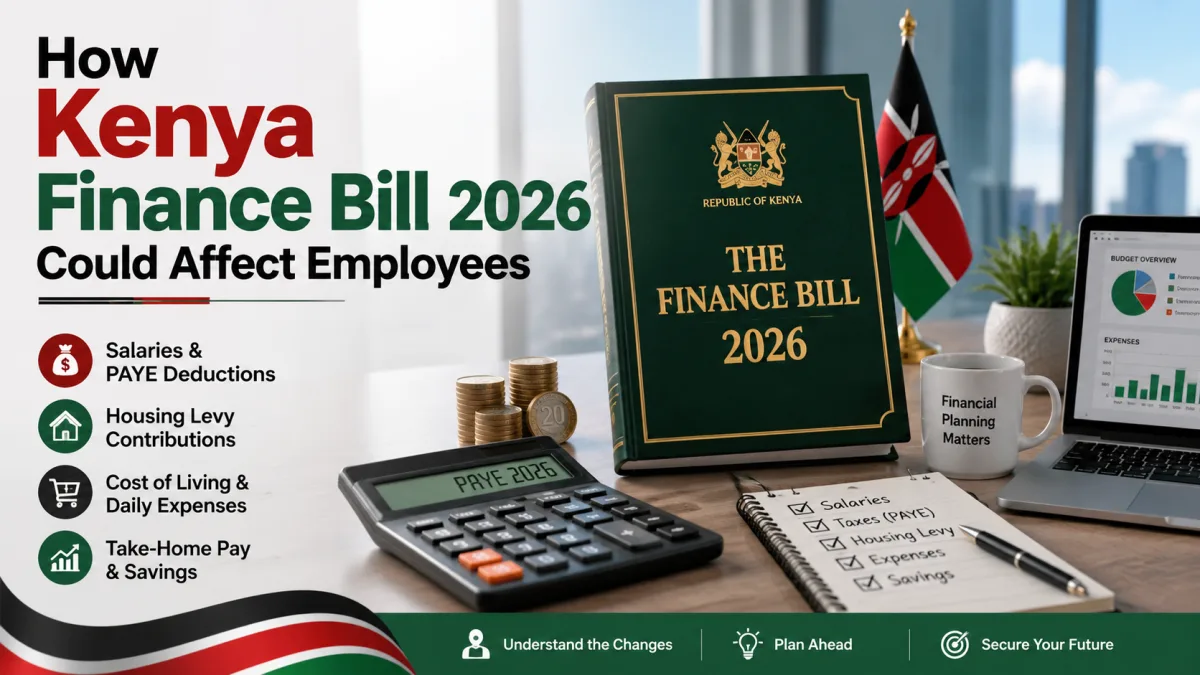
The Payroll Squeeze: How Kenya’s Finance Bill 2026 Could Reach Everyday Life
Most employees notice tax when the payslip arrives.
That is when the numbers become personal. Gross salary appears first. Then PAYE. Then social health contributions. Then pension contributions. Then housing levy. What remains is the number that determines rent, food, transport, school fees, family support, savings, debt repayments, and every small decision that fills the month.
But the real effect of tax policy begins long before payday.
It starts when a business reviews its operating costs. It appears when a landlord calculates the return on a rental property. It shows up when a payment platform adjusts fees, when a shop raises prices, when an employer postpones hiring, and when a household that once saved a little every month begins to run out of money before the next salary comes in.
This is why the Kenya Finance Bill 2026 matters to employees even if they do not run companies, own rental property, operate digital platforms, or file complex tax returns. Finance Bills are not only government documents. They are household documents. They shape the price of living.
The Bill is still part of a legislative process, which means proposals can change before becoming law. That distinction matters. A proposed tax is not the same as an enacted tax. Yet proposals are still important because they reveal policy direction. They show where government is looking for revenue, which sectors may carry more compliance costs, and which expenses could eventually be passed to consumers.
For employees, the central question is simple: what happens to disposable income?
The answer is more complicated than PAYE alone. A worker can keep the same salary and still feel poorer if deductions remain high, rent rises, transport becomes more expensive, digital transactions cost more, food prices increase, and debt repayments consume a larger share of income. Financial pressure is rarely caused by one deduction. It is usually caused by many small leaks in the household budget.
Why Finance Bills Matter to Ordinary Workers
A Finance Bill is one of the most practical economic documents in a country. Budgets describe spending priorities. Finance Bills describe how the government intends to raise part of the money. That means they affect income, consumption, business costs, investment decisions, compliance behavior, and public confidence.
For employees, the effect is often indirect. A worker may not see a new tax line on the payslip, but may still pay through higher prices. Businesses rarely absorb rising tax and compliance costs forever. Some costs reduce profit margins. Some delay expansion. Some reduce hiring. Some are passed to customers through prices, fees, or smaller product sizes.
This is the hidden channel through which tax policy enters everyday life.
A new tax on a financial service may appear to target payment providers. In practice, customers may pay higher transaction fees. A higher tax burden on landlords may appear to target rental income. In practice, tenants may face higher rent over time. A higher cost on imported or manufactured goods may appear to target businesses. In practice, consumers may meet it at the supermarket, hardware shop, electronics store, or transport stage.
The employee therefore sits at the center of the tax system in two ways. First, the employee pays direct taxes and statutory deductions from income. Second, the employee pays indirect taxes and passed-on costs through consumption.
This double exposure is why financial education is no longer optional. A household that does not understand income, expenses, taxes, inflation, debt, and savings becomes vulnerable whenever policy or prices change. A financially literate household may still feel the pressure, but it can prepare earlier, adjust faster, and avoid decisions that create long-term damage.
The Main Concern: Take-Home Pay
For salaried workers, the most watched number is not gross pay. It is net pay.
Gross pay can create an illusion of comfort. A person may earn what appears to be a respectable salary, yet take home far less after deductions. Once rent, transport, food, utilities, school fees, medical expenses, family obligations, and loan repayments are added, the margin may be thin.
This is why many employees pay close attention to PAYE bands and personal tax relief. Any adjustment that lowers income tax can improve household breathing room. Any failure to adjust tax bands in a period of rising living costs can leave workers feeling trapped.
When inflation raises prices but tax bands remain unchanged, employees can experience what economists call fiscal drag. This happens when nominal incomes rise but tax thresholds do not move enough to reflect the cost of living. A worker may receive a salary increase, but a meaningful portion is absorbed by tax and higher prices. The worker appears better paid on paper but not necessarily better off in real life.
This is one reason PAYE reform attracts so much public attention. A salary increase that disappears into deductions and inflation does not build financial confidence. It creates frustration because effort does not translate into visible progress.
The concern around the Finance Bill 2026 is that broad PAYE relief may not be the main feature of the proposals. For many employees, that means the existing pressure on take-home pay may continue. The absence of major relief can matter as much as the introduction of a new tax because households are already carrying several deductions before spending begins.
The Salary Is Already Divided Before It Arrives
Modern payslips tell a larger story about the cost of formal employment.
Before a worker receives net salary, several obligations may already be deducted. PAYE reduces taxable income according to the applicable rates. SHIF contributions support the social health financing system. NSSF contributions go toward retirement savings. The Affordable Housing Levy supports the government’s housing agenda. Loan deductions, pension top-ups, SACCO contributions, insurance premiums, union dues, and employer-specific deductions may also apply depending on the worker.
Each deduction may have a policy purpose. Health financing, retirement savings, and housing development are not meaningless ideas. The problem for employees is not always the existence of the deductions. The problem is the combined monthly effect.
A worker does not pay rent with policy intentions. A worker pays rent with net cash.
This is where many households feel squeezed. A deduction of one or two percent can sound small in public debate. On a payslip, however, several small percentages become a meaningful amount. For a household already operating with a narrow margin, even a modest reduction in disposable income can force trade-offs.
Those trade-offs are visible everywhere. A family delays medical checkups. A worker reduces savings. A parent borrows for school fees. Someone rolls over a mobile loan. A household buys cheaper food, postpones repairs, or moves to a less convenient location. These decisions may seem small, but they shape long-term financial stability.
The Finance Bill 2026 should therefore be understood against the background of existing payroll pressure. Employees are not beginning from zero. They are responding to proposed changes from a position where many already feel that formal income is heavily committed before it reaches the bank account.
Why the Housing Levy Matters to Disposable Income
The Affordable Housing Levy has become one of the most discussed deductions because it is calculated on gross salary. That distinction matters. A deduction based on gross pay applies before the employee experiences the reality of net income.
For a worker earning a modest salary, the deduction may compete directly with transport, food, savings, or rent. For a higher-income worker, the deduction may be more manageable but still contributes to the larger feeling that every additional shilling of income is divided among many obligations before it supports personal goals.
The housing question is especially sensitive because employees experience housing costs twice. They contribute through the levy, and many also pay rent or service mortgages. A worker who does not own a home may feel that housing policy is reducing current income without immediately reducing current rent. That perception can create tension, especially when rent continues rising in urban areas.
Housing policy also affects employers. Payroll costs influence hiring, compensation planning, and contract decisions. When formal employment becomes more expensive to administer, some businesses become cautious about increasing headcount or raising salaries. This does not mean every employer will stop hiring because of one levy. It means the total cost of employment matters when firms make decisions.
Employees should therefore look beyond the deduction itself. The larger question is how payroll-linked obligations influence wage growth, hiring confidence, and the financial space available to households.
SHIF, NSSF, and the New Shape of Mandatory Contributions
Health and retirement deductions are part of the formal worker’s financial life. In principle, they address real risks. Medical costs can destroy household finances. Retirement without savings can lead to dependency and poverty in old age. A strong social protection system can reduce vulnerability.
Yet the monthly cash-flow issue remains.
SHIF contributions reduce immediate disposable income in exchange for health coverage under the social health system. NSSF contributions reduce current pay in exchange for future retirement benefits. The value of these systems depends heavily on public trust, administrative efficiency, service quality, transparency, and the ability of contributors to see meaningful benefits.
When workers trust the system, deductions may still hurt, but they feel purposeful. When workers doubt the system, deductions feel like a burden without a visible return.
This is why communication and delivery matter. A government can design a contribution system with good intentions, but households judge it through experience. Can they access medical services? Are claims handled efficiently? Will retirement savings preserve value? Are records accurate? Are benefits reliable? These questions determine whether statutory deductions feel like social investment or forced extraction.
For employees, the practical lesson is to understand each deduction clearly. A payslip should not be a mystery. Workers should know what is deducted, why it is deducted, whether it is tax-deductible, how it is calculated, and what benefit it is meant to provide.
Financial literacy begins with reading the payslip.
The Cost of Living Channel
The most powerful effect of tax policy is often not direct taxation. It is the cost of living channel.
When businesses face higher taxes, higher compliance costs, or less favorable tax treatment, they must decide how to respond. They can accept lower profits, cut expenses, delay investment, reduce staff growth, increase prices, renegotiate contracts, or pass charges to customers.
In competitive markets, businesses may not pass on the full cost immediately. In less competitive markets, or in sectors where consumers have few alternatives, pass-through can happen faster. Essential goods and services are especially sensitive because households cannot simply stop consuming them.
This matters because employees are consumers before and after work. They pay for transport, airtime, internet, food, rent, school supplies, electricity, water, clothing, digital payments, medical care, and household goods. If tax changes raise the cost structure behind these items, workers may feel the effect even without a direct change to PAYE.
A household budget is like a container with fixed space. If food takes more room, savings may shrink. If rent takes more room, debt repayment may suffer. If transport rises, leisure disappears. If digital fees increase, small transactions become more expensive. The pressure does not need to be dramatic to be damaging. It only needs to be consistent.
That is the danger of gradual financial erosion. People often do not become financially unstable in one month. They become unstable through repeated small increases that outpace income growth.
Digital Services and the Everyday Transaction Economy
Kenya’s economy is deeply digital. Mobile money, online shopping, app-based services, digital wallets, merchant payments, internet subscriptions, and platform-based work are part of daily life. A tax proposal that affects digital payments or platform-based financial services therefore reaches far beyond technology companies.
Digital payments are no longer a luxury. They are infrastructure.
A worker pays fare, sends money home, buys tokens, pays school fees, receives side-income, shops online, pays for subscriptions, and manages bills through digital channels. Small fees matter because they are repeated often. A single transaction charge may seem minor. A month of repeated charges can become material.
If payment service providers face additional VAT or withholding tax complexity, they may absorb part of the cost, adjust pricing, redesign merchant fees, or pass charges along the chain. Consumers may experience this through higher transaction costs, merchant surcharges, increased platform fees, or less favorable pricing.
The effect can be especially heavy on lower- and middle-income households because they make frequent small transactions. A wealthier person may move larger amounts less frequently. A worker living month to month may transact repeatedly in smaller amounts: fare, lunch, tokens, airtime, family support, chama payments, loan repayment, school contributions, and emergency transfers.
When the tax system touches digital rails, it touches the rhythm of daily financial life.
The key point is not that digital services should never be taxed. Governments must raise revenue, and digital economies should not remain outside the tax base. The question is design. A well-designed system raises revenue without discouraging formalization, innovation, low-cost payments, small business growth, or financial inclusion. A poorly designed system can make formal digital transactions more expensive and push some activity back into cash or informal channels.
Online Work, Freelancing, and the Platform Economy
The digital economy is also an income source. Many employees now rely on side hustles, freelance work, content creation, online shops, delivery platforms, remote services, tutoring, design, coding, writing, consulting, and small digital businesses.
That means digital taxation affects both spending and earning.
A salaried employee who sells products online may face higher platform costs. A freelancer paid through digital channels may encounter more compliance requirements. A small merchant using payment gateways may pay more to receive money. A content creator may deal with platform deductions, withholding taxes, or additional reporting obligations.
For households trying to build resilience through extra income, the tax treatment of digital platforms matters. Side income can be the difference between survival and progress. It can pay school fees, reduce debt, build savings, or fund investment. If the cost of earning that income rises, the household’s safety margin shrinks.
At the same time, digital earners must understand tax compliance. Informal income is increasingly visible in a data-driven economy. Payment trails, platform records, bank deposits, digital invoices, and merchant systems make income easier to track. The future of tax administration is likely to rely more on data, not less.
This creates a practical lesson for employees with side hustles: keep records. Separate personal and business money where possible. Track revenue, expenses, inventory, platform fees, transport, packaging, internet, equipment, and taxes. A small business without records is financially blind. It may look profitable while quietly losing money.
Housing, Rent, and the Landlord Pass-Through Problem
Rent is one of the largest expenses in many Kenyan households. Any proposal affecting rental income therefore deserves attention from tenants, landlords, and policymakers.
When taxes on rental income rise or compliance becomes stricter, landlords face a decision. They can accept lower net returns, improve efficiency, formalize records, reduce maintenance, or raise rent when market conditions allow. In high-demand urban areas, landlords may have greater ability to pass costs to tenants. In weaker markets, they may absorb more of the burden.
Tenants usually experience the result indirectly. Rent may not rise immediately because leases, tenant affordability, and local competition matter. But over time, higher landlord costs can influence pricing decisions, especially when combined with maintenance costs, financing costs, land rates, service charges, repairs, and inflation.
This is the pass-through problem. A tax aimed at property income may eventually affect people who do not own property.
For employees, the lesson is to treat housing as a strategic financial decision, not merely a lifestyle choice. Rent should be evaluated against income stability, commute costs, family needs, safety, school access, and savings goals. A cheaper house far from work may increase transport costs. A convenient house may reduce time stress but consume too much income. A larger house may improve comfort but delay investment.
The best housing decision is not always the cheapest. It is the one that protects the household’s total financial position.
Why Rent Pressure Can Reshape Household Wealth
Rent has a powerful effect on wealth because it is recurring, large, and difficult to reduce quickly. A household can cancel entertainment, reduce eating out, or delay a purchase. Moving house is harder. It involves deposits, transport, disruption, school considerations, work commute, and emotional stress.
When rent consumes too much income, savings suffer. When savings suffer, emergencies become debt. When emergencies become debt, interest consumes future income. When interest consumes future income, investment becomes impossible. This is how housing pressure can delay wealth building for years.
Employees should therefore monitor rent-to-income ratios carefully. There is no universal percentage that works for every household, but the principle is clear: rent should not crowd out savings, insurance, debt repayment, food, transport, and long-term investment.
A household that earns more but upgrades housing too quickly may remain financially fragile. This is the income illusion. Higher income does not automatically create wealth if fixed expenses rise at the same speed.
Prices, Business Costs, and the Consumer’s Burden
Consumers often underestimate how many taxes are embedded in prices. By the time a product reaches a shelf, it may carry the effect of import duties, VAT, excise duty, fuel costs, withholding taxes, compliance expenses, licensing fees, financing costs, and currency movements.
The customer sees one price. Behind that price is a chain of costs.
When tax policy changes, businesses review that chain. A manufacturer may face higher input costs. A distributor may face higher transport costs. A retailer may face higher financing costs. A digital platform may face higher compliance costs. Each stage must decide whether to absorb or pass on the pressure.
This is why workers should not only ask, “Will my PAYE change?” They should also ask, “Will the things I buy become more expensive?”
The second question may matter more for lower-income households because they spend a larger share of income on essentials. A high-income household may respond to rising prices by saving slightly less. A low-income household may respond by skipping meals, borrowing, delaying rent, or cutting medical spending.
Tax policy is therefore also a social policy issue. It affects not only revenue collection but household resilience, inequality, consumption patterns, and public trust.
Employment and Business Confidence
Employees depend on employers. That makes business confidence a worker issue.
If a Finance Bill increases compliance requirements, narrows deductions, raises tax exposure, or creates uncertainty, businesses may become cautious. They may delay hiring, freeze salary increases, postpone expansion, or avoid long-term commitments. This is especially true for small and medium-sized enterprises, which often operate with limited cash flow and thin margins.
Large companies may have tax departments, legal advisers, and systems that can adapt quickly. Small businesses may struggle. A small employer facing more paperwork, higher costs, and penalties may respond by staying informal, reducing staff, or avoiding growth. That affects job creation.
For employees, this means tax policy can influence both current income and future opportunity. A person may keep their job but lose bargaining power if employers are cautious. A graduate may struggle to find work if businesses delay hiring. A worker may find fewer promotion opportunities if companies slow expansion.
Economic confidence is not abstract. It determines whether businesses invest, whether entrepreneurs take risks, whether banks lend, whether employers hire, and whether households spend.
The Household Budget Under Tax Pressure
When taxes and living costs rise, the household budget becomes the first line of defense.
Many people dislike budgeting because they imagine it as restriction. In reality, a budget is not a punishment. It is a visibility tool. It shows where money goes, which expenses are fixed, which are flexible, which debts are dangerous, and which habits quietly drain income.
A good budget does not need to be complicated. It needs to be honest.
The first step is to separate fixed obligations from variable spending. Fixed obligations include rent, school fees, insurance, loan repayments, regular family support, subscriptions, and recurring bills. Variable spending includes food choices, transport patterns, entertainment, clothing, airtime, data, social events, and impulse purchases.
The second step is to identify financial leaks. These are expenses that look small individually but become large over time. Transaction fees, unused subscriptions, frequent takeout, unplanned shopping, betting, penalty charges, late fees, and impulse mobile loans can quietly destroy cash flow.
The third step is to build a priority order. Food, shelter, essential transport, utilities, medical needs, school obligations, and minimum debt payments come first. Savings and insurance should be treated as essential, not optional, because they prevent future crises. Lifestyle spending should come after stability, not before it.
A household without a budget reacts emotionally. A household with a budget makes trade-offs consciously.
Emergency Savings Are No Longer Optional
Economic uncertainty exposes households without emergency funds.
An emergency fund is not an investment account. It is not designed to make someone rich. It is designed to prevent a temporary shock from becoming a long-term financial wound.
Without emergency savings, every unexpected event becomes a borrowing event. A medical bill becomes a loan. A job delay becomes rent arrears. A family emergency becomes mobile debt. A broken phone becomes a salary advance. Over time, the household spends more on interest and penalties than it would have saved by building a buffer.
The ideal emergency fund depends on income stability, dependents, job security, health risks, and monthly expenses. For many employees, building even one month of essential expenses can reduce stress. Three to six months is stronger, but the first target should be realistic enough to begin.
The mistake many people make is waiting to save large amounts. Emergency funds are built through consistency. A small automatic transfer every payday is powerful because it removes negotiation. The money leaves before lifestyle spending begins.
During periods of tax and price uncertainty, emergency savings become a form of personal insurance.
Debt Becomes More Dangerous When Living Costs Rise
Debt is not always bad. A mortgage can help acquire a home. A business loan can fund productive expansion. Education debt can increase earning power if handled carefully. SACCO loans can support investment when borrowed responsibly.
But high-interest consumer debt is dangerous, especially during a cost-of-living squeeze.
When expenses rise faster than income, many households borrow to maintain lifestyle. This creates a false sense of stability. The household appears to manage for a few months, but the debt repayment then becomes another fixed expense. If borrowing continues, income becomes trapped by the past.
Mobile loans, salary advances, payday loans, expensive hire-purchase arrangements, and credit used for consumption can become a cycle. The borrower solves this month’s shortage by creating next month’s deduction.
The most important debt question is not, “Can I qualify?” It is, “Will this debt improve my financial position after repayment?”
If debt buys an asset, increases earning power, reduces a necessary cost, or replaces more expensive debt with cheaper debt, it may be strategic. If debt pays for lifestyle, pressure, appearances, or emergencies that could have been handled through savings, it may weaken the household.
Employees facing tax and price pressure should prioritize debt reduction, especially high-interest debt. Paying off expensive debt is often one of the best guaranteed returns available because every shilling of avoided interest improves future cash flow.
Income Diversification Is Becoming a Survival Skill
A single salary is increasingly fragile.
This does not mean every employee must become a full-time entrepreneur. It means households should think seriously about additional income streams. Economic resilience improves when income does not depend entirely on one employer, one industry, one client, or one monthly payment.
Additional income can come from many sources: professional consulting, tutoring, farming, online services, small trade, rental assets, dividends, interest, royalties, transport assets, agency work, skilled freelance services, or a family business. The right option depends on skills, time, capital, risk tolerance, and discipline.
The danger is chasing income ideas without financial thinking. A side hustle is not automatically profitable. Revenue is not profit. Sales are not cash flow. A business that brings in money but consumes time, transport, inventory, platform fees, debt, and stress may not be worth it.
Employees should evaluate side income with the same seriousness as employment. What is the startup cost? What problem does it solve? Who pays? How often? What are the margins? What taxes apply? What records are needed? How much time does it require? Can it grow without damaging the main job?
The goal is not busyness. The goal is resilience.
Investing Protects the Future From the Present
When money becomes tight, investing is often the first habit people abandon. That is understandable, but dangerous.
Investing is how households move from survival to ownership. Savings protect against emergencies. Investments build future income, capital growth, and financial independence. Without investing, a worker remains fully dependent on labor income. If the salary stops, the financial engine stops.
Inflation makes investing even more important. Cash that sits idle loses purchasing power over time. Prices rise, and the same amount of money buys less. Long-term investing helps preserve and grow wealth by placing money into productive assets.
For Kenyan employees, investment options may include money market funds, SACCO shares and deposits, Treasury bills, Treasury bonds, pension contributions, unit trusts, listed equities, real estate, business ownership, and retirement accounts. Each has different risks, liquidity, expected returns, tax treatment, and time horizons.
The key principle is alignment. Short-term money should not be placed in risky long-term assets. Emergency funds should remain accessible. Long-term wealth money can accept more volatility if the investor understands the risk. Retirement money should be protected from impulsive withdrawals. Business capital should be separated from household spending.
Investing is not gambling. It is disciplined ownership of assets based on time, risk, value, and cash flow.
Tax Awareness Is Part of Financial Literacy
Many people treat tax as something only accountants need to understand. That belief is costly.
Employees do not need to become tax experts, but they should understand the basics. They should know how PAYE works, what statutory deductions apply, which contributions may reduce taxable income, how side income is treated, what records to keep, how filing works, and what penalties can arise from non-compliance.
Tax ignorance can create two types of damage. The first is overpayment or missed relief. A worker may fail to claim allowable deductions, misunderstand benefits, or ignore opportunities to structure finances more efficiently. The second is penalties. A person with side income may assume small businesses are invisible, only to face compliance problems later.
Tax awareness also improves citizenship. People who understand taxes can participate better in public debate. They can ask sharper questions: Is the tax fair? Is it efficient? Who bears the final cost? Does it encourage investment or discourage it? Does it protect low-income households? Is revenue being used transparently?
A financially educated citizen is harder to mislead.
The Bigger Economic Picture
Finance Bills influence behavior.
When taxes on consumption rise, people may buy less or shift to cheaper alternatives. When taxes on investment rise, investors may delay projects or demand higher returns. When payroll costs rise, employers may slow hiring. When digital transactions become more expensive, some users may reduce formal digital activity. When rental taxation changes, landlords may adjust pricing, records, or investment plans.
These behavioral responses matter because tax policy is not only arithmetic. Governments may estimate revenue from a tax change, but actual outcomes depend on how people respond. A tax that looks profitable on paper may collect less than expected if it discourages the activity being taxed. A tax that appears narrow may have wider effects if businesses pass costs to consumers.
The best tax systems raise revenue while preserving productivity, investment, fairness, and public trust. The worst systems create complexity, uncertainty, avoidance, resentment, and pressure on households.
Kenya’s challenge is not unique. Many countries face the same tension: governments need revenue for infrastructure, health, education, debt service, security, salaries, and development, while citizens need enough disposable income to live, save, invest, and build confidence.
The balance is delicate.
What Employees Should Do Now
Read the Payslip Carefully
Employees should understand every deduction. A payslip is a financial statement. It shows the difference between what an employer pays and what the household receives. Workers should compare gross pay, taxable pay, PAYE, SHIF, NSSF, housing levy, pension contributions, loan deductions, and net pay.
Understanding the payslip helps workers make better salary negotiations, loan decisions, savings plans, and career choices.
Rebuild the Budget Around Net Income
Budgets should be based on net pay, not gross salary. Many financial mistakes begin when people make commitments based on what they earn before deductions. Rent, car loans, school choices, lifestyle upgrades, and family commitments should be judged against take-home pay.
A household that budgets from gross income is planning with money it does not actually receive.
Protect Cash Flow
Cash flow is the foundation of financial stability. Employees should reduce unnecessary fixed expenses, avoid expensive debt, negotiate bills where possible, review subscriptions, plan purchases, and keep a small buffer in the account.
The goal is to prevent every month from becoming a crisis.
Build Emergency Savings Gradually
Emergency savings should be automatic. Even a small amount saved consistently can change household behavior. The first milestone can be modest: one week of expenses, then one month, then three months. Progress matters more than perfection.
Reduce High-Interest Debt
Expensive debt should be attacked with urgency. Employees can list debts by interest rate, repayment amount, and remaining balance. The highest-interest debts usually deserve priority because they damage cash flow fastest.
Increase Earning Power
The strongest response to rising costs is not only cutting expenses. It is increasing earning power. Skills, certifications, professional networks, digital competence, communication, sales ability, technical skills, and business knowledge can all raise income over time.
Employees should invest in skills that increase market value.
Develop a Second Income Carefully
Side income should be treated as a financial project, not a fantasy. Start small, track numbers, avoid unnecessary debt, keep records, and reinvest profits wisely. The best side income uses existing skills, solves a real problem, and does not destroy the worker’s main source of income.
Invest Consistently
Investing should continue even when amounts are small. A worker who invests a little every month builds the habit of ownership. Over time, consistency, compounding, and income growth can produce meaningful wealth.
What Employers Should Understand
Employers should not ignore the financial pressure employees face. A workforce under financial stress is less focused, less healthy, less productive, and more vulnerable to absenteeism, debt problems, and low morale.
Financial wellness is becoming a workplace issue.
Employers can help by communicating payslip deductions clearly, supporting retirement education, offering financial literacy sessions, reviewing compensation structures, providing responsible benefits, and avoiding exploitative salary-advance cultures. Clear communication builds trust, especially during periods of tax change.
Businesses should also model the impact of proposed tax changes early. Waiting until implementation can create pricing shocks, compliance errors, and employee confusion.
Why Public Trust Matters
Tax systems depend on trust.
Citizens are more willing to comply when they believe taxes are fair, revenue is used responsibly, public services improve, corruption is punished, and leaders share the burden. When trust is weak, every tax proposal becomes politically explosive, even if the government has legitimate revenue needs.
For employees, trust is built through visible value. Better healthcare access, reliable infrastructure, quality education, safe roads, efficient public services, and transparent spending make taxation easier to accept. Without visible value, deductions feel like loss rather than contribution.
This is why financial education and public accountability belong in the same conversation. Citizens should understand taxes, but governments must also earn confidence through responsible management.
The Personal Finance Lesson Behind the Finance Bill
The Kenya Finance Bill 2026 is not only a tax story. It is a reminder that personal finance does not happen in isolation.
A household budget is affected by Parliament, Treasury, employers, landlords, banks, global oil prices, exchange rates, school fees, health systems, digital platforms, and business confidence. People cannot control all these forces. But they can control how prepared they are.
Preparation does not remove pressure. It improves response.
An employee with emergency savings responds differently from one with no buffer. A household with low debt responds differently from one trapped in high-interest loans. A worker with marketable skills responds differently from one whose income is stagnant. An investor responds differently from someone who only consumes. A financially literate citizen responds differently from someone who waits for payday and hopes the money will be enough.
Economic change rewards preparation.
Final Thoughts
The Kenya Finance Bill 2026 could affect employees far beyond payroll deductions. Its proposals may influence digital payments, business costs, rent expectations, consumer prices, compliance behavior, and household financial planning.
The immediate concern for workers is take-home pay. The deeper concern is purchasing power. A salary only matters by what it can support after deductions and prices. If net income remains under pressure while everyday costs rise, households must become more deliberate.
This is the moment for employees to read payslips, review budgets, reduce expensive debt, build emergency savings, increase income streams, and learn how investing works. Financial literacy cannot stop tax changes, but it can help people make stronger decisions under pressure.
Understanding money is no longer optional.
It is one of the most valuable skills in an uncertain economy.

