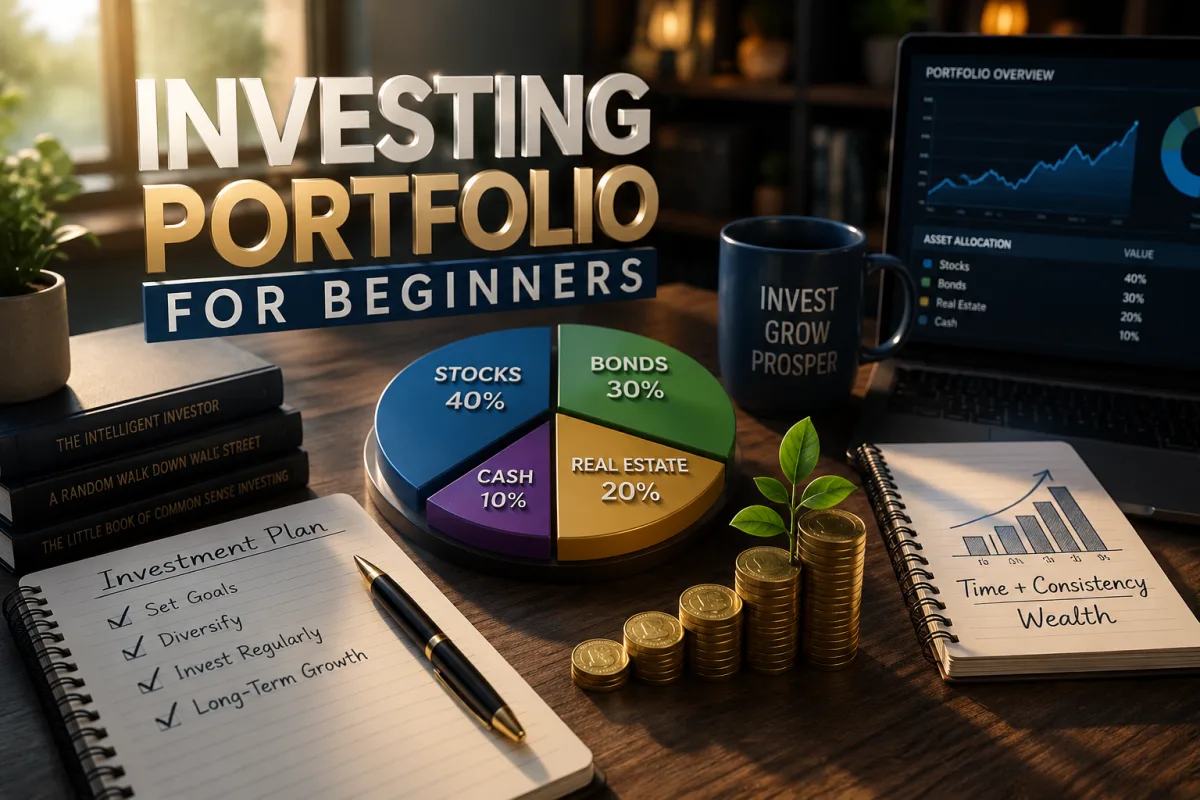
The First Portfolio: How Beginners Can Build Wealth Without Guessing
Every investor eventually faces the same quiet moment: the decision to stop merely saving money and begin putting money to work.
For some, that moment arrives after years of watching cash sit in a bank account while prices rise around them. For others, it comes after hearing about stocks, retirement accounts, index funds, dividends, or compound interest so often that avoiding the subject begins to feel more risky than learning it. Sometimes it comes with a first job, a raise, a business profit, an inheritance, or the realization that earning income alone may never be enough to build lasting wealth.
The first investment portfolio is more than a collection of funds, stocks, or accounts. It is a personal financial system. It reflects how much risk a person can handle, how long their money can remain invested, what kind of life they are trying to build, and whether they understand the difference between wealth creation and financial excitement.
Beginners often believe investing starts with choosing the right stock. It does not. It starts with choosing the right structure.
A portfolio is not built to impress people. It is built to survive uncertainty. It must survive market declines, economic recessions, rising interest rates, inflation, headlines, personal emergencies, emotional impulses, and long stretches when nothing exciting seems to happen. A good beginner portfolio does not require genius. It requires clarity, discipline, diversification, and time.
The greatest advantage a beginner has is not access to secret information. It is the ability to build good habits before bad ones become expensive. A beginner who learns to invest steadily, diversify intelligently, keep costs low, and stay patient can outperform a more experienced person who constantly chases trends, trades emotionally, or confuses confidence with skill.
The purpose of a first portfolio is not to get rich quickly. Its purpose is to create a durable foundation for wealth.
Why a Portfolio Matters More Than a Single Investment
Many people enter investing through stories. They hear about someone who bought shares in a company before it became famous. They see a chart of a stock that multiplied in value. They read about investors who turned small sums into fortunes. These stories are powerful because they are simple, dramatic, and emotionally satisfying.
But wealth is rarely built from one brilliant decision. More often, it is built from a system of repeated decisions made over many years.
A portfolio matters because no one can reliably predict the future of a single investment. A company can be admired and still disappoint shareholders. A sector can be popular and still become overpriced. A bond can appear safe and still lose value when interest rates rise. Real estate can feel permanent and still suffer from debt, vacancies, taxes, repairs, or changing local demand.
A portfolio spreads risk across different assets so that one mistake, one recession, one industry decline, or one poor prediction does not destroy the entire plan. This is the principle behind diversification. Diversification does not guarantee profit, and it does not eliminate loss. What it does is reduce dependence on a single outcome.
A single investment asks, “What will happen to this?” A portfolio asks, “How can I build a system that can work across many possible futures?”
This distinction is essential for beginners. The investing world rewards humility more than certainty. The future is never fully visible. Markets move because millions of people, companies, governments, and institutions make decisions under changing conditions. Prices respond to earnings, interest rates, inflation, innovation, politics, fear, greed, liquidity, and expectations. No beginner needs to master every variable before investing. But every beginner must respect uncertainty.
A portfolio is the practical expression of that respect.
The Real Goal of a Beginner Portfolio
The first goal of a beginner portfolio is not maximum return. Maximum return usually requires maximum concentration, maximum risk, or maximum luck. Beginners who pursue maximum return too early often build fragile portfolios that depend on perfect timing and emotional endurance they have not yet developed.
The real goal is sustainable participation.
Investors build wealth by participating in the growth of productive assets over long periods. Stocks allow investors to own pieces of businesses. Bonds allow investors to lend money to governments or companies in exchange for interest. Real estate funds allow investors to participate in property income and values. Cash and money market holdings provide liquidity and stability. Each asset plays a role.
A beginner portfolio should help the investor stay in the game. That means it must be understandable. It must be diversified. It must match the investor’s time horizon. It must avoid unnecessary complexity. It must be resilient enough that the investor does not panic during normal market declines.
The investor who can remain consistent for twenty or thirty years has an advantage over the investor who frequently starts over. The greatest damage many beginners suffer is not from one bad year in the market. It is from abandoning the plan after one bad year, waiting too long to return, and missing the recovery.
The portfolio should therefore be designed around behavior as much as mathematics.
Before Investing: The Financial Foundation
Investing is powerful, but it is not a substitute for financial stability. A beginner should not treat the market as a rescue vehicle for poor cash management, uncontrolled debt, or lack of emergency savings.
Before building a portfolio, the investor should understand three basic foundations: cash flow, emergency reserves, and debt quality.
Cash flow is the difference between money coming in and money going out. A person who spends every dollar earned has no consistent fuel for investing. The amount invested each month matters less at the beginning than the habit of investing itself. A modest monthly contribution made consistently can become meaningful over time because it creates rhythm, discipline, and ownership.
Emergency reserves protect the portfolio from forced selling. If every unexpected expense requires selling investments, the investor may be forced to withdraw during a market decline. An emergency fund acts as a financial shock absorber. It allows investments to remain invested during temporary personal disruptions.
Debt quality also matters. Not all debt carries the same burden. A low-interest mortgage on an affordable home is different from high-interest credit card debt used to finance consumption. High-interest debt can quietly overpower investment returns. If a person is paying extremely high interest on consumer debt, aggressively investing before addressing that debt may be mathematically and emotionally inefficient.
This does not mean every beginner must be debt-free before investing. It means the investor should know which debts are productive, which are manageable, and which are dangerous. Investing works best when it is part of a broader financial structure rather than an isolated act of optimism.
Understanding Assets: What Actually Goes Inside a Portfolio
A beginner portfolio usually contains a combination of asset classes. An asset class is a broad category of investment that behaves in a certain way and serves a certain purpose. The main categories for most beginners are stocks, bonds, cash equivalents, and sometimes real estate investment funds.
Stocks represent ownership in businesses. When you own a stock fund, you own tiny pieces of many companies. Those companies may sell products, provide services, develop technology, manufacture goods, operate infrastructure, manage healthcare systems, or run financial networks. Stocks can grow significantly over time because businesses can increase profits, expand, innovate, and raise prices. But stocks can also decline sharply because their prices reflect expectations about the future.
Bonds represent loans. When you own a bond fund, you are typically lending money to governments, municipalities, or corporations. In exchange, borrowers pay interest. Bonds are often used to reduce volatility and provide income, but they are not risk-free. Bond prices can fall when interest rates rise. Lower-quality bonds can suffer if borrowers struggle to repay.
Cash equivalents include savings accounts, treasury bills, money market funds, and similar low-risk instruments. Cash provides stability and flexibility. It does not usually build long-term wealth as effectively as productive assets, especially after inflation, but it plays a crucial role in emergencies and short-term needs.
Real estate investment trusts, often called REITs, allow investors to own shares in portfolios of income-producing real estate. They may include apartments, warehouses, offices, data centers, healthcare facilities, retail centers, or other properties. REITs can provide income and diversification, but they also carry risks linked to property markets, interest rates, debt, and economic conditions.
A beginner does not need to own every type of asset immediately. The first portfolio can be simple. In fact, simplicity is often an advantage. The goal is not to collect investments. The goal is to combine assets in a way that supports the investor’s long-term plan.
The Power of Asset Allocation
Asset allocation is the decision about how much of a portfolio should go into each asset class. For beginners, this is often more important than choosing individual funds.
A portfolio that is 90 percent stocks and 10 percent bonds will behave very differently from a portfolio that is 50 percent stocks and 50 percent bonds. The first may offer greater long-term growth potential but larger declines along the way. The second may offer more stability but lower growth potential. Neither is automatically right or wrong. The right allocation depends on the investor’s goals, time horizon, financial situation, and emotional tolerance for loss.
Asset allocation is the steering wheel of the portfolio. It determines the general direction and risk level.
Beginners often underestimate how painful market declines can feel. A 20 percent decline on paper sounds manageable until a $20,000 portfolio becomes $16,000, or a $100,000 portfolio becomes $80,000. The mathematics are simple, but the emotions are not. Losses feel personal. Headlines intensify fear. Friends and relatives may offer confident warnings. Social media may amplify panic.
A good allocation should be aggressive enough to pursue growth but conservative enough that the investor can remain committed during stress.
For a young investor with decades before retirement, a higher stock allocation may be reasonable because time allows for recovery from downturns. For someone investing money needed within a few years, a high stock allocation can be dangerous because the market may decline just when the money is needed. For someone near retirement, the right allocation may need to balance growth, income, and preservation.
Asset allocation is not about predicting next year. It is about aligning risk with time.
Risk Tolerance Is Not Just a Questionnaire
Many investment platforms ask beginners to complete a risk questionnaire. These tools can be useful, but they are imperfect. A person’s stated risk tolerance during calm markets may be very different from their actual risk tolerance during a crisis.
Risk tolerance has three parts: ability, willingness, and need.
Ability refers to financial capacity. A person with stable income, emergency savings, low debt, and a long time horizon has a greater ability to take investment risk than someone with unstable income, no savings, high debt, and near-term expenses.
Willingness refers to emotional comfort. Some people can watch their portfolio decline and remain calm. Others lose sleep, check balances repeatedly, and feel compelled to sell. Emotional discomfort does not make someone weak. It simply means the portfolio must be designed honestly.
Need refers to the return required to reach a goal. A person who has saved diligently may not need extreme risk to meet retirement needs. Another person starting late may feel pressure to pursue higher returns, but taking more risk does not guarantee success. Sometimes the better answer is increasing savings, reducing expenses, working longer, or adjusting goals.
A beginner should never build a portfolio based only on what appears optimal in a spreadsheet. The best portfolio is not the one with the highest theoretical return. It is the one the investor can actually hold through changing markets.
Time Horizon: The Investor’s Hidden Superpower
Time horizon is the length of time before invested money is needed. It is one of the most important concepts in portfolio construction.
Money needed next month should not be invested in stocks. Money needed for a home down payment next year should probably not be placed in a highly volatile portfolio. Money intended for retirement thirty years from now can usually accept more short-term volatility because it has more time to recover.
Time transforms risk. In the short term, the stock market can behave unpredictably. Over longer periods, business growth, reinvested earnings, innovation, and productivity can become more important. This does not mean long-term investing is risk-free. It means time gives productive assets room to work.
Beginners often focus on the question, “What should I buy?” A better first question is, “When will I need this money?”
Different goals may require different portfolios. An emergency fund belongs in cash or cash-like instruments. A three-year goal may require conservative investments. A retirement account for a 25-year-old may hold mostly growth assets. A college fund for a child may gradually become more conservative as tuition approaches.
One person can have several portfolios or several allocations inside different accounts. The key is matching the money to the mission.
Diversification: The Art of Not Needing to Be Right About Everything
Diversification is often described as not putting all your eggs in one basket. The phrase is familiar because the principle is simple. But true diversification goes deeper than owning many things.
Owning ten technology stocks is not the same as owning a diversified portfolio. Those companies may be affected by the same interest rate trends, valuation pressures, investor sentiment, and industry cycles. Owning several funds that all hold the same large companies may create the appearance of diversification without much substance.
Real diversification spreads exposure across companies, sectors, countries, asset classes, and sources of return. A broad stock index fund may own hundreds or thousands of companies. A total bond fund may own many bonds with different maturities and issuers. International funds may provide exposure to economies outside the investor’s home market.
Diversification accepts that the future will surprise us. Some companies will fail. Some industries will disappoint. Some countries will struggle. Some years will favor large companies, others small companies. Some periods will favor growth stocks, others value stocks. Sometimes bonds will stabilize a portfolio. Sometimes inflation will challenge both stocks and bonds.
A diversified portfolio will always contain something that looks disappointing. That is normal. The purpose is not for every asset to win at the same time. The purpose is for the portfolio as a whole to avoid depending on one narrow bet.
Beginners should view diversification as a form of humility. It says, “I do not know exactly which asset will perform best, so I will own a thoughtful mix.”
Index Funds and the Beginner’s Advantage
Index funds have changed investing because they allow ordinary people to own broad markets at low cost. Instead of trying to pick winning stocks, an index fund attempts to track a market index. A total stock market index fund may own shares across an entire national market. A global stock index fund may include companies from many countries. A bond index fund may hold a broad basket of bonds.
The power of index investing is not that it guarantees the best return. It does not. The power is that it removes many unnecessary decisions. The beginner does not need to identify tomorrow’s winning company, sector, manager, or trading signal. The investor can participate in broad economic growth while keeping costs low and behavior simple.
Costs matter because every fee paid is money that no longer compounds for the investor. A fund charging high annual expenses must overcome that cost before the investor benefits. Over decades, even small differences in fees can become meaningful. Low-cost funds do not make investing risk-free, but they reduce a drag that investors can control.
Index funds also reduce the emotional burden of stock selection. When an individual stock falls, the investor may wonder whether the company is permanently damaged. When a broad index falls, the investor can usually understand the decline as part of market volatility. This does not remove fear, but it can make patience easier.
For many beginners, a portfolio built around low-cost diversified index funds is a rational starting point. It offers exposure, simplicity, and discipline. More advanced strategies can come later, if they are needed at all.
The Three-Fund Portfolio Concept
One of the simplest beginner frameworks is the three-fund portfolio. It typically includes a domestic stock fund, an international stock fund, and a bond fund. The idea is not magical. It is simply a way to capture broad diversification with minimal complexity.
The domestic stock fund provides exposure to companies in the investor’s home country. The international stock fund provides exposure to companies outside the home country. The bond fund provides stability and income potential. Together, these three components can form a complete portfolio for many long-term investors.
A beginner might adjust the percentages based on risk tolerance and time horizon. A younger investor may hold a larger stock allocation and a smaller bond allocation. A more conservative investor may hold more bonds. Someone with a global view may allocate more to international stocks. Someone who wants simplicity may use a single target-date fund instead.
The beauty of the three-fund concept is that it teaches the right questions. How much should be in stocks? How much should be in bonds? How much should be invested outside the home country? How often should the portfolio be rebalanced? These questions are more useful than asking which stock will double next.
A simple portfolio is not an unsophisticated portfolio. Often, simplicity reflects wisdom. Complexity can create hidden overlap, higher costs, tax problems, and decision fatigue. A beginner who owns three broad funds and contributes steadily may be better positioned than someone who owns twenty fashionable investments they do not understand.
Target-Date Funds: The One-Fund Portfolio
Some beginners want an even simpler option. A target-date fund may serve that role.
A target-date fund is designed around an estimated retirement year or future goal year. A fund with a date far in the future usually holds more stocks. As the target date approaches, the fund gradually becomes more conservative by increasing bonds and reducing stock exposure. This gradual shift is often called a glide path.
The appeal is simplicity. The investor can choose one fund that automatically handles diversification, allocation, and rebalancing. For workplace retirement accounts, target-date funds are often a common default option.
The limitation is that not all target-date funds are identical. Two funds with the same target year may hold different stock percentages, international allocations, bond strategies, and fees. Beginners should still understand what the fund owns. A target-date fund is simple, but it should not be treated as invisible.
For someone who feels overwhelmed and wants a reasonable starting point, a low-cost target-date fund can be useful. It allows the investor to begin while learning over time. The danger is not simplicity. The danger is delaying investing for years because the first decision feels too complicated.
How Much Should a Beginner Invest?
The right amount to invest depends on income, expenses, debt, emergency savings, and goals. But the habit matters more than the initial amount.
A beginner who invests a small amount every month is doing something more valuable than building an account balance. They are building identity. They are becoming the kind of person who buys assets before lifestyle consumes every dollar. This identity compounds alongside the money.
Some investors begin with a percentage of income. For example, they may invest 10 percent, 15 percent, or more depending on their situation. Others start with a fixed monthly amount and increase it after raises. Someone paying down debt may invest a smaller amount while directing more cash toward high-interest balances. Someone with strong cash flow may invest aggressively.
The most powerful strategy is often automation. Automatic contributions remove the need to make a fresh decision every month. The money moves before it can be spent casually. This turns investing from an occasional act of motivation into a financial routine.
As income rises, beginners should be careful not to let lifestyle rise at the same speed. The gap between income and spending is where wealth is built. A raise can become a larger apartment, a newer car, more subscriptions, and more expensive habits. Or it can become a higher savings rate, more investments, and greater future freedom.
The beginner portfolio grows not only from returns but from contributions. In the early years, contributions often matter more than investment performance. A 10 percent return on a small account may be less important than increasing the amount invested. Over time, as the portfolio grows, returns begin to do more of the heavy lifting.
Dollar-Cost Averaging and the Discipline of Consistency
Dollar-cost averaging means investing a fixed amount at regular intervals, regardless of market conditions. When prices are high, the fixed amount buys fewer shares. When prices are low, it buys more shares. Over time, this approach reduces the pressure to pick the perfect moment.
Beginners often hesitate because they fear investing right before a market decline. This fear is understandable. No one wants to see their first investment immediately lose value. But waiting for certainty can become a permanent excuse. Markets can always look uncertain because the future always contains risk.
Dollar-cost averaging gives the beginner a process. Instead of asking, “Is now the perfect time?” the investor asks, “Am I following my plan?” This shift matters. It moves investing from prediction to discipline.
For investors with a large lump sum, the decision is more complex. Historically, investing earlier often gives money more time in the market, but emotionally, spreading the investment over several months can make the process easier. The right approach depends on the person. A mathematically optimal strategy that causes panic may not be optimal in real life.
For most beginners investing from monthly income, dollar-cost averaging happens naturally. Each paycheck becomes a chance to buy more ownership. Market declines become uncomfortable but useful because new contributions purchase assets at lower prices.
Rebalancing: Keeping the Portfolio Honest
Over time, investments do not grow at the same rate. If stocks perform well for several years, they may become a larger share of the portfolio than intended. If bonds lag behind, the portfolio may become riskier without the investor noticing. Rebalancing brings the portfolio back to its target allocation.
Suppose a beginner chooses an allocation of 80 percent stocks and 20 percent bonds. After a strong stock market period, the portfolio may become 90 percent stocks and 10 percent bonds. Rebalancing would involve directing new contributions toward bonds or selling some stocks to restore the original balance.
Rebalancing feels easy in theory and difficult in practice. It often requires selling what has recently performed well and buying what has recently disappointed. That can feel unnatural. But this is exactly why rebalancing is valuable. It imposes discipline when emotions might otherwise take control.
Beginners do not need to rebalance constantly. Checking once or twice a year may be enough for many long-term investors. Some use percentage bands, rebalancing only when an allocation drifts meaningfully from the target. Investors using target-date funds or managed accounts may have rebalancing handled automatically.
The purpose of rebalancing is not to improve returns in every period. It is to keep the portfolio aligned with the investor’s risk plan. Without rebalancing, a portfolio can slowly become something the investor never intended to own.
The Difference Between Investing and Speculating
Beginners are often surrounded by speculation disguised as investing. A friend recommends a stock because it is “about to take off.” A social media personality promotes a trading strategy. A headline announces a hot sector. A chart shows a dramatic rise. The temptation is strong because speculation offers emotion, speed, and the possibility of being early.
Investing and speculating are not the same.
Investing is the purchase of assets based on a rational expectation of long-term value, income, or growth. Speculating is the purchase of something primarily because the buyer expects someone else to pay a higher price soon. Investing studies fundamentals, risk, valuation, time, and cash flows. Speculation often studies momentum, excitement, and crowd behavior.
There is nothing wrong with acknowledging that some people speculate. The danger is pretending speculation is a wealth plan. Beginners who confuse the two may risk money they cannot afford to lose, abandon diversification, or measure success by short-term price movements.
A beginner portfolio should be built on investing principles. If the investor later chooses to set aside a small amount for speculative ideas, that money should be clearly separated from the core portfolio. It should be money the investor can lose without damaging long-term goals. The core should not depend on excitement.
Wealth is usually built by owning productive assets, reinvesting, and allowing time to work. Speculation may create stories. Investing creates structure.
Common Beginner Mistakes
The first major mistake is waiting too long to start. Many beginners believe they need perfect knowledge before investing. They want to understand every fund, every tax rule, every market cycle, and every economic indicator. Education is valuable, but perfection can become procrastination. A simple, diversified, low-cost portfolio started today may be better than an elaborate plan delayed for years.
The second mistake is chasing recent performance. Investors often buy whatever has performed best lately. This feels logical because recent winners appear strong. But markets are cyclical. Assets that have risen sharply may be expensive. Popular sectors may already reflect high expectations. Chasing performance can lead beginners to buy high and sell low.
The third mistake is taking too much risk before understanding volatility. A beginner may build an aggressive portfolio during a rising market and believe they have high risk tolerance. The real test comes when prices fall. If the investor sells during the decline, the portfolio was too aggressive.
The fourth mistake is checking the portfolio too often. Daily balance checks turn long-term investing into an emotional scoreboard. Market movements that are meaningless over thirty years can feel urgent over thirty minutes. Frequent checking increases the temptation to act.
The fifth mistake is ignoring fees and taxes. High fees reduce compounding. Tax-inefficient trading can create unnecessary costs. Beginners do not need advanced tax strategies at the start, but they should understand that investment returns are not only about what the market earns. They are also about what the investor keeps.
The sixth mistake is copying someone else’s portfolio without understanding their circumstances. A portfolio suitable for a 25-year-old with stable income may be wrong for a 60-year-old nearing retirement. A strategy appropriate for a wealthy investor may be too risky for someone with no emergency fund. Advice must be filtered through personal context.
Building a Portfolio Step by Step
A beginner can build a first portfolio through a practical sequence.
The first step is defining the goal. Is the money for retirement, a home, education, financial independence, or general wealth building? The goal determines the time horizon. A long-term retirement goal can usually accept more volatility than a short-term purchase.
The second step is assessing the financial foundation. The investor should review income, expenses, emergency savings, and debt. This does not require perfection. It requires honesty. Investing should not create financial fragility.
The third step is choosing the account type. Retirement accounts may offer tax advantages. Brokerage accounts may offer flexibility. Education accounts may support college savings. The account is the container; the investments are what go inside. Beginners sometimes confuse the two. Opening an account is not the same as being invested.
The fourth step is selecting an asset allocation. The investor decides how much should go into stocks, bonds, and cash-like holdings based on time horizon and risk tolerance. This decision sets the portfolio’s risk level.
The fifth step is choosing low-cost diversified investments to fill the allocation. This might mean a target-date fund, a three-fund portfolio, or another simple structure. The investments should be understandable and aligned with the plan.
The sixth step is automating contributions. Automation turns intention into action. A beginner should decide how much to invest regularly and make the process as automatic as possible.
The seventh step is reviewing periodically. The investor can check whether contributions are on track, whether the allocation has drifted, whether fees remain low, and whether life changes require adjustments. Review does not mean constant tinkering. It means responsible maintenance.
A Practical Beginner Portfolio Example
Consider a 28-year-old investor named Maya. She has stable employment, an emergency fund covering several months of expenses, manageable student loan payments, and no high-interest credit card debt. She wants to invest for retirement and long-term wealth. Her time horizon is more than thirty years.
Maya decides she can tolerate market volatility because she does not need the money soon. She chooses a growth-oriented allocation of 90 percent stocks and 10 percent bonds. To keep things simple, she uses broad, low-cost funds: a domestic total stock market fund, an international stock market fund, and a total bond market fund.
Her portfolio might look like this: 60 percent domestic stocks, 30 percent international stocks, and 10 percent bonds.
This is not the perfect portfolio. There is no perfect portfolio. But it is diversified, low-cost, understandable, and aligned with her time horizon. Maya automates monthly contributions. Once a year, she checks whether the percentages have drifted and rebalances if necessary.
Now consider Daniel, age 52. He has retirement savings but wants to become more intentional. He hopes to retire in about fifteen years. He has a moderate risk tolerance. A 90 percent stock allocation may expose him to more volatility than he wants. Daniel chooses 65 percent stocks and 35 percent bonds. He still wants growth, but he also wants more stability as retirement becomes more visible.
Maya and Daniel do not need the same portfolio because they do not have the same time horizon, risk capacity, or goals. Good investing is personal without needing to be complicated.
Why Cash Still Has a Role
Some beginners hear that cash loses purchasing power to inflation and conclude that all cash is bad. This is too simplistic.
Cash is a poor long-term wealth-building asset, but it is an excellent short-term stability asset. It pays bills, covers emergencies, funds opportunities, and prevents forced selling. A portfolio without adequate cash outside it may become vulnerable during personal financial stress.
The key is purpose. Cash for emergencies is prudent. Cash for a home purchase in six months is appropriate. Cash held for years because the investor is afraid to begin may become costly. Cash should not be judged in isolation. It should be judged by the job it is meant to perform.
A beginner should separate emergency cash from investment cash. The emergency fund is not failed investing. It is the foundation that allows investing to continue.
Inflation and the Need to Own Productive Assets
Inflation is the gradual rise in the cost of goods and services. It reduces the purchasing power of money. A dollar saved today may buy less in the future if prices rise over time.
This is one reason investing matters. Cash may feel safe because the balance does not fluctuate much, but purchasing power can quietly erode. Productive assets such as businesses and real estate have the potential to adjust over time. Companies may raise prices, expand earnings, develop new products, and grow with the economy. Real estate may generate rents that adjust over time. Bonds may provide income, though their inflation protection depends on structure and interest rates.
Beginners should understand that avoiding volatility is not the same as avoiding risk. A bank balance may look stable while losing real purchasing power. A stock portfolio may fluctuate sharply while offering long-term growth potential. Different risks require different tools.
The purpose of a beginner portfolio is to balance these risks: the visible risk of market declines and the quieter risk of inflation.
Compounding: The Quiet Engine of Wealth
Compounding occurs when investment returns begin generating their own returns. At first, progress can look slow. A small portfolio may not produce dramatic gains. But over long periods, reinvested returns can become powerful.
Imagine an investor who contributes consistently for decades. In the early years, most growth comes from new contributions. Later, as the portfolio grows, returns on the accumulated balance may exceed annual contributions. Eventually, the portfolio can begin to feel like a financial engine.
This is why time matters so much. Starting earlier gives compounding more years to work. But starting later is not hopeless. A later starter can still build wealth by increasing contributions, investing wisely, managing risk, and avoiding major mistakes.
Compounding rewards patience, but it punishes interruption. Frequent withdrawals, panic selling, high fees, and speculative losses can break the compounding chain. The beginner’s job is to protect the process.
Taxes and Account Location
Taxes can affect investment returns, but beginners should not let tax complexity prevent them from starting. The basic idea is simple: different accounts receive different tax treatment.
Retirement accounts may offer tax advantages. Some provide an upfront tax benefit, allowing contributions to reduce taxable income. Others provide tax-free withdrawals later if rules are followed. Employer-sponsored plans may include matching contributions, which can be especially valuable. A match is not merely a benefit; it is part of compensation.
Taxable brokerage accounts offer flexibility. They do not have the same retirement restrictions, but dividends, interest, and realized gains may create taxes. Long-term investors often reduce tax friction by using low-turnover funds, holding investments for long periods, and avoiding unnecessary trading.
Account location means placing certain investments in the accounts where they are most tax-efficient. This can become more important as wealth grows. For a beginner, the priority is usually simpler: use available tax-advantaged accounts wisely, keep costs low, avoid excessive trading, and understand the basic tax consequences of selling.
Taxes matter, but they are one part of the system. A tax-efficient bad investment is still a bad investment. A good portfolio should make sense before taxes and be managed intelligently after taxes.
When Individual Stocks Make Sense
Many beginners are attracted to individual stocks because they are tangible. Owning shares of a familiar company feels more exciting than owning a broad index fund. There is educational value in studying businesses, reading annual reports, and understanding how companies make money.
But individual stocks introduce company-specific risk. A business can lose market share, face lawsuits, suffer management failures, become overvalued, or be disrupted by competitors. Even excellent companies can produce poor investment returns if purchased at too high a price.
Beginners who want to own individual stocks should consider doing so only after building a diversified core. The core portfolio should carry the main responsibility for long-term goals. Individual stocks can be a smaller satellite position for learning and potential enhancement.
A practical rule is to limit individual stock exposure to an amount that would not damage the financial plan if it performed poorly. This prevents enthusiasm from becoming concentration risk.
Owning individual stocks requires ongoing attention. The investor must understand the company, valuation, balance sheet, competitive position, and risks. Buying a stock because the brand is famous is not analysis. Buying because the price has risen is not analysis. Buying because someone online is confident is not analysis.
For many beginners, the best first lesson in stocks is that broad ownership often beats narrow excitement.
The Emotional Cycle of a New Investor
Investing teaches emotions as much as numbers. A beginner may feel excitement after the first contribution. Then impatience when growth seems slow. Then confidence after gains. Then anxiety during declines. Then regret for not investing more earlier. Then fear that everything will collapse. These emotions are normal.
The market does not care that someone is new. It will rise and fall on its own schedule. The beginner’s advantage is to prepare emotionally before the test arrives.
One helpful practice is writing an investment policy statement. This does not need to be formal. It can be a one-page document explaining the investor’s goals, target allocation, contribution plan, rebalancing rules, and reasons for investing. During market stress, the document becomes a reminder from the calmer past to the anxious present.
Another helpful practice is reducing noise. Financial news is designed to explain every movement, even when short-term movements are random or unknowable. A beginner who consumes too much market commentary may confuse information with wisdom. More data does not always lead to better decisions.
The portfolio should be checked, but not worshiped. It is a tool for life, not the center of life.
How to Measure Progress
Beginners often measure progress by short-term returns. This can be misleading. A strong market may make a poor process look good. A weak market may make a good process look bad.
Better measures include savings rate, consistency of contributions, diversification, fee control, debt reduction, emergency fund strength, and alignment with goals. These are factors the investor can influence.
In the early years, a beginner should celebrate shares accumulated, not just account value. Market declines may reduce the current balance, but ongoing contributions buy more shares. Over long periods, the number of productive assets owned can matter more than the temporary market price.
Progress should also be measured by knowledge. A beginner who understands asset allocation, volatility, compounding, taxes, and behavior is becoming more capable. Financial confidence built on education is more durable than confidence built on a rising market.
The Role of Professional Advice
Some beginners can build a simple portfolio on their own. Others benefit from professional guidance, especially if they have complex taxes, business income, inherited assets, stock compensation, estate planning needs, or anxiety about major decisions.
A good financial adviser does more than pick investments. They help clarify goals, manage risk, coordinate taxes, plan retirement income, evaluate insurance needs, and prevent emotional mistakes. The value of advice often appears during transitions: marriage, divorce, children, career changes, business sales, inheritance, or retirement.
Beginners should understand how advisers are paid. Some charge a percentage of assets. Some charge hourly or flat fees. Some earn commissions. Compensation does not automatically determine quality, but transparency matters. The investor should know whether recommendations may create conflicts of interest.
Professional advice can be valuable, but it should not replace basic understanding. Even with an adviser, the investor should know what they own, why they own it, what it costs, and how it supports their goals.
A Beginner Portfolio Is a Living System
A first portfolio will not remain unchanged forever. Life changes. Income rises or falls. Goals become clearer. Families grow. Careers shift. Markets evolve. Tax laws change. Retirement moves closer. A portfolio should be stable enough to avoid constant tinkering but flexible enough to adapt when life genuinely changes.
The beginner’s first allocation may be appropriate for several years. Later, the investor may increase contributions, add account types, refine tax strategy, adjust international exposure, or reduce risk. The foundation remains the same: own productive assets, diversify, control costs, invest consistently, and align risk with time horizon.
Investing maturity is not measured by how complex the portfolio becomes. It is measured by how well the portfolio serves the investor’s life.
The First Year: What Beginners Should Expect
The first year of investing is often psychologically important. The beginner learns how it feels to see balances move. They learn whether they are tempted to check too often. They learn how headlines affect them. They learn whether automation helps. They learn how easy it is to become distracted by other people’s opinions.
The first year should be treated as a training year, not a final judgment. If the market rises, the beginner should not assume investing is easy. If the market falls, the beginner should not assume investing was a mistake. One year is too short to evaluate a long-term strategy.
The best first-year goals are behavioral: make every scheduled contribution, maintain the emergency fund, avoid panic selling, read account statements, understand each holding, and review the allocation once or twice. These actions build competence.
The investor should also watch for lifestyle lessons. Does investing create a sense of purpose around money? Does it make unnecessary spending less appealing? Does it encourage learning about business, economics, and personal finance? A portfolio can change how a person sees income. Money becomes not only something to spend, but something to deploy.
From Consumer to Owner
At its deepest level, investing changes a person’s relationship with the economy. Consumers buy products. Owners own pieces of the companies, properties, and debt structures that produce income and growth.
This does not mean consumption is bad. Life is meant to be lived. But wealth tends to favor ownership. The person who spends every dollar remains dependent on future labor. The person who consistently buys assets gradually builds a second source of financial power.
A beginner portfolio is often the first step in that transformation. It may start small, but its meaning is large. It represents the decision to participate in wealth creation rather than only consumption.
Every contribution is a vote for future freedom. Every reinvested dividend is a small act of patience. Every market decline endured without panic strengthens discipline. Every year of consistency makes the portfolio less dependent on the investor’s next paycheck.
What a Beginner Should Do Now
The beginner should start with clarity, not complexity. Define the goal. Understand the time horizon. Build or protect an emergency fund. Address dangerous debt. Choose an account. Select a diversified allocation. Use low-cost funds. Automate contributions. Rebalance periodically. Keep learning.
The first portfolio does not need to be impressive. It needs to be functional. It should be simple enough to understand, diversified enough to survive mistakes, and disciplined enough to grow over time.
The investor who begins with these principles avoids many traps. They do not need to chase every trend. They do not need to predict every market turn. They do not need to become a professional analyst before owning productive assets. They need a plan they can follow.
Wealth building is not a single dramatic event. It is the accumulation of ownership, discipline, and time. A beginner portfolio is where that accumulation begins.
The first investment may feel small. The first account balance may look unimpressive. The first year may feel slow. But the early stage is where the most important habit forms: the habit of turning income into assets.
That habit can change a financial life.

