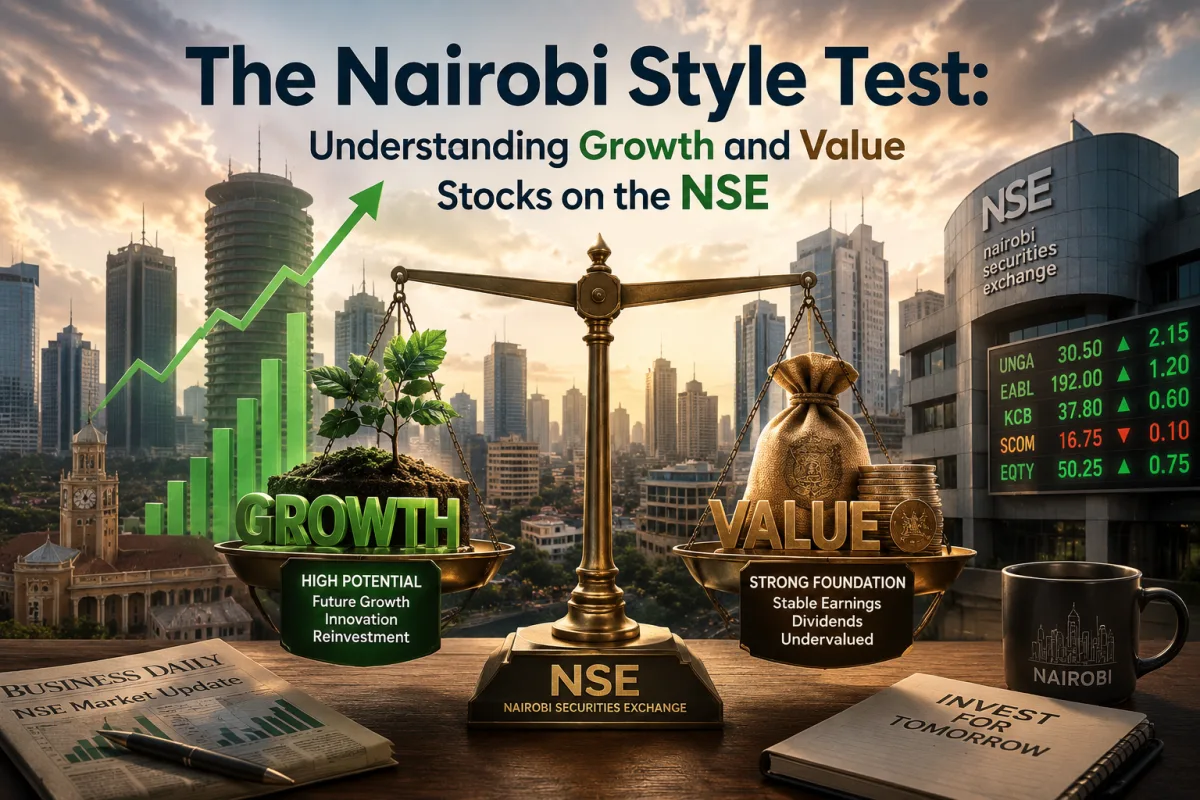
The Nairobi Style Test: Understanding Growth and Value Stocks on the NSE
Growth and value investing are often discussed as if they belong only to Wall Street, London, or other large global markets. Yet the same distinction matters deeply for investors on the Nairobi Securities Exchange.
Every investor buying shares on the NSE is making a judgment about the future. Sometimes that judgment is based on growth: the belief that a company can expand earnings, customers, assets, market share, or cash flows faster than the market expects. Sometimes it is based on value: the belief that a company is priced too cheaply relative to its earnings, dividends, assets, recovery potential, or long-term worth.
The labels may sound simple, but applying them in Kenya requires care.
The NSE is not the same as the New York Stock Exchange or Nasdaq. It has fewer listed companies, lower liquidity in many counters, heavier sector concentration, dominant blue-chip names, significant banking and telecom influence, and a market where dividends can matter greatly. The NSE’s official listed companies page shows issuers across sectors such as banking, insurance, investment, agriculture, commercial and services, telecommunications, manufacturing, construction, energy, and real estate investment trusts. :contentReference[oaicite:2]{index=2}
This means a Kenyan investor should not simply ask, “Is this a growth stock or a value stock?” The better question is, “What expectations are already in the price, and what must happen for this investment to work?”
A growth stock on the NSE is not necessarily a technology company. It may be a bank expanding earnings, a telecom company growing digital services, an insurer improving profitability, a logistics-linked business recovering demand, or a consumer company gaining market share. A value stock is not automatically a neglected bargain. It may be cheap because investors are overlooking it, or cheap because the business is weak, illiquid, overleveraged, poorly governed, or trapped in a declining sector.
The distinction matters because many investors lose money not by misunderstanding companies, but by misunderstanding expectations. A strong company can be a poor investment if bought at an inflated price. A struggling company can be profitable if bought cheaply enough and if recovery is real. But a cheap company that keeps deteriorating is not value. It is a value trap.
Growth and value investing on the NSE are therefore less about labels and more about discipline.
What Growth Stocks Mean on the NSE
A growth stock is a share of a company expected to increase revenue, earnings, customers, cash flow, assets, or market share faster than the broader market or faster than its own past performance.
In large global markets, growth stocks are often associated with technology, software, biotechnology, e-commerce, and artificial intelligence. On the NSE, the growth label can look different. Kenya’s listed market has fewer pure technology companies, so growth may appear through banking expansion, mobile money ecosystems, regional operations, consumer penetration, infrastructure demand, insurance adoption, or operational recovery after difficult periods.
A Kenyan growth stock may have several features. It may show rising earnings per share over several years. It may be increasing dividends because profits are growing. It may be expanding into new business lines. It may be gaining customers. It may benefit from digital adoption, regional trade, financial inclusion, or population growth. It may have management that reinvests capital effectively.
Safaricom is often discussed by Kenyan investors as a growth-oriented blue-chip because its business is not only traditional telecommunications. Its long-term story has included mobile money, data, enterprise services, and regional expansion. In 2026, Reuters reported that Safaricom launched Ziidi Trader on M-Pesa, allowing users to buy NSE shares directly through the platform, a development linked to broadening retail participation in Kenya’s capital markets. :contentReference[oaicite:3]{index=3}
Banks can also display growth characteristics. A bank that grows customer deposits, loan books, non-funded income, digital banking revenues, regional subsidiaries, and profits may behave like a growth stock even though banking is traditionally considered a mature sector. In Kenya, large banks such as Equity Group, KCB Group, Co-operative Bank, NCBA, Absa Bank Kenya, Stanbic Holdings, and I&M Holdings are often watched not only for dividends but also for earnings momentum and regional strategy.
Growth investing on the NSE therefore requires looking beyond sector stereotypes. The investor should ask: is the company expanding profitably, and is the market price already assuming too much future success?
What Value Stocks Mean on the NSE
A value stock is a share that appears inexpensive relative to business fundamentals. These fundamentals may include earnings, book value, dividends, assets, cash flow, or liquidation value. A value investor believes the market price is lower than the company’s reasonable worth.
On the NSE, value opportunities may appear in mature companies with strong dividends, banks trading below historical valuation levels, insurers priced below book value, agricultural companies with valuable land or export earnings, manufacturing firms in recovery, media companies facing pessimism, or companies temporarily affected by sector weakness.
But the word “cheap” must be handled carefully.
A share trading at a low price is not automatically cheap. A company trading at a low price-to-earnings ratio is not automatically undervalued. A company trading below book value is not automatically a bargain. The market may be pricing in genuine problems: weak governance, falling revenue, debt pressure, poor liquidity, legal disputes, regulatory risk, currency exposure, declining industry relevance, or years of poor earnings.
In Kenya, some counters can remain apparently cheap for a long time because few investors are willing to buy them. Liquidity matters. A share may look undervalued on paper but be difficult to exit without moving the price. This is one of the major differences between applying value investing on the NSE and applying it in deeper global markets.
A true value stock is not merely unpopular. It must have a credible path to value realization. That path may be earnings recovery, dividend growth, asset sale, improved governance, sector rebound, restructuring, stronger capital allocation, or renewed investor interest.
Value investing on the NSE is therefore not about buying the lowest-priced shares. It is about buying mispriced businesses with survivable risks.
The Core Difference: Growth Pays for the Future, Value Demands a Discount Today
The difference between growth and value is ultimately a difference in expectations.
A growth investor accepts that the current price may look expensive compared with today’s earnings because tomorrow’s earnings may be much larger. The investor is paying for future expansion. The risk is that the future may disappoint. If growth slows, margins fall, competition increases, regulation changes, or valuation multiples contract, the share price can fall even if the company remains profitable.
A value investor is less willing to pay for optimism. The value investor wants a discount today. They want the current price to provide protection against uncertainty. The risk is that the discount may exist for a reason. The business may be deteriorating faster than the market realizes, or the hoped-for recovery may never arrive.
This distinction is especially important on the NSE because many investors are attracted to dividends and low share prices. A high dividend yield may look like value, but if earnings are weakening and the dividend is unsustainable, the yield can be a warning sign. A rising company may look expensive, but if it can compound earnings for many years, the price may still be reasonable.
The investor should never judge style by appearance alone. Growth can be overpriced. Value can be a trap. The work is in the analysis.
How to Identify a Growth Stock in Kenya
A Kenyan investor looking for growth stocks should begin with earnings. Is profit after tax growing consistently? Are earnings per share increasing? Is growth driven by real operations or one-off gains? Are margins stable or improving?
The second measure is revenue quality. A company can grow revenue but fail to grow profit if costs rise faster. Growth is valuable when it translates into cash flow, dividends, reinvestment capacity, or stronger competitive position.
The third measure is return on equity or return on capital. A company that reinvests money at high returns can compound shareholder value. A company that grows by using capital inefficiently may become larger without becoming more valuable.
The fourth measure is market opportunity. Does the company serve a growing market? Kenya’s financial services, telecommunications, infrastructure, energy, healthcare, logistics, education, and consumer sectors may all create growth opportunities, but each company must be assessed individually.
The fifth measure is management execution. Growth is not automatic. A company may have opportunity but fail through poor governance, weak strategy, reckless debt, bad acquisitions, or operational mistakes.
The sixth measure is valuation. A growth company bought at too high a price may produce disappointing investment returns. The investor should ask what growth rate is already implied by the share price.
A practical growth checklist for NSE investors includes rising earnings, expanding market share, strong cash flow, good governance, manageable debt, reinvestment opportunity, and a valuation that does not require perfection.
How to Identify a Value Stock in Kenya
A Kenyan investor looking for value stocks should begin with valuation ratios, but not end there.
Price-to-earnings ratio can show how much investors are paying for each shilling of earnings. A low ratio may indicate value, but it may also reflect expected earnings decline. Price-to-book ratio can be useful for banks, insurers, and asset-heavy companies, but book value must be credible. Dividend yield can reveal income potential, but only if the dividend is sustainable. Price-to-cash-flow can help assess whether profits are backed by cash.
The second step is balance sheet strength. A company with too much debt can look cheap before financial distress becomes obvious. Interest costs, refinancing risk, currency-linked liabilities, and working capital pressure must be examined.
The third step is business quality. Does the company still have customers, brands, assets, licenses, distribution, or strategic value? Or is it cheap because its business model is fading?
The fourth step is governance. Investors in Kenya should pay close attention to board quality, disclosure, dividend policy, related-party transactions, audit history, and treatment of minority shareholders. A company can be cheap for years if investors distrust management.
The fifth step is liquidity. If few shares trade, entering and exiting positions can be difficult. Illiquidity can increase the discount investors demand.
The sixth step is catalyst. What could make the market revalue the company? Higher earnings, dividend restoration, debt reduction, sector recovery, new management, regulatory clarity, strategic investment, or asset monetization can all act as catalysts.
A practical value checklist for NSE investors includes low valuation, strong or recoverable business economics, survivable debt, credible management, dividend or asset support, reasonable liquidity, and a clear reason the market may eventually change its view.
Examples of Growth Characteristics on the NSE
Growth characteristics can appear in several types of NSE companies.
A telecommunications company may show growth through mobile data usage, mobile money revenue, enterprise services, regional expansion, digital platforms, and customer monetization. A bank may show growth through loan expansion, deposits, digital channels, insurance partnerships, asset management, regional subsidiaries, and non-funded income. An insurer may show growth through underwriting improvement, investment income, and penetration of underserved markets.
Some companies may show growth after recovery rather than from long-term expansion. A company emerging from years of weak performance may grow earnings rapidly from a low base. This is sometimes called turnaround growth. It can be profitable, but it carries higher risk because the improvement may not last.
The investor must distinguish structural growth from cyclical rebound. Structural growth comes from durable expansion in customers, markets, efficiency, and earnings power. Cyclical rebound comes from recovery after difficult conditions. Both can create returns, but they require different expectations.
For example, a bank’s earnings may rise because interest margins improve during a particular rate cycle. That is useful, but it may not be permanent. A telecom company may grow because data consumption and mobile money usage continue rising across years. That may be more structural, though still subject to regulation, competition, and valuation risk.
Growth investing is strongest when the company has a long runway and the price does not already assume flawless execution.
Examples of Value Characteristics on the NSE
Value characteristics can appear in companies that are profitable but ignored, asset-rich but underappreciated, dividend-paying but unfashionable, or temporarily affected by sector weakness.
Banks sometimes become value opportunities when investor sentiment turns negative because of credit risk, regulatory pressure, interest rate uncertainty, or economic slowdown. If the bank remains well-capitalized, profitable, and capable of paying dividends, a depressed valuation may create opportunity.
Insurance companies may trade below book value if investors worry about underwriting performance, investment losses, or weak liquidity. If management improves profitability and the balance sheet remains strong, value may emerge.
Agricultural and manufacturing companies may hold valuable assets but face earnings volatility. Investors must decide whether asset value can realistically benefit shareholders or whether it remains trapped.
Media or commercial companies may look cheap after industry disruption, but the investor must ask whether the business model can adapt. Cheapness alone does not solve structural decline.
Value investing on the NSE should therefore be cautious. The smaller and less liquid the company, the more important governance, disclosure, and exit strategy become.
Dividend Yield: Kenya’s Important Value Signal
Dividends are central to many Kenyan equity investors. In a market where capital gains can be uneven and liquidity varies widely, dividends provide tangible return. Many investors view dividend-paying companies as value opportunities because they return cash to shareholders.
A high dividend yield can be attractive, but it must be tested.
The first question is whether the dividend is covered by earnings. If a company pays more in dividends than it earns, the payout may not be sustainable. The second question is whether earnings are backed by cash. Accounting profit without cash flow can weaken dividend safety. The third question is whether the balance sheet can support the payout. A company should not borrow heavily to maintain dividends. The fourth question is whether management has a consistent dividend policy.
Dividend yield can also rise for the wrong reason. If a share price falls sharply, the historical dividend yield may look high. But if the market expects the dividend to be cut, the yield may be misleading.
For NSE investors, dividend investing can be a powerful strategy, but it should not be confused with automatic value investing. A good dividend stock combines sustainable cash generation, fair valuation, good governance, and reasonable growth or stability.
Banking Stocks: Growth, Value, or Both?
Kenyan banking stocks are among the most important counters on the NSE. They can display both growth and value characteristics.
They may be growth stocks when earnings, deposits, loan books, fee income, digital banking, regional operations, and customer bases are expanding. They may be value stocks when they trade at modest price-to-earnings or price-to-book ratios while maintaining strong profitability and dividends.
This is why style labels can be limiting. A bank can be both growth and value if it is expanding earnings while still trading at a reasonable valuation. Another bank can be a value trap if it looks cheap but has deteriorating asset quality, weak capital, governance issues, or poor profitability.
Investors should examine non-performing loans, capital adequacy, cost-to-income ratios, net interest margins, loan growth, deposit growth, dividend payout, regional exposure, and management quality. A bank is not cheap or attractive simply because its share price is low.
In June 2026, Reuters reported that Absa Group planned to raise its stake in Absa Bank Kenya through a tender offer while retaining the bank’s NSE listing, and described Kenya as strategically important to Absa’s East Africa growth ambitions. This kind of corporate action can influence investor perception because it signals how a parent company values its Kenyan subsidiary. :contentReference[oaicite:4]{index=4}
Bank stocks on the NSE require both growth and value thinking. Investors must ask whether the bank can grow profitably and whether the current price offers a sufficient margin of safety.
Safaricom and the Growth Premium Question
Safaricom is often treated as a special case because of its size, brand, mobile money ecosystem, telecom infrastructure, and central role in Kenya’s digital economy. Large companies with dominant franchises often trade at valuation premiums because investors believe their earnings are more resilient or their growth options are stronger.
But even dominant companies must be evaluated by price.
A growth premium can be justified if earnings, cash flow, dividends, and strategic expansion continue to support it. It can become dangerous if investors pay too much for a company whose future growth slows. The larger a company becomes, the harder it may be to grow at very high rates indefinitely. Regulatory pressure, competition, capital expenditure, currency risk, and regional expansion challenges can all affect returns.
The lesson is not that Safaricom is always a growth stock or always expensive. The lesson is that growth investors must examine whether the current valuation is justified by realistic future earnings.
For any dominant NSE counter, quality is not enough. The investor must still ask what expectations are already priced in.
Liquidity: The NSE Factor Many Investors Ignore
Liquidity is one of the most important differences between investing on the NSE and investing in larger markets.
Liquidity refers to how easily shares can be bought or sold without significantly affecting the price. Large, actively traded counters are easier to enter and exit. Smaller counters may trade infrequently. A stock may look attractive on valuation, but if there are few buyers when the investor wants to sell, the practical return may be lower than expected.
This affects both growth and value investing.
A small growth company may have strong potential but limited trading activity. If the market does not notice it, the share may remain undervalued for a long period. A value stock may look cheap but be difficult to sell. Illiquidity can also increase volatility because small trades may move prices sharply.
Investors should therefore include liquidity in their analysis. How often does the counter trade? What is the typical volume? Is the bid-ask spread wide? Would the investor be able to exit a meaningful position? Is the stock suitable for a long-term holding period?
On the NSE, liquidity is not a footnote. It is part of risk.
Market Capitalization and Concentration
The NSE is relatively concentrated. A small number of large companies can have a significant influence on indices and investor sentiment. Market capitalization data from CEIC showed NSE market capitalization at about KES 3.41 trillion in May 2026. :contentReference[oaicite:5]{index=5}
Concentration affects style investing because large-cap growth or value opportunities can dominate portfolios. If an investor buys a broad NSE fund or tracks major indices, exposure may be heavily influenced by the largest counters such as Safaricom, major banks, and leading consumer or infrastructure-related firms.
This can be useful because large companies tend to have better liquidity and stronger disclosure. But it can also reduce diversification. An investor may believe they own the Kenyan market broadly while actually depending heavily on a few companies or sectors.
Growth and value analysis should therefore be done at portfolio level, not only stock level. How much exposure is in banks? How much is in telecom? How much is in consumer goods? How much is in illiquid small caps? How much is in dividend stocks versus growth-oriented stocks?
A portfolio can be diversified by number of counters but concentrated by economic exposure.
When Growth Performs Better in Kenya
Growth stocks tend to perform well when investors are willing to pay for future expansion. This may happen when earnings growth is scarce, interest rates are favorable, market confidence improves, foreign investors return, or a company demonstrates strong results over several reporting periods.
In Kenya, growth sentiment may also be influenced by digital adoption, banking sector profitability, telecom innovation, infrastructure development, regional expansion, and improving macroeconomic conditions. If investors believe a company can grow earnings despite economic pressure, they may reward it with a higher valuation.
But growth investing can suffer when interest rates rise, liquidity tightens, currency pressure increases, foreign investors withdraw, or earnings disappoint. Companies priced for perfection may fall sharply when results merely become average.
The growth investor must therefore remain disciplined. Strong narratives are not enough. Growth must eventually appear in financial statements.
When Value Performs Better in Kenya
Value stocks tend to perform well when pessimism becomes excessive and investors begin to recognize overlooked earnings, dividends, assets, or recovery potential.
In Kenya, value may perform better after periods of market weakness, high yields in fixed income that pressure equities, foreign investor selling, currency stress, or broad pessimism toward listed companies. When conditions stabilize, undervalued companies may recover significantly.
Value can also perform well when dividend yields become attractive relative to alternative investments, especially if investors believe payouts are sustainable. Banks, insurers, utilities, and mature companies may attract investors seeking income and valuation support.
But value investing can underperform for long periods if economic conditions remain weak, corporate earnings disappoint, governance concerns persist, or investor liquidity remains low. A cheap share can stay cheap longer than expected.
The value investor must therefore combine patience with selectivity. Buying cheap assets is not enough. The business must survive and eventually prove the market too pessimistic.
Growth Traps and Value Traps
A growth trap occurs when investors overpay for a company’s future. The company may be good, but the price assumes too much. If growth slows, the valuation can compress. The investor loses money not because the business failed, but because expectations were unrealistic.
A value trap occurs when investors buy a cheap stock that continues deteriorating. The low price appears attractive, but the business is weak. Earnings fall, dividends are cut, debt rises, governance disappoints, or the industry declines. The stock remains cheap or becomes cheaper.
Both traps are common because investors are emotional. Growth traps appeal to hope. Value traps appeal to bargain hunting.
On the NSE, avoiding growth traps requires valuation discipline. Avoiding value traps requires business-quality discipline. Investors should not pay any price for a good company, and they should not buy any poor company merely because it looks cheap.
How Kenyan Investors Can Use Both Styles
Most investors do not need to choose only growth or only value. A balanced NSE portfolio can include both.
Growth exposure may provide participation in companies expanding earnings and benefiting from long-term economic change. Value exposure may provide dividends, valuation discipline, and potential recovery gains. Together, the two styles can reduce dependence on one market environment.
For example, a portfolio may include large liquid companies with growth characteristics, banks with both dividend and earnings growth potential, selected undervalued counters with strong balance sheets, and some fixed income or money market exposure outside equities. The exact mix depends on risk tolerance, time horizon, income needs, and liquidity requirements.
Younger investors with long time horizons may accept more growth exposure. Investors seeking income may prefer dividend-paying value stocks. Retirees may need more stability and cash flow. Business owners whose wealth is already concentrated in one company may need broader diversification.
The right strategy is personal. The key is to avoid chasing whichever style recently performed best.
A Practical NSE Growth-versus-Value Checklist
Before buying an NSE stock, an investor can ask several practical questions.
What does the company do, and how does it make money? Are revenue and earnings growing? Is the growth structural or cyclical? Is the company profitable in cash terms? Does it pay dividends, and are they sustainable? What is the price-to-earnings ratio? What is the price-to-book ratio where relevant? How does valuation compare with history and peers? Is the balance sheet strong? How much debt does the company carry? How liquid is the counter? Does management communicate clearly? Are minority shareholders treated well? What could cause the share price to rise? What could cause permanent loss?
If the answer depends mainly on future expansion, the stock leans growth. If the answer depends mainly on today’s price being too low relative to current or recoverable value, the stock leans value. If both are true, the opportunity may be especially interesting. If neither is true, the investor may simply be speculating.
Final Thoughts
The difference between growth and value stocks on the NSE is not a matter of fashionable labels. It is a matter of price, expectations, quality, and risk.
Growth stocks are bought because the investor expects future earnings, cash flows, customers, or market share to expand meaningfully. Value stocks are bought because the investor believes the current price is too low relative to earnings, assets, dividends, or recovery potential. Growth investing can create wealth when companies compound for years. Value investing can create wealth when pessimism is excessive and the market eventually corrects its mistake.
Both styles can work in Kenya. Both can fail. Growth can become overpriced. Value can become a trap. Dividends can be attractive but unsustainable. Low prices can hide weak businesses. Strong companies can disappoint if bought without valuation discipline.
The serious NSE investor should therefore think beyond slogans. A good investment is not good because it is called growth or value. It is good because the expected return justifies the risk, the company’s economics are sound, the valuation is reasonable, and the investment fits the investor’s portfolio.
Growth teaches investors to respect future potential. Value teaches investors to respect the price paid today. On the Nairobi Securities Exchange, wealth is built by understanding both lessons and applying them with patience, discipline, and clear judgment.
 Article
 Article
 Article
 Article
 Article
 Article
 Article
 Article