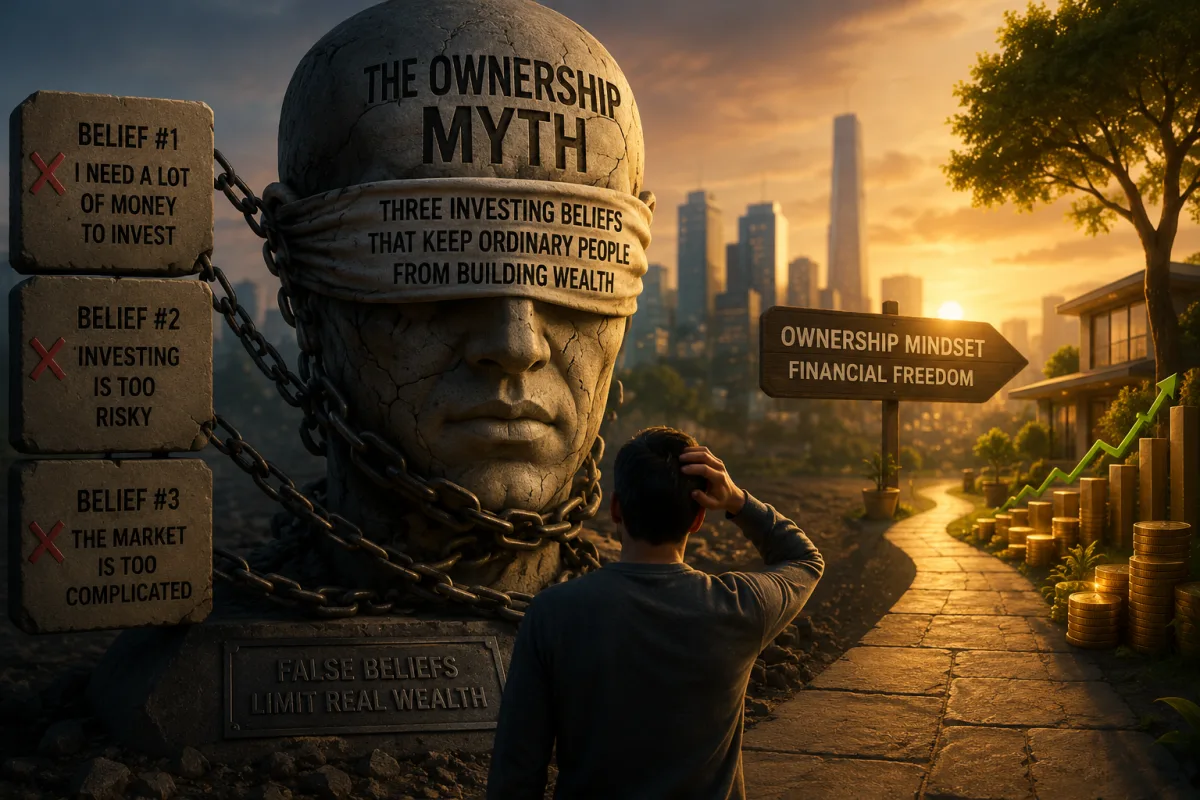
The Ownership Myth: Three Investing Beliefs That Keep Ordinary People From Building Wealth
Investing is no longer just for the rich.
That sentence should feel liberating, but for many people it still feels hard to believe. They hear the word investing and imagine private bankers, Wall Street terminals, exclusive meetings, expensive suits, complicated charts, wealthy families, insider language and people who already have millions. They assume investing is something that begins after success, not something that helps create it.
That belief is expensive.
The greatest financial divide is not always between people who earn and people who do not earn. It is often between people who only consume income and people who convert income into ownership. The first group works, spends, pays bills, handles emergencies and starts again next month. The second group also works and spends, but a portion of their income is quietly redirected into assets that can grow, produce income and compound over time.
Investing is the bridge between earning money and owning wealth.
Yet millions of people never cross that bridge because they are stopped by myths. They believe they need to be rich before they start. They believe they need a finance degree. They believe small amounts are pointless. They believe investing is gambling. They believe markets are too complicated. They believe they missed their chance. They believe the system is reserved for insiders.
Some caution is healthy. Investing without understanding risk can be dangerous. Speculation, scams, leverage, overconfidence and emotional trading can destroy money. But fear disguised as wisdom can also destroy opportunity. A person who never invests long-term money may avoid market losses, but they may also miss compounding, dividends, asset growth and the chance to protect purchasing power from inflation.
The poor stay poor not only because they lack income. Many stay poor because every dollar is forced to remain a worker, never becoming an owner.
Income pays for today. Ownership builds tomorrow.
This article focuses on three myths that keep ordinary people from investing. The first myth is that investing is only for the rich. The second is that investing requires a finance degree. The third is that small amounts do not matter. These myths are powerful because they sound practical. They allow people to delay action while feeling responsible. But each one collapses under closer examination.
The truth is simpler and more demanding: investing is not reserved for millionaires. It is one of the ways ordinary people become millionaires. Investing does not require knowing everything. It requires understanding enough to begin wisely and avoid obvious mistakes. Small amounts do matter because habits, time and compounding turn repetition into financial force.
Wealth is not built only by people who start with more. It is also built by people who start earlier, stay consistent, control costs, avoid bad debt, increase income and keep buying assets while others keep buying appearances.
Why Investing Feels Out of Reach
Investing feels out of reach because the financial industry often makes it look more complicated than it needs to be.
The language can be intimidating. Equities, bonds, asset allocation, expense ratios, diversification, volatility, market capitalization, exchange-traded funds, dividends, yields, rebalancing, benchmarks, portfolio construction, risk-adjusted returns and tax efficiency can all sound like a foreign language to a beginner. When people do not understand the language, they assume the room is not meant for them.
Investing also feels out of reach because wealth is visible only at the end of the process.
People see the person with a large portfolio, rental property, business equity or dividend income and assume the person began with wealth. Sometimes that is true. Some people inherit capital. Some begin with family support. Some have advantages others do not. But many investors start with small contributions from ordinary income and build gradually.
The early years of investing are not impressive from the outside. There is no dramatic lifestyle change. There may be no visible reward. The investor sends a modest amount to an investment account and continues living normally. The portfolio may look small for years. Then one day the account begins to feel meaningful. Years later, it may become life-changing.
Because the beginning is quiet, people underestimate it.
Another reason investing feels unreachable is that many people meet finance through debt before they meet it through ownership. Their first experience with money products may be credit cards, loans, overdrafts, mobile lending, store financing or salary advances. Finance becomes associated with pressure, interest charges and repayment stress. Investing then feels like another world, one reserved for people who have already escaped.
But investing is not the opposite of ordinary life. It is a tool for changing ordinary life over time.
The Real Purpose of Investing
Investing is not primarily about getting rich quickly.
At its best, investing is the process of buying assets that can grow, produce income or preserve purchasing power over time. These assets may include shares, bonds, funds, real estate, businesses, retirement accounts, pension plans or other regulated investment vehicles. The exact tools vary by country and investor profile, but the principle is the same: money is directed into something that can work beyond immediate consumption.
The purpose is ownership.
When you invest in shares or stock funds, you may own pieces of businesses. When you invest in bonds, you may lend money in exchange for interest. When you invest in real estate, you may own property that can produce rent or appreciate. When you invest in a business, you may own a system that produces profit. When you invest through retirement vehicles, you are building assets for a future stage of life.
This is different from saving alone.
Saving is essential. It protects money. It creates emergency reserves. It funds short-term goals. It prevents debt. But saving alone may not be enough for long-term wealth because cash can lose purchasing power to inflation and may not grow meaningfully. Investing gives long-term money a chance to grow.
Investing is also different from gambling.
Gambling depends on uncertain outcomes where the odds often favor the house. Speculation can resemble gambling when people buy assets they do not understand, chase quick profits, borrow heavily, follow hype or risk money they cannot afford to lose. Investing, properly done, is based on ownership, time horizon, diversification, risk management and expected return. It still involves uncertainty, but it is not the same as betting blindly.
The goal is not excitement. The goal is financial progress.
Myth One: Investing Is Only for the Rich
The first myth is that investing is only for people who already have a lot of money.
This belief keeps many people trapped in a waiting room. They say they will invest when they earn more, when they have a large lump sum, when they become financially comfortable, when they finish every other goal or when they finally feel like investors. Years pass. Income may rise, but expenses rise too. The perfect starting moment never arrives.
The myth reverses the actual wealth-building sequence.
Many people do not become investors because they are rich. They become rich because they invest. Not all at once. Not perfectly. Not without setbacks. But by repeatedly converting income into assets over long periods.
Investing is not a reward for already being wealthy. It is one of the mechanisms through which wealth is built.
The idea that investing requires large amounts made more sense in earlier eras when access was limited, brokerage costs were high, information was scarce and many products were reserved for affluent clients. But modern financial systems in many countries have made investment access broader. Retirement plans, mutual funds, index funds, exchange-traded funds, pension schemes, unit trusts, robo-advisers, fractional shares and digital platforms have lowered barriers for many investors.
Access alone does not guarantee success. Investors still need caution, education and discipline. But the old idea that investing begins only after accumulating a fortune is outdated.
The real question is not, “Am I rich enough to invest?”
The better question is, “What amount can I invest consistently without harming my essential obligations and emergency safety?”
Why Waiting to Be Rich Is So Costly
Waiting to be rich before investing is costly because it wastes time.
Time is one of the most powerful ingredients in investing. The earlier money is invested, the more years it has to compound. A small amount invested early can sometimes do more than a larger amount invested much later because the early money gets more time to grow.
Waiting also allows lifestyle to absorb income increases.
A person may say, “I will invest when I earn more.” Then they earn more and move to a better apartment. They upgrade transport. They eat out more. They support more people. They take on new payments. The income rises, but the surplus does not. They are still waiting.
This is why investing must often begin before it feels easy.
The first contribution may be small. It may not feel impressive. But it changes the direction of money. It creates the habit of ownership. It tells income that some portion belongs to the future.
Wealth begins when surplus is assigned to assets, not when income reaches a magical number.
The Wealthy Investor and the Ordinary Investor
A wealthy investor may begin with more capital, but an ordinary investor can still use the same principles.
The wealthy investor may buy larger positions, access private opportunities, hire advisers and diversify across more assets. The ordinary investor may begin with a modest monthly contribution into a simple diversified fund or retirement account. The scale is different. The principle is similar: money is moved from consumption into ownership.
The ordinary investor should not copy every strategy used by the wealthy. Private deals, complex products, leverage and concentrated investments may not be suitable. But the ordinary investor can copy the core habits: spend below income, invest consistently, diversify, control costs, avoid destructive debt, reinvest returns and think long term.
The myth says investing belongs to the rich.
The truth is that investing belongs to anyone who can create surplus and direct it intelligently.
How to Start With a Small Amount
Starting small requires structure.
First, build a basic emergency buffer. Investing money that may be needed tomorrow can create stress and forced selling. Short-term safety comes first.
Second, eliminate or aggressively manage high-interest debt. If debt is compounding against you at a high rate, investing small amounts while ignoring the debt may not improve your financial position.
Third, choose a simple investment path. This might be an employer retirement plan, pension contribution, diversified mutual fund, index fund, exchange-traded fund, government bond, money market fund for short-term goals, or another regulated option suitable to your country and goals.
Fourth, automate the contribution. A small amount invested every payday is better than a large intention that never happens.
Fifth, increase the amount over time. Every raise, bonus, paid-off debt or side-income payment can increase investment contributions.
The first amount is not meant to make you rich immediately. It is meant to begin the system.
Myth Two: Investing Requires a Finance Degree
The second myth is that investing requires expert financial knowledge.
This myth keeps intelligent people on the sidelines because they confuse wise investing with professional investment management. They assume that because they cannot analyze companies like analysts, forecast interest rates, interpret every economic indicator or build complex valuation models, they should not invest at all.
This is not true.
Investing well does require education. A person should understand risk, time horizon, diversification, fees, taxes, inflation, asset classes and the difference between saving, investing and speculation. But ordinary investors do not need to master every advanced finance topic before beginning. In fact, waiting until you know everything is another form of procrastination.
Most households do not need a complicated investment strategy. They need a reliable one.
A reliable strategy may be built around simple principles: keep emergency cash separate, invest long-term money, use diversified funds, control fees, contribute regularly, avoid concentrated bets, avoid panic selling and review periodically. These principles can be learned without a finance degree.
Financial knowledge matters, but simplicity is not ignorance.
The Difference Between Complexity and Quality
Many people confuse complexity with quality.
An investment plan with many products, technical language, frequent trades, exotic assets and complicated forecasts may sound sophisticated. But complexity does not guarantee better outcomes. It can increase fees, confusion, taxes, risk and dependence on others.
A simple diversified portfolio can be more effective than a complicated portfolio that the investor does not understand.
Quality investing is not measured by how impressive the strategy sounds. It is measured by whether it fits the goal, controls risk, keeps costs reasonable, can be followed through market cycles and helps build wealth over time.
For ordinary investors, the greatest risk is often not being too simple. It is being too confused to act or too tempted by complexity they do not understand.
A clear plan beats a clever plan abandoned in fear.
What Beginners Actually Need to Know
A beginner does not need to know everything, but they should know the basics.
They should understand that emergency money should remain safe and liquid. Money needed soon should not be invested aggressively. Long-term money can accept more volatility because it has time to recover.
They should understand that diversification reduces dependence on one company, sector or asset. Owning many investments through a fund can be safer than betting everything on one idea.
They should understand that fees matter because they reduce returns and compounding. A small annual cost can become large over decades.
They should understand that market declines are normal. A falling portfolio does not automatically mean the plan is broken.
They should understand that higher returns usually come with higher risk. Any promise of high return with little or no risk should be questioned.
They should understand that taxes and regulations differ by country. A strategy that works in one place may not apply directly elsewhere.
They should understand that investing is a long-term habit, not a one-time event.
This foundation is enough to begin learning through action while avoiding many major mistakes.
Why Simple Funds Changed the Game
Simple diversified funds changed investing because they allowed people to own many securities through one product.
A broad fund can hold shares of many companies. A bond fund can hold many bonds. A global fund can provide exposure across countries. An index fund can track a market benchmark. A balanced fund can combine asset classes. These products are not perfect, but they can reduce the need for beginners to select individual investments one by one.
This matters because stock picking is difficult.
To pick individual stocks well, an investor must study businesses, valuation, competition, management, financial statements, industry dynamics and risk. Some people enjoy this and can do it carefully. Many cannot or should not. A diversified fund allows them to invest without pretending to be professional analysts.
The beginner should still understand what the fund owns, what it costs and what risks it carries. But the level of complexity is more manageable than building a portfolio from scratch.
You do not need to identify the winning stock if your diversified fund already owns many possible winners.
When Advice Is Worth Paying For
A finance degree is not required, but good advice can still be valuable.
Some situations are complex. Business owners, high earners, people nearing retirement, families with estate planning needs, cross-border investors, people with tax complexity, people with large inheritances or people recovering from financial mistakes may benefit from professional guidance.
The key is to understand incentives.
Is the adviser paid by fees, commissions or product sales? Are they required to act in your best interest? Are fees transparent? Do they explain risks clearly? Do they pressure you? Do they recommend products you understand? Do they help with planning or only selling?
Good advice should make your financial life clearer, not more confusing.
The myth says you need a finance degree to invest. The truth is that you need enough knowledge to make informed decisions, enough humility to seek help when needed and enough discipline not to outsource your judgment blindly.
Myth Three: Small Amounts Do Not Matter
The third myth is that small investments are pointless.
This belief is especially damaging because it stops people at the exact stage where they should be building the habit. A person looks at the amount they can invest and thinks, “What difference will this make?” They may be able to invest only $10, $25, $50 or $100 at first. Because the amount seems small, they do nothing.
But wealth building is not only about the first amount. It is about the pattern the first amount begins.
Small investments matter because they create identity. They turn a person from a spectator into a participant. They create familiarity with investment accounts. They build confidence. They start compounding. They make future increases easier.
Small investments also matter because they rarely stay small if the habit is protected.
A person may begin with $50 per month. After a raise, it becomes $100. After paying off debt, it becomes $250. After building a side income, it becomes $500. After expenses are controlled, it grows again. The first small contribution is not the ceiling. It is the floor.
The myth judges the seed by its size. Wealth judges the system by its repetition.
The Mathematics of Repetition
Small amounts become meaningful through repetition.
One contribution may not change much. A monthly contribution repeated for years can change the direction of net worth. The amount grows through deposits, returns and reinvestment. The portfolio begins as a habit, then becomes a balance, then becomes an asset base.
Repetition also turns investing into a normal part of life.
When investing is occasional, it feels like a major decision every time. When it is automated, it becomes part of payday. Money arrives. A portion moves to investments. The rest funds life. This reduces emotional friction.
The person who waits for a large amount may never begin. The person who starts small builds the muscle that will handle larger amounts later.
Small amounts do not stay small when income growth, discipline and time join them.
Compounding Begins Quietly
Compounding does not announce itself in the early years.
At first, most portfolio growth comes from contributions. Returns may look modest. A small dividend may feel insignificant. A market gain may be tiny in dollar terms. This is why beginners become discouraged.
But compounding needs a base before it can become visible.
A $100 investment earning a return produces a small result. A $10,000 portfolio produces more. A $100,000 portfolio produces much more. The same percentage return becomes more powerful as the asset base grows.
The first years are about building that base.
Every small contribution increases the amount that can compound. Every reinvested return adds to the base. Every year invested gives the process more time. The investor who quits early because results look small never reaches the stage where compounding becomes dramatic.
The quiet beginning is not proof that investing does not work. It is proof that compounding has just started.
Small Amounts Teach Big Behavior
Small investments teach behavior before large money is at risk.
A beginner who invests small amounts learns how markets move, how statements look, how dividends work, how fees appear, how emotions react to losses and gains, and how to stay disciplined. This education is valuable.
It is better to learn with small amounts than wait until a large bonus, inheritance or retirement payout arrives and make emotional mistakes.
Small investing creates financial maturity. It teaches patience. It exposes fear. It reveals whether the investor is chasing excitement or building a plan.
By the time larger amounts are available, the investor is less likely to panic or speculate because the habit already exists.
The Myth Behind the Myths: “People Like Me Do Not Invest”
Behind these three myths is a deeper belief: people like me do not invest.
This belief can come from family history, culture, income level, past mistakes, lack of exposure, debt, fear or financial shame. If no one around you invests, investing can feel foreign. If your family only talked about survival, ownership may feel unrealistic. If you have made money mistakes, you may feel unqualified.
But investing is not an identity reserved for a class of people. It is a behavior.
A person becomes an investor by investing. They become more knowledgeable by learning. They become more confident by acting carefully. They become wealthier by repeating the behavior over time.
You do not need permission from your background to build assets.
The shift begins when you stop seeing investing as something rich people do and start seeing it as how income becomes wealth.
Investing Versus Speculation
One reason people fear investing is that they confuse it with speculation.
Speculation is often driven by short-term price movements, hype, rumors, leverage, urgency and the hope of quick profit. It may involve assets the buyer does not understand. It often depends on selling to someone else at a higher price rather than owning something with durable value.
Investing is different.
Investing is based on ownership, time, expected return, risk management and suitability. A long-term investor buys assets because they believe those assets can produce income, grow in value or contribute to a diversified financial plan. The investor understands that prices may fluctuate and that patience is required.
Beginners should not be told that investing is risk-free. It is not. But they should also not be scared away by confusing disciplined investing with reckless speculation.
The goal is to become an investor, not a gambler wearing investor language.
The Foundation Before Investing
Investing should not happen in isolation.
Before investing aggressively, a person should build a basic financial foundation. This includes spending below income, creating a starter emergency fund, managing high-interest debt, protecting against major risks and understanding short-term obligations.
Emergency money should not be invested in volatile assets. Rent money should not be traded. School fees due soon should not be placed in risky investments. Tax money should not be gambled. Money needed soon has a different job from money needed decades later.
This foundation protects the investor from being forced to sell at the wrong time.
Once safety cash and debt priorities are handled, long-term surplus can move into investments. The foundation does not delay investing forever. It makes investing sustainable.
The First Investment Decision
The first investment decision should be simple and deliberate.
Start with the goal. Is the money for retirement, financial independence, a future home, education, long-term wealth or business capital? The goal determines the time horizon.
Then decide the amount. Choose an amount that can be invested consistently without disrupting essentials. It can increase later.
Then choose the account or platform. This depends on your country, available products, fees, regulation, tax treatment and accessibility. Retirement accounts or employer plans may be useful if available. Diversified funds may be appropriate for beginners. Government securities, bonds, money market funds, index funds or other regulated products may have different roles.
Then automate the contribution. Investing only when you remember is weaker than investing on payday.
Finally, commit to learning continuously. The first investment does not require perfect knowledge, but it should begin a serious education.
The Role of Index Funds and Diversified Funds
For many ordinary investors, diversified funds can be a practical starting point.
A diversified fund holds many securities, reducing dependence on one company. An index fund tracks a market index, allowing investors to own a broad slice of a market at relatively low cost in many cases. These funds are not risk-free, but they can help beginners avoid the pressure of picking individual stocks.
This directly challenges the myth that investing requires a finance degree.
A beginner does not need to know which company will win if they use a broad fund that owns many companies. They still need to understand the fund’s risk, cost, holdings and suitability. But the decision becomes more manageable than selecting individual stocks.
Broad funds also support automatic investing. A person can contribute monthly, reinvest returns and allow the portfolio to grow over time.
Simple ownership can be powerful when it is consistent.
Why Investing Is a Habit Before It Is a Portfolio
Investing begins as a habit before it becomes a meaningful portfolio.
The first contribution may be small. The first balance may look unimpressive. The first year may not feel dramatic. But the habit is the foundation. Without the habit, larger income may still disappear into lifestyle. With the habit, income increases can be captured and invested.
The habit is what allows wealth to grow when circumstances improve.
A person who already invests $50 per month can increase to $100, then $250, then $500. A person who invests nothing may spend every raise because no system exists to capture it.
This is why starting matters even when the numbers are modest.
The habit turns income growth into investment growth.
How to Invest Without Feeling Overwhelmed
To avoid overwhelm, build a simple process.
First, separate safety cash from investment money. Emergency funds and short-term goals stay liquid. Long-term money can be invested.
Second, choose one core investment approach. Do not try to buy every product, follow every trend or open too many accounts at once.
Third, automate a fixed contribution on payday.
Fourth, review monthly for cash flow and quarterly or semiannually for investments. Do not check long-term investments obsessively.
Fifth, increase contributions when income rises.
Sixth, ignore most hype. If you do not understand an investment, do not buy it because someone sounds confident.
Seventh, keep learning one topic at a time: emergency funds, debt, index funds, bonds, retirement accounts, taxes, inflation, diversification, estate planning.
Overwhelm falls when the next step is clear.
Why Poor People Are Often Taught Only to Save
Many lower-income households are taught to save, but not to invest.
Saving is necessary, especially when income is unstable. It protects against emergencies and debt. But if financial education stops at saving, wealth building remains incomplete. Cash reserves can prevent disaster, but long-term wealth usually requires ownership.
This creates a hidden disadvantage.
People with access to investment education learn how money can become assets. People without that education may believe the only safe strategy is to hold cash or buy visible possessions. They may work hard and save when possible, but inflation and life events erode progress.
The solution is not to dismiss saving. It is to place saving in the correct role.
Save for safety. Invest for growth. Use cash to prevent debt. Use assets to build wealth.
Financial education should teach both defense and offense.
Why High Earners Can Stay Poor Without Investing
High income does not guarantee wealth.
A person can earn a large salary and still have little net worth if they spend everything, carry debt, avoid investing and upgrade lifestyle constantly. The bank account may look active, but the balance sheet remains weak.
Investing is what helps income survive beyond the month it is earned.
Without investing, high earners may become dependent on high income forever. If the job ends, health changes or business slows, financial pressure appears quickly. Assets provide a second layer of strength.
This is why the myths are not only dangerous for low-income earners. They also trap professionals, entrepreneurs and high earners who believe investing can wait because income is strong.
Income is not wealth until part of it is kept and converted into assets.
The Role of Automation
Automation makes investing easier because it removes repeated negotiation.
When investing depends on remembering, motivation or whatever remains at month-end, it often fails. Spending happens first. Investing waits. Then life absorbs the money.
Automated investing reverses the order.
On payday, a set amount moves into an investment or retirement account. The decision has already been made. The remaining money funds bills and lifestyle. This turns investing from an occasional act into a system.
Automation is especially useful for people starting small. A modest automatic contribution may not feel dramatic, but it builds consistency. Over time, the amount can increase.
The goal is to make ownership the default.
The Role of Income Growth
Investing becomes more powerful when income grows.
A person with limited surplus may begin small, but they should also work on earning power. Skills, promotions, freelancing, consulting, business income, better pricing, sales ability and career strategy can all increase investable surplus.
The mistake is increasing income without increasing investments.
Every raise should raise investment contributions. Every bonus should have an investment allocation. Every paid-off debt should redirect old payments to assets. Every side income stream should partly fund wealth building.
This is how ordinary investors accelerate.
They do not only rely on market returns. They increase the amount invested by increasing income and controlling lifestyle.
The Role of Patience
Investing requires patience because wealth does not usually appear immediately.
Beginners may expect fast results and become disappointed when the first year looks ordinary. Markets may fall. Returns may be modest. Contributions may seem small. This is normal.
Long-term investing works through time, repetition and compounding. The early years build the base. The later years reveal the power of the base.
Patience also protects against bad decisions.
Impatient investors chase hot assets, sell during declines, switch strategies constantly and confuse activity with progress. Patient investors continue contributing, rebalance when needed, keep costs low and allow the plan to work.
The goal is not to become rich overnight. The goal is to become wealthier every decade.
The Role of Risk
Investing involves risk, and pretending otherwise is irresponsible.
Stock markets can fall. Bonds can lose value. Real estate can decline or become illiquid. Businesses can fail. Currencies can move. Inflation can erode cash. Fees can reduce returns. Taxes can affect outcomes. Fraud can destroy capital.
The answer is not to avoid all risk. The answer is to manage risk intelligently.
Diversify. Keep emergency cash. Avoid investing money needed soon. Understand what you own. Avoid leverage unless you fully understand it. Control fees. Use regulated platforms where possible. Be skeptical of guaranteed high returns. Match investments to time horizon. Keep learning.
Poverty is also risky. Depending entirely on one paycheck is risky. Holding only cash for decades is risky. Carrying debt is risky. Having no retirement plan is risky.
Investing risk must be compared with the risk of not investing.
The Three Myths Rewritten
The first myth says investing is only for the rich.
The better belief is this: investing is how ordinary income begins turning into wealth.
The second myth says investing requires a finance degree.
The better belief is this: simple, diversified, disciplined investing can be learned by ordinary people.
The third myth says small amounts do not matter.
The better belief is this: small amounts build the habit, and the habit can grow with income, time and consistency.
These new beliefs are not motivational slogans. They are practical financial principles. They remove excuses without removing responsibility.
You still need to learn. You still need to avoid scams. You still need to build emergency savings. You still need to control debt. You still need to invest consistently. But you no longer need to wait until you are rich, perfectly educated or able to invest a large amount.
A Practical Starting Plan
First, calculate your monthly surplus. Know how much money remains after essential expenses.
Second, create a starter emergency fund if you do not have one. This protects against immediate debt.
Third, list high-interest debts and create a repayment plan. Expensive debt should not be ignored.
Fourth, identify long-term money. This is money not needed for emergencies or near-term expenses.
Fifth, choose a simple investment vehicle suitable to your country, goals and risk tolerance. Consider retirement accounts, employer plans, pension schemes, diversified funds, index funds, bonds or other regulated options.
Sixth, automate a small contribution on payday.
Seventh, increase contributions after raises, bonuses, side income and debt payoff.
Eighth, reinvest returns during the accumulation phase where appropriate.
Ninth, review progress quarterly by tracking net worth.
Tenth, keep learning without using learning as an excuse to delay forever.
Common Beginner Mistakes
The first mistake is waiting to have a lot of money before investing.
The second mistake is investing emergency money in volatile assets.
The third mistake is following tips without understanding the investment.
The fourth mistake is confusing trading with investing.
The fifth mistake is carrying high-interest debt while chasing risky returns.
The sixth mistake is paying high fees without knowing what value is received.
The seventh mistake is selling in panic during normal market declines.
The eighth mistake is investing once and never contributing again.
The ninth mistake is increasing lifestyle after every raise instead of increasing investments.
The tenth mistake is believing one mistake means you are not meant to invest.
Every beginner should expect a learning curve. The goal is to make small, controlled mistakes while avoiding catastrophic ones.
What Investing Can Change
Investing can change the relationship between work and money.
Without investing, income must keep arriving to support every future need. Retirement, emergencies, education, housing, family support and freedom all depend on future labor. With investing, part of today’s labor is converted into assets that can support tomorrow.
Investing can also change identity.
A person who invests begins to see themselves as an owner. They think differently about spending, debt, raises and time. They ask whether money is building anything. They begin measuring net worth, not only income.
Investing can change opportunity.
Assets can create options: leaving a bad job, starting a business, helping family, retiring with dignity, taking career risks, funding education or handling emergencies without panic.
Investing does not solve every problem. It cannot replace fair wages, economic opportunity, health, education or discipline. But it is one of the most important tools available to people who want income to become something more permanent.
Final Thoughts
Investing is no longer just for the rich.
The belief that it is only for wealthy people keeps ordinary earners trapped in consumption. The belief that it requires a finance degree keeps capable people stuck in fear. The belief that small amounts do not matter keeps beginners from building the habit that could change their future.
These myths are expensive because they delay ownership.
You do not need millions to begin. You need surplus, however small, and a plan to grow it. You do not need to become a financial expert overnight. You need enough knowledge to avoid obvious mistakes and choose simple, diversified, suitable investments. You do not need a large lump sum. You need consistency, time and the willingness to increase contributions as income grows.
Wealth building is not reserved for people who can predict the next winning stock. It is available to people who understand the power of ownership. A modest amount invested regularly can become meaningful over time. A raise captured before lifestyle expands can become assets. A paid-off debt payment redirected to investments can become future freedom. A simple diversified fund can give exposure to businesses the investor could never build alone.
The rich may invest more, but they do not own the idea of investing.
Ordinary people can invest. Workers can invest. Freelancers can invest. Business owners can invest. Parents can invest. Young adults can invest. Late starters can invest. People recovering from debt can invest. The starting point may differ, but the direction is the same: income becomes surplus, surplus becomes assets, assets compound, and compounding creates choices.
The question is no longer whether investing is for people like you.
The question is whether your next surplus dollar will remain only money to spend, or whether it will become the first piece of something you own.
 Article
 Article
 Article
 Article
 Article
 Article
 Article
 Article