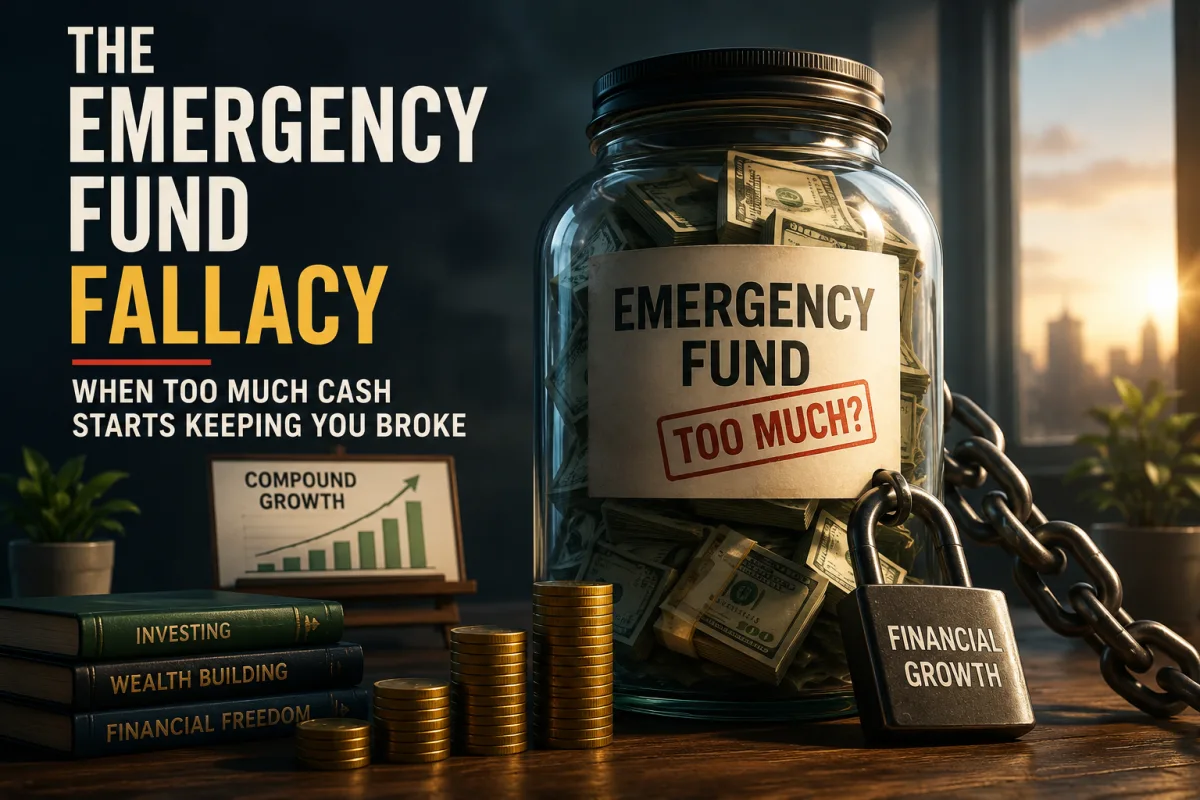
The Emergency Fund Fallacy: When Too Much Cash Starts Keeping You Broke
Too much emergency cash will keep you broke.
That sentence sounds wrong to anyone who has lived through financial instability. Cash feels like safety. Cash pays rent when income disappears. Cash handles medical bills without panic. Cash repairs the car, replaces the broken appliance, covers the delayed paycheck and protects a family from immediately reaching for debt. For people who have experienced job loss, business failure, high-interest borrowing, family emergencies or years of living paycheck to paycheck, cash can feel like oxygen.
That feeling is not irrational.
An emergency fund is one of the most important foundations in personal finance. Without it, every unexpected expense becomes a potential debt spiral. Without it, investments may need to be sold at the wrong time. Without it, a temporary income disruption can become a long-term financial wound. Cash reserves give people breathing room, dignity and decision-making power.
But a useful tool can become a trap when it is asked to do the wrong job.
The emergency fund fallacy is the belief that if some cash is good, much more cash must always be better. Six months of essential expenses may provide strong protection for many households. But two years of expenses sitting permanently in cash may begin to damage long-term wealth. The person feels safe because the balance is large, but the money is no longer only protecting the household. It is also sitting idle while inflation erodes purchasing power and compounding opportunities pass by.
This is the quiet danger of excessive cash hoarding.
The bank balance stays stable, so the loss does not feel obvious. There is no dramatic market crash, no red number on a statement, no sudden decline. Instead, the damage appears slowly. Prices rise. Investment years are missed. Retirement contributions remain too low. Long-term goals are delayed. The person has enough cash to survive a crisis, but not enough invested assets to build freedom.
An emergency fund is for safety, not growth.
That distinction matters. Cash should protect you from urgent short-term shocks. It should not be forced to carry your entire financial future. Long-term money needs a different assignment. It needs to be invested, diversified, reinvested and given time to compound. If every extra dollar remains trapped in emergency savings, the household may become cash-rich and asset-poor.
Safety is necessary. But safety without growth becomes stagnation.
The goal is not to shame people for saving. The goal is to graduate cash from fear to strategy. A healthy financial plan keeps enough liquid money to handle real emergencies, then sends excess cash to work. It draws a clear line between emergency reserves, sinking funds, short-term goals and long-term investments. It respects liquidity without worshiping it.
The emergency fund should be a shield. It should not become a cage.
Why Emergency Funds Became Personal Finance Gospel
Emergency funds became a central personal finance rule because most financial crises begin with a lack of liquidity.
A household may not be poor on paper. It may have income, retirement contributions, a car, household goods or even property. But if no cash is available when an urgent expense appears, the household is vulnerable. The next problem must be solved through borrowing, late payments, family dependence, selling assets or delaying important care.
This is why financial educators often emphasize emergency savings before investing aggressively. The advice is practical. People without cash are forced to make bad decisions at bad times. A small emergency fund can prevent a minor problem from becoming high-interest debt. A larger fund can protect against job loss, medical disruption or business slowdown.
Emergency funds also create emotional stability.
A person with no savings lives close to panic. Every expense feels threatening. Every delay in income becomes stressful. Every unexpected bill creates shame or urgency. Cash reserves reduce that pressure. They help people sleep. They create space between life and crisis.
For people recovering from debt, an emergency fund is especially important. Debt often returns through emergencies. A credit card that was paid off gets used again because the car breaks down. A personal loan returns because a medical expense appears. A payday loan is taken because rent is due before salary arrives. Emergency savings interrupt that cycle.
So the emergency fund rule is not wrong.
The mistake comes when a rule designed to create stability becomes a permanent excuse to avoid investing long-term money.
The Difference Between Enough Cash and Excess Cash
Enough cash protects your life.
Excess cash protects your fear.
This distinction can be uncomfortable, but it is essential. Enough cash has a defined purpose. It covers a certain number of essential expenses. It prepares for known irregular costs. It supports short-term goals. It is based on real risk: income instability, dependents, health needs, business volatility, job security, insurance gaps and family responsibilities.
Excess cash is different.
Excess cash is money that remains in cash even though it is not needed for emergencies, not assigned to short-term goals and not part of a planned reserve. It sits there because investing feels uncomfortable, because markets feel uncertain, because past debt created fear or because the saver has no rule for when cash becomes investment capital.
Enough cash has a number.
Excess cash has no finish line.
If you say, “I need six months of essential expenses because my income is variable and I support children,” that is a strategy. If you say, “I will keep saving cash until I feel safe,” that may become endless because fear rarely announces that it has had enough.
A healthy financial plan defines the emergency fund target in advance. Once that target is reached, additional surplus should be directed toward the next priority: debt repayment, investing, retirement, property, business capital, education, insurance or other long-term goals.
The emergency fund should have a ceiling. Wealth building needs the surplus above that ceiling.
Why Two Years of Expenses in Cash Can Become a Problem
Keeping two years of expenses in cash may sound extremely safe.
For some people in unusual situations, a very large cash reserve may be justified. A business owner with unstable income, someone facing an uncertain medical situation, a household planning relocation, a worker in a highly volatile industry or a family expecting a major life transition may reasonably hold more cash for a season.
The problem is not temporary strategic cash.
The problem is permanent fear cash.
If a household keeps two years of expenses liquid for many years while also underinvesting for retirement, missing market growth, avoiding assets and letting inflation reduce purchasing power, the cash reserve has become a drag. It is protecting against short-term risk while increasing long-term risk.
Consider what two years of expenses represents. If essential expenses are $3,000 per month, a two-year cushion is $72,000. If those expenses are $5,000 per month, the cushion is $120,000. That money may provide comfort, but if it remains idle for a decade, the missed compounding can be substantial.
Again, the issue is not whether cash is useful. It is whether every dollar of that cash needs to remain liquid.
If six or nine months of expenses provides adequate protection, the remaining cash may be long-term money wearing an emergency label. Long-term money should not be trapped in short-term tools forever.
At some point, extra safety becomes delayed wealth.
Inflation: The Invisible Leak in Excess Cash
Inflation is one of the main reasons excessive cash can keep people broke.
Inflation reduces purchasing power over time. The number in the savings account may stay the same, but the cost of life rises. Food, rent, healthcare, insurance, transport, school fees, utilities and services may become more expensive. If cash earns less than inflation, the real value of the money falls.
This loss is emotionally different from an investment loss.
If an investment account falls, the decline is visible. The investor sees the lower balance and feels pain. If cash loses purchasing power to inflation, the bank balance may look stable. The loss appears in the real world when the same money buys less. Because the pain is gradual, people underestimate it.
This makes excessive cash deceptively comfortable.
A large emergency fund can feel like progress every time the saver checks the account. But if the money is earning little and prices are rising, the household may be moving backward in real terms. The cash is still useful for emergencies, but it is not preserving long-term purchasing power well enough to carry future goals.
Inflation does not mean emergency funds should be invested aggressively. Emergency money should remain safe. But it does mean that money beyond the emergency need should be evaluated differently.
Cash is a strong short-term protector and a weak long-term builder.
The Opportunity Cost of Hoarding Cash
Opportunity cost is the return you give up by choosing one option over another.
When excess cash sits in a savings account for years, the opportunity cost may be missed investment returns, missed dividends, missed interest, missed business growth, missed property deposits, missed retirement contributions and missed compounding. The saver may avoid visible market volatility, but they also avoid the growth potential of ownership.
Opportunity cost is easy to ignore because it does not appear as a bill.
No one sends a statement showing the returns you did not earn. No bank alerts you that your excess cash missed five years of compounding. No lender demands payment for the wealth you failed to build. The cost is silent.
That silence makes it dangerous.
A person may feel financially responsible because they saved aggressively. They may be responsible. But if saving never transitions into investing, the financial plan remains incomplete. Cash is the foundation. Assets are the building. A foundation alone is not a house.
Every dollar sitting in cash should be asked a question: is your job safety, short-term spending or long-term growth?
If the answer is long-term growth, cash may be the wrong place.
The Psychology Behind Excessive Emergency Funds
People do not hoard emergency cash because they are foolish.
They usually do it because something taught them that instability is dangerous. They may have grown up in a household where money was always short. They may have watched a parent lose a job. They may have carried debt for years. They may have experienced medical bills, business failure, divorce, eviction, unpaid invoices, family pressure or financial betrayal. Cash becomes emotional protection against repeating pain.
This matters because numbers alone may not solve the problem.
A spreadsheet can show that someone has more cash than needed, but their nervous system may still feel unsafe. Investing the excess may feel like losing control. Market fluctuation may feel like danger. The person may prefer a lower long-term return because cash gives immediate psychological relief.
Financial planning must respect emotions, but not surrender completely to them.
The answer is not to tell fearful savers to invest everything immediately. The answer is to create a written cash policy. Define the emergency fund target. Define sinking funds. Define known short-term goals. Define when extra cash becomes investment money. Move gradually if needed. Automate. Start with conservative investments if appropriate. Build confidence through structure.
Fear should be acknowledged, then given boundaries.
The Emergency Fund Is Not a Retirement Plan
An emergency fund cannot replace retirement planning.
Retirement requires assets that can support decades of expenses. Cash alone is usually not enough because it may not grow fast enough to keep up with inflation or long-term needs. A large savings account may feel reassuring in middle age, but it can be depleted quickly if it must fund retirement, healthcare, housing and family support for many years.
This is especially dangerous for people who feel proud of cash savings but have little invested.
They may say, “At least I have money in the bank.” That is good. But if retirement accounts, pension contributions, investment portfolios or income-producing assets are weak, the long-term plan may still be fragile.
An emergency fund is designed for temporary disruption. Retirement planning is designed for a permanent change in income structure. These are different problems.
Temporary disruption requires liquidity.
Retirement requires sustainable income and long-term purchasing power.
Do not ask emergency cash to do retirement’s job. It was not built for that.
The Emergency Fund Is Not an Investment Strategy
An emergency fund is a risk management tool, not an investment strategy.
Its purpose is to be available. Its return is measured partly in disasters avoided: debt not taken, investments not sold, bills not missed, panic not triggered. Judging an emergency fund by investment returns misunderstands its job.
But the reverse is also true. Judging long-term money by emergency fund standards misunderstands the job of investing.
Long-term investment money does not need to be available tomorrow. It needs to grow over years and decades. It can accept volatility because the timeline is longer. It can be placed in diversified assets that have growth potential. It should be reviewed, managed and aligned with goals, but it should not be kept permanently idle simply because cash feels simpler.
The emergency fund and the investment portfolio should work together.
The emergency fund protects the portfolio from forced selling. The portfolio protects the future from inflation and undergrowth. Cash provides stability. Investments provide growth. One without the other leaves a gap.
A shield is not an engine. An engine is not a shield. A strong financial life needs both.
How Much Emergency Cash Is Enough?
The right emergency fund is personal.
The common recommendation of three to six months of essential expenses is a useful starting point, not a universal law. Some people need less. Some need more. The correct number depends on risk.
Start with essential expenses, not lifestyle spending. Essential expenses include housing, food, utilities, transport, insurance, medication, childcare, minimum debt payments and basic family responsibilities. They do not include luxury travel, entertainment, premium subscriptions or discretionary upgrades that could be paused in a crisis.
Then consider income stability.
A person with stable employment, strong benefits and multiple income earners in the household may need a smaller fund than a freelancer, business owner or commission-based worker. A household with one breadwinner and several dependents may need more. Someone in a volatile industry should hold more than someone in a secure role.
Then consider obligations.
Children, aging parents, medical conditions, property maintenance, business responsibilities, debt, insurance gaps and family support all increase the need for liquidity.
Then consider access to other resources.
A household with strong insurance, low fixed costs, no debt and supportive income sources may need less cash than one with high obligations and weak safety nets.
The right number is the amount that protects you from realistic shocks without freezing long-term wealth.
The Three-Month Fund
A three-month emergency fund may be appropriate for some people.
This might include a single person with stable income, low fixed expenses, good insurance, low debt and strong family or professional support. It may also apply to dual-income households where either income can cover essentials if the other disappears temporarily.
The advantage of a three-month fund is that it provides meaningful protection while allowing more surplus to be invested sooner. The risk is that it may be too small for people with unstable income, dependents or high obligations.
A three-month fund is not irresponsible if it matches the household’s reality.
But it should be based on essential expenses and realistic risk, not overconfidence.
The Six-Month Fund
A six-month emergency fund is a strong standard for many households.
It provides enough runway to handle job loss, health disruption, family emergencies or income delays without immediate panic. It is especially useful for families, single-income households, people with moderate obligations or workers in industries where job searches may take time.
Six months of essential expenses often strikes a practical balance between safety and growth.
It is large enough to create confidence but not so large that it necessarily prevents investing. Once this fund is complete, many households can redirect additional surplus toward long-term investments while continuing to maintain the cash reserve.
The six-month fund should be reviewed as expenses change. If essential expenses rise, the target may need adjustment. If debt falls or income becomes more secure, the target may not need to expand indefinitely.
Six months is a protection level, not a cash-hoarding commandment.
The Twelve-Month Fund
A twelve-month emergency fund may be reasonable for certain situations.
Business owners, freelancers, people with highly variable income, households with one earner, workers in unstable industries, people with health uncertainty or families with major obligations may benefit from a larger reserve.
A one-year cushion can create powerful peace of mind. It can allow a business owner to survive slow periods, a professional to search for the right job, a caregiver to take time off or a family to handle prolonged disruption.
But even a twelve-month fund should have a purpose.
If the reason is clear, the fund is strategic. If it exists only because the saver is afraid to invest anything beyond it, the household may need a plan to move excess cash into growth assets after the target is reached.
The larger the emergency fund, the more important it becomes to define where emergency savings end and long-term investing begins.
The Two-Year Cushion
A two-year cushion is not automatically wrong, but it should be questioned carefully.
There are seasons when two years of cash may make sense. Someone planning to leave a job, start a business, take a sabbatical, move countries, care for a family member, face medical uncertainty or transition into retirement may intentionally build a large cash reserve. In those cases, the money is not simply an emergency fund. It is transition capital.
Transition capital has a timeline and a purpose.
The problem is when a two-year cushion becomes permanent by default. If the household is not in transition, has stable income, has adequate insurance, has manageable expenses and still holds two years of expenses in cash while underinvesting, the cash may be excessive.
The cost is not only lower return. It is delayed ownership.
Two years of expenses can represent a large amount of capital. If part of that capital belongs to long-term goals, keeping it liquid forever may stop compounding before it begins.
The right question is not, “Does two years of cash feel safe?”
Of course it does.
The better question is, “What future wealth am I sacrificing by keeping this much money idle?”
Safety Cash, Sinking Funds and Growth Capital
The solution to the emergency fund fallacy is separating cash by purpose.
Safety cash is your true emergency fund. It covers unexpected urgent needs and income disruption.
Sinking funds are cash reserves for predictable expenses. Annual insurance, school fees, car repairs, taxes, medical checkups, home maintenance, holidays and professional licenses should be saved for separately. These costs may not happen monthly, but they are not true emergencies.
Short-term goal cash is money needed within a defined period. A home deposit due in one year, tuition due next term, relocation costs or a planned large purchase should remain safe and accessible.
Growth capital is money not needed soon. It belongs to long-term goals such as retirement, financial independence, wealth building, business ownership or future income. This money should not be trapped permanently in cash.
When all these categories are mixed together in one savings account, the balance becomes confusing. A person may think they have too much emergency cash when part of it belongs to taxes, school fees and annual bills. Another may think they have a prudent reserve when much of it is actually long-term capital hiding from markets.
Name the money. Then give each category the correct tool.
The Account Separation Strategy
Account separation helps prevent cash confusion.
One account can hold monthly spending. Another can hold emergency savings. Another can hold sinking funds. Another can hold short-term goals. Investment accounts can hold long-term wealth-building money.
This structure makes decisions clearer.
If the emergency fund is complete, you stop adding to it unless expenses rise or it is used. If the car repair fund is low, you fund it before the next maintenance cycle. If the home deposit is needed next year, you keep it safe. If money has no short-term job, it can move toward investments.
Without separation, a large cash balance can become emotionally misleading.
You may feel wealthy because the balance is high, but some of that money may already belong to future bills. Or you may feel safer than necessary because growth capital is buried inside the emergency fund.
Separate accounts turn vague cash into clear decisions.
When Too Much Cash Comes From Debt Trauma
People who have escaped debt often overcorrect into cash hoarding.
This is understandable. Debt can be painful. It can bring shame, stress, collection calls, arguments, interest charges and years of feeling trapped. After becoming debt-free, many people promise themselves they will never be vulnerable again. Cash becomes proof that the old life is over.
That proof matters.
But if fear of debt prevents all investing, the household may remain financially limited. The person is no longer paying interest to lenders, but they are also not earning enough returns from assets. They have escaped one trap and entered another.
The answer is not to reduce cash recklessly. The answer is to build a strong but bounded emergency fund, then redirect former debt payments into investments.
Debt repayment discipline can become wealth-building discipline. The same monthly payment that once reduced balances can buy assets. The emergency fund prevents a return to debt. Investments create the future.
Debt trauma should lead to better systems, not permanent cash paralysis.
When Too Much Cash Comes From Market Fear
Some people hold excessive cash because they are afraid of investing.
They may have seen market crashes, heard stories of losses, been exposed to scams or watched friends speculate badly. They may not understand funds, bonds, shares, retirement accounts or asset allocation. Cash feels simple. Investing feels dangerous.
Market fear should be respected, but educated.
Investing does involve risk. Markets can fall. Assets can lose value. Bad products exist. Fees and taxes matter. Fraud exists. But avoiding all long-term investing creates different risks: inflation risk, longevity risk, retirement shortfall risk and opportunity cost.
The solution is not to jump from cash into speculation. The solution is to learn and begin gradually.
Start with basic concepts: diversification, time horizon, emergency funds, index funds, bonds, fees, risk tolerance and asset allocation. Use regulated platforms where possible. Avoid promises of guaranteed high returns. Invest only long-term money. Start with a small amount if needed. Automate contributions.
The goal is not to become fearless. The goal is to become financially literate enough to stop using cash as the only answer.
When Too Much Cash Comes From Lack of Goals
Sometimes people hoard cash because they do not know what they want the money to do.
Without goals, cash becomes the default destination. Money comes in, expenses are paid, and whatever remains sits in savings. The balance grows, but there is no plan for retirement, investing, property, business, education or financial independence.
This can look disciplined, but it may be directionless.
Goals turn cash into strategy. An emergency fund has a target. A home deposit has a timeline. Retirement has an investment plan. Financial independence has an asset goal. A business has capital needs. Education has cost estimates. Without these, all money feels like general safety money.
The question is: what is the money for?
If the answer is unclear, the cash will keep growing without becoming wealth. Create goals, timelines and categories. Once the short-term goals are funded, send long-term money to long-term tools.
Cash without goals becomes a waiting room where wealth can sit for years.
The Right Way to Invest Excess Emergency Cash
If you determine that you have excess emergency cash, do not move it impulsively.
First, confirm the true emergency fund target. Use essential expenses and realistic risk.
Second, identify sinking funds and short-term goals. Do not accidentally invest money needed soon.
Third, isolate the excess. This is money above emergency needs, known expenses and near-term goals.
Fourth, define the goal for the excess. Retirement, financial independence, long-term wealth, property, business capital or education will each require different planning.
Fifth, choose a suitable investment strategy. This may involve diversified funds, index funds, retirement accounts, pension plans, bonds, real estate investment trusts, government securities, business investment or other appropriate assets depending on your context.
Sixth, decide whether to invest gradually or as a lump sum. If market fear is strong, a scheduled gradual plan may help. The key is to set dates and amounts so gradual investing does not become endless hesitation.
Seventh, automate future surplus. Once the emergency fund is full, additional savings should flow to investments unless there is a new short-term goal.
The aim is not to punish yourself for saving too much. The aim is to put every dollar in the right role.
The Lump Sum Anxiety Problem
Moving excess cash into investments can feel frightening because the amount may be large.
A person who has accumulated a two-year cushion may look at the excess and worry about investing at the wrong time. What if the market falls next month? What if they regret it? What if they need the money? What if they make a mistake?
These concerns are common.
One solution is to invest gradually over a defined period. For example, move the excess into investments over six, nine or twelve months. This can reduce regret if markets fall shortly after the first investment. It also helps the saver emotionally adjust to seeing money outside the bank account.
Another solution is to invest a portion immediately and phase in the rest.
The important point is that the plan must have a schedule. If the plan is merely “I will invest when I feel ready,” the cash may sit for years. Emotional readiness is unreliable because market uncertainty never disappears completely.
A written schedule turns anxiety into process.
Why Automating the Overflow Works
Automation prevents emergency funds from growing beyond their target by default.
Once your emergency fund reaches its chosen number, future surplus should automatically flow elsewhere. This might be retirement contributions, brokerage investments, pension top-ups, debt repayment, business capital or other goals.
Think of it as an overflow system.
The emergency fund fills to its target. After that, additional money overflows into growth assets. If the emergency fund is used, automation temporarily refills it. Once restored, overflow resumes.
This system prevents the common mistake of continuing to save cash simply because saving cash is familiar.
Automation also reduces emotional debate. You do not ask every month whether the world feels safe enough to invest. Your financial policy has already decided. Cash has a ceiling. Growth receives the excess.
This is how a saver becomes an investor without abandoning safety.
Why Emergency Fund Targets Should Change With Life
An emergency fund is not set forever.
Life changes. Marriage, children, divorce, business ownership, illness, aging parents, home ownership, relocation, job stability, income changes and retirement can all affect the right cash target.
A young single professional may need less cash than a parent with children. A business owner may need more than a salaried employee. A household with one income may need more than a dual-income household. A retiree drawing from investments may need a different cash strategy from a worker still earning income.
Review your emergency fund at least once or twice a year.
Ask whether essential expenses changed. Ask whether income stability changed. Ask whether dependents changed. Ask whether insurance improved or weakened. Ask whether debt increased or decreased. Ask whether the current fund still matches risk.
A right-sized emergency fund adapts to life.
But adaptation is not the same as endless expansion.
The Retiree Exception
Retirees may need more cash than younger investors because they are drawing from assets rather than adding to them through salary.
During retirement, cash can prevent selling investments during market downturns. A retiree may hold one to three years of spending needs in cash or conservative assets depending on portfolio structure, pension income, risk tolerance and withdrawal strategy.
This is not the same as a young worker hoarding two years of cash while failing to invest.
The retiree’s cash reserve supports withdrawals and sequence-of-return risk management. The worker’s excess cash may be avoiding long-term compounding. The life stage matters.
Even retirees usually need some growth assets because retirement can last decades and inflation can raise costs. Too much cash can still be risky if it reduces long-term purchasing power.
The right cash level depends on whether you are accumulating wealth, transitioning or drawing it down.
The Business Owner Exception
Business owners may also need larger cash reserves.
A business has operating expenses, payroll, taxes, suppliers, inventory, rent, software, equipment, marketing and slow periods. Personal emergency savings alone may not be enough. Business reserves should be separate from household reserves.
For business owners, cash is not always idle. It may be working as resilience capital.
But even business owners should define reserve targets. How many months of operating expenses should the business hold? What taxes are due? What seasonal gaps must be covered? What expansion capital is needed? What part of cash is truly excess?
Excess business cash may be reinvested into the business, distributed to the owner, used to reduce debt or invested outside the business for diversification.
The key is clarity. Business volatility justifies more cash, but not vague cash hoarding without a capital plan.
The Freelancer Exception
Freelancers and contractors often need larger emergency funds because income can be irregular.
Clients pay late. Projects end. Sales cycles vary. Work may be seasonal. There may be no employer benefits, paid leave or stable paycheck. A larger personal reserve can protect against these realities.
For variable-income workers, six to twelve months of essential expenses may be reasonable. Some may need more if income is highly unstable or dependents rely on them.
But the same principle applies: define the target.
A freelancer can also create an income buffer account. All client payments flow into one account. The freelancer pays themselves a steady monthly amount. Surplus builds reserves, taxes and investments. This structure reduces the need to treat every dollar as emergency money.
Irregular income requires more liquidity, but it also requires disciplined investing once liquidity is adequate.
The Healthcare Exception
Medical uncertainty can justify larger cash reserves.
If a person or family member has a serious health condition, high deductibles, uncertain insurance coverage, expected treatment costs or income risk due to health, more cash may be prudent. In such cases, liquidity can protect care decisions and reduce stress.
But even here, the cash should be structured.
Separate medical reserves from general emergency funds. Estimate likely out-of-pocket costs. Review insurance. Consider disability or income protection where available and suitable. Keep long-term money separate from medical cash once reserves are adequate.
Health risk is real. It should shape the emergency fund target. But it should not automatically prevent all long-term investing unless the situation truly requires full liquidity.
Risk should be measured, not feared without boundaries.
Emergency Cash After Debt Freedom
After paying off debt, many people want to build a large emergency fund before investing.
This is understandable and often wise. Debt freedom can feel fragile without cash. A starter emergency fund should usually come before aggressive investing. A full emergency fund can prevent a return to borrowing.
The danger is never moving beyond the emergency fund phase.
A debt-free person may keep saving cash for years because investing feels risky. They may say they are still building security, but the emergency fund may already be large enough. The old debt payment should eventually become an investment contribution.
A practical sequence works well.
First, pay off high-interest debt. Second, build a starter emergency fund. Third, complete a full emergency fund. Fourth, create sinking funds. Fifth, redirect additional surplus to long-term investments. Sixth, keep the emergency fund maintained but not endlessly expanded.
Debt freedom should lead to asset building, not permanent cash accumulation.
How Excess Cash Delays Financial Independence
Financial independence depends on assets that can support expenses.
Cash can support expenses temporarily, but invested assets have the potential to grow and produce income over time. If a person holds too much cash, the journey to financial independence may slow significantly.
There are two reasons.
First, excess cash usually earns lower long-term returns than growth assets. Second, the person may continue needing active income because assets are not growing fast enough to cover future expenses.
Financial independence is not achieved by feeling safe today alone. It requires building a future income engine.
A large emergency fund may protect against one crisis. Investments can help protect against decades of dependence.
The goal is not to empty the emergency fund. It is to stop letting emergency thinking dominate money meant for independence.
How Excess Cash Delays Retirement
Retirement can be delayed by excessive cash hoarding during working years.
Retirement portfolios need time to grow. Contributions made earlier have more time to compound. If a worker spends many years accumulating cash far beyond emergency needs while contributing too little to retirement assets, they may reach later life with safety money but not enough growth money.
This can create a painful realization.
The person saved diligently. They avoided debt. They were careful. Yet retirement remains underfunded because too much long-term capital stayed in cash. They avoided one kind of risk while accepting another: the risk of not having enough.
Retirement planning requires a balance between liquidity and growth.
Workers need emergency funds. But they also need retirement contributions, pension planning, diversified investments and assets that can keep up with long-term costs.
Cash alone rarely creates retirement freedom.
How Excess Cash Can Hide Low Confidence
Sometimes excess cash is not a financial decision. It is a confidence problem.
The saver may not trust themselves to invest wisely. They may not know which platform to use. They may fear being cheated. They may not understand taxes. They may worry about choosing the wrong fund. So they do nothing.
This kind of caution can be solved through education and small action.
Read about basic asset classes. Learn how diversified funds work. Understand retirement accounts available in your country. Study fees. Ask qualified professionals questions. Start with a small amount. Use regulated providers. Avoid anything you cannot explain.
Confidence grows through informed repetition.
The solution to low confidence is not hoarding cash forever. It is building knowledge until action becomes possible.
How to Know If Your Emergency Fund Is Too Large
Your emergency fund may be too large if several signs appear.
You have more than twelve months of essential expenses in cash with no specific reason.
You are underinvested for retirement while cash keeps growing.
You have no short-term goal attached to the excess cash.
You continue adding to emergency savings after reaching your own target.
You feel anxious about investing any amount, even money not needed for years.
You use the phrase “just in case” for every surplus dollar.
Your bank balance is high, but your net worth growth is slow.
You have no written rule for when cash becomes investment capital.
You are protecting against unlikely scenarios while ignoring likely long-term needs.
You feel safe today but are not building freedom for tomorrow.
One sign alone may not prove a problem. Together, they suggest cash may have become excessive.
How to Right-Size Your Emergency Fund
Right-sizing begins with essential expenses.
Calculate the monthly cost of housing, food, utilities, transport, insurance, medication, childcare, minimum obligations and basic family support. Exclude luxuries that could be paused during crisis.
Then choose your target range based on risk.
Three months may suit stable, low-obligation households. Six months may suit many families and workers with moderate risk. Nine to twelve months may suit variable-income earners, single-income households, business owners or those with higher obligations. More may be justified for specific transitions or medical situations.
Next, separate sinking funds from emergency funds.
Annual expenses should not inflate the emergency fund unnecessarily. They need their own category.
Then identify excess cash.
Any amount above emergency reserves, sinking funds and short-term goals should be reviewed for long-term investment.
Finally, set a rule. For example: maintain six months of essential expenses in emergency cash, keep sinking funds fully funded and invest all surplus above those targets monthly.
This rule turns cash from emotion into strategy.
How to Keep Cash From Rebuilding Excessively
Even after investing excess cash, the habit of hoarding may return.
To prevent this, create an overflow rule. Once emergency savings reach the target, all new surplus goes to investments unless a specific short-term goal is created.
Automate the overflow if possible.
On payday, money moves first to bills, emergency savings if needed, sinking funds and investments. If the emergency fund is full, the emergency transfer pauses or redirects to investments. If the fund is used, the transfer resumes until it is restored.
This keeps cash at the right level without requiring constant decisions.
The emergency fund becomes a reservoir with a maximum line, not a lake that expands forever.
The Emotional Safety Plan
If reducing excess cash feels emotionally difficult, build an emotional safety plan.
First, keep the emergency fund slightly above the mathematical target if it helps you begin investing. A person who needs six months but feels better with eight months may still be fine if the extra two months allows them to invest the rest.
Second, invest gradually. Move excess cash in scheduled portions.
Third, start with diversified, understandable investments rather than speculative products.
Fourth, keep a written investment policy so market headlines do not trigger panic.
Fifth, remind yourself that investing long-term money does not eliminate safety. It creates another form of safety: future purchasing power.
Financial behavior must be sustainable. A plan that ignores emotion may fail. A plan ruled entirely by emotion may also fail. The goal is structure that respects both math and psychology.
The Investment Policy After the Emergency Fund
Once the emergency fund is complete, every household needs an investment policy.
An investment policy does not need to be complex. It should answer basic questions.
How much emergency cash will we hold?
Which expenses have sinking funds?
What money is needed within one to three years?
What percentage of income will be invested monthly?
Which accounts or funds will receive contributions?
What asset allocation fits our goals?
How often will we review and rebalance?
When will we increase contributions?
What will we do during market declines?
When these questions are answered in advance, cash hoarding becomes less likely. The household knows what happens after safety is complete.
Without an investment policy, the emergency fund may become the final destination for every surplus dollar.
The Role of Index Funds and Diversified Investments
For many people, diversified investments can help move excess cash into growth without requiring stock picking.
Index funds, mutual funds, exchange-traded funds, pension funds, balanced funds, bond funds and other diversified vehicles may offer exposure to many securities through one product. The right choice depends on country, fees, taxes, regulation, time horizon and risk tolerance.
Diversified investing does not eliminate risk. Markets can fall. Bond values can move. Currency can fluctuate. Fees and taxes matter. But diversification reduces dependence on one company or asset.
This can be useful for cash-heavy savers who are afraid of investing because they think they must pick winning stocks.
You do not need to move from emergency cash to speculation. You can move from excess cash to a structured, diversified investment plan.
The goal is measured growth, not excitement.
The Role of Bonds and Conservative Investments
Some excess cash may belong in conservative investments rather than aggressive growth assets.
Bonds, treasury instruments, money market funds, fixed-income funds or high-quality short-term instruments can play a role depending on goals and risk tolerance. They may offer more return potential than ordinary cash while still being less volatile than stocks in many cases.
However, conservative investments are not all the same. Some carry interest-rate risk, credit risk, liquidity risk, currency risk or fees. Investors should understand what they own.
Conservative investments can be useful for medium-term goals or for investors gradually moving from cash into a broader portfolio.
The key is matching the tool to the timeline.
Short-term emergency money stays liquid. Medium-term money may use conservative tools. Long-term money may include growth assets.
The Role of Retirement Accounts
Retirement accounts are often one of the best destinations for excess cash that is truly long-term.
If a person has a full emergency fund but low retirement savings, increasing retirement contributions can be a powerful move. Some employer plans may offer matching contributions or tax advantages. Self-employed people may have pension or retirement options depending on jurisdiction.
Retirement accounts are not emergency funds. They may have restrictions, penalties or tax consequences for early withdrawal. That is why emergency cash must be separate.
But once safety is funded, retirement money should be given time to grow.
A person who hoards cash for decades while neglecting retirement may feel safe now and vulnerable later. Retirement contributions convert excess present liquidity into future income potential.
The emergency fund protects the next crisis. Retirement investing protects the later life.
The Role of Debt Payoff
Excess emergency cash may also be used to reduce high-interest debt.
If someone is holding a large cash cushion while carrying expensive credit card debt, payday loans, overdrafts or high-interest personal loans, the financial plan may be inefficient. The debt interest may be compounding against them faster than cash can help.
This does not mean emptying all emergency savings to pay debt. That can be risky. But it may make sense to keep an appropriate emergency fund and use excess cash to reduce expensive debt.
Paying off high-interest debt can be one of the strongest uses of excess cash because it eliminates a guaranteed cost and frees future cash flow.
After the debt is gone, the old payment should be redirected to investments.
This sequence turns excess cash into debt freedom, then into wealth building.
The Role of Insurance
Insurance can reduce the amount of emergency cash needed for certain risks.
Health insurance, disability or income protection, life insurance, property insurance, vehicle insurance, business insurance and liability coverage can all protect against risks that cash alone may not handle efficiently.
Without insurance, a household may feel the need to hoard enormous cash reserves because any disaster could be financially devastating. With appropriate insurance, the emergency fund can focus on deductibles, income gaps and immediate needs rather than trying to cover every catastrophic scenario alone.
Insurance does not replace emergency savings. Claims can take time. Policies have exclusions. Deductibles exist. But insurance can reduce the need to self-insure everything through cash.
A strong safety system combines cash reserves, insurance and risk reduction.
Do not make your savings account responsible for risks that insurance should carry.
The Role of Low Fixed Costs
Low fixed costs reduce the required emergency fund.
If your essential monthly expenses are low, six months of protection requires less cash. If fixed costs are high, the emergency fund target grows. This means lifestyle choices directly affect how much money must remain liquid.
Housing, transport, school fees, debt payments, subscriptions and recurring obligations can all increase the emergency fund requirement.
A household with $2,000 of essential monthly expenses needs $12,000 for a six-month fund. A household with $8,000 of essential monthly expenses needs $48,000. The higher-cost household must keep far more cash idle just to achieve the same number of months of protection.
Lower fixed costs free more money for investment.
This is one of the hidden wealth benefits of living below your means. It reduces both monthly pressure and the size of the required cash cushion.
The Emergency Fund and Time Freedom
An emergency fund buys short-term time freedom.
It gives you time to find work, time to recover, time to make decisions, time to avoid bad debt and time to negotiate. This is valuable.
But long-term time freedom comes from assets.
Investments, pensions, property, business equity and other productive assets can eventually support life without full dependence on active income. If too much money remains in emergency cash, the path to time freedom slows.
The emergency fund is the first freedom layer. It is not the final one.
Once short-term time is protected, long-term time must be purchased through ownership.
What to Do If You Already Have a Two-Year Cushion
If you already have a two-year cushion, begin with gratitude rather than guilt.
You have done something many people struggle to do: you created liquidity. That discipline is valuable. Now the task is to refine it.
First, calculate your essential expenses. Confirm how much of the cushion is based on necessities rather than full lifestyle spending.
Second, decide the proper emergency fund target. This may be six, nine, twelve or more months depending on your life.
Third, identify transition needs. Are you planning a move, business launch, sabbatical, medical treatment or retirement transition? If yes, some cash may be transition capital.
Fourth, separate sinking funds and short-term goals.
Fifth, identify true excess cash.
Sixth, create a phased investment plan for the excess. Choose suitable accounts and assets.
Seventh, automate future surplus toward investments once cash targets are met.
You are not abandoning safety. You are giving surplus cash a better job.
Common Mistakes With Emergency Funds
The first mistake is having no emergency fund at all.
The second mistake is investing emergency money in volatile assets.
The third mistake is confusing sinking funds with emergency savings.
The fourth mistake is saving based on full lifestyle instead of essential expenses.
The fifth mistake is never setting a target.
The sixth mistake is continuing to add cash after the target is reached.
The seventh mistake is holding years of expenses in cash while neglecting retirement.
The eighth mistake is using cash hoarding to avoid learning about investing.
The ninth mistake is failing to adjust the fund as life changes.
The tenth mistake is believing that because cash is safe in the short term, it is safe for every long-term goal.
A good emergency fund protects you from crisis. A poor emergency fund strategy protects you from growth.
A Practical Cash-to-Growth Framework
First, create a starter emergency fund if you have none.
Second, pay down high-interest debt while maintaining basic cash protection.
Third, calculate essential monthly expenses.
Fourth, choose an emergency fund target based on risk.
Fifth, build sinking funds for predictable expenses.
Sixth, keep short-term goal money safe.
Seventh, invest surplus beyond these cash needs.
Eighth, automate the overflow into retirement accounts, diversified investments, bonds, funds, property goals or business capital based on your plan.
Ninth, review the cash target twice a year.
Tenth, resist the urge to let fear keep moving the finish line.
This framework keeps liquidity strong without allowing liquidity to become the entire strategy.
The Mindset Shift: From Hoarder to Allocator
The emergency fund fallacy is solved by becoming an allocator.
A hoarder asks, “How much cash can I keep so I never feel unsafe?”
An allocator asks, “What job should each dollar do?”
Some dollars should provide immediate liquidity. Some should prepare for annual expenses. Some should fund goals due soon. Some should reduce debt. Some should buy investments. Some should protect through insurance. Some should build skills. Some should support family. Some should create freedom.
Allocation is more mature than accumulation.
Saving cash is often the first discipline. Assigning money correctly is the next discipline. The goal is not to keep everything close. The goal is to place money where it can perform its proper function.
Safety cash should stay safe. Growth capital should grow.
Final Thoughts
Emergency funds are essential.
They protect against job loss, medical costs, delayed income, repairs, family emergencies and ordinary life shocks. They prevent high-interest debt. They keep investments from being sold at the wrong time. They create peace, dignity and decision-making power.
But too much emergency cash can keep you broke.
When six months of essential expenses becomes two years of permanent cash with no clear reason, the emergency fund may stop being a safety tool and start becoming a wealth obstacle. Inflation erodes purchasing power. Opportunity cost accumulates. Retirement remains underfunded. Long-term money misses compounding. The saver feels protected, but the future may be neglected.
The solution is not to abandon cash. The solution is to right-size it.
Define essential expenses. Choose a target based on real risk. Separate emergency funds from sinking funds and short-term goals. Keep enough cash to handle realistic shocks. Then invest the surplus. Automate the overflow. Review the target as life changes. Respect fear, but do not let fear own every dollar.
Your emergency fund should protect your life, not replace your investment plan.
Cash is a shield. It guards the present. Investments are an engine. They build the future. If you carry only a shield and never build an engine, you may survive storms but never move far.
Build the shield. Keep it strong. Then put the rest of your money to work.
 Article
 Article
 Article
 Article
 Article
 Article
 Article
 Article