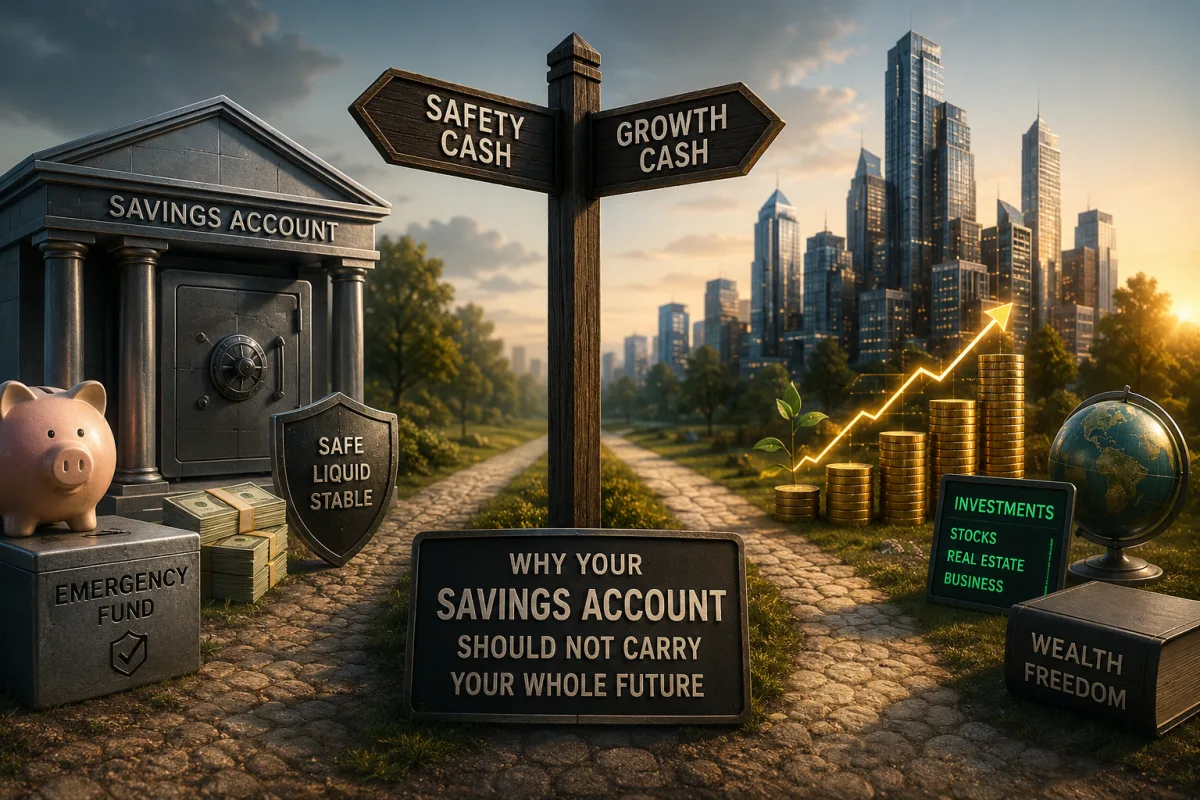
Safety Cash vs. Growth Cash: Why Your Savings Account Should Not Carry Your Whole Future
Your savings account is for safety, not growth.
That sentence sounds simple, but it solves one of the most common personal finance problems: people often ask one pool of money to do two very different jobs.
They want cash to be available immediately in an emergency. They also want cash to build long-term wealth. They want the money to be stable, liquid, risk-free, inflation-proof, high-returning and always accessible. They want one account to act as a fire extinguisher, retirement engine, investment portfolio, property fund, school fee reserve, business capital account and emotional comfort blanket.
No single account can do all of that well.
Money needs a job. Some money should protect you. Some money should grow for you. Some money should pay predictable expenses. Some money should fund long-term goals. Some money should remain liquid. Some money should be invested. Financial stress often begins when those roles are mixed together.
Safety cash is money you keep because life is unpredictable. It is for job loss, medical costs, urgent repairs, temporary income disruption, family emergencies and other shocks that require quick access. This money should be stable. It should be boring. It should not be exposed to sharp market losses. Its job is not to impress you with returns. Its job is to be there.
Growth cash is different. It is money you do not need soon. It is money meant for retirement, financial independence, long-term wealth, children’s future education, property acquisition, business expansion or goals years away. This money should not sit idle forever in a low-return account simply because cash feels safe. Long-term money needs the chance to grow, compound and fight inflation. Its job is not immediate access. Its job is future purchasing power.
The mistake is confusing liquidity with wealth.
A large savings balance can feel powerful because it is visible and stable. You can open the account and see the money sitting there. It does not swing with the market. It does not demand investment knowledge. It does not make you nervous during economic news. But if too much long-term money remains in cash, inflation can quietly reduce its value. Years of compounding can be lost. Retirement can remain underfunded. Financial independence can stay distant.
Cash is necessary, but cash is not enough.
A strong financial life draws a hard line between emergency liquidity and long-term wealth-building investments. The line protects both sides. Emergency money stays safe so you are not forced to sell investments in a crisis. Investment money stays invested so it has time to grow. Cash shields the present. Growth assets build the future.
Confusing the two can either make you fragile or make you stagnant.
The Two Jobs Money Must Not Confuse
Money has many jobs, but two of the most important are safety and growth.
Safety money exists to prevent panic. It gives you the ability to handle life without immediately borrowing, selling assets or making desperate decisions. It sits close enough to reach when needed. It sacrifices high return for certainty and access.
Growth money exists to create future wealth. It accepts some uncertainty because the goal is not next week’s stability. The goal is long-term purchasing power. Growth money is placed in assets that can rise in value, produce income or compound over time. It may fluctuate, but it has a chance to do what cash usually cannot do over long periods.
Problems begin when safety money is invested like growth money. A person puts emergency savings into volatile assets because they want better returns. Then a crisis arrives during a market decline, and they must sell at a loss. The money failed at its safety job.
Problems also begin when growth money is stored like safety money. A person keeps retirement savings in cash for years because investing feels risky. The account balance feels stable, but inflation reduces purchasing power and compounding is delayed. The money failed at its growth job.
The question is not whether cash is good or investing is good. The question is what the money is for.
Every financial decision should begin there.
What Safety Cash Is
Safety cash is money reserved for protection.
It includes your emergency fund, short-term reserves and cash set aside for necessary expenses that could arrive soon. This money belongs in places that are safe, liquid and easy to understand. A savings account, money market account, high-yield savings account, short-term deposit or other cash-like vehicle may be suitable depending on country, fees, access and protection rules.
The key characteristics are stability and liquidity.
Stability means the money should not fall sharply in value at the wrong time. Liquidity means you can access it quickly without major penalties, delays or market losses. If your car breaks down and you need the money tomorrow, you should not have to wait for a property sale, business distribution or stock market recovery.
Safety cash is not supposed to make you rich. That is not its job.
This point is important because people often become frustrated when emergency savings earn modest returns. They compare the savings account to stock market gains, property appreciation or business profits and feel that the cash is underperforming. But emergency money should not be judged by investment standards. It should be judged by whether it prevents financial damage during crisis.
Safety cash earns its return by preventing debt, panic, forced selling and late fees.
That return is not always visible, but it is real. If an emergency fund prevents a high-interest loan, it has protected you. If it allows you to survive job loss without selling investments during a downturn, it has protected you. If it gives you time to make a better decision, it has protected you.
What Growth Cash Is
Growth cash is surplus money that should become invested capital.
The phrase may sound contradictory because cash itself does not usually grow much. But growth cash refers to money available for long-term wealth-building purposes. It is money that should not remain permanently idle. It should be directed toward assets that can produce returns over time.
Growth cash may fund retirement accounts, diversified investment funds, index funds, mutual funds, exchange-traded funds, bonds, real estate investment trusts, rental property, business ownership, dividend-paying shares, pension contributions, education investments, income-producing tools or other long-term assets suitable for the person’s goals and risk profile.
This money has a longer time horizon. It is not needed for rent next month or medical emergencies tomorrow. Because it has time, it can accept some fluctuation. It can endure market cycles. It can benefit from reinvested returns and compounding.
The purpose of growth cash is not immediate comfort. The purpose is future strength.
When long-term money sits in cash for years, it may feel safe but remain underemployed. It is like hiring a worker and asking them to stand still. The money is available, but it is not building much. Over time, inflation can reduce what it can buy. Opportunity cost increases.
Growth cash should eventually be put to work.
The Hard Line: Time Horizon
The cleanest way to separate safety cash from growth cash is time horizon.
Money needed within days, weeks or months should be safe and liquid. Money needed within one to three years should usually be conservative because there may not be enough time to recover from investment losses. Money needed in five, ten, twenty or thirty years can usually be treated differently because time allows more room for volatility.
This time-based separation removes confusion.
If money is for next month’s rent, it is safety cash. If money is for a medical emergency, it is safety cash. If money is for school fees due in six months, it is safety or short-term goal cash. If money is for a home deposit needed next year, it should not be treated like retirement money. If money is for retirement in thirty years, leaving it in cash forever may be too conservative.
The time horizon tells the money what kind of risk it can take.
Short-term money cannot afford large temporary losses. Long-term money cannot afford permanent stagnation. Both risks matter. The right tool depends on when the money will be needed.
This is why a strong financial plan does not ask, “Where should I put my money?” in a general way. It asks, “When will I need this money, and what must it do before then?”
The Emergency Fund Belongs on the Safety Side
Your emergency fund belongs firmly on the safety side.
This money should not be invested aggressively. It should not be tied up in illiquid assets. It should not depend on market timing. It should not require you to sell shares, redeem long-term investments or wait for a buyer when life is already stressful.
The emergency fund exists for unexpected, necessary and urgent costs.
Unexpected means the event was not planned. Necessary means the expense protects health, housing, work, family or basic functioning. Urgent means delaying creates serious consequences. A job loss qualifies. A medical emergency qualifies. A necessary car repair may qualify if the car supports work. A leaking roof may qualify. A holiday does not qualify. A phone upgrade usually does not qualify. Annual insurance should be handled through a sinking fund, not emergency savings.
The size of the emergency fund depends on risk.
A single person with stable income and low expenses may need three months of essential expenses. A family with children, one main earner, variable income or health concerns may need six months or more. A business owner may need both personal and business reserves. Someone supporting extended family may need extra liquidity.
The emergency fund should be large enough to prevent panic but not so large that it absorbs all long-term investment capital.
Sinking Funds Also Belong on the Safety Side
Sinking funds are savings for predictable but irregular expenses.
They are not emergency funds, but they are still safety-side money because they are needed within a known time frame. Examples include annual insurance, school fees, car repairs, medical checkups, home maintenance, tax payments, professional licenses, holidays, family events and equipment replacement.
Sinking funds prevent predictable costs from becoming emergencies.
If you know a bill comes every year, it should not surprise you every year. Divide the expected cost by the number of months before it is due and save monthly. This turns a large irregular expense into a manageable monthly assignment.
This matters because many people raid emergency funds or use debt for expenses that were actually predictable. Then the emergency fund is weak when a true crisis arrives. Sinking funds protect the emergency fund by giving known costs their own money.
Since sinking fund money is often needed within months or a few years, it should usually remain in cash or conservative cash-like vehicles. The goal is not high growth. The goal is availability at the right time.
Safety cash includes both emergency reserves and planned short-term reserves.
Retirement Money Belongs on the Growth Side
Retirement money usually belongs on the growth side, especially when retirement is many years away.
Retirement requires future purchasing power. If money sits in cash for decades, it may not grow enough to support future expenses after inflation. A person may feel safe today but become underprepared tomorrow.
Long-term retirement investing may include diversified funds, pension schemes, retirement accounts, equities, bonds, real estate, balanced portfolios or other assets appropriate to age, country, risk tolerance and time horizon. The exact allocation should change as a person moves closer to retirement, but long-term money generally needs growth exposure.
This does not mean retirement portfolios should be reckless. It means they should be designed for long-term growth and preservation, not merely short-term stability.
A young worker with thirty years before retirement should not usually treat all retirement money like an emergency fund. The risk of market volatility exists, but the risk of inflation and undergrowth also exists. A retiree already withdrawing money may need more cash and stability, but even retirees often need some growth assets to protect against inflation over a long retirement.
Retirement planning requires matching the portfolio to the timeline. The more distant the goal, the more important growth becomes.
Why Savings Accounts Feel Safer Than They Are
Savings accounts feel safe because they avoid visible volatility.
If you deposit $10,000, the balance may still show $10,000 next month, plus some interest. There is comfort in that. No market chart. No daily price swings. No dramatic headlines. No fear of buying at the wrong time.
But safety has more than one meaning.
A savings account may protect the nominal balance, but it may not protect purchasing power. If prices rise faster than the interest earned, the real value of the money declines. You still have the same number, but that number buys less.
This is the danger of confusing stability with growth.
Visible losses feel more painful than invisible erosion. An investment decline appears on a statement. Inflation appears gradually in grocery bills, rent, healthcare, transport, education and insurance. One loss is obvious. The other is quiet. Both matter.
A savings account is safe for money you need soon. It can be unsafe for money that must grow for decades if it causes you to miss compounding and lose purchasing power.
The question is not whether the balance moves. The question is whether the money is doing the right job.
Inflation: The Silent Tax on Idle Cash
Inflation is one of the main reasons long-term money cannot remain in cash forever.
When inflation rises, the cost of goods and services increases. The same amount of money buys less. If your cash earns a low return while prices rise faster, your purchasing power falls. This is not always felt immediately, but over years it can be significant.
Inflation is especially dangerous because it punishes people who believe they are avoiding risk by holding cash. They avoid market volatility but accept purchasing power erosion.
This does not make cash bad. It means cash must be right-sized.
Emergency cash should remain cash because its purpose is immediate protection. Short-term goal cash should remain stable because the goal is near. But retirement money, financial independence money and long-term wealth-building money need a plan for inflation.
Growth assets are not guaranteed to beat inflation every year, but over long periods, investors usually seek assets that have the potential to grow faster than prices. Businesses can raise prices. Real estate may adjust rents. Bonds may pay income. Equity ownership can participate in economic growth. Diversified portfolios can help manage risk.
Inflation turns idle long-term cash into a slowly shrinking tool.
The Cost of Keeping Too Much Cash
Holding too much cash creates opportunity cost.
Opportunity cost is what you give up by choosing one option over another. If long-term money sits in cash, the opportunity cost may be years of investment returns, compounding, dividends, interest, business growth or asset appreciation.
This cost is easy to ignore because nothing appears to happen. The cash remains. There is no dramatic failure. But a decade later, the person may realize they saved diligently yet did not build enough wealth.
Too much cash often comes from fear.
Fear of losing money. Fear of markets. Fear of being cheated. Fear of not knowing enough. Fear after debt. Fear after seeing others lose money. Fear of making a mistake. These fears are understandable, but they can become expensive if they prevent all long-term investing.
The answer is not to move all cash into risky assets. The answer is to define the proper cash amount, keep that amount safe and invest the surplus according to a plan.
Cash should protect your financial life. It should not paralyze it.
The Cost of Keeping Too Little Cash
Keeping too little cash creates fragility.
Some people become so focused on investing that they leave themselves exposed. Every spare dollar goes into stocks, property, business, retirement accounts or long-term assets. On paper, they may be building wealth. In real life, they may be one emergency away from borrowing.
This is dangerous because investments are not always available at the right time. Markets may be down. Property may take time to sell. Retirement accounts may have restrictions or penalties. Business money may be tied up in inventory or receivables. Selling under pressure can damage long-term returns.
An emergency fund protects investments by reducing forced withdrawals.
This is why safety cash should be built before aggressive investing. The exact amount depends on risk, but some liquidity is essential. A person with no cash buffer may be technically invested but emotionally unstable. Every market decline feels threatening because the money might be needed soon.
Too little cash turns investing into anxiety. Enough cash makes investing easier to hold.
The Ideal System: Buckets by Purpose
A practical way to separate safety cash and growth cash is to use buckets.
The first bucket is daily operating cash. This covers ordinary monthly spending: food, transport, utilities, household items and personal spending.
The second bucket is bills and obligations. This covers rent, mortgage, insurance, school fees, loan payments, subscriptions and fixed commitments.
The third bucket is emergency cash. This covers unexpected urgent needs and income disruption.
The fourth bucket is sinking funds. This covers predictable irregular expenses.
The fifth bucket is short-term goals. This may include a home deposit, planned move, wedding, education payment or business purchase due within a few years.
The sixth bucket is long-term investments. This funds retirement, financial independence and wealth building.
The seventh bucket is opportunity capital. This may be money for business expansion, property investment, professional development or strategic investments.
Each bucket has a different risk level because each bucket has a different purpose.
Daily spending should be liquid. Emergency cash should be safe. Sinking funds should be stable. Short-term goals should be conservative. Long-term investments can accept more volatility. Opportunity capital should be sized carefully because risk can vary widely.
Buckets prevent money from being confused.
How Much Safety Cash Is Enough?
The right amount of safety cash depends on essential expenses and personal risk.
Start with essential monthly expenses. Include housing, food, utilities, transport, insurance, medication, minimum debt payments, childcare, school fees where unavoidable and necessary family support. Exclude luxury spending that could be paused during a crisis.
Then decide how many months of essential expenses you need.
Three months may be enough for someone with stable employment, dual income, low obligations, strong insurance and low debt. Six months may be better for a family with dependents, one main income, variable income, higher fixed expenses or limited support. More than six months may be reasonable for business owners, freelancers, people in unstable industries, those with health concerns or households supporting extended family.
The emergency fund should be personalized. Copying someone else’s number can create either false confidence or unnecessary cash drag.
After the emergency fund is complete, continue funding sinking funds and short-term goals separately. Then direct surplus toward growth.
Enough safety cash should allow you to sleep. Excess safety cash should not put your future to sleep.
When Safety Cash Becomes Fear Cash
Safety cash becomes fear cash when it grows beyond any reasonable purpose and remains idle because of anxiety.
A person may have twelve months of expenses saved, no major short-term goals, stable income, strong insurance and no debt, yet still continue putting every surplus dollar into cash because investing feels uncomfortable. They may call it safety, but it may actually be fear.
Fear cash is not assigned to a specific need. It is assigned to emotional avoidance.
The problem is not the emotion itself. Financial fear can come from real experiences: debt, job loss, family instability, market losses, scams or childhood scarcity. These experiences shape behavior. But if fear controls every decision, wealth building stalls.
A healthier approach is to create a written safety policy. Decide how much emergency cash is enough. Decide which sinking funds are needed. Decide what short-term goals require cash. Once those are funded, define a rule for investing surplus.
This removes the endless question, “Do I feel safe enough yet?”
Without a rule, fear may always ask for more cash. With a rule, cash has a boundary.
When Growth Cash Becomes Gambling Money
Growth cash should be invested, but investing is not the same as gambling.
Some people hear that cash loses value to inflation and respond by rushing into risky products they do not understand. They speculate, trade aggressively, chase high yields, buy hype-driven assets, borrow to invest or follow strangers promising fast returns.
This is not growth planning. It is anxiety in another form.
Growth cash should be directed into a strategy. That strategy should match goals, time horizon, risk tolerance, fees, taxes and diversification. A long-term investor may use broad funds, retirement accounts, balanced portfolios, bonds, real estate, business investments or other assets based on knowledge and suitability. The goal is not excitement. The goal is sustainable growth.
The line between investing and gambling often lies in understanding and process.
Do you know what you own? Do you know how returns are generated? Do you understand the risks? Is the position sized appropriately? Is it diversified? Can you hold through volatility? Does it match a long-term goal? Or are you hoping for fast money without understanding the downside?
Growth cash should be brave, not reckless.
Matching Money to Risk
Every financial goal has a risk profile.
Money needed tomorrow should not take market risk. Money needed in six months should prioritize stability. Money needed in two years may accept only limited risk. Money needed in twenty years can usually accept more volatility because there is time to recover.
This is called matching money to risk.
A common mistake is using one risk level for all goals. Some people keep everything in cash, making long-term money too conservative. Others invest everything, making short-term money too risky. A proper plan uses different tools for different timelines.
Emergency fund: cash or cash-like instruments.
Annual expenses: sinking funds in cash or conservative accounts.
Short-term goals: stable, liquid or low-volatility options.
Medium-term goals: balanced approach depending on flexibility.
Long-term goals: diversified growth assets.
This matching protects both liquidity and growth. It ensures that short-term needs are not exposed to unnecessary volatility and long-term goals are not trapped in low-return cash forever.
Why Investing Requires Emotional Preparation
Many people keep too much cash because they are emotionally unprepared for volatility.
They may understand that investing is necessary, but the first market decline causes panic. They see the account fall and feel they made a mistake. They want to sell, return to cash and never invest again.
This reaction is common because cash trains people to expect stable numbers. Investments behave differently. A long-term portfolio can move up and down significantly while still being appropriate for the goal.
Emotional preparation means expecting volatility before it happens.
Do not invest money that may be needed soon. Keep emergency cash separate. Diversify. Understand that market declines are normal. Decide your asset allocation before headlines become frightening. Avoid checking investments obsessively. Review periodically instead of reacting constantly.
Investing is easier when safety cash is already in place. The emergency fund tells your brain, “I do not need to sell long-term assets for short-term problems.”
Cash gives you the emotional room to let investments work.
Why Cash Gives Investors Staying Power
Cash is not the enemy of investing. Proper cash supports investing.
A person with no emergency fund may sell investments during a downturn because they need money. A person with adequate safety cash can leave investments alone. They can wait for recovery. They can continue contributing. They can avoid turning temporary volatility into permanent loss.
This is one of the strongest arguments for maintaining safety cash.
Emergency savings may earn modest returns, but they protect the investment portfolio from forced liquidation. That protective role can be worth more than the interest rate suggests.
Cash also gives opportunity. During job loss, cash buys time. During business disruption, cash allows decisions. During market declines, cash prevents panic. During family emergencies, cash preserves dignity.
The goal is not cash versus investing. The goal is cash supporting investing.
Why Investments Give Cash a Limit
Investments are also necessary because they give cash a limit.
Without investments, the desire for safety can become endless. A person may always feel they need more cash. But a long-term investment plan says, “This money is not for emergencies. It is for growth.”
That separation creates discipline.
Instead of using every surplus dollar to build an ever-larger cash pile, the investor funds the emergency reserve, funds sinking funds and then invests the rest. The system makes growth automatic.
Investments turn surplus into ownership. Ownership can produce dividends, interest, appreciation, rental income, business profits or long-term portfolio growth. Cash rarely creates that kind of wealth alone.
If cash is the shield, investments are the engine.
A shield without an engine protects you in place. An engine without a shield may crash during stress. A strong financial life needs both.
Safety Cash After Paying Off Debt
People who have recently paid off debt often struggle with the safety-versus-growth line.
After debt, cash feels healing. Seeing money accumulate instead of disappear into payments can be emotionally powerful. It is natural to want a large cash cushion after years of financial pressure.
But the post-debt phase also creates opportunity. The old debt payment can become an investment contribution. If all of it goes to cash forever, wealth building may stall.
The right approach is staged.
First, build a starter emergency fund if none exists. Second, create sinking funds for predictable expenses. Third, complete a full emergency fund appropriate to your risk. Fourth, begin investing the freed cash flow. Fifth, increase investment contributions as confidence grows.
This respects the emotional need for safety without allowing fear to dominate the entire financial future.
Debt freedom should lead to both protection and ownership.
Safety Cash for Families
Families usually need more safety cash than single adults with few obligations.
Children, school fees, medical needs, housing, transport, childcare and family support create more potential shocks. If one income supports several people, the emergency fund may need to be larger. If both partners earn income, the household may have more flexibility, but job loss or illness can still create stress.
Family safety cash should include emergency reserves and sinking funds. School fees, uniforms, medical checkups, family travel, home repairs and insurance should be planned. These costs should not constantly invade long-term investments.
At the same time, families must be careful not to use children as an excuse to avoid all investing. Children increase the need for protection, but they also increase the need for long-term planning. Education, retirement, housing and family security require assets.
A family financial system should protect the present while still funding the future.
Safety Cash for Business Owners and Freelancers
Business owners and freelancers need special cash planning because income is often irregular.
They may receive large payments one month and little the next. Clients may delay payment. Expenses may arrive before revenue. Taxes may be due in irregular amounts. Business equipment may need replacement. Revenue can fall suddenly.
For this reason, variable-income earners often need both personal and business safety cash.
Personal safety cash covers household expenses. Business safety cash covers operating expenses, taxes, payroll, software, inventory, marketing, rent, equipment and slow periods. Mixing the two can create confusion.
Growth cash for business owners can also take different forms. Some surplus should be invested outside the business to diversify personal wealth. Some may be reinvested into the business if it can produce strong returns. Some may fund retirement accounts.
The key is not to treat every business bank balance as personal spending money. Some cash belongs to taxes, suppliers, staff, reserves and future obligations.
Business cash needs both safety structure and growth discipline.
Safety Cash for Retirees
Retirees need a different balance between safety cash and growth cash.
During working years, income replenishes cash. During retirement, income may come from pensions, investments, rental income, business distributions or withdrawals. Because active income may be lower or absent, retirees need enough liquidity to cover near-term spending and avoid selling growth assets during downturns.
Many retirees benefit from holding cash or conservative assets for near-term expenses while keeping part of the portfolio invested for long-term growth. This is because retirement can last decades, and inflation can erode purchasing power.
Too little cash creates forced-selling risk. Too much cash creates inflation risk. The balance depends on expenses, guaranteed income, health, age, portfolio size, market conditions, risk tolerance and family obligations.
Retirement does not eliminate the safety-versus-growth decision. It makes the decision more important.
The Three-Account Rule
A simple starting system is the three-account rule.
The first account is the operating account. This handles monthly spending and bills.
The second account is the safety account. This holds emergency savings and short-term reserves. It should be separate enough to avoid accidental spending.
The third account is the growth account. This includes investment and retirement accounts designed for long-term wealth.
This simple separation prevents one balance from misleading you.
If all money sits in one account, you may think you have more available than you do. Some of the money may belong to future bills, emergencies or investments. Separate accounts create mental clarity.
As finances become more complex, you may add more accounts: sinking funds, tax reserves, business reserves, education funds or property funds. But the basic principle remains: operating money, safety money and growth money should not be confused.
The Payday Split
The payday split is a practical way to enforce the line.
When income arrives, divide it immediately. Some goes to bills. Some goes to safety cash. Some goes to sinking funds. Some goes to investments. Some remains for lifestyle.
This prevents the common problem of investing or saving only what remains at the end of the month. If safety and growth are funded last, they may not be funded at all.
The payday split can be automated. For example, on payday, transfers move to emergency savings, sinking funds and investment accounts before spending begins. The exact percentages depend on goals and life stage.
A person still building emergency savings may send more to safety cash. A person with a completed emergency fund may send more to growth investments. A person with irregular income may use percentages instead of fixed amounts.
The important rule is that both safety and growth receive deliberate funding.
How to Move Excess Cash Into Investments
If you realize you are holding too much cash, move carefully but decisively.
First, calculate your required safety cash. Include emergency fund, sinking funds, short-term goals and near-term obligations.
Second, identify excess cash. This is money beyond your reasonable safety needs and not required soon.
Third, define the goal for that excess. Retirement? Long-term wealth? Property? Financial independence? Education? The goal shapes the investment.
Fourth, choose an investment strategy. Consider diversified funds, retirement accounts, bonds, equities, real estate investment trusts or other suitable assets depending on your context.
Fifth, decide whether to invest at once or gradually. Some people prefer lump-sum investing. Others prefer staged investing to reduce anxiety. The best choice depends on temperament, market conditions and advice.
Sixth, automate future surplus so excess cash does not rebuild unnecessarily.
The goal is not to rush blindly. The goal is to stop letting fear keep long-term money idle.
How to Rebuild Safety Cash Without Stopping Growth Forever
Sometimes emergency savings are used and must be rebuilt.
When this happens, it may be wise to temporarily reduce investment contributions and direct more money to safety cash. But rebuilding safety should not become a permanent excuse to stop growth.
Create a target and timeline.
For example, if your emergency fund falls by $2,000, decide how much monthly surplus will rebuild it and by when. During that period, you may reduce investment contributions. Once the safety fund is restored, return to the normal growth plan.
This prevents all-or-nothing thinking. Financial life changes. Money moves between priorities. The key is to avoid permanent drift.
Safety cash should be replenished after use. Growth investing should resume after safety is restored.
The Emotional Line Between Peace and Fear
The right amount of safety cash gives peace.
Too little creates anxiety because every surprise threatens debt. Too much may also create anxiety because it reflects fear of every possible outcome. The person keeps saving cash but never feels safe enough to invest.
Peace comes from having a defined system.
Know your emergency fund target. Know your sinking funds. Know your short-term goals. Know your investment plan. Know which account serves which purpose. When each role is funded properly, you do not need to ask the same questions every month.
A written rule can help. For example: maintain six months of essential expenses in emergency cash, keep sinking funds for known expenses, invest all long-term surplus monthly and review annually. This rule reduces emotional decision-making.
Financial peace is not having unlimited cash. It is knowing your money is assigned correctly.
Common Mistakes With Safety Cash and Growth Cash
The first mistake is investing emergency money. This creates forced-selling risk.
The second mistake is keeping retirement money in cash for years. This creates inflation and opportunity risk.
The third mistake is having no sinking funds. Predictable expenses then become emergencies.
The fourth mistake is holding too much cash because of fear. Safety becomes stagnation.
The fifth mistake is holding too little cash because of overconfidence. Growth becomes fragility.
The sixth mistake is not separating accounts. Money gets spent for the wrong purpose.
The seventh mistake is chasing high returns with short-term money. A near-term goal can be damaged by volatility.
The eighth mistake is avoiding investing because the first step feels confusing. Delay can become expensive.
The ninth mistake is failing to adjust safety cash as life changes. Marriage, children, business ownership, health issues and retirement all affect liquidity needs.
The tenth mistake is thinking cash is risk-free. Cash has inflation risk when held too long.
A Practical Safety-and-Growth Framework
Begin by listing every major financial goal.
Next to each goal, write when the money may be needed. Less than one year. One to three years. Three to five years. More than five years. More than ten years.
Then assign the correct tool.
Money needed in less than one year should usually be cash or cash-like. Money needed in one to three years should usually remain conservative. Money needed in three to five years may require a balanced approach depending on flexibility. Money needed in more than five or ten years can usually include more growth investments.
Then automate the funding. Emergency fund transfers, sinking fund transfers and investment contributions should happen near payday.
Finally, review twice a year. Ask whether cash is too high, too low or correctly sized. Ask whether investment contributions are strong enough. Ask whether any goal has changed time horizon.
This framework keeps cash and investments in their proper roles.
Final Thoughts
Your savings account is for safety, not growth.
That does not make savings accounts bad. It makes them specific. Safety cash is essential because life is unpredictable. It prevents debt, panic and forced selling. It gives you time to handle job loss, medical costs, urgent repairs and family emergencies. It prepares for predictable expenses through sinking funds. It creates financial stability.
But safety cash should not be asked to carry your whole future.
Long-term wealth requires growth cash: money directed into assets that can compound, produce income and protect purchasing power over time. Retirement, financial independence and long-term family security usually need more than a stable bank balance. They need ownership.
The line between safety cash and growth cash should be hard and clear.
Emergency money stays liquid. Short-term goal money stays stable. Long-term money gets invested. Cash protects the present. Investments build the future. Sinking funds prevent predictable expenses from becoming emergencies. Automation keeps both safety and growth funded before spending absorbs the surplus.
The danger is imbalance.
Too little cash makes you fragile. Too much cash makes you stagnant. Investing emergency money creates risk. Hoarding long-term money creates a different risk. A wise financial plan respects both sides.
Do not worship cash. Do not ignore cash. Give it the right job.
When your savings account protects your life and your investments build your future, money finally begins working in the right order.
 Article
 Article
 Article
 Article
 Article
 Article
 Article
 Article