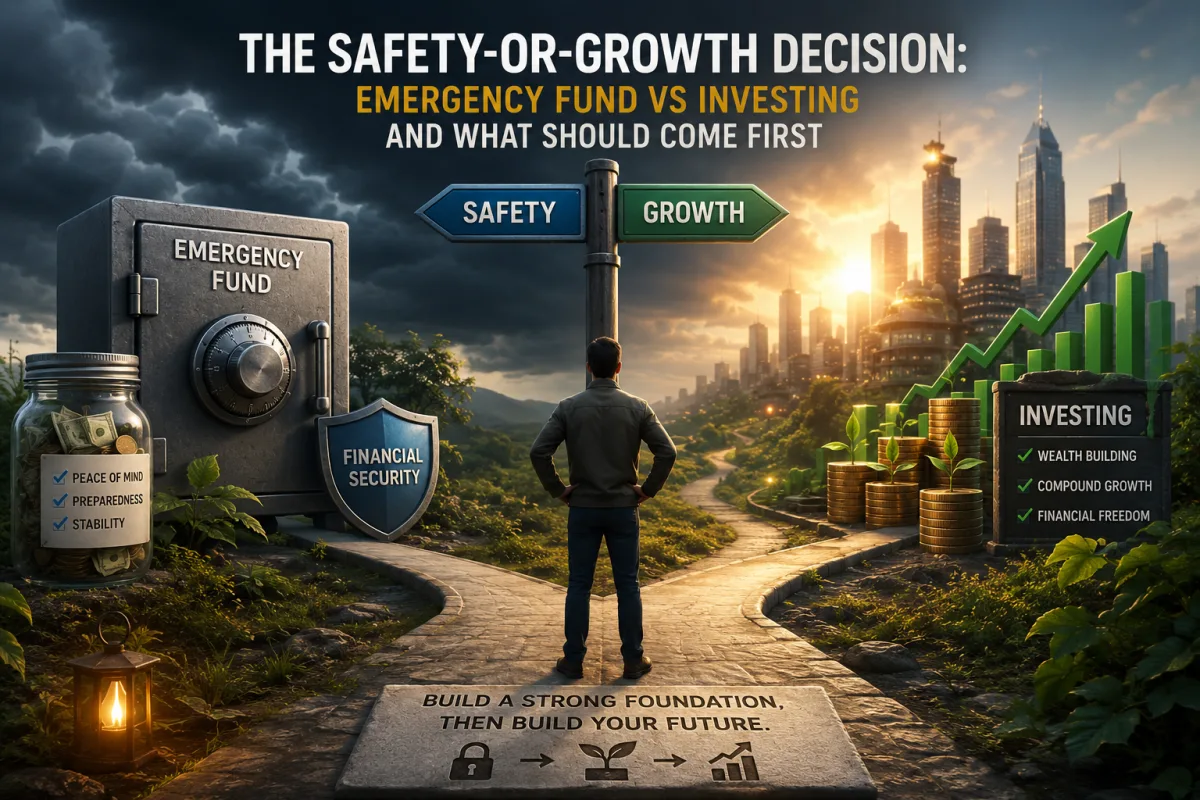
The Safety-or-Growth Decision: Emergency Fund vs Investing and What Should Come First
One of the most common personal finance questions is also one of the most misunderstood: should you build an emergency fund first, or should you start investing?
The question feels simple because it appears to offer only two choices. Cash or investments. Safety or growth. Protection or opportunity. But real financial life is rarely that neat. A person may have rent due next month, credit card debt, a stable salary, a retirement plan at work, children, medical expenses, a business idea, student loans, a market opportunity, and no savings. Another person may have a secure job, no debt, strong insurance, and money sitting idle for years because they are afraid to invest. The right answer depends on vulnerability, time horizon, debt, income stability, obligations, and behavior.
An emergency fund and an investment portfolio serve different purposes.
An emergency fund protects the present. Investing builds the future. Emergency savings help you survive shocks without borrowing or selling assets at the wrong time. Investments help your money grow, beat inflation, create income, and build long-term wealth. One is a shield. The other is an engine.
The mistake is treating them as enemies.
A person who invests aggressively with no cash reserves may build wealth on paper but remain fragile in real life. One medical bill, car repair, job loss, delayed payment, or family emergency can force them into debt or make them sell investments during a market decline. A person who keeps all money in cash for years may feel safe but lose purchasing power to inflation and miss the compounding power of investing. Too little cash creates crisis risk. Too much cash creates stagnation risk.
The goal is not to choose safety forever or growth forever. The goal is to build them in the right order and proportion.
For most people, the answer begins with a starter emergency fund. Then high-interest debt must be addressed. Then investing can begin in a measured way while emergency savings continue growing. Over time, the emergency fund becomes the foundation that allows investments to stay invested. The portfolio becomes the engine that allows wealth to grow beyond cash savings.
A strong financial life needs both liquidity and growth.
What an Emergency Fund Really Does
An emergency fund is cash set aside for unexpected, necessary expenses or temporary income disruption.
Its purpose is not to earn the highest return. Its purpose is to be available when life becomes expensive without warning. The emergency fund exists for situations such as job loss, delayed income, urgent medical costs, car repairs, home repairs, family emergencies, temporary business slowdown, insurance deductibles, or essential travel during a crisis.
An emergency fund is different from ordinary savings. Saving for a holiday is not an emergency fund. Saving for a phone upgrade is not an emergency fund. Saving for school fees, annual insurance, taxes, or planned repairs is important, but those are sinking funds for predictable expenses. An emergency fund is for events that are unexpected, urgent, and financially disruptive.
The emergency fund is also different from an investment account. It should not be exposed to serious market volatility. If emergency money is invested in stocks and the market falls just when money is needed, the person may be forced to sell at a loss. That defeats the purpose.
The emergency fund gives a person time and choice.
It gives time to find a new job instead of accepting the first desperate offer. It gives time to repair a car without using high-interest debt. It gives time to handle a family issue without destroying the budget. It gives time for investments to recover during market declines. It allows a person to make decisions from stability rather than panic.
Cash may look unproductive when compared with investment returns, but that view is incomplete. The emergency fund produces a return that is not always visible: it prevents expensive mistakes.
It prevents credit card debt. It prevents payday borrowing. It prevents selling investments at the wrong time. It prevents missed bills, late fees, and financial stress. It protects the rest of the wealth-building system.
What Investing Really Does
Investing is the process of using money to buy assets that can grow, produce income, or increase purchasing power over time.
Investments may include shares, index funds, mutual funds, exchange-traded funds, bonds, treasury instruments, retirement accounts, real estate, business ownership, real estate investment trusts, or other income-producing assets. Unlike emergency cash, investments are meant to work over longer periods. They may fluctuate in value, but they offer the possibility of growth beyond what cash can usually provide.
Investing matters because saving alone is often not enough to build wealth.
Cash is necessary for stability, but cash usually grows slowly. Inflation can reduce its purchasing power over time. If prices rise and money sits still, the bank balance may look safe while the real value declines. Investing is how surplus income is converted into ownership, compounding, dividends, interest, rental income, business equity, and long-term financial freedom.
The power of investing is time. The earlier money is invested, the longer it can compound. Compounding happens when returns begin earning returns of their own. At first, the effect may look small. Over years and decades, it can become significant.
This is why delaying investing forever can be costly.
A person who waits until every possible risk is eliminated may never begin. There will always be uncertainty: economic cycles, job changes, family needs, market volatility, inflation, elections, recessions, and personal emergencies. The purpose of an emergency fund is not to remove all uncertainty before investing. It is to create enough stability so investing can continue through uncertainty.
Investing builds the future, but it should not be used to solve every present problem. Money needed soon should not usually be invested aggressively. Money needed for long-term goals should not remain permanently idle.
Why This Decision Feels Difficult
The emergency fund versus investing decision feels difficult because both options are rational.
Building cash reserves feels responsible. It reduces anxiety and protects against shocks. But cash can feel slow, especially when investment markets are rising or when people talk about compounding. Investing feels productive. It creates the possibility of wealth. But investing without protection can create stress when life interrupts.
The emotional conflict is real.
A person with no savings may feel embarrassed about not investing. A person with investments but no cash may feel successful until an emergency arrives. A person in debt may want to invest because they fear missing out, even while interest drains their cash flow. A person with too much cash may feel safe but quietly fall behind long-term goals.
The decision becomes clearer when each dollar is matched to its job.
Money needed for emergencies should protect. Money needed for short-term goals should remain stable. Money needed for long-term goals should grow. Money used to pay high-interest debt should stop financial bleeding. Money used for investments should be money that can remain invested long enough to handle volatility.
Confusion happens when one pool of money is expected to do every job.
An investment account cannot safely be both a retirement fund and emergency cash if withdrawals may be needed at any moment. An emergency fund cannot also be the main wealth-building engine if it remains in cash forever. Each part of the financial system needs a defined role.
The First Priority: A Starter Emergency Fund
For most people, the first priority is a starter emergency fund.
This is not necessarily the full emergency fund. It is the first layer of protection. Its job is to stop small emergencies from becoming new debt while the person works on other priorities.
A starter emergency fund may be one month of essential expenses, or a smaller amount if income is very tight. The exact number depends on the person’s situation, but the principle is simple: before aggressively investing, create enough cash to absorb ordinary surprises.
Why not invest first?
Because life does not wait for markets to cooperate. If every spare dollar goes into investments and a necessary expense arrives, the person may have to borrow or sell investments. If markets are down, selling can lock in losses. If credit is used, interest can destroy progress.
A starter emergency fund creates a buffer. It does not need to solve every possible crisis. It simply creates enough space to avoid panic from common disruptions.
This step is especially important for people with unstable income, dependents, poor access to affordable credit, weak insurance, or high fixed expenses. The more fragile the household, the more urgent the starter fund becomes.
Once the starter fund exists, the person can move to the next decision: debt, full emergency savings, or investing.
High-Interest Debt Changes the Order
High-interest debt should not be ignored in the emergency fund versus investing discussion.
Debt with very high interest rates acts like a negative investment. While investments may or may not earn a certain return, high-interest debt definitely charges the borrower according to its terms. A credit card balance, payday loan, overdraft, or high-cost personal loan can compound against the borrower quickly.
For many people, the strongest early financial move is to build a starter emergency fund, then attack high-interest debt aggressively.
This does not mean stopping all investing in every situation. If an employer offers a retirement contribution match, it may be wise to contribute enough to capture that benefit while repaying debt, depending on the debt rate and cash flow. But generally, carrying expensive debt while investing heavily can weaken progress. The investment portfolio may grow, but interest charges may grow faster or create stress.
Debt repayment also improves cash flow. Once a debt is gone, the payment that used to go to lenders can be redirected toward emergency savings and investments. This creates momentum.
The mistake is investing because it feels sophisticated while ignoring debt that is quietly draining the household.
Before choosing investing over debt repayment, ask: what interest rate am I paying? Is the debt growing? Am I still adding new balances? Do I have a starter emergency fund? Could investment returns realistically exceed the debt cost after taxes and risk? What emotional pressure does this debt create?
High-interest debt often deserves priority because it is both mathematically expensive and psychologically heavy.
When a Full Emergency Fund Should Come Before Serious Investing
Some people should prioritize a fuller emergency fund before investing beyond basic retirement contributions.
This is usually true when financial vulnerability is high. A person with unstable employment, irregular business income, dependents, health concerns, limited family support, high fixed expenses, one household breadwinner, or weak insurance may need a larger cash cushion before taking significant investment risk.
A freelancer with variable income may need more emergency savings than a salaried employee with strong job security. A household with children may need more than a single person with low expenses. A business owner may need both personal and business reserves. A person supporting parents or relatives may need extra liquidity because emergencies may involve more than their own household.
A full emergency fund commonly ranges from three to six months of essential expenses. Some people need more. The right amount is not based on a universal rule. It is based on risk.
Essential expenses include housing, food, utilities, insurance, minimum debt payments, transport, medication, school costs, and unavoidable family responsibilities. The emergency fund does not need to cover luxury spending, restaurants, travel, or nonessential subscriptions. In an emergency, lifestyle can be reduced.
A larger emergency fund is not a sign of fear if it matches real vulnerability. It is a form of financial maturity.
Once the emergency fund is adequate, investing becomes easier because investments are less likely to be disturbed by short-term shocks.
When Investing Should Begin Before the Emergency Fund Is Fully Complete
There are situations where investing should begin before the emergency fund reaches its final target.
If a person waits until they have six months of expenses saved before investing anything, they may delay investing for years. That delay can reduce compounding time, especially for younger workers. A balanced approach may be better.
After building a starter emergency fund and controlling high-interest debt, many people can begin modest investing while continuing to grow emergency savings. This creates both safety and growth.
For example, someone may save part of their monthly surplus toward the emergency fund and invest part into a retirement account or diversified portfolio. The ratio can change as the emergency fund grows. Early on, perhaps most surplus goes to cash reserves. Later, more goes to investments.
This approach recognizes two truths at once: emergencies happen, and time in the market matters.
Investing can also begin earlier when income is stable, expenses are low, debt is manageable, insurance is strong, and the person has access to support if needed. A young professional with a secure job and low obligations may not need to wait for a very large cash reserve before investing. A business owner with volatile income may need to be more cautious.
The question is not whether investing is good. The question is whether your financial foundation is strong enough for the money invested to remain invested.
The Employer Match Exception
One important exception is an employer retirement match.
If an employer offers to contribute money when the employee contributes to a retirement plan, that match can be extremely valuable. Failing to contribute enough to receive the match may mean leaving compensation unused.
For many people, it makes sense to contribute enough to receive the full employer match even while building an emergency fund or repaying moderate debt. This depends on cash flow and debt severity. If someone is in immediate crisis, unable to pay rent, or relying on expensive debt for basics, stabilization may come first. But once basic cash flow is under control, capturing employer match can be a priority.
The employer match is not free in the casual sense; it usually comes with plan rules, vesting rules, investment choices, and withdrawal restrictions. But it is still often one of the most attractive wealth-building opportunities available to employees.
This is a reminder that financial priorities are not always perfectly sequential. Some decisions can overlap.
How Much Should Be in an Emergency Fund?
The right emergency fund size depends on essential expenses and risk level.
A common target is three to six months of essential expenses. But the number should be personalized.
A person may need a smaller fund if they have stable employment, low fixed expenses, strong insurance, no dependents, dual household income, and easy ability to reduce spending. A person may need a larger fund if they have irregular income, dependents, health risks, business ownership, one income source, high fixed expenses, or uncertain employment.
Calculate essential monthly expenses first. Include rent or mortgage, basic food, utilities, transport, insurance, medication, minimum debt payments, school fees, and unavoidable family responsibilities. Exclude luxuries that could be paused during a crisis.
Then multiply that monthly number by the number of months of protection needed.
If essential expenses are $2,000 per month, three months requires $6,000. Six months requires $12,000. If essential expenses are $800 per month, the targets are $2,400 and $4,800. The actual number should reflect the household’s reality, not someone else’s rule.
The emergency fund should also be reviewed over time. If rent rises, children are born, income becomes variable, debt increases, or health circumstances change, the fund may need to grow. If debt falls, insurance improves, and income stabilizes, the required cushion may be lower.
Where Should Emergency Money Be Kept?
Emergency money should be kept somewhere safe, liquid, and separate.
Safe means the money should not be exposed to large market losses. Liquid means it can be accessed quickly when needed. Separate means it should not be mixed with daily spending where it can disappear accidentally.
Suitable places may include a savings account, high-yield savings account, money market account, money market fund, short-term deposit with reasonable access, or other low-risk cash equivalent available in the person’s country. The exact choice depends on fees, withdrawal terms, deposit protection, regulation, and convenience.
The emergency fund should not usually be invested in stocks, long-term bonds, speculative assets, private deals, real estate, business inventory, or anything that may take time to sell. These assets may be useful for wealth building, but they are not ideal for emergency liquidity.
Some people split emergency savings into layers. A small amount sits in an immediately accessible account. The rest sits in a higher-yield but still liquid cash product. This can improve returns while preserving access.
The emergency fund should be boring. That is part of its job.
What Counts as an Emergency?
A strong emergency fund needs clear rules.
Without rules, emergency savings can become a lifestyle fund. A holiday, phone upgrade, sale, birthday celebration, or nonessential purchase may begin to feel like an emergency. The fund shrinks, and when a real crisis arrives, the money is gone.
A true emergency is unexpected, necessary, and urgent.
Unexpected means it was not reasonably planned. Necessary means it protects health, income, safety, housing, family obligation, or basic functioning. Urgent means delaying would create serious consequences.
A medical emergency can qualify. A job loss can qualify. A car repair can qualify if the car is necessary for work. A home repair can qualify if it affects safety or habitability. A family crisis may qualify. A planned annual insurance premium does not qualify because it should be handled through a sinking fund. A holiday does not qualify. A discounted luxury item does not qualify.
After using emergency savings, the next priority should be rebuilding the fund. The emergency fund is not a one-time achievement. It is a permanent part of financial stability.
The Cost of Overbuilding an Emergency Fund
While emergency savings are essential, too much cash can slow wealth creation.
Some people keep years of expenses in cash because investing feels risky. They may feel safe, but the safety is incomplete. Inflation can reduce purchasing power. Long-term goals may fall behind. Retirement may become underfunded. The money may not be working hard enough for goals that are decades away.
Cash protects against short-term risk. It does not solve long-term growth risk.
Overbuilding an emergency fund can happen when fear becomes the plan. A person may continue saving cash long after reaching a reasonable reserve because investing feels uncertain. But uncertainty is part of wealth building. The answer is not to avoid investing forever. The answer is to invest according to risk tolerance, diversification, and time horizon.
Once the emergency fund is adequate, additional surplus should usually be directed toward higher-value goals: investing, debt reduction, retirement, business capital, education, property, or other wealth-building assets.
An emergency fund should be large enough to protect you, not so large that it prevents growth.
The Cost of Investing Too Early
Investing too early can also be expensive.
This happens when a person puts money into long-term assets before they have cash for short-term shocks. The investment may be good, but the timing may be wrong. If an emergency arrives, the person may withdraw at a loss, pay penalties, trigger taxes, or borrow at high interest.
The danger is not only financial. It is emotional. Someone who invests without a safety buffer may panic during market declines because they know they might need the money soon. They may sell at the worst time. They may conclude investing is unsafe, when the real problem was using investment accounts for emergency money.
Investing requires the ability to leave money alone.
If a person cannot handle a common emergency without touching investments, they may not yet have enough liquidity. A starter fund or fuller emergency fund can make them a better investor by reducing the pressure to react.
Investing too early is often not a mistake of ambition. It is a mistake of sequence.
The Best Sequence for Most People
Although every household is different, many people benefit from a practical sequence.
First, create cash-flow visibility. Know income, expenses, debts, and obligations. Without visibility, priorities cannot be set properly.
Second, build a starter emergency fund. This prevents small shocks from becoming new debt.
Third, contribute enough to capture any valuable employer retirement match if cash flow allows.
Fourth, attack high-interest debt. This stops expensive compounding from working against you.
Fifth, continue building the emergency fund toward an appropriate target based on risk.
Sixth, begin or increase investing for long-term goals. Use diversified investments aligned with time horizon and risk tolerance.
Seventh, balance ongoing investing with other goals such as insurance, sinking funds, retirement, education, property, and business capital.
This sequence is flexible. A person with no debt may move faster into investing. A person with unstable income may build more cash first. A person with employer match may invest early. A business owner may need larger reserves. The principle is to build enough safety to protect growth, then build enough growth to avoid stagnation.
How to Balance Both at the Same Time
Many people do not need to choose 100 percent emergency fund or 100 percent investing.
After a starter emergency fund is in place and high-interest debt is under control, splitting surplus can be effective. For example, a person may direct 70 percent of surplus to emergency savings and 30 percent to investing until the emergency fund reaches one month of expenses. Then they may shift to 50 percent cash and 50 percent investing. Once the emergency fund is complete, most surplus may go to investing.
The exact percentages are not universal. They should reflect risk.
If income is unstable, put more toward cash. If income is stable and the emergency fund is already decent, invest more. If debt is expensive, debt repayment may take a larger share. If retirement is badly underfunded, investing may need to begin sooner.
Balancing both can reduce regret. The person sees cash reserves growing while also starting the compounding process. This can be psychologically helpful, especially for beginners.
The key is automation. Set automatic transfers to emergency savings and investment accounts. Money that waits for manual action is more likely to be spent.
Emergency Fund First for Unstable Income
People with unstable income usually need stronger emergency savings.
Freelancers, entrepreneurs, commission-based workers, contract workers, seasonal employees, gig workers, and small business owners often face irregular cash flow. A strong month may be followed by a weak one. Clients may delay payment. Projects may pause. Business expenses may arrive before revenue.
For these people, the emergency fund is not only for rare emergencies. It is also a cash-flow stabilizer.
A variable-income earner may need separate reserves: a personal emergency fund, a business emergency fund, a tax reserve, and sinking funds for known expenses. Mixing all these together can create confusion.
Investing still matters, but liquidity must be stronger because income volatility creates repeated pressure. Without cash reserves, the person may be forced to borrow during weak months and then repay during strong months, creating a cycle that prevents wealth building.
For unstable income, cash is not laziness. It is survival infrastructure.
Investing Earlier for Stable Income
People with stable income may be able to invest earlier while building emergency savings gradually.
A person with a secure salary, low fixed expenses, no dependents, strong insurance, and little debt may not need to wait for a large emergency fund before investing. A starter fund plus a steady savings plan may provide enough protection while compounding begins.
This is especially true for young workers with long time horizons. Waiting years to invest can reduce future growth. Small early contributions can matter because they have decades to compound.
However, stable income should not create overconfidence. Jobs can still be lost. Health can change. Family obligations can appear. A starter emergency fund remains important. The difference is that the person may not need to delay all investing until the fund is fully complete.
Stability allows more balance. It does not eliminate the need for protection.
What If You Have Low Income?
Low income makes the decision harder because there may not be enough surplus to fund everything.
In this case, the first priority is usually cash-flow control and income growth. A person cannot build a strong emergency fund or investment portfolio without margin. The plan may need to include reducing expenses where possible, negotiating bills, increasing hours, changing jobs, building skills, freelancing, or creating a side income.
Even with low income, a starter emergency fund matters. It may grow slowly, but even a small cushion can prevent borrowing. Investing may begin with very small amounts once basic stability is in place, but the main focus should be increasing surplus.
The mistake is assuming small amounts do not matter. Small amounts build habits. But the other mistake is pretending that budgeting alone can solve a serious income problem. Sometimes the wealth plan must be an earning plan.
Low income requires patience, creativity, and focus. Build the first cushion, stop destructive debt, increase earning power, then grow savings and investments as margin improves.
What If You Are Older and Behind on Retirement?
For someone older and behind on retirement, the emergency fund versus investing decision becomes more urgent.
There may be fewer years for compounding, so investing matters. But emergencies still matter, especially because health risks and job disruption can become more serious later in life. The person cannot ignore safety, but they may not be able to spend years building cash before investing.
A balanced approach is often necessary. Build a reasonable cash reserve, eliminate destructive debt, and increase retirement investing aggressively where possible. This may require higher savings rates, working longer, downsizing, increasing income, delaying retirement, reducing lifestyle costs, or using catch-up contributions where available.
The emergency fund should be sufficient to prevent forced withdrawals from retirement investments during market downturns. At the same time, excess cash beyond a reasonable reserve may need to be invested to support future income.
Being behind does not mean giving up. It means the plan must become more intentional.
What If You Already Have Investments but No Emergency Fund?
Some people invest before building cash reserves. This is not always disastrous, but it creates vulnerability.
If you already have investments but no emergency fund, do not necessarily sell investments immediately unless risk is urgent. Instead, redirect new surplus toward emergency savings until a starter fund exists. Pause nonessential investing if needed. Build cash quickly enough to reduce the chance of forced selling.
If investments are in taxable accounts and easily accessible, they may feel like an emergency fund. But relying on them can be risky because market value may fall when money is needed. Retirement accounts may have penalties, taxes, or restrictions, making them poor emergency tools.
The goal is to separate roles. Investments should remain invested for long-term goals. Emergency savings should handle short-term shocks.
Once the emergency fund is built, investment contributions can resume or increase.
What If You Have a Large Emergency Fund but No Investments?
Some people have the opposite problem: they keep a large amount in cash but have little or nothing invested.
This may feel safe, especially for people who have experienced financial instability. But too much cash can delay wealth. Inflation can reduce purchasing power. Retirement can become underfunded. Long-term goals may remain out of reach.
If the emergency fund is larger than necessary, divide cash by purpose. Keep enough for emergencies. Set aside sinking funds for known expenses. Keep short-term goal money safe. Then consider investing long-term surplus according to risk tolerance and goals.
Beginning investors do not need to move all excess cash into markets at once. They can invest gradually. This may reduce anxiety and create discipline.
The goal is not to abandon safety. It is to stop using safety as an excuse to avoid growth.
The Role of Insurance
Insurance affects how much emergency savings is needed.
A household with strong health insurance, disability coverage, life insurance, property insurance, and income protection may need less cash for catastrophic events than a household with no protection. Insurance does not replace an emergency fund, but it reduces the size of some risks.
Without insurance, the emergency fund may need to be much larger, yet even a large emergency fund may not cover catastrophic events. A major illness, disability, death of a breadwinner, house fire, or serious liability claim can exceed ordinary savings.
Good financial planning combines emergency savings with insurance. Cash handles smaller and immediate shocks. Insurance handles large risks that could destroy the financial plan.
Before investing heavily, review whether the major risks in your life are covered appropriately. This is especially important for people with dependents, debt, business ownership, property, or health concerns.
The Role of Sinking Funds
Sinking funds prevent predictable expenses from invading the emergency fund.
Many people use emergency savings for expenses that were not really emergencies: annual insurance, school fees, car service, holiday travel, property maintenance, professional licenses, or family events. The emergency fund then disappears, even though the expenses could have been planned.
A sinking fund is a separate savings pool for a known future expense. If a cost is expected, save for it gradually. This keeps the emergency fund intact for true surprises.
Sinking funds also make investing easier. If short-term obligations are funded separately, long-term investments are less likely to be interrupted.
A complete cash system includes daily spending money, sinking funds, emergency savings, and investments. Each has a role.
Emergency Fund vs Investing Is Really Liquidity vs Growth
The deeper issue is liquidity versus growth.
Liquidity means money can be accessed quickly without major loss. Growth means money has the potential to increase over time. Cash provides liquidity but limited growth. Investments provide growth but may lack stability in the short term.
A strong financial plan needs both. Too much liquidity and not enough growth can leave a person safe today but underprepared tomorrow. Too much growth and not enough liquidity can leave a person wealthy on paper but fragile in crisis.
The right balance changes over time.
A young person with stable income and low obligations may lean more toward growth after basic cash reserves. A family with dependents may need more liquidity. A retiree may need both cash for near-term spending and investments for long-term inflation protection. A business owner may need significant liquidity because income and expenses fluctuate.
Understanding the trade-off helps remove guilt. Cash is not bad. Investing is not reckless. Each is useful when matched to the right purpose.
How Inflation Affects the Decision
Inflation makes investing necessary for long-term goals.
When prices rise, cash loses purchasing power. An emergency fund is still necessary because stability matters, but keeping too much long-term money in cash can be costly. Over many years, the same amount of money may buy less housing, food, healthcare, education, and transport.
Investments are not guaranteed to beat inflation every year, but growth assets have historically been used to protect and increase purchasing power over longer periods. This is why retirement money, education money with long time horizons, and financial freedom money usually need investment exposure.
Inflation does not mean emergency funds are useless. It means emergency funds should be right-sized. Keep enough cash for protection, then invest long-term surplus for growth.
The purpose of cash is short-term resilience. The purpose of investing is long-term purchasing power.
How Market Volatility Affects the Decision
Market volatility is the reason emergency funds matter.
Investments can fall in value. Stocks can decline sharply. Bonds can fluctuate. Real estate can become illiquid. Business investments can slow. If a person needs money during a downturn, they may be forced to sell at unfavorable prices.
An emergency fund reduces this risk by covering short-term needs while investments recover. This is especially important for retirement investors, business owners, and anyone with long-term portfolios.
Volatility should not scare people away from investing entirely. It should teach them to separate short-term cash from long-term assets.
A good investor does not avoid all volatility. A good investor avoids being forced to sell because of poor liquidity planning.
A Simple Decision Framework
To decide whether to prioritize emergency savings or investing, ask several questions.
Do I have at least a starter emergency fund? If not, build one first.
Am I relying on credit cards or high-interest loans for ordinary expenses? If yes, stabilize cash flow and stop new debt.
Do I have high-interest debt? If yes, prioritize repayment after a starter emergency fund, while considering employer match if available.
Is my income stable? If not, build a larger cash reserve.
Do people depend on my income? If yes, emergency savings and insurance become more important.
Do I have money sitting in cash for goals more than five or ten years away? If yes, consider investing part of it.
Am I delaying investing because of fear even though I already have sufficient reserves? If yes, begin with a simple, diversified investment plan.
Will I need this money soon? If yes, keep it safe. If no, growth may matter more.
This framework turns the question from emotional debate into financial diagnosis.
Common Mistakes
The first mistake is investing every spare dollar without cash reserves. This creates forced-selling risk.
The second mistake is keeping all money in cash for years because investing feels uncomfortable. This creates inflation and retirement risk.
The third mistake is using emergency funds for predictable expenses. Sinking funds should handle known costs.
The fourth mistake is building a large emergency fund while carrying expensive debt. High-interest debt may be draining more than cash is earning.
The fifth mistake is ignoring employer retirement matches. Some opportunities should be captured early if cash flow allows.
The sixth mistake is investing short-term money aggressively. Money needed soon should be protected.
The seventh mistake is treating credit cards as emergency funds. Borrowed money is not the same as saved money.
The eighth mistake is never rebuilding the emergency fund after using it.
The ninth mistake is failing to adjust emergency savings as life changes.
The tenth mistake is copying someone else’s number without considering personal risk.
Final Thoughts
The emergency fund versus investing decision is not really a fight between two good choices. It is a question of sequence and balance.
An emergency fund protects the present. Investing builds the future. Cash gives stability. Investments create growth. Emergency savings prevent debt and forced selling. Investing helps money compound and protect long-term purchasing power. A person who wants financial strength needs both.
For most people, the practical order is clear. Build a starter emergency fund first. Stop relying on expensive debt. Capture valuable employer retirement matches where appropriate. Pay down high-interest debt. Grow emergency savings to a level that matches your risk. Begin investing as soon as the foundation is strong enough for the money to stay invested. Then continue building both liquidity and long-term assets as life evolves.
The exact balance depends on your income stability, dependents, debt, insurance, expenses, job security, age, and goals. A freelancer may need more cash. A young employee with stable income may invest earlier. A parent with one household income may need a larger reserve. A person behind on retirement may need to invest aggressively while still protecting against shocks.
The best financial plan does not worship cash or chase returns blindly. It gives every dollar a job.
Emergency money should be safe and accessible. Long-term money should be invested for growth. Predictable expenses should have sinking funds. High-interest debt should be attacked. Insurance should protect against major risks. Investments should be diversified and aligned with time horizon.
Safety without growth can leave you stuck. Growth without safety can leave you exposed. Wealth is built when protection and compounding work together.
The emergency fund is the foundation. Investing is the engine. Build the foundation strong enough to support the engine, then let the engine run long enough to change your financial life.
 Article
 Article
 Article
 Article
 Article
 Article
 Article
 Article