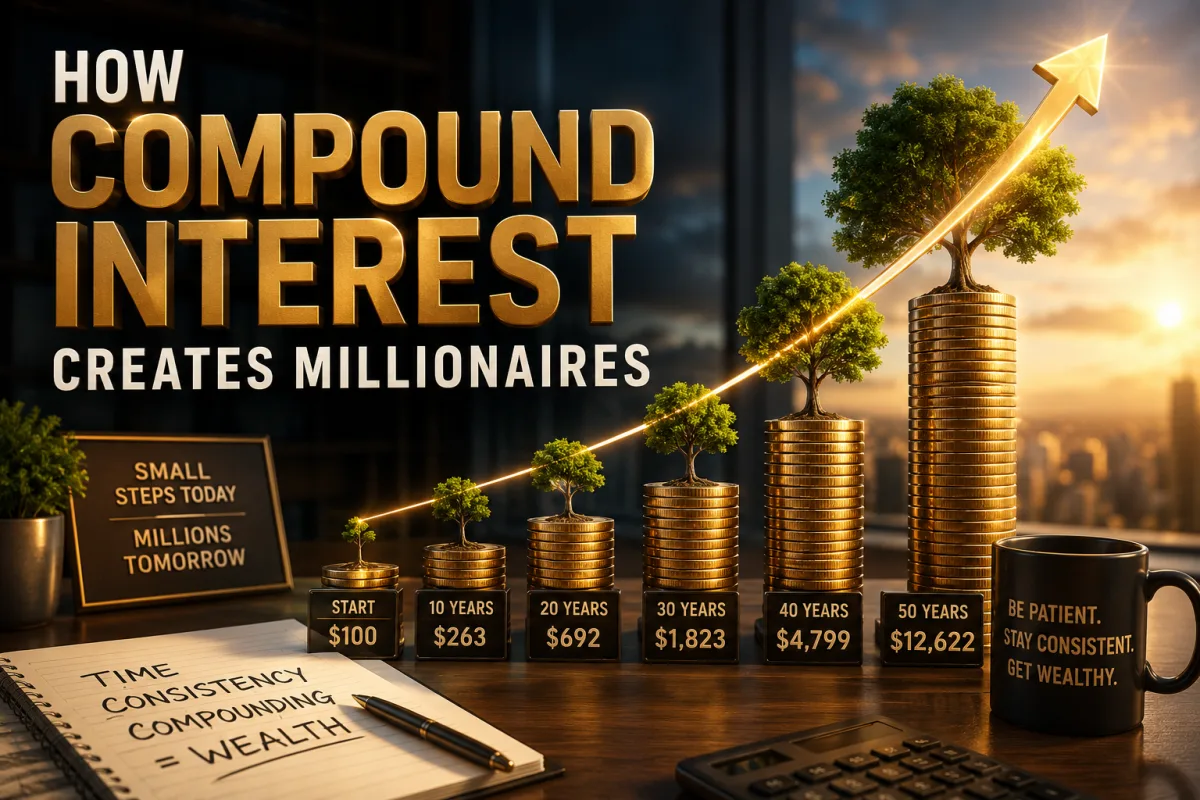
The Quiet Multiplier: How Compound Interest Turns Time Into Millionaire Wealth
Most millionaires are not created in a single dramatic moment.
They are not all lottery winners, celebrities, founders, heirs, athletes, or investors who discovered one perfect stock before everyone else. Some people do become wealthy through sudden events, but many become millionaires through a quieter force: money earning returns, those returns earning more returns, and time allowing the process to repeat.
This is compound interest.
Compound interest is often described as earning interest on interest. That definition is accurate, but too small. Compounding is the process by which money begins to grow from its own growth. A dollar invested earns a return. That return is added to the base. The larger base earns a larger return. Over time, the growth becomes less dependent on the original contribution and more dependent on the accumulated engine that has been built.
At first, compounding looks unimpressive. A small investment produces a small return. A dividend payment may seem too tiny to matter. A retirement contribution may feel like a drop in the ocean. A monthly investment may not change life immediately. This is why many people underestimate compounding. They judge it too early.
Compounding is not designed to impress in the first month. It is designed to overwhelm over decades.
The first years of wealth building are often powered mainly by personal contributions. You save. You invest. You repeat. The portfolio grows because you keep adding money. Later, something changes. The portfolio itself begins contributing more to growth. Investment returns become larger than annual contributions. Dividends become meaningful. Market gains move the account by amounts that once took years to save. The money begins to work with visible force.
This is the moment many people mistake for luck. It is usually the result of delayed compounding.
Compound interest creates millionaires because it rewards four behaviors that are available to ordinary people: starting, contributing, reinvesting, and waiting. It does not require perfection. It does not require predicting every market cycle. It does not require winning every year. It requires building an asset base and giving that base enough time to multiply.
But compounding is not magic. It can work for you or against you. Investments compound wealth. High-interest debt compounds obligations. Low fees help compounding. High fees slow it. Reinvestment accelerates compounding. Constant withdrawals interrupt it. Patience strengthens it. Panic selling destroys it. The same force that can create millionaires can also trap borrowers if used in reverse.
Understanding compound interest is therefore not merely a mathematical lesson. It is a wealth-building philosophy.
What Compound Interest Really Means
Compound interest means returns are calculated on both the original money and the returns that have already been earned.
Imagine investing $10,000 at an annual return of 8 percent. In the first year, the investment earns $800. If that $800 remains invested, the second year’s return is calculated on $10,800, not only on the original $10,000. At 8 percent, the second year earns $864. The difference may seem small, but the process continues. Each year, the base becomes larger. Each year, the return is earned on a bigger amount.
Simple interest works differently. With simple interest, the return is based only on the original principal. If $10,000 earns simple interest of 8 percent, it earns $800 each year. With compounding, the annual return can grow because the previous returns remain in the account and begin earning returns of their own.
The difference becomes dramatic over time.
Compounding is why long-term investing can build wealth far beyond the original money contributed. It is why reinvested dividends matter. It is why retirement accounts can grow slowly for years and then accelerate. It is why patience is financially valuable. It is why withdrawing too early can be costly.
The key is that compounding needs a growing base. The base can grow through contributions, reinvested returns, dividends, interest, capital gains, rental surplus, business profits, or any income that is kept and reinvested instead of consumed.
Compounding is not limited to bank interest. The phrase “compound interest” is often used broadly to describe compounded investment returns. Stocks, funds, bonds, real estate, businesses, and reinvested income can all compound when returns are retained and used to generate more returns.
The principle is universal: growth begins to produce more growth.
Why Compounding Feels Slow at First
Many people quit compounding before it becomes powerful because the early stage feels too slow.
If someone invests $100 and earns 8 percent, the first year produces only $8. That does not feel life-changing. If they invest $1,000 and earn 8 percent, the first year produces $80. Helpful, but still modest. Even $10,000 earning 8 percent produces $800 in the first year. This is meaningful, but not millionaire-level wealth.
Early compounding disappoints people who expect quick transformation.
The problem is not that compounding is weak. The problem is that the base is still small. Eight percent of a small number is a small number. But eight percent of a large number is powerful. The same return rate that produces $80 on $1,000 produces $8,000 on $100,000 and $80,000 on $1,000,000.
This is why the first stage of compounding depends heavily on saving and investing consistently. At the beginning, contributions do most of the work. The investor must build the base before the base can carry more of the load.
This stage requires faith in arithmetic. The investor may not see dramatic results, but the habit is building the machine. Each contribution increases the amount that can compound. Each reinvested dividend adds to the base. Each year of patience gives the base more time.
Compounding is like planting a tree. In the early years, the growth seems modest. Then the root system strengthens. The trunk thickens. Branches spread. Eventually, the tree produces shade far larger than the original seed suggested.
The Millionaire Equation
Compound interest creates millionaires through a combination of five variables: starting amount, contribution amount, rate of return, time, and behavior.
The starting amount matters because more money invested early has more time to grow. But it is not the only factor. Many millionaires begin with small amounts and build through steady contributions.
The contribution amount matters because it adds fuel. A person investing $100 per month and a person investing $1,000 per month will not usually reach the same result at the same time, assuming similar returns. Higher contributions accelerate the journey.
The rate of return matters because it determines how quickly money grows. A portfolio earning 4 percent grows much more slowly than one earning 8 percent. But higher return usually requires higher risk, so return should be pursued intelligently.
Time matters because compounding needs repeated cycles. The more years money remains invested, the more chances it has to grow on previous growth.
Behavior matters because investors can interrupt compounding. Panic selling, frequent withdrawals, high fees, speculation, debt misuse, lifestyle inflation, and impatience can weaken the process.
The millionaire outcome usually appears when these variables work together. A person starts as early as possible, invests consistently, earns reasonable long-term returns, reinvests gains, avoids destructive behavior, and waits long enough.
There is no mystery in the equation. The difficulty is living it.
Time Is the Most Powerful Ingredient
Time is the one variable that cannot be recovered once lost.
An investor who starts early gives every dollar more years to compound. This can be more powerful than starting later with larger contributions. A young investor may not have much money, but they have time. That time is a financial asset.
Consider two investors. One begins investing at 25 and invests consistently for 40 years. Another begins at 40 and invests for 25 years. The second investor may earn more and contribute more, but the first investor has a 15-year head start. Those early contributions can double multiple times before the second investor even begins.
The advantage of starting early is not only that more money is invested. It is that early money gets more doubling cycles.
This is why procrastination is expensive. Waiting five years may not feel serious, especially when retirement or millionaire status seems distant. But those five years are not just five years of missed contributions. They are five years of missed compounding on those contributions for the rest of the investor’s life.
Starting early does not mean starting perfectly. A small amount invested consistently is better than waiting for a perfect amount later. The first contribution begins the clock.
Time turns modest returns into meaningful wealth. Without time, investors are forced to rely more heavily on high contributions or high returns. High contributions may be difficult. High returns may require risky choices. Starting early reduces pressure.
The Rule of 72 and Millionaire Thinking
The Rule of 72 is a useful shortcut for understanding compounding.
Divide 72 by the annual rate of return, and the result is the approximate number of years it takes money to double. At 6 percent, money doubles in about 12 years. At 8 percent, it doubles in about 9 years. At 10 percent, it doubles in about 7.2 years. At 12 percent, it doubles in about 6 years.
This rule helps investors think in doubling periods rather than single years.
If $10,000 doubles at 8 percent every 9 years, it becomes about $20,000 after 9 years, $40,000 after 18 years, $80,000 after 27 years, and $160,000 after 36 years, before fees and taxes. The annual return is the same, but the dollar growth becomes larger after each doubling.
This is how compounding creates surprise. The first doubling adds $10,000. The fourth doubling adds $80,000. Later doublings do more visible work because the base is larger.
The Rule of 72 also teaches caution. If someone promises to double money in 2 years, the implied annual return is about 36 percent. If someone promises to double money in 1 year, the implied annual return is about 72 percent. Such returns may happen in rare businesses or speculative situations, but they are not normal low-risk returns.
Millionaire thinking respects compounding without becoming seduced by impossible promises.
Why Regular Contributions Matter
Most people do not become millionaires by investing one large lump sum and waiting.
They become millionaires by investing repeatedly. Monthly contributions, payroll deductions, retirement account deposits, dividend reinvestment, business profit reinvestment, and annual increases all build the compounding base.
Regular contributions matter because they create momentum even when investment returns are unpredictable. Markets rise and fall. Interest rates change. Economic conditions shift. But the investor who contributes consistently continues building ownership through cycles.
Contributions also reduce dependence on perfect timing. Instead of trying to guess the best day to invest, the investor puts money to work regularly. This can help manage emotion. Some contributions will be made when prices are high. Others will be made when prices are low. Over time, consistency can be more reliable than prediction.
The contribution habit is especially important in the early years, when investment returns are still small relative to the portfolio. A person with a $5,000 portfolio who contributes $500 per month is adding significantly to the base. A person with a $500,000 portfolio may see market movements larger than monthly contributions. The journey changes over time.
The early investor’s job is to build the base. The later investor’s job is to protect and grow it.
Reinvestment Is the Accelerator
Compounding becomes much stronger when returns are reinvested.
Dividends can be spent or reinvested. Interest can be withdrawn or reinvested. Rental surplus can fund consumption or buy more assets. Business profits can be distributed or reinvested. The decision affects long-term growth.
Reinvestment means income from assets is used to buy more assets. More assets then produce more income or growth. This creates a feedback loop.
For example, a dividend-paying investment may distribute cash. If the investor spends the dividend, the portfolio may still grow through price appreciation, but the dividend no longer adds to the asset base. If the dividend is reinvested, it buys more shares or units. Those additional shares can generate future dividends and appreciation. Over decades, reinvestment can make a large difference.
The same principle applies to business. A profitable business owner who reinvests in systems, staff, equipment, marketing, product development, or new assets may increase future profits. A landlord who reinvests rental surplus into maintenance, reserves, and additional property may strengthen long-term wealth. An investor who reinvests interest grows capital faster.
Reinvestment requires delayed gratification. Spending investment income feels rewarding. Reinvesting it often feels invisible at first. But reinvestment is how income becomes wealth rather than only lifestyle.
Compound Interest Versus Simple Saving
Saving money is essential, but saving alone may not create millionaire wealth for most people.
If a person saves $500 per month in cash for 40 years, they will save $240,000 before interest. That is a meaningful achievement, but it is far from $1 million. If that money is invested and earns a long-term return, compounding can increase the final amount substantially.
This does not mean cash is useless. Cash is necessary for emergencies, short-term goals, and stability. But long-term wealth usually requires growth. Investments provide the possibility of growth because they connect money to businesses, lending, property, or other productive assets.
The distinction is important. Saving is the habit of keeping money. Investing is the process of giving kept money a chance to grow. Compounding is what happens when growth remains in the system long enough to produce more growth.
A person who saves but never invests may be financially disciplined but underpowered for long-term goals. A person who invests without saving habits may struggle to maintain contributions. Wealth requires both: the discipline to save and the courage to invest wisely.
How Ordinary Income Becomes Millionaire Wealth
Compound interest is powerful because it does not require extraordinary income if time and discipline are strong enough.
A person earning ordinary income can become wealthy by consistently converting part of that income into assets. This is not always easy. It may require living below means, avoiding lifestyle inflation, increasing income, managing debt, and resisting social pressure. But the mechanism is available.
The monthly investor has a different mindset from the monthly spender. The spender asks, “What can this income buy me now?” The investor asks, “What can this income build for me later?”
Every paycheck becomes a chance to buy freedom. A portion pays current life. A portion protects against emergencies. A portion pays down debt. A portion buys assets. Over years, the asset portion grows. Over decades, the asset portion can become large enough to change the person’s options.
This is how ordinary income becomes extraordinary wealth. Not by one heroic decision, but by repeated conversion.
Income is the raw material. Surplus is the seed. Investing is the planting. Compounding is the growth. Time is the weather. Behavior is the farmer.
The Role of the Savings Rate
The savings rate is the percentage of income saved and invested.
It is one of the most important variables in becoming a millionaire because it determines how much fuel enters the compounding engine. A person saving 5 percent of income will usually build wealth more slowly than someone saving 20 percent or 30 percent, assuming similar income and returns.
A high savings rate does two things. It increases contributions and often reduces the lifestyle needed to feel comfortable. Lower spending means more money is available to invest. It also means less wealth may be required for financial independence later.
The savings rate can improve through two paths: spending control and income growth.
Spending control creates immediate margin. Reducing waste, avoiding excessive housing costs, managing transport expenses, limiting debt, and controlling lifestyle inflation can free money. Income growth expands capacity. Promotions, negotiation, business income, freelancing, consulting, and skill development can increase the amount available to invest.
The most powerful combination is rising income with controlled expenses. When income grows and lifestyle does not absorb all of it, the savings rate can rise quickly. That rising savings rate accelerates compounding.
Millionaires are often built in the gap between what they earn and what they choose not to spend.
Lifestyle Inflation: The Enemy of Compounding
Lifestyle inflation occurs when spending rises every time income rises.
It is one of the most common reasons people fail to build wealth despite earning more over time. A raise becomes a larger apartment. A bonus becomes a holiday. A promotion becomes a car loan. A profitable business year becomes personal luxury. The person earns more, but the compounding engine receives little additional fuel.
Lifestyle inflation is dangerous because it feels deserved. People work hard and want to enjoy progress. Enjoyment is not the problem. The problem is allowing every increase in income to become a permanent increase in spending.
Every lifestyle upgrade has two costs. The first is the immediate price. The second is the lost compounding on the money that could have been invested. A recurring expense is especially costly because it reduces future surplus every month.
Wealth builders capture part of every income increase. If income rises, investment contributions rise. If debt is paid off, former payments are redirected to assets. If a bonus arrives, a portion is invested before lifestyle spending begins.
This does not require living miserably. It requires sequencing. Build assets first. Let lifestyle expand from strength, not from impulse.
Fees Can Steal Compounding Quietly
Fees may look small, but they can have a large effect over decades.
Investment management fees, fund expense ratios, advisory charges, platform fees, transaction costs, account fees, commissions, and hidden product costs reduce the return that remains invested. Since compounding depends on returns staying in the system, every unnecessary cost weakens the engine.
A difference of 1 percent per year may not feel dramatic in one year. Over 30 or 40 years, it can represent a large amount of wealth. This is because the money lost to fees is not only gone once; it also loses all future compounding.
This does not mean all fees are bad. Good advice, proper planning, tax strategy, risk management, and professional service can be worth paying for. The issue is value. Every fee should be understood and justified.
Investors should know what they pay, why they pay it, and whether lower-cost alternatives can deliver similar results. In many cases, broad diversified low-cost funds can help investors keep more of the market return. In other situations, professional advice may prevent costly mistakes.
The principle is simple: compounding rewards money that stays invested. Fees remove money from the compounding base.
Taxes Affect the Real Compounding Rate
Taxes also affect compounding because they reduce the return investors keep.
Interest, dividends, capital gains, rental income, business profits, and withdrawals may all be taxed depending on jurisdiction and account structure. An investment earning 8 percent before tax may compound at a lower rate after tax. The difference can be meaningful over decades.
Tax planning is not about illegal avoidance. It is about using the rules properly. Retirement accounts, tax-advantaged accounts, long-term capital gains treatment, pension structures, business structures, and careful withdrawal planning can all affect how much money remains invested.
The timing of taxes matters too. If taxes are deferred, more money may remain invested for longer. If taxes are paid annually on income that could have been reinvested, compounding may slow. The best structure depends on the country, investor profile, income type, and goals.
A serious wealth builder thinks in after-tax returns. The return that matters is not the headline return. It is the return kept after fees, taxes, and inflation.
Inflation Is Compounding in Reverse
Inflation means prices rise over time. It quietly reduces purchasing power.
If money grows at 4 percent but inflation is 4 percent, real purchasing power may not grow much before taxes and fees. If cash earns little while inflation rises, the account balance may look stable while the ability to buy goods and services declines.
This is why long-term wealth cannot rely entirely on cash. Emergency savings should be safe and liquid, but retirement money and long-term wealth usually need growth assets that have the potential to beat inflation over time.
Inflation compounds too. If living costs rise year after year, future expenses can be much higher than today’s expenses. A person planning for millionaire status must ask whether one million in the future will buy what they imagine. A nominal millionaire may not be financially free if inflation has reduced the value of that money.
The goal is not only to become a millionaire in name. The goal is to build real purchasing power.
High-Interest Debt: Compounding Against You
Compound interest creates millionaires when it works through assets. It creates financial pressure when it works through debt.
Credit card debt, payday loans, overdrafts, high-interest personal loans, and other expensive liabilities can compound against the borrower. Interest is charged on balances. If balances remain unpaid, the cost grows. Minimum payments may keep the account current but fail to reduce the debt quickly.
This is why high-interest debt is so dangerous. It uses the same mathematical force investors seek, but in reverse. The lender earns. The borrower pays.
A person trying to build wealth while carrying expensive debt may feel like they are running uphill. Investment returns may be uncertain, but debt interest is contractually owed. Paying off high-interest debt can therefore be one of the strongest wealth-building moves available.
Debt repayment also creates future surplus. Once the debt is gone, the payment that used to go to lenders can be redirected toward investments. This turns compounding from enemy to ally.
Before seeking high returns, eliminate the high-cost liabilities that are already compounding against you.
Why Market Volatility Does Not Destroy Compounding by Itself
Many people fear investing because markets fluctuate.
They see prices rise and fall and assume compounding cannot work in such an environment. But compounding in investment markets does not require a smooth upward line. It requires long-term growth, reinvestment, and the investor’s ability to remain invested through volatility.
Stock markets, funds, real estate values, and business assets do not grow at the same rate every year. Some years are strong. Some are weak. Some are negative. The long-term investor must understand that volatility is part of the journey.
What destroys compounding is often not volatility itself, but behavior in response to volatility. Panic selling after declines can lock in losses. Waiting for perfect certainty can keep money idle. Chasing hot investments after they rise can lead to poor timing. Constantly switching strategies can prevent compounding from taking root.
A disciplined investor expects declines before they happen. They keep emergency cash so they are not forced to sell. They diversify. They invest according to time horizon. They review but do not react to every headline.
Compounding needs staying power. Volatility tests whether the investor has it.
The First $100,000 Is Often the Hardest
Many wealth builders observe that the first major milestone is the hardest.
The first $100,000 often requires intense personal effort because investment returns are still small relative to contributions. The investor must save, budget, earn, pay down debt, and invest consistently. The portfolio is not yet large enough to do much heavy lifting.
But once the base grows, compounding becomes more visible. A 7 percent return on $10,000 is $700. A 7 percent return on $100,000 is $7,000. A 7 percent return on $500,000 is $35,000. A 7 percent return on $1,000,000 is $70,000.
The same percentage produces very different dollar outcomes depending on the base.
This is why early wealth building can feel slow and later wealth building can feel faster. The early stage is about building the engine. The later stage is about letting the engine produce more of its own force.
The first $100,000 may require discipline that no one applauds. But it is a powerful foundation because it gives compounding something meaningful to work with.
How Compounding Changes After the Portfolio Grows
As the portfolio grows, the relationship between contributions and returns changes.
In the beginning, annual contributions may be larger than investment returns. A person with $20,000 invested who contributes $10,000 per year is growing mainly through saving. If the portfolio earns 8 percent, the return is $1,600. Contributions are still the main driver.
Later, the portfolio may become large enough that returns rival or exceed contributions. A $500,000 portfolio earning 8 percent produces $40,000 in growth in a strong year before taxes and fees. That may be more than the investor contributes from income.
This transition is psychologically important. It is when the investor begins to feel that assets are working alongside them. The portfolio becomes a second income engine, even if returns fluctuate.
This is also when risk management becomes more important. Losing 20 percent on a $20,000 portfolio is painful but recoverable through contributions. Losing 20 percent on a $1,000,000 portfolio is a $200,000 decline. The investor must be emotionally prepared and properly diversified.
Compounding creates wealth, but larger wealth requires stronger discipline.
Why Millionaires Keep Investing After They Become Millionaires
Becoming a millionaire does not end the compounding process.
A $1,000,000 portfolio can continue growing if returns are reinvested and withdrawals are controlled. At 7 percent, it could generate $70,000 in growth in a year before fees and taxes, though actual returns will vary. If the investor withdraws all growth every year, the portfolio may remain more static. If some growth is reinvested, the compounding continues.
This is why many millionaires become multimillionaires over time. The base is larger, so compounding has more material to work with. The challenge shifts from accumulation only to preservation, tax planning, diversification, withdrawal strategy, and risk control.
At this stage, avoiding major mistakes becomes as important as seeking growth. Excessive concentration, speculation, leverage, fraud, family conflict, poor tax planning, and uncontrolled lifestyle can damage wealth.
Millionaire wealth is not permanent by itself. It must be stewarded. Compounding can continue only if capital survives.
The Role of Asset Allocation
Asset allocation determines how money is divided among different types of assets.
An investor may hold stocks, bonds, cash, real estate, retirement accounts, business equity, or other assets. The mix affects return potential, volatility, liquidity, income, inflation protection, and risk.
For long-term compounding, growth assets often matter because they have the potential to increase purchasing power over decades. Stocks, equity funds, businesses, and some real estate can provide growth. Bonds and fixed income can provide stability and income. Cash provides liquidity but limited growth. The right mix depends on goals, time horizon, risk tolerance, income stability, and life stage.
A young investor may hold more growth assets because they have time to recover from volatility. An older investor or someone near financial independence may need more stability. A business owner whose wealth is concentrated in one company may need diversification. A landlord with most wealth in property may need liquid investments.
Compounding requires return, but it also requires survival. Asset allocation is how investors balance growth with the ability to stay invested.
The Danger of Chasing Unrealistic Returns
The desire to become a millionaire faster can lead investors into dangerous choices.
High returns shorten the doubling time, but they often come with higher risk. An investment promising unusually high returns with little or no risk should raise suspicion. Sustainable wealth is rarely built by trusting promises that violate common sense.
Speculative schemes often use compounding language to attract investors. They show how money could double quickly. They emphasize early success stories. They create urgency. They discourage questions. They may pay early investors with money from later investors. They may rely on leverage or hidden risk.
The serious investor asks what produces the return. Is it business profit? Interest from a reliable borrower? Rental income? Market appreciation? Productivity? Or merely recruitment, hype, or price speculation?
Compounding is powerful enough without unrealistic promises. A reasonable long-term return, sustained for decades with consistent contributions, can build substantial wealth. Chasing impossible returns can destroy the capital needed to compound at all.
The first rule of compounding is to keep the money alive.
The Behavioral Habits That Allow Compounding to Work
Compound interest is mathematical, but becoming a millionaire through compounding is behavioral.
The investor must spend less than they earn. They must invest the difference. They must reinvest returns. They must avoid destructive debt. They must resist lifestyle inflation. They must remain patient during slow periods. They must avoid panic during downturns. They must ignore comparison. They must control fees and taxes. They must keep learning.
None of these habits is complicated. But each one is tested repeatedly.
When income rises, lifestyle inflation tests the savings rate. When markets fall, fear tests patience. When friends appear richer, comparison tests discipline. When speculative opportunities promise fast wealth, greed tests judgment. When the portfolio grows, overconfidence tests risk management. When returns are boring, impatience tests consistency.
Compounding works best for people who can keep good behavior boring for a long time.
The investor’s greatest advantage may not be intelligence. It may be temperament.
How to Begin Compounding With Little Money
A person does not need to be wealthy to begin compounding.
The first step is creating surplus. Track income and expenses. Reduce waste. Control debt. Build a starter emergency fund. Increase income where possible. The goal is to free even a small amount that can be invested consistently.
The second step is choosing an appropriate investment vehicle. This might be a retirement account, employer plan, pension, index fund, mutual fund, exchange-traded fund, bond fund, money market fund for short-term savings, or other regulated investment available in the person’s country. Beginners should prioritize simplicity, diversification, cost control, and understanding.
The third step is automation. Automatic contributions reduce reliance on motivation. Money invested before it can be spent has a better chance of staying invested.
The fourth step is increasing contributions over time. Start with what is possible. Then raise the amount after salary increases, debt repayment, bonuses, side income, or expense reductions.
The fifth step is reinvestment. Let dividends and interest stay in the system during the accumulation phase unless there is a clear reason to withdraw.
The sixth step is patience. Early results may be small. The investor must continue anyway.
Compounding begins the moment money is invested and left to grow. The amount can be modest. The habit is the foundation.
How to Accelerate the Path to Millionaire Status
There are responsible ways to accelerate compounding.
The first is to increase income. Higher income creates more potential surplus. Skills, promotions, business growth, consulting, freelancing, and better pricing can increase investable cash.
The second is to increase the savings rate. Control lifestyle inflation. Redirect raises and bonuses toward assets. Reduce low-value recurring expenses.
The third is to invest consistently. Irregular investing slows the process. Automatic contributions create discipline.
The fourth is to reinvest returns. Dividends, interest, and distributions should remain invested during the wealth-building phase unless needed for a specific purpose.
The fifth is to control fees. Lower unnecessary costs improve net compounding.
The sixth is to use tax-efficient structures where legally available and appropriate.
The seventh is to diversify. Avoid catastrophic losses from one failed asset.
The eighth is to avoid high-interest debt. Debt compounding against you weakens investment compounding for you.
The ninth is to stay invested through volatility. Missing recoveries can be costly.
The tenth is to start now. The earlier the clock begins, the more doubling periods are available.
Acceleration does not require reckless risk. It requires improving the variables that matter.
Compounding and Financial Freedom
Compound interest does more than create millionaires. It creates options.
As assets grow, dependence on active income can decline. Dividends, interest, rental income, business distributions, and portfolio withdrawals may eventually support part of life. The person may work by choice rather than necessity. They may reduce hours, change careers, start a business, retire earlier, support family, give more, or handle emergencies with less fear.
This is the real purpose of compounding. The goal is not merely to see a large number on a screen. The goal is to convert time, discipline, and ownership into freedom.
A millionaire portfolio may or may not be enough for full financial independence, depending on expenses, taxes, inflation, healthcare, family obligations, and location. But reaching that level of wealth can still transform financial choices.
Compounding turns small repeated sacrifices into future flexibility. The sacrifice may be invisible today, but the freedom can be visible later.
Common Mistakes That Interrupt Compounding
The first mistake is starting too late. Delay reduces the number of compounding years available.
The second mistake is investing inconsistently. Missing contributions slows base-building.
The third mistake is withdrawing too often. Taking money out interrupts the growth loop.
The fourth mistake is carrying high-interest debt. Debt compounds against the borrower.
The fifth mistake is chasing unrealistic returns. Large losses can erase years of progress.
The sixth mistake is paying high unnecessary fees. Costs reduce the return that remains invested.
The seventh mistake is ignoring taxes. Poor tax planning weakens after-tax compounding.
The eighth mistake is holding too much long-term money in cash. Inflation can erode purchasing power.
The ninth mistake is panic selling. Emotional exits can lock in losses and miss recoveries.
The tenth mistake is lifestyle inflation. Rising expenses consume the money that should be invested.
The eleventh mistake is failing to diversify. One bad investment can damage the entire plan.
The twelfth mistake is expecting compounding to feel exciting. Its power is often boring until it is large.
A Practical Compounding Plan
First, calculate your current net worth. Know what you own and what you owe.
Second, create monthly surplus. Track spending, reduce waste, increase income, and control lifestyle inflation.
Third, build emergency savings. This prevents forced withdrawals from investments.
Fourth, eliminate high-interest debt. Stop compounding from working against you.
Fifth, choose a diversified investment strategy aligned with your time horizon and risk tolerance.
Sixth, automate contributions. Make investing a default behavior.
Seventh, reinvest dividends, interest, and distributions during the accumulation years.
Eighth, increase contributions whenever income rises or debt payments end.
Ninth, review fees, taxes, and allocation periodically.
Tenth, stay patient long enough for compounding to become visible.
This plan is simple. Its power comes from repetition.
Final Thoughts
Compound interest creates millionaires because it allows money to grow from its own growth.
At first, the process is quiet. Contributions do most of the work. Returns look small. Progress may feel slow. But over time, the base grows. Reinvested returns begin earning returns. The portfolio starts producing larger gains. Later, the same percentage return creates amounts that once seemed impossible.
This is why patience is not a soft virtue in finance. It is a wealth-building asset.
The millionaire created by compounding is usually not someone who predicted every market move. They are someone who started, contributed, reinvested, avoided destructive debt, controlled lifestyle inflation, reduced unnecessary fees, stayed diversified, and refused to interrupt the process every time emotions changed.
Compounding is available to ordinary people, but it is not automatic. It must be protected. Debt can reverse it. Fees can slow it. Taxes can reduce it. Inflation can weaken it. Panic can interrupt it. Speculation can destroy it. But discipline can strengthen it.
The path is not glamorous: earn, save, invest, reinvest, repeat. Yet this ordinary pattern can create extraordinary results when given enough time.
Compound interest does not reward impatience. It rewards ownership held long enough to multiply. It rewards the person who understands that the first small investment is not small if it is the beginning of a lifelong system.
Millionaire wealth often looks sudden only to people who did not see the decades of quiet compounding behind it.
 Article
 Article
 Article
 Article
 Article
 Article
 Article
 Article