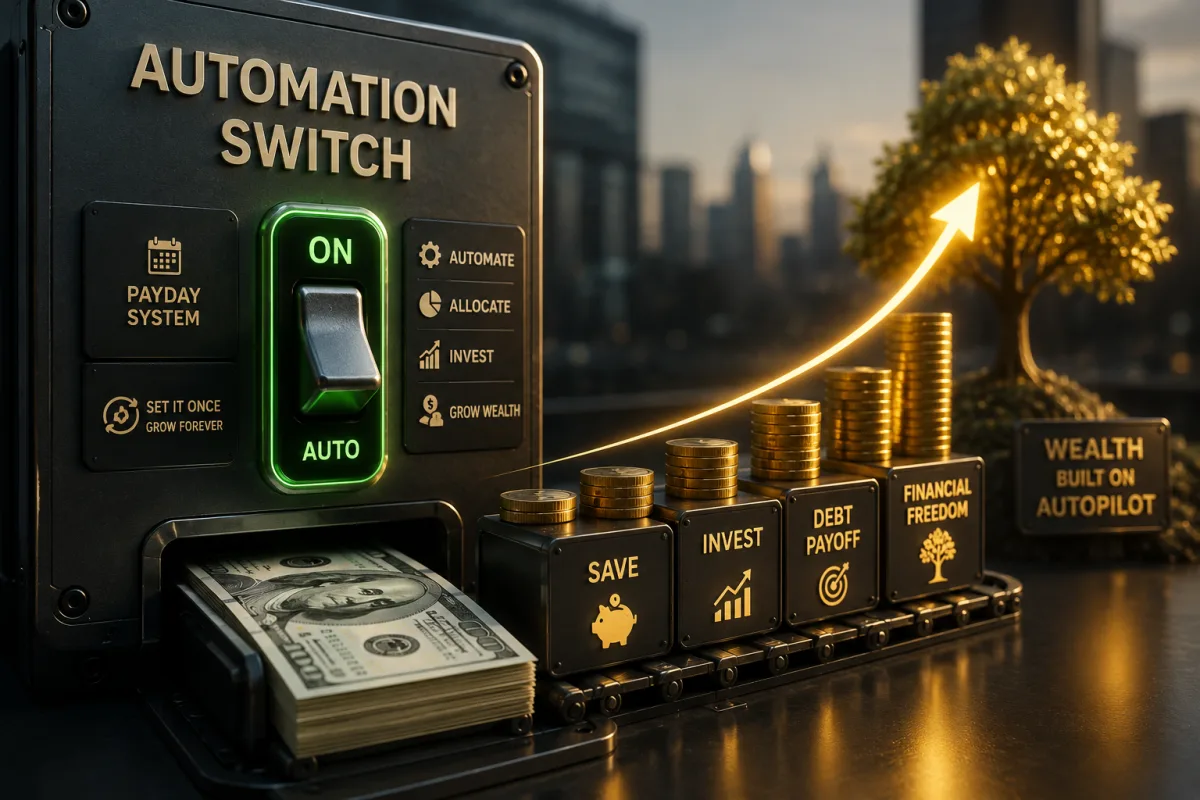
The Automation Switch: How Payday Systems Build Wealth When Willpower Runs Out
Stop relying on willpower to build wealth.
Willpower can help you start. It can help you cut expenses for a season, attack a credit card balance, say no to impulse purchases and send extra money toward debt. It can carry you through the intense phase of financial recovery when the goal is clear and the pain is fresh.
But willpower is not a wealth-building system.
Willpower gets tired. It weakens after long workdays, family pressure, social invitations, emotional stress, financial uncertainty and constant decision-making. It is strongest when motivation is high and weakest when life becomes normal again. That is why many people can follow a debt payoff plan for a while, then drift once the debt is gone. The crisis ends. The pressure fades. The discipline that once felt urgent becomes optional.
This is where the automation switch becomes essential.
The automation switch is the moment when you stop managing your financial future manually and build a payday system that moves money before you can spend it. It is the shift from active debt-payoff discipline to passive investment automation. Instead of waking up every month and deciding whether to save, invest or spend, the decision has already been made. On payday, money moves automatically into emergency savings, retirement accounts, investment portfolios, sinking funds and long-term goals.
You do not wait to see what is left.
You do not depend on mood.
You do not negotiate with yourself every month.
You build a system where your future is paid first.
This matters especially after paying off debt. During debt repayment, the system may already have existed in reverse. A monthly payment left your account. An automatic transfer reduced a balance. A lender collected money on schedule. You may have hated the payment, but the structure was powerful: the money moved whether you felt inspired or not.
After debt freedom, many people remove the payment and fail to replace it. The old debt payment becomes available cash. Available cash becomes lifestyle. Lifestyle becomes the new obligation. A few months later, the person is debt-free but not wealthier. The money that once went to lenders now disappears into restaurants, subscriptions, small upgrades, convenience purchases and emotional spending.
The automation switch prevents that drift.
It says: the payment continues, but the destination changes. The lender is no longer paid. Your future is paid. The debt account is no longer credited. Your emergency fund, investment account, retirement plan or asset portfolio is credited. The discipline that got you out of debt is not abandoned. It is redirected.
This is how wealth becomes less dependent on heroic effort and more dependent on design.
Why Willpower Fails as a Wealth Strategy
Most people overestimate how much financial progress can be built through willpower alone.
They believe they will save at the end of the month if they are careful. They believe they will invest when they remember. They believe they will avoid impulse spending because they know better. They believe motivation will return every payday with the same strength it had when they first made the plan.
Real life rarely works that way.
Money competes with emotion. A hard week makes convenience spending easier to justify. A friend’s invitation makes the budget feel restrictive. A child’s request creates guilt. A sale creates urgency. A family emergency creates pressure. A social media post creates comparison. A stressful month makes future goals feel distant and current comfort feel necessary.
Willpower must fight all of these battles repeatedly.
Automation removes many of them.
When savings and investments move automatically on payday, the money is gone from the spending account before most temptations appear. The decision is made while the mind is calm, not while emotions are loud. The budget adapts to what remains. The future is no longer dependent on leftover discipline.
This is the same reason debt payments are so effective at claiming income. Lenders do not wait for borrowers to feel generous. They set due dates, minimum payments, direct debits, penalties and reminders. The system is designed to collect. Wealth builders need a system designed to build.
If lenders can automate your obligation to them, you can automate your obligation to yourself.
The Post-Debt Danger Zone
The months after paying off debt are financially dangerous because they feel safe.
When debt is active, the problem is visible. There is a balance. There is interest. There is a due date. There may be stress, shame or urgency. The goal is clear: reduce the debt until it reaches zero.
After debt is gone, the visible enemy disappears. That should feel good. But it can also remove structure.
The money that once had a fixed destination now sits in the account. At first, the extra cash feels like breathing room. Then it becomes a restaurant meal. Then a subscription. Then an upgrade. Then a weekend trip. Then a higher lifestyle baseline. Soon the old debt payment has been replaced by new consumption.
This is how people escape debt without building wealth.
The post-debt danger zone is not caused by laziness. It is caused by a system gap. The debt payment ended, but no wealth payment replaced it.
The automation switch closes that gap immediately.
The month after your final debt payment, schedule an automatic transfer for the same amount or a large portion of it. If you were paying $300 per month toward debt, automate $300 toward emergency savings, investments, retirement or a combination of goals. If that feels too aggressive, automate $200 and allow $100 for lifestyle relief. But do not leave the full amount unassigned.
The best time to automate wealth building is before your lifestyle notices the money is available.
Payday Is the Best Time to Build Wealth
Payday is the most powerful moment in personal finance because income has not yet been claimed by daily life.
Before bills, groceries, transport, entertainment, family requests and impulse purchases compete for the money, payday offers a clean opportunity to assign it. A strong financial system uses that moment deliberately.
The common mistake is managing money backward. Income arrives. Spending begins. Bills are paid. Small purchases accumulate. Social expenses appear. Emergencies interrupt. Then, at the end of the month, the person checks what remains and hopes to save or invest.
Usually, little remains.
Payday automation reverses the order. Income arrives. Savings and investments move first. Bills are funded. Sinking funds receive money. Debt payments, if any, are scheduled. Lifestyle spending happens with what remains.
This is not deprivation. It is priority.
The future receives money before the present consumes everything. This is the practical meaning of paying yourself first. It does not require feeling motivated every month. It requires setting the transfer once, reviewing it periodically and allowing the system to work.
Payday is when your financial values should become transactions.
From Debt Payment to Wealth Payment
The easiest automation amount is the old debt payment.
If you have just paid off a loan, credit card or other debt, your budget already survived without that money. You were sending it away every month. The only question is where it goes now.
Calling it a wealth payment can change how you see it.
A debt payment repairs the past. A wealth payment builds the future. A debt payment reduces what you owe. A wealth payment increases what you own. A debt payment makes lenders whole. A wealth payment makes you stronger.
The habit can remain almost identical. The money still leaves your spending account. The date may be the same. The amount may be the same. The emotional meaning changes completely.
This is powerful because it avoids lifestyle inflation. If you immediately increase spending after debt freedom, rebuilding discipline later becomes harder. But if you keep the payment alive, you preserve momentum without creating a new sacrifice.
The first wealth payment after debt may go to emergency savings. Later, once the emergency fund is complete, the same automated payment can redirect to investments. The system can evolve, but the habit should remain.
Do not retire the payment. Promote it.
The First Automation: Emergency Savings
The first automation after debt should usually protect against returning to debt.
This means emergency savings.
An emergency fund is cash reserved for unexpected, necessary expenses or temporary income disruption. It protects against medical bills, job loss, delayed salary, car repairs, home repairs, urgent travel and other shocks that could otherwise force borrowing.
Automation makes the emergency fund grow without constant decision-making. On payday, a transfer moves money into a separate savings account. The account should be safe, liquid and separate from daily spending. It should not be mixed with grocery money or entertainment money.
At first, the target may be small. Build $500, $1,000 or one month of essential expenses depending on income and currency. Then expand toward three to six months of essential expenses, or more if income is unstable or dependents rely on you.
Essential expenses include housing, food, transport, utilities, insurance, medication, minimum obligations and necessary family responsibilities. The emergency fund does not need to cover luxury spending. In a crisis, lifestyle can be reduced.
The point is not to hold cash forever. The point is to create enough protection that investments will not be interrupted by ordinary emergencies.
Emergency savings automation is the financial shock absorber.
The Second Automation: Sinking Funds
Emergency funds protect against surprises. Sinking funds prepare for predictable costs.
Many people fall back into debt because they ignore irregular expenses. Annual insurance, school fees, car servicing, medical checkups, property repairs, holidays, taxes, professional licenses, birthdays and family events may not happen monthly, but they are not truly unexpected.
A sinking fund spreads these expenses across the year.
If an annual insurance premium costs $1,200, automate $100 per month into an insurance fund. If car maintenance averages $600 per year, automate $50 per month into a car fund. If school fees arrive each term, automate monthly contributions before the bill arrives.
This is one of the most underrated uses of automation.
Without sinking funds, a person may feel disciplined most months and then panic when a large predictable bill appears. They borrow, use a credit card or raid the emergency fund. Then they rebuild. Then another predictable expense appears. The cycle continues.
Automated sinking funds make financial life smoother. They turn irregular costs into monthly assignments. They also protect the emergency fund from being used for expenses that should have been planned.
When predictable expenses are funded automatically, debt has fewer doors through which to return.
The Third Automation: Retirement Contributions
Retirement planning becomes easier when contributions happen automatically.
Many people delay retirement saving because retirement feels distant. They plan to start later, after income rises, after expenses fall, after children grow, after business improves or after life becomes easier. But later is expensive because lost compounding time cannot be recovered easily.
Automation solves the problem of delay.
If an employer retirement plan, pension scheme or tax-advantaged account is available, contributions should be set up as early as possible. If an employer offers a matching contribution, capturing it can be one of the most valuable financial moves available, depending on cash flow and debt situation.
For self-employed people, retirement automation is even more important because no employer may be forcing the habit. A freelancer, consultant or business owner should create their own payday system. Each time income arrives, a percentage should move to taxes, emergency reserves and retirement investments.
The key is to automate before lifestyle absorbs the money.
Retirement wealth is rarely built from occasional large deposits made when someone feels inspired. It is built from repeated contributions that happen in ordinary months. Automation turns retirement from an intention into a transaction.
The Fourth Automation: Long-Term Investing
After emergency savings and short-term obligations are under control, automation should move money into long-term investments.
This is where the old debt discipline becomes wealth acceleration.
Long-term investments may include diversified funds, index funds, mutual funds, exchange-traded funds, bonds, retirement accounts, real estate investment trusts, dividend-paying shares or other regulated investment options suitable for your country and risk profile. The specific vehicle matters, but the habit matters first: money is invested consistently before it can be spent.
Automated investing helps solve the problem of market timing. Instead of waiting for the perfect moment, the investor contributes regularly. Some contributions happen when prices are high. Some happen when prices are low. Over time, the investor builds ownership through different market conditions.
This does not remove risk. Investments can fall. Returns are not guaranteed. Asset allocation, diversification, fees, taxes and time horizon still matter. But automation reduces the behavioral risk of forgetting, delaying or spending the money first.
A person who invests only when motivated may invest inconsistently. A person who automates contributions builds a habit that can compound.
Wealth is not built by thinking about investing every month. It is built by money entering assets every month.
The Fifth Automation: Debt Prevention
Automation can also prevent new debt.
One way is by automating credit card payments in full, if credit cards are used responsibly. Another is by automating transfers to sinking funds so predictable expenses do not require borrowing. Another is by automating bill payments to avoid late fees, penalties and stress.
Debt prevention also includes setting spending boundaries. For example, you may create a separate account for discretionary spending. Once payday transfers are completed and bills are funded, a fixed amount moves into the spending account. That is the lifestyle allowance. When it is gone, spending pauses.
This system prevents the main account from becoming a vague pool of money.
Debt often returns when people overestimate available cash. They look at a balance and feel safe, forgetting that rent, insurance, school fees, taxes or future repairs are hidden inside that balance. Account separation makes reality clearer.
Automation is not only about growth. It is also about preventing leaks.
The Automation Stack
A strong payday automation system has layers.
The first layer is income routing. When income arrives, it enters a main account or income account.
The second layer is protection. Automatic transfers move money to emergency savings and sinking funds.
The third layer is obligations. Bills, insurance premiums, rent, debt payments if any, taxes and essential commitments are funded or scheduled.
The fourth layer is growth. Retirement contributions and investment transfers happen automatically.
The fifth layer is lifestyle. Money for groceries, transport, entertainment, personal spending and enjoyment remains available in controlled categories or accounts.
The sixth layer is review. Once a month, the system is checked. Transfers are adjusted if income or expenses change. The plan is not ignored; it is maintained.
This stack makes financial priorities visible. It also reduces the pressure to make dozens of decisions every month. The system does the first work. You review and refine.
Automation does not mean abandoning control. It means controlling money in advance.
Why Automation Works Psychologically
Automation works because it changes the default.
Human beings tend to follow the path of least resistance. If saving requires logging into an account, deciding an amount, resisting spending and manually transferring money, it may not happen consistently. If spending is easy and saving is manual, spending wins too often.
Automation makes saving and investing the easy path.
The money moves without needing a fresh decision. The spending account shows what is available after priorities are funded. This reduces temptation because the full income amount is never treated as spendable.
Automation also reduces decision fatigue. People make many choices every day. Adding repeated financial decisions increases the chance of inconsistency. A preset system preserves mental energy.
Most importantly, automation creates identity. Each payday, the system proves that you are a saver, investor and wealth builder. You do not need to feel like one every day. The evidence appears in your accounts.
Repeated automated action becomes financial self-trust.
Automation and the Problem of Motivation
Motivation is useful but unreliable.
People are motivated after a financial scare. They are motivated after reading a book. They are motivated after paying off debt. They are motivated after seeing someone else succeed. But motivation fades when life becomes busy.
Automation protects financial progress from emotional weather.
You may feel tired, but the transfer happens. You may feel distracted, but the investment contribution happens. You may feel tempted, but the emergency fund money is already separate. You may forget, but the system remembers.
This does not mean emotions no longer matter. You still need discipline to avoid canceling transfers, raiding accounts or increasing lifestyle too quickly. But automation reduces the number of moments where discipline is required.
Good systems do not eliminate willpower. They conserve it.
How Much Should You Automate?
The right automation amount depends on income, expenses, debt, goals and life stage.
A person just emerging from debt may automate a small amount to emergency savings first. Someone with a full emergency fund may automate more to investments. A high-income household may automate a large percentage of income. A variable-income freelancer may automate percentages rather than fixed amounts.
A useful starting point is the old debt payment. If you were paying $400 per month to a loan, consider automating $400 toward wealth goals. If that is too much, begin with $250 or $300 and increase later.
Another method is percentage-based automation. For example, 10 percent of income to retirement, 5 percent to emergency savings until complete, 5 percent to investments and a fixed amount to sinking funds. Percentages work well when income varies.
The amount should be challenging but sustainable. If automation is too aggressive and causes overdrafts or constant transfers back, it may fail. If it is too small, progress may be slow. Start with a realistic amount and increase as confidence grows.
The best automation plan is one you can keep during normal life, not only during a highly motivated month.
Automating With Irregular Income
Automation is harder with irregular income, but it is still possible.
Freelancers, business owners, commission earners, contractors, gig workers and seasonal workers may not receive the same amount on the same date every month. Fixed transfers can create stress if income arrives late or unevenly.
The solution is to automate by percentage and priority.
When income arrives, divide it immediately. A percentage goes to taxes. A percentage goes to emergency savings. A percentage goes to business reserves. A percentage goes to retirement or investments. A percentage goes to personal spending. This can be done manually at first, then automated where tools allow.
Another strategy is to create a buffer account. Income flows into the buffer. The buffer pays a fixed monthly “salary” to the household. Automation runs from that salary. In strong months, the buffer grows. In weak months, it stabilizes cash flow.
Irregular income requires stronger cash reserves because timing risk is real. But the principle remains the same: money should be assigned before it is absorbed.
Variable income is not an excuse for financial drift. It simply requires a more flexible automation system.
Automation After Each Debt Is Paid Off
If you have multiple debts, automation can create a powerful sequence.
When one debt is paid off, keep its payment amount moving automatically. If other high-interest debts remain, redirect the payment to the next debt. This creates a debt snowball or avalanche effect. The total monthly debt attack grows as each balance disappears.
When all destructive debt is gone, redirect the total former debt payment to wealth goals.
This prevents the common mistake of letting each paid-off debt become lifestyle money. Instead, every victory increases momentum. A $100 payment joins a $200 payment. Then a $300 payment. Eventually, the same amount that once attacked debt can build investments.
This approach teaches continuity. Debt payoff and wealth building are not separate lives. They are phases of the same financial discipline.
The money keeps moving toward freedom.
The Automation Order for Beginners
If you are beginning from scratch after debt, use a clear order.
First, automate a starter emergency fund. Build enough to avoid small shocks becoming debt.
Second, automate sinking funds for predictable expenses that are likely to create future borrowing.
Third, automate remaining high-interest debt payments if any debt remains.
Fourth, automate retirement contributions, especially if employer benefits are available.
Fifth, automate long-term investing once the basic foundation is stable.
Sixth, automate bill payments to avoid penalties and missed due dates.
Seventh, automate account reviews or reminders so the system stays aligned with life.
This order can be adjusted. A person with an employer match may contribute while building emergency savings. A person with unstable income may prioritize cash reserves longer. A person with no debt and strong savings may move quickly to investing. The order is a framework, not a prison.
Automation Does Not Mean Ignoring Your Money
Automation is not financial autopilot in the careless sense.
A plane on autopilot still requires a pilot. The route must be set. Conditions must be monitored. Adjustments must be made. The same is true for money.
Automated transfers should be reviewed. Are they still affordable? Are goals changing? Is the emergency fund complete? Are investment contributions too low? Have fees changed? Has income increased? Are sinking funds overfunded or underfunded? Are bills still accurate? Has lifestyle crept up?
A monthly review is enough for many people. Look at account balances, transfers, upcoming expenses and progress. A deeper quarterly review can include net worth, investments, debt, insurance and goals.
Automation handles repetition. Review handles direction.
The system should not become invisible. It should become reliable.
The Danger of Automating Bad Habits
Automation is powerful, which means it can also work against you.
Subscriptions automate spending. Car loans automate depreciation and interest. Buy-now-pay-later plans automate future pressure. Credit card minimum payments automate slow repayment. Lifestyle memberships automate money leaving without review.
Many people already have automation. It is simply pointed in the wrong direction.
A financial reset should include auditing automatic payments. List every subscription, loan payment, membership, insurance premium, app charge, donation, service and recurring purchase. Ask whether each one still serves your life.
Cancel what no longer matters. Renegotiate where possible. Replace automatic consumption with automatic wealth building.
The question is not whether your money is automated. The question is who benefits from the automation.
Automation and Lifestyle Inflation
Payday automation is one of the strongest defenses against lifestyle inflation.
Lifestyle inflation occurs when spending rises every time income rises. A raise becomes a bigger apartment. A bonus becomes a luxury purchase. A promotion becomes a car loan. A profitable business month becomes personal spending.
Automation helps because income increases can be captured before lifestyle adjusts.
When your income rises, increase automated savings and investment contributions immediately. If the raise is $500 per month, automate $250 or $300 before it becomes normal spending. This allows some lifestyle improvement while still accelerating wealth.
The same rule applies to bonuses, commissions and side income. Decide in advance what percentage goes to investments, emergency savings, debt repayment, taxes or long-term goals.
Income growth becomes wealth only if part of it is captured. Automation captures it before habits expand.
Automation and Investing Through Market Volatility
Automated investing helps investors stay consistent through market cycles.
Markets rise and fall. News changes. Fear and excitement alternate. A manual investor may stop contributing during downturns because they feel afraid. They may invest heavily after markets rise because they feel confident. This can lead to poor timing.
Automated contributions reduce the emotional burden. Money enters the investment account according to the plan. During downturns, contributions may buy assets at lower prices. During strong markets, contributions continue building the portfolio.
This does not guarantee profit or eliminate risk. Asset allocation and time horizon still matter. But automation supports disciplined behavior.
Market volatility is easier to endure when emergency savings are separate and investments are automated for long-term goals.
The investor’s job is not to react to every headline. The investor’s job is to keep the system aligned with the goal.
Automation and Net Worth Growth
The best measure of whether automation is working is net worth.
Net worth equals assets minus liabilities. Automated saving and investing should increase assets over time. Automated debt repayment should reduce liabilities. Together, they improve financial position.
After paying off debt, tracking net worth becomes especially important. During debt repayment, progress was visible in falling balances. After debt, progress should be visible in rising assets.
Review net worth monthly or quarterly. Include cash, emergency savings, investments, retirement accounts, property equity, business assets and debts. The number will fluctuate if investments move, but the long-term trend should improve.
Automation turns net worth growth from occasional effort into a recurring process.
If net worth is not improving despite automation, review the system. Transfers may be too small, spending may be rising, investments may be inappropriate, fees may be high or new liabilities may be appearing.
The Minimum Effective Automation System
You do not need a complicated system to begin.
The minimum effective automation system has three transfers.
The first transfer goes to emergency savings.
The second transfer goes to a sinking fund for predictable expenses.
The third transfer goes to long-term investing or retirement.
If you still have high-interest debt, replace the investment transfer temporarily with extra debt repayment, or balance both depending on your situation.
These three transfers are enough to change the direction of a financial life. They protect against shocks, prepare for known expenses and build future assets.
Once this system works, it can be expanded. Add separate funds for taxes, education, property, business capital, giving or travel. Increase investment contributions. Add automatic rebalancing or retirement contributions where available.
Start simple. Complexity can come later if needed.
How to Set Up the Automation Switch
Begin by identifying your payday dates.
Then list your old debt payments. These amounts are the easiest candidates for wealth automation.
Next, decide your first three destinations: emergency fund, sinking fund and investment or retirement account. If your emergency fund is empty, give it priority.
Set transfers to happen within 24 to 48 hours of income arriving. Waiting too long increases the chance that money will be spent.
Use separate accounts or clearly labeled categories. Money for emergencies should not sit with money for entertainment. Money for annual insurance should not sit with money for groceries.
Automate bills where it reduces late fees and stress, but keep enough oversight to avoid overdrafts.
Schedule a monthly money review. Check transfers, balances and upcoming expenses.
Increase the automated amount after raises, bonuses or paid-off debts.
The setup may take one afternoon. The effect can last for years.
What to Do If Automation Feels Too Restrictive
Automation can feel restrictive at first because it reduces visible spending money.
This feeling is normal. You are changing the order of money. The full paycheck is no longer available for immediate use. Some of it has already been assigned to future goals.
The solution is not to cancel automation immediately. The solution is to adjust intelligently.
If transfers are causing overdrafts, lower them temporarily and review expenses. If lifestyle money is too tight, decide whether the issue is unrealistic automation, uncontrolled spending or income that needs to grow. If the system feels emotionally difficult, start smaller and increase gradually.
Automation should challenge you, not break your budget.
Include planned enjoyment. A system with no room for life may fail. The goal is not to eliminate all spending. The goal is to ensure spending happens after priorities are funded.
A good automation system creates freedom, not resentment.
The Role of Account Separation
Account separation makes automation easier to follow.
When all money sits in one account, the balance can mislead you. You may think money is available when it actually belongs to rent, insurance, taxes, school fees, repairs or investments.
Separate accounts or subaccounts create clarity.
You might have an income account, bills account, emergency savings account, sinking fund account, investment account and lifestyle spending account. The exact structure depends on your bank, tools and preferences. The principle is that money should be separated by purpose.
This prevents accidental spending. If the lifestyle account is low, spending slows. You do not raid the emergency fund unknowingly. You do not spend annual insurance money on weekend entertainment.
Automation and account separation work together. Automation moves the money. Separation protects its purpose.
Automating Skill Investment
Wealth automation should not only fund financial assets. It can also fund earning power.
A portion of monthly surplus can be automated into a learning fund. This fund can pay for courses, books, certifications, coaching, conferences, software, tools or professional development that increases income potential.
This is especially useful after debt repayment. The old debt payment can help build the skills that increase future surplus.
Skill investment should be intentional. Do not buy courses endlessly without application. Choose learning that can improve career value, business income, pricing power or technical ability.
Automating a learning fund sends an important message: your earning power is an asset worth maintaining.
Automation for Couples and Families
Automation becomes even more important when money is shared.
Couples and families face more moving parts: rent or mortgage, school fees, food, transport, insurance, childcare, medical costs, family support, debt, savings, investments and personal spending. Without a system, disagreements can increase.
A shared automation plan creates clarity. Income arrives. Household bills are funded. Emergency savings grow. Children’s expenses are prepared for. Investments are made. Personal spending allowances are separated. Family support has a defined category.
This reduces conflict because priorities are agreed in advance.
Couples should review the system together. Automation should not become secrecy. Both partners should understand where money goes, why transfers exist and how progress is measured.
A household builds wealth faster when the system reflects shared goals.
Automation and Financial Peace
One of the greatest benefits of automation is peace.
Financial anxiety often comes from uncertainty. Did I save enough? Did I invest this month? Will the annual bill surprise me? Did I forget a payment? Am I spending money that belongs to something else? Will I fall back into debt?
Automation reduces these questions.
Emergency savings grow automatically. Sinking funds prepare automatically. Investments happen automatically. Bills are scheduled. The spending account shows what is available. The system does not remove every financial challenge, but it creates order.
Order creates confidence.
Debt freedom removes pressure. Automation prevents pressure from returning. Together, they create the foundation for wealth and peace.
Common Automation Mistakes
The first mistake is automating too late in the month. Transfers should happen near payday, not after spending has already begun.
The second mistake is automating too much too soon. If the amount causes overdrafts, the system may fail.
The third mistake is not separating accounts. Automated money can still be spent accidentally if it remains mixed with daily cash.
The fourth mistake is automating investments before building any emergency cushion. This can force withdrawals or new debt.
The fifth mistake is forgetting sinking funds. Predictable expenses can destroy progress if they are not funded.
The sixth mistake is never increasing transfers. Income growth should increase wealth automation.
The seventh mistake is ignoring fees and account terms. Automated investing should still be cost-conscious.
The eighth mistake is automating bad subscriptions while failing to automate wealth.
The ninth mistake is failing to review the system. Automation needs maintenance.
The tenth mistake is canceling transfers during emotional months instead of adjusting the budget thoughtfully.
The Wealth Habit That Runs Without Applause
Automation is not glamorous.
No one applauds when a transfer moves to an emergency fund. No one sees the investment contribution. No one praises the sinking fund. No one notices that the old debt payment is now buying assets. Automation is quiet.
That is why it works.
It does not depend on public recognition. It does not need social approval. It does not require constant excitement. It simply repeats. Over months, the emergency fund grows. Over years, investments accumulate. Over decades, compounding becomes meaningful.
Wealth often comes from habits that are invisible while they are working.
The automation switch is one of those habits. It changes money before money changes mood.
Final Thoughts
Debt payoff requires discipline. Wealth building requires systems.
When you are paying off debt, active discipline may be enough for a season. You track balances. You cut expenses. You send extra payments. You stay focused until the balance reaches zero. But after debt freedom, the challenge changes. The goal is no longer only to destroy liabilities. The goal is to build assets.
That requires the automation switch.
Stop relying on willpower to build wealth. Move money on payday. Keep the old debt payment alive. Redirect it to emergency savings, sinking funds, retirement accounts and investments. Separate money by purpose. Capture raises before lifestyle grows. Review the system monthly. Increase transfers as income rises. Let automation do the repetitive work that motivation cannot sustain forever.
The system does not need to be complicated. It needs to be consistent.
Payday arrives. Your future is paid first. Bills are funded. Predictable expenses are prepared for. Investments receive money. Lifestyle spending happens with what remains. Month after month, the system quietly builds what will later look like financial strength.
This is how debt freedom becomes wealth.
The same discipline that once paid lenders can now pay your future. The same monthly payment that once repaired the past can now buy ownership. The same payday that once brought stress can become the moment your wealth engine turns on.
Willpower starts the journey. Automation keeps it going.
 Article
 Article
 Article
 Article
 Article
 Article
 Article
 Article