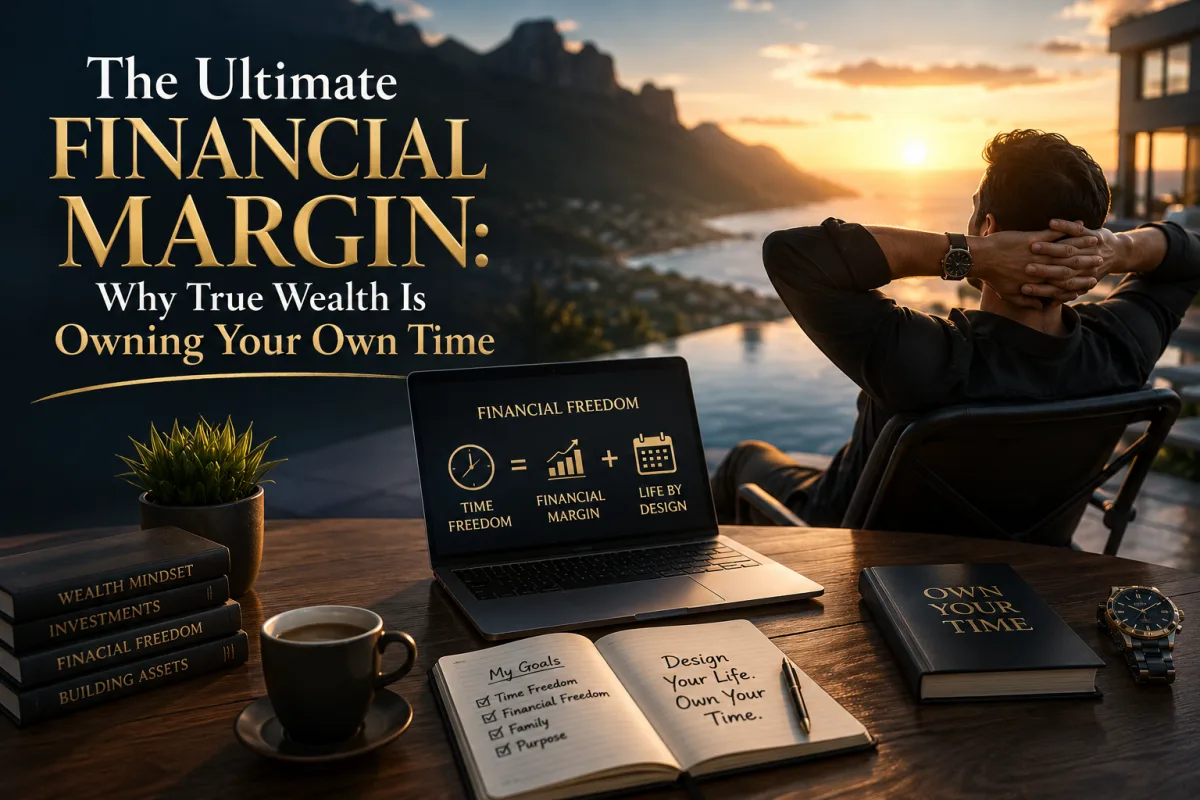
The Ultimate Financial Margin: Why True Wealth Is Owning Your Own Time
True wealth is owning your own time.
Not looking rich. Not earning the highest salary in the room. Not having the largest house, the most impressive car, the most enviable title or the most polished lifestyle. Those things may signal success, but they do not always produce freedom. A person can appear wealthy and still have no control over Monday morning. A person can earn a high income and still be trapped by debt, status expectations, family pressure, business obligations, lifestyle inflation and fear of losing the next paycheck.
The ultimate financial margin is not merely the gap between income and expenses. It is the gap between what life demands from you and what you are free to choose.
Money matters because it can buy food, housing, healthcare, education, security, dignity and opportunity. But once the essentials are covered, money’s deepest power is time control. It can buy the ability to say no, to wait, to recover, to choose work more carefully, to leave bad environments, to care for family, to rest without guilt, to take creative risks, to start again and to live without every hour being assigned by necessity.
That is the freedom most people are actually seeking when they say they want wealth.
Yet many people pursue wealth in a way that reduces freedom. They chase income but build an expensive lifestyle that requires constant performance. They pursue net worth but sacrifice health, relationships and meaning. They earn more but spend more, then need even more. They buy assets but also buy obligations. They build businesses that own them. They take promotions that increase pay but remove control. They collect symbols of success while losing ownership of their calendar.
This is the paradox of modern financial ambition: many people become financially larger without becoming personally freer.
A high net worth is useful only if it improves life. It is a tool, not a soul. A portfolio, house, business, pension, savings account or investment account has meaning because of what it allows: safety, choice, flexibility, generosity, independence, creativity and peace. If wealth does not eventually return time to the owner, the owner may become a servant of the wealth.
The goal is not to reject ambition. Ambition can build companies, careers, families, communities and legacies. The goal is to aim ambition correctly. Money should not become an endless scoreboard. It should become a margin of freedom.
The question is not only, “How much am I worth?”
The better question is, “How much of my life do I own?”
Why Net Worth Is Not the Final Goal
Net worth is important.
It measures assets minus liabilities. It tells you whether you own more than you owe. It helps reveal whether income is becoming wealth. It exposes the difference between looking successful and being financially strong. A rising net worth often signals that a person is saving, investing, reducing debt and building assets.
But net worth is not the final goal.
Net worth is a financial measurement. Freedom is a life measurement. Someone can have a high net worth and still feel trapped if their wealth is illiquid, their expenses are enormous, their identity depends on status, their business cannot run without them or their obligations consume every hour. Another person may have a more modest net worth but far more freedom because their expenses are low, assets produce income, debt is minimal and time is flexible.
This does not mean net worth does not matter. It means net worth must be connected to purpose.
Money that cannot buy choice is incomplete wealth. Assets that require constant stress may not create freedom. Income that demands total exhaustion may be expensive in ways the bank account does not show. A large balance sheet can become a prison if it funds a life that cannot slow down.
The healthiest financial goal is not simply to maximize net worth forever. It is to build enough wealth, in the right structure, to support the life you actually want.
Net worth should serve time worth.
The Difference Between Being Rich and Being Free
Being rich and being free are related, but they are not the same.
Being rich usually means having a lot of money, income, assets or visible financial capacity. Being free means having control over your choices. Rich is often measured by amount. Free is measured by dependence.
A person can be rich but not free if they cannot stop working without collapse, cannot say no to clients, cannot leave a toxic job, cannot rest, cannot reduce spending, cannot disappoint others, cannot escape debt or cannot maintain their lifestyle without constant pressure.
A person can be free with less money if their needs are covered, their obligations are manageable, their assets support them, their time is flexible and their identity is not chained to consumption.
The difference is margin.
Financial margin gives space between you and desperation. Time margin gives space between you and exhaustion. Emotional margin gives space between you and constant fear. True wealth brings these margins together.
The goal is not poverty disguised as simplicity. The goal is not pretending money does not matter. The goal is to understand that money is most valuable when it increases control over life.
The rich person asks, “How much can I acquire?”
The free person asks, “How much control does this give me over my days?”
Time Is the Real Currency
Money can be earned, lost, invested, borrowed, inherited, spent and recovered.
Time is different.
Every day spent is gone permanently. A year of burnout cannot be fully refunded. A childhood missed cannot be repurchased. Health neglected for decades cannot always be restored. Relationships starved of attention may not return to their original strength. Creative ambitions delayed forever may remain unrealized.
This is why time is the deeper currency.
Money is valuable because it can influence how time is spent. It can reduce the number of hours sold for survival. It can allow a person to choose better work, take time off, recover from illness, care for a child, support an aging parent, build a business patiently or retire with dignity.
But money can also consume time. Expensive lifestyles require maintenance. Large homes require upkeep. Luxury purchases create insurance, storage, repairs and replacement expectations. High-status careers may demand constant availability. Businesses can create wealth while devouring every waking hour.
Every financial decision should therefore be judged by its time effect.
Does this purchase save time or steal it? Does this investment create future freedom or create complexity? Does this promotion improve life or only increase income while reducing control? Does this debt buy something meaningful or pledge future hours to yesterday’s spending?
Money is not only spent in dollars. It is spent in life.
The Financial Margin That Creates Freedom
Financial margin begins with the gap between income and expenses.
If you earn more than you spend, you have surplus. Surplus can become savings, debt repayment, investments, business capital, insurance, education or generosity. Without surplus, wealth building becomes difficult because every dollar is already claimed.
But the ultimate financial margin goes further than monthly surplus.
It includes cash reserves that prevent panic. It includes low debt that reduces fixed obligations. It includes investments that grow without daily labor. It includes skills that increase earning power. It includes insurance that protects against disasters. It includes a lifestyle that does not require constant income escalation. It includes the ability to pause, choose and recover.
Financial margin is what allows you to think clearly.
A person with no margin often makes decisions under pressure. They accept bad deals because cash is urgent. They stay in harmful jobs because there is no cushion. They borrow at high interest because emergencies cannot wait. They delay health care because money is tight. They say yes when they should say no because income is fragile.
Margin changes decision quality.
With margin, you can negotiate. You can wait for a better opportunity. You can leave a bad client. You can handle a delayed paycheck. You can invest long term without selling during every crisis. You can choose more carefully.
Freedom begins when life stops negotiating from desperation.
Why High Income Alone Does Not Create Time Ownership
High income can help build freedom, but it does not guarantee it.
A high earner can still be trapped if expenses rise with income. Bigger income can fund bigger obligations: larger housing, private schools, luxury cars, social expectations, family support, memberships, staff, travel, debt and business costs. If every raise becomes a permanent expense, income growth does not create freedom. It creates a more expensive cage.
This is why some high earners feel poor.
They may earn more than most people but have little control. Their lifestyle requires constant income. Their assets are weaker than their image. Their fixed costs are high. Their stress is hidden behind visible success.
The difference between high income and wealth is retention.
Wealth comes from what remains after income is spent. Freedom comes from what that retained wealth can do. If income is converted into assets, the person becomes less dependent over time. If income is converted into lifestyle alone, the person remains dependent no matter how large the paycheck becomes.
High income is a powerful shovel. It can dig a person out of debt, build investments quickly and create freedom faster. But if used only to expand consumption, it digs a deeper lifestyle trench.
The question is not how much income you make. The question is how much of your income buys back your future time.
The Quiet Power of Low Fixed Costs
Low fixed costs are one of the most underrated forms of wealth.
Fixed costs are expenses that must be paid regularly: rent, mortgage, car payments, insurance, school fees, subscriptions, loan payments, staff, memberships, utilities and other recurring commitments. The higher they are, the more income must arrive every month before freedom begins.
Low fixed costs create flexibility.
A person with modest fixed expenses can survive income disruption more easily. They can invest more. They can take career risks. They can start a business. They can work less if needed. They can retire earlier with a smaller portfolio. They can change direction without immediate financial collapse.
High fixed costs do the opposite. They turn income into obligation before it even arrives.
This does not mean everyone should live cheaply forever. Housing, education, transportation, health and family needs matter. But every fixed cost should be judged carefully because it reduces future freedom. A large recurring commitment is not only a payment. It is a claim on your future time.
The fewer claims on your future income, the more of your future belongs to you.
Debt as a Theft of Future Time
Debt can be useful in some situations, but destructive debt steals future time.
When you borrow for consumption, you bring future income into the present. The purchase happens now. The repayment happens later. Interest makes the later repayment larger than the original cost. This means future hours of work are already assigned to past spending.
That is why debt can feel so suffocating.
It reduces choice before income even arrives. A paycheck comes in, but part of it is not yours. It belongs to the lender. Debt turns future time into scheduled payments.
Strategic debt may be different if it funds an asset, education or business opportunity that increases earning power or net worth. Even then, risk must be managed carefully. But high-interest consumer debt, lifestyle debt and recurring borrowing usually reduce freedom.
Paying off debt is therefore not only a financial act. It is a time recovery act.
Every balance eliminated frees future income. Every interest charge avoided gives more of your life back to you. Every old payment redirected into investments turns time from obligation into ownership.
Debt freedom matters because it restores control over future cash flow.
Assets as Stored Time
Assets are stored time when they can support future life.
An investment account represents hours worked that were not spent. A rental property represents income converted into ownership. A business represents effort turned into a system. A pension represents current sacrifice reserved for future security. A cash reserve represents time protected from panic.
Not all assets are equal. Some grow. Some produce income. Some are illiquid. Some are risky. Some are expensive to maintain. Some are mostly emotional or lifestyle assets. But productive assets can become a way of storing today’s work for tomorrow’s freedom.
This is the essence of wealth building.
You work. You earn. You spend less than you earn. You invest the difference. The investment becomes an asset. The asset may grow or produce income. Over time, assets begin supporting more of life, reducing dependence on active labor.
The transition from labor income to asset support is the transition toward time ownership.
At first, assets may support only small choices. An emergency fund allows you to handle a crisis. A small investment account gives confidence. A dividend pays a bill. A side business covers groceries. Later, assets may support larger choices: changing jobs, taking a sabbatical, retiring early, reducing hours or funding family care.
Assets matter because they convert past discipline into future choice.
The Freedom Ratio
A useful way to think about time ownership is the freedom ratio.
The freedom ratio compares passive or semi-passive income to essential expenses. If your essential expenses are $3,000 per month and your assets produce $300 per month, 10 percent of your basic life is covered by assets. If assets produce $1,500, half of your essential life is covered. If assets produce $3,000, your basic financial life is covered without full dependence on active work.
This is not a perfect measure because investment income can fluctuate, taxes matter, inflation matters and assets may need reinvestment. But the concept is powerful.
Freedom is not only about the size of the portfolio. It is about how much of your life the portfolio can support.
A person with a large net worth and huge expenses may have a lower freedom ratio than someone with moderate assets and low expenses. This is why lifestyle matters. The less your life costs, the more freedom each asset dollar can buy.
The freedom ratio connects wealth to time.
Instead of asking only, “How much do I have?” ask, “How much of my life could this support?”
The Role of Emergency Savings in Time Ownership
Emergency savings are the first layer of time ownership.
An emergency fund does not make a person rich, but it buys time during disruption. If a job ends, cash buys time to search carefully. If a medical issue arises, cash buys time to get care without immediate debt. If a business slows, cash buys time to adjust. If a family emergency appears, cash buys time to respond.
Without emergency savings, life becomes reactive.
Every unexpected expense creates urgency. Urgency often leads to borrowing, selling assets, accepting bad terms or making poor decisions. An emergency fund interrupts that pattern.
This is why cash reserves are not dead money. They are decision reserves.
Emergency cash should be safe and liquid. It should not be invested aggressively. Its purpose is not high return. Its purpose is to preserve choice under pressure.
Time ownership begins with not being forced into desperate decisions by ordinary emergencies.
The Role of Investing in Time Ownership
Investing is the long-term engine of time ownership.
Emergency savings buy short-term breathing room. Investing buys long-term independence. Through investments, income becomes assets, assets can grow and returns can compound.
Investing may involve retirement accounts, pension plans, index funds, diversified portfolios, bonds, real estate, business equity, dividend-paying shares, income funds or other suitable assets. The correct approach depends on goals, time horizon, country, risk tolerance, taxes and knowledge.
The principle is that long-term surplus should not remain idle forever.
Cash protects the present, but investments build the future. If all money remains in cash, inflation can erode purchasing power and freedom may remain distant. If all money is invested without cash reserves, volatility can create stress and forced selling. A strong plan needs both safety and growth.
Investing allows money to participate in productivity beyond your own labor. Businesses grow, bonds pay interest, properties generate rent, funds distribute income and portfolios compound. You are no longer relying only on the hours you personally sell.
That is the beginning of time leverage.
The Role of Work in a Freedom-Based Wealth Plan
Financial freedom does not always mean never working again.
For many people, the goal is not permanent idleness. Work can provide meaning, structure, identity, creativity, contribution and community. The problem is not work itself. The problem is compulsory work under financial pressure.
Freedom changes the relationship with work.
When you own your time, work becomes more of a choice. You can choose projects that matter. You can reject abusive environments. You can negotiate better. You can reduce hours. You can take risks. You can build something slowly. You can work because it is meaningful, not only because bills are chasing you.
This is why the ultimate goal should not be laziness. It should be autonomy.
Autonomy means you have meaningful control over how you spend your days. You may still work hard. You may still build, serve, lead, teach, create or invest. But the work is no longer driven entirely by financial fear.
Wealth is most powerful when it turns work from compulsion into choice.
Why Freedom Requires Knowing What Is Enough
Freedom requires a definition of enough.
Without enough, wealth becomes an endless race. Every milestone moves. The first goal is an emergency fund. Then a portfolio. Then a bigger house. Then a higher status. Then a larger business. Then a larger number. Ambition keeps expanding, but peace never arrives.
Enough does not mean stopping growth. It means knowing what money is for.
How much does your life actually require? What lifestyle supports health, dignity, family and joy without trapping you? How much investment income would cover essentials? How much margin would make work optional? What level of wealth allows generosity without anxiety? What are you unwilling to sacrifice for more money?
These questions matter because money has no natural finish line.
If you do not define enough, someone else will define success for you. Social media, peers, family expectations, professional status and consumer culture will always offer a more expensive version of life.
Enough is the boundary that converts wealth from accumulation into freedom.
The Cost of Chasing More Forever
Chasing more forever can become costly.
More income may require more hours. More status may require more performance. More possessions may require more maintenance. More business growth may require more complexity. More visibility may require more pressure. More wealth may require more attention than the life it was supposed to improve.
There is nothing wrong with growth when it serves purpose. The danger is growth without a life philosophy.
A person may spend decades pursuing wealth and then realize they traded too much time for money they did not need, approval that did not satisfy and possessions that became burdens. They may have built financial capital while spending health capital, relationship capital and peace.
The goal is not to romanticize smallness. The goal is to examine trade-offs honestly.
Every version of more has a cost. The wise person asks whether the additional money buys enough additional freedom to justify the cost.
Sometimes the answer is yes. Sometimes the answer is no.
Designing a Life Around Time Ownership
A freedom-based financial plan starts with life design.
What do you want your days to look like? How much work do you want? Where do you want flexibility? What responsibilities matter most? What kind of health do you want to protect? What relationships need time? What creative or spiritual life do you want to cultivate? What would you stop doing if money were less of a constraint?
These questions should guide the money plan.
If your goal is to spend more time with children, a financial plan that requires constant travel and exhaustion may conflict with the goal. If your goal is to build a business, you may need cash reserves and lower fixed costs. If your goal is early retirement, the savings rate must be high. If your goal is flexible work, debt reduction and emergency savings may matter more than visible lifestyle.
Money should be structured around the life it is supposed to support.
Without this connection, people build wealth by default and then wonder why success feels empty.
The Three Stages of Time Ownership
Time ownership often develops in stages.
The first stage is survival margin. This means being able to handle basic expenses and small emergencies without constant crisis. The key tools are budgeting, emergency savings, debt control and income stability.
The second stage is flexibility margin. This means having enough savings, low enough debt and strong enough income to make better choices. You can change jobs, negotiate, leave bad clients, take short breaks, invest consistently and absorb larger shocks.
The third stage is autonomy margin. This means assets or passive income can support a meaningful portion of life. Work becomes more optional. Major choices are less controlled by paycheck dependence. Retirement, semi-retirement, entrepreneurship or lifestyle redesign becomes realistic.
Each stage matters.
People often imagine freedom only as the final stage, but the earlier margins are life-changing too. Having one month of expenses saved can change stress. Having six months can change courage. Having investments that cover 25 percent of expenses can change career decisions. Having enough assets to cover essential living costs can change identity.
Freedom is not only one finish line. It is a series of expanding choices.
The First Freedom: The Ability to Say No
One of the first signs of wealth is the ability to say no.
No to a predatory loan. No to a bad client. No to an underpaid role. No to lifestyle pressure. No to family requests that would destroy your stability. No to a purchase that creates debt. No to work that damages health. No to panic.
Saying no requires margin.
Without savings, debt is harder to refuse. Without investments, income pressure is harder to resist. Without low fixed costs, bad jobs become harder to leave. Without a plan, social pressure becomes harder to manage.
Many people think wealth is the ability to say yes to anything. But often, wealth is the ability to say no to what does not serve your life.
The first freedoms are defensive. They protect your time from being claimed by fear.
The Second Freedom: The Ability to Wait
The ability to wait is another form of wealth.
People without financial margin are often forced into speed. They accept the first offer. They sell at the wrong time. They borrow under bad terms. They take work immediately even if it is harmful. They make decisions from urgency.
People with margin can wait.
They can wait for a better job, a better buyer, a better investment opportunity, a better client, a better tenant, a better business decision or a better moment. Waiting is not always wise, but the ability to wait is powerful because it expands options.
Cash reserves buy waiting time. Low expenses lengthen waiting time. Investments reduce dependence. Skills create alternative income. Together, they allow patience.
Patience is easier when bills are not chasing you.
The Third Freedom: The Ability to Choose Work
Choosing work is different from needing work at any cost.
Most people need to work, and there is dignity in work. But financial margin improves the terms. A person with no margin may accept any work that pays. A person with margin can choose work that fits values, health, family and long-term growth.
This freedom can appear before full retirement.
You may choose a lower-paying but healthier job because investments and savings support the gap. You may start consulting because emergency reserves reduce risk. You may reduce overtime because debt is gone. You may turn down clients who mistreat you because your business has reserves.
The point is not to stop working. The point is to stop being cornered.
Time ownership changes the quality of work decisions.
The Fourth Freedom: The Ability to Rest
Rest is a financial issue more than many people admit.
People without margin often cannot rest properly. They work when sick. They skip recovery. They ignore burnout. They postpone medical care. They fear unpaid time. Their bodies become collateral for financial instability.
Wealth should protect rest.
Emergency savings, insurance, paid leave, investments and lower expenses all make rest more possible. A person with financial margin can recover after illness, take parental leave, grieve properly, step back after burnout or pause after a major life event.
Rest is not laziness. It is maintenance of the person who earns, loves, thinks and builds.
If wealth does not create room to recover, it may be failing one of its deepest purposes.
The Fifth Freedom: The Ability to Be Generous Without Fear
Money also creates freedom to give.
Generosity can support family, friends, community, faith, education, healthcare, art, entrepreneurship and causes that matter. But generosity without margin can become stress. A person may give from guilt, borrow to help, neglect their own future or become financially fragile while trying to rescue others.
True generosity is strongest when it is sustainable.
Financial freedom allows giving without panic. It allows planned support, not only reactive sacrifice. It allows a person to help others while still maintaining emergency savings, insurance, retirement planning and household stability.
Owning your time also means having time to give, mentor, teach, care and serve.
The highest form of wealth is not only having enough for yourself. It is having enough strength to contribute without destroying your foundation.
The Sixth Freedom: The Ability to Create
Creativity often requires margin.
Writing a book, building a business, developing a product, creating art, launching a nonprofit, changing careers, learning a new skill or starting a project can require time before reward. Without financial margin, many creative ambitions remain trapped because immediate income needs dominate.
Assets and savings create creative runway.
A person with one year of expenses saved can take risks that someone living paycheck to paycheck cannot. A person with investment income can accept slower creative growth. A person with low fixed costs can build without needing instant profit.
This is why time ownership matters for more than retirement. It matters for contribution.
Many people do not lack ideas. They lack runway. Wealth can build that runway.
Why Financial Independence Is Really Life Independence
Financial independence is often described as having enough assets to cover expenses without needing paid work.
That definition is useful, but the emotional meaning is larger. Financial independence is life independence. It means your basic survival is no longer completely dependent on satisfying an employer, client, market, customer, lender or social expectation.
This does not mean you become isolated or irresponsible. It means necessity no longer controls every choice.
Financial independence may be full or partial. Full independence means assets cover life completely. Partial independence means assets cover some portion, reducing pressure. Even partial independence can be powerful.
If investments cover 20 percent of your expenses, you need less active income. If they cover 50 percent, you have more flexibility. If they cover essentials, work becomes more optional. Each percentage point buys back time.
Financial independence is not only a number. It is a reduction in dependence.
The Freedom Number
A freedom number estimates how much invested wealth is needed to support your desired life.
To calculate it, begin with annual expenses. Separate essential expenses from lifestyle expenses. Then estimate how much income your assets would need to produce or how much you could withdraw sustainably. The exact method depends on country, taxes, inflation, investment returns, retirement age, risk and personal circumstances.
The freedom number is not perfect. It changes as life changes. But it gives direction.
Without a number, people chase wealth endlessly. With a number, wealth becomes linked to life design. You can ask whether current savings rate, investment contributions and expenses are moving you closer.
A lower-cost life reduces the freedom number. Higher expenses increase it. This means lifestyle decisions directly affect how much wealth is required to own your time.
The freedom number is not about escaping responsibility. It is about knowing what financial structure would give you real choice.
Why Lifestyle Inflation Delays Time Ownership
Lifestyle inflation is one of the biggest enemies of time ownership.
When income rises, spending often rises with it. A raise becomes a bigger apartment, better car, more expensive schools, more travel, more dining, more subscriptions and higher social expectations. The person earns more but remains equally dependent because the cost of life rises too.
Lifestyle inflation delays freedom in two ways.
First, it reduces surplus available for investing. Second, it increases the amount of wealth needed to become independent. If annual expenses rise from $40,000 to $80,000, the asset base needed to support life rises dramatically.
This is why every lifestyle upgrade should be judged against time.
Does this purchase improve life enough to justify delaying freedom? Some upgrades will. Many will not. The goal is not to avoid comfort. The goal is to buy comfort intentionally rather than allowing income to disappear automatically.
Every raise should increase investments before lifestyle expands.
The Danger of Golden Handcuffs
Golden handcuffs are benefits, compensation or status that keep someone in a situation they would otherwise leave.
A person may dislike their job, but the salary is high. They may be exhausted, but bonuses are large. They may want a different life, but the lifestyle requires the income. They may dream of leaving, but stock options, benefits, prestige or debt keep them attached.
Golden handcuffs are not always bad. High-paying opportunities can be used strategically. The danger is failing to convert them into freedom.
If a high salary funds high spending, the handcuffs tighten. If a high salary funds debt payoff, investments and low fixed costs, the handcuffs can eventually be unlocked.
The correct strategy is to use intense earning seasons to build assets, not only identity.
Let the high-income period buy your exit options.
Business Ownership and Time Ownership
Business ownership can create wealth, but not always time freedom.
Some businesses become assets. They produce profit, build equity, employ systems and operate without the owner’s constant presence. Other businesses become demanding jobs with more stress, more risk and less predictability than employment.
Entrepreneurs must be honest about this distinction.
A business that cannot function without you may generate income but not freedom. A business that requires every hour, every decision and every emotional reserve may own your time more completely than a job ever did.
The goal is to build systems, delegation, pricing power, cash reserves, recurring revenue and processes that reduce dependence on the owner. Not every business will become passive, but a healthy business should eventually create more options, not fewer.
Business wealth should be measured not only by revenue, but by owner freedom, resilience and transferable value.
The Role of Skills in Buying Time
Skills are time-buying assets.
A valuable skill can increase hourly value, reduce dependence on one employer, create consulting income, support entrepreneurship or allow flexible work. The more valuable and transferable your skills, the more control you may have over where, how and for whom you work.
Skill investment is therefore part of wealth building.
Learning to sell, write, code, analyze, manage, lead, negotiate, design, teach, advise, build systems or solve specialized problems can increase income and flexibility. Health skills, communication skills and emotional discipline also matter.
Money invested in the right skill can buy future time because it increases earning power per hour.
The goal is not only to work harder. It is to make each hour more valuable and eventually reduce the number of hours required for survival.
The Role of Health in Financial Freedom
Health is one of the most important forms of wealth because time without health is limited freedom.
A person can build a large portfolio but lose the ability to enjoy it if health is neglected. Years of overwork, stress, poor sleep, no exercise, weak nutrition and ignored medical needs can create costs that money cannot fully repair.
Financial freedom should include health protection.
This may involve insurance, preventive care, exercise, rest, nutrition, mental health support, boundaries and work design. Money should be used to support the body and mind, not only the balance sheet.
There is no wisdom in becoming financially independent while destroying the person who was meant to enjoy the independence.
Owning your time means having the health to live it.
The Role of Relationships in Time Wealth
Relationships are part of time wealth.
Money can provide comfort, but it cannot replace years of neglected family, shallow friendships or emotional absence. A financially successful life can still feel poor if it is disconnected.
This does not mean every financial ambition must be sacrificed for relationships. It means wealth should be built in a way that leaves room for the people who matter.
Financial margin can support relationships by reducing stress, allowing shared experiences, enabling care and creating time. But lifestyle ambition can also harm relationships if it consumes attention and energy.
The ultimate financial margin should create more capacity for love, friendship, parenting, service and presence.
Time ownership is not only private freedom. It is relational freedom.
Money as a Tool for Peace
Peace is one of money’s highest returns.
Not the fragile peace of pretending problems do not exist, but the grounded peace of preparedness. Bills are covered. Debt is controlled. Emergency savings exist. Insurance protects major risks. Investments are growing. The lifestyle is sustainable. Work is meaningful or at least chosen with intention.
This kind of peace is not always visible.
It may look ordinary from the outside. A person may drive a modest car, live in a reasonable home, avoid status spending and invest quietly. But inside, they may have more peace than someone displaying far more wealth.
Peace is not laziness or lack of ambition. It is the absence of constant financial threat.
A financial plan should be judged partly by whether it reduces fear.
How to Build the Ultimate Financial Margin
Begin by defining what time freedom means for you.
Do you want early retirement, flexible work, career independence, less stress, time with children, creative work, travel, health recovery, caregiving capacity, business ownership or simply fewer financial emergencies? The definition matters because the financial plan should match it.
Next, calculate essential expenses. Know the monthly cost of your basic life. This number shows how much money is required to keep life stable.
Then build emergency savings. Cash reserves create immediate time margin.
Reduce destructive debt. Debt repayment restores future cash flow.
Control fixed costs. Lower obligations make freedom easier.
Invest consistently. Assets create long-term time ownership.
Increase income without letting lifestyle absorb every raise. Higher surplus accelerates freedom.
Build skills. Skills increase earning power and optionality.
Protect health and insure major risks. Freedom should not be fragile.
Track net worth, but also track freedom metrics: months of expenses saved, percentage of expenses covered by assets, debt-to-income ratio, investment rate, hours controlled and ability to say no.
This turns wealth building into a life system, not only a financial scoreboard.
Freedom Metrics That Matter
Net worth matters, but freedom metrics reveal more.
The first metric is runway. How many months could you live without active income?
The second is savings rate. What percentage of income becomes future freedom?
The third is fixed-cost ratio. How much of your income is already committed before choices begin?
The fourth is debt burden. How much future income belongs to lenders?
The fifth is investment income coverage. What percentage of essential expenses could assets cover?
The sixth is work optionality. Could you change jobs, reduce hours or survive a career transition?
The seventh is calendar control. How much of your week is chosen rather than forced?
These metrics connect money to life. A rising net worth is good. A rising freedom margin is better.
When More Money Is Still Necessary
There are stages where more money is necessary.
If income does not cover basic needs, the priority is income growth, stability and safety. If debt is overwhelming, repayment or restructuring may be urgent. If emergency savings are empty, cash matters. If retirement is underfunded, investment contributions may need to rise. If family responsibilities are large, income may need to grow.
Freedom philosophy should not be used to romanticize financial struggle.
Money solves real problems when there is not enough. The message is not that net worth is irrelevant. The message is that net worth should eventually serve freedom.
At first, the goal may be survival. Then stability. Then flexibility. Then autonomy.
Each stage needs money. But as money grows, the question should shift from “How do I get more?” to “What kind of life is this money building?”
When Less Is the Wealth Move
Sometimes the wealthiest move is choosing less.
Less fixed cost. Less debt. Less comparison. Less unnecessary complexity. Less status pressure. Less work that destroys health. Less spending that creates no lasting value. Less chasing.
Choosing less can increase freedom because it reduces the amount of money required to support life.
This is not the same as having low ambition. It is strategic restraint. A person who keeps expenses reasonable can invest more, retire earlier, take risks and withstand shocks. A person who constantly upgrades may need much more wealth to achieve the same freedom.
Less can be a form of leverage.
Every dollar you do not need to spend is a dollar that can buy time instead.
The Legacy of Time Ownership
Owning your time can also change what you pass on.
Legacy is not only money left after death. It is also the life model children and communities observe. Do they see someone consumed by bills and status, or someone who uses money with intention? Do they learn that wealth means appearances, or do they learn that wealth means choices? Do they inherit only assets, or also financial wisdom?
A person who owns their time can mentor, teach, support, care and participate more fully.
They can build a legacy of presence, not only property. They can show the next generation that money is a tool for dignity and freedom, not a scoreboard that never ends.
The ultimate financial margin is personal, but its effects can be generational.
Common Mistakes in Pursuing Time Freedom
The first mistake is chasing net worth without defining the life it should support.
The second mistake is allowing lifestyle inflation to raise the freedom number every year.
The third mistake is holding high debt while pretending to be financially successful.
The fourth mistake is building assets that create more stress than freedom.
The fifth mistake is neglecting health while pursuing wealth.
The sixth mistake is ignoring relationships until money goals are reached.
The seventh mistake is never deciding what enough means.
The eighth mistake is relying on income alone instead of building assets.
The ninth mistake is underestimating the power of low fixed costs.
The tenth mistake is confusing retirement from work with freedom to live meaningfully.
A freedom-based plan avoids these traps by keeping time at the center.
A Practical Freedom Plan
First, write down what owning your time means. Be specific.
Second, calculate essential monthly expenses and current runway.
Third, build emergency savings until you have meaningful protection.
Fourth, eliminate high-interest debt and avoid new destructive borrowing.
Fifth, keep fixed costs below the level your income can comfortably support.
Sixth, automate investments on payday.
Seventh, increase the investment rate with every raise, bonus and paid-off debt.
Eighth, build skills that increase income per hour.
Ninth, track net worth and freedom metrics.
Tenth, review whether your money decisions are buying more time, more stress or merely more appearance.
This plan is simple, but not easy. It requires discipline, honesty and patience. It also requires resisting the cultural pressure to make wealth visible before it is useful.
The Final Shift
The final shift is moving from accumulation to autonomy.
Accumulation asks how much more can be gathered. Autonomy asks how much life can be reclaimed. Accumulation can be endless. Autonomy has a purpose.
This does not mean you stop building wealth. It means you build wealth with a destination. You use income to buy assets. You use assets to buy freedom. You use freedom to live deliberately.
Money is powerful, but it is not the highest good. Time is closer. Health, love, purpose, peace and contribution are closer still. Wealth should serve those things.
The ultimate financial margin is the point where money creates space around your life. Space to choose. Space to rest. Space to work with purpose. Space to care. Space to think. Space to say no. Space to build. Space to be present.
Final Thoughts
True wealth is owning your own time.
A high net worth can help, but it is not enough by itself. Income can help, but it is not enough by itself. Assets can help, but they must be structured to support freedom. The real goal is not simply to become financially impressive. The real goal is to become financially free enough to live with intention.
That freedom begins with margin.
Spend less than you earn. Reduce destructive debt. Keep emergency cash. Control fixed costs. Invest consistently. Build skills. Protect health. Capture raises before lifestyle inflation swallows them. Track net worth, but also track how much of your life you actually control.
Every financial decision either sells future time, protects future time or buys future time.
Debt often sells it. Emergency savings protects it. Investments buy it. Low fixed costs preserve it. Skills increase its value. Lifestyle inflation consumes it. Financial independence returns it.
The ultimate financial question is not whether you can afford a richer-looking life. It is whether your money is giving you more ownership of the only life you have.
Build wealth, but do not worship the number. Use the number. Aim it at freedom. Let your assets create choices, your savings create peace, your income create ownership and your discipline create time.
Because the wealthiest person is not always the one with the most money.
It is the one whose days belong to them.
 Article
 Article
 Article
 Article
 Article
 Article
 Article
 Article