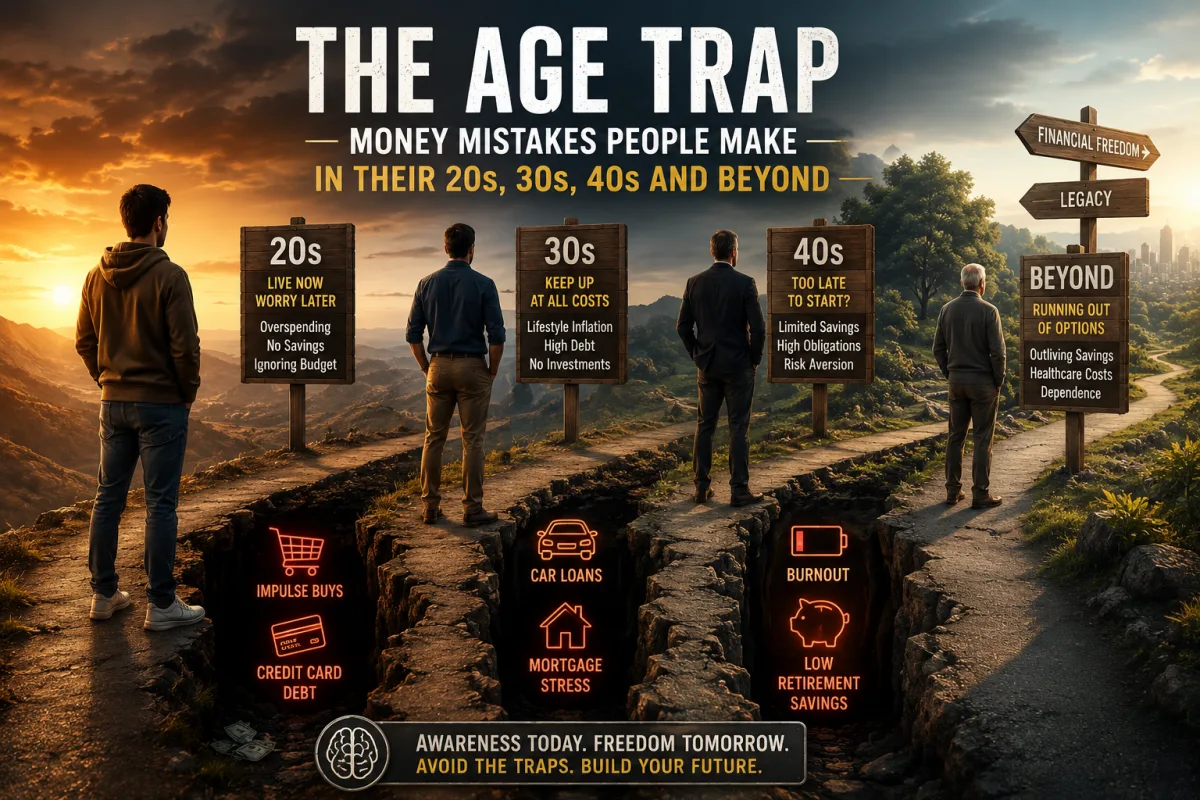
The Age Trap: Money Mistakes People Make in Their 20s, 30s, 40s and Beyond
Money mistakes are not the same at every age.
A 22-year-old and a 52-year-old may both struggle financially, but usually for different reasons. The younger person may be losing time, building poor habits, avoiding investing, overspending socially or treating credit as extra income. The older person may be carrying too much debt, delaying retirement planning, supporting too many people, ignoring health costs or realizing too late that income alone did not become wealth.
This is why personal finance should be understood by life stage.
Every decade has its own financial opportunities and traps. Your 20s offer time, energy, learning capacity and the power of early compounding. Your 30s often bring higher income, family decisions, housing choices, career growth and bigger obligations. Your 40s are a critical wealth-building decade because income may be stronger, but responsibilities can also peak. Your 50s and beyond demand seriousness because retirement moves from distant idea to approaching reality.
The danger is that each decade’s mistakes can follow a person into the next one.
A person who ignores saving in their 20s may enter their 30s with no cushion. A person who inflates lifestyle in their 30s may enter their 40s with high fixed expenses. A person who delays investing in their 40s may enter their 50s with panic instead of a plan. A person who reaches their 50s with no retirement strategy may find that time, once the greatest asset, is now the missing ingredient.
Financial progress does not require living perfectly at every age. Everyone makes mistakes. The problem is not making one mistake. The problem is allowing a decade of mistakes to compound quietly.
The best time to correct financial behavior is always the current decade.
Why Money Mistakes Change With Age
Money mistakes change with age because income, responsibilities, time horizon and risk are constantly changing.
In the early adult years, time is abundant but money may be limited. The biggest opportunity is to build habits and start investing early. The biggest risk is wasting time because the numbers look small. A young adult may think saving or investing a little does not matter. But early habits have decades to compound.
In the 30s, income may begin rising, but obligations often rise too. Marriage, children, rent, mortgages, career changes, school fees, insurance, business ambitions and family support can all arrive at once. The biggest opportunity is to turn rising income into assets. The biggest risk is lifestyle inflation.
In the 40s, the financial margin can become powerful or disappear completely. Many people are in their peak earning years, but they may also be supporting children, aging parents, mortgages, businesses and social expectations. The biggest opportunity is aggressive wealth building. The biggest risk is realizing that high income has not translated into net worth.
In the 50s and beyond, retirement is no longer abstract. Health, debt, insurance, estate planning, adult children, aging parents and withdrawal planning become urgent. The biggest opportunity is to consolidate, protect and prepare. The biggest risk is denial.
Each decade asks a different question. In your 20s: will you build the foundation early? In your 30s: will you control growth before lifestyle consumes it? In your 40s: will you convert peak earning power into wealth? In your 50s: will you protect your future before time runs out?
Money Mistakes in Your 20s
Your 20s are financially powerful because time is on your side.
This is the decade when small habits can become enormous advantages. The first emergency fund, first investment account, first debt-free month, first salary negotiation, first budget and first consistent savings habit may seem modest, but they set direction. A person who learns to manage money early has decades to benefit.
The great mistake of the 20s is believing the decade does not matter because wealth still feels far away.
Many young adults assume they will fix money later when they earn more. Sometimes income does rise later. But habits also harden. Debt can accumulate. Lifestyle expectations can grow. Years of compounding can disappear. The 20s are not about becoming rich immediately. They are about becoming the kind of person who can build wealth.
1. Having No Savings
No savings in your 20s creates future stress.
At this age, many people are starting careers, studying, freelancing, building businesses or trying to stabilize income. Money may be tight. But having no savings means every unexpected cost becomes a crisis. A medical bill, rent gap, phone repair, family emergency, delayed paycheck or transport issue can push a person into debt.
The first savings goal should not be glamorous. Build a small emergency fund. Even a modest cushion can prevent borrowing. Then aim for one month of essential expenses, then three months as income stabilizes.
The habit matters more than the amount at first. A young adult who saves consistently, even in small amounts, learns that income is not only for spending. That lesson is the beginning of wealth.
2. Spending to Impress
Your 20s can be socially expensive.
Friends may be going out, traveling, buying new phones, upgrading wardrobes, attending events and posting lifestyles online. The pressure to look successful can arrive before financial stability. This creates a dangerous pattern: spending for status while savings remain empty.
The problem is not enjoyment. The problem is performance spending. A person may spend money they do not have to create an image that does not build wealth.
The solution is to define personal priorities early. Spend on what genuinely matters, but stop financing appearances. If an expense would not feel worthwhile without an audience, it deserves questioning.
The wealthiest decision in your 20s may be learning to live below your image.
3. Ignoring Investing
Ignoring investing in your 20s means losing time.
Many young adults delay investing because they feel they do not earn enough, do not know enough or have more urgent priorities. Some delay for five, ten or fifteen years. The cost is not only missed contributions. It is missed compounding.
Investing early allows money to grow over a longer period. Small amounts invested consistently can become meaningful because they have decades to compound. A person who starts later can still build wealth, but they may need much larger contributions to catch up.
The beginner should not chase complicated investments. Start by learning the basics: diversified funds, retirement accounts, employer plans, bonds, shares, risk, fees, taxes and time horizon. Invest money that is meant for long-term goals, not rent or emergency needs.
The first investment is not only financial. It is psychological. It changes identity from consumer to owner.
4. Using Credit Cards Badly
Credit cards can become financial traps when treated as extra income.
A credit limit is not money earned. It is borrowing capacity. If a young adult uses credit cards to fund lifestyle and carries balances, interest can grow quickly. Minimum payments may create the illusion of control while the debt lingers for years.
Credit cards should be payment tools, not survival tools. If used, they should be paid in full by the due date. If that is not possible, the spending is probably too high for current income.
Learning credit discipline early protects future opportunities. Poor credit habits can affect borrowing costs, housing, business financing and stress levels later.
The rule is simple: never let yesterday’s lifestyle consume tomorrow’s paycheck.
5. Having No Side Income or Skill Growth
Your 20s are a powerful decade for building earning potential.
Some people rely only on their first job and never develop additional skills. This can limit growth. The digital economy rewards people who can write, sell, design, code, analyze data, manage projects, create content, teach, consult or solve specialized problems.
A side income is not only about extra money. It can teach sales, customer service, pricing, discipline and market demand. It can also become emergency income if a job ends.
The best place to begin is skill-building. What skill could increase your income in the next two years? What service could you offer? What problem can you solve better than others?
Your first side income may be small. But the skill behind it can become a lifelong asset.
6. Partying Too Much
Excessive partying can waste both money and potential.
Social life matters. Friendship matters. Rest and enjoyment matter. But when nightlife, alcohol, travel, events, dining and entertainment consume most disposable income, financial growth stalls. The hidden cost is not only the money spent. It is also lost energy, missed learning time, weak health, poor work performance and delayed goals.
The goal is not to eliminate fun. The goal is to avoid building a lifestyle around constant spending.
A useful habit is setting a monthly enjoyment budget. Spend it without guilt, but stop when the limit is reached. This creates balance between present life and future freedom.
7. Having No Goals
No goals means no direction.
A young adult without financial goals may spend whatever arrives because nothing specific is being built. Goals turn money into a tool. A goal may be an emergency fund, debt freedom, a professional certification, a business launch, a first investment account, a home deposit, travel without debt or moving out independently.
Goals should be written and measurable. “I want to save more” is weak. “I want to save $2,000 in the next 12 months” gives direction. “I want to invest” is vague. “I want to invest 10 percent of income monthly” creates behavior.
Your 20s do not need a perfect life plan. But they do need financial direction.
How to Win Financially in Your 20s
To win financially in your 20s, build the foundation early.
Track spending. Build a starter emergency fund. Avoid high-interest debt. Learn how investing works. Start investing even if the amount is small. Build valuable skills. Increase income deliberately. Live below your means. Avoid comparison spending. Set goals that make money useful.
The 20s are not about having everything figured out. They are about avoiding mistakes that steal time. Time is the great advantage of youth. Protect it.
Money Mistakes in Your 30s
Your 30s are often the decade where financial life becomes heavier.
Income may rise, but so do responsibilities. Many people marry, have children, buy homes, start businesses, care for relatives, move cities, upgrade lifestyles or take on larger debts. The financial decisions become larger and harder to reverse.
The biggest risk in your 30s is confusing higher income with financial progress.
If income rises but spending, debt and obligations rise at the same speed, wealth does not grow. The 30s should be a decade of converting earning power into net worth. If lifestyle consumes the entire increase, the decade can pass with little to show for it.
1. Lifestyle Inflation
Lifestyle inflation is one of the most common money mistakes in the 30s.
A person earns more and upgrades everything: housing, car, clothes, holidays, restaurants, subscriptions, gadgets and social spending. The upgrades may feel normal because peers are doing the same. But every permanent expense reduces future flexibility.
Lifestyle inflation creates empty accounts because it absorbs raises before they become assets.
The solution is to capture income increases deliberately. When income rises, allocate part to investments, emergency savings, retirement or debt repayment before upgrading lifestyle. Enjoy some progress, but do not let lifestyle consume all progress.
Wealth grows when income rises faster than expenses.
2. Having No Emergency Fund
No emergency fund in your 30s creates constant panic.
This decade often includes higher fixed obligations. Rent or mortgage, children, school fees, insurance, car payments, family support and debt may all be present. Without cash reserves, one emergency can destabilize the entire household.
A proper emergency fund should reflect real responsibilities. A single person with stable income may need less. A family with children and one main earner may need more. A business owner may need both personal and business reserves.
Emergency savings should be liquid and separate from daily spending. Its job is not to earn high returns. Its job is to prevent crisis borrowing.
In your 30s, an emergency fund is no longer optional. It is household infrastructure.
3. Delaying Investments
Delaying investments in your 30s can shrink future retirement options.
Some people reach their 30s and still say they will invest later. But later becomes expensive. The 30s still offer meaningful compounding time, but the advantage is smaller than it was in the 20s. Waiting another decade increases the pressure on future contributions.
Investing should become systematic in this decade. Retirement accounts, employer plans, diversified funds, shares, bonds, property or business investments may all play a role depending on circumstances. The key is consistency.
A person in their 30s should aim to invest a growing percentage of income. If debt is high, investments may begin alongside debt repayment once emergency savings and high-interest debt strategy are in place.
Delaying investment is not caution if it becomes avoidance.
4. Depending on One Income
Depending entirely on one income source creates risk.
A job can be lost. A business can slow. A client can leave. A company can restructure. An industry can change. A household with one income and many obligations is vulnerable.
This does not mean everyone must build five side hustles immediately. It means income resilience should be a goal. Build skills, maintain professional networks, create side income, invest for dividends or interest, support a spouse’s earning power, or build a business gradually.
Multiple income streams can begin small. A freelance project, rental room, consulting offer, digital product, investment portfolio or weekend business can create additional strength.
The goal is not busyness. The goal is reducing dependence on one fragile source.
5. Ignoring Insurance
Ignoring insurance in your 30s can create expensive mistakes.
This is the decade when more people have dependents, debt, property, vehicles, businesses or family responsibilities. A medical crisis, disability, accident, death of a breadwinner, theft, fire or liability claim can destroy financial progress.
Insurance should match real risks. Health insurance, life insurance, disability or income protection, property insurance, vehicle insurance, business insurance and liability protection may all matter depending on your life.
The mistake is either having no insurance or buying the wrong insurance without understanding it. Read policy terms. Understand exclusions, premiums, limits and claim conditions.
Insurance is not exciting, but it protects the wealth-building plan from disasters too large to absorb alone.
6. Buying Liabilities
Your 30s can become the decade of expensive liabilities.
Many people buy cars, furniture, electronics, luxury goods and lifestyle upgrades through debt. These purchases may provide comfort, but they do not usually build wealth. They create payments.
An asset puts money into your future. A liability takes money from your future. Some purchases are necessary, but the problem begins when liabilities are bought to signal success.
Before a major purchase, ask whether it strengthens net worth or weakens it. Does it generate income? Does it reduce necessary costs? Does it improve earning power? Or does it mainly create status and monthly payments?
The 30s should be the decade of buying assets before appearances.
7. Having No Financial Plan
No financial plan in your 30s creates delayed freedom.
At this age, financial decisions become too important to manage casually. A plan should include budgeting, debt repayment, emergency savings, investing, retirement, insurance, tax planning, children’s education, housing and estate basics.
A plan does not need to be complicated. It should answer practical questions. How much do we save? How much do we invest? Which debt comes first? How much emergency cash is enough? What insurance is needed? What are the next five financial goals?
Without a plan, money is managed by urgency and emotion. With a plan, money is directed.
How to Win Financially in Your 30s
To win financially in your 30s, turn rising income into rising net worth.
Build a full emergency fund. Invest consistently. Avoid lifestyle inflation. Protect the household with insurance. Reduce destructive debt. Build income resilience. Create a written financial plan. Track net worth. Choose assets before liabilities.
The 30s are not only about earning more. They are about making sure more income becomes more freedom.
Money Mistakes in Your 40s
Your 40s can be a powerful wealth-building decade.
Many people have more experience, stronger skills and higher income than they had in earlier years. But they may also face heavy responsibilities: children, school fees, mortgages, aging parents, business obligations, health concerns and social pressure.
The 40s are dangerous because they can create the illusion that there is still plenty of time.
There may be time, but not unlimited time. Retirement is closer. Children’s education may be near. Health may begin to matter more. Career changes may become more complicated. The investment runway is shorter than it was.
This decade requires financial seriousness.
1. Having No Passive Income
No passive income in your 40s can mean working forever, or at least working longer than desired.
Passive income does not mean effortless money. It means income from assets, systems or ownership rather than direct labor alone. Dividends, interest, rental income, business distributions, royalties, digital products and investment withdrawals can all play a role.
In the 40s, the goal should be to build income sources beyond active work. This may begin through retirement accounts, investment portfolios, property, business ownership or intellectual property.
The mistake is relying entirely on salary while spending everything. If active income stops, the household has no backup engine.
Passive income begins with surplus. Create surplus, buy assets, reinvest income and let time work.
2. Poor Health Habits
Poor health habits can become bigger costs in your 40s.
Health affects income, expenses and quality of life. Ignoring sleep, exercise, nutrition, stress, medical checkups and mental health can eventually reduce earning power and increase medical costs.
A person may work hard to build wealth while quietly damaging the body that earns the income. This is not sustainable.
Health should be part of financial planning. Preventive care, insurance, fitness, rest and stress management are not luxuries. They protect earning ability and reduce the risk of expensive crises.
Your health is one of your largest financial assets. Treat it accordingly.
3. Supporting Everyone
Supporting everyone can drain wealth.
By the 40s, many people are financially relied upon by children, parents, siblings, relatives, employees or community networks. Helping others is meaningful. But unlimited support can destroy the giver’s financial future.
The mistake is saying yes to every request while neglecting retirement, emergency savings and debt repayment. This can create resentment and long-term insecurity.
The solution is sustainable generosity. Create a family support budget. Decide what can be given without damaging essential goals. Help relatives build capacity where possible. Do not use debt to maintain the image of being able to rescue everyone.
A stronger financial foundation allows better support over time.
4. Making No Investments
No investments in your 40s means missed opportunities.
Cash savings alone may not be enough for retirement or long-term wealth because inflation reduces purchasing power. Investing is how money participates in growth.
If someone reaches their 40s with little invested, the response should not be shame. It should be action. Calculate net worth. Build a plan. Increase savings rate. Use retirement accounts where available. Consider diversified investments aligned with risk tolerance and time horizon.
The 40s still provide time for compounding, but the plan must become more intentional. Waiting another decade can create serious pressure.
Investing in your 40s is not too late. But delay becomes more expensive every year.
5. Fear of Change
Fear of change can create stagnation.
By the 40s, people may avoid career moves, business changes, skill upgrades or investment decisions because they fear risk. They may stay in underpaid roles, outdated industries, weak businesses or stagnant habits because the familiar feels safer.
But refusing all change is also risky. Industries shift. Technology advances. Health changes. Children grow. Markets move. Skills can become outdated.
The goal is not reckless change. It is intelligent adaptation. Learn new skills. Review career options. Improve business systems. Rebalance investments. Consider whether your current path still supports your future.
Stability is valuable, but stagnation can become expensive.
6. Overspending
Overspending in your 40s can delay retirement.
This is often the decade of higher lifestyle expectations. Larger homes, better cars, children’s activities, private education, travel, family events and social obligations can all increase spending. If income is strong, overspending may be hidden for years.
The problem appears when retirement savings are reviewed and the numbers are weak.
Every recurring expense should be tested. Does this spending support our values? Can we afford it while still investing enough? Are we funding status or freedom? Are children’s expenses balanced with retirement needs?
Your 40s should be the decade of margin. If every dollar is consumed, future options shrink.
7. Having No Discipline
No discipline in your 40s can mean no wealth despite years of work.
By this decade, financial habits have often become deeply established. If spending is uncontrolled, debt is normal, investing is irregular and goals are vague, income may continue passing through without becoming assets.
Discipline does not mean misery. It means alignment. Money should follow priorities, not impulses.
Set automatic investment contributions. Review net worth. Reduce debt. Create spending limits. Protect savings from lifestyle pressure. Make financial review a monthly habit.
In the 40s, discipline is no longer optional. It is the bridge between earning and becoming financially secure.
How to Win Financially in Your 40s
To win financially in your 40s, use peak earning power wisely.
Increase investment contributions. Build passive income sources. Protect health. Manage family support sustainably. Avoid lifestyle excess. Upgrade skills. Review retirement numbers. Reduce major debts. Create a serious financial plan.
The 40s are a decade of conversion. Convert income into assets, assets into income and discipline into freedom.
Money Mistakes in Your 50s and Beyond
Your 50s and beyond are the decades where financial avoidance becomes costly.
There is still time to improve, but less time to recover from major mistakes. Retirement planning, health planning, estate planning, debt reduction and income protection become urgent. The financial question changes from “How much can I build?” to “How long can what I build support me?”
This stage requires honesty.
1. Having No Retirement Plan
No retirement plan creates financial fear.
Many people reach their 50s without knowing how much they need, how much they have, when they can retire or what income will support them. The uncertainty creates anxiety, but avoidance makes it worse.
A retirement plan should estimate expenses, income sources, savings, investments, pensions, property income, business income, healthcare costs, taxes, inflation and desired retirement age.
If the numbers are weak, action is still possible. Increase savings, reduce expenses, work longer, downsize, pay off debt, build income streams or adjust retirement expectations. The plan may not be ideal, but it can be improved.
The worst retirement plan is no plan.
2. Living Beyond Means
Living beyond means in your 50s creates endless stress.
At this stage, debt-funded lifestyle is especially dangerous because there are fewer working years left to recover. Large car loans, credit card balances, unnecessary home upgrades, luxury travel and family spending can weaken retirement security.
The solution is to align lifestyle with reality. This may require difficult decisions: downsizing, cutting recurring expenses, selling unused assets, reducing support commitments or delaying major purchases.
Living within means is not failure. It is protection.
3. Having No Assets
No assets in later life creates insecurity.
Assets are what support life when active income slows. These may include retirement accounts, investment portfolios, property, business ownership, cash reserves, bonds, annuities, pensions or income-producing rights.
If someone reaches their 50s with few assets, the priority is to build aggressively and protect what exists. Increase savings rate. Use available retirement vehicles. Reduce debt. Build conservative investments appropriate to time horizon. Avoid speculative risks that could destroy capital.
It may be tempting to chase high returns to catch up quickly. This can be dangerous. A major loss late in life is harder to recover from.
The focus should be disciplined accumulation, not desperate speculation.
4. Depending Fully on Children
Depending fully on children can create lost independence.
In many families, adult children support parents. This can be honorable and loving. But relying entirely on children without building any personal financial base can create pressure for the next generation. Children may have their own families, debts, health issues, job instability and goals.
The goal should be to preserve as much independence as possible. Build savings, reduce debt, protect health, use pensions or benefits where available, consider smaller housing, create income from assets and communicate openly with family.
Family support can be part of the plan, but it should not be the only plan if alternatives exist.
5. Ignoring Health
Ignoring health in later life can create rising expenses.
Medical costs can become one of the largest retirement risks. Poor health can reduce earning ability, increase dependence and drain savings. Preventive care, insurance, exercise, nutrition, sleep and stress management become financially important.
Health planning should include insurance review, medical checkups, emergency reserves, long-term care considerations where relevant and lifestyle changes that reduce future risk.
Money and health are connected. A retirement plan that ignores health is incomplete.
6. Having No Estate Plan
No estate plan creates family confusion.
Estate planning is not only for the wealthy. Anyone with children, property, savings, investments, insurance, business interests or debts should have a plan for what happens after death or incapacity.
A basic estate plan may include a will, updated beneficiaries, property documents, account records, insurance details, powers of attorney, guardianship decisions and clear instructions for family members. Business owners may need succession plans.
Without planning, families may face legal delays, conflict, hidden accounts, disputed property and unnecessary stress.
Estate planning is an act of care.
7. Having No Purpose
No purpose can create a mental decline after work slows.
Retirement is not only a financial event. It is a life transition. Work often provides routine, identity, community, status and meaning. Leaving work without a purpose can create boredom, isolation or depression.
Financial planning should include life planning. What will you do with time? Who will you spend it with? What gives meaning? Will you volunteer, mentor, travel, teach, farm, consult, create, care for family, build a small business or serve your community?
Money can fund retirement, but purpose gives retirement shape.
How to Win Financially in Your 50s and Beyond
To win financially in your 50s and beyond, become brutally honest and deeply intentional.
Calculate retirement readiness. Reduce debt. Build and protect assets. Review insurance. Plan healthcare. Create an estate plan. Avoid risky catch-up schemes. Support children wisely without losing your own independence. Define purpose beyond work.
It is never too late to improve. But later decades require faster honesty.
The Mistake That Appears in Every Decade
Although each age has different traps, one mistake appears everywhere: living without financial direction.
In your 20s, no direction creates wasted time. In your 30s, no direction creates lifestyle inflation. In your 40s, no direction creates missed wealth-building opportunities. In your 50s, no direction creates retirement fear.
Financial direction does not require perfection. It requires knowing what money is supposed to do. Is it building emergency security? Paying off debt? Buying assets? Funding education? Protecting family? Creating freedom? Supporting retirement? Building a legacy?
Money without direction is absorbed by life. Money with direction becomes power.
How to Correct Money Mistakes at Any Age
The first step is to calculate your current position. List income, expenses, assets and debts. Calculate net worth. Know the truth.
The second step is to create surplus. Reduce waste, increase income and stop destructive debt. Without surplus, financial progress remains fragile.
The third step is to build emergency savings. Cash reserves prevent ordinary shocks from becoming debt.
The fourth step is to attack high-interest debt. Free future income from past spending.
The fifth step is to invest consistently. Convert income into assets that can grow.
The sixth step is to protect against risk. Insurance, health planning, legal documents and diversification matter.
The seventh step is to review progress regularly. Net worth, savings rate, debt balances and investment contributions reveal whether life is improving financially.
The eighth step is to match financial decisions to life stage. A 25-year-old should not invest like a 60-year-old. A 55-year-old should not take the same speculative risks as someone with 40 years to recover.
The ninth step is to stop using shame as an excuse. Shame keeps people stuck. Action creates recovery.
Final Thoughts
Every age carries financial opportunities and financial traps.
Your 20s give you time, but time can be wasted. Your 30s may bring rising income, but income can be consumed by lifestyle inflation. Your 40s may bring earning power, but earning power can disappear into obligations without becoming assets. Your 50s and beyond may still offer improvement, but avoidance becomes more expensive.
The goal is not to live perfectly in every decade. The goal is to understand what each decade requires.
In your 20s, build the foundation: save, learn, invest early, avoid bad debt and develop earning power. In your 30s, control lifestyle, protect family, invest consistently and build a plan. In your 40s, convert income into assets, manage obligations and prepare seriously for independence. In your 50s and beyond, protect wealth, reduce debt, plan retirement, prepare your estate and design a meaningful life beyond work.
Money mistakes become dangerous when they remain invisible. Once they are named, they can be corrected.
No decade is financially hopeless. A person can start late and still improve. A person can recover from debt. A person can rebuild after mistakes. A person can begin investing after years of delay. A person can reduce lifestyle, increase income, repair credit, build savings and create a retirement plan.
The earlier the correction begins, the more time it has to compound. But the current decade is always the decade you can control.
Financial wisdom is not only knowing what to do with money. It is knowing what your age demands, what your future needs and what mistakes must stop before they become permanent.
 Article
 Article
 Article
 Article
 Article
 Article
 Article
 Article