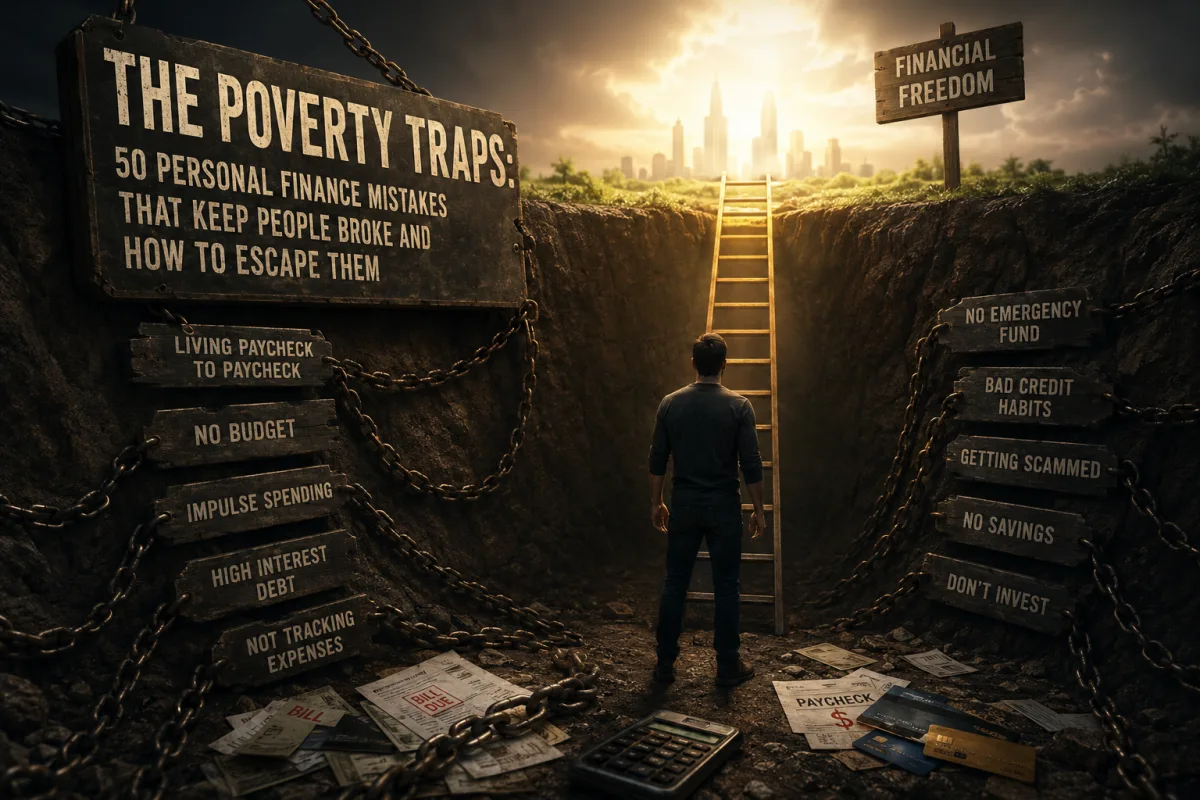
The Poverty Traps: 50 Personal Finance Mistakes That Keep People Broke and How to Escape Them
Poverty is not always caused by one dramatic financial failure.
Sometimes it is caused by small mistakes repeated for years. A little overspending. A little debt. A little delay. A little avoidance. A little comparison. A little fear of investing. A little lifestyle inflation after every raise. None of these choices may look catastrophic in a single month. But over time, they compound into financial weakness.
This is one of the hardest truths in personal finance: people can work hard and still remain broke if their money habits quietly destroy progress.
A person may earn more than they used to and still feel trapped. They may receive promotions, bonuses, business profits, side income, gifts, or windfalls, yet the bank balance remains low and debt remains high. The problem is not always income. Often, the problem is the system that receives the income.
Money needs direction. Without direction, it drifts toward bills, impulses, emergencies, status, debt, and short-term comfort. Wealth is not built only by earning. It is built by keeping, protecting, and multiplying part of what is earned.
The 50 mistakes below are not written to shame anyone. Many people make them because of pressure, lack of education, family responsibilities, economic difficulty, social expectations, or simply because no one taught them another way. The goal is not blame. The goal is recognition. Once a mistake becomes visible, it can be corrected.
Financial progress begins when a person stops asking only, “Why am I not earning enough?” and also asks, “What is my money doing after I earn it?”
1. Living Without a Clear Picture of Where Money Goes
The first mistake is financial blindness.
Many people earn, spend, borrow, repay, and repeat without ever seeing the full pattern. They know money is tight, but they do not know exactly why. They may blame one large bill while ignoring dozens of small leaks. They may think they are careful because they remember a few disciplined choices, but their bank statements reveal a different story.
Without tracking, money becomes emotional. A person feels broke but cannot diagnose the cause. They feel guilty after spending but do not know which category is the problem. They promise to “do better” but never define what better means.
To avoid this mistake, track every expense for at least 30 days. Use a notebook, spreadsheet, bank export, budgeting app, or simple categories. The tool matters less than honesty. Divide expenses into housing, food, transport, debt, family support, subscriptions, entertainment, insurance, savings, giving, and miscellaneous spending.
The goal is not perfection. The goal is visibility. You cannot control what you refuse to measure.
2. Confusing Income With Wealth
A high income can create comfort, but it does not automatically create wealth.
Income is money coming in. Wealth is what remains and grows after expenses and liabilities. A person can earn a large salary and still have low net worth if they spend everything. Another person can earn moderately and build wealth steadily by saving, investing, and avoiding destructive debt.
This mistake keeps people poor because it encourages lifestyle confidence before financial strength exists. A raise becomes permission to spend. A bonus becomes a luxury purchase. A strong month in business becomes proof that money will always be available.
To avoid this mistake, track net worth, not only income. Net worth equals assets minus liabilities. Assets include savings, investments, retirement accounts, property equity, and business value. Liabilities include credit cards, loans, mortgages, overdrafts, and unpaid obligations.
If income rises but net worth does not, wealth is not being built. The money is passing through.
3. Spending First and Saving Whatever Is Left
Many people save only after all spending is done. The problem is that nothing is usually left.
Life always presents reasons to spend. Bills arrive. Friends invite. Children need things. Homes need repairs. Phones break. Food costs rise. A sale appears. A social event comes up. If saving waits until spending is finished, saving becomes optional and fragile.
Wealth builders reverse the order. They pay themselves first. As soon as income arrives, a portion goes to savings, investments, emergency reserves, or debt reduction before lifestyle spending begins.
To avoid this mistake, automate saving. Treat your future like a mandatory bill. Start with an amount you can sustain, even if small. Increase it when income rises. The habit matters first; the amount can grow over time.
Saving what is left gives the present full control. Paying yourself first gives the future a seat at the table.
4. Having No Emergency Fund
Without emergency savings, every surprise becomes debt.
A car repair, medical bill, rent increase, delayed salary, job loss, family emergency, or home repair can push a household into borrowing. The person may use credit cards, mobile loans, overdrafts, salary advances, or informal debt. The emergency passes, but the debt remains.
This is how many people stay poor: not because they never earn, but because every unexpected event resets progress.
To avoid this mistake, build an emergency fund gradually. Start with a small starter reserve, then grow toward one month of essential expenses, then three months, then more if your income is unstable or you have dependents. Keep the money liquid and separate from daily spending.
An emergency fund is not wasted cash. It is protection against being forced into expensive decisions.
5. Using Credit Cards as Income
A credit card limit can feel like extra money, but it is not income. It is borrowed capacity.
When people use credit cards to maintain a lifestyle they cannot pay for in full, they are moving today’s spending into tomorrow’s income. The next paycheck arrives already weakened by yesterday’s purchases. If the balance is carried, interest makes the original purchase more expensive.
This mistake keeps people stuck because credit card debt often compounds against them. Minimum payments create the illusion of control while balances decline slowly or continue growing.
To avoid this mistake, use credit cards only as payment tools, not borrowing tools. Charge only what can be paid in full by the due date. If you already carry balances, stop adding new debt and create a repayment plan.
A credit card should support convenience, not survival.
6. Paying Only Minimum Payments
Minimum payments are designed to keep an account current, not to free the borrower quickly.
A person making only minimum payments may feel responsible because they are paying on time. But much of the payment may go toward interest. The balance can remain for years, especially if new purchases continue.
This mistake drains wealth quietly. Money that could build an emergency fund or investment account goes to finance charges instead.
To avoid it, pay more than the minimum whenever possible. Use the debt avalanche method by attacking the highest-interest debt first, or the debt snowball method by paying the smallest balance first for momentum. Stop using the card while paying it down.
The minimum payment keeps the lender satisfied. It does not necessarily make you financially free.
7. Borrowing for Lifestyle Instead of Assets
Debt used for lifestyle can become a poverty trap.
Borrowing for clothes, holidays, gadgets, celebrations, furniture, dining, or status purchases may create short-term pleasure but long-term obligation. The purchase loses excitement quickly, while payments continue.
Not all debt is equal. Debt used carefully for education, property, or business may increase earning power or asset ownership. But debt used to appear successful often delays actual success.
To avoid this mistake, ask before borrowing: will this debt increase my income, acquire an asset, reduce a necessary cost, or protect something valuable? If not, it may be lifestyle debt. Save for it instead, reduce the purchase, delay it, or skip it.
Borrowing should build the future, not decorate the present.
8. Letting Lifestyle Rise With Every Raise
Lifestyle inflation is one of the main reasons people stay broke despite earning more.
A raise should create more surplus. Instead, it often creates a larger apartment, better car, more expensive restaurants, upgraded phone, longer holidays, and new obligations. The person earns more but still feels the same pressure because expenses rose too.
This mistake is dangerous because it feels deserved. People work hard and want to enjoy progress. The problem is not enjoyment. The problem is allowing every increase to become spending.
To avoid it, decide in advance how raises and bonuses will be allocated. For example, invest half of every raise, save part of every bonus, and use only a defined portion for lifestyle. This allows enjoyment while still building wealth.
Income growth becomes powerful only when spending grows slower than income.
9. Buying Things to Impress People
Status spending is expensive because it serves an audience that may not even care.
People buy cars, clothes, phones, homes, events, and experiences to signal success. The pressure can come from friends, family, colleagues, social media, or personal insecurity. The problem is that appearances are not assets. Looking wealthy can prevent becoming wealthy.
This mistake keeps people poor by directing money toward symbols rather than ownership. The person may receive admiration but lose financial flexibility.
To avoid it, separate genuine enjoyment from performance. Ask: would I still buy this if no one saw it? Would I still value it if I could not post it, mention it, or use it to signal status? Does it fit my financial plan?
Wealth grows faster when money is used to build freedom before it is used to buy applause.
10. Not Knowing the Difference Between Needs and Wants
Many financial problems begin when wants are promoted into needs.
A need supports survival, stability, health, work, family responsibility, or essential functioning. A want improves comfort, pleasure, identity, convenience, or status. Wants are not bad, but confusing them with needs destroys prioritization.
When everything feels necessary, nothing can be cut. The budget becomes rigid. Debt becomes easier to justify. Saving feels impossible.
To avoid this mistake, classify expenses honestly. Housing is a need, but the most expensive housing option may be a want. Food is a need, but constant delivery may be a want. Transport is a need, but a luxury vehicle may be a want.
The goal is not to eliminate wants. The goal is to fund needs, savings, and investments before wants consume the plan.
11. Ignoring Small Leaks
Small expenses can become large when repeated.
Subscriptions, delivery fees, snacks, unused memberships, app purchases, bank charges, impulse buys, convenience fees, and small daily habits may not seem serious individually. Together, they can absorb money that could build savings or reduce debt.
This mistake persists because each expense feels too small to matter. But wealth is often shaped by repeated patterns, not isolated events.
To avoid it, review bank and card statements monthly. Cancel unused subscriptions. Set spending limits for convenience purchases. Use cash or debit for categories that tend to leak. Build awareness around repeated small transactions.
A leak does not need to be large to sink progress if it never stops.
12. Ignoring Big Structural Costs
Some people focus on small leaks while ignoring major financial burdens.
Housing, transport, school fees, debt payments, insurance, taxes, and family obligations often determine whether a household has surplus. A person may cancel subscriptions and still struggle because rent or car payments are too high.
This mistake keeps people poor because large fixed expenses reduce flexibility every month. Once committed, they are harder to change.
To avoid it, evaluate the big categories before upgrading. Keep housing reasonable relative to income. Avoid car loans that strain cash flow. Be realistic about school, location, commuting, and lifestyle commitments. If a structural cost is already too high, develop a transition plan rather than ignoring it.
Small savings matter, but large decisions shape the financial architecture.
13. Not Having a Budget
A budget is not punishment. It is a plan for income.
Without a budget, money is allocated by impulse, urgency, habit, and pressure. The person may pay bills and spend normally, then realize too late that savings and important goals were ignored.
A budget does not need to be complicated. It should identify income, fixed expenses, variable expenses, debt payments, savings, investments, and future obligations. It should be realistic enough to follow.
To avoid this mistake, create a simple monthly budget before the month begins. Assign every major category. Include irregular expenses by saving for them monthly. Review at the end of the month and adjust.
A budget does not restrict freedom. It directs money toward the freedom you want.
14. Creating Unrealistic Budgets
An unrealistic budget fails because it ignores real life.
Some people create strict plans that leave no room for food variation, transport changes, children’s needs, gifts, repairs, entertainment, or emergencies. The budget looks good on paper but collapses by the second week. Then the person feels like budgeting does not work.
The issue is not budgeting. The issue is fantasy budgeting.
To avoid it, use past spending as evidence. If you usually spend a certain amount on groceries, do not cut it in half without a real plan. Include a miscellaneous category. Include sinking funds. Allow modest enjoyment so the budget can survive.
A good budget should challenge waste, not deny reality.
15. Not Saving for Irregular Expenses
Many expenses are predictable but irregular.
Insurance premiums, school fees, car repairs, holidays, medical checkups, birthdays, property repairs, annual subscriptions, taxes, and professional fees may not happen every month, but they happen. When no money is set aside, they feel like emergencies.
This mistake creates debt cycles. The expense arrives, the person borrows, then spends the next months repaying. By the time the debt is cleared, another irregular expense appears.
To avoid it, create sinking funds. Divide expected annual costs by 12 and save monthly. Keep the money separate from daily spending.
Irregular does not mean unexpected. Planning turns future shocks into normal expenses.
16. Waiting Too Long to Invest
Many people delay investing until they feel rich enough, smart enough, or certain enough.
They wait for higher income, perfect market timing, more confidence, or a large lump sum. Years pass. The opportunity lost is not only the money they did not invest, but the compounding time they gave away.
Investing early matters because time is one of the most powerful wealth-building tools. Small amounts invested consistently can grow meaningfully over long periods.
To avoid this mistake, start with education and simple diversified investments appropriate to your goals and risk tolerance. Begin with amounts you can sustain. Increase contributions as income grows. Do not invest emergency money or money needed soon in volatile assets.
The perfect time is visible only in hindsight. The disciplined time is often now, if the foundation is stable.
17. Trying to Get Rich Quickly
The desire for quick wealth can lead to slow poverty.
People chase schemes, hot tips, speculative trades, guaranteed high returns, unregulated platforms, and businesses they do not understand because steady progress feels too slow. Some make money briefly, then lose more because risk was ignored.
Quick-rich thinking is dangerous because it appeals to impatience and desperation. It encourages concentration, leverage, secrecy, and emotional decisions.
To avoid it, ask hard questions. How does this investment make money? What could go wrong? Who regulates it? Can I lose capital? Why is the return so high? Why is this opportunity being offered to me? What fees apply? Can I exit?
Wealth built too fast without understanding is often lost just as fast.
18. Investing Without Understanding the Asset
Buying what you do not understand is not investing. It is guessing.
People invest in stocks, property deals, crypto assets, private loans, businesses, funds, and structured products without understanding how returns are generated. They rely on friends, influencers, salespeople, or excitement.
This mistake keeps people poor because ignorance hides risk. By the time problems appear, it may be too late to exit.
To avoid it, explain the investment in plain language before committing money. What do you own? How does it produce return? What are the risks? How liquid is it? What fees apply? What is the worst-case scenario? How does it fit your portfolio?
If you cannot explain it simply, you are not ready to risk serious money.
19. Putting All Money in One Investment
Concentration can create wealth, but it can also destroy it.
Some people put nearly everything into one stock, one property, one business, one currency, one employer, one friend’s deal, or one sector. If it works, the results can be impressive. If it fails, the damage can be severe.
This mistake often comes from overconfidence. The investor believes they have found the opportunity. They underestimate the possibility of being wrong.
To avoid it, diversify across asset classes, sectors, institutions, and sources of return. Do not allow one investment to determine your financial survival unless you fully understand and can withstand the risk.
Diversification is humility converted into portfolio design.
20. Keeping Too Much Money Idle
Cash is necessary, but excessive idle cash can weaken long-term wealth.
Some people save diligently but never invest. They keep all money in low-yield accounts for years because they fear losses. The balance appears safe, but inflation reduces purchasing power over time.
Cash should have a job. Emergency cash protects. Short-term savings fund upcoming expenses. But long-term money usually needs growth assets to maintain and increase purchasing power.
To avoid this mistake, separate money by time horizon. Money needed soon should remain safe and liquid. Money needed in many years can be invested according to risk tolerance and goals.
Safety is not only avoiding price movement. It is also protecting future purchasing power.
21. Not Increasing Income
Cutting expenses matters, but income growth matters too.
Some people focus only on saving pennies while ignoring skills, career growth, negotiation, business opportunities, or side income. They become excellent at restriction but never expand earning power.
This can keep people stuck, especially when income is too low to support basic needs and wealth goals. A budget cannot solve every income problem.
To avoid this mistake, treat earning power as an asset. Learn valuable skills. Ask for raises when justified. Change jobs strategically. Freelance. Consult. Sell a service. Build a business. Seek roles closer to revenue, responsibility, or specialized expertise.
Wealth grows faster when discipline meets rising income.
22. Depending on One Income Source Forever
One income source is convenient until it disappears.
A job can be lost. A client can leave. A business can slow. A tenant can move out. A platform can change rules. A product can become outdated. Dependence on one income stream creates vulnerability.
To avoid this mistake, build additional income gradually. This may include freelance work, dividends, interest, rental income, consulting, digital products, business profits, royalties, or investments. Start with one stream that fits your skills and time.
The goal is not to become distracted by many projects. The goal is to reduce dependence over time.
Financial resilience improves when income has more than one engine.
23. Underpricing Your Work
Many people stay financially stuck because they charge too little or accept too little.
This affects employees, freelancers, consultants, and business owners. They fear asking for more. They assume clients will leave. They undervalue experience. They accept low pay for years without testing the market.
Underpricing creates a hidden poverty trap because the person may work hard but generate insufficient surplus.
To avoid it, research market rates. Track your results. Improve your skills. Practice negotiation. Raise prices gradually where value supports it. Move toward better clients or employers. Do not confuse being affordable with being valuable.
Your income should reflect the value you create, not only the fear you carry.
24. Not Negotiating
Failure to negotiate can cost a lifetime of money.
People avoid negotiation because it feels uncomfortable. They accept first salary offers, vendor prices, loan terms, rent increases, client fees, and business deals without discussion. Over years, the cost compounds.
To avoid this mistake, prepare before negotiation. Know market rates. Know your value. Know alternatives. Ask respectfully and specifically. Negotiate salary, benefits, payment terms, interest rates, supplier contracts, and professional fees where appropriate.
Negotiation is not greed. It is financial self-advocacy.
25. Ignoring Insurance
Insurance feels unnecessary until it becomes essential.
People often avoid insurance because premiums feel like money lost. But one uninsured medical crisis, accident, disability, death, fire, theft, lawsuit, or business interruption can destroy years of progress.
Insurance is not an investment. It is risk transfer. Its purpose is to protect against losses too large to comfortably absorb.
To avoid this mistake, review major risks. Health, life, disability, income protection, property, liability, vehicle, and business insurance may matter depending on your situation. Do not over-insure small risks while ignoring catastrophic ones.
Wealth is not only built by growth. It is preserved by protection.
26. Buying the Wrong Insurance
Having insurance is not enough if the cover does not match the risk.
Some people buy policies they do not understand because an agent recommended them. Others mix investment and insurance without understanding costs. Some have life insurance but no income protection. Others insure phones but ignore health or disability risk.
To avoid this mistake, read policy terms. Understand exclusions, premiums, waiting periods, benefit limits, claim conditions, and surrender costs. Buy insurance for clear risks. Compare options. Seek independent advice where needed.
The right insurance solves a real financial problem. The wrong insurance creates false confidence.
27. Ignoring Taxes
Taxes affect real income, real returns, and real cash flow.
People stay poor when they treat tax as an afterthought. Freelancers spend all client income without reserving tax. Landlords ignore rental obligations. Investors misunderstand withholding or capital gains. Business owners mix personal and business money, then panic at filing time.
To avoid this mistake, learn the tax rules that apply to your income streams. Keep records. Set aside tax money as income is earned. File on time. Use legal deductions and tax-advantaged accounts where available. Get professional help when finances become complex.
Tax planning is not optional once income grows. It is part of keeping wealth.
28. Mixing Business and Personal Money
Business owners and freelancers often damage their finances by mixing money.
They use business revenue for personal spending, pay personal bills from business accounts, fail to reserve taxes, and cannot tell whether the business is profitable. The bank balance becomes misleading because some money belongs to suppliers, taxes, payroll, or future operating costs.
To avoid this mistake, separate accounts. Pay yourself a defined salary or owner draw. Track revenue, expenses, profit, taxes, and reserves. Keep business records clean. Do not treat gross revenue as personal income.
A business can make sales and still leave the owner poor if cash is not managed properly.
29. Not Knowing the Difference Between Revenue and Profit
Revenue is what comes in. Profit is what remains after costs.
This mistake affects entrepreneurs, freelancers, landlords, and side hustlers. They celebrate sales but ignore expenses, taxes, fees, repairs, advertising, inventory, transport, software, commissions, and time.
To avoid it, calculate net profit regularly. For every income stream, subtract all costs. Include hidden costs such as your time, maintenance, debt service, and tax. Measure profit margins, not just top-line income.
Revenue creates excitement. Profit builds wealth.
30. Failing to Plan for Retirement
Many people postpone retirement planning because it feels far away.
They assume they will start later, earn more later, invest later, or rely on children, business, property, or government support. But later becomes expensive because lost time cannot be recovered easily.
Retirement planning is not only for old age. It is the process of building assets that can support you when active income slows or stops.
To avoid this mistake, start contributing early, even modestly. Use retirement accounts, pension schemes, employer matches, investment portfolios, and long-term assets where appropriate. Increase contributions as income grows.
The best time to prepare for future independence is before dependence becomes urgent.
31. Depending on Children as a Retirement Plan
Family support is meaningful, but relying entirely on children for retirement can create pressure and risk.
Children may have their own families, debts, health issues, income limitations, or economic struggles. Depending on them fully can strain relationships and pass financial instability to the next generation.
To avoid this mistake, build your own retirement assets as much as possible. Invest, insure, reduce debt, and create income-producing assets. Teach children financial responsibility rather than making them the sole retirement plan.
Support from family can be a blessing. It should not be the only strategy.
32. Not Teaching Children About Money
Wealth can disappear when the next generation does not understand money.
Parents may work hard, build assets, and sacrifice, but never teach children budgeting, saving, investing, debt, work ethic, delayed gratification, or stewardship. Children then repeat mistakes or consume inherited wealth quickly.
To avoid this mistake, involve children in age-appropriate money lessons. Teach saving, giving, earning, budgeting, and wise spending. Explain the difference between assets and liabilities. Model discipline. Discuss money without creating fear or entitlement.
Financial education at home can become a form of inheritance.
33. Avoiding Money Conversations With a Partner
Money silence can damage relationships and finances.
Couples may avoid discussing debt, spending, goals, family obligations, income, accounts, or financial fears. One partner may save while the other borrows. One may invest while the other spends. Hidden debt may emerge too late.
To avoid this mistake, schedule regular money conversations. Discuss income, expenses, debts, savings, goals, responsibilities, and values. Agree on shared priorities. Maintain transparency around major financial decisions.
A household cannot build wealth if its financial direction is divided and hidden.
34. Choosing the Wrong Financial Partner
The person you build life with can strongly affect your financial future.
A partner with destructive debt habits, gambling problems, chronic overspending, financial secrecy, unwillingness to work, or refusal to plan can make wealth building difficult. Love matters, but financial behavior also matters.
To avoid this mistake, discuss money before major commitments. Understand each other’s debts, goals, habits, family obligations, and expectations. Seek alignment, not identical personalities. Build systems for shared decisions.
Financial compatibility is not about both people earning the same. It is about both people respecting the same direction.
35. Lending Money Without Boundaries
Generosity can become financial damage when there are no limits.
People lend to friends, relatives, partners, or business contacts without written agreements, repayment dates, or realistic expectations. When repayment fails, relationships suffer and savings disappear.
To avoid this mistake, decide in advance how much you can afford to give or lend without damaging your own obligations. Put serious loans in writing. Do not lend emergency funds or investment capital casually. Be honest when you cannot help financially.
You can be generous without sacrificing your financial foundation.
36. Trying to Rescue Everyone Financially
Some people remain poor because they carry more financial responsibility than they can afford.
They support extended family, friends, partners, siblings, parents, community requests, and emergencies while neglecting their own savings and debt. The pressure may be cultural, emotional, or moral. But if giving destroys the giver, the system becomes unsustainable.
To avoid this mistake, create a giving budget. Decide what you can support monthly without harming essential goals. Help in structured ways where possible. Support people toward self-sufficiency rather than endless dependence.
A strong financial foundation allows better generosity over time.
37. Gambling With Money Needed for Stability
Gambling is not a wealth plan.
Sports betting, casino games, lotteries, speculative trading, and high-risk schemes can create excitement and the possibility of sudden gain. But when money needed for rent, food, school fees, debt repayment, or savings is risked, financial stability is endangered.
To avoid this mistake, separate entertainment from financial planning. If gambling occurs, it should be with money that can be fully lost without affecting obligations. If gambling becomes compulsive, seek help immediately.
The desire for escape can become the trap itself.
38. Ignoring Health Until It Becomes Expensive
Health and wealth are connected.
Poor health can reduce earning power, increase medical costs, interrupt work, and force family members to provide support. Ignoring preventive care, rest, nutrition, exercise, mental health, and medical checkups can become financially costly.
To avoid this mistake, treat health as part of financial planning. Maintain insurance where possible. Build emergency reserves. Take preventive care seriously. Protect sleep and mental health. Do not sacrifice health endlessly for income.
Your ability to earn is one of your largest assets. Protecting it matters.
39. Not Investing in Skills
Skills drive earning power.
People stay poor when they stop learning, remain in low-value roles, resist technology, avoid professional growth, or fail to adapt to market changes. The world changes, and income often follows value creation.
To avoid this mistake, invest in skills that increase your market value. Learn communication, sales, technology, finance, leadership, data, writing, negotiation, or specialized technical abilities. Choose skills with real demand.
Education is not valuable merely because it is expensive. It is valuable when it increases capability, opportunity, and earning power.
40. Spending Windfalls Instead of Using Them Strategically
Bonuses, refunds, gifts, inheritances, commissions, and business profits can change a financial life if used well.
Many people spend windfalls immediately because the money feels extra. They buy luxuries, travel, upgrade gadgets, host events, or settle short-term desires. Soon the money is gone and nothing lasting remains.
To avoid this mistake, create a windfall rule before money arrives. Allocate portions to debt repayment, emergency savings, investing, business capital, giving, and enjoyment. This prevents emotion from deciding everything.
A windfall should move you forward, not merely make one month feel rich.
41. Not Having Clear Financial Goals
Money without goals gets absorbed by life.
People who do not define goals may save inconsistently, invest randomly, overspend easily, and borrow without a clear reason. Goals give money direction.
To avoid this mistake, write specific goals: emergency fund amount, debt-free date, investment contribution target, home deposit, retirement number, education fund, business capital, or income goal. Attach timelines and monthly actions.
A goal turns money from a vague resource into a tool.
42. Copying Other People’s Financial Decisions
What works for someone else may be wrong for you.
People buy homes, cars, stocks, businesses, insurance products, or investment schemes because friends or relatives did. They do not consider income, risk tolerance, debt, family obligations, liquidity, or goals.
To avoid this mistake, evaluate decisions based on your own numbers. Ask whether the choice fits your cash flow, time horizon, risk capacity, and priorities. Learn from others, but do not outsource judgment to their circumstances.
Personal finance is personal because context matters.
43. Trusting Financial Advice Without Checking Incentives
Not everyone giving financial advice is neutral.
Salespeople may earn commissions. Influencers may earn sponsorship income. Friends may want validation for their own decisions. Advisors may have conflicts. This does not mean advice is always bad, but incentives matter.
To avoid this mistake, ask how the person is paid. Read documents. Compare options. Seek regulated or qualified professionals when needed. Get second opinions for major decisions. Understand before signing.
Good advice can build wealth. Bad advice can become expensive for years.
44. Ignoring Fees
Fees can quietly reduce wealth.
Investment fees, account fees, loan fees, insurance charges, management fees, transaction costs, penalties, late fees, overdraft fees, and platform charges may seem small individually. Over time, they can consume significant money.
To avoid this mistake, review all fees. Understand what you pay and why. Choose low-cost investments where appropriate. Avoid late payment penalties. Compare loan and insurance costs. Pay for value, not confusion.
Every unnecessary fee is money that cannot compound for you.
45. Not Reading Contracts
Financial contracts define obligations, but many people sign without reading.
Loans, leases, insurance policies, investment agreements, business partnerships, employment contracts, service agreements, and property documents can contain fees, penalties, lock-ins, exclusions, rate changes, obligations, and legal risks.
To avoid this mistake, read before signing. Ask questions. Seek professional advice for large commitments. Understand exit terms, penalties, interest rates, renewal clauses, and responsibilities.
A contract you did not read can still control your money.
46. Staying in Bad Financial Habits Because of Shame
Shame keeps people stuck.
A person may avoid checking balances, opening bills, discussing debt, seeking help, or admitting mistakes because they feel embarrassed. Avoidance allows problems to grow.
To avoid this mistake, separate your identity from your financial situation. Debt is a problem to solve, not proof of personal failure. Missed savings are a signal, not a life sentence. Ask for help, create a plan, and begin with one corrective action.
Shame thrives in silence. Progress begins with honesty.
47. Selling Investments in Panic
Market declines are uncomfortable, but panic selling can damage long-term wealth.
People invest during optimism, then sell during fear. They convert temporary volatility into permanent loss. Later, they hesitate to reinvest until prices recover, missing part of the rebound.
To avoid this mistake, invest according to time horizon and risk tolerance. Keep emergency cash so you are not forced to sell. Diversify. Create an investment policy. Expect declines before they happen.
The best time to prepare for market fear is before fear arrives.
48. Taking Too Little Risk
Risk avoidance can also keep people poor.
Some people fear all investing, entrepreneurship, negotiation, career moves, or growth opportunities. They keep all money in cash, stay underpaid, avoid learning new skills, and never buy assets. They feel safe but fall behind inflation and opportunity.
To avoid this mistake, distinguish smart risk from reckless risk. Smart risk is researched, measured, diversified, and aligned with goals. Reckless risk is emotional, concentrated, and poorly understood.
Building wealth requires some risk. The goal is not to avoid risk completely, but to take the right risks intelligently.
49. Failing to Plan for Death or Disability
Many people build financial lives with no continuity plan.
If they die or become incapacitated, families may struggle to access accounts, manage property, continue businesses, pay debts, or understand insurance. Lack of planning can create legal delays and family conflict.
To avoid this mistake, prepare basic estate documents. Update beneficiaries. Keep records of accounts, policies, debts, assets, and important contacts. Discuss essential information with trusted people. Business owners should create succession plans.
Planning for death is not pessimism. It is protection for those who remain.
50. Believing It Is Too Late to Change
The final mistake is giving up.
People may believe they are too old, too indebted, too underpaid, too far behind, or too financially damaged to improve. This belief becomes self-fulfilling. If change feels impossible, no action is taken.
It may be too late to start early, but it is not too late to start wisely. A 25-year-old can benefit from time. A 45-year-old can benefit from focus. A 60-year-old can benefit from clarity, debt reduction, and better planning. Every stage has a next best move.
To avoid this mistake, stop comparing your starting point to someone else’s progress. Identify the next level: track spending, create surplus, build reserves, pay debt, invest, increase income, protect assets, or plan retirement. Start there.
The past explains the current situation. It does not have to control the next decision.
The Pattern Behind These Mistakes
The 50 mistakes may appear different, but many share the same roots.
Some come from lack of awareness. People do not track money, calculate net worth, read contracts, or understand investments.
Some come from lack of margin. Expenses rise to meet income, emergencies create debt, and savings never begin.
Some come from emotional spending. Comparison, shame, status, fear, and impatience override judgment.
Some come from poor protection. No emergency fund, no insurance, no estate plan, and no diversification leave the household vulnerable.
Some come from underinvestment. People delay investing, avoid skill growth, keep money idle, or take too little smart risk.
Some come from weak systems. Without budgets, sinking funds, tax reserves, and automatic savings, every month depends on willpower.
The solution is not one perfect financial move. It is building a system that prevents repeated mistakes.
How to Start Escaping the Mistakes
Start with visibility. Track income, expenses, debts, and assets. Know the truth.
Then create margin. Reduce waste, renegotiate costs, control lifestyle, and increase income where possible. Without margin, every plan remains fragile.
Build a starter emergency fund. This prevents the next surprise from becoming debt.
Attack high-interest debt. Free your future income from past spending.
Automate saving and investing. Do not rely only on motivation.
Invest in skills. More earning power gives the plan more fuel.
Protect against major risks. Review insurance, legal documents, and family responsibilities.
Learn before investing. Avoid schemes, hype, and pressure.
Review progress regularly. Net worth, debt balances, savings rate, and investment contributions reveal whether life is improving financially.
Most importantly, change one habit at a time. Trying to fix all 50 mistakes in one week creates discouragement. Choose the mistake causing the greatest damage and correct it first.
Final Thoughts
People are not kept poor only by lack of income. They are often kept poor by financial systems that leak, borrow, react, delay, and avoid.
A person can earn more and remain stuck if lifestyle rises, debt grows, savings are ignored, investments are delayed, and risk is unmanaged. Another person can begin with modest income and move forward by creating surplus, protecting cash flow, investing consistently, and avoiding destructive mistakes.
The goal is not perfection. Everyone makes money mistakes. The danger is repeating them without learning.
Financial progress begins when mistakes become visible. A budget reveals leaks. A net worth statement reveals reality. A debt list reveals urgency. An emergency fund creates protection. An investment plan creates direction. A conversation with a partner creates alignment. A decision to stop borrowing for lifestyle creates freedom.
Wealth is not built by one heroic decision. It is built by hundreds of corrected habits.
Each avoided mistake leaves more money available for stability, ownership, and freedom. Each better decision weakens the cycle of financial stress. Each month of discipline proves that the future does not have to repeat the past.
The path out of being broke is not mysterious. Earn with intention. Spend with awareness. Save before life absorbs everything. Borrow carefully. Invest patiently. Protect what you build. Learn continuously. Refuse to let shame, comparison, or impatience direct your money.
Personal finance is not about becoming perfect with money. It is about becoming honest enough, disciplined enough, and patient enough to let better choices compound.
 Article
 Article
 Article
 Article
 Article
 Article
 Article
 Article