The Savings Priority: Why Paying Yourself First Breaks the Paycheck-to-Paycheck Cycle
Most people do not plan to live paycheck to paycheck. It happens quietly.
At first, the problem looks temporary. A salary comes in, bills are paid, food is bought, rent is settled, transport is handled, school fees are considered, airtime and data are topped up, a debt payment is made, and a few personal needs are covered. By the time the month reaches its final week, the money has thinned out. Savings are postponed. The person promises to do better next month.
Then next month arrives with its own emergencies, social obligations, price increases, medical costs, family requests, and small daily purchases that never seemed large enough to matter. The cycle repeats. Income enters. Income exits. The worker remains busy, responsible, and exhausted, but not financially stronger.
The paycheck-to-paycheck trap is not always caused by laziness or lack of ambition. Many hardworking people fall into it. Some earn modest incomes and face genuine pressure from rent, food, transport, school costs, healthcare, and debt. Others earn good incomes but still save little because their lifestyle expands to consume every raise. The numbers differ, but the pattern is the same: money is treated as available for spending before it is assigned to building security.
The most important shift is simple but powerful: savings must come first.
That does not mean bills should be ignored. It does not mean people should pretend that rising costs are easy. It means that saving cannot be left until the end of the month, because the end of the month rarely protects your future. If savings depend on leftovers, savings will usually be small, inconsistent, or nonexistent.
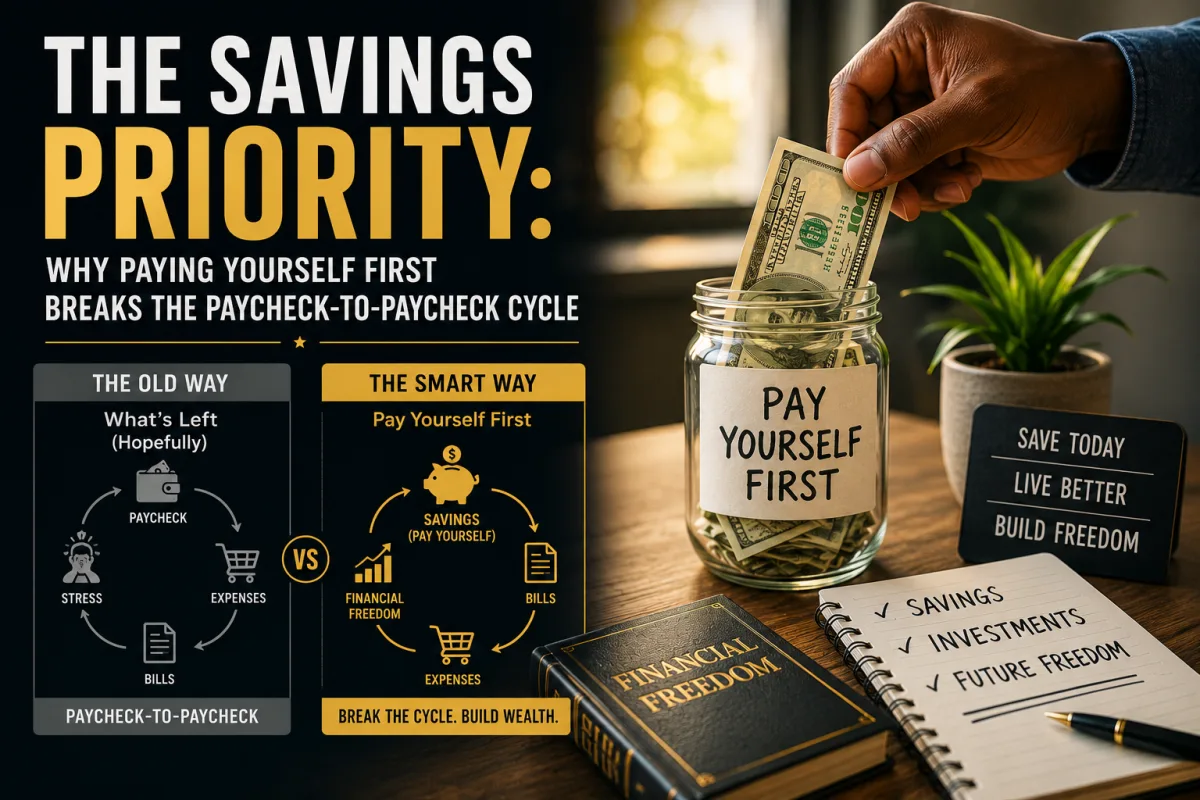
Paying yourself first changes the order of financial life. Instead of earning, spending, and hoping to save, you earn, save, and then spend within what remains. The difference is not only mathematical. It is psychological. It tells your money that your future is not optional.
The Paycheck-to-Paycheck Cycle Is a System
People often think of paycheck-to-paycheck living as a personal failure. In reality, it is usually a system made up of income, expenses, habits, obligations, debt, emotions, and planning gaps.
Income matters. A household earning too little to cover basic needs faces a real structural challenge. No budgeting method can magically turn insufficient income into abundance. When food, rent, transport, school fees, and medical costs consume almost everything, the path forward may require income growth, debt relief, lower housing costs, shared expenses, public support, or major lifestyle restructuring.
But spending habits also matter. Many households earning reasonable incomes remain trapped because money has no clear assignment. Small leaks become permanent drains. Subscriptions renew unnoticed. Transport choices become expensive. Eating out becomes routine. Social pressure turns into financial pressure. Mobile loans fill gaps and then create larger gaps through fees and interest. The person is not necessarily irresponsible. The person is financially unstructured.
A paycheck-to-paycheck cycle survives because it becomes normal. The mind adapts to scarcity. Bills are paid only when urgent. Saving is postponed until “things improve.” Debt is used to smooth over shortfalls. Income increases bring relief for a while, but spending rises to match. Each month feels separate, yet the pattern remains continuous.
Breaking the cycle requires more than motivation. It requires a new financial operating system.
Why Saving Last Usually Fails
Saving what remains after spending sounds reasonable until you observe how money behaves.
Money without a purpose is quickly claimed. If it sits in a spending account, it feels available. The mind says there is still enough. A small purchase feels harmless. A friend invites you somewhere. A family need appears. A discount seems too good to ignore. A delivery fee feels minor. A weekend plan becomes more expensive than expected. None of these decisions may seem reckless individually, but together they consume the surplus.
By the time the month ends, there is little left to save. The person concludes that saving is impossible. Yet in many cases, saving was possible at the beginning of the month before spending decisions absorbed the money.
This is why paying yourself first works. It removes savings from the battlefield of daily spending. The money is moved before temptation, obligation, forgetfulness, and lifestyle pressure can claim it.
The principle is not complicated. When income arrives, a fixed amount or percentage is transferred immediately to savings, an emergency fund, debt repayment, or investment. What remains becomes the amount available for living expenses. The act of saving is no longer a reward for perfect spending. It becomes the first bill you pay.
This order matters because financial progress depends on priority. People usually pay rent because rent is treated as non-negotiable. They pay school fees because education is treated as important. They buy food because survival is essential. Paying yourself first places your future in that same category of importance.
Saving Is Not About the Amount First
Many people delay saving because they believe the amount is too small to matter.
They say they will start when they earn more, when debt is cleared, when rent reduces, when prices stabilize, when business improves, when children grow older, or when life becomes easier. Some of those reasons are understandable. But waiting for perfect conditions is dangerous because financial life rarely becomes perfectly calm.
The first goal of saving is not to become wealthy overnight. The first goal is to build the habit of keeping part of what you earn.
A person who saves a small amount consistently is learning a skill. That skill can expand when income rises. A person who saves nothing while earning little may still save nothing when earning more because the habit was never built. Income growth without saving discipline often leads to lifestyle inflation, not wealth.
This is why the starting amount matters less than the starting behavior. Saving 5% of income may seem modest, but it creates a pattern. Saving even a fixed small amount each payday creates evidence that the future deserves a claim on today’s income.
Over time, the amount can increase. A person may begin with 3%, move to 5%, then 10%, then higher as debt falls or income grows. The savings rate becomes a measure of financial strength. The key is to begin with an amount that can survive real life, then improve it deliberately.
The Emergency Fund: Your First Financial Wall
An emergency fund is not glamorous. It does not promise high returns. It will not impress people at a dinner table. But it is one of the most important assets a household can own.
An emergency fund is money set aside for unexpected expenses: medical bills, job loss, urgent travel, household repairs, school emergencies, delayed income, business slowdowns, or family crises. It protects you from turning every surprise into debt.
Without an emergency fund, life becomes expensive in a different way. A small crisis forces borrowing. Borrowing creates repayments. Repayments reduce next month’s income. Reduced income creates another shortfall. Another shortfall leads to more borrowing. What began as one emergency becomes a debt cycle.
An emergency fund interrupts that chain.
It gives you breathing room. It allows you to make decisions without panic. It reduces dependence on high-cost loans, salary advances, overdrafts, credit cards, or informal borrowing. It gives dignity because you do not have to explain every crisis to friends, relatives, employers, or lenders.
The ideal emergency fund size depends on life circumstances. A single person with stable employment and low obligations may start with one month of essential expenses. A household with children, irregular income, medical needs, or dependents may need three to six months or more. A self-employed person may need a larger cushion because income can fluctuate.
The first target should be achievable. Build a small starter fund first. Then expand it. Trying to build six months of expenses immediately may feel discouraging. Building the first week of expenses, then the first month, creates momentum.
Where an Emergency Fund Should Be Kept
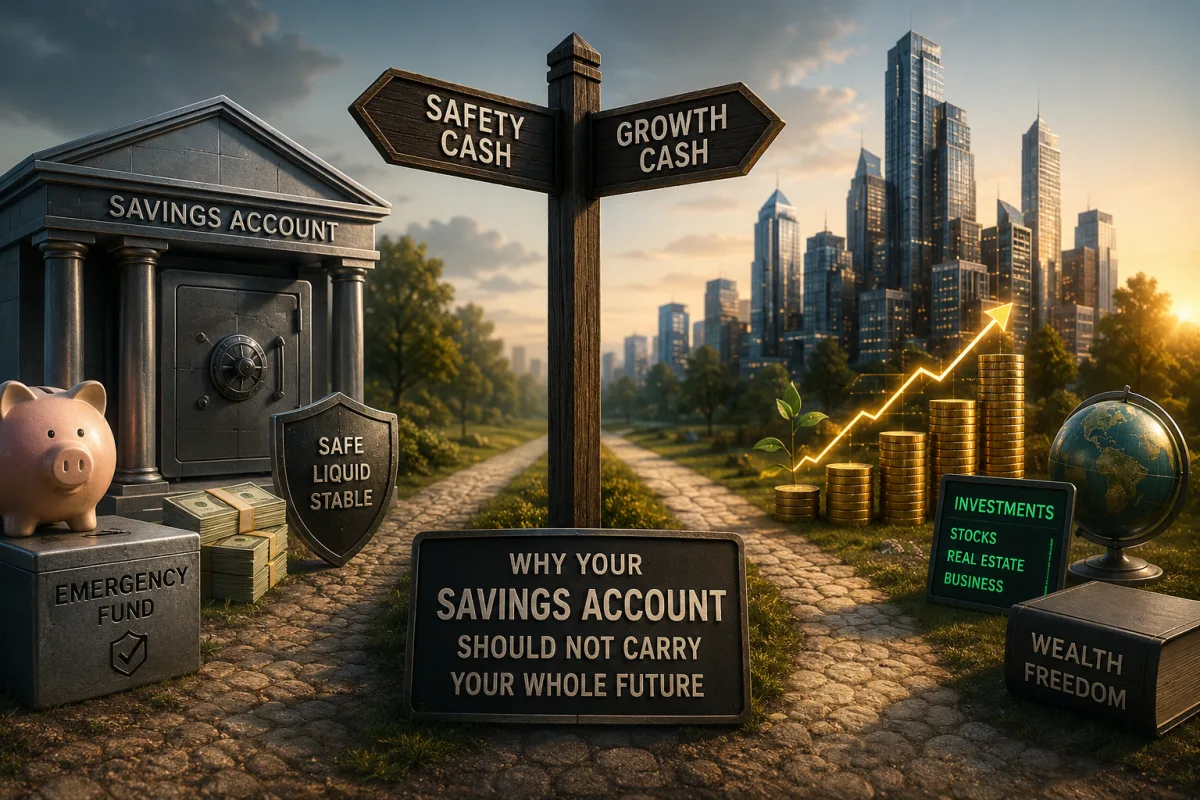
An emergency fund should be safe, accessible, and separate from everyday spending.
Safety matters because emergency money is not meant for speculation. It should not be placed in risky investments that may fall in value when you need the cash. Accessibility matters because emergencies do not wait for complicated withdrawal processes. Separation matters because money mixed with daily spending tends to disappear.
The right place depends on the financial products available to the household. It may be a savings account, a money market fund, a separate mobile savings wallet, or another low-risk cash-like account. The key is not to chase the highest return. The key is to protect liquidity and discipline.
An emergency fund is not designed to make you rich. It is designed to prevent financial setbacks from becoming financial disasters.
Budgeting Is Not Punishment
Many people dislike budgeting because they associate it with restriction. They imagine a budget as a document that says no to everything enjoyable.
A good budget is not punishment. It is a spending plan. It helps you decide in advance what your money must do. Without a budget, your money still goes somewhere, but often not where you would have chosen intentionally.
Budgeting gives every major category a role: housing, food, transport, utilities, school fees, debt, savings, giving, insurance, healthcare, family support, personal spending, and long-term goals. It turns income from a vague amount into an organized tool.
The power of a budget is not perfection. No month goes exactly as planned. The power is awareness. A budget shows whether your lifestyle fits your income. It reveals whether debt is taking too much space. It shows whether savings are being treated seriously. It helps you adjust before the month collapses.
People who do not budget often make decisions based on account balance. If money is still there, they spend. But an account balance can be misleading because it does not show upcoming obligations. You may have money today, but rent, school fees, loan repayment, or insurance may be due soon. A budget prevents you from mistaking available cash for free cash.
The Budget Must Reflect Real Life
A budget that looks impressive on paper but ignores reality will fail.
Some people create budgets that assume they will never attend social events, never support relatives, never buy clothes, never experience illness, never travel unexpectedly, and never want small pleasures. That kind of budget may produce a beautiful spreadsheet, but it does not survive human life.
A realistic budget includes irregular and emotional spending. It creates room for transport changes, small gifts, family support, personal care, repairs, and modest enjoyment. The goal is not to remove humanity from money. The goal is to prevent unplanned spending from destroying the financial plan.
If social obligations are part of your life, budget for them. If family support is recurring, name it clearly. If you need personal spending money, assign a limit. If you know December is expensive, prepare for it throughout the year. A budget is strongest when it tells the truth.
Truth creates control. Denial creates shortfalls.
Expense Tracking Reveals the Leaks
Most people underestimate small spending.
They remember rent, school fees, loan payments, and major purchases. They forget snacks, data bundles, delivery fees, small transfers, impulse shopping, extra transport, convenience purchases, and frequent “just this once” decisions. The amounts are small enough to feel harmless but frequent enough to become significant.
Expense tracking exposes the pattern.
For 30 days, record every expense. Not only the big ones. Every expense. Write it in a notebook, use a spreadsheet, use a budgeting app, or record it in mobile notes. The method matters less than the honesty.
At the end of the month, group the spending into categories. Food. Transport. Rent. Utilities. Debt. Family support. Entertainment. Subscriptions. Personal care. Giving. Medical. Miscellaneous. Then study the results.
The goal is not shame. The goal is information.
You may discover that transport is higher than expected. You may find that eating out costs more than groceries. You may realize that mobile money charges, data, or small transfers are adding up. You may see that debt repayments are consuming income before you can save. You may notice subscriptions you no longer value.
Once spending is visible, choices become easier. You can cut what does not matter to protect what does.
Needs, Wants, and Values
Personal finance often divides spending into needs and wants. The distinction is useful, but real life is sometimes more complex.
A need is essential for basic living: shelter, food, transport to work, healthcare, utilities, basic clothing, and education obligations. A want is something that improves comfort, pleasure, status, or convenience but is not essential. Values are the deeper priorities that give spending meaning: family, faith, health, growth, freedom, generosity, learning, security, or community.
A strong budget respects all three, but not equally.
Needs must be covered. Wants must be controlled. Values must guide trade-offs.
For example, supporting a parent may not fit neatly into a textbook category, but it may reflect a serious family value. Education spending may be expensive but aligned with long-term priorities. Health insurance may feel painful to pay but protect the household from catastrophic costs.
The danger comes when wants disguise themselves as values. Status spending often does this. A person may say they are spending for relationships, confidence, or professional image, when the real driver is social comparison. Not all image spending is wrong. Clothing, grooming, and presentation can matter professionally. But when appearance consumes savings, the cost is too high.
Financial maturity means aligning spending with true priorities, not temporary pressure.
Lifestyle Inflation: The Silent Thief of Raises
Many people believe higher income will automatically solve their financial problems. Sometimes it does. If income is too low to cover basic needs, earning more is essential. But for many earners, higher income only creates a larger version of the same problem.
This is lifestyle inflation.
Lifestyle inflation occurs when spending rises as income rises. A raise leads to a better apartment, more eating out, more expensive clothes, higher social spending, upgraded devices, larger family contributions, or a new car loan. Some upgrades may be reasonable. The danger is allowing every increase in income to be absorbed by lifestyle before it improves net worth.
The paycheck-to-paycheck cycle can exist at many income levels. The numbers grow, but the stress remains. A person earning more may have nicer furniture, better clothes, and more impressive social plans, yet still have no emergency fund and no investments.
The best time to increase savings is immediately after income increases. Before the new money becomes part of daily lifestyle, assign a portion to savings, debt reduction, and investment. If your salary rises by 20%, you do not need to raise your spending by 20%. You can improve your life and improve your future at the same time.
A powerful rule is to save part of every raise before spending the rest. This allows lifestyle to improve gradually while wealth grows deliberately.
Debt Can Steal the Future Before It Arrives
Debt is not always bad. A mortgage can help acquire a home. A business loan can finance productive expansion. Education debt may increase earning power if the cost and outcome make sense. Carefully used credit can help manage timing differences between income and expenses.
But consumer debt can trap households.
High-interest loans, mobile borrowing, credit card balances, salary advances, and informal debts often consume future income. Each repayment reduces the money available next month. When next month becomes tight, more borrowing fills the gap. The borrower feels relief today but loses flexibility tomorrow.
Debt turns future income into past spending.
This is why escaping paycheck-to-paycheck living often requires a debt plan. Saving and debt repayment should not be seen as enemies. Both create financial resilience. The right balance depends on interest rates, emergency savings, income stability, and debt pressure.
If debt interest is very high, aggressive repayment may be necessary. But even then, a small emergency fund can prevent new borrowing when unexpected expenses arise. Without any cash buffer, every emergency pushes the person back into debt.
The Debt Repayment Strategy
There are two common approaches to debt repayment.
The first is the avalanche method. You list debts by interest rate and focus extra payments on the highest-interest debt first while paying minimums on the rest. This method saves the most money mathematically because expensive debt is eliminated first.
The second is the snowball method. You list debts by balance and focus extra payments on the smallest debt first. Once it is cleared, you move to the next smallest. This method may not save the most interest, but it creates motivation by producing quick wins.
The best method is the one you can follow consistently. For some people, mathematical efficiency is motivating. For others, emotional progress matters more. What matters most is that debt stops expanding and begins shrinking.
Debt repayment should also include behavior change. If a person clears debt but keeps the same spending habits, the debt may return. The deeper goal is not only to repay what is owed. It is to stop needing expensive debt to survive ordinary months.
Income Growth Is Part of the Solution
Budgeting is powerful, but it has limits.
A person can reduce waste, track expenses, and plan carefully, yet still face a genuine income problem. When income is too low, the solution cannot be only cutting. There must also be a plan to earn more.
Income growth can come through career advancement, better negotiation, professional training, freelancing, small business, consulting, part-time work, digital skills, farming, trade, or monetizing existing abilities. The right path depends on skills, time, market demand, family responsibilities, and risk tolerance.
The key is to connect additional income to financial progress. Many people earn extra money and spend all of it because they never assign it a purpose. Side income should have a job before it arrives. It may build the emergency fund, clear debt, pay school fees, fund insurance, invest, or support a business goal.
Extra income without discipline becomes extra consumption. Extra income with a plan becomes acceleration.
Irregular Income Requires a Different Budget
Self-employed people, freelancers, commission earners, casual workers, and small business owners face a special challenge: income does not arrive predictably.
A fixed monthly budget may not work when income changes from month to month. In this case, the first step is to identify essential monthly expenses. This is the survival number. It includes rent, basic food, transport, utilities, minimum debt payments, school obligations, insurance, and other unavoidable costs.
Then build a buffer during good months. When income is high, do not treat all of it as available for spending. Set aside money for weaker months, taxes, business expenses, emergencies, and future obligations. Irregular earners need a larger cash cushion because income volatility is itself a risk.
One useful method is to pay yourself a fixed monthly amount from business or freelance income. The income enters a separate account, and you transfer a regular “salary” to your personal spending account. During strong months, the surplus remains in the buffer. During weak months, the buffer fills the gap.
This creates stability where income is unstable.
Automation Reduces Reliance on Willpower
Financial discipline becomes easier when good decisions are automated.
If you wait to decide whether to save every month, the decision must compete with mood, stress, temptation, and urgent needs. Automation removes part of that struggle. A standing order, scheduled transfer, automatic deduction, or separate savings wallet can move money before you spend it.
The goal is to make saving the default. When income arrives, savings leave immediately. What remains is what you learn to live on.
Automation works best when combined with separation. If savings remain too easy to access, they may be raided for non-emergencies. A separate account creates friction. The money is still available when truly needed, but not mixed with daily spending.
Willpower is useful, but systems are stronger. A person under pressure should not have to rely on perfect discipline every day. The financial system should support the desired behavior.
The First 90 Days of Escaping the Trap
Breaking the paycheck-to-paycheck cycle can feel overwhelming, but the first 90 days can create a foundation.
Month One: See the truth
Track every expense. List all debts. Record income. Identify fixed costs and variable spending. Calculate how much is needed for basic survival. Do not judge the numbers yet. Just see them clearly.
At the end of the month, identify three spending leaks. These are areas where money leaves without adding enough value. Choose cuts that are realistic, not dramatic. The goal is progress, not punishment.
Month Two: Build the first buffer
Choose a starter emergency fund target. It may be one week of expenses, a fixed cash amount, or enough to cover a common emergency. Pay yourself first on payday, even if the amount is small. Move the money to a separate place.
Begin paying extra toward one debt if possible. Avoid taking new consumer debt unless there is a true emergency.
Month Three: Strengthen the system
Review the budget. Adjust categories based on real spending. Automate savings if possible. Increase the savings amount slightly if the first two months worked. Create a plan for irregular expenses such as school fees, annual subscriptions, travel, insurance, or holidays.
By the end of 90 days, the person may not be wealthy, but they will no longer be financially blind. They will have a clearer budget, a savings habit, a small buffer, and a debt direction. That is the beginning of control.
Why Financial Resilience Comes Before Investing
Many people want to invest before they are financially stable. This is understandable. Investing sounds exciting. It promises growth. It feels like the path to wealth.
But investing without savings can be dangerous.
If you have no emergency fund, you may be forced to sell investments at the wrong time. If your income is unstable and your expenses are disorganized, market volatility can create panic. If high-interest debt is growing, investment returns may not overcome the cost of borrowing.
Financial resilience should come first. That means a basic emergency fund, manageable debt, clear monthly expenses, and insurance where appropriate. Once the foundation is in place, investing becomes more sustainable because you can leave investments alone long enough for compounding to work.
Saving is defense. Investing is offense. A strong financial life needs both, but defense usually comes first.
The Emotional Side of Saving
Money is not only arithmetic. It is emotional.
People spend because they are tired, stressed, lonely, proud, hopeful, afraid, generous, or under pressure. They spend to belong. They spend to reward themselves. They spend to avoid embarrassment. They spend because they grew up without enough and now want to feel free. They spend because saying no is difficult.
Any savings plan that ignores emotion will struggle.
The goal is not to remove pleasure from life. The goal is to separate meaningful spending from reactive spending. Meaningful spending aligns with values and fits within the plan. Reactive spending responds to pressure, comparison, boredom, or impulse.
One useful question before discretionary spending is: will I still respect this decision next week? Another is: does this purchase support the life I am building or only the feeling I want right now?
These questions slow down the moment. They create space between desire and decision.
Family, Culture, and Financial Boundaries
In many households, personal finance is not purely personal. Income supports siblings, parents, relatives, church obligations, community events, funerals, weddings, medical emergencies, and informal networks of care.
This generosity can be honorable. Families and communities survive because people help one another. But generosity without boundaries can create financial instability. A person who gives beyond capacity may become the next person in need of rescue.
The answer is not selfishness. The answer is planned generosity.
If family support is part of your life, include it in the budget. Decide what you can afford. Communicate limits respectfully. Avoid making promises based on income you do not yet have. Do not borrow at high interest to maintain an image of generosity. Sustainable support is better than dramatic support that destroys your finances.
Financial boundaries protect both the giver and the people who depend on the giver. When your financial foundation is stronger, your ability to help becomes stronger too.
What to Do When the Budget Still Does Not Work
Sometimes a person tracks expenses, cuts waste, creates a budget, and still cannot save. This is discouraging, but it is valuable information.
If the budget does not work, the problem may be structural. Housing may be too expensive relative to income. Debt payments may be too high. School costs may need restructuring. Transport may be consuming too much. Income may be insufficient. Medical costs may require insurance or family planning. Business income may be too unstable.
At this point, small cuts may not be enough. A major decision may be required: moving to cheaper housing, renegotiating debt, finding a roommate, changing transport patterns, increasing income, selling an expensive asset, pausing nonessential commitments, or seeking professional financial advice.
Hard decisions are not signs of failure. They are signs that the numbers are finally being respected.
The Wealth Principle Behind Paying Yourself First
Every financial life is shaped by one question: who gets paid from your income?
The landlord gets paid. The lender gets paid. The supermarket gets paid. The transport provider gets paid. The school gets paid. The mobile network gets paid. The entertainment provider gets paid. The government gets paid. The question is whether you also get paid.
Paying yourself first means you are not only a worker, consumer, borrower, and bill payer. You are also a builder of assets.
This is the foundation of wealth. Wealth grows when part of income is converted into assets before it disappears into consumption. At first, the asset may be cash savings. Later, it may become money market funds, bonds, retirement accounts, business capital, real estate, stocks, or education that increases earning power. But the first act is the same: keep part of what you earn.
A person who earns and spends everything remains dependent on the next income cycle. A person who earns, saves, and invests gradually buys freedom from that cycle.
The Final Shift: From Survival to Ownership
The paycheck-to-paycheck trap is exhausting because it keeps the future permanently underfunded.
Every month becomes a race to reach the next payday. Every emergency becomes a threat. Every delay in income becomes a crisis. Every opportunity feels out of reach because there is no capital. The person may be working hard, but money never stays long enough to become power.
Paying yourself first changes that direction.
It begins with one decision: before the world claims all your income, your future will claim part of it. That decision may start small. It may feel uncomfortable. It may require cutting expenses, saying no, tracking money, facing debt, or seeking more income. But over time, the habit becomes identity.
You stop seeing saving as deprivation. You begin seeing it as protection. You stop treating emergencies as proof that planning is impossible. You begin using planning to reduce the damage of emergencies. You stop waiting for leftovers. You begin assigning money to freedom before lifestyle absorbs it.
This is how financial resilience is built. Not through one dramatic decision, but through repeated acts of priority.
The paycheck-to-paycheck cycle is broken when saving becomes non-negotiable, spending becomes intentional, debt becomes managed, income becomes purposeful, and the future is funded before comfort consumes the present.
That is the quiet power of paying yourself first.
It turns income into security. It turns discipline into options. It turns small savings into confidence. And over time, it turns a monthly paycheck into the foundation of lasting wealth.
 Article
 Article
 Article
 Article
 Article
 Article
 Article
 Article