
The Government Securities Ladder: How Treasury Bills and Bonds Turn Cash Into Predictable Wealth
Many people want their money to grow, but they are afraid of losing it. They hear about shares rising and falling, businesses failing, property disputes, cryptocurrency crashes, investment scams, and friends who put money into schemes that disappeared. This fear is understandable. Wealth creation requires risk, but not every form of risk is suitable for every person or every goal.
Treasury bills and Treasury bonds occupy a special place in the investment world because they are among the most widely used tools for balancing safety, income, and predictability. They are issued by governments to raise money, and investors buy them in exchange for a return. For households, institutions, pension funds, insurance companies, banks, and conservative investors, government securities often form the backbone of financial planning.
Yet many ordinary investors do not fully understand them. Some think Treasury bills are only for banks and wealthy people. Some assume Treasury bonds are complicated. Others hear about attractive interest rates and invest without understanding maturity, price, yield, inflation, taxes, liquidity, or interest rate risk. A tool that should bring stability can create confusion when used blindly.
The purpose of Treasury bills and bonds is not to make investors rich overnight. Their power is quieter. They help investors preserve capital, earn predictable income, diversify portfolios, plan for future cash needs, and build wealth through disciplined reinvestment. They can turn idle cash into productive capital. They can turn lump sums into income. They can turn short-term savings into structured financial ladders. They can give an investor a reliable foundation on which riskier wealth-building assets can rest.
The investor who understands government securities gains more than an investment product. They gain a framework for thinking about time, risk, income, and financial planning.
What Are Treasury Bills?
Treasury bills, commonly called T-bills, are short-term government securities. They are issued by a government to borrow money for a short period, usually less than one year. Instead of paying interest periodically, T-bills are commonly sold at a discount and redeemed at face value when they mature.
For example, an investor may buy a T-bill with a face value of 100,000 for 96,000. At maturity, the government pays the investor 100,000. The difference of 4,000 is the investor’s return before taxes and costs, where applicable. The investor does not receive monthly interest. The return is built into the discounted purchase price.
This structure makes T-bills useful for short-term cash management. They are often issued in maturities such as 91 days, 182 days, or 364 days, though exact terms depend on the country. Because they mature quickly, investors use them for money they may need soon but do not want to leave idle.
T-bills are especially useful for emergency reserves beyond immediate spending cash, school fees planning, business working capital, tax reserves, project funds, short-term savings goals, and money waiting for another investment opportunity. They are more structured than a normal bank account and often offer better returns than idle cash, while still keeping maturity periods relatively short.
The key idea is simple: a Treasury bill is a short-term loan from the investor to the government.
What Are Treasury Bonds?
Treasury bonds, commonly called T-bonds, are longer-term government securities. When an investor buys a Treasury bond, they are lending money to the government for a longer period, often several years. In return, the government usually pays periodic interest, commonly called coupon payments, and repays the principal at maturity.
For example, an investor may buy a 10-year Treasury bond with a face value of 100,000 and a coupon rate of 12 percent per year. Depending on the bond terms, the investor may receive interest payments once or twice a year. At the end of the 10 years, the government repays the principal amount.
Treasury bonds are useful for investors seeking predictable income over a longer period. They are often used by retirees, pension schemes, insurance companies, long-term savers, income investors, and people who want more predictable cash flow than shares or business income can provide.
Unlike T-bills, which are mainly about short-term placement of cash, T-bonds are about long-term income and capital planning. They can fund retirement income, education planning, future construction, wealth preservation, or portfolio diversification.
The key idea is equally simple: a Treasury bond is a longer-term loan from the investor to the government, usually with regular interest payments.
Why Governments Issue T-Bills and T-Bonds
Governments need money to operate. They collect taxes, fees, duties, and other revenues, but spending needs may exceed available cash at certain times. Governments borrow to fund budgets, refinance maturing debt, support infrastructure, manage cash flow, and finance development priorities.
Treasury bills help governments manage short-term funding needs. Treasury bonds help governments raise longer-term money. By issuing securities to investors, the government creates a formal borrowing system instead of relying only on taxes or direct loans.
For investors, this creates an opportunity. They can lend to the government and earn a return. For the financial system, government securities create a benchmark for interest rates. Banks, pension funds, fund managers, insurers, and individual investors all use government securities as reference points for pricing risk and allocating capital.
This is why Treasury markets are important beyond individual investors. They influence borrowing costs, bank lending rates, pension returns, fund performance, and the broader economy.
The Difference Between Treasury Bills and Treasury Bonds
The main difference between Treasury bills and Treasury bonds is time.
Treasury bills are short-term. They mature within a year or less in many markets. They are usually sold at a discount and redeemed at face value. They are often used for liquidity, short-term savings, and cash management.
Treasury bonds are long-term. They may mature after two, five, ten, fifteen, twenty, or more years depending on the issuing government. They usually pay periodic interest and return principal at maturity. They are often used for income, long-term planning, and portfolio stability.
The second difference is how returns are received. T-bill returns are usually received at maturity through the difference between purchase price and face value. T-bond returns usually come through coupon payments during the life of the bond, plus repayment of principal at maturity.
The third difference is interest rate risk. Because T-bills mature quickly, their prices are less sensitive to changes in interest rates. Longer-term bonds are more sensitive. If interest rates rise after you buy a long bond, the market value of your bond may fall if you sell before maturity. If interest rates fall, the market value may rise.
The fourth difference is planning purpose. T-bills are better suited for short-term goals. T-bonds are better suited for long-term income and capital allocation.
A strong investor does not ask which one is better in general. The better question is: which one fits the purpose of this money?
How Investors Make Money From T-Bills
T-bill returns are usually earned through discount pricing. The investor pays less than the face value and receives the full face value at maturity.
Suppose an investor buys a 182-day T-bill with a face value of 100,000 at a discounted price of 95,500. At maturity, the investor receives 100,000. The gross return is 4,500. The actual annualized yield depends on the maturity period, purchase price, taxes, and calculation method.
This is different from a bank account where interest may be credited monthly or quarterly. With a T-bill, the investor typically knows the maturity date and the amount to be received at maturity. This makes planning easier.
T-bills can also be rolled over. When one matures, the investor can reinvest the proceeds into another T-bill. This creates a cycle of short-term compounding. The investor may also ladder maturities so that different T-bills mature at different times, creating regular access to cash.
The return from a T-bill may look modest compared with speculative investments, but its strength lies in predictability and capital preservation. A person who consistently places short-term money into T-bills instead of allowing it to sit idle can improve financial discipline and earn returns with relatively lower risk.
How Investors Make Money From T-Bonds
T-bond investors earn mainly through coupon payments and, if they sell before maturity, possible capital gains or losses.
The coupon is the stated interest rate paid on the bond’s face value. If an investor owns a bond with a face value of 1,000,000 and a coupon rate of 12 percent per year, the annual coupon income is 120,000 before taxes where applicable. If paid semi-annually, the investor may receive 60,000 twice a year.
At maturity, the government repays the face value. If the investor holds the bond to maturity and the government honors its obligation, the investor receives the planned income and principal repayment.
However, bonds can trade in the secondary market before maturity. Their prices can rise or fall based on interest rates, demand, inflation expectations, liquidity, and market conditions. If an investor sells a bond before maturity at a higher price than they paid, they may earn a capital gain. If they sell at a lower price, they may incur a capital loss.
This is one of the most important lessons for bond investors. A bond may be predictable if held to maturity, but its market price can fluctuate before maturity.
Face Value, Price, Coupon, and Yield
To understand government securities, investors must understand four basic terms: face value, price, coupon, and yield.
Face value is the amount the government promises to repay at maturity. It is sometimes called par value. If you buy a bond with a face value of 100,000, that is the principal amount used to calculate coupon payments and the amount repaid at maturity, assuming no default.
Price is what the investor pays to buy the security. A T-bill is usually bought below face value. A bond can be bought at par, above par, or below par depending on market conditions.
Coupon is the interest rate paid by a bond on its face value. If a bond has a 10 percent coupon and a face value of 100,000, the annual coupon is 10,000 before taxes where applicable.
Yield is the investor’s effective return based on the price paid, coupon received, time to maturity, and repayment amount. Yield is often more important than coupon because two investors may buy the same bond at different prices and therefore earn different effective returns.
A bond with a high coupon is not automatically the best investment. If many investors want that bond, its price may rise, reducing the yield for new buyers. A bond with a lower coupon may offer an attractive yield if bought at a discount. Serious investors look beyond the coupon and study the yield.
The Auction Process
Many governments sell Treasury bills and bonds through auctions. Investors submit bids, and the government accepts bids according to the auction rules.
In some markets, investors can submit competitive or non-competitive bids. A competitive bidder states the yield or rate they are willing to accept. If the bid is too aggressive, it may not be accepted. A non-competitive bidder agrees to accept the average or determined auction rate, depending on the system. This is often simpler for ordinary investors.
Auctions matter because they determine pricing and yields. Demand from investors, inflation expectations, liquidity in the financial system, government borrowing needs, central bank policy, and market sentiment can all affect auction results.
Beginners should not invest blindly based only on what someone says the rate may be. They should understand the auction calendar, minimum investment amounts, bidding process, settlement dates, maturity dates, tax treatment, and how results are communicated.
Investing becomes easier when the process is understood before money is committed.
Primary Market and Secondary Market
The primary market is where investors buy new Treasury bills or bonds directly when the government issues them. The secondary market is where existing securities are bought and sold before maturity.
If you buy a T-bill or bond at auction, you are participating in the primary market. If you buy a bond from another investor after it has already been issued, you are participating in the secondary market.
The secondary market is important because it provides liquidity. An investor who owns a long-term bond may not want to wait ten or twenty years for maturity. If there are willing buyers, the investor can sell before maturity. The selling price may be higher or lower than the original purchase price.
This creates opportunity and risk. A bond investor may sell for a profit if market conditions are favorable. They may also sell at a loss if they need cash when prices are low.
This is why investors should match bond maturities with financial goals. If you may need the money soon, a long-term bond may be unsuitable unless you are comfortable with market-price risk.
Why T-Bills Are Useful for Short-Term Goals
T-bills are especially useful when the investor has money that should not be exposed to high volatility but should not remain idle.
Consider a family preparing for school fees due in six months. The money is important and has a clear deadline. Putting it into shares would be risky because the market could fall before the fee payment date. Leaving it in a low-interest account may be convenient but less productive. A T-bill with a suitable maturity can help the family earn a return while aligning with the payment timeline.
A business can use T-bills for tax reserves, supplier funds, or seasonal working capital. An individual can use them for a home deposit, wedding fund, travel plan, insurance premium, or emergency reserve beyond immediate cash needs.
The guiding principle is timing. If the goal is short-term, the investment should be short-term. T-bills help match money to near-term obligations.
Why T-Bonds Are Useful for Income
T-bonds are useful for investors who want predictable income. The coupon payments can support living expenses, retirement cash flow, education planning, or reinvestment.
For example, a retiree may use Treasury bonds to create semi-annual income. A parent may buy bonds whose coupon payments help support school expenses. A long-term investor may reinvest coupons into additional bonds, T-bills, money market funds, or other assets.
Bond income can be psychologically valuable because it creates cash flow without selling the asset. Many investors prefer receiving regular interest to depending entirely on capital gains.
However, bond income should be evaluated after inflation and taxes. A coupon that looks attractive in nominal terms may be less powerful if inflation is high. The investor must ask: what is the real return after the cost of living increases?
Capital Preservation and Safety
Government securities are often considered low-risk because they are backed by the government’s ability to tax, borrow, and manage national finances. In many countries, Treasury securities are treated as among the safest local-currency investments available.
But low-risk does not mean no-risk. Governments can face fiscal stress. Inflation can reduce purchasing power. Currency depreciation can affect investors when measured against foreign currencies. Long-term bond prices can fall when interest rates rise. Liquidity may vary. Tax rules may change.
The investor should respect the difference between default risk and total investment risk. A government may repay the security exactly as promised, but the investor may still lose purchasing power if inflation is high. A bond may pay coupons faithfully, but if the investor sells before maturity during a period of rising rates, they may receive less than expected.
Safety is not one thing. It has several dimensions: safety of principal, safety of income, safety of purchasing power, and safety of access.
Interest Rate Risk
Interest rate risk is one of the most important risks in bond investing. Bond prices and interest rates move in opposite directions. When market interest rates rise, existing bonds with lower coupons become less attractive, so their market prices may fall. When market interest rates fall, existing bonds with higher coupons become more attractive, so their market prices may rise.
This matters most for investors who sell before maturity. If you hold a bond to maturity, price fluctuations along the way may not matter as much, provided the issuer repays. But if you need to sell before maturity, market prices matter.
Longer-term bonds are more sensitive to interest rate changes than shorter-term bonds. A 20-year bond can move more sharply than a 2-year bond when rates change. This is because investors are locked into the coupon for a longer time.
Beginners often focus only on coupon income and ignore price risk. That is dangerous. A high coupon does not eliminate interest rate risk.
The solution is not to avoid bonds. The solution is to match maturity to purpose, diversify maturities, and understand what could happen if rates move.
Reinvestment Risk
Reinvestment risk is the risk that when a T-bill matures or a bond pays interest, the investor may not be able to reinvest the money at the same attractive rate.
For example, an investor may buy a 364-day T-bill at a strong yield. One year later, the T-bill matures, but market rates may have fallen. The investor can reinvest, but the new return may be lower.
Bond investors face reinvestment risk with coupon payments. If rates decline, coupons received may have to be reinvested at lower yields. Over time, this can affect total return.
Longer-term bonds can reduce reinvestment risk because the coupon is locked for a longer period. However, they increase interest rate risk if sold before maturity. Shorter-term T-bills reduce price volatility but increase the frequency of reinvestment decisions.
There is always a trade-off. The investor’s job is to choose the trade-off that best matches their needs.
Inflation Risk
Inflation is the silent test of every fixed-income investment. If your investment earns 10 percent but the cost of living rises by 12 percent, your money has grown in nominal terms but lost purchasing power in real terms.
T-bills and T-bonds can provide income and stability, but they do not automatically defeat inflation. The real return is the return after inflation. Investors should always think in real terms, not only nominal rates.
Inflation is especially important for long-term bonds. If an investor locks money into a long bond and inflation rises sharply, the fixed coupon may become less attractive. The market price of the bond may also fall if investors demand higher yields.
This does not mean long bonds are bad. It means investors must consider inflation expectations, portfolio diversification, and maturity structure. Some markets offer inflation-linked bonds, which adjust payments according to inflation. Where available, these can play a useful role, though they also have their own risks and terms.
A good portfolio does not rely only on fixed income for long-term inflation protection. It may also include productive assets such as equities, real estate, businesses, SACCOs, pension funds, or other growth investments depending on the investor’s situation.
Liquidity Risk
Liquidity is the ability to access cash when needed. T-bills are generally liquid because they mature quickly. T-bonds may be liquid if there is an active secondary market, but the price may not be favorable when the investor wants to sell.
An investor should not confuse “can be sold” with “can be sold without loss.” A bond can often be sold before maturity, but the market price may be lower than the face value. If the investor needs cash urgently, they may accept a poor price.
This is why emergency money should not be locked entirely in long-term bonds. A proper liquidity structure may include bank cash, mobile money, a money market fund, T-bills, and only then longer-term bonds.
Liquidity planning protects the investor from becoming a forced seller.
Tax Considerations
Taxes affect the actual return an investor keeps. Depending on the country and the type of security, interest income, discount income, coupon payments, or capital gains may be taxed differently. Some bonds may have tax exemptions or special treatment, while others may not.
Investors should always ask whether quoted rates are before tax or after tax. A headline return can look attractive, but the net return may be lower after withholding tax, transaction costs, account fees, or brokerage charges.
Tax planning becomes more important for larger portfolios. Investors should keep records of purchase prices, coupon income, maturity proceeds, taxes withheld, and sales transactions. Proper records help with personal planning and compliance.
The return that matters is not what is advertised. It is what remains in the investor’s pocket after all deductions.
The Treasury Ladder Strategy
A Treasury ladder is a strategy where an investor spreads money across securities with different maturity dates. Instead of putting all money into one T-bill or one bond, the investor creates a schedule of maturities.
For example, an investor may divide money among 91-day, 182-day, and 364-day T-bills. As each matures, they can use the cash or reinvest it. This gives regular access to money while still earning returns.
A bond ladder works similarly. An investor may buy bonds maturing in two, five, seven, ten, and fifteen years. As shorter bonds mature, the investor can reinvest into new longer bonds or use the cash for planned expenses.
The ladder strategy helps manage reinvestment risk, liquidity risk, and interest rate uncertainty. If rates rise, some money matures soon and can be reinvested at higher rates. If rates fall, some longer securities continue earning previously locked-in coupons.
A ladder does not maximize returns in every scenario, but it creates balance. For many investors, balance is more valuable than trying to predict interest rates perfectly.
Using T-Bills for Emergency Planning
An emergency fund must be accessible, but not all of it needs to sit in a low-interest account. A practical approach is to divide emergency money into layers.
The first layer is immediate cash for urgent needs. This may be held in a bank account or mobile wallet. It should be available instantly.
The second layer may be held in a money market fund or short-term deposit. It can take a little longer to access but may earn better returns.
The third layer may be held in short-term T-bills. These are useful for money that is part of the emergency reserve but not needed instantly.
This structure allows the investor to earn more without sacrificing all liquidity. However, it requires planning. If all emergency money is locked in a 364-day T-bill, the investor may struggle during a sudden crisis unless they can sell or borrow against it.
Emergency planning is not about chasing the highest yield. It is about ensuring the right money is available at the right time.
Using T-Bonds for Retirement Income
Treasury bonds can be useful in retirement planning because they provide predictable coupon payments. A retiree may structure bonds so that interest payments arrive at different times of the year. This can supplement pension income, rental income, business income, or withdrawals from other investments.
The advantage is predictability. The retiree knows when income is expected and can plan expenses accordingly. The bond principal may also be preserved if held to maturity.
But retirement investors should avoid putting all wealth into long-term fixed-rate bonds without considering inflation, healthcare costs, liquidity, and changing family needs. A retirement portfolio should balance income, growth, liquidity, and protection.
Some retirees become too conservative and hold only cash or short-term instruments. This may feel safe but may fail to keep up with inflation over a long retirement. Others take too much risk and expose essential income to market volatility. Treasury bonds can help create a middle ground, but they should fit into a broader retirement plan.
Using Government Securities for School Fees
Education planning is one of the most practical uses of T-bills and bonds. School fees have deadlines. Missing those deadlines creates stress. Government securities can help match investments to fee schedules.
For fees due within a year, T-bills may be appropriate. A parent can choose maturities that align with school terms. For university expenses several years away, bonds or a mix of bonds and other investments may be considered.
The key is maturity matching. Money needed in January should not mature in March. Money needed next term should not be exposed to a volatile investment whose value may fall before payment.
Parents who plan ahead through T-bills and bonds reduce the need for emergency loans. This protects the household from expensive debt and financial panic.
Using T-Bills and T-Bonds in Business
Businesses often hold cash for taxes, payroll, suppliers, expansion, and seasonal operations. Leaving all business cash idle can be inefficient. But investing business cash recklessly can endanger operations.
T-bills can be useful for short-term business reserves. A business that knows it will need funds in three or six months may use T-bills to earn a return while preserving maturity discipline. Treasury bonds may be used for longer-term reserves, though businesses must be careful not to lock up working capital needed for operations.
The business owner should separate operating cash from investment cash. Money needed for payroll next week should not be invested in a long security. Money set aside for taxes should mature before the tax deadline. Expansion funds should be invested only in instruments that match the expected timing of use.
Business liquidity mistakes can be costly. A slightly higher return is not worth missing payroll or supplier obligations.
Government Securities Versus Bank Deposits
Bank deposits and government securities both serve conservative investors, but they are different.
A bank deposit is money placed with a bank. The bank may pay interest depending on the account or fixed deposit terms. Government securities are direct loans to the government. The investor earns returns from the Treasury instrument.
Bank deposits may offer convenience, easier access, and sometimes deposit insurance up to certain limits depending on the country. T-bills and bonds may offer attractive rates and direct government exposure, but they require understanding auctions, maturity, pricing, and sometimes secondary markets.
The better option depends on purpose. Everyday transaction money belongs in a bank or mobile account. Short-term savings may fit T-bills or money market funds. Long-term income money may fit bonds. A strong financial plan can use all of them.
Government Securities Versus Money Market Funds
Money market funds often invest in instruments such as T-bills, bank deposits, commercial paper, and other short-term securities. When you invest in a money market fund, you are usually buying units in a pooled fund managed by professionals. When you buy T-bills directly, you are holding a specific government security.
The money market fund may offer convenience, diversification, professional management, and easier partial withdrawals. Direct T-bill investing may offer more control over maturity and direct knowledge of the security held.
A beginner may prefer a money market fund for simplicity. A more hands-on investor may prefer direct T-bills for planned maturities. Both can be useful. The choice depends on fees, access, liquidity, returns, minimum investment size, and investor knowledge.
Government Securities Versus Shares
T-bills and T-bonds are debt instruments. Shares are ownership instruments. When you buy government securities, you are lending money. When you buy shares, you are buying ownership in a company.
Debt instruments usually provide more predictable income but limited upside. Shares can provide higher long-term growth but with greater volatility and uncertainty.
An investor should not treat them as enemies. They serve different roles. Government securities can provide stability and income. Shares can provide growth and inflation protection over time. A balanced investor may hold both.
The correct mix depends on age, goals, risk tolerance, income stability, time horizon, and financial responsibilities.
Common Mistakes Investors Make With T-Bills and T-Bonds
The first mistake is investing without a goal. A T-bill or bond should be tied to a purpose: liquidity, income, school fees, retirement, capital preservation, or portfolio diversification.
The second mistake is chasing the highest rate without understanding maturity. A long bond may offer an attractive coupon, but if you need the money soon, you may face price risk.
The third mistake is confusing coupon with yield. A high coupon does not always mean the best return if the bond is expensive.
The fourth mistake is ignoring inflation. A nominal return can still be weak in real terms.
The fifth mistake is failing to plan for taxes and fees. Net return matters.
The sixth mistake is putting emergency money into instruments that are not accessible when needed.
The seventh mistake is selling bonds before maturity without understanding market prices.
The eighth mistake is failing to reinvest matured T-bills or coupon payments. Idle proceeds interrupt compounding.
The ninth mistake is depending only on government securities for all wealth creation. They are useful, but long-term wealth may require growth assets too.
The tenth mistake is investing based on hearsay. Government securities are understandable, but investors must still read instructions, auction results, statements, and terms.
How to Build Wealth With Treasury Bills
Building wealth with T-bills requires discipline rather than drama. The strategy begins by identifying short-term goals and placing money into maturities that match those goals.
A person may decide to invest a portion of monthly savings into rolling 91-day or 182-day T-bills. As each bill matures, the proceeds are reinvested unless the money is needed. Over time, this creates a cycle of short-term compounding.
Another investor may create a T-bill ladder. One bill matures every three months, giving regular access to cash. The investor earns returns while maintaining liquidity.
A business owner may use T-bills to hold tax reserves. Instead of letting the money sit idle, it earns a return until the tax payment date approaches.
The wealth effect of T-bills is not usually explosive. It comes from avoiding idle cash, reducing unnecessary spending, preventing panic borrowing, and earning returns on money that would otherwise produce nothing.
How to Build Wealth With Treasury Bonds
Building wealth with T-bonds requires a longer view. The investor can buy bonds for income, reinvest coupons, and hold to maturity. Over time, coupon income can buy more securities, fund other investments, or support living expenses.
For example, a working professional may buy bonds during high-rate periods and reinvest coupons into additional T-bills, bonds, ETFs, SACCO deposits, or retirement accounts. A retiree may use coupons for expenses while preserving principal. A parent may buy bonds with maturities aligned to future university years.
The key is reinvestment. A bond that pays income can become more powerful when that income is not immediately consumed. Reinvested coupons create a compounding effect. The investor begins with one bond, then uses its income to acquire more assets.
T-bonds can also help investors avoid emotional decisions. When markets are volatile, predictable coupon payments can provide confidence. This stability may prevent panic selling of growth investments.
The Role of Reinvestment
Reinvestment is where conservative investing becomes quietly powerful. T-bills mature. Bonds pay coupons. The investor must decide whether to spend or reinvest.
If every return is consumed, wealth grows slowly. If returns are reinvested, the portfolio begins to compound. T-bill proceeds can buy new T-bills. Bond coupons can buy more bonds. Interest income can be directed into growth assets. Over time, the money produced by investments begins to create more investments.
This is the wealth principle behind all serious investing: assets should create more assets.
Consumption is not always wrong. A retiree may need bond coupons for living expenses. A parent may need T-bill proceeds for school fees. But when the goal is wealth creation, reinvestment should be the default whenever possible.
A Practical Portfolio Structure
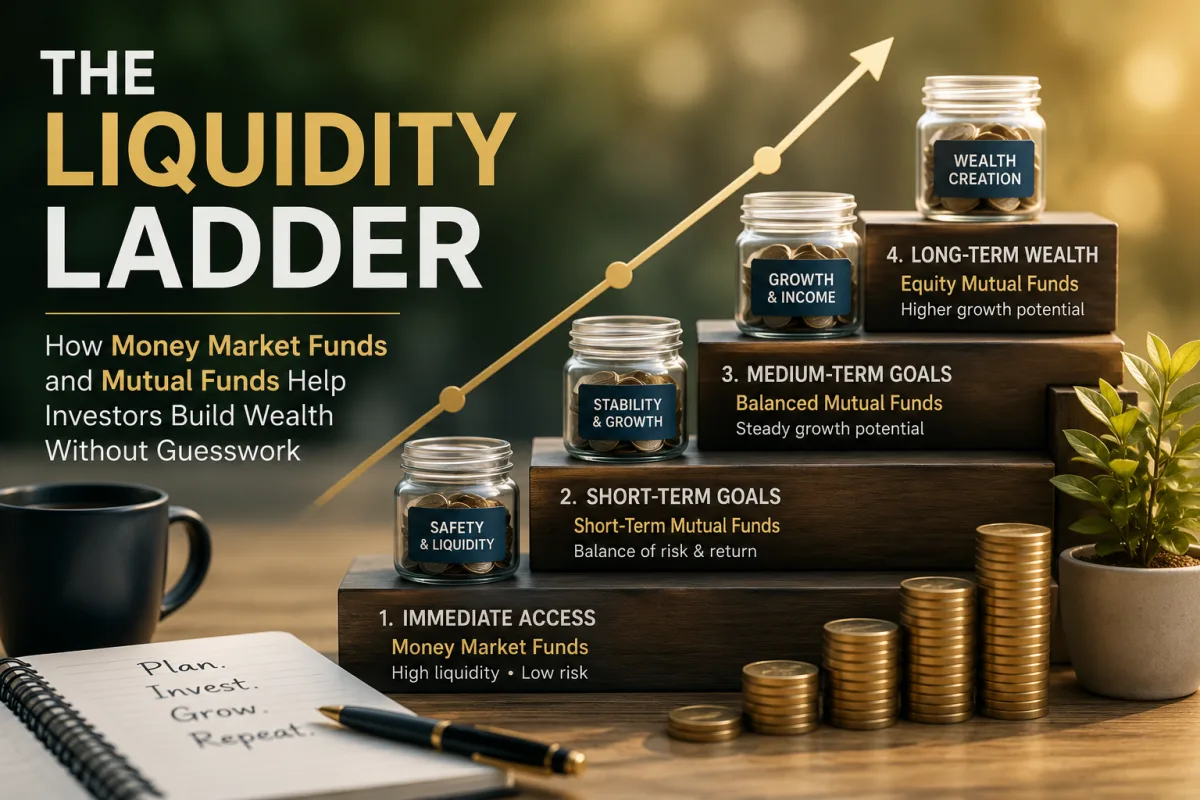
A practical investor can use government securities as part of a layered portfolio.
The first layer is immediate cash for daily needs. This belongs in a bank account, mobile wallet, or other highly liquid form.
The second layer is emergency reserves and short-term goals. This may include money market funds, fixed deposits, and T-bills.
The third layer is income and medium-term planning. This may include Treasury bonds, bond funds, or other income assets.
The fourth layer is long-term growth. This may include equities, ETFs, real estate, businesses, pension funds, SACCO investments, and other productive assets.
This structure helps each investment do its proper job. T-bills are not forced to create long-term growth. Shares are not forced to provide emergency liquidity. Bonds are not forced to replace all other investments.
Wealth grows better when money is organized by purpose.
How Beginners Should Start
A beginner should start by learning the process before investing large amounts. Understand minimum investment requirements, auction dates, account setup, payment instructions, maturity periods, taxes, and how statements are issued.
Start with a small amount that does not create stress. A short-term T-bill can be a useful first step because the maturity is near and the structure is easier to observe. After experiencing the full cycle of application, allocation, payment, maturity, and reinvestment, the investor gains confidence.
Before buying long-term bonds, beginners should understand coupon payments, yield, secondary market pricing, and what happens if they need to sell before maturity. A long bond should not be bought simply because the coupon looks attractive.
The beginner’s goal is not to look sophisticated. The goal is to understand what they own.
How Experienced Investors Use Government Securities
Experienced investors use T-bills and T-bonds for strategy. They may manage liquidity, lock in yields, create income ladders, balance equity risk, preserve capital, or position for interest rate changes.
They may compare yields across maturities to decide whether short-term or long-term securities offer better value. They may use bonds to match future liabilities. They may reinvest coupons into undervalued assets. They may hold T-bills while waiting for market opportunities.
Institutional investors often use government securities as portfolio anchors because they provide reference rates, liquidity, and predictable cash flows. Individual investors can learn from this. The goal is not to copy institutions exactly, but to understand why stable assets matter.
Risky assets may create growth. Stable assets help investors survive long enough to benefit from growth.
The Psychology of Predictable Income
Predictable income has emotional value. A bond coupon arriving on schedule can make an investor feel calm. A T-bill maturity can create confidence. This matters because investing behavior is often shaped by fear.
An investor with no stable assets may panic when markets fall. An investor with T-bills and bond income may be less likely to sell shares or property under pressure. Stability in one part of the portfolio can protect discipline in another.
This is why government securities are not only about returns. They are also about financial temperament. They create a base from which the investor can take appropriate risks elsewhere.
A calm investor usually makes better decisions than a desperate one.
When T-Bills and T-Bonds May Not Be Suitable
T-bills and T-bonds are useful, but not always suitable.
If an investor has expensive debt, paying down that debt may produce a better guaranteed benefit than investing in government securities. If a person lacks emergency cash, locking money into a longer security may create liquidity problems. If the investor needs high long-term growth, holding only T-bills may be too conservative. If inflation is high and yields are low, real returns may be unattractive.
Long-term bonds may be unsuitable for money needed soon. Short-term T-bills may be unsuitable for investors seeking long-term income certainty. Government securities should not be used blindly because they are considered safe.
Every investment must answer to the purpose of the money.
A Simple Example
Consider two investors with the same income.
The first investor keeps all savings in a normal account. The money is accessible, but it earns little. Because it is easy to access, the investor spends from it frequently. After several years, little has accumulated.
The second investor keeps daily spending money in a normal account, emergency reserves in a liquid fund, short-term planned expenses in T-bills, and longer-term income money in Treasury bonds. T-bills mature before school fees are due. Bond coupons are reinvested. The investor tracks maturities and avoids unnecessary borrowing.
The second investor is not taking wild risks. They are simply organizing money better. Over time, this organization creates more income, less panic, and stronger financial discipline.
That is the quiet power of Treasury securities.
The Long-Term Lesson
Treasury bills and Treasury bonds are not glamorous investments. They do not promise overnight riches. They do not create dramatic stories of sudden wealth. Their strength is structure.
T-bills help short-term money earn a return while staying aligned with near-term goals. T-bonds help long-term investors earn predictable income and plan future cash flows. Together, they can support liquidity, income, capital preservation, and portfolio balance.
But they must be used intelligently. Understand maturity. Understand yield. Understand inflation. Understand taxes. Understand liquidity. Understand what happens if you sell before maturity. Reinvest when possible. Match each security to a real financial goal.
Wealth is often built not by chasing the most exciting investment, but by placing money where it can serve a clear purpose. Treasury bills and bonds help investors do exactly that. They turn cash into planned capital. They turn savings into income. They turn uncertainty into structure.
The investor who learns to use them well gains one of the most valuable advantages in personal finance: predictable money working patiently in the background.
 Article
 Article
 Article
 Article
 Article
 Article
 Article
 Article