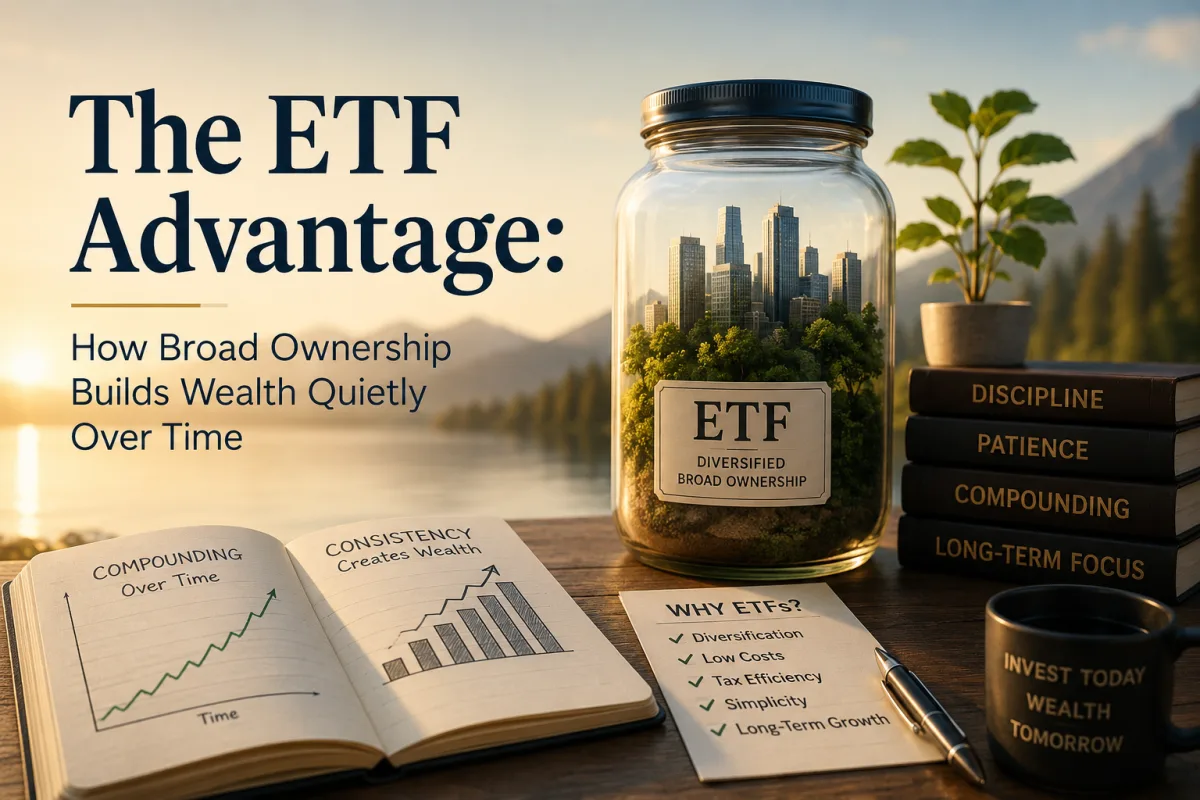
The ETF Advantage: How Broad Ownership Builds Wealth Quietly Over Time
Wealth creation often appears more complicated than it needs to be. Many people believe successful investing requires constant trading, insider knowledge, perfect timing, or the ability to identify the next great company before everyone else does. They imagine wealth as a reward reserved for financial professionals, market experts, or people with large amounts of capital.
Exchange-traded funds challenge that idea.
An ETF allows an ordinary investor to buy a basket of assets through a single investment. Instead of trying to choose one winning company, the investor can own many companies. Instead of guessing which bond will perform best, the investor can own a diversified bond portfolio. Instead of attempting to time every market movement, the investor can build exposure gradually and let time, discipline, and compounding do much of the work.
This is the quiet power of ETFs. They simplify access to ownership.
At their best, ETFs help investors participate in the growth of businesses, industries, markets, and economies. They turn investing from a guessing game into a structured wealth-building process. They do not remove risk, and they do not guarantee success. But they give investors a practical way to own productive assets without needing to become full-time analysts.
The real promise of ETFs is not that they make people rich quickly. It is that they make long-term investing more accessible, diversified, transparent, and cost-conscious. For wealth creation, those qualities matter deeply.
What Is an ETF?
An ETF, or exchange-traded fund, is an investment fund that trades on a stock exchange like an ordinary share. When an investor buys an ETF, they are buying units in a fund that holds a collection of assets. These assets may include shares, bonds, commodities, real estate securities, or a mix of instruments depending on the ETF’s objective.
Many ETFs are designed to track an index. For example, an ETF may track a broad stock market index, a government bond index, a sector index, or a global market index. Instead of trying to beat the market through active selection, the ETF may aim to mirror the performance of that market or index as closely as possible.
This is why ETFs are often associated with passive investing. Passive investing does not mean lazy investing. It means the investor accepts that broad market exposure, low costs, and time may be more reliable than constant prediction. Rather than asking, “Which single company will win?” the ETF investor often asks, “How can I own a diversified portion of the market?”
Some ETFs are actively managed, meaning a fund manager makes decisions about what to buy and sell. Others are thematic, focusing on areas such as technology, clean energy, healthcare, dividends, infrastructure, or emerging markets. Some are conservative. Others are highly risky. The label ETF tells you the structure, not the full risk. The contents of the ETF determine what the investor really owns.
This distinction is essential. An ETF is a container. The assets inside the container matter most.
The Ownership Principle Behind ETFs
Wealth is built by ownership. People who own productive assets participate in the value those assets create. A worker earns income from labour. An owner earns from capital. The strongest financial lives often combine both: income from work and ownership of assets that can grow, pay income, or preserve value.
ETFs give investors a simple route into ownership. A broad equity ETF may allow a person to own small pieces of many companies. Those companies may sell goods, provide services, innovate, expand, pay dividends, and increase in value over time. The ETF investor does not need to run those companies. They participate as an owner through the fund.
This is a powerful mental shift. Many people spend their entire lives only as consumers of companies. They buy products, pay bills, use services, and support corporate profits through spending. Investors, by contrast, seek to own part of the productive system. They want their money to work inside businesses, not only flow out to businesses.
An ETF helps ordinary people move from consumption to ownership. It allows a person with a modest amount of money to own diversified exposure to companies that may otherwise be difficult to buy one by one.
The ownership principle is the foundation of ETF wealth creation. The investor is not simply saving money. They are acquiring claims on assets.
Why Diversification Matters
Diversification is one of the most important ideas in investing. It means spreading money across different assets so that the failure or weakness of one investment does not destroy the entire portfolio.
If an investor buys shares in only one company, their financial outcome depends heavily on that company’s performance. The company may succeed, but it may also suffer from poor management, competition, regulation, fraud, technological change, debt problems, or economic downturns. Even strong companies can disappoint investors.
An ETF can reduce company-specific risk by holding many securities. A broad market ETF may hold dozens, hundreds, or even thousands of companies. If one company struggles, it may have a limited effect on the overall fund. The investor is no longer depending on a single horse to win the race. They own part of the field.
Diversification does not eliminate market risk. If the entire market falls, a broad equity ETF can fall too. But diversification can reduce the danger of being wrong about one company, one sector, or one bond issuer.
This is especially useful for beginners. Many new investors are attracted to individual shares because the stories are exciting. One company is expanding. Another is launching a product. A third is rumoured to be undervalued. But excitement is not a risk management strategy. A diversified ETF may be less dramatic, but it can be more durable.
Wealth creation is not only about finding winners. It is also about surviving mistakes. Diversification helps investors survive.
The Cost Advantage
Costs matter because every fee paid is money that no longer compounds for the investor. A fund with high fees must work harder just to deliver the same net return as a lower-cost fund.
One of the reasons ETFs became popular is that many offer low expense ratios, especially those that track broad indexes. Because a passive ETF does not need a large team constantly trying to select winning securities, it can often operate at a lower cost than many actively managed funds.
Low costs are not exciting. They do not make headlines. But over long periods, they can have a significant impact.
Consider two investors who earn the same market return before fees. One pays high annual costs, while the other pays low costs. In the first year, the difference may look small. Over twenty or thirty years, the gap can become substantial because the lower-cost investor keeps more money invested and compounding.
This is one of the most underrated wealth principles: what you do not pay in unnecessary costs remains available to grow.
Investors should not choose an ETF only because it is cheap. A low-cost bad investment is still a bad investment. But when comparing similar funds with similar exposure, cost becomes a major factor. The long-term investor should respect small percentages because compounding magnifies them.
How ETFs Create Wealth Over Time
ETFs create wealth through several mechanisms. The first is capital growth. If the underlying assets rise in value, the ETF’s price may rise. A broad stock ETF, for example, may increase over time as the companies inside it grow earnings, expand operations, and become more valuable.
The second mechanism is income. Many ETFs receive dividends from shares or interest from bonds. Depending on the ETF structure, that income may be distributed to investors or reinvested within the fund. Income can become a powerful part of total return, especially when reinvested.
The third mechanism is compounding. When returns generate more returns, wealth begins to accelerate. Reinvested dividends buy more units. More units produce more future income. Market growth applies to a larger base. Over many years, this compounding effect can become more important than the original contributions.
The fourth mechanism is disciplined accumulation. ETFs are well-suited to regular investing. A person can invest monthly, quarterly, or whenever income allows. Regular contributions reduce the pressure to time the market perfectly. They also transform investing from an event into a habit.
The fifth mechanism is broad participation. A diversified ETF allows the investor to benefit from the collective progress of many companies or assets. Some holdings will fail. Some will stagnate. Some will perform well. A few may become exceptional. The broad ETF captures the combined outcome.
The investor does not need to predict every winner. They need to remain invested in a sensible portfolio long enough for ownership and compounding to work.
The Power of Time
Time is one of the most important ingredients in ETF investing. The longer the time horizon, the more opportunity compounding has to work and the more chance an investor has to recover from temporary market declines.
Short-term markets can be unpredictable. Prices move because of news, interest rates, politics, inflation, earnings, investor emotions, currency movements, and global events. Over days or months, even high-quality markets can fall sharply. Over many years, the result is more closely linked to economic productivity, business profits, valuations, and reinvested income.
This is why ETFs are often powerful for long-term goals such as retirement, children’s education many years away, financial independence, or generational wealth. The investor is not trying to guess next week’s price. They are building ownership over decades.
A young investor has a special advantage. Even small monthly investments can become meaningful if sustained for long periods. The early years may feel slow because the portfolio is small. Later, the growth can become more visible as returns are earned on a larger base.
The hardest part is often psychological. People underestimate what consistent investing can achieve because early progress looks modest. They quit before compounding becomes impressive.
ETF wealth rewards those who can keep going when the process feels ordinary.
ETFs Versus Individual Shares
Buying individual shares can create wealth, but it requires knowledge, discipline, research, and emotional control. The investor must evaluate companies, understand financial statements, assess management, study competition, consider valuation, monitor risks, and decide when to buy or sell.
Some investors enjoy this process and do it well. Many do not.
An ETF offers a different path. Instead of trying to choose the best company, the investor owns a basket. This reduces the need to be right about one stock. It also reduces the emotional drama that can come from watching a single company rise or fall sharply.
Individual shares can outperform ETFs if chosen well. They can also underperform badly or become worthless. ETFs usually sacrifice the possibility of spectacular single-stock gains in exchange for broader diversification and lower company-specific risk.
For most ordinary investors, this trade-off is sensible. The goal is not to impress others with clever stock picks. The goal is to build wealth reliably enough to fund real life.
A balanced approach is also possible. An investor may keep the core of their portfolio in broad ETFs and use a smaller portion for individual shares. This protects the foundation while allowing room for personal conviction.
ETFs Versus Mutual Funds
ETFs and mutual funds are both pooled investment vehicles, but they differ in how they trade and how they are structured. Mutual funds are usually bought and sold through the fund provider at the end-of-day net asset value. ETFs trade on an exchange during market hours, meaning their prices can move throughout the day.
Many ETFs are passive and low-cost, though not all. Many mutual funds are actively managed, though some are index funds. The distinction is not always about active versus passive; it is also about access, trading, fees, transparency, and investor behavior.
ETFs can offer flexibility because investors can buy and sell them during the trading day. But this flexibility can become a weakness if it encourages unnecessary trading. A long-term investor does not need to watch ETF prices every hour.
Mutual funds may be simpler for investors who prefer automatic contributions and do not want to interact with the stock exchange. ETFs may be attractive for investors who want lower costs, transparency, and exchange-based access.
The better choice depends on the investor’s market, platform, costs, tax treatment, available funds, and personal discipline. The structure matters, but the investment behavior matters more.
Types of ETFs
ETFs come in many forms. Understanding the main types helps investors avoid mismatches.
Broad Market Equity ETFs
These ETFs track a wide stock market index. They may cover a country, region, or global market. Their goal is to provide exposure to many companies across different sectors. For long-term wealth creation, broad equity ETFs are often used as core portfolio holdings because they provide diversified ownership of productive businesses.
Bond ETFs
Bond ETFs invest in government bonds, corporate bonds, municipal bonds, or other fixed-income securities. They may focus on short-term bonds, long-term bonds, high-quality bonds, or higher-yielding bonds. Bond ETFs can provide income and stability, but they are not risk-free. Interest rate changes and credit risk can affect performance.
Sector ETFs
Sector ETFs focus on one industry, such as technology, banking, healthcare, energy, consumer goods, or real estate. They can be useful for investors who want targeted exposure, but they carry concentration risk. If the sector performs poorly, the ETF may suffer even if the broader market is doing well.
Dividend ETFs
Dividend ETFs invest in companies that pay dividends or have a history of dividend growth. They may appeal to income-focused investors. However, a high dividend yield is not always a sign of strength. Sometimes it reflects a falling share price or business stress. Investors should examine the fund’s quality, diversification, and strategy.
International and Global ETFs
These ETFs provide exposure beyond one country. They can help investors diversify geographically. A local economy may struggle while other regions grow. Global exposure can reduce dependence on a single market, though it may introduce currency risk.
Commodity ETFs
Commodity ETFs may track assets such as gold, silver, oil, or agricultural commodities. Some hold physical commodities, while others use futures contracts. These ETFs can behave very differently from equity or bond ETFs. They may be useful for diversification or inflation protection, but they require careful understanding.
Thematic ETFs
Thematic ETFs focus on investment themes such as artificial intelligence, clean energy, cybersecurity, electric vehicles, robotics, water, or infrastructure. They can be exciting, but excitement is not the same as durability. Many thematic funds launch after a theme has already become popular, meaning investors may pay high prices for a crowded idea.
Leveraged and Inverse ETFs
Leveraged ETFs aim to magnify daily returns. Inverse ETFs aim to move opposite to an index. These are complex trading tools and are usually unsuitable for ordinary long-term investors. They can lose value quickly and behave in unexpected ways over time. Wealth builders should approach them with extreme caution or avoid them entirely unless they fully understand the risks.
Building a Core ETF Portfolio
A strong ETF strategy often begins with the core. The core is the foundation of the portfolio. It should be diversified, low-cost, understandable, and aligned with the investor’s long-term goals.
For many investors, the core may include a broad equity ETF and a bond or money market allocation. Younger investors with long time horizons may hold more equity exposure. Older investors or those with lower risk tolerance may hold more bonds, cash, or conservative assets.
The core should not be built around excitement. It should be built around resilience. A broad market ETF may not be the most thrilling investment in any given year, but it can provide exposure to the productive economy. A bond ETF may not deliver spectacular growth, but it can help manage volatility and provide income.
Once the core is in place, investors may choose to add satellite positions. These may include sector ETFs, dividend ETFs, international ETFs, or thematic ETFs. Satellites should be smaller and deliberate. They should not dominate the portfolio unless the investor fully understands the concentration risk.
A useful principle is to keep the foundation boring and let any experimentation remain limited. Wealth usually depends more on the core than the decorations.
Dollar-Cost Averaging and Regular Investing
One of the most practical ways to build wealth through ETFs is regular investing. This is often called dollar-cost averaging, though the same idea applies in any currency. The investor contributes a fixed amount at regular intervals, regardless of whether the market is up or down.
When prices are high, the contribution buys fewer units. When prices are low, it buys more units. Over time, this reduces the pressure to invest all money at the perfect moment.
Regular investing also builds discipline. It turns wealth creation into a system rather than a mood. The investor does not wait for motivation, headlines, or predictions. They invest according to a plan.
This approach is especially useful for salaried workers, freelancers, entrepreneurs, and families. Income arrives regularly, so investing should also happen regularly. Waiting until there is a large surplus often fails because expenses expand to absorb available money.
The best investment habit is often the one that happens automatically.
Reinvesting Dividends
Dividends can be powerful, but only if the investor uses them wisely. When an ETF receives dividends from its holdings, the fund may distribute them to investors or reinvest them depending on the fund structure. If dividends are paid out, the investor can choose to spend them or reinvest them.
For wealth creation, reinvestment is often the stronger strategy. Reinvested dividends buy more units. More units may produce more future dividends. This creates a compounding cycle.
Spending dividends may be appropriate for retirees or income-focused investors. But younger investors and long-term wealth builders should be cautious about consuming every distribution. Income from investments feels rewarding, but early consumption can weaken long-term growth.
The question is simple: do I need this income today, or can it buy more ownership for tomorrow?
Risk in ETF Investing
ETFs reduce some risks, but they introduce or retain others. Investors must understand them clearly.
Market risk is the risk that the assets inside the ETF decline in value. A broad equity ETF can fall during a stock market downturn. A bond ETF can fall when interest rates rise. A commodity ETF can fall when commodity prices weaken.
Tracking error is the risk that the ETF does not perfectly match the performance of its index. Fees, trading costs, replication methods, cash holdings, and market conditions can create differences.
Liquidity risk matters when an ETF does not trade frequently or when the underlying assets are hard to sell. Low trading volume can lead to wider bid-ask spreads, making it more expensive to buy or sell.
Concentration risk occurs when an ETF is heavily exposed to a few companies, sectors, or countries. Some indexes are market-cap weighted, meaning the largest companies can dominate the fund.
Currency risk affects ETFs that invest internationally. If the ETF’s assets are denominated in a foreign currency, exchange rate movements can affect returns for the local investor.
Behavioral risk may be the greatest risk of all. ETFs are easy to trade. That convenience can tempt investors to buy and sell too often, chase performance, panic during downturns, or speculate in funds they do not understand.
The ETF is a tool. The investor’s behavior determines whether the tool builds wealth or destroys it.
The Danger of Treating ETFs Like Bets
Because ETFs trade like shares, they can be misused like shares. Some investors jump from one ETF to another based on headlines. They buy a technology ETF after technology has already soared. They buy a commodity ETF after prices have already spiked. They buy a thematic ETF because a trend sounds futuristic. They sell broad market ETFs during downturns because fear becomes stronger than the plan.
This turns ETFs from investment vehicles into betting slips.
Wealth creation through ETFs requires patience. The investor should know why each ETF is in the portfolio. What role does it play? Is it for growth, income, diversification, inflation protection, or short-term speculation? How long should it be held? What conditions would justify selling?
Without answers, the investor is not investing. They are reacting.
How to Choose an ETF
Choosing an ETF begins with purpose. The investor should ask what the ETF is meant to achieve. Is it a core long-term holding? A source of income? A defensive allocation? A geographical diversifier? A tactical position?
Next, examine the underlying index or strategy. What does the ETF actually own? How many holdings does it have? Which sectors dominate? Which countries dominate? Are the holdings high quality? Is the index broad or narrow?
Then review costs. The expense ratio is important, but it is not the only cost. Trading commissions, bid-ask spreads, taxes, platform fees, and currency conversion costs can also affect returns.
Liquidity matters. An ETF with very low trading volume may be harder to buy or sell at a fair price. Investors should understand how actively the ETF trades and how close the market price stays to the fund’s net asset value.
Fund size and provider reputation also matter. Larger funds from reputable providers may have better liquidity and operational strength, though size alone is not a guarantee.
Finally, read the factsheet and prospectus. These documents reveal the fund’s objective, holdings, risks, fees, distribution policy, and structure. Investors who skip these documents are buying without understanding.
Expense Ratios and Hidden Costs
The expense ratio is the annual cost charged by the ETF as a percentage of assets. A lower expense ratio allows more of the investment return to remain with the investor.
But investors should also consider the bid-ask spread. The bid is the price buyers are willing to pay. The ask is the price sellers are willing to accept. The difference is a cost to the investor. Highly liquid ETFs usually have narrower spreads. Less liquid ETFs may have wider spreads.
Trading commissions can also matter, especially for small frequent purchases. Platform fees, custody fees, foreign exchange charges, withholding taxes, and regulatory fees may reduce returns.
An ETF with a low expense ratio may still be expensive to access if the investor pays high brokerage or currency conversion fees. The full cost of ownership matters.
Tax Considerations
Tax can influence ETF returns. Dividends, interest distributions, capital gains, and foreign withholding taxes may apply depending on the investor’s country, the ETF’s domicile, and the type of account used.
Some ETFs distribute income. Others accumulate income within the fund. Some investors may prefer accumulating ETFs for long-term compounding, while others may prefer distributing ETFs for cash flow. Tax treatment may differ.
International ETFs can introduce additional tax considerations. For example, foreign dividends may be subject to withholding tax before reaching the investor. Estate tax rules, reporting obligations, and local tax laws may also matter for larger portfolios.
Investors should understand the tax rules that apply to them. The return that matters is not the headline return. It is the after-tax return kept by the investor.
ETFs and Inflation Protection
Inflation is one of the quiet enemies of wealth. It reduces purchasing power over time. Money that sits idle may appear safe, but if prices rise faster than the money grows, the owner becomes poorer in real terms.
Equity ETFs can help fight inflation because companies may increase prices, grow revenues, and expand earnings over time. This does not happen smoothly or equally, but ownership of productive businesses can provide long-term inflation resistance.
Bond ETFs may provide income, but inflation can reduce the real value of fixed payments. Inflation-linked bond ETFs, where available, may offer more direct protection.
Commodity ETFs, such as gold or energy funds, may sometimes perform well during inflationary periods, but they can be volatile and should not be treated as guaranteed protection.
The best inflation defence is often a diversified portfolio that includes growth assets, income assets, and sufficient liquidity.
ETFs for Retirement Planning
ETFs can be useful for retirement because they support long-term, diversified, low-cost investing. A retirement investor may build exposure to broad equity ETFs during working years, gradually add bond ETFs or conservative assets as retirement approaches, and later use income-producing ETFs to support withdrawals.
The retirement strategy should reflect time horizon. A person in their twenties or thirties may have decades to recover from market downturns, allowing more growth exposure. A person five years from retirement may need more stability. A retiree drawing income must manage sequence risk, which is the danger of selling investments during a market downturn early in retirement.
ETFs are tools, not retirement plans by themselves. The investor still needs contribution discipline, asset allocation, withdrawal planning, tax awareness, and protection against emergencies.
But because ETFs can provide diversified exposure at relatively low cost, they can form a strong part of a retirement wealth strategy.
ETFs for Young Investors
Young investors have time, and time is a major advantage. A young person does not need to begin with large capital. They need to begin with consistency.
ETFs can help young investors avoid two common traps. The first is keeping all money in cash because investing feels intimidating. The second is gambling on individual stocks or speculative assets because slow investing feels boring.
A broad ETF offers a middle path. It allows the young investor to own markets without needing to predict every winner. Monthly contributions can begin small and grow as income rises. Dividends can be reinvested. Market downturns can become opportunities to buy more units at lower prices.
The young investor should focus on learning, saving rate, diversification, and emotional discipline. The first goal is not to build a perfect portfolio. It is to build an investing habit that can last for decades.
ETFs for Income Investors
Some investors want income rather than growth. Dividend ETFs, bond ETFs, and real estate investment trust ETFs may provide distributions. These can be useful for retirees, semi-retired investors, or people seeking supplementary cash flow.
But income investors must be careful. A high yield can be a warning sign if it reflects declining asset prices or risky underlying holdings. The sustainability of income matters more than the size of the headline yield.
Income investors should examine the source of distributions. Are they coming from dividends, bond interest, option premiums, capital returns, or other strategies? Is the income stable? How did the ETF perform during difficult markets? What risks are being taken to generate the yield?
Income is valuable, but unsafe income can damage capital.
ETFs and Financial Independence
Financial independence is the point where investment income, business income, or accumulated assets can support living expenses without complete dependence on employment. ETFs can support this goal because they make diversified asset accumulation easier.
The path is straightforward but demanding. Spend less than you earn. Invest the difference consistently. Use broad, low-cost ETFs where suitable. Reinvest returns. Increase contributions as income rises. Avoid panic selling. Keep costs low. Maintain liquidity. Let time work.
This process lacks glamour, but it has logic. Financial independence is not usually achieved through one brilliant investment. It is built through repeated ownership decisions.
ETFs help because they reduce complexity. The investor does not need to assemble a large portfolio manually. They can use a few carefully selected funds to gain broad exposure and focus energy on income growth, savings discipline, and long-term behavior.
Asset Allocation: The Real Driver
Choosing the right ETF matters, but asset allocation matters even more. Asset allocation is how the investor divides money among equities, bonds, cash, real estate, commodities, and other assets.
An investor with too much equity exposure may panic during downturns. An investor with too much cash may fail to grow. An investor with too much concentration may suffer if one sector declines. The right allocation balances growth, stability, income, and liquidity.
A simple investor may hold a broad equity ETF, a bond ETF, and a money market or cash reserve. A more advanced investor may add international exposure, inflation-linked bonds, dividend ETFs, or sector positions. The structure should match goals, not fashion.
Asset allocation should also change over time. A young investor may prioritise growth. A parent saving for school fees may prioritise safety for that goal. A retiree may prioritise income and capital preservation. The same ETF can be wise for one person and unsuitable for another depending on timing and purpose.
Rebalancing the Portfolio
Rebalancing means returning a portfolio to its intended allocation. If equities perform very well, they may become a larger percentage of the portfolio than planned. If they fall sharply, they may become a smaller percentage. Rebalancing forces the investor to manage risk rather than drift emotionally with the market.
For example, an investor may choose a portfolio of 70 percent equity ETFs and 30 percent bond or cash assets. If equities rise strongly, the portfolio may become 80 percent equity. Rebalancing may involve selling some equity units or directing new contributions toward bonds until the target is restored.
This discipline can reduce risk. It also encourages buying underweighted assets and trimming overweighted ones. Rebalancing should not be done too frequently, because trading costs and taxes may apply. Annual or semi-annual reviews may be enough for many long-term investors.
The purpose of rebalancing is not to predict markets. It is to maintain the risk level the investor originally chose.
Common ETF Mistakes
The first mistake is buying an ETF without knowing what it owns. A fund name can be misleading. Always examine holdings and strategy.
The second mistake is chasing recent performance. Investors often buy after a fund has already risen sharply, then become disappointed when performance cools.
The third mistake is overconcentration. Owning five ETFs does not guarantee diversification if all five hold similar companies or sectors.
The fourth mistake is ignoring costs. Expense ratios, spreads, commissions, platform charges, taxes, and currency conversion costs all matter.
The fifth mistake is trading too often. ETFs make trading easy, but wealth creation usually requires patience.
The sixth mistake is using leveraged or inverse ETFs without understanding them. These products are not designed for ordinary long-term wealth building.
The seventh mistake is investing emergency money in volatile ETFs. Short-term money needs safety and liquidity.
The eighth mistake is selling during downturns without reviewing the long-term plan. Panic can convert temporary losses into permanent losses.
The ninth mistake is failing to reinvest dividends when the goal is long-term growth.
The tenth mistake is expecting ETFs to remove all risk. They do not. They organise risk into a more manageable structure.
A Practical ETF Wealth Plan
A practical ETF wealth plan can be built in stages.
Stage One: Build Stability
Before investing heavily in ETFs, create financial stability. Pay down expensive debt. Build an emergency fund. Understand your monthly cash flow. Protect yourself with appropriate insurance where necessary. Investing works best when the rest of your financial life is not constantly in crisis.
Stage Two: Define Goals
Separate short-term, medium-term, and long-term goals. Money needed within a year should not be placed in volatile equity ETFs. Money needed after ten or twenty years can usually accept more risk. Each goal should have a time horizon.
Stage Three: Choose Core Exposure
Select broad, diversified ETFs that match your goals. A core portfolio should be simple enough to understand and strong enough to hold through market cycles. Avoid building the foundation around narrow themes.
Stage Four: Invest Regularly
Create a monthly or quarterly contribution habit. Increase contributions when income rises. Do not wait for perfect market conditions. Consistency is more important than precision.
Stage Five: Reinvest and Review
Reinvest dividends where appropriate. Review fees, allocation, performance, and goals at least once a year. Rebalance when necessary. Avoid unnecessary trading.
Stage Six: Protect the Plan
Keep emergency money outside volatile ETFs. Avoid borrowing recklessly to invest. Do not allow social pressure, headlines, or fear to dictate decisions. Wealth creation requires emotional protection as much as financial structure.
A Simple Example of ETF Wealth Creation
Consider two investors with the same income.
The first investor keeps savings in a bank account for years because investing feels risky. The money remains accessible, but it grows slowly. Inflation gradually reduces its purchasing power. The investor feels safe, but long-term wealth does not meaningfully grow.
The second investor keeps an emergency fund in cash or a money market fund, then invests a fixed amount every month into a diversified equity ETF and a bond ETF. They reinvest distributions. During market downturns, they continue investing because the money is meant for long-term goals. After many years, they own a growing portfolio of productive assets.
The difference is not that the second investor predicted the future perfectly. The difference is that they created a system. They separated short-term safety from long-term growth. They used ETFs to access broad ownership. They allowed time and compounding to work.
This is how ordinary investing becomes wealth creation.
The Mindset of a Successful ETF Investor
The successful ETF investor is not necessarily the person with the highest intelligence or the most financial jargon. It is often the person with the clearest discipline.
They understand that markets will fall sometimes. They expect volatility rather than being shocked by it. They know that low costs matter. They avoid unnecessary complexity. They do not confuse news with strategy. They understand what they own. They invest consistently. They keep short-term money safe and long-term money productive.
They also accept that wealth creation is not entertainment. A good ETF portfolio may feel boring. It may not produce dramatic stories at dinner. It may not satisfy the desire to be seen as clever. But it can quietly accumulate ownership in businesses, bonds, and markets across years.
Boring can be beautiful when it builds freedom.
When ETFs May Not Be Suitable
ETFs are useful, but they are not suitable for every situation.
If money is needed very soon, a volatile ETF may be inappropriate. If an investor cannot tolerate seeing account values decline, they may need a more conservative allocation. If trading costs are very high in a particular market, small frequent ETF purchases may be inefficient. If an ETF is too complex to understand, it should be avoided.
ETFs also do not replace emergency funds, insurance, debt management, estate planning, or income growth. A person with expensive debt may need to reduce that burden before investing aggressively. A family without emergency savings may be forced to sell ETF units during a downturn. A business owner with unstable cash flow may need larger liquidity reserves.
Investment tools work best when used within a complete financial plan.
The Long-Term Wealth Lesson
ETFs represent a major shift in investing. They allow ordinary people to access diversified portfolios that were once harder or more expensive to build. They make market ownership easier. They reduce dependence on stock-picking. They often lower costs. They support disciplined long-term investing.
But the ETF itself is not the source of wisdom. The investor must bring the wisdom.
A broad ETF held patiently can help build wealth. A narrow ETF bought at the height of excitement can disappoint. A low-cost ETF used consistently can support financial independence. A leveraged ETF misunderstood by a beginner can cause serious losses. The structure is powerful, but only when matched with purpose.
To create wealth through ETFs, focus on ownership, diversification, cost control, time, and behavior. Build a stable financial base first. Choose funds you understand. Invest regularly. Reinvest returns. Keep your portfolio aligned with your goals. Avoid panic. Avoid hype. Let compounding do its quiet work.
Wealth is not always created by finding something rare. Sometimes it is created by doing something simple with uncommon consistency.
That is the ETF advantage.
 Article
 Article
 Article
 Article
 Article
 Article
 Article
 Article