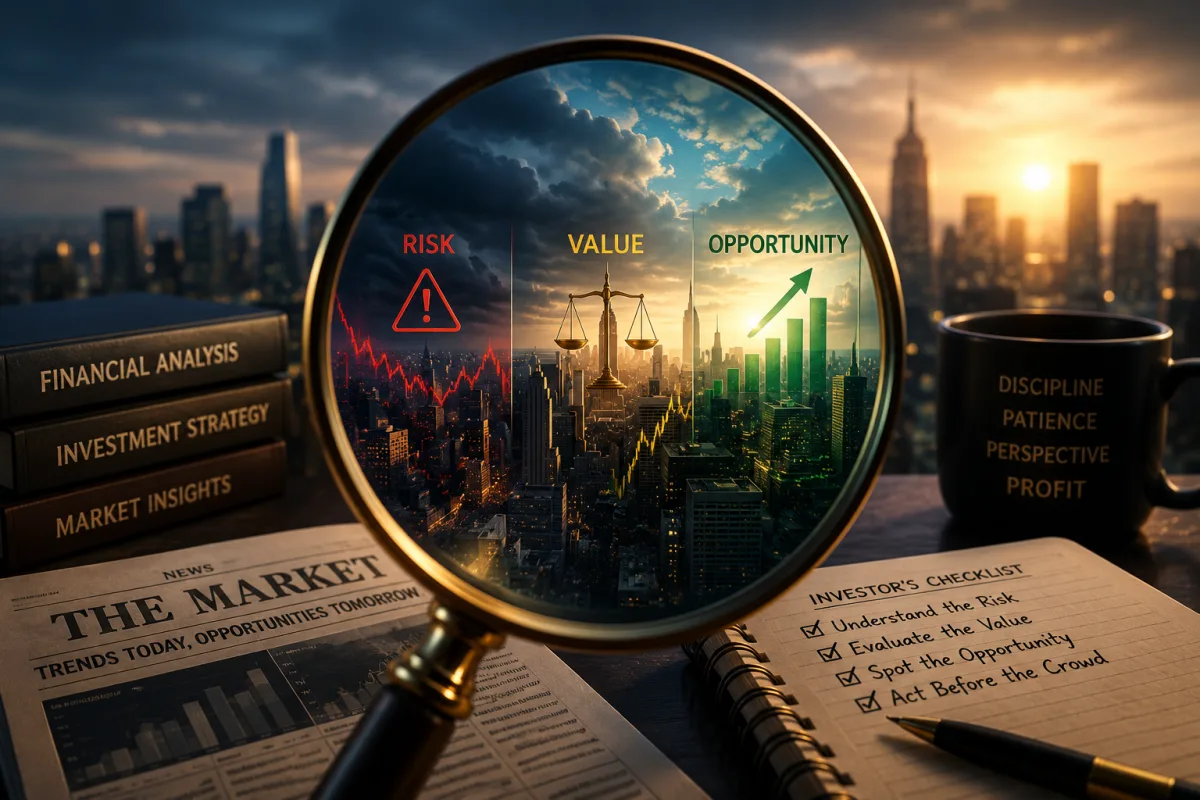
The Investor’s Lens: How to See Risk, Value and Opportunity Before the Market Does
Investment insight is not the ability to predict tomorrow’s market movement.
It is the ability to understand what matters when everyone else is distracted by what is moving. It is the discipline to separate price from value, risk from volatility, confidence from evidence, and opportunity from excitement. In a world filled with charts, headlines, forecasts, social media commentary, analyst opinions, and investment products, the real advantage is not more information. It is better judgment.
Many people enter investing looking for answers. Which stock will rise? Which fund is best? Should they buy now or wait? Is the market too high? Will interest rates fall? Is real estate safer than shares? Is cash a mistake? These are natural questions, but they often begin too late in the process. Strong investors first ask deeper questions: What is the purpose of this money? What risk can I afford? What return do I need? What do I actually own? What could go wrong? How long can I wait? What is already priced in?
Investment insight begins when money is no longer treated as a guessing game and starts being treated as capital.
Capital has a job. It must be allocated. It must be protected. It must be given time to work. It must be matched to goals. It must be measured against risk. It must not be thrown at every promising story simply because the story is popular.
The investor’s task is not to know everything. No one does. The task is to build a framework strong enough to make reasonable decisions under uncertainty. Markets will always surprise. Economies will always shift. Companies will rise and fall. Interest rates will change. Political events will interrupt assumptions. Human emotion will push prices too high and too low. The investor who survives and prospers is not the one who avoids uncertainty, but the one who prepares for it.
This is the foundation of investment insight.
Insight Begins With Ownership
The first insight every investor must understand is that investing is ownership.
A share is not a lottery ticket. It is a claim on part of a business. A bond is not merely a number in an account. It is a loan made to a borrower. A real estate investment is not just land, walls, or rent. It is exposure to location, financing, tenants, maintenance, regulation, and demand. A fund is not a mysterious product. It is a container holding underlying assets.
When investors forget ownership, they become price watchers. They obsess over daily movements without understanding the asset behind the movement. They buy because a chart is rising. They sell because a headline is frightening. They confuse market activity with investment progress.
Ownership changes the conversation. The investor begins asking what the asset produces, what risks it carries, who manages it, how it is priced, how it fits the portfolio, and why it should be held. This shift is essential. A person who understands ownership is less likely to be seduced by hype because they know that every investment must eventually be supported by economics.
Ownership also creates patience. A business owner does not check the estimated value of the business every hour and decide whether to sell based on each fluctuation. They focus on revenue, costs, customers, competitive position, cash flow, and long-term strategy. Public market investors should adopt some of that same discipline. The screen may show prices changing constantly, but the underlying businesses do not become fundamentally different every minute.
Investment insight begins when the investor stops asking only, “Will the price go up?” and begins asking, “What do I own, and why should it become more valuable over time?”
Price Is What You Pay, Value Is What You Receive
One of the most important distinctions in investing is the difference between price and value.
Price is visible. It changes constantly. It is quoted in markets, shown in apps, published in statements, and discussed in headlines. Value is harder. It depends on future cash flows, asset quality, competitive advantage, growth, risk, management, interest rates, inflation, and investor expectations.
A high-quality asset can be a poor investment if bought at an excessive price. A troubled asset can be profitable if bought at a deep enough discount and if the risks are understood. Many investors focus only on quality and ignore valuation. They assume that a great company is always a great investment. This is not true. If expectations become too optimistic, even excellent companies can disappoint shareholders.
Valuation is the discipline of asking whether the price makes sense relative to the value received. It does not require perfect precision. No investor can calculate the future exactly. But valuation prevents blind enthusiasm. It forces investors to ask what assumptions are already built into the price.
For example, if a company’s share price implies years of rapid growth, the investor must ask whether such growth is realistic. If a property price assumes rising rents forever, the investor must examine tenant demand, financing costs, maintenance, taxes, and vacancy risk. If a bond offers a high yield, the investor must ask whether the borrower is genuinely strong or whether the yield is compensation for serious credit risk.
Valuation protects investors from paying any price for a good story.
Risk Is More Than Volatility
Many investors are taught that risk means volatility. Volatility is the movement of prices up and down. It matters because it affects emotions, liquidity, and timing. But volatility is not the only risk, and sometimes it is not the most dangerous risk.
The deeper risk is permanent loss of capital. This can happen when an investor buys an asset at an extreme price, invests in a weak business, lends to an unreliable borrower, uses too much debt, falls for fraud, sells in panic, or locks money into an illiquid product that cannot meet future needs.
There is also inflation risk. Cash may feel safe because the balance does not fluctuate, but inflation can reduce purchasing power over time. There is concentration risk when too much wealth is tied to one company, property, sector, employer, currency, or country. There is liquidity risk when an asset cannot be sold quickly without accepting a large discount. There is currency risk when assets and obligations are in different currencies. There is behavioral risk when the investor’s emotions become the main threat to the portfolio.
A complete investor looks at risk from many angles. What could cause this investment to fail? How much could I lose? How quickly could I access the money? What assumptions must be true for this to work? What happens if interest rates rise, inflation persists, income falls, tenants leave, a borrower defaults, or markets decline? How does this investment behave alongside everything else I own?
Risk is not something to fear blindly. It is something to price, manage, and respect.
The Time Horizon Determines the Strategy
Every investment decision should begin with time.
Money needed in three months should not be treated the same as money needed in thirty years. Short-term money requires stability and liquidity. Long-term money can usually tolerate more volatility because it has time to recover. Problems arise when investors mismatch assets and goals.
A person saving for school fees due next term should not place that money in volatile stocks. A business owner needing cash for taxes should not chase a higher return in an illiquid investment. A young professional saving for retirement decades away may take too little risk if all money sits in cash. Each goal has its own proper instrument.
Time horizon also affects emotional interpretation. A market decline is painful, but it means something different depending on when the money is needed. For a long-term investor still contributing, lower prices may allow new contributions to buy more ownership. For a retiree withdrawing money, the same decline may require careful income planning to avoid selling too much at depressed prices.
The question “Is this a good investment?” is incomplete. A better question is, “Is this a good investment for this money, for this purpose, over this time frame?”
Diversification Is a Form of Humility
Diversification is often explained as not putting all your eggs in one basket. That is true, but the deeper principle is humility.
Diversification admits that the future cannot be known with certainty. Even a well-researched investment can disappoint. Even a strong company can face disruption. Even a prime property can suffer from weak demand or regulatory change. Even a popular sector can become overpriced. Even a respected fund manager can underperform.
A diversified portfolio spreads exposure across assets, industries, geographies, currencies, and sources of return. It reduces the damage one mistake can cause. It does not eliminate loss. It does not guarantee smooth returns. In fact, a diversified portfolio will almost always contain something that is underperforming. That is not a flaw. It is the price of not depending entirely on one outcome.
Many investors believe they are diversified because they own many investments. But owning many things is not the same as diversification. Ten funds may all hold the same large companies. Five properties may all depend on the same local economy. Several businesses may all rely on the same customer base. A portfolio can look busy while remaining concentrated.
True diversification requires looking beneath labels. What actually drives the returns? What risks are shared? What happens if interest rates rise? What happens if the local currency weakens? What happens if the economy slows? What happens if one sector loses favor?
Diversification is not about lacking conviction. It is about recognizing that conviction can be wrong.
Cash Has a Job
Some investors treat cash as failure. They believe every shilling, dollar, pound, or euro should always be invested for maximum return. This thinking ignores the role of liquidity.
Cash protects the plan. It funds emergencies, near-term goals, opportunities, taxes, repairs, family obligations, and business needs. It prevents forced selling when markets are down. It gives the investor psychological stability. A person with adequate cash reserves can hold long-term assets more calmly during market stress.
The problem is not cash itself. The problem is purposeless cash. Money needed soon should be held safely. Money needed decades from now may lose purchasing power if left idle. The investor should separate cash by function: emergency cash, planned spending cash, opportunity cash, and long-term investment capital.
Cash is not the engine of long-term wealth, but it is the shock absorber. Without it, the engine may fail when the road becomes rough.
Income and Growth Serve Different Purposes
Investments can create value in different ways. Some provide income. Others focus on growth. Some attempt to do both.
Income investments distribute cash through interest, dividends, rent, or other payments. They can be useful for retirees, institutions, or investors who need regular cash flow. Growth investments may pay little income today but aim to increase in value over time. They may suit investors with longer horizons who can wait for appreciation.
Neither is automatically superior. The right balance depends on goals. A young investor who reinvests dividends may benefit from growth. A retiree may need income stability. A business owner may need liquidity more than capital appreciation. A family planning school fees may need predictable instruments.
Investors often make mistakes when they chase income without understanding risk. A high yield may be attractive, but high yields often exist for a reason. The borrower may be weak, the property may be risky, the dividend may be unsustainable, or the investment may be illiquid. Income that destroys capital is not true income. It is return of risk disguised as reward.
Growth investing has its own danger. Investors may pay too much for future possibilities. A company can grow revenue but still fail to produce attractive shareholder returns if expectations were too high at purchase. A property can appreciate but still deliver poor net returns after financing, taxes, vacancy, and maintenance.
Insight means knowing what type of return is being pursued and what risks are being accepted to pursue it.
The Market Is Not the Economy
Investors often assume that if the economy is struggling, markets must fall, or if the economy is strong, markets must rise. The relationship is more complex.
Markets are forward-looking. Prices reflect expectations about the future, not only current conditions. A stock market can rise during weak economic news if investors believe conditions will improve. It can fall during strong economic news if the good news was already priced in or if it increases fears of higher interest rates. A company can grow earnings but see its share price fall if investors expected even more.
This is why headlines can be misleading. An investor who reacts only to current news may be late. The market may have anticipated the news months earlier. The key question is not merely whether news is good or bad. The key question is how the news compares with expectations already reflected in prices.
This principle applies beyond public markets. Real estate prices, bond yields, private business valuations, and currency movements all reflect expectations. A crowded opportunity may already be expensive. An unpopular asset may contain potential if the pessimism is excessive.
Investment insight requires thinking in terms of expectations.
Costs Quietly Shape Returns
Investment costs are easy to ignore because they often appear small. A management fee, advisory fee, trading charge, custody fee, bid-ask spread, performance fee, fund expense ratio, insurance charge, or early exit penalty may seem minor in isolation. Over time, costs can significantly reduce returns.
Every fee must be justified by value. A low-cost diversified fund may be appropriate for broad market exposure. A higher-cost active manager may be worthwhile only if the manager provides skill, access, risk control, or planning value that exceeds the cost. A complex product with several hidden charges should be examined carefully.
Costs matter especially because they are one of the few variables investors can control. No investor can control market returns. But investors can control unnecessary trading, excessive fees, poor tax decisions, and product complexity.
This does not mean cheapest is always best. Advice, planning, risk management, and access can be valuable. But value must be clear. Paying for quality is different from paying because costs are hidden.
The investor should always ask: What am I paying, to whom, for what service, and how does it improve my outcome?
Taxes Are Part of Investment Reality
Investment returns should be judged after costs and taxes. A high gross return may become ordinary after tax. A lower-return strategy may be more attractive if it is tax-efficient, liquid, and suitable.
Tax considerations differ by country, account type, product, holding period, income level, and investor status. The principle is universal: taxes should be managed, not ignored. This may involve using retirement accounts, pension structures, tax-advantaged accounts, long-term holding strategies, careful realization of gains, and professional advice when investments become complex.
Tax should not be the only driver of investment decisions. A poor investment does not become good because it has a tax benefit. But ignoring tax can weaken a good investment plan.
Insightful investors ask about the return they keep, not only the return advertised.
Behavior Is the Hidden Portfolio Manager
The most dangerous risk in many portfolios is not the market. It is the investor.
Investors buy high when excitement is strongest. They sell low when fear is loudest. They chase recent winners. They abandon strategies after temporary underperformance. They overconcentrate in familiar assets. They confuse activity with intelligence. They trust confident voices more than evidence. They check portfolios too often and mistake volatility for emergency.
Behavioral discipline is therefore not a soft subject. It is central to performance.
A reasonable plan can fail if the investor cannot follow it. A diversified portfolio can be destroyed by panic selling. A long-term investment can become a short-term loss if the investor abandons it during stress. A strong savings rate can be weakened by lifestyle inflation. A well-priced opportunity can be missed because fear prevents action.
Good investors build systems that protect them from themselves. They automate contributions. They rebalance on a schedule. They write investment policies. They limit speculative exposure. They avoid constant checking. They define goals before markets become emotional. They understand that discipline matters most when discipline feels hardest.
Investment insight is not only analytical. It is behavioral.
The Danger of Forecast Addiction
Forecasts are everywhere. Experts forecast interest rates, currencies, inflation, stock markets, property prices, oil prices, elections, recessions, and sector performance. Some forecasts are thoughtful. Many are entertainment dressed as certainty.
The problem is not using forecasts. The problem is depending on them too heavily. A portfolio built around one forecast becomes fragile if the forecast is wrong. Since the future is uncertain, strong portfolios should be able to survive multiple scenarios.
Instead of asking, “What will happen?” investors should ask, “What if I am wrong?”
What if inflation stays higher than expected? What if rates fall more slowly? What if the currency weakens? What if a recession arrives? What if the market rallies while I am waiting in cash? What if property prices stagnate? What if my income falls? What if a tenant leaves? What if a company’s growth slows?
This kind of scenario thinking produces better decisions than prediction alone. It encourages diversification, liquidity, margin of safety, and humility.
The best investors do not need to be right about everything. They build portfolios that can keep working even when some assumptions fail.
Margin of Safety
Margin of safety is the gap between what an investor pays and what an asset is reasonably worth, or the cushion built into a financial decision to protect against error.
In stock investing, margin of safety may mean buying at a price below conservative estimates of value. In real estate, it may mean ensuring that rental income can cover costs even with vacancies. In lending, it may mean requiring strong collateral and borrower capacity. In personal finance, it may mean keeping emergency reserves and avoiding excessive debt.
Margin of safety exists because investors are human. Analysis can be wrong. Conditions can change. Costs can rise. Revenue can disappoint. Tenants can leave. Markets can decline. A decision that works only if everything goes perfectly is not robust.
Beginners often ignore margin of safety because they are attracted to maximum upside. Experienced investors learn that avoiding ruin is part of building wealth. A smaller gain with strong protection may be superior to a dramatic opportunity with fragile assumptions.
Margin of safety is the investor’s admission that the future will not follow the spreadsheet exactly.
Liquidity: The Forgotten Dimension
Liquidity is the ability to convert an asset into cash quickly without a significant loss in value. It is one of the most underestimated investment factors.
Publicly traded stocks and funds are generally more liquid than private businesses or real estate. Bank deposits and treasury bills may be more liquid than long-term property projects. Some products advertise attractive returns but lock money for years. Others may allow withdrawal but impose penalties or delays.
Illiquidity is not always bad. Investors may earn higher returns for accepting it. Real estate, private equity, and long-term projects can create wealth. But illiquidity must be matched with time horizon. Money that may be needed soon should not be trapped in an asset that cannot be sold easily.
Liquidity planning prevents distress. A wealthy person can be asset-rich but cash-poor. A family can own land and still struggle to pay school fees. A business owner can have inventory and receivables but lack cash for payroll. An investor can have high-value holdings but be unable to sell at a fair price during a crisis.
Insightful investing asks not only, “What return can I earn?” but also, “When and how can I access my money?”
Concentration Builds Fortunes and Destroys Them
Many great fortunes were built through concentration. Entrepreneurs often become wealthy because most of their net worth is tied to one business. Real estate families may build wealth through concentrated property ownership. Early investors in exceptional companies may earn extraordinary returns.
But concentration also destroys wealth. One business can fail. One property market can decline. One employer stock can collapse. One currency can weaken. One customer can disappear. One political or regulatory change can damage an industry.
The challenge is knowing when concentration is intentional and when it is accidental.
A founder may need concentration while building a company. But once wealth is created, some diversification may protect the family from losing everything to one risk. An employee may receive shares in their employer, but if their salary and investments depend on the same company, their exposure is larger than it appears. A property investor may own several buildings, but if all are in the same area and tenant segment, the risk is concentrated.
Concentration can be a wealth creation tool, but diversification is often a wealth preservation tool. The transition from building wealth to protecting wealth requires maturity.
Real Estate Is Not Automatically Safe
Real estate feels safe because it is tangible. People can see land, buildings, walls, and tenants. This tangibility creates confidence. But real estate carries serious risks.
Property can be overpaid for. Titles can be disputed. Construction can exceed budget. Tenants can default. Vacancies can rise. Maintenance can be expensive. Taxes and service charges can increase. Financing costs can change. Regulations can shift. Liquidity can disappear. A property can sit unsold for months or years if the price is wrong.
Real estate can be an excellent wealth-building asset when purchased well, financed prudently, managed properly, and held for the right purpose. But it should not be treated as risk-free simply because it is physical.
Investors should evaluate net returns, not just rent. They should account for repairs, vacancy, insurance, taxes, management, financing, legal costs, and time. They should compare property returns with alternative investments. They should avoid buying land only because everyone says land always rises.
The real estate insight is simple: the asset may be tangible, but the risk is still real.
Fixed Income Is Not Risk-Free
Bonds, treasury bills, fixed deposits, and money market instruments are often viewed as safe investments. Many are lower risk than equities, but they are not all risk-free.
Fixed income carries interest rate risk, credit risk, inflation risk, reinvestment risk, and liquidity risk. A bond price can fall when interest rates rise. A borrower can default. Inflation can reduce the real value of interest payments. A maturing investment may need to be reinvested at a lower rate. A product may not allow early withdrawal without penalties.
Government securities are often considered among the safer local currency instruments because they are backed by the state, but they still carry inflation and interest rate considerations. Corporate bonds may offer higher yields but require careful evaluation of the issuer’s financial strength. Fixed deposits depend on the strength of the bank and may be subject to deposit insurance limits depending on jurisdiction.
Yield should never be considered alone. A high yield is a message. It may signal opportunity, or it may signal risk. The investor must find out which.
Equities Reward Patience but Punish Fragility
Equities can be powerful long-term wealth creators because they provide ownership in businesses. Over time, profitable companies can grow earnings, reinvest, pay dividends, innovate, and expand. But equity investing is volatile. Prices can fall sharply even when long-term prospects remain intact.
The equity investor needs time, diversification, and emotional strength. Money needed soon should not be heavily exposed to equities. Money invested in equities should be prepared for declines. The investor must understand that volatility is part of the return journey.
Equity investing also requires humility. Individual stock selection is difficult. Many investors are better served by diversified funds that provide broad exposure. Those who choose individual stocks should understand the business, valuation, competitive environment, balance sheet, governance, and risks.
The key insight is that equities are not merely numbers moving on a screen. They are ownership in businesses. Their long-term value depends on business performance, but their short-term prices depend heavily on market emotion.
Alternative Investments Require Extra Discipline
Alternative investments include private equity, venture capital, hedge funds, commodities, private credit, structured products, art, collectibles, crypto assets, and other non-traditional opportunities. Some alternatives can add diversification or return potential. Others can be expensive, illiquid, opaque, or speculative.
Alternatives require careful due diligence. Investors should understand how returns are generated, who manages the product, what fees apply, how assets are valued, when money can be withdrawn, what regulations apply, and what could cause loss.
The more exclusive an investment sounds, the more disciplined the investor should become. Exclusivity can be used as a sales tool. A private opportunity is not automatically superior to a public one. Complexity is not proof of sophistication.
Alternative investments may belong in some portfolios, especially for experienced or high net worth investors. But they should not replace the fundamentals: liquidity, diversification, valuation, risk control, and suitability.
The Importance of an Investment Policy
An investment policy is a written framework that guides decisions. It does not need to be complicated. It should state the investor’s goals, time horizon, target allocation, contribution plan, liquidity needs, rebalancing rules, risk limits, and reasons for investing.
The value of an investment policy appears during emotional periods. When markets rise quickly, the policy reminds the investor not to chase. When markets fall sharply, it reminds the investor not to panic. When a new opportunity appears, it provides a standard for evaluation.
Without a policy, every decision is vulnerable to mood. A persuasive friend, confident adviser, alarming headline, or temporary loss can redirect the portfolio. With a policy, decisions are anchored.
Institutions use investment policies because capital requires governance. Individuals should learn from that discipline. Wealth may be personal, but it still deserves structure.
Rebalancing: Selling Discipline and Buying Discipline
Rebalancing means returning a portfolio to its intended allocation after market movements shift the percentages.
If equities rise strongly, they may become a larger share of the portfolio than planned. If bonds or cash become too small, the portfolio may carry more risk than intended. Rebalancing trims what has grown and adds to what has lagged. This can feel uncomfortable because it often means selling winners and buying assets that feel less exciting.
That discomfort is exactly why rebalancing is useful. It forces discipline. It prevents a portfolio from becoming accidentally aggressive after a bull market or excessively conservative after a decline.
Rebalancing does not need to happen constantly. Many investors review once or twice a year, or when allocations move significantly away from target. The method matters less than the habit of maintaining alignment.
A portfolio without rebalancing can slowly become a different portfolio from the one the investor intended.
Information Is Not the Same as Insight
Modern investors have access to more information than any previous generation. They can see prices instantly, read global news, follow analysts, compare funds, watch interviews, join forums, and receive alerts all day. Yet more information has not necessarily produced better investors.
Information becomes insight only when it is filtered through a framework.
A headline about inflation matters differently to a bond investor, a property buyer, a retiree, a business owner, and a young equity investor. A currency movement may be a threat to one person and an opportunity to another. A market decline may be dangerous for someone needing cash soon but useful for someone investing monthly for decades.
Without context, information creates noise. With context, it improves judgment.
The investor should ask: Does this information affect my goals, time horizon, asset allocation, risk exposure, or valuation assumptions? If not, it may be interesting but not actionable.
How to Recognize a Real Opportunity
A real investment opportunity usually contains several qualities. The asset is understandable. The risk is identifiable. The price is reasonable relative to value. The time horizon fits the investor’s needs. The investment improves the portfolio rather than merely adding excitement. The downside is survivable. The expected return compensates for the risk.
A false opportunity often relies on urgency, social proof, vague explanations, guaranteed returns, secrecy, or fear of missing out. It may sound impressive but collapse under basic questions. How does it make money? Who is the counterparty? What could go wrong? How do I exit? What fees apply? What regulation exists? Why is this opportunity being offered to me?
Good opportunities do not always feel comfortable. Sometimes the best opportunities appear when sentiment is poor. But discomfort alone does not make an investment attractive. The investor still needs analysis.
Opportunity is not whatever is rising. Opportunity is value mispriced relative to risk.
Investment Insight for Beginners
Beginners should not try to master every investment before starting. They should master the foundations.
First, build financial stability. An emergency fund, controlled debt, and steady cash flow make investing easier to sustain. Second, define goals. Third, choose a sensible asset allocation. Fourth, use diversified, low-cost investments where appropriate. Fifth, automate contributions. Sixth, avoid speculation with money needed for important goals. Seventh, keep learning.
The beginner’s greatest advantage is time. Even modest amounts invested consistently can grow meaningfully over long periods. But time only works if the investor remains in the game. Panic selling, chasing trends, high fees, and inconsistent contributions weaken the advantage.
Beginners should focus less on being clever and more on being consistent. In investing, ordinary discipline often beats occasional brilliance.
Investment Insight for Experienced Investors
Experienced investors face different risks. They may become overconfident. They may believe past success proves skill when luck played a role. They may accumulate too many assets without a clear structure. They may enter complex investments without sufficient due diligence. They may concentrate wealth because a strategy worked before.
As wealth grows, the focus should gradually expand from return generation to risk management, tax efficiency, liquidity, estate planning, and family governance. A mistake on a large portfolio can be more damaging than a mistake on a small one. Protecting wealth becomes as important as growing it.
Experienced investors should periodically simplify. They should ask which investments still serve a purpose, which are redundant, which are too costly, which create unnecessary tax complexity, and which risks are hidden. A portfolio built over many years can become cluttered.
Investment maturity is not measured by the number of products owned. It is measured by clarity.
Investment Insight for Business Owners
Business owners often have most of their wealth tied to their company. This can create significant wealth, but it also creates concentration. The owner’s income, net worth, reputation, and future may all depend on one enterprise.
For business owners, investing outside the business is not a lack of confidence. It is risk management. Profits can be used to build liquid reserves, retirement portfolios, real estate, fixed income, and diversified assets. This creates protection if the business faces disruption.
Business owners must also distinguish business cash from personal wealth. Revenue is not profit. Profit is not always distributable cash. Cash needed for taxes, suppliers, payroll, debt, and working capital should not be invested casually or spent personally.
The investment insight for business owners is that the business may be the engine, but the family balance sheet needs more than one engine.
Investment Insight for Families
Families invest differently from individuals because decisions affect several people. Education, housing, healthcare, retirement, inheritance, family support, and succession all shape the portfolio.
A family investment plan should clarify who makes decisions, what goals matter, how much risk is acceptable, how emergencies are handled, and how assets will be transferred if something happens. Families with significant wealth may need wills, trusts, shareholder agreements, insurance, and governance structures.
Without communication, investment decisions can create conflict. One spouse may think money is safely invested while another does not understand the risks. Adult children may expect inheritance without understanding obligations. Family businesses may lack succession plans. Property may be owned informally, creating future disputes.
Investment insight for families includes more than returns. It includes clarity, documentation, and continuity.
The Long View
Markets move in cycles. Optimism rises. Prices climb. Confidence expands. Then something changes. Fear returns. Prices fall. Headlines become dark. Eventually recovery begins, often before the news feels safe. This cycle repeats in different forms across generations.
The investor who understands cycles does not assume good times last forever or bad times last forever. They prepare during strength and remain rational during weakness. They know that both greed and fear can distort judgment.
The long view does not mean ignoring present risks. It means placing them in context. A temporary decline may matter little for a thirty-year goal but matter greatly for a one-year obligation. A recession may create pain but also future opportunity. A market boom may create profits but also danger if valuations become excessive.
Long-term thinking is not passive. It is disciplined patience.
Final Thoughts
Investment insight is not a secret formula. It is a way of seeing.
It sees ownership behind prices. It sees risk behind returns. It sees valuation behind stories. It sees time horizon behind strategy. It sees behavior behind performance. It sees costs behind products. It sees liquidity behind confidence. It sees the difference between opportunity and excitement.
The investor who develops this lens does not need to react to every headline or chase every trend. They can make decisions from structure rather than emotion. They can build portfolios that reflect goals, withstand uncertainty, and compound over time.
Investing will always involve uncertainty. No framework removes that. But uncertainty does not require guessing. It requires discipline, humility, and judgment.
The market will continue to move. Prices will rise and fall. New products will appear. Forecasts will change. Narratives will come and go. The investor’s responsibility is to remain anchored to principles that endure.
That is where real investment insight begins.
 Article
 Article
 Article
 Article
 Article
 Article
 Article
 Article