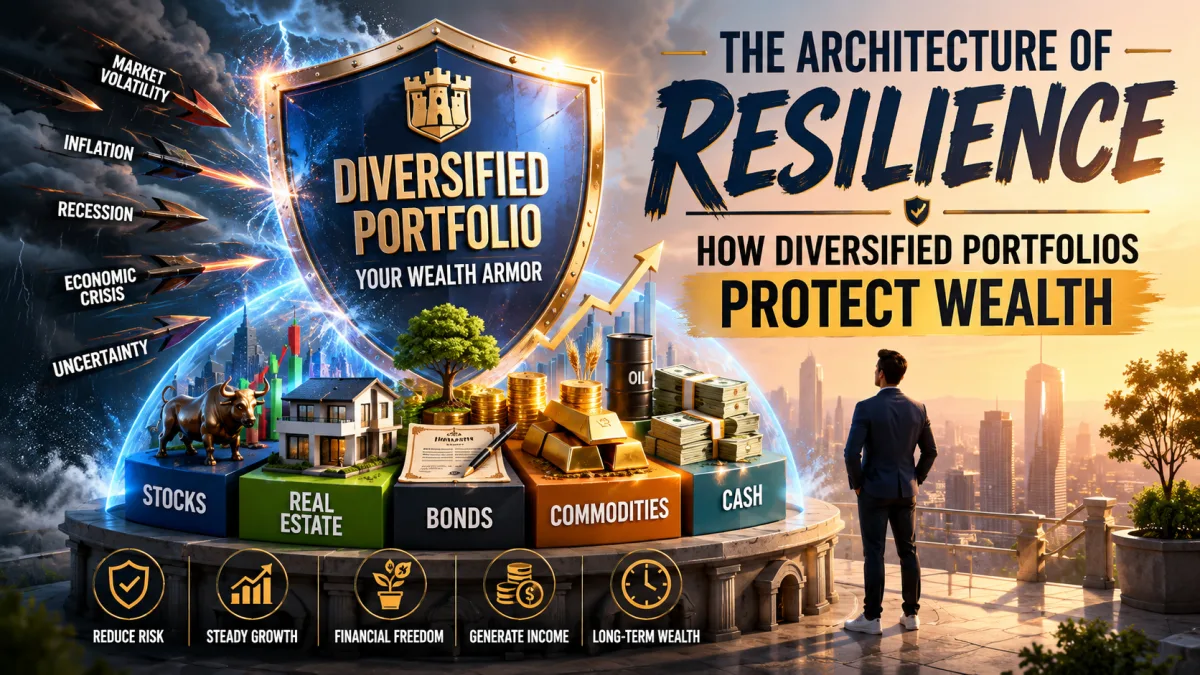
The Architecture of Resilience: How Diversified Portfolios Protect Wealth
Putting all your money in one place can feel courageous. It can feel decisive. It can even feel intelligent when the investment is rising and everyone around you is applauding the result.
But concentration has a hidden weakness. It asks your financial future to depend on too few outcomes.
One company must keep executing. One industry must keep growing. One country must keep leading. One currency must keep holding strength. One market cycle must keep moving in your favor. One story must remain true.
That is not strength. That is fragility wearing the costume of conviction.
Diversification is the discipline of refusing to let one mistake, one shock, one failed business, one political event, one recession, or one market reversal destroy years of saving. It is not designed to make every year spectacular. It is designed to keep you in the game long enough for compounding to do its quiet work.
Investors often hear diversification described with a familiar phrase: do not put all your eggs in one basket. The phrase is useful, but it is too small for the concept. Diversification is not merely about owning more things. It is about owning things that do not all fail for the same reason at the same time.
A person can own twenty investments and still be dangerously concentrated. If all twenty are technology companies, they may move together. If all twenty depend on the same country, the same interest-rate environment, the same customer base, the same commodity price, or the same economic trend, the portfolio may look diversified while behaving like a single bet.
Real diversification has architecture. It has layers. It has balance. It has purpose.
The goal is not to eliminate risk. No serious investment plan can do that. The goal is to choose which risks are worth taking, reduce the risks that do not pay you enough, and build a portfolio that can survive conditions you did not predict.
Why Diversification Matters More Than Confidence
Confidence feels persuasive. An investor studies a company, reads the financial statements, follows management interviews, understands the product, and decides the opportunity is exceptional. The temptation is to put a large amount of money into that one position.
Sometimes this works. A concentrated investment can create extraordinary wealth when the investor is right and patient. Many famous fortunes were built this way. Entrepreneurs hold large stakes in their own companies. Early investors in great businesses sometimes see life-changing returns. Concentration can be powerful.
But concentration has another side. It can also destroy wealth quickly.
History is full of companies that looked dominant until they were not. Retailers that once seemed permanent lost customers to new business models. Technology leaders missed platform shifts. Banks collapsed after hidden risks became visible. Energy companies suffered when commodity prices moved against them. Manufacturers were disrupted by cheaper competitors. Businesses praised as safe became examples in textbooks of what investors failed to see.
The problem is not that investors are always careless. The problem is that the future contains surprises.
Even careful analysis cannot reveal every risk. Fraud can be hidden. Debt can be underestimated. Regulation can change. A new competitor can arrive. Consumer behavior can shift. A lawsuit can damage a business. A supply chain can break. A charismatic founder can make poor decisions. A company can be good while its stock is priced too high.
Diversification begins with humility. It says, “I may be wrong. Even when I am right, something unexpected may happen. My financial life should not depend on perfect foresight.”
This humility is not weakness. It is one of the deepest forms of investing intelligence.
Diversification Is Not About Owning Everything Randomly
Some investors misunderstand diversification as accumulation. They buy more and more holdings until their portfolio becomes a cluttered collection of funds, stocks, accounts, and products. They assume that more names automatically mean more safety.
That is not necessarily true.
Diversification is not the same as owning many things. It is owning different exposures. The distinction matters.
If you own five funds that all track the same group of large companies, you may not be meaningfully diversified. You may simply be paying different fees for the same underlying exposure. If you own several stocks in the same industry, they may all rise and fall together. If you own assets that all depend on falling interest rates, the portfolio may suffer when rates rise. If your salary, home value, and investment portfolio all depend on the same local economy, your life may be more concentrated than your brokerage statement suggests.
Effective diversification requires asking what actually drives each investment.
Does it depend on corporate profits? Interest rates? Inflation? Economic growth? Consumer spending? Commodity prices? Real estate values? Currency movements? Government policy? Credit conditions? Technological adoption? Global trade?
Once you understand the drivers, you can build a portfolio whose parts do not all depend on one outcome. This is the heart of diversification.
The First Layer: Diversifying Across Companies
The most basic layer of diversification is company diversification. Instead of owning one business, you own many.
This protects you from company-specific risk. A single company can disappoint even when the economy is healthy. Earnings may fall. Management may make mistakes. A product may fail. Competitors may gain ground. A scandal may damage trust. A balance sheet may weaken. Investors may decide the company is worth less than they once believed.
If your entire portfolio is tied to that one company, the damage can be severe. If that company is one small holding among hundreds, the damage is contained.
This is one reason broad index funds and exchange-traded funds are so useful. A single fund can give an investor exposure to hundreds or thousands of companies. Instead of needing to select each business individually, the investor can own a broad slice of a market.
This does not mean every company in the fund is excellent. Some will struggle. Some may fail. Some may underperform for years. But the portfolio does not rely on each company succeeding. It relies on the collective productivity of many businesses over time.
That collective exposure is difficult for a beginner to recreate by buying individual stocks one at a time. It is also difficult to maintain. Companies change. Industries shift. Winners and losers rotate. A broad fund handles much of that structure automatically.
For many investors, company diversification is the first major improvement over speculation. It changes the question from “Will this one company make me rich?” to “Can a broad group of productive businesses grow my wealth over time?”
The Second Layer: Diversifying Across Industries
Owning many companies is helpful, but it is not enough if those companies all belong to the same industry.
Industry concentration can be subtle because it often happens during periods of success. When one sector is performing well, investors are drawn toward it. They read more about it. They hear more success stories. They see more headlines. Their friends talk about it. Their portfolio begins to tilt toward what has recently worked.
This can happen with technology, energy, banking, real estate, healthcare, mining, consumer brands, or any sector that captures investor attention.
The danger is that industries move in cycles. A sector can dominate for years and then struggle. Regulations may change. Profit margins may shrink. Demand may slow. Capital may flood into the industry and reduce returns. A new technology may disrupt old leaders. A commodity cycle may reverse.
A diversified portfolio spreads money across industries because different sectors respond differently to economic conditions.
Consumer staples may be more stable during downturns because people still buy essential goods. Technology may grow rapidly during innovation cycles but suffer when valuations become too high. Banks may benefit from certain interest-rate environments and struggle in others. Energy companies may rise when commodity prices increase and fall when prices weaken. Healthcare may be influenced by demographics, regulation, and innovation. Industrial companies may depend heavily on economic expansion.
No sector is always best. The leadership changes.
Industry diversification accepts that reality. It prevents yesterday’s winner from becoming tomorrow’s weakness in your portfolio.
The Third Layer: Diversifying Across Asset Classes
Company and industry diversification still live mostly inside the world of stocks. A portfolio made entirely of stocks can be diversified within equities and still experience severe declines when the stock market as a whole falls.
That is why asset-class diversification matters.
Different asset classes behave differently because they represent different financial claims. Stocks represent ownership in businesses. Bonds represent loans to governments or companies. Cash represents liquidity and stability. Real estate represents property ownership. Commodities represent physical resources. Each asset class responds differently to growth, inflation, interest rates, credit stress, and investor sentiment.
Stocks are often the engine of long-term growth. They allow investors to participate in business profits and economic expansion. But stocks can be volatile. Their prices can fall sharply when earnings expectations decline or fear rises.
Bonds can provide income and stability, although they also carry risks. Their prices can move when interest rates change, inflation expectations shift, or credit quality deteriorates. High-quality bonds may help cushion a portfolio during certain stock-market declines, but they are not magic. They work best when chosen with a clear understanding of duration, credit quality, and purpose.
Cash does not usually build wealth over long periods, especially after inflation. But cash has a role. It provides flexibility. It funds emergencies. It prevents forced selling. It allows an investor to meet near-term needs without liquidating long-term assets at an unfavorable time.
Real estate may provide income, inflation sensitivity, and diversification from traditional stocks and bonds. But it can be illiquid, expensive to maintain, and heavily dependent on location, financing, tenants, regulation, and interest rates.
Alternative assets may offer diversification in some cases, but they often bring complexity, higher fees, lower transparency, and liquidity limits. New investors should be especially cautious with products that sound sophisticated but are difficult to understand.
The purpose of asset-class diversification is not to own every possible investment. It is to combine assets whose strengths and weaknesses differ. A portfolio with growth assets, stabilizing assets, and liquid reserves is usually more resilient than one built entirely around a single return source.
The Fourth Layer: Diversifying Across Regions
Many investors have a home-country bias. They invest mostly in companies from the country where they live. This is understandable. Local companies are familiar. Local news is easier to follow. Local currency feels natural. Local markets may be easier to access.
But a person’s home country is still one economy.
Even strong economies go through difficult periods. Political decisions can affect markets. Currencies can weaken. Local industries can become less competitive. Demographic trends can change. Regulations can shift. Inflation can rise. Banking systems can face stress. A country that once led global markets can underperform for long stretches.
Global diversification spreads exposure across regions, currencies, economies, and political systems. It allows investors to participate in growth beyond their home market.
This does not mean international investing always performs better. Some periods favor one region, while other periods favor another. Currency movements can help or hurt returns. International markets bring their own risks. But the reason to diversify globally is not to predict which country will win next year. It is to avoid depending entirely on one country’s future.
For investors in smaller economies, regional diversification can be especially important. If your job, property, business, and savings are already tied to your local economy, investing some wealth internationally may reduce concentration in your overall financial life.
A diversified portfolio should not only ask, “What do I own?” It should also ask, “Where is my wealth exposed?”
The Fifth Layer: Diversifying Across Time
Diversification is usually discussed across investments, but time diversification is also important.
Investing a large amount all at once can work well over long periods, especially when markets rise after the investment. But it can be emotionally difficult if prices fall immediately afterward. Regular contributions spread entry points across different market conditions.
This is the logic behind dollar-cost averaging. By investing on a fixed schedule, you buy during good markets, bad markets, expensive markets, and fearful markets. You remove the pressure of identifying the perfect moment.
Time diversification also applies to goals. Money needed in one year should not be invested the same way as money needed in thirty years. A strong portfolio separates short-term, medium-term, and long-term needs.
Short-term money needs stability and access. Medium-term money may need a balance of caution and growth. Long-term money can usually accept more volatility in exchange for higher potential return.
Problems arise when investors mix these time horizons. They invest emergency money in volatile assets. They keep retirement money entirely in cash for decades. They take long-term risk with short-term money and short-term caution with long-term money.
Diversification across time means matching the investment to the deadline. It gives each dollar a job.
Risk and Return Must Be Balanced, Not Avoided
Every investor wants return. Fewer investors want the discomfort required to earn it.
This is why understanding risk is essential. Risk is not simply the possibility that an account balance falls this week. Risk includes permanent loss, inflation, liquidity problems, excessive debt, concentration, poor behavior, high fees, and failing to meet financial goals.
A portfolio that never moves may feel safe, but if it fails to grow enough to preserve purchasing power, it carries a different kind of risk. A portfolio that seeks maximum growth may build wealth faster, but it may also fall sharply and tempt the investor to abandon the plan.
The right portfolio is not the one with the highest theoretical return. It is the one you can hold through real conditions.
This point is often underestimated. An aggressive portfolio may look smart in a spreadsheet. But if the investor panics during the first major decline, the strategy fails. Behavior turns paper risk into real loss.
Diversification helps because it can reduce the emotional pressure of investing. A portfolio that is less extreme may be easier to hold. The investor may be less tempted to sell during downturns. The result can be better long-term outcomes, not because the portfolio was always the highest-returning option, but because it was survivable.
Survivability is one of the most important qualities in wealth building.
The Stock and Bond Decision
For many investors, the central allocation question is how much to hold in stocks and how much to hold in bonds or other stabilizing assets.
Stocks offer growth potential. Over long periods, they have historically rewarded investors for owning businesses and accepting volatility. But they can decline sharply, sometimes for extended periods.
Bonds are often used to reduce volatility and provide income. High-quality bonds can act as a stabilizer, although their behavior depends on interest rates, maturity, inflation, and credit risk. Not all bonds are conservative. A long-term bond fund or a lower-quality bond fund can behave very differently from a short-term government bond fund.
A young investor with decades before retirement may hold a higher stock allocation because time allows recovery from market declines. A person nearing retirement may prefer more stability because they may need to withdraw money sooner. Someone already retired must think about income, inflation, and the risk of selling assets during downturns.
Risk tolerance also matters. Two people of the same age can respond differently to volatility. One may calmly invest through a market decline. Another may lose sleep and sell at the bottom. The best allocation must fit both the financial timeline and the human being who must live with it.
This does not mean investors should let fear dominate the plan. Too little growth can be dangerous over long periods. But too much volatility can also create bad behavior. The right balance is the one that gives the portfolio a reasonable chance to meet the goal while allowing the investor to stay committed.
Why Broad Funds Are Powerful Building Blocks
Broad funds are one of the most important tools available to ordinary investors.
A broad stock-market fund can hold hundreds or thousands of companies. A bond fund can hold many bonds across issuers and maturities. An international fund can provide exposure to companies outside the investor’s home market. With a few funds, an investor can build a portfolio that would have been difficult and expensive for individuals to create in earlier generations.
The power of broad funds comes from simplicity, diversification, and cost control.
Simplicity matters because complicated portfolios are harder to manage. The more moving parts an investor has, the easier it becomes to make mistakes, duplicate exposure, chase performance, or lose track of the plan.
Diversification matters because broad funds reduce dependence on a single company or sector. The investor participates in a wider opportunity set.
Cost control matters because fees reduce returns. A low-cost fund leaves more of the investment return with the investor. Over decades, that difference can become substantial.
This is why a diversified portfolio does not need to look impressive. A total market fund, an international fund, and a high-quality bond fund may look almost too simple. But simplicity is often a strength.
The goal is not to impress other investors. The goal is to build wealth efficiently and protect it from avoidable mistakes.
False Diversification: When a Portfolio Looks Safer Than It Is
False diversification happens when a portfolio appears spread out but is still exposed to the same underlying risk.
One common example is owning several funds with overlapping holdings. An investor may hold multiple large-company funds, growth funds, technology funds, and popular ETFs, only to discover that many of them own the same dominant companies. The portfolio has many names but not much difference.
Another example is owning stocks in different companies that all depend on the same economic force. A portfolio filled with banks, real estate companies, and highly leveraged businesses may be broadly exposed to credit conditions and interest rates. A portfolio filled with oil producers, energy service firms, and commodity exporters may depend heavily on energy prices.
False diversification can also happen outside the investment account. Consider a person who works for a technology company, receives stock compensation from that company, invests heavily in technology funds, and lives in a city whose economy depends on technology jobs. Their financial life may be concentrated even if their investment account contains several holdings.
The same can happen with real estate. A person may own a home, invest in local property, hold shares in property-related companies, and depend on rental income from one city. If that city weakens, multiple parts of their wealth can suffer together.
To identify false diversification, look beneath labels. Ask what the portfolio truly depends on. If many holdings would likely struggle under the same scenario, the diversification may be weaker than it appears.
Over-Diversification: When More Becomes Messy
Diversification protects wealth, but over-diversification creates confusion.
An investor does not need dozens of funds to be diversified. Too many holdings can make it harder to understand the portfolio. It can increase fees, complicate tax reporting, duplicate exposure, and make rebalancing more difficult.
Over-diversification often begins with good intentions. An investor hears about a promising fund and adds it. Then another. Then a sector fund. Then a thematic fund. Then an income fund. Then an international fund that overlaps with an existing global fund. Over time, the portfolio becomes a financial junk drawer.
The problem is not merely messiness. A cluttered portfolio can hide risk. The investor may not know the true stock allocation, bond duration, sector exposure, geographic exposure, or fee level. Decisions become reactive instead of strategic.
A clean portfolio is easier to maintain. Each holding should have a purpose. If an investment does not clearly improve diversification, reduce cost, increase expected return appropriately, or serve a specific goal, it may not belong.
Good diversification is not maximum complexity. It is thoughtful coverage.
The Role of Rebalancing
Even a well-designed portfolio will drift.
If stocks perform strongly for several years, they may grow into a larger share of the portfolio than originally planned. The investor may wake up with more risk than intended. If bonds or defensive assets outperform during a difficult period, the portfolio may become more conservative than intended.
Rebalancing restores the target mix.
Suppose an investor chooses a portfolio of 70 percent stocks and 30 percent bonds. After a strong stock market, the portfolio becomes 80 percent stocks and 20 percent bonds. Rebalancing would involve bringing the portfolio back toward the original target. This may mean directing new contributions toward bonds, or in some cases selling some stocks and buying bonds.
Rebalancing can feel uncomfortable because it often means trimming what has recently done well and adding to what has recently lagged. But that discomfort is the point. It creates discipline. It prevents performance chasing. It keeps risk aligned with the plan.
Rebalancing does not need to happen constantly. Many investors review once or twice a year, or rebalance when allocations drift beyond a chosen range. Too much rebalancing can create unnecessary trading and tax consequences. Too little can allow risk to drift too far.
The right approach depends on account type, taxes, transaction costs, and personal preference. But the principle is clear: a portfolio should not be allowed to become something different from what it was designed to be.
Diversification and Inflation
Protecting wealth is not only about avoiding market declines. It is also about preserving purchasing power.
Inflation reduces the real value of money. If prices rise faster than your assets grow, your wealth may look stable on paper while becoming weaker in practice.
Cash is most vulnerable to this over long periods. It is necessary for emergencies and short-term needs, but large idle cash balances can lose purchasing power when inflation is high.
Stocks can offer some inflation protection over long periods because businesses may raise prices, grow earnings, and own productive assets. But stocks can also suffer during inflationary periods, especially if interest rates rise or profit margins are squeezed.
Bonds can be hurt by inflation because fixed interest payments become less valuable in real terms. Some inflation-linked bonds are designed to address this, but they come with their own mechanics and risks.
Real assets, such as certain forms of real estate or commodities, may respond differently to inflation. But they are not guaranteed solutions. Real estate can be affected by financing costs, vacancies, maintenance, and local demand. Commodities can be volatile and difficult to hold directly.
The practical lesson is that inflation risk should be considered when building a diversified portfolio. Wealth protection means thinking not only about nominal account balances, but about what those balances can buy in the future.
Diversification and Income Needs
Investors who need income must think differently from investors who are only accumulating wealth.
A retiree, for example, may need the portfolio to support regular withdrawals. A business owner may need investment income to smooth irregular cash flow. A family may want assets that help fund education costs or future obligations.
Diversification can help manage income risk. Relying on one rental property, one dividend stock, one bond issuer, or one business for income can be dangerous. If that income source weakens, the investor’s lifestyle may be affected.
A diversified income strategy may include bond interest, stock dividends, rental income, cash reserves, and systematic withdrawals from a broader portfolio. The exact mix depends on the investor’s needs, tax situation, and risk tolerance.
Income investors should be careful not to chase yield blindly. A high yield may indicate higher risk. A company with an unusually high dividend may be signaling that investors expect the dividend to be cut. A bond with a very high yield may reflect credit concerns. A product promising high income with low risk deserves close scrutiny.
Diversification protects income by making sure one payment source does not carry the entire burden.
The Human Benefit: Diversification Helps Investors Stay Invested
The greatest advantage of diversification may be behavioral.
A concentrated portfolio can create emotional extremes. When it rises, the investor feels brilliant. When it falls, the investor feels threatened. The account balance becomes a daily judgment of identity and intelligence.
A diversified portfolio is less dramatic. It may still fall, but usually not for the same reason as one concentrated position. Some parts may hold up better than others. This can reduce panic and help the investor stay committed.
Staying invested matters because many investors do not fail from lack of opportunity. They fail from poor timing driven by emotion. They buy after excitement rises. They sell after fear peaks. They change strategies too often. They abandon long-term plans because short-term discomfort becomes unbearable.
Diversification cannot remove emotion, but it can make emotion easier to manage.
A portfolio that allows you to sleep is not weak. It is practical. The best portfolio is not the one that looks most aggressive in good times. It is the one you can hold through bad times without making destructive decisions.
How to Build a Diversified Portfolio From the Ground Up
Building a diversified portfolio begins with goals, not products.
Before choosing investments, define what the money is for. Retirement, financial independence, education, a home purchase, business capital, family security, and general wealth building may require different timelines and risk levels.
Next, separate money by time horizon. Keep emergency funds and near-term spending needs in stable, liquid places. Do not ask volatile investments to protect money you need soon.
Then decide the broad asset allocation. This is the mix between growth assets, stabilizing assets, and cash. For many investors, this means deciding how much belongs in stocks, bonds, and liquid reserves.
After that, diversify within each asset class. For stocks, consider exposure across companies, sectors, and regions. For bonds, consider credit quality, maturity, and issuer type. For real estate or other assets, consider location, leverage, liquidity, and concentration.
Then choose low-cost, transparent investment vehicles where possible. Broad index funds and ETFs can be efficient tools. They are not the only tools, but they are often strong building blocks.
Finally, create a maintenance process. Decide how often contributions will be made, how often the portfolio will be reviewed, and when rebalancing will occur. A portfolio is not something to redesign every week. It is something to build thoughtfully and maintain patiently.
A Simple Portfolio Framework
A simple diversified portfolio might begin with a broad domestic stock fund as the core. This gives exposure to many companies in the investor’s home market.
It might add an international or global stock fund to reduce dependence on one country. This expands the opportunity set and introduces regional diversification.
It might include a high-quality bond fund or other stabilizing asset to reduce volatility and provide balance. The size of this allocation depends on age, goals, risk tolerance, and time horizon.
It should also include cash reserves outside the investment portfolio for emergencies and near-term needs. Cash may not be exciting, but it prevents forced selling.
This framework can be adjusted. A younger investor with a long horizon may hold more stocks. A retiree may hold more stabilizing assets. A business owner with irregular income may need more cash. An investor in a small domestic market may place greater emphasis on global exposure.
The important point is that each part has a job. The stock funds pursue growth. The international exposure reduces country dependence. The bond allocation adds stability. The cash reserve protects the plan from life’s surprises.
That is portfolio architecture. Not random ownership. Deliberate design.
When Concentration May Be Unavoidable
Some forms of concentration are difficult to avoid.
A founder may have most of their wealth in a business. An employee may receive company stock as compensation. A homeowner may have much of their net worth tied to one property. A family business may represent both income and wealth. A professional may work in an industry closely connected to their investments.
In these cases, diversification becomes even more important for the assets that can be controlled.
If your income already depends on one company, you may not want your investment portfolio heavily tied to the same company. If your home and job are linked to one local economy, global investments may provide balance. If your business is your main asset, your personal portfolio may need more liquidity and less exposure to the same industry.
Concentration is not always foolish. Sometimes it is the result of entrepreneurship, career opportunity, or property ownership. But unmanaged concentration is dangerous.
The right question is not, “Am I concentrated?” Many people are. The better question is, “Where am I concentrated, and how can the rest of my financial life reduce that risk?”
Diversification Does Not Guarantee Comfort
A diversified portfolio can still lose money.
This point must be stated clearly because some investors misunderstand diversification as protection from all declines. It is not. During severe market stress, many assets can fall together. Stocks across regions can decline at the same time. Credit markets can weaken. Real estate can struggle. Even bonds can fall in certain interest-rate environments.
Diversification reduces dependence on a single risk. It does not repeal the laws of markets.
An investor who expects diversification to prevent every loss will be disappointed. An investor who understands diversification as risk management will be better prepared.
The measure of a diversified portfolio is not whether it rises every month. The measure is whether it gives the investor a better chance of surviving uncertainty, meeting long-term goals, and avoiding catastrophic concentration.
Diversification is not a shield against discomfort. It is a defense against ruin.
The Cost of Ignoring Diversification
The cost of poor diversification often appears suddenly, but the risk builds quietly.
An employee keeps too much wealth in company stock because the company has always done well. A homeowner buys multiple properties in the same city because local prices have been rising. An investor fills a portfolio with fashionable technology stocks because recent returns look unstoppable. A retiree buys high-yield products because the income looks attractive. A young investor puts savings into one speculative asset because social media says it is the future.
For a while, these decisions may look brilliant. Concentrated bets often look best right before they become dangerous. Rising prices validate the story. Doubters look foolish. Risk feels theoretical.
Then conditions change.
The company disappoints. The local property market slows. Interest rates rise. The fashionable sector falls. The dividend is cut. The speculative asset collapses. The investor discovers that wealth was not protected; it was exposed.
The emotional cost can be as severe as the financial cost. Losing money from overconcentration can create shame, fear, and distrust of investing altogether. Some people respond by becoming too conservative for the rest of their lives, missing future opportunities because one avoidable mistake damaged their confidence.
Diversification is a way to protect both capital and conviction.
How Often Should a Portfolio Be Reviewed?
A diversified portfolio should be reviewed regularly, but not obsessively.
Daily checking is rarely useful for long-term investors. It encourages emotional reactions to normal market movement. It can make investing feel like entertainment or danger, depending on the day.
A thoughtful review once or twice a year is often enough for many investors. During the review, the investor can ask several practical questions. Is the asset allocation still appropriate? Have the holdings drifted from their targets? Are fees still reasonable? Has the investor’s life changed? Are upcoming cash needs properly funded? Has any holding become unnecessary or duplicative?
Major life changes may require additional review. Marriage, children, a new job, a business sale, inheritance, retirement, relocation, or a major health event can all change financial needs. A portfolio should serve the investor’s life, not remain frozen out of habit.
But review is different from constant tinkering. The purpose is maintenance, not restlessness.
Practical Lessons for Investors at Different Stages
A young investor should focus on building the habit, keeping costs low, and accepting that volatility is part of long-term growth. With decades ahead, the greatest asset may be time. Diversification should prevent reckless concentration while still allowing enough growth exposure.
A mid-career investor should pay close attention to contribution rates, retirement targets, family obligations, and concentration risks. This is often the stage when income is higher but responsibilities are also heavier. Diversification should support both growth and resilience.
An investor nearing retirement should think carefully about sequence risk, liquidity, income needs, and reducing the chance of being forced to sell after a major decline. Diversification becomes less about maximizing return and more about balancing growth with stability.
A retired investor should manage withdrawals, inflation, income sources, and capital preservation. Too much risk can be dangerous, but too little growth can allow inflation to erode purchasing power over a long retirement. Diversification must support sustainability.
A business owner should recognize that the business may already represent a large concentrated asset. Personal investments may need to provide balance, liquidity, and exposure outside the business’s industry or local economy.
There is no universal perfect portfolio. There are only principles that must be applied to real lives.
The Quiet Strength of a Portfolio Built to Last
A diversified portfolio may not create impressive stories at dinner. It does not offer the thrill of saying you placed everything on one winning idea. It does not promise overnight transformation. It does not feed the ego in the same way a concentrated winner can.
But wealth is not built for applause. It is built for freedom, security, options, and endurance.
The investor who diversifies is making a mature decision. They are admitting that the future is uncertain. They are refusing to let excitement overpower judgment. They are building a structure that can bend without breaking.
Diversification protects against the disasters that interrupt compounding. That is its power. A portfolio does not need to win every race. It needs to avoid being eliminated.
Over decades, survival matters. Staying invested matters. Avoiding catastrophic mistakes matters. Reducing emotional pressure matters. Keeping costs low matters. Giving good assets enough time to work matters.
A diversified portfolio brings these ideas together.
The Takeaway
Diversification is not a slogan. It is a wealth-protection system.
It spreads risk across companies so one business cannot ruin you. It spreads risk across industries so one sector cycle does not dominate your future. It spreads risk across asset classes so your portfolio is not dependent only on stocks. It spreads risk across regions so one country does not carry the entire burden. It spreads risk across time so you are not forced to guess the perfect moment.
The purpose is not to avoid every decline. That is impossible. The purpose is to build a portfolio strong enough to survive uncertainty and steady enough for you to hold.
Fast wealth is fragile when it depends on one outcome. Durable wealth is built through structure, patience, and discipline.
Spread your money wisely. Keep the plan simple. Rebalance when needed. Avoid unnecessary complexity. Let diversification protect the foundation while time and compounding do their work.
Want a portfolio built to last? Subscribe for weekly Wealth Insights on growing and protecting your wealth.
 Article
 Article
 Article
 Article
 Article
 Article
 Article
 Article