The Retirement Number: How Much You Really Need Before You Stop Working
Most people ask the retirement question as if there is one correct number.
How much do you need to retire?
One million dollars. Two million dollars. Twenty-five times your annual expenses. Ten times your salary. Enough to replace 80 percent of your income. Enough to live comfortably. Enough to never worry again.
These answers sound helpful because they are simple. They are also incomplete.
Retirement is not funded by a magic number. It is funded by cash flow. The real question is not only how much money you have saved. The real question is whether your assets, income sources, spending habits, health costs, taxes, inflation protection, and investment strategy can support your life for as long as retirement lasts.
That is why two people with the same portfolio can have completely different retirement outcomes.
One person may retire comfortably with a modest portfolio because they own their home, have low expenses, no debt, a simple lifestyle, reliable pension income, and affordable healthcare. Another person may feel financially insecure with far more money because they carry debt, support several dependents, live in a high-cost area, spend heavily, and need expensive medical care.
The retirement number is personal because retirement is personal.
It depends less on what your neighbor saved and more on what your life costs. It depends less on your final salary and more on your future spending. It depends less on one account balance and more on the relationship between income, expenses, time, risk, and flexibility.
A good retirement plan begins with a clear truth: you are not trying to reach an impressive number. You are trying to buy financial independence from employment income.
Retirement Is an Income Problem, Not Just a Savings Problem
Many people think retirement planning is about building the largest possible pile of money. Bigger is better, of course. More savings creates more options. But a pile of money is only useful if it can produce or support income.
During your working years, your paycheck funds your life. In retirement, that paycheck must be replaced by other sources. These may include investment withdrawals, pension payments, rental income, business income, dividends, bond interest, annuities, government benefits, or part-time work.
The central retirement question is this: can your non-work income support your spending without running out too soon?
This is why retirement planning must begin with expenses. Not salary. Not ego. Not a round number. Expenses.
If you currently earn a high income but spend modestly, your retirement target may be lower than expected. If you earn a moderate income but spend nearly all of it, your retirement target may be higher than expected. Retirement does not care how much you used to earn. It cares how much you need to withdraw.
That distinction changes the whole conversation.
A person earning $150,000 and spending $60,000 may be closer to retirement than a person earning $300,000 and spending $290,000. The first person has a lower lifestyle to fund and a higher savings capacity. The second person has a larger income but a more expensive life.
Income impresses people. Expenses determine retirement.
The First Step: Know What Your Life Actually Costs
You cannot calculate a retirement number without knowing your current cost of living.
Many people guess. They estimate rent or mortgage payments, groceries, utilities, and transport, but forget the irregular expenses that appear throughout the year. Insurance premiums, repairs, medical costs, gifts, travel, school support, subscriptions, taxes, clothing, family obligations, holidays, professional fees, technology replacements, and emergencies all matter.
A retirement budget built on incomplete expenses is dangerous because it creates false confidence.
Start by calculating your annual spending today. Use bank statements, card statements, receipts, budgeting apps, or a spreadsheet. Group spending into essential categories, lifestyle categories, debt payments, savings, investing, taxes, and irregular expenses.
Then separate what will continue in retirement from what may change.
Some costs may fall. Work clothing, commuting, professional expenses, payroll taxes, and retirement contributions may decline. A mortgage may be paid off. Children may become independent. Debt may be eliminated.
Other costs may rise. Healthcare may increase. Travel may grow in the early retirement years. Home maintenance may become more expensive as the property ages. Help with domestic tasks may become necessary. Inflation may raise the price of everyday life. Supporting family members may continue longer than expected.
The goal is not to predict every cost perfectly. That is impossible. The goal is to build a realistic spending base.
If you do not know what your life costs now, you are guessing what retirement will cost later.
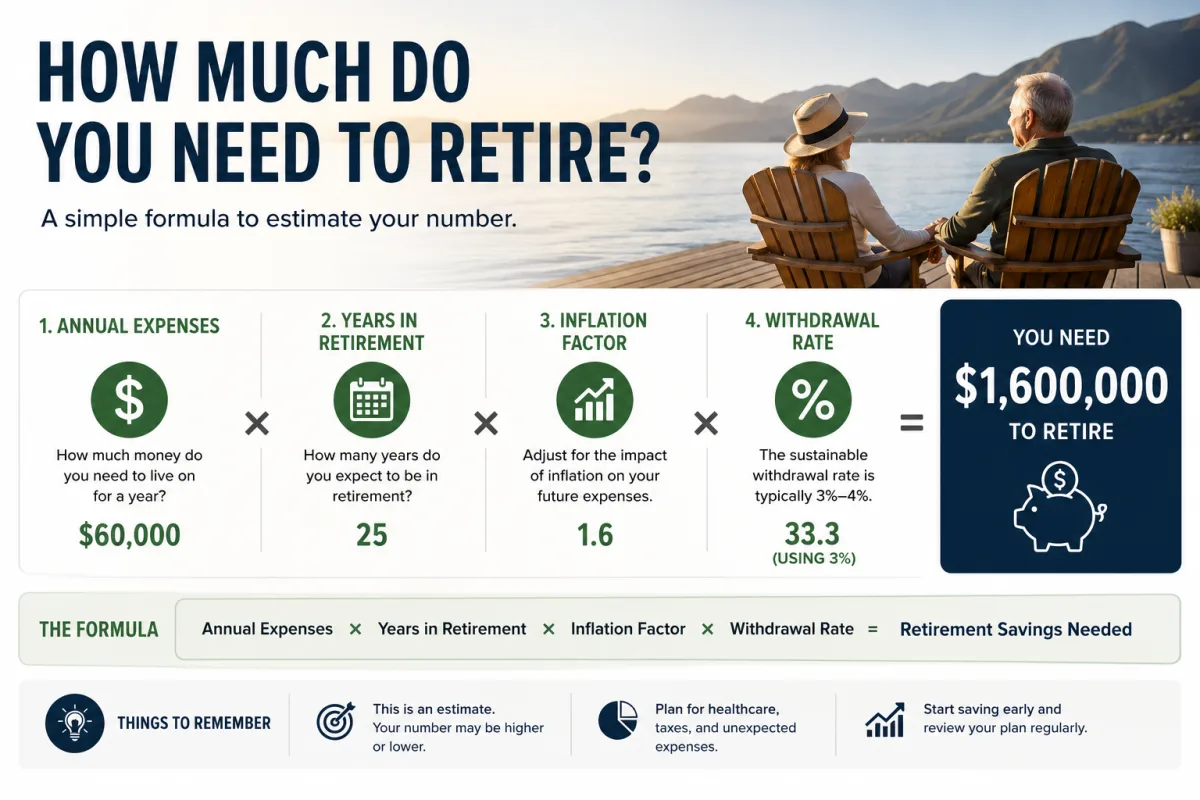
The Simple Formula: Annual Expenses Multiplied by 25
One common retirement rule says you need about 25 times your annual retirement expenses invested.
This idea comes from the logic of a 4 percent withdrawal rate. If you withdraw 4 percent of your portfolio in the first year of retirement and adjust withdrawals over time, a diversified portfolio may have a reasonable chance of lasting through a long retirement, depending on market conditions, fees, taxes, inflation, and spending flexibility.
The 25-times rule is simple:
If you need $40,000 per year from investments, multiply $40,000 by 25. Your target is $1,000,000.
If you need $60,000 per year, the target is $1,500,000.
If you need $80,000 per year, the target is $2,000,000.
If you need $120,000 per year, the target is $3,000,000.
This rule is useful because it connects retirement wealth to spending. It shows why lifestyle is so powerful. Every permanent increase in annual spending raises the portfolio required to support it.
For example, an extra $10,000 of annual retirement spending may require roughly $250,000 more in invested assets using the 25-times framework. That does not mean you should never enjoy life. It means lifestyle decisions have long-term capital consequences.
But the 25-times rule is not a law. It is a starting estimate.
It may be too aggressive for someone retiring very early, facing high healthcare uncertainty, paying high investment fees, or unwilling to reduce spending during market downturns. It may be too conservative for someone with strong pension income, flexible expenses, part-time income, or a shorter expected retirement period.
Use it as a compass, not a contract.
Why the 4 Percent Rule Is Not Perfect
The 4 percent rule is popular because it gives people a simple way to think about retirement withdrawals. But simplicity can become dangerous when people treat a rule of thumb as a guarantee.
No withdrawal rule can promise safety in every future environment.
Retirement outcomes depend on investment returns, inflation, taxes, fees, asset allocation, withdrawal timing, spending behavior, life expectancy, and market conditions early in retirement. A person who retires just before a severe market decline may face a different challenge than someone who retires at the beginning of a strong bull market.
This is called sequence-of-returns risk. It means the order of investment returns matters. A portfolio that suffers large losses early in retirement while withdrawals are being made can be damaged more severely than a portfolio that experiences those same losses later.
Imagine two retirees with the same average return over thirty years. One experiences strong returns early and weak returns later. The other experiences weak returns early and strong returns later. Even with the same average return, their outcomes can be very different because withdrawals during early losses remove capital before it has time to recover.
This is why retirement planning should include flexibility. A retiree who can reduce discretionary spending during bad markets has a stronger plan than one who must withdraw the same amount no matter what happens. A retiree with cash reserves, bond income, rental income, or part-time work may avoid selling stocks during downturns. A retiree with no flexibility may face more risk.
The 4 percent rule is a useful framework. It is not a substitute for judgment.
The Better Question: How Much Must Your Portfolio Provide?
Your retirement expenses do not all have to come from your investment portfolio.
This is an important point. Many people calculate their retirement number by multiplying total spending by 25, but they forget to subtract other reliable income sources.
Suppose you expect to spend $70,000 per year in retirement. If you have no pension, no rental income, and no other income, your portfolio may need to support most of that amount. Using the 25-times rule, that could imply a target near $1,750,000.
But suppose you expect $25,000 per year from a pension or other reliable income source. Now your portfolio only needs to provide $45,000 per year. Using the same rule, the target falls to $1,125,000.
This is why retirement planning should calculate the income gap.
The formula is simple:
Expected annual retirement spending minus reliable annual retirement income equals the amount your portfolio must provide.
That income gap is the number to multiply.
Reliable income sources can reduce the pressure on your portfolio. But they should be evaluated carefully. Is the income inflation-adjusted? Is it guaranteed? Is it tied to a business that may decline? Is it dependent on tenants? Is it taxable? Could it stop when a spouse dies? Could policy changes affect it? Could currency risk reduce its purchasing power?
Income is valuable, but quality matters.
Retirement Spending Usually Comes in Phases
Retirement is often discussed as one long, stable period. Real life is more uneven.
Many retirees experience three broad phases: the active years, the slower years, and the care years.
In the active years, spending may be higher than expected. People travel, renovate homes, support children or grandchildren, pursue hobbies, relocate, or enjoy the freedom they worked for. This phase can be fulfilling, but it can also be expensive.
In the slower years, discretionary spending may decline. Travel may reduce. Entertainment may become simpler. Daily routines may become more settled. Some lifestyle expenses fall naturally.
In the care years, healthcare, support, assisted living, home modifications, medication, caregiving, or long-term care costs may rise. This phase can be financially significant, especially for people without adequate insurance, family support, or dedicated reserves.
A strong retirement plan recognizes that expenses are not flat.
You may need more flexibility early, more stability later, and more protection against healthcare costs near the end. Planning for only the first phase can create trouble. Planning only for basic living costs can underestimate the real cost of aging.
The retirement number should not only fund a lifestyle. It should fund resilience.
Healthcare Can Change the Retirement Calculation
Healthcare is one of the largest uncertainties in retirement planning.
Healthy people often underestimate future medical costs because they plan based on how they feel today. But retirement may last twenty, thirty, or even forty years. Health needs can change dramatically over that time.
Medical costs can include insurance premiums, deductibles, prescriptions, dental care, vision care, specialist visits, mobility support, home care, medical devices, physical therapy, and long-term care. In some countries, public healthcare reduces part of this burden. In others, private insurance and out-of-pocket costs can be substantial.
The key is to understand the healthcare system where you live and plan accordingly.
Ask what coverage you will have after leaving work. Ask whether employer benefits continue. Ask what private insurance may cost. Ask whether premiums rise with age. Ask what is excluded. Ask how long-term care is handled. Ask whether your spouse or dependents are covered.
Healthcare planning is not pessimism. It is protection.
A retirement plan that ignores health costs may look strong on paper but weak in real life. Medical needs have a way of arriving when flexibility is lowest. Building room for them protects both money and dignity.
Debt Changes Everything
Debt in retirement can raise the amount you need because it increases fixed obligations.
A retiree with no mortgage, no car loan, and no high-interest debt has more flexibility than a retiree whose income must cover loan payments every month. Debt turns part of retirement spending into a non-negotiable obligation.
This does not mean every retiree must be completely debt-free. Some wealthy retirees carry manageable debt strategically. But for many households, entering retirement with high-interest consumer debt, large loan payments, or an unaffordable mortgage creates unnecessary stress.
Debt also increases sequence risk. If markets fall, a retiree with low fixed expenses can reduce discretionary spending. A retiree with heavy debt payments has less room to adjust. The withdrawals must continue because the lender must be paid.
Before retirement, evaluate every debt. What is the interest rate? What is the monthly payment? When will it be paid off? Is it tied to an asset? Is the payment affordable without work income? Could refinancing, faster repayment, downsizing, or restructuring improve retirement security?
Reducing debt before retirement can lower the portfolio required to sustain your lifestyle. It can also reduce anxiety.
Freedom from debt is not the only form of retirement wealth, but it is one of the most valuable forms of retirement flexibility.
Inflation Is the Silent Retirement Tax
Inflation is dangerous because it does not take money from your account directly. It reduces what the money can buy.
A retirement budget that looks comfortable today may feel tight twenty years from now if prices rise steadily. Food, utilities, insurance, housing, healthcare, transportation, and services can all become more expensive over time.
This matters because retirement can last for decades.
If your income does not grow with costs, your purchasing power shrinks. A fixed pension, fixed annuity, or cash-heavy portfolio may feel safe at the beginning but lose strength over time. This is why retirees often need some growth exposure even after they stop working.
Stocks, real estate, inflation-linked bonds, business income, and other growth-oriented assets may help protect purchasing power, though each carries risk. The right mix depends on age, needs, risk tolerance, and income sources.
The mistake is assuming retirement money only needs to be safe from market declines. It also needs to be safe from slow erosion.
A good retirement number must account for future prices, not only today’s bills.
Your Retirement Age Changes the Number
The age at which you retire has a major effect on how much you need.
Retiring at 45 is very different from retiring at 65. An early retiree must fund more years without employment income. They may also have more years before government benefits, pension access, or retirement account access begins. Healthcare coverage may be more expensive. The portfolio must survive a longer period of withdrawals.
Retiring later can reduce the target in several ways. You have more years to save. Your investments have more years to compound. Your retirement period may be shorter. Some benefits may be larger if delayed. Debt may be paid down. Children may become financially independent.
This is why working a few extra years can have a powerful impact. It can increase assets and reduce the number of years those assets must support.
But retirement age is not always fully voluntary. Health issues, job loss, caregiving responsibilities, industry changes, or employer decisions can force people to stop earlier than planned. A strong plan should include some margin for the possibility that retirement begins before the ideal date.
Planning to work forever is not a retirement strategy. It is a hope. Work can be part of the plan, but it should not be the only plan.
Location Can Make or Break the Retirement Number
Where you live has a major effect on how much you need to retire.
Housing, taxes, healthcare, transport, food, insurance, utilities, and lifestyle costs vary widely by location. A portfolio that supports a comfortable life in one town may feel inadequate in an expensive city. A modest retirement income may stretch far in one country and barely cover basics in another.
Relocation can be one of the most powerful retirement planning tools, but it must be considered carefully.
Moving to a lower-cost area can reduce housing expenses, taxes, and daily costs. It may allow a smaller portfolio to support a better lifestyle. But cheaper is not always better. Access to healthcare, safety, family, climate, infrastructure, transportation, community, legal systems, and quality of life all matter.
A low-cost location that isolates you from family support or medical care may not be a good retirement choice. A beautiful destination with unstable currency, complex residency rules, or weak healthcare may create hidden risks.
The right retirement location balances cost with livability.
If your retirement number feels too high, do not only ask how to save more. Ask whether your planned lifestyle and location are making retirement more expensive than necessary.
The Role of Home Ownership
Home ownership can reduce retirement pressure, but it is not automatically a complete solution.
A paid-off home can lower monthly expenses because there is no rent or mortgage payment. It can provide stability, protect against rising rents, and serve as a valuable asset. For many households, owning a home outright is one of the strongest forms of retirement security.
But homes still cost money.
Property taxes, insurance, repairs, maintenance, utilities, renovations, security, and accessibility upgrades can be significant. A large home may become expensive or impractical later in life. A home may also be illiquid, meaning it cannot easily pay for groceries or healthcare unless sold, rented, borrowed against, or otherwise monetized.
Some retirees downsize to unlock equity and reduce costs. Others rent part of a property, relocate, or use home equity as a backup resource. Each choice has trade-offs.
Renters need a different plan. They may have more flexibility and less maintenance responsibility, but they face rent inflation and the need to fund housing costs indefinitely.
The question is not whether owning or renting is universally better. The question is how housing fits into your retirement cash flow.
How Much Is Enough for a Basic Retirement?
A basic retirement number covers essential expenses with limited lifestyle spending.
This includes housing, food, utilities, healthcare, insurance, transport, taxes, basic clothing, communication, and modest personal spending. It may not include frequent travel, major gifts, luxury purchases, large hobbies, or significant family support.
To calculate this number, estimate your essential annual retirement expenses. Subtract reliable income sources. Multiply the remaining gap by a reasonable withdrawal multiple, such as 25, while remembering that the result is a starting estimate.
For example, if essential expenses are $36,000 per year and reliable income provides $16,000, the portfolio must provide $20,000. Using the 25-times framework, the estimated target would be $500,000.
This does not mean $500,000 guarantees safety. It means that under this simplified framework, the portfolio may be designed to support the income gap. The real plan must still consider taxes, inflation, healthcare, investment risk, and flexibility.
A basic retirement is about security. It answers the question: can I cover the essentials if I stop working?
How Much Is Enough for a Comfortable Retirement?
A comfortable retirement includes more than survival.
It may include travel, hobbies, dining out, family support, home improvements, generosity, entertainment, wellness, and a stronger healthcare cushion. It allows more room for choice.
The calculation is the same, but the spending estimate is higher.
If comfortable retirement spending is $80,000 per year and reliable income provides $25,000, the portfolio must provide $55,000. Using the 25-times framework, the target would be $1,375,000.
This number may rise if the retiree wants more safety, expects high healthcare costs, retires early, faces high taxes, or wants to leave a legacy. It may fall if the retiree has flexible spending, part-time income, lower housing costs, or other assets.
Comfort is personal. For one person, comfort means a quiet life in a paid-off home with family nearby. For another, it means international travel and premium healthcare. For another, it means funding grandchildren’s education or supporting charitable work.
A comfortable retirement must be defined before it can be funded.
How Much Is Enough for Financial Independence?
Financial independence is the point where work becomes optional because assets and income sources can support your life.
This does not always mean you stop working. Many financially independent people continue working, building businesses, investing, teaching, consulting, volunteering, or creating. The difference is that they are no longer dependent on a paycheck for survival.
The financial independence number is usually tied closely to annual spending. The lower your required spending, the lower the asset base needed. The higher your spending, the higher the target.
This is why financial independence is influenced by both sides of the equation: assets and lifestyle.
You can move closer by saving and investing more. You can also move closer by reducing permanent expenses, eliminating debt, relocating, building income-producing assets, or simplifying your lifestyle.
Financial independence is not only a wealth level. It is a relationship between money and freedom.
The Retirement Number for Couples
Couples need a shared retirement calculation, not two separate guesses.
Retirement planning for couples must consider both partners’ ages, health, income sources, pensions, spending habits, debts, insurance, family obligations, and life expectancy. One partner may retire earlier. One may have better benefits. One may expect longer life. One may be more comfortable with investment risk. One may support relatives. These differences matter.
Couples also need to discuss what happens when one partner dies. Some pension benefits reduce or stop. Expenses may not fall as much as expected. Housing costs may remain similar. Healthcare needs may rise. The surviving partner may need a plan that remains strong on one income.
Money silence inside a marriage or partnership can damage retirement security. Both people should understand the assets, debts, accounts, insurance, beneficiaries, estate documents, and income sources.
A retirement plan should not live only in one person’s head.
The Retirement Number for Single People
Single people face a different retirement challenge.
They may have more flexibility in lifestyle decisions, location, and spending. But they may also have only one income during the working years and one set of benefits in retirement. They may not have a spouse’s pension, second Social Security-style benefit, or partner income to rely on. Care needs may require more paid support later in life.
This makes emergency savings, insurance, estate planning, healthcare planning, and social support especially important.
A single person should plan not only for expenses, but for who will help make decisions if health declines. Legal documents, trusted contacts, medical directives, and organized financial records matter.
Retirement planning is not only about money. It is also about support systems.
Retirement Is Harder Without Investing
Saving is essential, but saving alone may not be enough for long retirements.
Cash provides safety for short-term needs, but over decades it may struggle to keep up with inflation. Retirement money often needs growth, especially for people who may live many years after leaving work.
This is where investing becomes important.
A diversified portfolio of stocks, bonds, and other suitable assets can help retirement savings grow before and during retirement. Stocks may provide long-term growth. Bonds may provide income and stability. Cash may provide liquidity. Other assets may play a role depending on the investor’s situation.
The right mix changes with time. A young worker saving for retirement decades away may hold more growth assets. A person near retirement may begin reducing risk and building cash reserves. A retiree may need a balance of growth, income, and stability.
The mistake is thinking retirement investing ends on the retirement date. For many people, investing continues throughout retirement because the money must last for decades.
Retirement is not the end of investing. It is a new phase of investing.
Why Fees Matter More Than People Think
Fees reduce the money available to fund retirement.
A small annual fee may not seem important, but over decades it can consume a meaningful portion of returns. Investment management fees, fund expense ratios, advisory fees, platform fees, transaction costs, insurance product charges, and hidden costs all matter.
This does not mean every fee is bad. Good advice can be valuable, especially for complex situations. But fees should be clear, reasonable, and justified by value.
High fees increase the portfolio required to support the same lifestyle. They also reduce flexibility during retirement. Every dollar paid unnecessarily to financial intermediaries is a dollar that cannot support your future spending.
Understand what you are paying. Ask how the advisor is compensated. Review fund costs. Avoid products you do not understand. Keep the investment plan as simple as your situation allows.
Retirement planning is difficult enough. Do not let unnecessary fees quietly raise the finish line.
Taxes Can Change the Number
Retirement spending is funded with after-tax money. That means taxes can affect how much you need to withdraw.
Different accounts and income sources may be taxed differently. Pension income, investment withdrawals, rental income, business income, dividends, interest, capital gains, and retirement account distributions may each have different treatment depending on your country’s tax rules.
A person who needs $60,000 per year to spend may need to withdraw more than $60,000 if taxes are due on the withdrawals. This is why retirement calculations should distinguish between gross income and spendable income.
Tax planning can influence which accounts to draw from first, when to realize gains, how to manage required withdrawals where applicable, how to give, how to structure estate plans, and whether certain investments are better held in certain account types.
You do not need to become a tax expert, but you should not ignore taxes. As retirement approaches, professional tax advice may be worth the cost.
The number that matters is not what your account statement says. It is what you can actually spend after taxes.
Family Support Can Raise the Retirement Target
Many retirement calculations assume that the retiree supports only themselves or a spouse. Real life is often more complicated.
Parents may still support adult children. Grandparents may help with school fees. Relatives may need medical assistance. Family members may depend on the retiree for housing, food, or emergency help. Cultural expectations and personal values may make family support a permanent part of the budget.
This support should be planned, not ignored.
Generosity without structure can endanger retirement. A retiree may want to help loved ones but must also protect their own ability to live with dignity. If support is likely, include it in the spending estimate. Decide what is sustainable. Communicate boundaries where necessary.
A retirement plan that depends on never saying no may not be realistic.
Helping family is meaningful. Becoming financially dependent because of unplanned giving can create hardship for everyone later.
Emergency Reserves Still Matter in Retirement
Retirees need emergency funds too.
Some people assume that once they have a retirement portfolio, all money can be invested. But emergencies do not stop after retirement. Home repairs, medical needs, family crises, vehicle replacement, legal issues, and market downturns can all require liquidity.
Cash reserves help prevent forced selling.
If the stock market falls sharply and you need money immediately, having cash or short-term reserves can allow you to cover expenses without selling growth assets at depressed prices. This can protect the long-term portfolio.
The right reserve amount depends on expenses, income sources, risk tolerance, and portfolio design. Some retirees prefer one year of essential expenses in safer assets. Others hold more. Some rely on bond ladders, cash buckets, or pension income.
The principle is that retirement income should not depend entirely on selling volatile assets at whatever price the market offers that month.
The Danger of Retiring Too Early Without Flexibility
Early retirement is attractive because it offers time. Time to travel, rest, build, create, volunteer, study, spend with family, or escape work that no longer fits.
But early retirement requires more planning because the money must last longer.
A person retiring at 40 or 45 may need to fund fifty years of life. That is a very different challenge from funding twenty years. Inflation has more time to erode purchasing power. Healthcare costs may span a longer period. Market cycles become more important. Personal goals may change. Family responsibilities may continue.
Early retirees need strong margins. They may need lower withdrawal rates, flexible spending, diversified income, part-time work options, business income, or the willingness to return to work if conditions change.
The danger is not early retirement itself. The danger is early retirement built on overly optimistic assumptions.
Freedom is strongest when it has a margin of safety.
The Danger of Retiring Too Late
There is also a cost to delaying retirement indefinitely.
Some people keep working because they genuinely enjoy it. That can be healthy. Others keep working because they are afraid to stop, even when they have enough. They worry about market crashes, healthcare, inflation, boredom, identity, or losing relevance.
Working longer can improve finances, but time is also a finite asset.
A person who has enough money but no plan for using their freedom may continue trading years for dollars they do not need. This is not always wise. Retirement planning should not only ask how much money is enough. It should also ask what life is for.
There is a balance between financial prudence and life avoidance.
If you are close to your retirement number, begin planning the non-financial side as well. What will your days look like? Who will you spend time with? What work, service, creativity, travel, learning, or rest will give life meaning? What identity exists beyond your job title?
Money funds retirement. Purpose sustains it.
A Practical Retirement Calculation
A practical retirement calculation can be built in stages.
First, estimate your annual retirement spending. Include essentials, lifestyle costs, healthcare, taxes, insurance, housing, family support, travel, and irregular expenses.
Second, subtract reliable annual income. Include pensions, government benefits, rental income, annuity income, business income, or other dependable sources. Be conservative. Do not count uncertain income as guaranteed.
Third, calculate the portfolio income gap. This is the amount your investments must provide each year.
Fourth, multiply that gap by 25 as a starting estimate. Adjust upward if you want more safety, plan to retire early, expect high healthcare costs, have high fees, or need to support dependents. Adjust carefully if you have flexible spending, part-time work, strong guaranteed income, or lower expenses.
Fifth, test the number against real life. What happens if markets fall early? What happens if inflation is higher? What happens if healthcare costs rise? What happens if one spouse dies? What happens if you live longer than expected? What happens if family support increases?
Sixth, build a margin of safety. Retirement is too important to plan with perfect assumptions.
An Example of the Retirement Number
Consider a couple who expects to spend $75,000 per year in retirement. They expect $30,000 per year from reliable pension and government-style income. Their investment portfolio must provide $45,000 per year.
Using the 25-times rule, they would estimate a target of $1,125,000 in invested assets.
But that is only the first version.
If they still have a mortgage, the target may need to be higher until the mortgage is paid off. If healthcare costs are uncertain, they may want a larger cushion. If they plan to travel heavily for the first ten years, they may need a separate travel fund. If they can reduce spending during market downturns, the plan becomes more flexible. If one partner has a pension that drops after death, survivor planning becomes important.
The number is not the end of planning. It is the beginning of testing.
What If You Are Behind?
Many people calculate their retirement number and feel discouraged.
The target may look too large. The years may feel too short. The savings may seem too small. The temptation is to avoid the subject entirely.
Do not do that.
A late start is not solved by denial. It is solved by action.
If you are behind, several levers can improve the situation. Increase savings. Reduce expenses. Pay down high-interest debt. Invest appropriately. Work longer. Build additional income. Downsize housing. Relocate to a lower-cost area. Delay benefits where appropriate. Improve health habits. Reduce fees. Avoid speculative losses. Consider part-time work in retirement.
None of these levers is magic. But combined, they can meaningfully change the outcome.
A person who cannot reach the ideal retirement number may still build a better retirement than the one they would have had by doing nothing.
Progress matters even when perfection is impossible.
What If You Are Ahead?
Some people are closer to retirement than they realize because they have controlled spending, invested consistently, avoided debt, and built assets over time.
If you are ahead, the challenge changes. The question becomes how to protect what you have built and use it wisely.
This may involve reducing concentrated risk, reviewing asset allocation, planning withdrawals, understanding taxes, updating estate documents, checking insurance, discussing retirement with a spouse, and thinking carefully about purpose.
Being ahead does not mean becoming careless. A large portfolio can still be damaged by overspending, bad investments, family pressure, fraud, poor tax planning, or unmanaged healthcare costs.
Financial independence requires stewardship.
The Retirement Number Is a Moving Target
Your retirement number will change over time.
Expenses change. Markets change. Inflation changes. Health changes. Family obligations change. Tax rules change. Interest rates change. Goals change. A number calculated at age 35 may need updating at 45, 55, and 65.
This is why retirement planning should be reviewed regularly.
A yearly review can help you update savings rates, investment performance, spending assumptions, debt payoff progress, insurance needs, and retirement timeline. Major life events should also trigger a review: marriage, divorce, children, inheritance, job loss, business sale, relocation, illness, or the death of a loved one.
A retirement plan is not a document you write once. It is a system you maintain.
The Answer in One Sentence
You need enough to cover your annual retirement spending, after subtracting reliable income, with a portfolio large enough to survive inflation, taxes, healthcare costs, market declines, and a long life.
For a rough estimate, many people start with 25 times the annual amount they need from investments. But the real answer must be adjusted for your age, lifestyle, debt, location, health, family obligations, income sources, and risk tolerance.
This is why “How much do I need to retire?” is not a one-number question. It is a planning question.
The Real Goal
The real goal of retirement planning is not to win a contest of account balances.
The goal is to create a life where work becomes optional, expenses are funded, risks are managed, and your time belongs more fully to you.
That requires more than saving. It requires knowing what your life costs. It requires controlling lifestyle inflation. It requires eliminating unnecessary debt. It requires investing with patience. It requires protecting against healthcare costs and inflation. It requires building income sources that do not depend entirely on your labor. It requires honest conversations with the people affected by your decisions.
The retirement number is not about fear. It is about freedom.
Once you know the number, you can stop guessing. You can measure the gap. You can build a plan. You can decide whether to save more, spend less, invest differently, work longer, relocate, build income, or adjust the lifestyle you want.
Clarity turns retirement from a vague dream into a financial project.
You may not know the exact amount today. But you can begin with the right calculation: what will life cost, what income will you have, and how much must your assets provide?
Answer those questions honestly, and the retirement number becomes less mysterious.
It becomes a target you can build toward, one paycheck, one investment, one debt payment, and one disciplined decision at a time.
Ready to build a retirement plan that can last? Subscribe for weekly Wealth Insights on turning income into assets, assets into freedom, and freedom into a life with more choices.
 Article
 Article
 Article
 Article
 Article
 Article
 Article
 Article