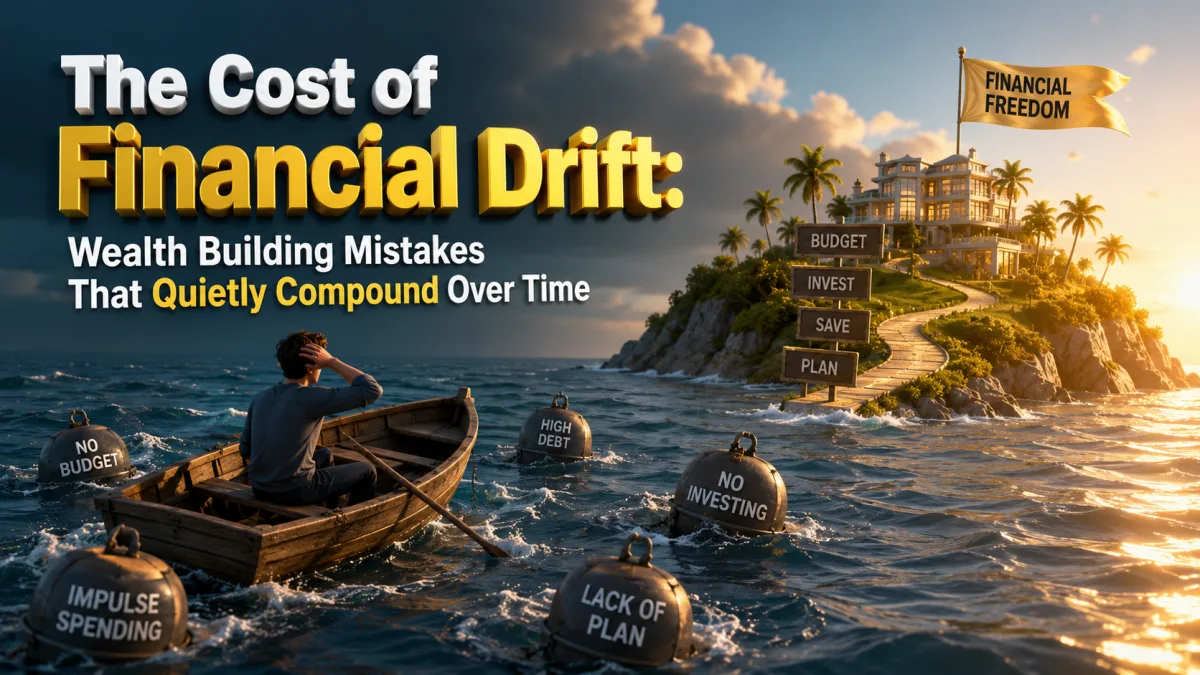
The Cost of Financial Drift: Wealth Building Mistakes That Quietly Compound Over Time
Wealth is not only built by making the right moves. It is also built by avoiding the wrong ones.
Many people work hard for decades and still struggle to build lasting financial security. They earn income. They pay bills. They try to save when they can. They may even invest occasionally. Yet their financial life never gains the momentum they expected. The problem is not always low income. Often, it is financial behavior repeated for years without enough attention.
Small mistakes become expensive when they are repeated. A single unnecessary purchase may not matter. A lifestyle that expands faster than income matters. One delayed investment contribution may not destroy a future. Years of waiting can. One emotional market decision may be recoverable. A habit of reacting to fear and hype can damage decades of progress.
Wealth building is deeply connected to compounding. Most people understand that money can compound. Fewer understand that mistakes compound too. Debt compounds. Bad habits compound. Avoidance compounds. Financial ignorance compounds. Time can multiply good decisions, but it can also multiply weak ones.
This is why avoiding mistakes is not a minor part of wealth creation. It is central. Every dollar not wasted on destructive debt can become investment capital. Every year not lost to procrastination can become a compounding year. Every emotional decision avoided protects the long-term plan. Every lesson learned improves future judgment.
Building wealth is not about perfection. No investor, business owner, saver, or household makes flawless decisions. Everyone misjudges something. Everyone spends money they could have used better. Everyone looks back and sees opportunities they missed. The goal is not to live without mistakes. The goal is to avoid the repeated mistakes that quietly prevent financial independence.
Why Wealth Mistakes Are So Expensive
Financial mistakes are expensive because money is connected to time. A dollar wasted today is not only a dollar gone. It is also the future growth that dollar might have produced if invested. A year spent delaying financial action is not only one year lost. It is one year of compounding that cannot be recovered.
The most damaging mistakes are often not dramatic. They are ordinary. They look like waiting to invest until life feels more settled. Upgrading lifestyle every time income rises. Depending on one paycheck. Carrying high-interest debt. Ignoring financial education. Selling investments during fear. Chasing opportunities that promise fast wealth. Spending profits instead of reinvesting them.
These behaviors do not always create immediate pain. That is what makes them dangerous. A person can delay investing for five years and still feel fine in the present. They can finance a lifestyle upgrade and enjoy it immediately. They can avoid learning about money and still get through the month. The consequences arrive later, often when time has become more valuable and less abundant.
Financial drift is the slow movement away from wealth without realizing it. It happens when money decisions are made automatically, emotionally, or socially rather than strategically. A person does not choose to be financially fragile. They simply never build a system strong enough to become financially resilient.
Avoiding wealth mistakes begins with seeing them clearly. Once the pattern is visible, it can be interrupted.
Mistake 1: Not Investing Early
Time is one of the most powerful wealth-building tools because it allows compounding to work. Compounding is the process by which returns begin to generate their own returns. At first, the effect may look small. Over long periods, it can become extraordinary.
Delaying investing weakens this process. The investor who waits does not only miss early contributions. They miss the growth those contributions could have produced. They also miss the growth on the growth. That is why waiting often becomes more expensive than people realize.
Many people delay investing because they believe they need a large amount of money to begin. This belief keeps them stuck. The early years of investing are not only about the size of contributions. They are about building the habit, learning how markets behave, becoming comfortable with volatility, and giving money time to grow.
A small investment made consistently can matter because it establishes direction. A person who learns to invest a modest amount can increase contributions as income rises. A person who waits for the perfect moment may never begin. Life rarely becomes perfectly calm. Expenses appear. Responsibilities grow. Confidence rises and falls. Markets move. The habit must begin before conditions are ideal.
Another reason people delay is fear. Investing involves risk. Markets decline. Businesses fail. Real estate can disappoint. But avoiding investing entirely creates another risk: the risk that money does not grow enough to support future goals. Inflation reduces purchasing power. Retirement requires assets. Financial freedom requires ownership.
The goal is not reckless investing. The goal is informed investing. A beginner does not need to chase complex strategies. Many wealth-building journeys begin with diversified funds, retirement accounts, regular contributions, and a long-term mindset. What matters most is starting, learning, and staying consistent.
The Real Cost of Waiting
The cost of waiting is easy to underestimate because it is invisible. When a person spends money, they see the purchase. When they delay investing, nothing obvious happens. No bill arrives that says, “You lost another year of compounding.” But the cost is real.
Imagine two people. One begins investing early with small amounts. The other waits until income is higher and then invests larger amounts. The late starter may feel more serious because the contributions are bigger. But the early investor has something money cannot easily buy later: time in the market.
This does not mean someone who starts later should give up. Starting late is better than never starting. But the lesson remains: the earlier the habit begins, the more powerful the formula becomes.
Investing early also changes identity. A person who invests becomes an owner. They begin to think about assets, growth, risk, and long-term value. That mindset influences future choices. The habit of ownership often matters as much as the first dollars invested.
Mistake 2: Lifestyle Inflation
Lifestyle inflation is one of the most common reasons people fail to build wealth despite earning more money. It happens when expenses rise every time income rises. A raise becomes a larger apartment. A bonus becomes a vacation. A promotion becomes a new car. A strong business year becomes a permanent lifestyle upgrade.
Some lifestyle improvement is natural. Money should improve life. A higher income can buy safer housing, better healthcare, quality food, education, comfort, travel, and meaningful experiences. The problem begins when every increase in income is consumed before it strengthens the balance sheet.
Lifestyle inflation is dangerous because it often feels deserved. A person works hard and wants proof that the hard work paid off. Spending becomes emotional validation. The purchase says, “I made it.” But if the purchase creates new obligations and reduces investment capacity, the person may look more successful while becoming less financially free.
High earners are especially vulnerable. A large income can hide weak financial habits for a long time. Bills get paid. Credit is available. The lifestyle appears stable. But if savings are low, debt is high, and investments are limited, the household may be fragile beneath the surface.
The real measure of financial progress is not how much lifestyle has expanded. It is how much freedom has expanded. Freedom comes from surplus, savings, investments, and ownership. If income rises but freedom does not, lifestyle inflation may be absorbing the gain.
How to Prevent Lifestyle Inflation
The best way to control lifestyle inflation is to decide in advance how income increases will be used. Without a plan, new income tends to disappear into spending. With a plan, every raise can improve both present life and future security.
One practical approach is to divide every income increase. A portion can improve lifestyle. A portion should increase savings or investments. A portion may reduce debt. This allows life to improve without sacrificing long-term wealth.
Automation helps. When investment contributions rise automatically after a raise, the money is less likely to become part of everyday spending. The household adjusts to the new amount available. This makes discipline easier because it removes repeated decision-making.
Another strategy is to be cautious with permanent expenses. Occasional spending is easier to control than recurring obligations. A subscription, loan payment, rent increase, car payment, or lifestyle commitment repeats month after month. Before taking on a new fixed expense, ask whether it supports financial freedom or only creates pressure.
The goal is not to live cheaply forever. The goal is to grow assets faster than lifestyle. When assets expand first, lifestyle becomes more sustainable.
Mistake 3: Depending on One Income Source
One income source can create vulnerability. A single paycheck may feel stable until it disappears. Job loss, industry disruption, health problems, economic downturns, business challenges, or family emergencies can quickly expose how fragile a household is when all money depends on one source.
This does not mean everyone must become an entrepreneur or build five income streams immediately. It means wealth builders understand the risk of depending completely on one source of income. They look for ways to increase resilience over time.
Diversified income can take many forms. It may include a spouse’s income, freelance work, consulting, rental income, dividends, interest, business income, royalties, digital products, or part-time services. Some income streams may be small at first. Their value is not only the amount they produce, but the optionality they create.
A second income stream can reduce panic during a job transition. Investment income can support retirement. A side business can become a full-time business. Skills developed through freelance work can increase career value. Rental income can create long-term cash flow. Dividends can be reinvested into more ownership.
Income diversification also changes mindset. A person who depends only on a paycheck may think mainly as an employee. A person building additional income begins thinking like an owner, investor, or problem solver. That shift can open opportunities.
The Difference Between Active and Asset-Based Income
Not all income streams are equal. Some require direct labor. Others are connected to assets. Active income includes salaries, wages, freelance work, consulting, and service businesses. Asset-based income includes dividends, rent, royalties, business profits from systems, and investment distributions.
Active income can be powerful, especially when it is high. It funds the early stages of wealth. But asset-based income is usually more scalable because it is tied to ownership. The long-term goal is not necessarily to replace all active income quickly. The goal is to use active income to acquire assets that may produce future income.
A person might begin with employment, add freelance income, invest part of the surplus into funds, later buy a rental property, and eventually build a business or digital asset. The path does not need to be dramatic. It needs to be intentional.
Depending on one income source is risky. Building multiple sources gradually is a form of financial defense.
Mistake 4: Ignoring Financial Education
Financial decisions affect every stage of life, yet many people spend years earning money without learning how money works. They learn how to perform a job but not how to build assets. They learn how to qualify for credit but not how interest can trap them. They learn how to spend but not how to invest. They learn how to earn income but not how to convert income into wealth.
Ignoring financial education is expensive because money decisions are constant. Every paycheck, loan, purchase, investment, insurance policy, tax decision, and business choice is affected by financial understanding. A person does not need to become an expert in every area, but basic literacy is essential.
Financial education improves investing decisions. It helps people understand diversification, risk, time horizons, fees, asset allocation, volatility, and compounding. It reduces the chance of panic selling or chasing hype.
It improves budgeting. A person who understands cash flow can identify waste, plan for irregular expenses, and create surplus. Without budgeting, money often disappears without explanation.
It improves risk management. Insurance, emergency funds, debt structure, investment diversification, and estate planning all require financial judgment. Ignoring risk does not make risk disappear.
It improves wealth-building strategy. A financially educated person understands the difference between assets and liabilities, income and wealth, saving and investing, speculation and ownership. These distinctions shape behavior.
Knowledge Compounds Financially
Knowledge compounds because better decisions build on each other. A person who learns to avoid high-interest debt saves money that can be invested. The investments grow. The growth encourages more learning. Better learning improves asset selection, risk management, and discipline.
The opposite is also true. A lack of knowledge compounds negatively. A person may take on expensive debt, avoid investing, buy unsuitable products, sell during panic, underinsure major risks, or misunderstand taxes. Each mistake can create new problems.
Financial education should be practical. Reading is useful, but the goal is application. Build an emergency fund. Understand your debt. Learn how investment accounts work. Study compounding. Review fees. Understand insurance basics. Learn the tax rules that apply to your situation. Ask better questions before signing financial agreements.
Wealth builders are lifelong students of money. They do not assume that earning income is enough. They learn how to direct income wisely.
Mistake 5: Chasing Quick Money
The desire for fast wealth is understandable. Slow progress can feel frustrating. People see others making money quickly and wonder why they should follow a patient plan. Social media intensifies this pressure by highlighting wins and hiding losses.
Chasing quick money often leads to emotional investing, poor decisions, excessive risk, and financial losses. It can push people into speculative assets they do not understand, concentrated bets they cannot afford, businesses they have not studied, or schemes that depend on hype rather than value.
Fast money is seductive because it promises escape from discipline. It suggests that a person can skip the ordinary process of earning, saving, investing, reinvesting, and waiting. That promise is dangerous. Wealth built without understanding is often lost without understanding.
This does not mean all high-growth opportunities are bad. Some investments, businesses, and innovations create extraordinary returns. But serious investors evaluate opportunity through risk, value, probability, time horizon, and position size. They do not confuse excitement with strategy.
The question is not, “Can this make money?” Many things can. The better question is, “What risk am I taking, what evidence supports the opportunity, what could go wrong, and can I survive being wrong?”
Sustainable Wealth Usually Looks Boring First
Most sustainable wealth is built slowly before it becomes impressive. Contributions to a retirement account may seem boring. Reinvested dividends may seem small. Debt reduction may not feel exciting. Building a business system may take years. Learning valuable skills may not produce immediate wealth.
But these ordinary actions create the foundation. Later, the results may appear sudden to outsiders. They see the portfolio, business, property, or financial freedom but not the years of quiet discipline behind it.
Quick-money thinking often causes people to abandon the very habits that would have made them wealthy. They stop contributing because progress feels slow. They sell stable assets to chase trends. They take risks out of impatience. They compare their early stage to someone else’s highlight.
Wealth builders respect speed, but they do not worship it. They prefer durable progress over fragile excitement.
Mistake 6: Overspending on Liabilities
Assets generate value. Liabilities consume cash flow. One of the most common wealth-building mistakes is spending too much money on things that reduce financial flexibility without producing future value.
A liability is not always bad. A home mortgage, car loan, student loan, or business obligation may have a purpose. The problem is excessive liabilities, especially when they are used to fund lifestyle rather than productive capacity.
Luxury spending can be enjoyable, but when it comes too early or too heavily, it slows wealth creation. Expensive cars, designer goods, large homes, high-end electronics, premium travel, and status purchases can absorb capital that might have become assets. Again, the issue is not enjoyment. The issue is proportion.
High-interest financing is especially damaging. When interest works against a household, income is redirected away from wealth building and toward lenders. Credit card balances and expensive consumer loans can keep people financially stuck even when income appears strong.
The hidden cost of liabilities is cash flow. Every monthly payment reduces freedom. It may limit the ability to invest, change jobs, start a business, handle emergencies, or take advantage of opportunities.
Buying the Appearance of Wealth
Many people overspend because they confuse the appearance of wealth with wealth itself. A luxury car, expensive watch, large house, or impressive vacation can signal success, but it does not prove financial strength. Without assets, savings, and manageable debt, visible consumption may simply be expensive performance.
Real wealth is often less visible. It may appear as investment accounts, business equity, rental properties, cash reserves, paid-off debt, insurance protection, and financial options. These things do not always attract attention, but they create freedom.
The wealth builder asks a different question before major purchases: “Will this decision strengthen or weaken my future options?”
Some purchases are worth making. A reliable car may support work. A comfortable home may improve family life. Travel may create meaningful experiences. But when spending is driven mainly by status, comparison, or impulse, it can quietly transfer future freedom into present appearance.
Mistake 7: Avoiding Risk Completely
Risk is uncomfortable, but avoiding all risk can limit wealth growth. Many people believe that keeping money in cash is safe. Cash is necessary for emergencies and short-term needs, but holding all long-term money in cash can expose a person to inflation and missed growth.
Inflation reduces purchasing power. Over time, the same amount of money may buy less. If savings do not grow, financial security can weaken even when the account balance stays the same.
Strategic investing helps protect and grow wealth over long periods. Stocks, real estate, businesses, and diversified funds all involve risk, but they also offer potential growth. The purpose of investing is not to eliminate uncertainty. It is to accept intelligent risk in exchange for potential return.
The key word is intelligent. Wealth builders do not take risk blindly. They study it. They diversify. They use appropriate time horizons. They avoid overconcentration. They keep emergency reserves. They match investments to goals. They understand that risk management is different from fear.
Avoiding risk completely may feel safe in the short term, but it can create long-term fragility. Retirement, education, healthcare, housing, and financial freedom often require growth. Growth requires some exposure to productive assets.
Smart Risk Versus Reckless Risk
Smart risk is measured. Reckless risk is emotional. Smart risk is tied to a plan. Reckless risk is tied to excitement, desperation, or social pressure.
A diversified investment portfolio held for decades may involve smart risk. Borrowing heavily to speculate on a trend may involve reckless risk. Buying a rental property after careful analysis may involve smart risk. Buying one without reserves because someone promised easy passive income may involve reckless risk. Starting a business with a tested idea and financial cushion may involve smart risk. Quitting a job overnight for an untested fantasy may involve reckless risk.
The goal is not to avoid risk. The goal is to take the kinds of risk that can reasonably reward patience, preparation, and skill.
Mistake 8: Failing to Reinvest
Spending all profits slows wealth growth. Reinvestment accelerates compounding. This mistake appears in investing, business, real estate, and personal finance.
An investor may receive dividends and spend them immediately instead of buying more shares. A business owner may extract every profitable dollar instead of improving systems, hiring talent, strengthening marketing, or expanding capacity. A real estate owner may spend all cash flow instead of maintaining reserves, improving properties, or acquiring additional assets.
Reinvestment is powerful because it increases the productive base. More shares can produce more dividends. Better business systems can produce more profit. Improved properties can attract better tenants or support higher rents. Additional assets can create additional income streams.
Compounding becomes stronger when returns remain in the system. The investor who constantly removes returns interrupts the process. The owner who reinvests allows growth to build on growth.
This requires delayed gratification. It is tempting to spend every gain, especially after years of work. But wealth builders understand that some profits should become future assets. They do not harvest every seed.
The Reinvestment Habit
Reinvestment works best when it becomes a habit rather than an occasional decision. A dividend reinvestment plan, automatic portfolio contributions, business reinvestment budget, or property reserve account can help returns stay productive.
The habit does not require reinvesting every dollar forever. At some point, assets may be designed to support lifestyle, retirement, giving, or family needs. But in the accumulation phase, reinvestment is one of the strongest accelerators of wealth.
A useful question is: “How much of today’s return should become tomorrow’s asset?”
That question keeps the wealth-building engine running.
Mistake 9: Emotional Financial Decisions
Fear and greed are two of the most destructive forces in personal finance. Fear can cause panic selling, excessive caution, or avoidance. Greed can cause overconfidence, speculation, and reckless borrowing. Both emotions can pull people away from sound strategy.
Panic selling is a common example. Markets decline, headlines become negative, and investors feel pressure to escape. Selling may provide emotional relief, but it can lock in losses and prevent participation in recovery. A long-term plan should expect volatility before it arrives.
Impulse spending is another emotional decision. Stress, boredom, comparison, celebration, and sadness can all trigger spending. The purchase may feel good briefly, but repeated impulse spending weakens surplus and delays investing.
Following hype blindly is also emotional. When everyone seems excited about an investment, business model, or trend, people fear missing out. They buy without understanding risk. They assume popularity equals safety. It does not.
Financial discipline does not mean emotions disappear. It means emotions do not control the plan. Wealth builders create systems to protect themselves from their own worst impulses.
Building Emotional Distance
One way to reduce emotional decisions is to create rules in advance. Decide how much to invest each month. Decide what percentage of income to save. Decide how much emergency cash to hold. Decide how much risk is acceptable. Decide when a purchase requires a waiting period. Decide how investments will be reviewed.
Rules are easier to follow when created calmly. They are harder to create during panic or excitement.
Another method is to slow down major decisions. Many financial mistakes happen quickly. A waiting period can prevent impulse. Before selling an investment, taking on debt, making a large purchase, or joining a speculative opportunity, create space for analysis.
Good financial decisions often feel less exciting than bad ones. That is not a flaw. Excitement is not the same as wisdom.
Mistake 10: Thinking Short Term
Wealth building usually takes years. Many people quit too early because results seem slow at first. They invest for a few months and become disappointed. They start saving and feel progress is too small. They begin a business and expect immediate profit. They learn a new skill but want instant income growth.
Short-term thinking is dangerous because it interrupts compounding. Compounding needs time. Businesses need time. Skills need time. Real estate needs time. Portfolios need time. Financial habits need time.
A short-term thinker asks, “What can this do for me now?” A long-term wealth builder asks, “What can this become if I repeat it for ten or twenty years?”
This shift changes behavior. A monthly investment contribution may seem small today, but repeated for decades it can become meaningful. A skill learned this year may increase income for the rest of a career. A business system built slowly may later create scalable profit. A debt payoff plan may feel restrictive now but create future freedom.
Short-term thinking also creates impatience with ordinary progress. People abandon good strategies because they are not dramatic. They chase new ideas instead of allowing sound decisions to mature. They compare their beginning to someone else’s peak.
Long-Term Thinking Is a Financial Advantage
Long-term thinking gives a person an advantage because many people are unwilling to practice it. Markets are full of short-term reactions. Consumer culture encourages immediate gratification. Social comparison rewards visible spending. Long-term investors, savers, and builders can use patience as a competitive edge.
A long-term thinker can buy assets during fear, continue investing during boredom, avoid debt during social pressure, reinvest profits instead of spending them all, and stay focused when others chase trends.
Patience is not passive. It is active commitment to a strategy that needs time. The long-term thinker still learns, adjusts, and manages risk. But they do not demand instant proof from every good decision.
The Better Wealth Strategy
A stronger wealth-building framework is simple: increase income, control expenses, invest consistently, build assets, diversify income, reinvest profits, and stay patient.
Increasing income creates more financial options. It gives the household fuel for saving, investing, debt repayment, and opportunity. Income can be increased through skills, negotiation, business, side income, and solving more valuable problems.
Controlling expenses creates surplus. Surplus is the foundation of wealth. Without it, income disappears into consumption. Expense control does not require misery. It requires intentionality.
Investing consistently turns surplus into ownership. Ownership allows money to participate in growth. Stocks, ETFs, real estate, businesses, retirement funds, and other assets can all play a role depending on the plan.
Building assets creates financial strength. Assets may produce income, appreciate, or both. The more productive assets a person owns, the less dependent they become on labor alone.
Diversifying income creates resilience. Multiple income sources reduce vulnerability and increase opportunity. A person does not need every income stream at once. They can build gradually.
Reinvesting profits accelerates growth. It keeps returns working. It turns income into more assets and more assets into more future income.
Staying patient allows compounding to work. Without patience, even good strategies may be abandoned too early.
Simple Strategies Often Outperform Complicated Ones
Many people assume wealth requires complexity. They look for advanced tactics, unusual investments, market timing, tax secrets, or hidden opportunities. Complexity can sometimes be useful, but it can also become a distraction.
Simple strategies often outperform complicated ones because they are easier to repeat. A person who automatically invests every month, avoids high-interest debt, increases income, controls lifestyle inflation, and reinvests returns may build more wealth than someone constantly chasing sophisticated ideas without discipline.
Wealth is not built by complexity alone. It is built by behavior. The best strategy is one a person can understand, sustain, and improve over time.
For many households, the most powerful financial moves are straightforward: spend less than you earn, build emergency savings, pay down destructive debt, invest consistently in diversified assets, increase income, protect against major risks, and avoid emotional decisions.
These actions may not sound impressive. That is why they work. They do not depend on hype. They depend on repetition.
How to Audit Your Own Wealth-Building Mistakes
A useful financial audit begins with honesty. The goal is not guilt. The goal is awareness. Ask where the formula is breaking.
Is income too low for your goals, or has income grown without creating surplus? Are expenses rising automatically? Are fixed payments too high? Is high-interest debt consuming cash flow? Are you saving consistently? Do you have an emergency fund? Are you investing regularly? Are you avoiding investing because of fear? Are you chasing trends because of impatience? Are you reinvesting returns? Are you depending on one income source? Are financial decisions driven by a plan or by emotion?
These questions reveal the real work. A person may not need an entirely new life. They may need to fix one or two leaks. Reducing lifestyle inflation, automating investments, paying off expensive debt, or learning basic investing can create major improvement over time.
Wealth building becomes easier when mistakes are identified early. A small leak repaired now prevents a larger problem later.
The Role of Environment
Financial behavior is influenced by environment. The people around you, the media you consume, the neighborhoods you frequent, the apps on your phone, and the expectations in your social circle can all affect money decisions.
If your environment constantly rewards spending, it becomes harder to save. If your social circle treats debt as normal, it becomes harder to question it. If your media diet is full of speculation and luxury, patience begins to feel foolish. If no one around you talks about investing, ownership may seem distant.
Wealth builders design a better environment. They follow educational sources. They spend time with disciplined people. They limit exposure to hype. They make saving and investing automatic. They keep long-term goals visible. They reduce situations that trigger unnecessary spending.
Discipline is easier when the environment supports it.
Recovering From Past Mistakes
Many people feel discouraged when they recognize past financial mistakes. They think about years they did not invest, money they wasted, debt they accumulated, or opportunities they missed. Regret is natural, but it should not become paralysis.
The purpose of identifying mistakes is not to punish yourself. It is to change the next decision. A person cannot recover lost years, but they can stop losing more. They cannot undo every poor purchase, but they can build better spending rules. They cannot erase every investment mistake, but they can create a stronger strategy.
Financial recovery begins with stabilization. Build a clear picture of income, expenses, debt, savings, and assets. Create a small emergency fund. Attack high-interest debt. Automate savings. Begin investing at a sustainable level. Learn steadily. Increase income where possible. Avoid new destructive obligations.
Progress may feel slow at first, especially after years of mistakes. But the same compounding that made mistakes expensive can make better decisions powerful. Once behavior changes, time begins working in a better direction.
Final Thought
Building wealth is not only about making money. It is about avoiding the behaviors that destroy financial progress.
Not investing early delays compounding. Lifestyle inflation absorbs income. Depending on one income source creates vulnerability. Ignoring financial education weakens judgment. Chasing quick money increases risk. Overspending on liabilities drains cash flow. Avoiding risk completely limits growth. Failing to reinvest slows compounding. Emotional decisions damage strategy. Short-term thinking interrupts progress.
These mistakes are common because they are human. People want comfort, certainty, excitement, status, and quick results. Wealth building requires a different pattern: discipline, ownership, patience, learning, and consistency.
The better strategy is simple. Increase income. Control expenses. Invest consistently. Build assets. Diversify income. Reinvest profits. Stay patient.
Small smart decisions repeated consistently create long-term financial freedom. Small mistakes repeated consistently create long-term financial pressure. The difference between the two is not always visible at first, but time reveals it.
Wealth belongs to those who protect their progress. Avoiding the wrong moves is one of the most powerful right moves a person can make.
 Article
 Article
 Article
 Article
 Article
 Article
 Article
 Article