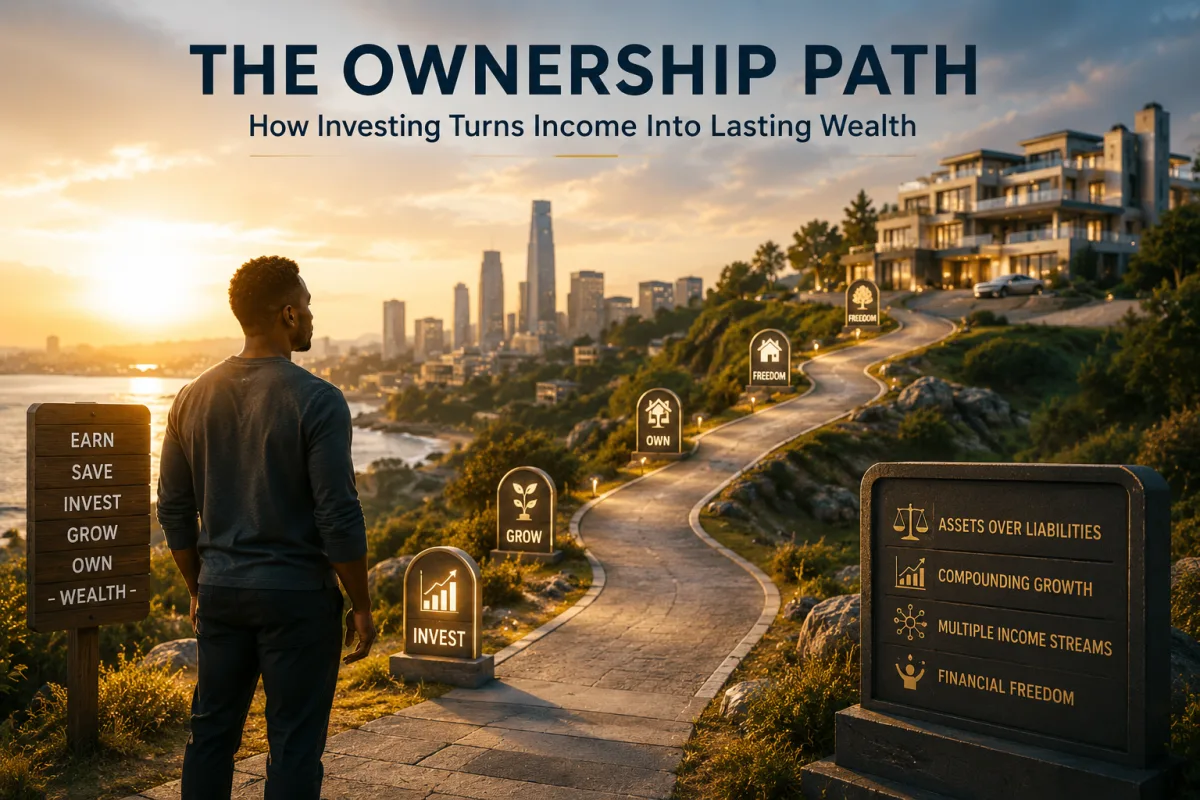
The Ownership Path: How Investing Turns Income Into Lasting Wealth
Wealth is rarely built by income alone.
Income pays for the present. It covers rent, food, transport, school fees, insurance, taxes, family obligations, debt payments and lifestyle choices. Income is necessary, but income by itself is fragile. It often depends on employment, clients, business activity, health, time and energy. If income stops, many financial lives weaken quickly.
Investing changes the equation because it turns income into ownership.
When a person invests, they move money from consumption into assets. Those assets may be shares in businesses, bonds that pay interest, real estate that produces rent, funds that hold diversified portfolios, or other productive instruments. The investor is no longer only earning from work. They are gradually building a financial base that can grow, produce income and create choices.
This is the central idea behind building wealth through investing: money earned today can be converted into assets that support tomorrow.
Most people understand this in theory, but many struggle to practice it. They wait for the perfect time. They fear market declines. They chase quick returns. They invest without a plan. They buy what is popular. They sell when prices fall. They confuse speculation with wealth creation. They hold too much cash for too long or take too much risk too soon. The result is often frustration, inconsistency and missed opportunity.
Building wealth through investing does not require predicting every market movement. It requires a durable system. The system begins with surplus income, continues through disciplined asset accumulation, and strengthens through diversification, patience, risk management and compounding.
The investor’s job is not to become brilliant overnight. The investor’s job is to become consistent for decades.
Investing Begins With the Decision to Own
The first step in wealth-building investing is a shift in identity: from consumer to owner.
A consumer uses money primarily to buy products, services, experiences and comfort. Consumption is not wrong. Life requires spending, and money should support a meaningful life. But consumption alone does not create lasting wealth. Once money is spent, it is gone. The product may provide utility or pleasure, but it usually does not produce future income.
An owner uses part of today’s income to acquire assets. Ownership gives a claim on future value. A shareholder owns part of a business. A bondholder owns a claim on future interest and repayment. A property investor owns an asset that may produce rent and appreciate. A fund investor owns a share of a broader pool of assets.
This distinction is powerful because the economy rewards ownership over time. Businesses create products, serve customers, raise prices, improve efficiency and generate profits. Governments and corporations borrow money and pay interest. Properties provide shelter, commercial space and rental income. Investors who own productive assets participate in these economic flows.
A person who spends every shilling, dollar or pound remains dependent on the next inflow of income. A person who consistently buys assets gradually builds a second engine. At first, the engine is small. It may produce little income and modest growth. But with time, contributions and reinvested returns, it can become meaningful.
Investing is the practice of buying ownership before lifestyle consumes every dollar.
The Difference Between Saving and Investing
Saving and investing are related, but they are not the same.
Saving protects money for near-term needs. It is best suited for emergencies, upcoming expenses, taxes, school fees, medical costs, rent deposits, travel plans, business reserves and other obligations that require certainty. Savings should usually be accessible and relatively stable.
Investing is designed for growth, income or long-term purchasing power. It accepts some level of risk in exchange for potential return. Investments can fluctuate. They can lose value. They may require years to work properly. This is why money needed soon should not be invested aggressively.
Many financial mistakes come from confusing these two roles. Some people keep long-term wealth in cash for years because they fear volatility. Their balance looks stable, but inflation gradually erodes purchasing power. Others invest short-term money in volatile assets and then panic when prices fall before the money is needed.
Wealth builders use both saving and investing. Savings provide stability. Investments provide growth. Cash protects the plan. Assets build the plan.
Before Investing: Build the Financial Foundation
Investing works best when the foundation is stable.
A person with no emergency fund, high-interest debt and unpredictable spending may struggle to invest consistently. Every unexpected expense becomes a crisis. Every market decline feels more frightening because invested money may be needed soon. Every debt payment reduces the surplus available for asset building.
The first foundation is cash flow. Wealth creation requires a surplus. A surplus exists when income exceeds expenses. Without surplus, there is no consistent money to invest. Increasing income helps. Reducing wasteful spending helps. The most powerful combination is earning more while preventing lifestyle inflation from absorbing every increase.
The second foundation is an emergency fund. Emergency savings protect the investor from forced selling. If a medical bill, car repair, job disruption or family emergency appears, the investor can use cash rather than sell investments during a bad market.
The third foundation is debt management. Not all debt is equal. A manageable mortgage on an affordable home is different from high-interest consumer debt used to finance lifestyle. Destructive debt can overpower investment returns and reduce flexibility. Before investing aggressively, a person should understand the interest rate, repayment burden and purpose of each debt.
The fourth foundation is insurance and protection. A person building wealth should protect against risks that could destroy years of progress: illness, disability, death, property loss, liability or business interruption. Investing without protection can create a fragile plan.
A strong foundation does not require perfection. It requires enough stability that investments can remain invested.
The Power of Compounding
Compounding is the quiet engine of wealth.
Compounding occurs when returns begin earning returns of their own. An investment produces growth or income. That growth is reinvested. The larger base then produces more growth. Over long periods, this process can become powerful.
In the beginning, compounding often feels unimpressive. A small investment account may grow slowly. Contributions may matter more than returns. The investor may wonder whether the effort is worth it. This is normal. Compounding is back-loaded. Its greatest effects often appear after years of consistency.
The investor who understands compounding respects time. Starting early helps because every year gives returns more room to build upon themselves. But starting later is still valuable. A later starter can increase contributions, reduce wasteful spending, invest intelligently and extend the time horizon where possible.
Compounding rewards patience, but it punishes interruption. Panic selling, frequent withdrawals, excessive fees, speculative losses and inconsistent contributions weaken the compounding chain. The investor must protect the process.
Compounding also works in reverse. Debt compounds when interest accumulates. Fees compound when they reduce returns year after year. Bad habits compound when small leaks become permanent patterns. Wealth builders place compounding on their side by owning assets and controlling liabilities.
Why Time in the Market Matters
Many beginners try to build wealth by waiting for the perfect moment to invest. They want to buy at the bottom and avoid every decline. This desire is understandable, but it can become costly.
Markets are uncertain. Prices can always fall after you invest. They can also rise while you wait. The perfect entry point is visible only in hindsight. Investors who wait for certainty may sit in cash for years, missing growth because the market never feels safe.
Long-term investing does not depend on perfect timing. It depends on participation. The longer money remains invested in productive assets, the more opportunity it has to benefit from business growth, interest, dividends, reinvestment and compounding.
This does not mean investing blindly. Valuation, risk and allocation matter. But for most wealth builders, consistent investing over long periods is more reliable than trying to move in and out based on forecasts.
Dollar-cost averaging is one practical solution. This means investing a fixed amount regularly, regardless of market conditions. When prices are high, the amount buys fewer shares. When prices are low, it buys more shares. The method reduces the pressure to choose the perfect day and turns investing into a habit.
The investor who contributes steadily during both calm and turbulent markets builds discipline. Over time, that discipline can matter more than clever predictions.
Asset Classes: What Investors Actually Own
To build wealth through investing, a person must understand the major asset classes.
Stocks represent ownership in businesses. When you buy shares or a stock fund, you participate in the future of companies. Stocks can produce strong long-term returns because businesses can grow earnings, innovate, expand and pay dividends. But stocks are volatile. Their prices can fall sharply during recessions, crises or periods of investor fear.
Bonds represent loans. When you buy a bond, you are lending money to a government, company or other issuer. The borrower usually pays interest and repays principal at maturity. Bonds can provide income and stability, but they carry risks such as interest rate risk, credit risk and inflation risk.
Cash equivalents include savings accounts, fixed deposits, treasury bills, money market funds and similar short-term instruments. They provide liquidity and stability, but they may not build long-term purchasing power if returns are lower than inflation.
Real estate can provide rental income, appreciation and inflation protection, but it also involves maintenance, taxes, financing, vacancy, legal risk and liquidity challenges. Real estate may be owned directly or through listed vehicles such as real estate investment trusts.
Alternative investments include private equity, commodities, private credit, structured products, hedge funds, art, collectibles and other non-traditional assets. Some may be useful for sophisticated investors, but they often require deeper due diligence because fees, liquidity and risk can be harder to evaluate.
No asset class is perfect. Each has a role. Wealth-building investing is the art of combining assets in a way that fits goals, time horizon and risk capacity.
Asset Allocation: The Portfolio’s Most Important Decision
Asset allocation is the decision about how much of a portfolio should be placed in each asset class. It is one of the most important drivers of long-term investment experience.
A portfolio with 90 percent stocks and 10 percent bonds will behave differently from one with 50 percent stocks and 50 percent bonds. The first may offer higher growth potential but larger declines. The second may be more stable but may grow more slowly. Neither is automatically right. The correct allocation depends on the investor.
Time horizon matters. A young investor saving for retirement decades away can usually accept more volatility than someone who needs the money in three years. Risk tolerance matters. Some investors can remain calm during market declines. Others become anxious and sell at the worst time. Financial capacity matters. A person with stable income, emergency savings and low debt can usually take more investment risk than someone with unstable cash flow.
The goal is not to choose the most aggressive allocation possible. The goal is to choose an allocation the investor can hold through real market stress.
Many investors overestimate their risk tolerance during rising markets. They believe they can handle volatility because they have not yet experienced a major decline with meaningful money at stake. The true test comes when account balances fall, headlines become frightening and people around them begin to panic.
A good allocation should be ambitious enough to build wealth and realistic enough to survive the investor’s behavior.
Diversification: The Discipline of Not Betting Everything on One Future
Diversification means spreading investments across different assets so that one failure does not destroy the entire plan.
It is one of the most important principles in investing because the future is uncertain. A company can disappoint. A sector can decline. A property market can weaken. A currency can fall. A borrower can default. A country can experience economic stress. Even well-researched investments can fail.
Diversification does not eliminate losses. A diversified portfolio can still decline. It does not guarantee high returns. It also means the investor will always own something that is underperforming. That is normal. The purpose is not for every asset to win at the same time. The purpose is to avoid dependence on one narrow outcome.
True diversification requires looking beneath labels. Owning ten funds does not help if they all hold the same stocks. Owning several properties may not diversify much if they are all in the same city and tenant segment. Owning employer shares while depending on the same employer for salary may create hidden concentration.
Diversification is a form of humility. It says, “I may be wrong, and the future may surprise me.” That humility protects wealth.
Index Funds and Broad Market Ownership
For many investors, broad diversified funds are one of the simplest ways to build wealth.
An index fund seeks to track a market index rather than select individual winners. A total stock market fund may own hundreds or thousands of companies. A bond index fund may own many bonds across issuers and maturities. A global fund may provide exposure to companies in many countries.
The advantage is simplicity and cost control. Instead of trying to identify the next winning company, the investor owns a broad slice of the market. Instead of depending on one manager’s skill, the investor participates in the overall growth of many businesses. Instead of paying high fees for constant activity, the investor can often keep costs low.
Index investing is not risk-free. A stock index can decline sharply. A bond index can lose value when interest rates rise. Broad ownership still requires the right time horizon and allocation. But for long-term wealth builders, diversified low-cost funds can provide a strong foundation.
The investor does not need to own only index funds. Some may add individual stocks, real estate, active funds or other strategies. But the core portfolio should be strong before complexity is added.
Individual Stocks: Opportunity and Risk
Individual stocks attract investors because they offer the possibility of exceptional returns. Owning shares in a great company early can create significant wealth. But individual stocks also carry company-specific risk.
A company can lose market share, face regulation, suffer poor management, become overvalued, take on too much debt, or be disrupted by competitors. Even a well-known company can become a poor investment if purchased at too high a price. Familiarity is not analysis.
Investors who buy individual stocks should understand the business. How does it make money? What gives it an advantage? What risks threaten it? How strong is the balance sheet? Is management trustworthy? Is the price reasonable relative to earnings, cash flow and growth prospects? How does the stock fit the overall portfolio?
For beginners, individual stocks should usually be smaller positions around a diversified core. This allows learning without placing the entire wealth plan at risk. The core should not depend on one stock becoming exceptional.
Individual stock investing can be rewarding, but it requires humility. The market does not reward confidence alone. It rewards ownership of value at a sensible price over time.
Real Estate as an Investment
Real estate has built wealth for many families because it combines tangible ownership, potential rental income, leverage and long-term appreciation. But real estate should be evaluated carefully, not romantically.
A property is not automatically a good investment because it is physical. The purchase price matters. Rental yield matters. Financing costs matter. Maintenance matters. Taxes, insurance, service charges, vacancy, legal documentation, location and tenant quality all matter.
Many people compare gross rent with purchase price and assume the investment is attractive. A serious investor calculates net return after costs. They also consider liquidity. Selling property can take time. If the investor needs cash urgently, a property may not provide it without a discount.
Leverage can increase returns when property values rise and rental income covers debt. It can also magnify losses when rates rise, vacancies occur or prices decline. Borrowing to buy real estate should be done with stress testing, not optimism alone.
Real estate can play a useful role in wealth creation, especially when bought well and managed properly. But it should be balanced with liquid investments. A person can be property-rich and cash-poor if too much wealth is tied up in illiquid assets.
Fixed Income: Stability, Income and Hidden Risk
Fixed income investments such as bonds, treasury bills, fixed deposits and money market instruments can provide income and stability. They are especially useful for emergency reserves, near-term goals, retirees and investors who want to reduce portfolio volatility.
But fixed income is not automatically risk-free. Bonds can fall in price when interest rates rise. Corporate borrowers can default. Inflation can reduce the real value of interest payments. Long-term bonds may be more sensitive to interest rate changes than beginners expect. Money market funds depend on the quality of underlying assets and the manager’s discipline.
The investor should always ask why a yield is high. A higher return may reflect a genuine opportunity, or it may reflect greater risk. The borrower may be weaker. The maturity may be longer. The product may be less liquid. The structure may contain fees or penalties.
Fixed income should be chosen based on purpose. Short-term money needs safety and access. Long-term portfolios may use bonds to reduce volatility and provide income. Retirees may use bonds as part of a withdrawal strategy. Business owners may use short-term instruments for reserves.
The goal is not simply to chase the highest yield. The goal is to match income, safety and liquidity to the investor’s needs.
Risk Management: Protecting the Wealth-Building Process
Investing always involves risk. The goal is not to eliminate risk completely. That is impossible. The goal is to take risks that are understood, compensated and appropriate.
Market risk is the risk that asset prices fall. Credit risk is the risk that a borrower fails to pay. Liquidity risk is the risk that an asset cannot be sold quickly at a fair price. Inflation risk is the risk that money loses purchasing power. Currency risk appears when assets and obligations are in different currencies. Concentration risk arises when too much wealth depends on one asset, company, sector or country. Behavioral risk is the risk that the investor makes emotional decisions.
A strong portfolio manages these risks through diversification, suitable allocation, emergency cash, moderate debt, proper time horizon and clear rules. The investor should know what could go wrong before investing. If the only explanation for an investment is that it has been rising, the analysis is incomplete.
Risk management may feel conservative, but it is central to wealth creation. A portfolio that suffers a permanent loss needs much higher future returns to recover. Avoiding large mistakes can be as important as finding great opportunities.
Speculation Is Not a Wealth Plan
Speculation is the attempt to profit from price movement, often over a short period, without a strong connection to underlying value. Speculation can be exciting. It can produce quick gains. It can also produce quick losses.
Many people confuse speculation with investing because both involve buying assets. The difference is the reasoning. Investing asks what an asset is worth, what it produces, how it fits the portfolio and why it should grow over time. Speculation often asks whether someone else will pay more soon.
Speculative assets, trading strategies and market trends can tempt investors because they promise speed. But wealth built too quickly through speculation is often lost quickly through the same behavior. A person who becomes accustomed to fast gains may take larger risks, use leverage, ignore diversification and underestimate downside.
If an investor wants to speculate, it should be with a small, clearly separated amount that can be lost without damaging long-term goals. The core wealth-building portfolio should not depend on excitement.
Long-term wealth is usually built by owning productive assets, not by constantly guessing what will become popular next.
Rebalancing: Keeping the Portfolio Aligned
Over time, investments grow at different rates. Stocks may rise faster than bonds. Real estate may become a larger share of net worth. Cash may build up after a bonus or business sale. A portfolio can drift away from its intended allocation.
Rebalancing brings the portfolio back to target. If stocks have risen strongly and now represent more risk than intended, the investor may direct new contributions elsewhere or sell some stock exposure. If markets have fallen and stocks are below target, the investor may buy more to restore balance.
Rebalancing feels uncomfortable because it often means trimming recent winners and adding to areas that have lagged. That discomfort is why it works as a discipline. It prevents the portfolio from becoming accidentally risky after good times or excessively fearful after bad times.
Investors do not need to rebalance constantly. Many review once or twice a year, or when allocations drift meaningfully. The purpose is not to maximize every short-term return. The purpose is to keep the portfolio aligned with the plan.
Taxes, Fees and the Return You Actually Keep
Investment success is not measured only by gross return. It is measured by what the investor keeps after fees, taxes and costs.
Fees may include fund management fees, advisory fees, trading commissions, custody fees, transaction charges, spreads, performance fees and product charges. Some are visible. Others are embedded. Over decades, unnecessary fees can reduce compounding significantly.
Taxes also matter. Interest, dividends, rental income, capital gains and retirement withdrawals may be treated differently depending on the country, account type and investor profile. Tax-efficient investing does not mean avoiding tax illegally. It means using available structures properly, planning sales carefully, understanding account rules and seeking professional advice when needed.
A high-return investment with heavy fees, poor liquidity and tax inefficiency may be less attractive than a simpler investment with a lower gross return but better net outcome.
The investor should always ask: What do I earn after all costs? What risks did I take to earn it? How does it fit my plan?
The Role of Income Growth
Investing builds wealth faster when it is supported by rising income.
Investment returns matter, but contributions matter greatly, especially in the early years. A person with a small portfolio may benefit more from increasing the monthly investment amount than from searching for a slightly higher return. Income growth creates more fuel for investing.
Income can grow through career advancement, negotiation, skill development, business ownership, freelancing, consulting, professional specialization or new income streams. The key is to avoid allowing every income increase to become lifestyle spending.
When income rises, the investor should capture part of the increase for assets. This is one of the most powerful wealth-building habits. A raise can become a larger car payment, or it can become a larger investment contribution. A bonus can disappear into consumption, or it can buy productive assets. A business profit can fund lifestyle inflation, or it can diversify the owner’s wealth.
The investor who combines income growth with disciplined investing gains an advantage over the investor who relies on returns alone.
Building the First Portfolio
A beginner can build a first portfolio with a simple process.
First, define the goal. Is the money for retirement, financial independence, education, a future home, business capital or general wealth building? The goal determines the time horizon.
Second, separate short-term and long-term money. Short-term obligations belong in savings or conservative instruments. Long-term wealth capital can be invested in growth assets.
Third, choose an asset allocation. A young long-term investor may hold more stocks. A conservative investor may hold more bonds and cash equivalents. Someone nearing retirement may need a balance of growth, income and stability.
Fourth, choose diversified low-cost investments where possible. This may include broad stock funds, bond funds, money market funds, treasury instruments or other suitable assets. The investor should understand each holding.
Fifth, automate contributions. Automation turns investing from a monthly debate into a habit.
Sixth, review periodically. The investor should check allocation, fees, performance relative to goals, contribution levels and life changes. Review does not mean constant trading.
A first portfolio does not need to be complicated. It needs to be clear, diversified, affordable and aligned with the investor’s life.
Investing Through Market Declines
Every long-term investor will experience market declines. They are not exceptions. They are part of investing.
Declines feel different when they happen with real money. A 20 percent decline is easy to discuss in theory. It is harder to watch on a statement. Fear rises. Headlines become dramatic. Friends may warn that more losses are coming. The investor may feel foolish for not selling earlier.
This is when the plan matters most.
If the portfolio was built for long-term goals, diversified properly and supported by emergency cash, a decline does not automatically require action. In fact, investors still contributing may benefit from buying at lower prices. The challenge is emotional, not mathematical.
Selling during panic can convert temporary volatility into permanent loss. Waiting for markets to feel safe before reinvesting can cause investors to miss recoveries. Market recoveries often begin before the news improves.
The best preparation happens before the decline. The investor should know why they own each asset, how much loss they can tolerate, what cash reserves are available and what rules guide rebalancing. A written investment policy can help prevent emotional decisions.
Wealth is built not only by choosing investments, but by holding them through difficult periods when the original reasoning remains valid.
Investing After Success
As wealth grows, the investing problem changes.
In the early years, the main challenge is accumulation. The investor needs to save, contribute and stay consistent. Later, the challenge becomes protection, tax efficiency, liquidity, estate planning and income generation. A mistake on a large portfolio can be more damaging than a mistake on a small one.
Successful investors should periodically review concentration. Has one asset become too large? Is too much wealth tied to an employer, business, property market or currency? Are there enough liquid reserves? Are beneficiaries updated? Is insurance adequate? Are estate documents in place? Are fees still reasonable?
Wealth creation eventually becomes wealth stewardship. The focus expands from growing money to preserving freedom, supporting family, managing risk and transferring assets wisely.
The investor should not assume that the strategy used to build wealth is automatically the right strategy to protect it. Concentration may create wealth. Diversification often preserves it.
Common Mistakes That Prevent Wealth
The first mistake is waiting too long. Many people postpone investing because they feel they do not know enough. Education is valuable, but endless delay is costly. A simple, sensible plan started early can outperform a perfect plan started too late.
The second mistake is investing without a goal. Money without purpose is easily moved by emotion. Goals create time horizons, and time horizons guide asset choices.
The third mistake is chasing performance. Investors often buy what recently performed best, only to discover that high past returns attracted them after much of the opportunity had passed.
The fourth mistake is overconfidence. A few successful trades or a rising market can make investors believe they are more skilled than they are. Overconfidence leads to concentration, leverage and poor risk control.
The fifth mistake is ignoring fees. High costs may seem small at first, but they reduce the amount that compounds.
The sixth mistake is panic selling. Market declines are emotionally painful, but abandoning a good long-term plan during fear can damage wealth.
The seventh mistake is confusing lifestyle with wealth. A rising income, better car, larger home or premium card may signal success, but wealth is measured by assets, resilience and freedom.
The Wealth-Building Mindset
Building wealth through investing requires more than technical knowledge. It requires a certain mindset.
The wealth-building investor thinks in decades, not days. They understand that markets are uncertain but ownership is powerful. They accept that volatility is the cost of long-term return. They do not need every investment to perform well at the same time. They are willing to look boring while their assets compound.
They also understand opportunity cost. Every dollar spent cannot be invested. Every high-interest debt payment reduces future flexibility. Every unnecessary fee weakens compounding. Every speculative loss steals capital from productive ownership.
This mindset does not require extreme frugality or joyless living. It requires intention. Wealth builders spend on what matters while protecting the surplus that buys assets. They enjoy life without allowing lifestyle to consume the future.
The most important question becomes: What does this money become?
Does it become temporary consumption, or does it become ownership? Does it become debt, or does it become an asset? Does it create pressure, or does it create freedom?
A Practical Long-Term Investing Framework
A person who wants to build wealth through investing can follow a durable framework.
Start by measuring net worth. List assets and liabilities. This creates a baseline. Then measure cash flow. Know what comes in, what goes out and what surplus can be invested.
Build emergency reserves. Protect the plan before chasing returns. Reduce destructive debt, especially high-interest consumer debt that drains cash flow.
Define goals and time horizons. Separate short-term money from long-term money. Choose an asset allocation that fits the purpose of each pool.
Invest consistently in diversified assets. Keep costs reasonable. Reinvest income where appropriate. Increase contributions as income rises. Avoid constant tinkering.
Review the portfolio periodically. Rebalance when needed. Update the plan when life changes. Protect against major risks through insurance, legal documents and liquidity planning.
Keep learning, but do not confuse learning with endless action. Sometimes the best investment decision is to continue doing what is already working.
This framework is not glamorous. That is why it works. It reduces dependence on predictions and increases reliance on behavior, structure and time.
Final Thoughts
Building wealth through investing is the process of turning income into ownership and allowing ownership to compound over time.
It begins with surplus. It grows through disciplined contributions. It strengthens through diversification and asset allocation. It survives through risk management. It accelerates through income growth. It matures through patience.
The investor does not need to know the future perfectly. They need a plan that can survive the future being imperfect. Markets will rise and fall. Interest rates will change. Economies will expand and contract. New opportunities will appear. Old assumptions will be tested. The investor’s advantage is not certainty. It is discipline.
Wealth is not built by watching money. It is built by assigning money a job.
Some money protects. Some money pays obligations. Some money buys assets. Some money creates income. Some money funds opportunity. The investor who understands these roles can build a financial life that becomes less dependent on work alone.
The path is available to anyone willing to begin with what they have, invest consistently, avoid destructive mistakes and think like an owner. The first contribution may look small. The first portfolio may feel ordinary. The first few years may seem slow. But wealth creation is cumulative. Small investments become larger balances. Reinvested returns create new returns. Assets begin to support goals. Time turns discipline into freedom.
That is how investing builds wealth: not through magic, not through prediction, and not through luck alone, but through ownership repeated patiently over time.

