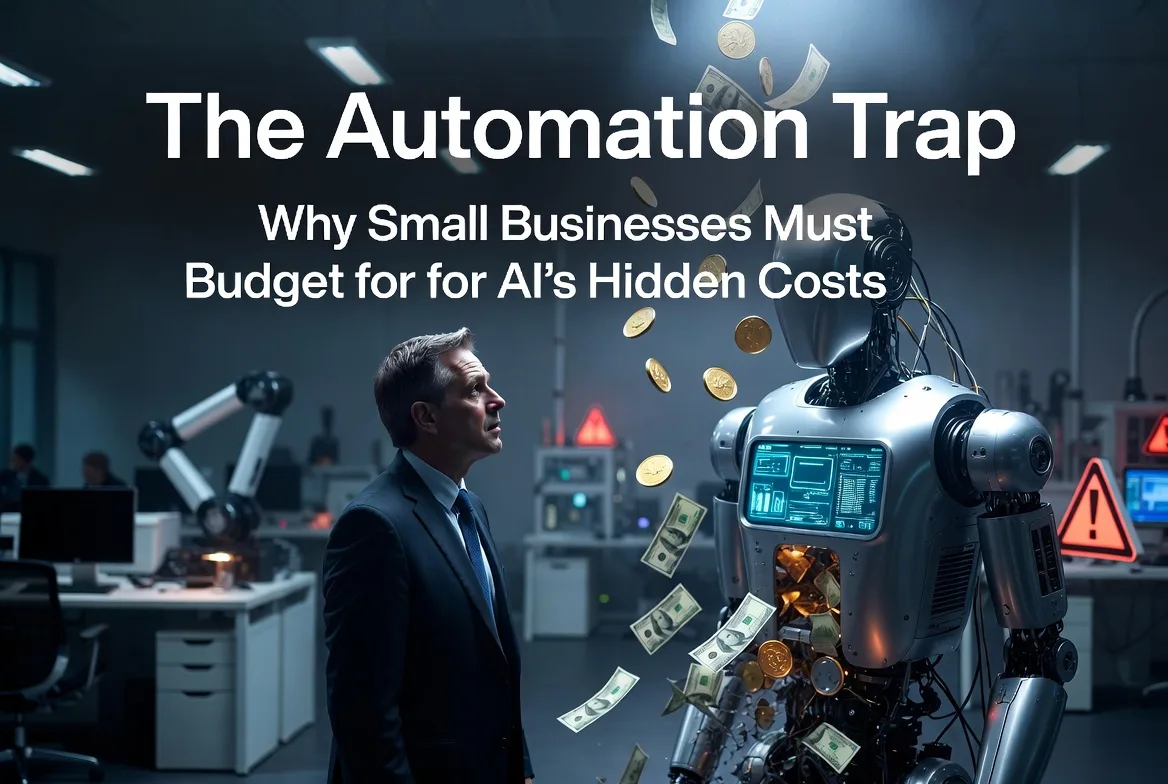
The Automation Trap: Why Small Businesses Must Budget for AI’s Hidden Costs
Artificial intelligence entered many small businesses through the side door. It was not always introduced through a formal technology strategy, a board-approved budget, or a carefully designed transformation plan. In many cases, it began with one employee testing a chatbot, one founder asking it to write a product description, one marketer using it to draft a campaign, one manager using it to summarize a spreadsheet, or one assistant asking it to reply to customers faster.
At first, the appeal was obvious. AI looked inexpensive. It looked fast. It looked available at all hours. It could draft emails, generate images, answer customer queries, summarize documents, create social media captions, prepare meeting notes, support sales outreach, write code, analyze feedback, and reduce the burden of repetitive work. For small businesses operating on thin margins, this felt less like a technology trend and more like a survival tool.
That survival argument is powerful. A small business does not have the staffing depth of a large corporation. It may not have a receptionist, analyst, copywriter, designer, data-entry clerk, customer-service team, research assistant, or operations coordinator. The owner often plays all these roles at once. Any tool that promises to perform several of them for a monthly subscription can feel transformative. In a difficult economic environment, automation can appear to offer what every small business wants: lower costs, higher productivity, faster execution, and fewer hiring commitments.
But every tool that saves money also changes the structure of risk. AI is not simply a cheaper employee. It is a new operating layer inside the business. It has direct costs, indirect costs, supervision costs, switching costs, training costs, security risks, quality risks, brand risks, compliance risks, and dependency risks. The business that treats AI as free labour may later discover that it has created a new expense category without building the financial discipline to manage it.
This is the automation trap. A small business adopts AI to reduce costs, then gradually becomes dependent on systems it does not fully understand, cannot fully control, and may not have budgeted for properly. The tool that was meant to simplify operations begins to require monitoring, subscriptions, prompts, usage limits, staff training, policy decisions, error correction, and contingency planning. The savings may still be real. But they are not automatic. They must be earned through governance.
AI Is Not Free Labour
The first mistake many businesses make is psychological. Because AI can perform tasks that people used to perform, owners begin to compare it with labour. If a chatbot can answer basic customer queries, why hire a receptionist? If an AI tool can produce graphics, why pay a designer for every small task? If software can draft sales emails, why expand the sales team? These comparisons are understandable, but incomplete.
Human labour and AI tools have different cost structures. An employee has salary, benefits, training time, supervision needs, employment obligations, and career expectations. AI has subscriptions, usage fees, tokens, integrations, workflow design, prompt engineering, data controls, quality review, cybersecurity exposure, and platform dependency. One cost structure is familiar. The other is newer and often less visible.
When a business replaces or supplements labour with AI, it may reduce payroll pressure. But it does not eliminate management responsibility. Someone must decide which tasks AI can handle, which tasks require human review, how errors are detected, how customer tone is protected, how data is secured, how outputs are archived, how subscriptions are controlled, and how rising prices will be absorbed. AI does not remove work; it changes where work appears.
The danger comes when businesses count only the obvious savings. A founder may say that an AI assistant costs far less than a receptionist. That may be true on a monthly invoice. But the comparison should include the time spent configuring the tool, correcting mistakes, calming confused customers, monitoring usage, updating prompts, paying for extra credits, integrating the system, and managing failure. The real question is not whether AI is cheaper than a person in one narrow task. The real question is whether the AI-supported workflow is cheaper, more reliable, and safer after all costs are included.
The Hidden Expense Category
Small businesses understand rent. They understand salaries. They understand inventory, utilities, fuel, packaging, loan repayments, taxes, and supplier bills. AI costs can be harder to recognize because they are often fragmented. A few dollars for one tool. A monthly subscription for another. Usage credits for a third. AI features added to software the company already uses. A premium plan required to access better models. Extra charges when usage increases. Add-ons for automation, analytics, storage, image generation, transcription, or voice support.
Because each charge may look small, the total can grow quietly. This is subscription creep in a new form. A business may begin with one affordable AI tool and later find itself paying for writing assistance, design generation, customer service automation, sales prospecting, meeting transcription, coding support, data analysis, document review, and internal knowledge search. Each tool promises productivity. Together, they become overhead.
Overhead matters because it must be paid whether revenue is strong or weak. A small business with variable income should be careful about fixed monthly costs. When AI tools become embedded in daily operations, cancelling them may no longer feel easy. Employees may rely on them. Processes may be built around them. Customer communication may pass through them. Marketing output may depend on them. The business may feel trapped between rising costs and operational disruption.
This is why AI must be budgeted like any other operating expense. It should not sit invisibly inside miscellaneous software spending. The business should track monthly AI costs, annual commitments, per-user fees, usage-based charges, integration costs, and expected price increases. It should also track the savings or revenue impact associated with each tool. A tool that costs little but saves little may not be valuable. A tool that costs more but protects a major revenue stream may be worth keeping. The point is not to spend less at all costs. The point is to know what the spending is doing.
Tokens Are Money
One of the most important mental shifts for AI budgeting is to treat usage as money. Many AI tools charge directly or indirectly based on consumption. The more prompts, images, calls, documents, messages, or processing units the business uses, the more it may pay. In some systems, this cost is obvious. In others, it appears through credits, tiers, throttling, or upgrades.
For a small business, usage-based pricing can be dangerous because it turns experimentation into expense. An employee generating dozens of images, testing long prompts, running repeated analyses, or automating customer interactions may not feel as if they are spending money. But they are consuming paid capacity. Without controls, a business can receive a surprise bill from activity that felt harmless in the moment.
This is not a reason to avoid AI. It is a reason to create usage discipline. Businesses should set spending limits, choose appropriate models for different tasks, train employees to avoid wasteful prompting, monitor high-consumption workflows, and review invoices regularly. Not every task requires the most advanced model. Not every draft requires repeated regeneration. Not every image experiment deserves unlimited attempts. Not every internal process should be automated before its economics are understood.
The financial principle is familiar from other parts of business. A restaurant does not allow unlimited use of expensive ingredients without portion control. A manufacturer does not let raw materials disappear without tracking yield. A delivery company monitors fuel. A construction firm tracks materials. AI tokens, credits, and usage units are digital raw materials. They deserve the same discipline.
Automation Amplifies Existing Chaos
AI often performs best when a business already has clear processes. It struggles when a company uses automation to cover disorganization. If customer records are messy, AI may send messages to the wrong people. If product information is inconsistent, AI may give inaccurate answers. If brand tone is undefined, AI may communicate awkwardly. If responsibilities are unclear, staff may assume the tool is handling work that no one is actually checking.
This is one of the great lessons of business technology: automation does not automatically create order. It often magnifies the system it enters. A disciplined workflow can become faster. A chaotic workflow can become faster chaos.
Before automating, small businesses should map the process manually. What happens when a customer calls? What information must be collected? Who is responsible for follow-up? What tone should be used? Which questions can be answered automatically? Which questions require a human? What should happen when the AI is uncertain? What records must be updated? What errors are unacceptable?
These questions may sound operational rather than financial, but operations and finance are inseparable. A poorly designed AI process can create refund requests, lost customers, reputational harm, staff confusion, duplicated work, or compliance exposure. A well-designed process can reduce cost while improving consistency. The difference is not the tool alone. It is the system around the tool.
The Cost of Bad Output
AI mistakes are not all equal. A strange internal memo may be harmless. A poorly worded sales email may be embarrassing. A wrong product description may cause returns. An inaccurate legal or medical statement may create liability. A misleading financial message may damage trust. A customer-service bot that apologizes unnecessarily may be awkward. A bot that gives false refund promises may be costly.
Small businesses must classify AI tasks by risk. Low-risk tasks may include brainstorming, summarizing internal notes, drafting first versions of social posts, generating ideas, or organizing non-sensitive information. Medium-risk tasks may include customer emails, product descriptions, sales outreach, operational instructions, and website copy. High-risk tasks include legal claims, financial advice, medical information, compliance communication, contractual language, hiring decisions, credit decisions, safety guidance, and anything involving sensitive customer data.
The higher the risk, the more human oversight is required. This oversight is a cost. It takes time. It may require trained staff. It may slow down workflows. But it is cheaper than allowing serious errors to reach customers, regulators, partners, or the public.
Business owners should resist the temptation to measure AI only by speed. Speed without accuracy can be expensive. The goal is not to produce more mistakes faster. The goal is to increase useful output while keeping quality under control. In many cases, the best use of AI is not fully autonomous work but assisted work: the machine drafts, summarizes, suggests, or classifies, while a human reviews, decides, and approves.
Brand Voice Is an Asset
Every business has a voice, whether it manages it or not. A boutique hotel, accounting firm, construction company, beauty salon, restaurant, law office, cleaning service, online shop, or design studio communicates a certain personality through its messages. Customers learn that personality over time. They come to expect a level of warmth, precision, humour, formality, empathy, or expertise.
AI can disrupt this voice. A generic email may sound efficient but lifeless. A chatbot may over-apologize, overpromise, or use language that does not match the business. A sales assistant may send messages that feel artificial. A marketing caption may sound like every other AI-generated caption on the internet. The risk is not only embarrassment. It is erosion of trust.
Brand voice is a financial asset because it helps customers recognize and trust the business. If automation makes the business sound careless, robotic, exaggerated, or inconsistent, it weakens that asset. A company that spent years building a reputation for thoughtful service should not hand customer communication to an untrained tool without clear guardrails.
Small businesses should create simple voice guidelines. How formal should messages be? Which words should be avoided? How should the business apologize? What promises can be made? When should a human intervene? What information should never be invented? What tone is appropriate for complaints, sales, follow-ups, and overdue invoices? These guidelines can be built into prompts, templates, and review processes.
A strong brand does not reject automation. It teaches automation how to behave.
The Dependency Problem
AI dependency can grow quietly. At first, the tool assists. Then it becomes convenient. Then it becomes routine. Then the business builds processes around it. Eventually, the owner may realize that daily operations depend on a platform whose pricing, availability, rules, features, and data policies can change at any time.
This is similar to platform dependency in social media, e-commerce marketplaces, payment systems, and delivery apps. A small business benefits from tools it does not own, but it also becomes exposed to decisions it cannot control. A platform can raise prices, change terms, restrict access, suffer outages, remove features, alter model behaviour, or introduce usage limits. The more deeply the business depends on it, the more disruptive those changes become.
Dependency is not always bad. Businesses depend on banks, electricity, internet providers, suppliers, landlords, and software vendors. The issue is concentration without contingency. If one AI tool becomes essential to customer service, sales, marketing, administration, and internal knowledge, the business should have a fallback plan. If prices double, what happens? If the tool is unavailable for a day, who takes over? If output quality changes, how will the business notice? If the vendor changes data policies, what information is exposed?
Small businesses should identify mission-critical AI tools and create continuity plans. That may include alternative vendors, manual procedures, data exports, documented prompts, staff training, backup communication channels, and clear ownership of each workflow. The goal is not to avoid dependency entirely. The goal is to avoid helpless dependency.
AI Can Reduce Hiring, But It Cannot Replace Management
One reason small businesses adopt AI is to avoid hiring too early. Hiring is expensive and risky. A new employee requires salary, training, supervision, tools, workspace, benefits where applicable, and management attention. For a business with uncertain revenue, AI can provide flexible capacity before the company is ready for permanent staff.
This can be sensible. A founder may use AI to handle routine drafting, reporting, lead research, appointment scheduling, or customer triage. This can delay hiring until the business has more predictable demand. It can help a lean team serve more customers. It can reduce administrative overload.
But AI does not eliminate the need for management. In fact, it can increase the need for managerial clarity. Someone must define the work, evaluate the output, correct errors, decide when automation is appropriate, and ensure that the business does not lose human judgement. A company that has weak management practices may use AI badly. It may automate tasks that should be redesigned. It may produce more output without knowing whether the output matters. It may confuse activity with productivity.
The best small businesses will use AI to make people more valuable, not merely to remove people from the equation. A salesperson using AI for research can spend more time building relationships. An accountant using AI for document organization can spend more time advising clients. A designer using AI for drafts can spend more time refining creative direction. A founder using AI for administrative summaries can spend more time making strategic decisions. The financial value comes from redeploying human attention toward higher-value work.
The False Economy of Replacing Expertise
AI can make non-experts feel temporarily powerful. A founder can generate legal language, tax explanations, marketing plans, financial projections, employee policies, product claims, and strategic analysis. Some of this may be useful as a starting point. But there is a danger in mistaking fluent output for expert judgement.
Expertise is not merely the ability to produce words. It includes knowing what matters, what is missing, what is risky, what applies in a specific jurisdiction, what assumptions are unrealistic, and what consequences may follow. AI may draft a contract clause, but a lawyer understands enforceability and negotiation context. AI may produce a tax summary, but an accountant understands local rules and the company’s actual records. AI may suggest a pricing model, but an experienced operator understands customer behaviour and competitive pressure.
Small businesses should use AI to prepare better for experts, not to eliminate experts where stakes are high. A founder can use AI to organize questions before meeting an accountant. They can use it to summarize documents before legal review. They can use it to model scenarios before discussing financing. This can reduce professional time and improve clarity. But replacing qualified advice entirely may create expensive mistakes.
The false economy is paying little today to create a large liability tomorrow. In finance, law, tax, safety, health, insurance, and compliance, cheap shortcuts can become costly.
Data Is Not Just Input
AI tools often require data to be useful. Businesses may upload customer lists, contracts, meeting transcripts, sales reports, invoices, product information, employee records, financial statements, marketing plans, or internal documents. This data helps the tool provide better answers. It also creates risk.
Small businesses must decide what information can be shared with AI systems and under what conditions. Sensitive customer data, confidential contracts, trade secrets, financial records, employee information, and personal identifiers should not be casually pasted into tools without understanding privacy settings, retention policies, vendor terms, and legal obligations.
Data carelessness can damage trust. Customers may forgive a slow reply more easily than misuse of their information. A small business that wants to appear modern must not become careless with confidentiality. Technology adoption should strengthen professionalism, not weaken it.
A basic AI data policy can help. It should state which tools are approved, what data may be used, what data is prohibited, who can upload files, how outputs should be reviewed, and what happens if sensitive information is accidentally shared. Employees should not be left to invent their own rules. In the absence of policy, convenience becomes the policy.
The Budget Line Every Small Business Needs
AI should have its own budget line. That budget should include subscriptions, usage fees, premium models, integrations, training, implementation, security, oversight time, professional review, and contingency reserves. It should also include an expected growth allowance because AI costs may rise as usage expands.
The business should review AI spending monthly or quarterly. Which tools are actively used? Which tools duplicate each other? Which tools save measurable time? Which tools improve revenue? Which tools create risk? Which users consume the most credits? Which workflows require the most correction? Which tools have become essential? Which can be cancelled?
This review should not be limited to the finance person. Operations, sales, marketing, customer service, and leadership should all participate where relevant. AI is not merely a software cost. It affects how the business works.
A simple scoring system can help. Each tool can be rated on cost, usage, time saved, revenue impact, quality, risk, dependency, and ease of replacement. Tools with high cost and low value should be removed. Tools with high value and high dependency should receive contingency planning. Tools with high risk should receive stronger oversight. Tools with low cost and high value can be expanded carefully.
When AI Savings Are Real
It would be wrong to discuss AI only as a risk. The savings can be real and significant. AI can help a small business respond faster, market more consistently, reduce repetitive administration, improve documentation, analyze customer feedback, support staff training, generate first drafts, organize knowledge, and test ideas cheaply. For a lean company, these gains can matter.
AI can also help small businesses compete with larger firms. A small agency can produce professional proposals faster. A retailer can analyze sales patterns. A consultant can prepare client materials more efficiently. A restaurant can draft menus, promotions, and supplier emails. A manufacturer can create training documents. A service business can handle routine inquiries after hours. These improvements can make the business more responsive and professional.
The key is to connect AI to specific business outcomes. Saving time is valuable only if the saved time is used well. Producing more content is valuable only if the content supports trust and sales. Automating customer service is valuable only if customers receive accurate help. Generating leads is valuable only if follow-up quality improves. AI should not become a toy that creates activity. It should become a tool that improves margins, revenue, service, or resilience.
The Human-in-the-Loop Business Model
The strongest small-business AI strategy is usually not full automation. It is human-in-the-loop automation. This means AI performs defined tasks while humans retain responsibility for judgement, approval, empathy, and accountability.
In customer service, AI can answer common questions, but a person should handle complaints, sensitive issues, unusual requests, and high-value clients. In marketing, AI can draft content, but a person should review claims, tone, and brand fit. In finance, AI can categorize transactions or summarize reports, but a person should review accuracy. In sales, AI can research prospects, but a person should build the relationship. In operations, AI can create checklists, but managers should verify feasibility.
This model recognizes the strengths and weaknesses of both machine and human labour. AI is fast, scalable, patient, and useful for pattern-based work. Humans understand context, emotion, ethics, accountability, and judgement. The business that combines both thoughtfully can gain efficiency without surrendering control.
Training Staff to Use AI Like Professionals
Employees need training. Not because AI is impossible to use, but because it is easy to use badly. Staff should understand what the business uses AI for, which tools are approved, how to protect data, how to write effective prompts, how to check outputs, how to manage costs, and when to escalate to a human.
Training should include examples of good and bad use. A good use might be asking AI to draft three versions of a follow-up email based on verified notes. A bad use might be asking AI to invent product specifications. A good use might be summarizing a meeting transcript for internal review. A bad use might be uploading confidential client records into an unapproved tool. A good use might be generating ideas for a campaign. A bad use might be publishing claims without fact-checking.
AI literacy is becoming part of financial literacy for business owners. A company that trains staff well can capture more value from tools it already pays for. A company that does not train staff may pay for software while absorbing avoidable errors.
The Owner’s Dashboard
A small-business owner does not need a complex AI governance department. But they do need a dashboard of practical questions.
What are we paying for AI each month? Which tools are included in that number? Who uses them? What workflows depend on them? What measurable value are they producing? What errors have occurred? What customer complaints involved automation? What data is being uploaded? What would happen if the main tool stopped working? Are prices fixed or usage-based? Do employees understand spending limits? Are outputs reviewed before reaching customers?
These questions should be revisited regularly. They help the owner move from excitement to control. The business should not discover its AI exposure only after a large bill, public mistake, data incident, or sudden vendor price increase.
AI and the Discipline of Focus
AI makes it easy to do more. More posts, more emails, more reports, more ideas, more images, more experiments, more automation. But doing more is not the same as building a stronger business. Small businesses are especially vulnerable to distraction because the owner already has limited time and capital.
The best AI strategy may be selective. Choose a few high-value workflows and improve them deeply. For example, a business might focus on customer inquiry response, proposal creation, bookkeeping support, and marketing drafts. It does not need to automate everything at once. Each automation should earn its place.
Focus also prevents tool overload. Every new tool requires learning, integration, monitoring, and payment. Too many tools can create complexity that cancels out productivity gains. A lean business should prefer fewer tools used well over many tools used casually.
The Financial Test Before Adopting Any AI Tool
Before paying for a new AI tool, a business should answer several questions. What problem does this solve? How much time or money does the problem currently cost? Who will use the tool? How often? What will it replace or improve? What is the monthly and annual cost? Is pricing fixed or usage-based? What data will it require? What mistakes could it make? Who reviews the output? How hard would it be to cancel? What happens if the price rises?
If these questions cannot be answered, the business may not be ready to adopt the tool. Curiosity is useful, but unchecked curiosity can become expense. Small businesses do not have unlimited room for experiments that become permanent subscriptions.
A trial period should have success criteria. For example, the tool must reduce proposal preparation time by 40 percent, improve response time to customer inquiries, reduce missed calls, increase qualified leads, lower design outsourcing costs, or improve reporting accuracy. At the end of the trial, the business should decide based on evidence, not novelty.
AI as an Operating Expense, Not a Miracle
The more AI becomes embedded in business software, the more ordinary it will feel. It will be part of email, accounting, customer relationship management, design, analytics, search, spreadsheets, payroll, inventory, and communication. This means AI will gradually stop being a separate trend and become part of everyday overhead.
That shift requires maturity. Small businesses should neither worship AI nor fear it blindly. They should treat it the way disciplined owners treat vehicles, machines, rent, inventory systems, or payment platforms. It is useful when it produces more value than it costs. It is dangerous when unmanaged. It must be maintained, monitored, and budgeted.
The businesses that benefit most will not be those that adopt every tool fastest. They will be those that understand their processes, protect their data, train their people, measure return on spending, and keep human judgement where it matters. They will use AI to strengthen the business rather than disguise disorder.
The Bigger Wealth Lesson
The AI story is really a wealth-building story. Small businesses build wealth when they turn revenue into durable systems. They lose wealth when they confuse activity with value, revenue with profit, and tools with strategy.
AI can help a business become more durable. It can document processes, reduce repetitive labour, speed up communication, support analysis, improve consistency, and allow small teams to do work that previously required larger staffs. But it can also create hidden liabilities if owners ignore cost control, quality control, dependency, and oversight.
The central financial principle is simple: every efficiency tool must be evaluated by its total economic effect. Does it increase profit after all costs? Does it reduce risk or add risk? Does it improve customer trust or weaken it? Does it free human time for higher-value work or create more supervision burden? Does it make the business more resilient or more dependent?
Small businesses do not need to reject AI to remain prudent. They need to domesticate it. They need budgets, policies, limits, review processes, and contingency plans. They need to remember that automation is not ownership. The business owns the benefit only when it controls the system around the tool.
A Practical AI Budgeting Framework
A small business can begin with a simple framework. First, list every AI tool being used, including tools embedded inside existing software. Second, record monthly cost, annual cost, users, and pricing model. Third, classify each tool by function: marketing, customer service, operations, finance, sales, administration, production, research, or analytics. Fourth, identify whether each tool is optional, useful, important, or mission-critical.
Fifth, estimate the value created. This can be time saved, revenue generated, costs avoided, errors reduced, or customer experience improved. Sixth, identify risks: data exposure, inaccurate output, brand damage, cost overruns, vendor dependency, or compliance issues. Seventh, set rules: spending limits, approved use cases, human review requirements, data restrictions, and escalation procedures. Eighth, review the list regularly and cancel tools that do not justify their place.
This framework does not require technical expertise. It requires managerial seriousness. The owner who can manage stock, payroll, rent, debt, and suppliers can also manage AI spending. The same principles apply: know the cost, control the risk, measure the return, and avoid dependency without a backup plan.
The Future Belongs to Disciplined Adopters
AI will continue to improve. It will become more capable, more integrated, and more persuasive. Small businesses that ignore it entirely may lose productivity advantages. But businesses that adopt it carelessly may create new fragility. The winners will be disciplined adopters.
A disciplined adopter does not ask, “How can AI replace people?” first. They ask, “Where is our business wasting time, money, or attention?” They do not ask, “Which tool is trending?” first. They ask, “Which process needs improvement?” They do not assume the cheapest output is the best outcome. They measure customer trust, quality, risk, and profit. They do not allow employees to experiment with sensitive data casually. They create rules. They do not let subscriptions accumulate unnoticed. They review spending. They do not build the entire company around one vendor without a fallback. They plan for change.
This discipline is not anti-technology. It is the only way technology becomes wealth-building rather than wealth-leaking. A tool becomes valuable when it is placed inside a sound business model. Without that model, AI can produce more noise, more bills, more errors, and more dependence.
The Real Promise of AI for Small Business
The real promise of AI is not that it will make business effortless. Business will never be effortless. Customers will still need service. Cash flow will still need management. Products will still need quality. Employees will still need leadership. Taxes will still need planning. Strategy will still require judgement. Competition will still exist.
The promise is that AI can help small businesses use scarce resources better. It can reduce the burden of routine work. It can help owners think through decisions. It can give small teams access to capabilities once reserved for larger companies. It can improve speed and consistency. It can make entrepreneurship less lonely by giving founders a tool for drafting, analyzing, organizing, and testing ideas.
But the promise is fulfilled only when the owner remains in command. The business must decide what AI is allowed to do. The business must decide what it is worth. The business must decide how much risk is acceptable. The business must decide where human judgement is non-negotiable.
AI can be an assistant, a lever, a cost saver, and a competitive advantage. It should not become an uncontrolled expense, an invisible dependency, or a substitute for managerial discipline. The small business that understands this will use AI differently. It will budget for it, supervise it, limit it, train around it, and measure it.
That is how automation becomes an asset instead of a trap. The goal is not to hire AI because it looks cheap. The goal is to build a stronger, more profitable, more resilient business. In the end, AI does not change the oldest rule of enterprise: tools do not create wealth by themselves. Disciplined owners do.
 Article
 Article
 Article
 Article
 Article
 Article
 Article
 Article