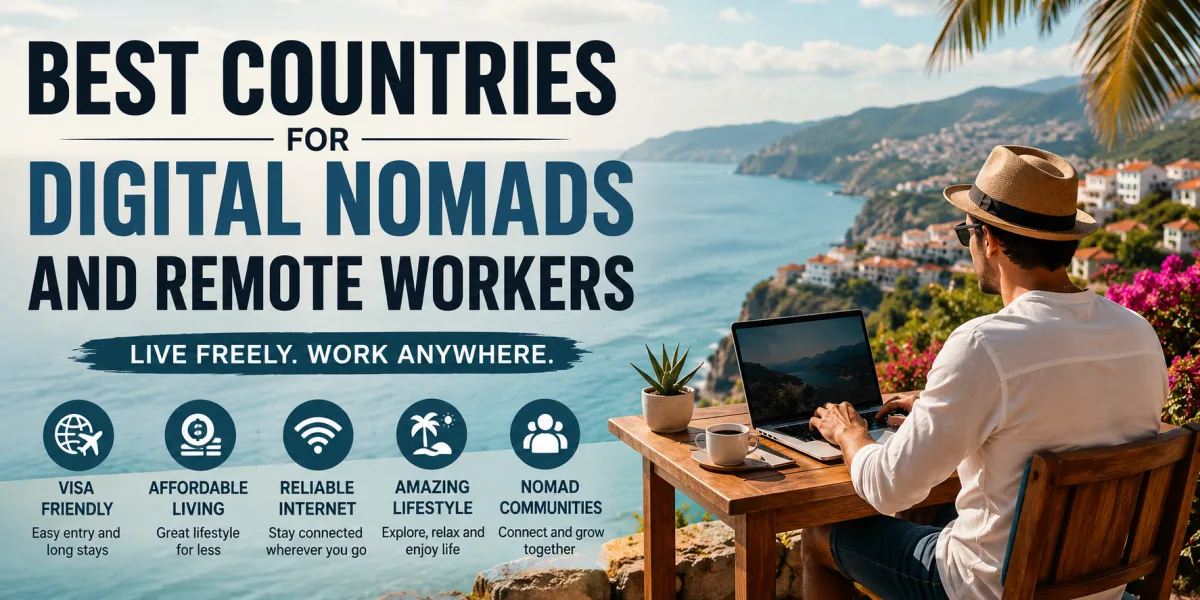
The Borderless Paycheck: Best Countries for Digital Nomads and Remote Workers
The dream of working from anywhere has matured. It is no longer only a fantasy of laptops on beaches, one-way tickets, and café tables overlooking old cities. For many people, remote work has become a practical financial strategy: earn from one market, live in another, reduce expenses, improve quality of life, and buy back time that might otherwise disappear into commuting, high rent, or geographic limitation.
But the digital nomad life is not as simple as choosing a beautiful country and opening a laptop. A country can be affordable but bureaucratically difficult. A visa can be attractive but tax rules can be unclear. A city can have fast internet but poor healthcare access. A beach town can be inspiring for two weeks and isolating after six months. A low-cost destination can become expensive if flights, insurance, coworking, short-term rentals, and currency swings are ignored.
The best country for a digital nomad is not the cheapest country. It is the country where your income, visa status, tax position, work schedule, healthcare needs, safety expectations, lifestyle preferences, and long-term financial goals fit together.
That distinction matters because remote work has created a new kind of geographic arbitrage. A worker paid by a U.S., U.K., Canadian, Australian, or European client may be able to live in a lower-cost country and increase their savings rate dramatically. A freelancer may use a digital nomad visa to stay legally in one place long enough to build routine and community. A remote employee may choose a time zone that supports both work performance and personal freedom. A founder may choose a country with strong infrastructure and lower living costs while building a business.
The opportunity is real. The OECD has noted that digital nomad visa schemes began appearing in OECD countries in 2020 and have continued spreading as governments try to attract cross-border remote workers with foreign income. These visa programs differ widely in eligibility, rights, duration, and obligations, which means remote workers must compare details rather than rely on the phrase “digital nomad visa” alone.
The wrong destination can damage the very freedom remote work is supposed to create. A worker who ignores tax residency can face unexpected liabilities. A freelancer who chooses an inconvenient time zone may lose clients. A family that overlooks healthcare may discover that low rent does not compensate for poor medical access. A remote employee who violates employer location rules may risk their job.
Choosing a digital nomad country is therefore a financial planning decision, not only a travel decision.
What Makes a Country Good for Digital Nomads?
A good digital nomad country must satisfy several layers of need. The first is legal permission. Can you live there while working remotely for foreign clients or a foreign employer? Tourist visas may allow travel, but they do not always permit remote work. Some countries tolerate remote work informally; others have created specific visas. A digital nomad should not assume that “remote” means legally simple.
The second layer is cost. Rent, utilities, groceries, transport, coworking, healthcare, insurance, mobile data, flights, visa fees, and taxes all matter. Many nomads compare rent and restaurant prices but forget the total cost of maintaining a life abroad. Short-term rentals often cost more than local leases. Imported goods may be expensive. Tourist areas may inflate prices. Currency movement can change affordability quickly.
The third layer is internet and work infrastructure. Reliable broadband, coworking spaces, power stability, mobile data, and quiet work environments are not luxuries for remote workers. They are income infrastructure. A beautiful destination with unstable connectivity may be a vacation spot, not a serious work base.
The fourth layer is safety and healthcare. A low-cost destination loses appeal if emergency care is difficult, insurance is weak, roads are dangerous, or crime risk is high. Healthcare matters even for young workers because accidents, infections, dental emergencies, and chronic conditions do not pause for travel.
The fifth layer is time zone. A remote worker serving U.S. clients from Southeast Asia may need late-night calls. A European freelancer serving Australian clients may face awkward mornings. Time zone mismatch can erode sleep, relationships, and productivity. The best destination supports the work calendar, not only the Instagram calendar.
The sixth layer is community. Digital nomad life can be lonely. A place with coworking spaces, language access, expat networks, local integration opportunities, and long-stay communities can be more sustainable than a cheaper but isolating destination. Wired has reported on digital nomad communities and platforms designed to help remote workers find real-world friendships, highlighting loneliness as a real challenge in nomadic life.
The Tax Question Most Nomads Avoid
Digital nomads often talk about visas and cost of living before talking about taxes. That is backwards. Tax residency can become one of the most expensive parts of remote work if misunderstood.
Many countries use day-count rules, often around 183 days, to determine tax residency, though the exact rules vary. Some countries tax residents on worldwide income. Some offer special regimes. Some digital nomad visas do not eliminate tax obligations. Some remote workers remain taxable in their home country while potentially creating obligations abroad. U.S. citizens, for example, generally have ongoing U.S. tax filing obligations even while living abroad.
Employers also care. A remote employee working from another country can create payroll, labor law, social security, immigration, data security, or corporate tax issues for the employer. This is why many companies restrict where employees may work, even if the job is technically remote.
The OECD has continued examining cross-border remote work and global mobility tax challenges, including residence status, taxation rights, and compliance implications. That policy attention reflects a simple reality: remote work across borders creates tax and legal complexity that individuals should not casually ignore.
Before choosing a country, a remote worker should ask three questions. Will I become tax resident there? Will my home country still tax me? Will my employer or business face compliance issues because of my location? These questions may require professional advice. A cheap destination can become expensive if the tax answer is wrong.
Portugal: Best for European Lifestyle and Established Nomad Infrastructure
Portugal remains one of the most discussed countries for remote workers because it combines European infrastructure, Atlantic climate, safety, English proficiency in major cities, and strong international communities. Lisbon, Porto, Madeira, and smaller coastal towns have attracted remote workers for years.
Portugal’s appeal is not only lifestyle. It offers access to Europe, strong cafés and coworking culture, good public transport in major cities, and a comparatively welcoming environment for foreigners. Madeira in particular has promoted itself as a digital nomad destination, and Lisbon has long been one of Europe’s most visible remote-work hubs.
The trade-off is cost. Portugal is no longer the hidden bargain it was often portrayed as a decade ago. Housing costs in Lisbon and Porto have risen sharply, and remote-worker demand has contributed to tension in some neighborhoods. A nomad earning a strong foreign income may still find Portugal attractive, but budget-conscious workers should compare smaller cities and islands rather than assuming Lisbon is affordable.
Portugal is best for remote workers who want European quality of life, a strong international community, ocean access, and a comfortable base for medium-term living. It is less ideal for nomads whose main goal is minimizing cost.
Spain: Best for Culture, Cities, and Long-Term European Living
Spain is a strong digital nomad option for people who want lifestyle depth: cities, beaches, trains, food culture, art, nightlife, and regional diversity. Barcelona, Madrid, Valencia, Málaga, Seville, and the Canary Islands all offer different versions of the remote-work life.
Spain’s digital nomad visa has made the country more accessible to non-EU remote workers who meet eligibility requirements. Spain also appeals to remote workers who want a slower lifestyle without leaving major-city amenities. The Canary Islands, especially Tenerife and Gran Canaria, have become popular among nomads because they offer European legal infrastructure with mild weather and strong remote-work communities.
The financial trade-off is regional. Madrid and Barcelona can be expensive, especially for central housing. Valencia, Málaga, Seville, and smaller cities may offer better value. The best choice depends on whether the worker values metropolitan opportunity, beach access, affordability, or community.
Spain is best for remote workers who want European lifestyle, strong public infrastructure, time-zone compatibility with Europe and Africa, and diverse city choices. It is less ideal for those who need very low monthly costs or simple tax situations.
Estonia: Best for Digital Government and Business-Minded Remote Workers
Estonia has a special place in digital nomad history because it was one of the first countries to create a formal digital nomad visa. It is also known for digital government, e-residency, and a strong technology culture. Tallinn offers a compact, efficient, digitally advanced base with access to the Baltics and wider Europe.
Estonia is not the warmest or cheapest destination, but it appeals to a specific kind of remote worker: founders, software professionals, consultants, and people who value administrative efficiency. The country’s digital systems and startup culture can make it feel unusually aligned with online work.
The climate may be a drawback for workers seeking year-round warmth. The small population can also feel limiting compared with larger countries. But for people who prefer order, clean infrastructure, and a digitally sophisticated environment, Estonia remains a serious option.
Estonia is best for remote workers who value digital administration, technology culture, and a quieter European base. It is less ideal for beach-focused nomads or those seeking the lowest cost of living.
Croatia: Best for Seasonal European Living and Adriatic Lifestyle
Croatia offers one of Europe’s most attractive lifestyle packages: Adriatic coastline, historic cities, islands, Mediterranean climate, and relative affordability compared with some Western European destinations. Zagreb, Split, Dubrovnik, Zadar, and smaller coastal towns all attract different kinds of remote workers.
Croatia has actively courted digital nomads with a formal visa approach and tourism infrastructure. Recent travel coverage has continued to identify Croatia as one of the visa options for Americans and other remote workers seeking longer stays abroad.
The best part of Croatia may also be its challenge: seasonality. Coastal areas can be vibrant and expensive in summer, quieter and cheaper in winter. For remote workers who enjoy seasonal rhythm, this can be ideal. For those who need year-round urban energy, Zagreb may be more practical.
Croatia is best for remote workers who want Europe, coastlines, moderate costs, and a slower lifestyle. It is less ideal for those who need a large year-round international business scene.
Bulgaria: Best Emerging European Value
Bulgaria has become increasingly attractive for cost-conscious remote workers who want an EU base without Western European prices. Sofia offers coworking spaces, cafés, technology talent, mountains nearby, and lower living costs than many EU capitals. Plovdiv and Varna provide alternative lifestyles with different cultural and coastal appeal.
Bulgaria became especially notable after introducing an affordable digital nomad visa. Condé Nast Traveler reported in July 2026 that Bulgaria’s digital nomad visa allows eligible remote workers to live in the country for one year, with an option to extend for another year, and that the income requirement was roughly €31,000 annually, lower than thresholds in several other European countries.
This makes Bulgaria a serious option for remote workers who want Europe, Schengen-area mobility, and lower costs. The trade-off is that Bulgaria may require more adaptation than Portugal or Spain for some foreigners. English access varies outside major cities, and the remote-worker ecosystem, while growing, is less polished than in more established nomad hubs.
Bulgaria is best for financially disciplined nomads who want European access, lower rent, and an emerging tech-oriented environment. It is less ideal for those seeking a highly polished expat lifestyle from day one.
Mexico: Best for North American Time Zones and Lifestyle Range
Mexico remains one of the strongest choices for U.S. and Canadian remote workers because of time-zone alignment, proximity, cultural richness, and diverse city options. Mexico City, Oaxaca, Playa del Carmen, Mérida, Guadalajara, Querétaro, and Puerto Vallarta all attract remote workers for different reasons.
The time-zone advantage is powerful. A remote worker serving U.S. clients can often keep normal working hours while living in a lower-cost or more lifestyle-rich environment. Flights to the United States and Canada are also relatively accessible, which matters for family visits, work trips, and emergencies.
Mexico’s cost profile varies dramatically. Mexico City’s popular neighborhoods can be expensive. Beach towns can be tourist-priced. Smaller cities may provide better value. Healthcare access can be strong in major cities, but insurance and private care planning are still important.
Mexico is best for North American remote workers who need U.S. time-zone compatibility, cultural depth, and a wide range of lifestyle choices. It is less ideal for people who want to avoid urban housing pressure or who need simple immigration certainty without careful planning.
Colombia: Best for Affordable City Living and U.S.-Friendly Time Zones
Colombia has become a major remote-work destination because it offers attractive cities, lower living costs, strong café culture, and time-zone compatibility with the Americas. Medellín, Bogotá, Cartagena, and smaller cities each offer different experiences.
Medellín is especially popular among digital nomads because of climate, coworking spaces, social life, and affordability relative to North American cities. Bogotá offers a larger business environment and cultural depth. Cartagena offers Caribbean appeal, though often at higher tourist pricing.
The financial attraction is strong, but safety and neighborhood selection matter. Colombia is not one uniform risk profile. A worker should research city districts, transport, healthcare, and local guidance carefully. The best experience often comes from living like a long-term resident rather than a careless tourist.
Colombia is best for remote workers who earn in stronger currencies, serve clients in U.S. or Latin American time zones, and want vibrant urban living at a lower cost. It is less ideal for people unwilling to research safety and local context carefully.
Thailand: Best for Lifestyle, Food, and Established Nomad Communities
Thailand has been a remote-worker favorite for years. Chiang Mai, Bangkok, Phuket, Koh Samui, and other destinations offer different versions of the digital nomad life. Thailand combines excellent food, strong hospitality infrastructure, coworking communities, warm weather, and relatively affordable living outside luxury zones.
Thailand’s visa landscape has evolved, including long-term and special visa options. Recent travel coverage has noted Thailand’s long-term and golden visa tiers, tax-related appeal, and ability to include dependents in some routes.
For remote workers, Thailand’s biggest strength is lifestyle value. A worker can live well, eat well, and connect with a large international community. Bangkok provides major-city energy and global connectivity. Chiang Mai offers a slower, cheaper, community-oriented base. Islands offer beauty but may be less ideal for serious work unless internet and workspace are carefully chosen.
The main challenge is time zone. Workers serving North American clients may need late-night calls. European clients are easier, but still require planning. Visa rules also need careful attention, especially for longer stays.
Thailand is best for remote workers with flexible schedules, Asian or European client bases, or enough autonomy to manage time-zone differences. It is less ideal for workers who must attend daily U.S. meetings.
Indonesia: Best for Creative Nomads and Tropical Lifestyle
Indonesia, especially Bali, is one of the world’s most famous digital nomad destinations. Canggu, Ubud, Uluwatu, and other areas attract entrepreneurs, creators, coaches, freelancers, and remote workers seeking a mix of tropical living, coworking, wellness culture, and international community.
The attraction is obvious: climate, scenery, food, community, and relative affordability compared with many Western cities. Bali also offers a dense ecosystem of coworking spaces, cafés, networking events, and short-term rental options.
The trade-offs are also real. Popular areas can be crowded and increasingly expensive. Infrastructure can vary. Traffic can be difficult. Visa rules require careful attention. The local impact of nomad inflows has also become a concern, especially around housing, culture, and environmental pressure.
Indonesia is best for creative workers, entrepreneurs, and freelancers who want community and lifestyle inspiration. It is less ideal for remote employees who need quiet, predictable, corporate-style work conditions every day.
Malaysia: Best for English Access and Southeast Asian Practicality
Malaysia is one of Southeast Asia’s most practical remote-work bases. Kuala Lumpur offers modern infrastructure, strong airport connectivity, English usage, diverse food, good private healthcare, and relatively affordable living compared with many global cities. Penang provides a slower lifestyle with cultural depth and coastal appeal.
Malaysia often appears in digital nomad visa rankings because it combines infrastructure, affordability, and regional access. Passportivity’s 2026 digital nomad visa index ranked Malaysia among the top five countries for digital nomads, alongside New Zealand, Dominica, Malta, and Australia.
Malaysia’s strength is balance. It may not have Bali’s mystique or Thailand’s tourism intensity, but it offers a practical lifestyle for workers who need reliable city infrastructure. The country can also work well for families because of international schools, healthcare, and English-language access in major areas.
Malaysia is best for remote workers who want Southeast Asian affordability with stronger urban infrastructure and English convenience. It is less ideal for people seeking a beach-first nomad identity.
Georgia: Best for Low Bureaucracy and Budget Flexibility
Georgia has attracted remote workers because of low costs, distinctive culture, mountain landscapes, wine regions, and relatively flexible entry rules for many nationalities. Tbilisi has become a notable remote-work hub, with cafés, coworking spaces, and a growing foreign community.
Georgia’s appeal is financial and cultural. Rent and daily expenses can be lower than much of Europe, while the country offers a unique location between Europe and Asia. For entrepreneurs and freelancers, Georgia has also been discussed for business-friendly tax structures, though individual circumstances require professional guidance.
The trade-offs include language barriers, infrastructure variation, political considerations, and distance from many home markets. It is not as frictionless as more established Western European bases, but it can be rewarding for adaptable workers.
Georgia is best for independent freelancers, entrepreneurs, and adventurous remote workers seeking affordability and cultural depth. It is less ideal for workers needing highly predictable corporate infrastructure or frequent travel to North America.
United Arab Emirates: Best for Low Income Tax and Global Connectivity
The United Arab Emirates, especially Dubai and Abu Dhabi, appeals to remote workers and entrepreneurs who value global connectivity, modern infrastructure, safety, luxury amenities, and a low-tax environment. The UAE is not a low-cost destination, but it can be financially attractive for high earners depending on tax residency and business structure.
Recent digital nomad tax comparisons continue to identify the UAE as a prominent low-tax destination, often noting its absence of personal income tax.
The UAE is best understood as a high-income remote-worker destination rather than a budget nomad base. Rent, schooling, insurance, dining, and lifestyle costs can be high. But for entrepreneurs, consultants, executives, and high-earning remote professionals, the infrastructure and tax environment may justify the cost.
The UAE is best for high earners, business owners, and remote workers who want global connectivity, safety, and modern infrastructure. It is less ideal for low-budget nomads or people seeking an organic low-cost cultural immersion.
Greece: Best for Mediterranean Living and Quality of Life
Greece offers Mediterranean climate, islands, history, food, and a slower lifestyle that appeals to remote workers seeking quality of life. Athens provides urban infrastructure and a growing startup scene, while Thessaloniki and island destinations offer different levels of affordability and pace.
Recent travel coverage has highlighted Greece as a strong option in global residence and visa discussions, citing quality of life and accessible processing.
Greece can be especially appealing to remote workers who want Europe without the pace or prices of Northern capitals. The challenge is choosing location carefully. Island life may be beautiful but seasonal. Athens may be more practical for year-round work. Bureaucracy and tax questions require planning.
Greece is best for remote workers who value Mediterranean lifestyle, European access, and cultural richness. It is less ideal for those seeking the lowest cost or the fastest administrative process.
South Korea: Best Emerging Option for High-Infrastructure Remote Workers
South Korea is becoming more visible in the remote-worker conversation because it offers world-class internet, safety, public transportation, culture, food, and urban efficiency. Seoul is expensive compared with many Asian destinations, but it delivers exceptional infrastructure.
South Korea officially introduced its F-1-D digital nomad, or workation, visa after completing a pilot program, with the visa becoming available on June 30, 2026, according to recent reporting.
South Korea may appeal to remote workers who value structure, speed, safety, and city life. It is not the cheapest option, and language barriers can matter, but the infrastructure is outstanding. The time zone works better for Asia-Pacific work than for North American schedules.
South Korea is best for remote workers with strong income, Asia-Pacific clients, and a preference for high-functioning urban environments. It is less ideal for low-cost living or U.S.-hours work.
New Zealand: Best for Safety, Nature, and English-Language Living
New Zealand is highly attractive for remote workers who value safety, nature, English-language access, outdoor life, and a stable environment. It is not a cheap country, but it offers a lifestyle many remote workers find deeply appealing.
Passportivity’s 2026 digital nomad visa ranking placed New Zealand first, citing factors such as safety, internet coverage, English as an official language, and relatively low minimum income requirements in its methodology.
New Zealand is best for remote workers with strong income who want nature, safety, and English-language ease. It is less suitable for workers trying to maximize savings through low living costs, especially in expensive areas such as Auckland or Queenstown.
Malta: Best for English-Speaking EU Access
Malta offers a rare combination: EU membership, English as an official language, Mediterranean climate, and an established expat environment. It can be appealing for remote workers who want European access without a major language barrier.
Malta ranked among the top countries in Passportivity’s 2026 digital nomad visa index, which compared destinations across factors relevant to digital nomads.
The island’s size is both a strength and weakness. It is easy to navigate and internationally oriented, but it can feel small. Housing costs can be high in desirable areas, and summer tourism can affect daily life.
Malta is best for remote workers who want English-language convenience, EU access, and Mediterranean living. It is less ideal for those seeking large-city variety or very low rent.
How to Choose the Best Country for Your Situation
The best destination depends on the worker. A U.S.-based employee who must attend daily meetings may prioritize Mexico, Colombia, or other Americas time-zone destinations. A freelancer with European clients may prefer Portugal, Spain, Bulgaria, Greece, Croatia, or Estonia. A founder serving Asia-Pacific clients may prefer Malaysia, Thailand, South Korea, or Indonesia. A high-income consultant optimizing tax and global travel may consider the UAE.
Start with income. How much do you reliably earn each month after taxes and business expenses? A country is affordable only if it allows you to save, insure yourself, and handle emergencies. Moving abroad to live paycheck to paycheck in a more beautiful place is not financial freedom.
Next, check legal status. Can you stay long enough legally? Do you need a digital nomad visa, long-stay visa, residence permit, or business visa? What income proof, insurance, criminal record checks, employment documents, or application fees are required?
Then check taxes. Will you become tax resident? Does the country tax foreign income? Does your home country still tax you? Is there a tax treaty? Will your employer allow the arrangement?
After that, check work infrastructure. Internet, power, coworking, workspace, phone service, and time zone must support your actual job. A destination that disrupts your income is not affordable, no matter how low the rent is.
Finally, check life fit. Healthcare, climate, language, food, community, safety, dating, family needs, schools, transport, and loneliness all matter. The spreadsheet may say one country is best, but your nervous system may disagree.
The Financial Risks of Digital Nomad Life
Digital nomad life can increase savings, but it can also create financial drift. Constant movement raises costs. Flights, deposits, short-term rentals, travel insurance, visas, coworking passes, storage units, international phone plans, and tourist-priced neighborhoods can quietly consume the savings that geographic arbitrage was supposed to create.
Taxes can also surprise people. A remote worker who spends too much time in one country may trigger residency. A freelancer may forget estimated taxes. A business owner may create compliance obligations abroad. A remote employee may violate employer policy. These risks are manageable, but not if ignored.
Healthcare is another risk. Travel insurance is not the same as comprehensive international health insurance. Emergency coverage, evacuation, chronic care, prescriptions, dental, maternity, and pre-existing conditions require careful reading. Families need even more planning.
There is also career risk. Remote workers must remain visible, reliable, and professionally connected. Time-zone distance can make promotions harder. Freelancers can lose clients if responsiveness drops. The freedom to move should not weaken the income engine.
A Practical Ranking by Worker Type
For North American remote employees, Mexico and Colombia often offer the best time-zone fit, strong lifestyle options, and lower costs than many U.S. and Canadian cities.
For European freelancers, Portugal, Spain, Bulgaria, Croatia, Greece, and Estonia offer strong regional access, though tax and visa rules vary significantly.
For budget-conscious remote workers who still want Europe, Bulgaria and parts of Croatia or Georgia may offer better value than Lisbon, Barcelona, or Amsterdam-style hubs.
For Southeast Asia lifestyle seekers, Thailand, Malaysia, and Indonesia stand out, with Malaysia offering practicality, Thailand offering established nomad infrastructure, and Indonesia offering creative community appeal.
For high earners and entrepreneurs, the UAE may offer strong infrastructure and tax appeal, though living costs can be high.
For safety and nature-focused remote workers with strong income, New Zealand is attractive, especially for those who value English-language ease and outdoor life.
For high-infrastructure Asia-Pacific workers, South Korea is becoming more interesting after the launch of its formal digital nomad visa pathway in 2026.
Build a Nomad Budget Before You Move
Before choosing a country, build a realistic monthly budget. Include rent, utilities, coworking, groceries, restaurants, transport, health insurance, travel insurance, visa costs, flights, local taxes, home-country taxes, subscriptions, phone data, emergency savings, retirement contributions, and leisure.
Then add a margin. Many first-time nomads underestimate costs by assuming local long-term prices while living like short-term visitors. Short stays are usually more expensive. Furnished rentals cost more. Moving frequently costs more. Eating out because the kitchen is inconvenient costs more.
A financially sound nomad budget should still allow saving and investing. If moving abroad only lowers expenses enough to fund more travel, it may improve lifestyle but not wealth. That may be a valid choice, but it should be conscious.
The most powerful version of digital nomadism is not endless consumption in cheaper places. It is using location flexibility to increase optionality: lower fixed costs, higher savings rate, broader network, deeper life experience, and more control over time.
The Best Country Is the One That Strengthens Your Life
Digital nomad life is often sold as escape. Escape from offices, high rent, winter, routine, or national limitations. But the better version is not escape. It is design.
The best country for you is the one that helps you work well, live safely, manage taxes legally, access healthcare, build community, save money, and grow professionally. For some, that will be Portugal or Spain. For others, Mexico or Colombia. For others, Thailand, Malaysia, Bulgaria, Estonia, Georgia, the UAE, South Korea, Malta, Greece, Croatia, Indonesia, or New Zealand.
The right answer depends less on rankings than on alignment. A destination that is perfect for a freelancer may be wrong for an employee. A country that is ideal for a single founder may be wrong for a family. A place that maximizes savings may not maximize wellbeing. A place with extraordinary lifestyle may not support your work hours.
Remote work gives geography back to the worker. That is powerful. But geography is only an advantage when it is chosen deliberately.
Choose the country that protects the paycheck, improves the life, and strengthens the long-term financial plan. The goal is not simply to work from anywhere. The goal is to build a life where place becomes a tool for freedom rather than another source of instability.
 Article
 Article
 Article
 Article
 Article
 Article
 Article
 Article