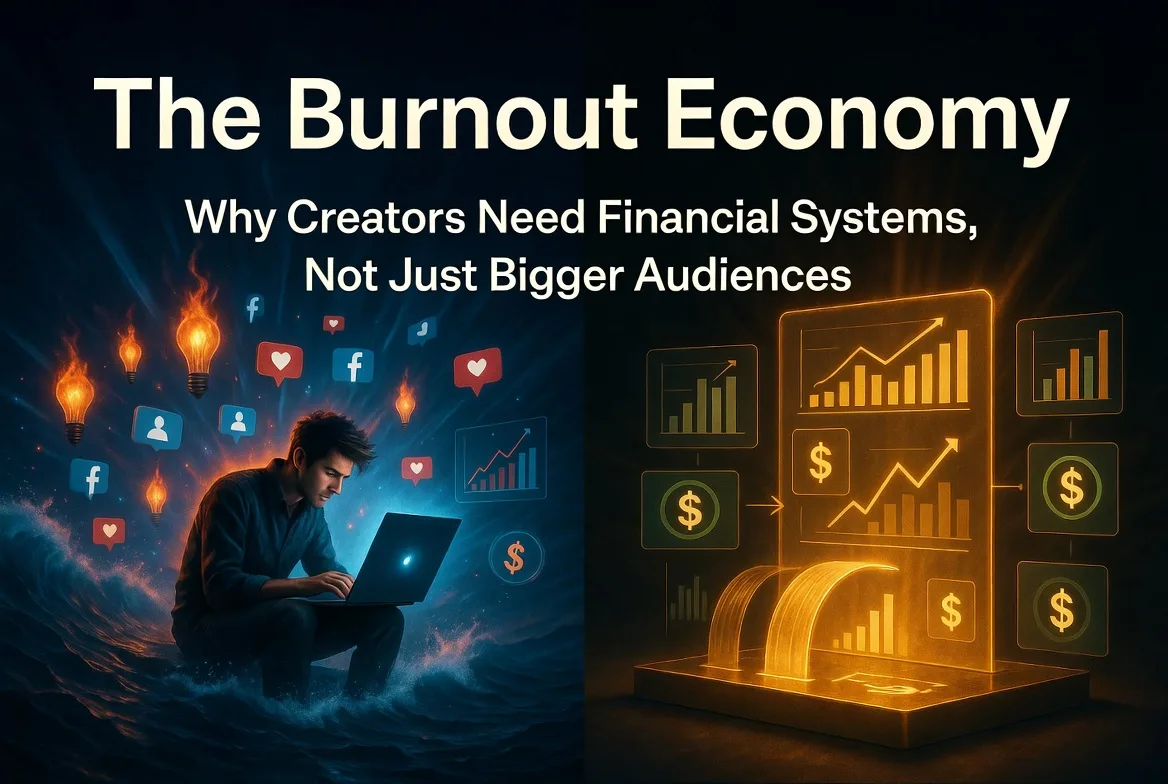
The Burnout Economy: Why Creators Need Financial Systems, Not Just Bigger Audiences
The creator economy is often sold as a story of freedom. A person starts with a phone, an idea, and an internet connection. They build an audience. They leave a traditional job. They earn from sponsorships, advertising, subscriptions, courses, affiliate links, appearances, digital products, or merchandise. They become their own media company. They own their schedule, their voice, and their relationship with the audience. From the outside, this looks like the modern dream of self-employment.
But every form of income has a hidden structure. A salary hides dependence on one employer. A business hides dependence on customers, suppliers, cash flow, and execution. Rental income hides maintenance, vacancies, financing costs, and regulation. Investment income hides volatility and uncertainty. Creator income hides something particularly personal: the worker is often the product, the brand, the salesperson, the performer, the strategist, the editor, the customer service department, and the emotional container for public reaction.
That is why creator burnout is not only a mental health issue. It is a financial issue. When income depends on visibility, attention becomes labour. When algorithms reward constant output, consistency becomes pressure. When sponsorships depend on engagement, personality becomes inventory. When the audience expects access, boundaries become harder to defend. When every pause risks lower reach, rest begins to feel expensive.
The creator economy has made it possible for millions of people to earn outside traditional employment. That opportunity is real. But the same economy has also produced a new financial vulnerability: income that appears independent but may be deeply dependent on platforms the creator does not control, moods they cannot predict, audiences they must continually satisfy, and personal energy they may eventually exhaust.
The Illusion of Freedom
Many people enter content creation because they want autonomy. They want to escape managers, offices, rigid schedules, commuting, or limited career paths. They want to turn skill, taste, personality, humour, expertise, beauty, analysis, storytelling, or lived experience into income. In the best cases, content creation does provide extraordinary leverage. A single post can reach more people than a traditional business could reach in years. A creator can build trust at scale. A niche expert can find a global audience. A teacher, designer, fitness coach, comedian, journalist, doctor, chef, or financial educator can convert knowledge into opportunity.
Yet autonomy is not the same as security. Many creators discover that they have not escaped bosses; they have multiplied them. The algorithm becomes a boss. The audience becomes a boss. The sponsor becomes a boss. The analytics dashboard becomes a boss. The creator may not report to a supervisor, but they may still wake up each morning asking whether the platform rewarded yesterday’s work.
This is a different kind of employment relationship. It has no HR department, paid leave, employer retirement contribution, medical insurance, or guaranteed monthly salary. It offers upside, but it often removes buffers. The creator can earn far more than they would in a conventional job during good periods. They can also earn unpredictably, lose momentum suddenly, or face public criticism that affects both income and identity.
Financial freedom is not the same as schedule freedom. A person can control their calendar and still be financially fragile. A creator can travel, work from home, and choose projects while still feeling trapped by the need to stay visible. True freedom requires systems that protect the person when attention falls, energy dips, platforms change, or life interrupts productivity.
Attention Is Not an Asset Until It Becomes Durable
The creator economy teaches people to value attention. Views, likes, shares, saves, comments, subscribers, followers, and watch time become the visible scoreboard. These metrics matter because they can influence distribution and revenue. But attention itself is not wealth. Attention is a raw material. It becomes wealth only when it is converted into durable assets, reliable income streams, owned relationships, intellectual property, brand equity, savings, investments, or businesses that can survive beyond the next post.
This distinction is crucial. A creator with a million followers may still be financially vulnerable if revenue is inconsistent, expenses are high, taxes are unmanaged, contracts are weak, and no savings have been built. Another creator with a smaller audience may be financially stronger because they own an email list, sell evergreen products, maintain low overhead, invest regularly, and avoid lifestyle inflation.
The public often confuses visibility with wealth. People assume that a well-known creator must be financially secure. In reality, fame can be expensive. Production quality rises. Travel costs rise. Assistants, editors, managers, photographers, lawyers, accountants, and software subscriptions become part of the operation. Audiences expect better output. Sponsors expect professionalism. The creator may feel pressure to display the lifestyle that reinforces the brand. The image of success can begin to consume the income that success produces.
Attention is powerful, but it is unstable. It must be harvested carefully. The creator’s goal should not be merely to become more visible. The goal should be to convert visibility into structures that create optionality. That may mean a diversified business model, a cash reserve, a pension plan, a taxable investment portfolio, insurance protection, documented processes, licensed content, paid communities, books, courses, consulting, or equity in ventures. The more durable the structure, the less the creator must depend on daily performance.
The Financial Shape of Burnout
Burnout is often discussed in emotional language: exhaustion, anxiety, numbness, cynicism, overwhelm, loss of motivation, or fear of logging on. Those experiences matter. But burnout also has a balance-sheet shape. It appears in missed invoices, delayed tax planning, impulsive spending, inconsistent saving, poor contract negotiation, neglected insurance, and income concentration.
A burned-out creator may keep accepting underpriced work because they are too tired to negotiate. They may say yes to sponsorships that do not fit their audience because cash flow feels uncertain. They may avoid looking at business accounts because the numbers create stress. They may delay hiring help because delegating requires energy. They may overspend during high-income months to compensate for emotional depletion. They may fail to set aside tax money because revenue feels temporary and urgent. They may continue producing despite needing rest because they fear the cost of silence.
This is why burnout can become self-reinforcing. Financial disorder creates stress. Stress reduces decision quality. Poor decisions weaken finances. Weaker finances make rest feel impossible. The creator works harder to recover stability, but the harder pace worsens exhaustion. Without intervention, the business becomes dependent on the very energy that the business is destroying.
A sustainable creator business must be designed around human limits. The plan must assume that the creator will get tired, sick, bored, criticised, distracted, or pulled into family responsibilities. It must assume that platforms will change. It must assume that some months will disappoint. It must assume that the audience may not respond equally to every idea. A financial system that depends on perfect energy is not a system. It is a gamble against biology.
Why Irregular Income Requires a Different Mindset
Traditional employees often build their finances around monthly predictability. Income arrives on a known date. Bills are scheduled around that date. Savings can be automated. Taxes may be withheld. Benefits may be partly handled by the employer. This structure is not perfect, but it provides rhythm.
Creator income often lacks that rhythm. One month may bring a major sponsorship. Another may bring delayed payments. Advertising revenue may fluctuate with seasonality, platform policy, audience behaviour, or niche trends. Affiliate income may spike during a launch and then fade. Course sales may depend on promotional cycles. Consulting may be project-based. A creator can appear successful on average while still experiencing cash-flow stress month to month.
The solution is not to pretend irregular income is regular. The solution is to build a cash-flow architecture that smooths volatility. Creators should think like business owners, not like employees with unpredictable pay. Revenue should first enter a business account. From there, money can be divided into tax reserves, operating expenses, owner pay, savings, investment contributions, and profit reserves. The creator should pay themselves a stable monthly amount whenever possible, even if the business earns unevenly.
This separation is psychologically powerful. It prevents every strong month from feeling like personal spending money. It prevents every weak month from feeling like personal failure. The business absorbs volatility so the household can maintain stability. Over time, the creator learns to judge success by annual profitability, cash reserves, audience quality, product strength, and personal sustainability rather than by the emotional swings of each payout.
The Platform Dependency Problem
Every creator should understand platform risk. A platform can change its algorithm, monetization rules, content policies, verification systems, search visibility, recommendation engine, or revenue-sharing model. An account can be hacked, suspended, demonetized, shadow-limited, or copied. A format that once performed well can stop working. A platform that once felt central to culture can decline. A creator who builds entirely on rented digital land is exposed to decisions made far beyond their control.
This does not mean creators should avoid platforms. Platforms provide distribution. They are powerful tools. But a platform should be treated as a channel, not the foundation of the entire financial life. The foundation should include owned assets and direct relationships. An email list, website, customer database, private community, podcast feed, book, course library, brand partnerships, and search-indexed content can reduce dependence on any single algorithm.
Platform dependency also affects mental health. When the creator’s income depends on opaque systems, uncertainty becomes constant. A post underperforms and the creator wonders whether the audience is tired of them. A video performs well and the creator feels pressure to repeat it. A new trend emerges and the creator wonders whether they must adapt or become irrelevant. The platform becomes not only a business partner but an emotional regulator.
Financial resilience reduces emotional dependency. The creator with six to twelve months of business reserves can endure a weak quarter. The creator with diversified income can ignore some trends. The creator with owned distribution can communicate without begging the algorithm. The creator with investment assets can make decisions from strategy rather than panic. Money does not solve every mental health challenge, but financial buffers create room to make healthier choices.
Audience Love Can Become Financial Pressure
Creators often begin with joy. They like teaching, entertaining, documenting, reviewing, performing, analysing, or helping. As the audience grows, the emotional contract changes. People expect consistency. They ask personal questions. They demand opinions. They criticise silence. They compare old content with new content. They reward vulnerability, but sometimes consume it without care. The creator learns that personal disclosure can increase engagement, which can increase income.
This creates a difficult financial incentive. The market may reward the creator for sharing more than is healthy. Personal stories can build trust. But when vulnerability becomes a growth strategy, boundaries become economically complicated. A creator may feel pressure to turn grief, illness, relationships, parenting, body image, faith, political opinion, or mental health into content because the audience responds. Over time, the private self shrinks.
The financial question is not only, “What content performs?” It is, “What content can I afford to keep making without losing myself?” A creator who monetizes personal access must decide where the business ends and the person begins. Boundaries are not bad for business. In the long run, boundaries protect the business because they protect the person the business depends on.
This may require clear content pillars, private zones, planned breaks, moderation policies, delayed posting, team support, and refusal to make certain personal experiences public. A creator can be authentic without being endlessly available. They can build trust without surrendering every part of life to the audience. The strongest creator businesses often have a defined editorial identity, not an open wound disguised as a brand.
The Tax Shock Waiting for New Creators
One of the first financial shocks for newly successful creators is tax. A salaried worker may be used to receiving net pay after deductions. A creator may receive gross business income and mistake it for spendable money. By the time tax obligations become clear, the cash may already have gone to equipment, rent, travel, lifestyle upgrades, debt repayments, family support, or reinvestment.
Tax planning is not glamorous, but it is one of the foundations of creator wealth. Every creator should have a system for setting aside tax money before spending. The exact percentage depends on jurisdiction, business structure, deductions, and total income. The principle is universal: tax belongs to the government before lifestyle belongs to the creator.
Creators should also understand deductible business expenses, recordkeeping, invoicing, sales tax or VAT obligations where applicable, withholding rules, foreign payments, and the difference between revenue and profit. International income can complicate matters further. A sponsorship from a foreign brand, platform payout from another country, or digital product sold globally may create documentation issues that casual creators are not prepared to handle.
A good accountant is not merely a compliance cost. For a serious creator, accounting advice is a form of risk management. It helps the business avoid penalties, plan cash flow, choose the right legal structure, understand profitability, and make better decisions. The creator who ignores taxes is not keeping more money. They are borrowing from the future under stressful terms.
Insurance for a Business Built Around a Person
Many creator businesses depend heavily on one individual. If that person cannot work, revenue may drop quickly. This makes insurance and protection planning essential. Traditional employees may receive some coverage through employers. Independent creators must build their own protection layer.
Health insurance matters because illness can damage both personal life and business continuity. Disability or income-protection coverage may matter where available because the creator’s ability to work is the engine of income. Life insurance may be necessary for creators with dependants, debts, or family obligations. Business insurance may be relevant for creators who host events, sell products, employ staff, give advice, rent studios, or face professional liability risks.
The correct insurance mix depends on the creator’s country, income level, family situation, business model, and legal exposure. The larger point is that creator income should not be treated as invincible simply because the creator is young, energetic, or popular. A business built around one person must protect that person’s earning power.
Creators should also consider operational protection. Password management, two-factor authentication, account recovery plans, data backups, contract storage, content archives, emergency contacts, and platform access protocols are not minor details. A hacked account can become a financial emergency. A lost hard drive can delay deliverables. A missing contract can weaken payment claims. Digital security is financial security.
Debt and the Performance Lifestyle
The creator economy can encourage visible consumption. Cameras, lighting, travel, clothing, home decor, restaurants, cars, events, and luxury experiences can become part of the content ecosystem. Sometimes these expenses are legitimate business investments. Sometimes they are lifestyle inflation wearing a business costume.
Debt becomes dangerous when creators borrow to maintain the appearance of momentum. A creator may finance equipment before revenue is stable. They may use credit cards to fund travel for content. They may lease a car because it fits the brand. They may rent a more expensive home because the space looks better on camera. They may spend to signal success before the business can support it.
The problem is that audience attention does not guarantee cash flow. A post may perform well without generating income. A brand deal may be delayed. A campaign may be cancelled. A product launch may underperform. Debt payments remain due even when engagement falls. The creator who builds a high fixed-cost life around variable income creates pressure that fuels burnout.
A healthier approach separates productive investment from image spending. Productive investment improves quality, saves time, increases revenue capacity, or reduces risk. Image spending mainly protects ego or public perception. The line can be subtle, but creators must learn to draw it. A camera that improves paid production may be an investment. A luxury trip taken mainly to appear successful may be a liability. A studio that supports multiple revenue streams may be strategic. A home upgraded beyond affordability because followers expect a lifestyle may become a trap.
The Emergency Fund Is a Creative Asset
An emergency fund is often described as boring cash. For creators, it is more than that. It is creative protection. Cash reserves allow the creator to refuse bad deals, take breaks, recover from illness, experiment with new formats, endure algorithm changes, and avoid desperate monetization.
Without cash reserves, every opportunity feels urgent. A creator may accept misaligned sponsorships, overwork, discount services, launch weak products, or violate audience trust because immediate income is needed. With reserves, the creator can think longer term. They can protect reputation. They can make decisions that preserve brand equity rather than chasing short-term cash.
Creators should consider two emergency funds: a household reserve and a business reserve. The household reserve protects personal living expenses. The business reserve protects operating costs such as software, team payments, rent, insurance, taxes, and production commitments. The size of these reserves depends on income volatility and dependants, but creators generally need larger buffers than salaried workers because their revenue is less predictable.
Cash may not produce exciting returns, but it produces strategic power. It gives the creator the right to pause. It reduces fear. It creates space between stress and decision. That space is one of the most valuable assets in a volatile career.
Retirement Planning for People Who May Never Retire Traditionally
Many creators love their work and cannot imagine retiring in the traditional sense. They may expect to create, teach, invest, advise, or build businesses for decades. But retirement planning is not only about stopping work. It is about reaching a point where work becomes optional.
Creator careers can be unpredictable. Audiences age. Platforms change. Personal interests evolve. Public visibility can become tiring. Health can shift. Family responsibilities can increase. A creator who assumes they will always be able to earn from content may be overestimating the durability of both attention and energy.
That is why creators need long-term investment plans. During high-income years, they should convert active income into passive and semi-passive assets. This may include retirement accounts, pension contributions, diversified index funds, bonds, real estate, business equity, cash-flowing products, or other appropriate investments. The goal is not to abandon creation. The goal is to ensure that creation remains a choice rather than a financial necessity.
The most financially mature creators understand that online income should be a bridge to ownership. Sponsorship income can buy investments. Platform revenue can fund pension contributions. Course profits can build reserves. Consulting fees can acquire productive assets. The creator’s labour should gradually create assets that do not require the creator to perform every day.
Turning Creator Income Into Wealth
There is a difference between making money and building wealth. Making money is income. Building wealth is retaining, protecting, and compounding part of that income over time. The creator economy is full of people who generate impressive revenue but fail to build lasting wealth because expenses, taxes, team costs, lifestyle inflation, and inconsistent planning consume the surplus.
The wealth-building creator treats every payment as part of a system. A portion goes to taxes. A portion goes to business operations. A portion goes to personal income. A portion goes to reserves. A portion goes to investment. A portion may go to giving, family support, or strategic reinvestment. This structure prevents the common mistake of letting income flow casually through accounts until it disappears.
Creators should also measure profit, not just revenue. A creator earning a large amount with high expenses may be less financially healthy than a smaller creator with strong margins. Vanity metrics exist in finance just as they exist on social platforms. Revenue can be a vanity metric if costs are ignored. Followers can be a vanity metric if trust is weak. Views can be a vanity metric if they do not convert. The serious creator studies the numbers that matter: profit margin, cash reserve months, income diversification, repeat customers, conversion rates, tax readiness, investment rate, and owner compensation.
The Need for a Personal Board
Creators often make major decisions alone. They negotiate contracts, assess sponsorships, plan launches, respond to criticism, manage money, and decide what parts of life to share. Isolation increases risk. A traditional company may have executives, lawyers, accountants, HR, advisers, and board members. A creator may have a manager, but not all managers are equipped to advise on mental health, tax, long-term wealth, or boundaries.
A personal board can help. This does not need to be formal. It can include an accountant, lawyer, financial adviser, therapist, experienced creator, business mentor, and trusted friend who is not impressed by fame. Each person serves a different role. The accountant protects the numbers. The lawyer protects rights. The adviser protects long-term financial direction. The therapist protects mental health. The mentor protects strategy. The grounded friend protects perspective.
The purpose of a personal board is to reduce emotionally driven decisions. When a sponsorship pays well but conflicts with values, the creator needs counsel. When a public controversy arises, they need calm advice. When income spikes, they need planning. When burnout appears, they need support before collapse. Wealth is easier to build when decision quality is protected.
Contracts Are Mental Health Documents
Creators often think of contracts as legal documents. They are also mental health documents. A vague contract creates anxiety. A rushed contract creates pressure. A contract with unclear revisions, usage rights, payment timelines, exclusivity terms, cancellation rules, or deliverables can turn a simple campaign into weeks of stress.
Good contracts protect time and energy. They define the scope of work. They limit revisions. They state payment dates. They clarify whether the brand can reuse the content, for how long, in which territories, and on which platforms. They address late payment, cancellation, reshoots, disclosure requirements, approval timelines, and exclusivity. They prevent the creator from being trapped in endless unpaid labour.
Undercharging is also a boundary problem. A creator who prices too low may need to accept too many deals to survive. That increases workload, weakens audience trust, and accelerates burnout. Pricing should reflect not only production time but audience value, creative skill, usage rights, opportunity cost, taxes, overhead, and the emotional labour of public association with a brand.
Building a Business That Can Rest
A sustainable creator business should be able to rest. This does not mean revenue never declines during breaks. It means the business is not destroyed by human pauses. Rest requires planning. Content can be batched. Evergreen assets can be built. Email sequences can run. Digital products can sell without daily posting. Team members can manage operations. Older content can continue attracting search traffic. Paid communities can have structures that do not require constant live presence. Sponsorship calendars can include planned gaps.
Creators should design seasons into their work. There can be production seasons, launch seasons, rest seasons, learning seasons, and maintenance seasons. Traditional media companies understand programming calendars. Athletes understand training and recovery cycles. Farmers understand planting and harvest. Creators often behave as if every week must be peak output. That is not sustainable.
The financial system must support these seasons. During high-revenue periods, reserves should be built for lower-output periods. During launches, taxes and profit should be separated. During rest, spending should be controlled. The creator who plans for seasonality can rest without treating rest as failure.
The Audience Also Benefits From Creator Boundaries
Some creators fear that boundaries will disappoint the audience. In reality, mature audiences often benefit from healthier creator behaviour. When creators model boundaries, they teach followers that productivity is not worth self-erasure. When they refuse misaligned sponsorships, they protect trust. When they take breaks, they normalize rest. When they speak honestly about business realities without oversharing, they improve financial literacy.
A creator who burns out may disappear abruptly, produce resentfully, or damage audience trust through desperate monetization. A creator with boundaries can serve longer. The best audience relationships are not built on constant access. They are built on consistent value, respect, and clarity.
Creators should communicate boundaries professionally. They do not need to explain every detail. They can state posting schedules, response policies, sponsorship standards, community rules, and break periods. Clear expectations reduce misunderstanding. The audience does not need ownership of the creator’s life in order to benefit from the creator’s work.
What Aspiring Creators Should Learn Before Monetizing
People who want to become creators should learn business basics early. They should understand budgeting, taxes, contracts, pricing, negotiation, platform risk, intellectual property, content rights, audience trust, insurance, and saving before major money arrives. Waiting until income grows can make the learning curve more painful.
An aspiring creator should begin with low fixed costs. They should avoid buying expensive equipment before proving demand. They should experiment with formats before building a costly production machine. They should keep their day job or another income source where possible until creator revenue becomes consistent. They should avoid comparing their early stage to someone else’s mature business.
They should also define success carefully. Not every creator needs millions of followers. A small expert audience can be more financially valuable than a large casual audience. A creator serving a specific professional niche may build a strong business with fewer followers than an entertainment creator who needs massive reach. The right audience is often more important than the largest audience.
What Established Creators Should Audit
Established creators need regular financial audits. The first audit is income concentration. What percentage of income comes from one platform, one sponsor, one product, or one format? The second is expense structure. Which costs are essential, and which exist mainly to maintain image? The third is cash reserves. How many months can the household and business survive if revenue falls sharply?
The fourth is tax readiness. Is money being set aside automatically? Are filings current? Are deductions documented? The fifth is legal protection. Are contracts reviewed? Are usage rights priced properly? Are intellectual property rights protected? The sixth is investment rate. What percentage of profit is being converted into long-term assets? The seventh is personal sustainability. Is the creator’s current output possible for three more years without serious harm?
This last question may be the most revealing. A business model that cannot be sustained physically, emotionally, or relationally is not truly profitable. It is extracting value from the future self.
The Wealth Principle Beneath the Creator Economy
The creator economy may feel new, but the wealth principle beneath it is old. Active income should be used to acquire assets. Labour should build ownership. Visibility should build durable relationships. Reputation should create optionality. Cash flow should become capital. A career should not depend forever on maximum personal output.
This principle applies to doctors, lawyers, athletes, musicians, consultants, entrepreneurs, and creators alike. High-earning active workers can appear wealthy while remaining fragile if they do not convert income into assets. The creator has a special version of this challenge because the income engine is public, emotional, and algorithmically mediated. That makes conversion even more urgent.
The creator should ask: What will remain if I stop posting for three months? What will remain if a platform changes? What will remain if sponsorship income falls? What will remain if I want a quieter life? The answer reveals whether the creator has built wealth or merely built momentum.
A Healthier Definition of Success
The creator economy needs a broader definition of success. Success is not only follower count, virality, brand deals, public recognition, or income screenshots. Success is the ability to create without destroying health. It is the ability to earn without losing boundaries. It is the ability to serve an audience without becoming owned by it. It is the ability to turn attention into assets. It is the ability to rest without financial panic.
For some creators, success will mean building a large media company. For others, it will mean a modest, profitable business that supports a good life. For others, it will mean using content as a channel for consulting, teaching, writing, speaking, or product sales. There is no single correct model. The wrong model is the one that requires constant self-extraction while pretending to be freedom.
Creators need financial systems because systems protect people from the most unstable parts of success. A system decides where money goes before emotion spends it. A system separates taxes before panic arrives. A system builds reserves before burnout demands rest. A system diversifies income before platforms change. A system invests during good years before attention moves elsewhere. A system creates boundaries before the audience learns to expect unlimited access.
The Practical Path Forward
A creator who wants to become financially stronger can begin with a few disciplined moves. Separate personal and business accounts. Track revenue and expenses monthly. Set aside tax money automatically. Build household and business emergency funds. Review contracts before signing. Raise prices when demand and value justify it. Diversify income streams carefully, not chaotically. Build owned channels. Invest a percentage of profit into long-term assets. Protect health with insurance where available. Schedule rest as part of the business model.
None of these steps require viral success. They require seriousness. A small creator can build strong habits before income grows. A large creator can repair weak systems before burnout becomes collapse. The work is not only financial administration. It is self-preservation.
The creator economy will continue to evolve. Platforms will rise and fall. Formats will change. Artificial intelligence will alter production. Brands will shift budgets. Audiences will migrate. Some creators will become companies. Some will leave the industry. Some will burn out. Some will build quietly durable wealth because they understood that attention was only the beginning.
The central lesson is simple: a bigger audience is not a financial plan. More visibility is not the same as more freedom. Higher income is not the same as wealth. A creator’s most valuable asset is not the account, the camera, the brand deal, or the algorithm. It is the human being whose judgement, energy, trust, and creativity make the business possible.
Protecting that human being is not separate from financial strategy. It is financial strategy. The creator who builds systems around health, cash flow, ownership, boundaries, and long-term investing has a better chance of turning online opportunity into lasting freedom. The creator who chases attention without structure may win the algorithm and still lose the life they were trying to build.
 Article
 Article
 Article
 Article
 Article
 Article
 Article
 Article