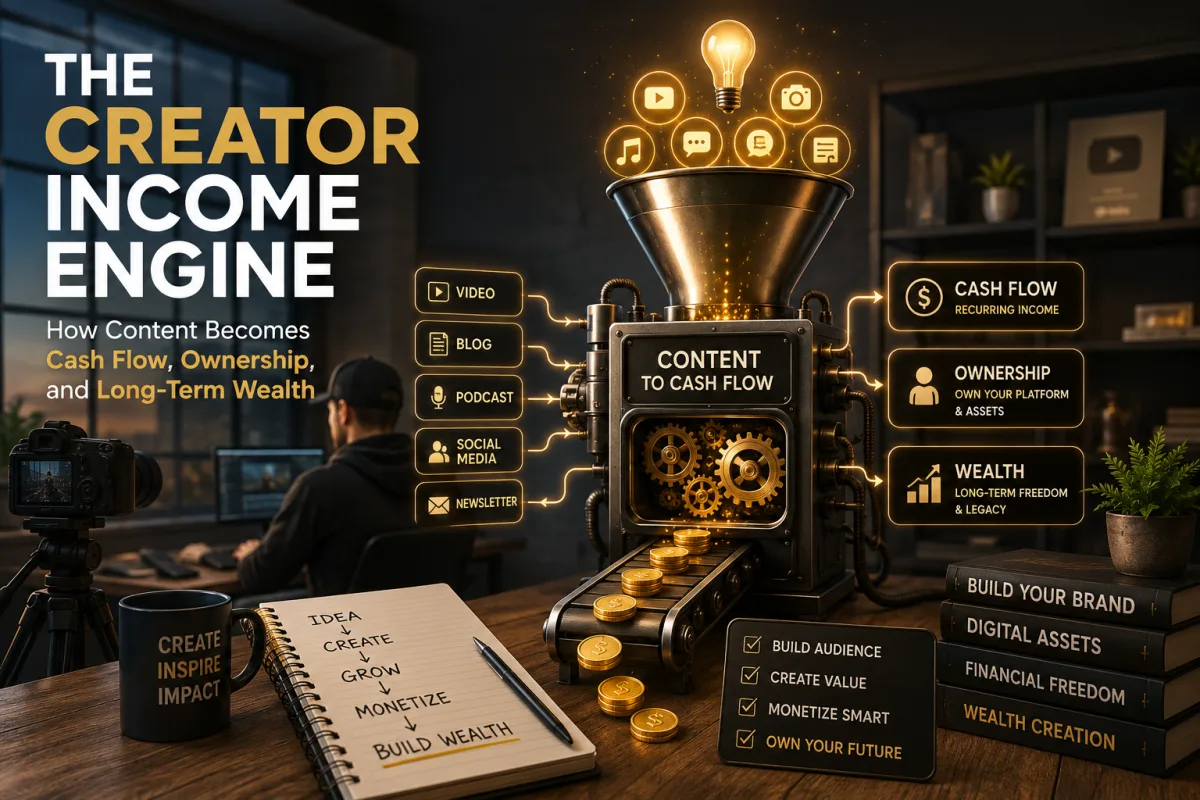
The Creator Income Engine: How Content Becomes Cash Flow, Ownership, and Long-Term Wealth
Content creation has become one of the most accessible business opportunities of the modern economy. A person with a phone, an internet connection, a clear message, and enough consistency can reach audiences that previous generations needed newspapers, television stations, radio networks, publishers, or advertising agencies to access.
But access is not the same as income.
Millions of people post videos, write newsletters, record podcasts, publish tutorials, share photos, livestream, teach online, review products, entertain audiences, and build personal brands. Some earn meaningful money. Some earn a little. Many earn nothing. The difference is rarely talent alone. It is strategy.
Content creation becomes profitable when attention is converted into trust, trust is converted into offers, and offers are converted into revenue. Views matter, but views are not the business. Followers matter, but followers are not the business. The business is the economic system built around the audience.
A creator who understands this stops asking only, “How do I go viral?” and starts asking better questions. Who am I serving? What problem do I solve? Why should people return? What can I sell ethically? Which income streams fit my audience? How do I build an asset that is not fully controlled by one platform?
Content can create money in many ways: advertising revenue, sponsorships, affiliate commissions, digital products, courses, consulting, coaching, subscriptions, paid communities, events, licensing, merchandise, books, templates, software, memberships, and business opportunities. The strongest creators rarely depend on one stream. They build layers.
The purpose of content is not only to be seen. The purpose is to create value at scale.
The New Economics of Attention
In the past, attention was expensive to access. A business had to pay for newspaper ads, radio slots, billboards, television commercials, direct mail, or retail shelf space. Media companies controlled distribution. Gatekeepers decided who appeared in front of the public.
The internet weakened those gates. Social platforms gave individuals the ability to publish directly. YouTube, TikTok, Instagram, Facebook, X, LinkedIn, Substack, podcasts, blogs, newsletters, and community platforms allow creators to reach people without traditional media permission.
This shift created the creator economy. A creator can now build an audience first and monetize later. A teacher can become a course seller. A comedian can become a touring performer. A fitness trainer can become a subscription brand. A finance educator can become a trusted advisor. A chef can sell recipe books. A designer can sell templates. A gamer can earn from streaming, sponsorships, and merchandise.
But the creator economy also created confusion. Many people mistake visibility for wealth. They assume that large follower counts automatically produce money. They assume that fame and financial stability are the same. They are not.
Attention is raw material. It becomes valuable when organized into trust, community, distribution, and purchasing behavior. A creator with 20,000 loyal followers may earn more than a creator with 500,000 passive followers if the smaller audience trusts them deeply and buys from them consistently.
The creator’s real asset is not only the content. It is the relationship with the audience.
How Platforms Pay Creators
Many creators begin by hoping platforms will pay them directly. This can happen, but it is only one part of the income picture.
YouTube, for example, offers monetization through the YouTube Partner Program. Its public eligibility pages explain that creators must meet policy and availability requirements, and YouTube lists ad revenue eligibility thresholds such as 1,000 subscribers plus either 4,000 valid public watch hours in the last 12 months or 10 million valid public Shorts views in the last 90 days. YouTube also has expanded Partner Program access for some fan-funding and shopping features at lower thresholds, such as 500 subscribers with recent uploads and either 3,000 public watch hours or 3 million Shorts views in the stated period.
TikTok’s monetization ecosystem includes features such as Creator Rewards, LIVE gifts, subscriptions, Series, and marketplace-related opportunities. TikTok’s own help pages state that Creator Rewards participation depends on eligibility requirements, region, account standing, and content quality, while eligible program videos generally must be original and longer than one minute.
Facebook has also expanded creator monetization across formats. Meta’s creator resources describe Facebook Content Monetization as a program where qualifying creators can earn from Reels, photos, stories, text posts, and videos, with payouts based on content performance.
Newsletter platforms offer another model. Substack allows writers to publish for free and enable paid subscriptions. Its support documentation says publishing is free, while paid subscriptions are subject to Substack’s 10 percent transaction fee plus Stripe payment-processing fees.
These platform programs matter, but they should not be the entire business model. Platform payouts can change. Eligibility rules can change. Algorithms can change. Advertiser demand can change. A creator who depends only on platform revenue is building on rented land.
Platform money is useful. Owned money is stronger.
The Difference Between a Creator and a Creator Business
A creator makes content. A creator business converts content into a repeatable economic system.
The difference is enormous.
A creator may post daily, attract views, and receive praise but still struggle financially. A creator business has a defined audience, clear positioning, monetization channels, products, services, data capture, financial tracking, and long-term strategy.
The creator asks, “What should I post today?” The creator business asks, “What audience am I building, what value am I delivering, and what revenue model fits that value?”
A creator may chase trends endlessly. A creator business builds a recognizable point of view. A creator may celebrate vanity metrics. A creator business studies conversion, retention, revenue per audience member, customer satisfaction, and profit margins. A creator may depend on one platform. A creator business builds distribution across multiple channels and collects email addresses, customer relationships, and intellectual property.
The goal is not to remove creativity. The goal is to protect creativity with a business model.
Many talented creators burn out because they create without structure. They post constantly, respond to every trend, say yes to weak deals, undercharge for services, ignore taxes, and never build assets beyond the next upload. They become busy but not secure.
Content becomes wealth when it is treated as a business asset.
Start With a Valuable Niche
The first serious decision in content creation is positioning. A niche is not just a topic. It is the intersection between what you know, what people care about, and what can produce economic value.
Some niches are broad: personal finance, fitness, beauty, parenting, travel, food, education, technology, business, career development, comedy, lifestyle, gaming, faith, sports, or entertainment. But broad niches are crowded. A beginner usually needs a sharper angle.
Personal finance is broad. “Helping young professionals get out of debt and start investing” is sharper. Fitness is broad. “Strength training for women over 40” is sharper. Food is broad. “Affordable meal planning for busy families” is sharper. Career content is broad. “Helping nurses transition into healthcare administration” is sharper.
A good niche helps the audience quickly understand why the creator matters. It also makes monetization easier because specific audiences have specific needs. Specific needs lead to specific offers.
The best niches have three qualities. They attract attention. They solve real problems. They support monetization.
A creator can build an audience around entertainment alone, but monetization may depend heavily on ads, sponsorships, live shows, merchandise, or fan support. A creator who solves urgent problems can often monetize through products, services, consulting, templates, courses, and affiliate offers. Neither path is wrong. They simply require different strategies.
Before choosing a niche, ask: do people spend money in this category? Are there products, services, tools, books, courses, subscriptions, events, or brands already serving this audience? Can I create content for this topic for several years without losing interest? Do I have enough credibility or willingness to learn publicly?
A niche should not trap you. It should give you a starting identity.
Build Trust Before You Sell
Content monetization depends on trust. People may watch someone they do not trust, but they rarely buy from someone they do not trust.
Trust is built through consistency, usefulness, honesty, personality, proof, and time. A creator earns trust when the audience repeatedly receives value without feeling manipulated. The value may be education, entertainment, inspiration, clarity, analysis, encouragement, or practical help.
Many beginners rush to monetize before trust exists. They post a few times, gain a small audience, and immediately push products. The audience senses the imbalance. The creator has not yet earned the right to ask.
This does not mean creators should wait forever to sell. It means the selling should match the relationship. A new creator may begin with low-friction monetization such as affiliate links to genuinely useful tools, small digital products, or simple services. As trust grows, higher-value offers become more natural.
Trust also requires ethical boundaries. Do not promote products you would not use. Do not exaggerate results. Do not hide sponsorships. Do not pretend every recommendation is neutral when you are being paid. Research on affiliate marketing and financial influencers continues to raise concerns about weak disclosure practices, especially in ecosystems where audience trust can quickly become transactions.
Trust is slow to build and fast to lose. For a creator, it is the most valuable currency.
The Main Ways Content Creators Make Money
There is no single way to earn through content creation. The strongest model depends on the creator’s niche, audience size, trust level, platform, skills, and business goals.
Most creator income falls into several categories.
Advertising Revenue
Advertising revenue is money earned when platforms place ads around or inside content and share part of that revenue with the creator. YouTube is the most familiar example for many people, but other platforms also have monetization programs.
The advantage of ad revenue is that it can be passive once the content is published. A video, article, or post may continue earning if people keep consuming it. The disadvantage is that creators usually need meaningful scale before ad revenue becomes substantial. Earnings depend on views, watch time, geography, advertiser demand, niche, content format, and platform rules.
Advertising revenue works best for creators who can generate consistent attention. Education, entertainment, commentary, tutorials, reviews, and evergreen searchable content can all support ad income. But relying only on ads can be fragile because the creator does not control rates or policies.
Ads are a useful income stream, not a complete wealth strategy.
Sponsorships and Brand Deals
Sponsorships occur when a brand pays a creator to feature, mention, review, or integrate a product or service into content. This can be highly profitable because brands pay for access to trust and audience attention.
A creator does not always need millions of followers to attract sponsors. A smaller creator with a focused audience can be valuable if the audience is relevant and engaged. A personal finance creator with 15,000 loyal followers may be attractive to a budgeting app, investment platform, insurance company, or bank. A fitness creator with 10,000 engaged followers may be attractive to a supplement brand, gym apparel company, or equipment seller.
Sponsorship income depends on audience quality, niche, engagement, content quality, brand fit, negotiation skill, and professionalism. Creators who understand their audience data, deliver good creative work, and maintain trust can command better deals.
The danger is over-sponsorship. If every post feels like an advertisement, the audience may stop trusting the creator. The best sponsorships feel aligned. They solve a real audience problem and fit naturally into the creator’s content.
Affiliate Marketing
Affiliate marketing allows creators to earn commissions when audience members buy through their referral links or codes. This works especially well for product reviews, tutorials, comparisons, software recommendations, financial tools, beauty products, books, courses, travel services, and equipment.
The advantage is that creators can earn without creating the product themselves. The disadvantage is that commissions vary, tracking can be imperfect, and the creator’s reputation is tied to the products recommended.
Affiliate marketing should be treated as a trust business. Promote only products that genuinely fit the audience. Explain who the product is for and who it is not for. Disclose affiliate relationships clearly. Do not turn every piece of content into a sales trap.
Good affiliate content helps the audience make better decisions. Bad affiliate content pushes anything that pays.
Digital Products
Digital products are one of the most powerful creator monetization models because they can be built once and sold many times. Examples include ebooks, templates, guides, spreadsheets, presets, design assets, meal plans, workout plans, budgeting tools, Notion dashboards, study notes, scripts, checklists, and downloadable resources.
Digital products work best when they solve a specific problem. A general ebook called “How to Be Successful” may struggle. A practical budgeting spreadsheet for self-employed workers may sell because it solves a clear pain. A content calendar template for real estate agents may sell because it saves time for a defined audience.
The creator’s content creates demand by teaching and demonstrating expertise. The product gives the audience a shortcut, system, or tool.
Digital products can produce high margins, but they still require marketing, customer support, updates, and quality control. A poor product may create quick income but damage long-term trust.
Online Courses and Workshops
Courses allow creators to teach a process in a structured way. They are suitable when the audience wants transformation, not just information. A course may teach photography, investing basics, public speaking, coding, makeup, business planning, exam preparation, freelancing, writing, language learning, fitness, or career development.
A course should not simply be a collection of videos. It should move the learner from a starting point to a desired result. The more specific the result, the easier it is to sell and deliver.
Workshops can be easier than full courses because they are focused and time-bound. A creator may host a two-hour paid workshop on building a personal budget, editing short videos, writing LinkedIn posts, meal prepping, negotiating salary, or setting up a small business bookkeeping system.
Courses and workshops depend heavily on trust. People pay when they believe the creator can help them achieve a result.
Services, Coaching, and Consulting
Services are often the fastest way for a creator to make money because they do not require a large audience. A creator with a small but targeted audience can sell consulting, coaching, design, writing, editing, social media management, photography, video production, strategy sessions, tutoring, fitness coaching, career coaching, or business advisory services.
Content acts as proof. It shows expertise before the sales conversation begins. A person who posts helpful tax tips may attract bookkeeping clients. A person who shares website design breakdowns may attract design clients. A person who teaches interview preparation may attract coaching clients.
The advantage of services is speed of monetization. The disadvantage is limited scalability. Time is finite. Once the creator’s calendar is full, income can grow only through higher pricing, group offers, hiring a team, or productizing the service.
Services are a strong early-stage monetization path because they teach the creator what the audience is willing to pay for.
Subscriptions and Memberships
Subscriptions create recurring revenue. Instead of selling once, the creator earns monthly or annually from members who want ongoing value. This may include premium newsletters, paid communities, private podcasts, exclusive videos, research reports, templates, live sessions, coaching groups, or member-only content.
The advantage is predictability. Recurring revenue can stabilize a creator business. The challenge is retention. Members must continue receiving enough value to stay.
A subscription should not be launched only because the creator wants monthly income. It should exist because the audience has an ongoing need. Investors may pay for market commentary. Writers may pay for craft workshops. Business owners may pay for accountability and templates. Fitness followers may pay for monthly programs. Students may pay for exam support.
Subscription income rewards consistency and community management. It is less about one viral moment and more about serving people repeatedly.
Merchandise and Physical Products
Merchandise can work when a creator has a strong identity or community. T-shirts, mugs, notebooks, hats, bags, apparel, and accessories can generate income, but merchandise is rarely the best first monetization path unless the audience has strong emotional attachment.
Physical products can become much larger than merchandise. Beauty creators launch cosmetics. Fitness creators launch equipment. Food creators launch sauces or packaged goods. Education creators publish books. Lifestyle creators launch planners. Parenting creators create children’s products.
Physical products require more capital, logistics, inventory management, quality control, shipping, customer service, and risk. They can create significant wealth, but they are more complex than digital products.
A creator should not rush into physical products simply because they look impressive. The product must fit the audience and the creator’s operational capacity.
Licensing and Intellectual Property
Creators can also make money by licensing content, formats, images, music, writing, designs, or intellectual property. A photographer can license images. A musician can license tracks. A writer can license articles. A creator with a recognizable character, phrase, method, or format can turn it into intellectual property.
This income stream is often overlooked because it requires legal awareness and business development. But it can be powerful because intellectual property can generate income beyond the creator’s direct labor.
Creators should keep records, understand contracts, protect original work, and avoid signing away rights carelessly.
The Audience Ladder
Not every audience member is ready to buy. A creator needs to understand the audience ladder.
At the bottom are strangers. They have never heard of you. Content helps them discover you.
Next are casual viewers. They have seen your content but do not yet feel connected. Consistency helps them remember you.
Then come followers or subscribers. They have chosen to receive more from you. Value helps them trust you.
After that are engaged community members. They comment, share, reply, attend live sessions, or join your email list. Relationship helps them believe in your work.
Then come buyers. They purchase products, services, subscriptions, or affiliate recommendations. Results help them return.
At the top are advocates. They recommend you to others. They defend your brand. They become part of your growth engine.
Many creators try to sell to strangers before building the ladder. A better strategy is to create content that moves people upward step by step.
Own Your Audience
One of the most important wealth lessons in content creation is this: do not build entirely on rented land.
Social platforms are powerful, but they are not fully yours. Your account can be restricted. Reach can decline. Algorithms can change. Monetization can be paused. A platform can favor one format this year and another format next year. A creator who has no direct connection to the audience is vulnerable.
Owning your audience means building channels you control more directly. The most common are email lists, websites, customer databases, communities, SMS lists, and private platforms. An email subscriber is more valuable than a passive follower because you can communicate without depending entirely on algorithmic distribution.
This does not mean abandoning social media. Social media is excellent for discovery. Owned channels are better for relationship and monetization.
A strong creator system uses platforms to attract attention, then invites the audience into a deeper relationship. Watch the video, then join the email list. Read the post, then download the free template. Attend the live session, then join the community. Enjoy the free content, then consider the paid product.
Audience ownership turns attention into an asset.
The Content Funnel
A content funnel is the path from discovery to purchase. It does not need to be manipulative. At its best, it is simply a helpful journey.
The top of the funnel is discovery content. This includes short videos, viral posts, searchable tutorials, opinion pieces, and shareable insights. Its job is to attract new people.
The middle of the funnel is trust content. This includes deeper videos, newsletters, case studies, behind-the-scenes explanations, live Q&A sessions, podcasts, and educational series. Its job is to show credibility and build relationship.
The bottom of the funnel is conversion content. This includes product demos, testimonials, launch emails, webinars, consultations, sales pages, comparison guides, and direct offers. Its job is to help the right people buy.
A creator who only makes discovery content may get views but weak income. A creator who only makes sales content may repel people. A healthy business needs all three.
People discover you through reach. They trust you through depth. They buy when the offer matches their need.
Content That Makes Money
Not all content has the same commercial value. Some content attracts attention but does not lead to buying. Some content attracts fewer views but produces stronger income.
Entertainment content can scale massively, but monetization may depend on ads, sponsorships, merchandise, fan support, and live events. Educational content can monetize through courses, templates, consulting, subscriptions, books, and affiliate tools. Review content can monetize through affiliate links and brand deals. Personal brand content can monetize through services, speaking, coaching, and partnerships.
High-income content usually does one of four things. It solves a painful problem. It helps people make money. It helps people save money. It helps people improve status, health, relationships, skill, confidence, or identity.
This does not mean every post should be commercial. It means the creator should understand which content builds reach, which builds trust, and which builds revenue.
A finance creator may post a short video on common money mistakes for reach. They may write a newsletter explaining budgeting psychology for trust. They may sell a budgeting template for revenue. The three pieces work together.
Content is not random when it is connected to a business model.
How to Price Creator Offers
Many creators undercharge because they price based on effort rather than value. They ask, “How long did this take me to make?” instead of “What problem does this solve and what is the result worth to the buyer?”
A template that saves a business owner ten hours may be worth more than a long ebook that solves no urgent problem. A one-hour consultation that helps someone avoid a costly mistake may be worth more than a large generic course. A niche newsletter that helps professionals make better decisions may justify a higher subscription price than a broad entertainment newsletter.
Pricing should consider audience ability to pay, the value of the result, market alternatives, creator credibility, delivery cost, support level, and positioning.
Low prices can help beginners get traction, but staying too cheap can attract customers who do not value the work. High prices can work when the outcome is valuable and the creator has trust. The price must match the promise.
Creators should test pricing, listen to customer feedback, and improve offers over time. The goal is not to charge the maximum possible once. The goal is to build a profitable, ethical, sustainable business.
The Fastest Path to First Income
For beginners, the fastest path to money is usually not ad revenue. It is services or a small product.
Ad revenue often requires scale. Sponsorships usually require proof of audience quality. Subscriptions require ongoing trust. But services can begin with a small audience if the skill is clear.
A video editor can post editing breakdowns and offer editing packages. A fitness coach can post training tips and offer personalized programs. A writer can post examples and offer copywriting services. A finance educator can post budgeting lessons and offer paid workshops. A designer can post brand audits and offer design services.
The beginner should not wait for a huge audience to validate the business. A small audience can produce income if the offer is specific.
The first income teaches more than theory. It reveals who buys, what they value, what objections they have, and what results they want. This information helps the creator build better content and better products.
From Active Income to Scalable Income
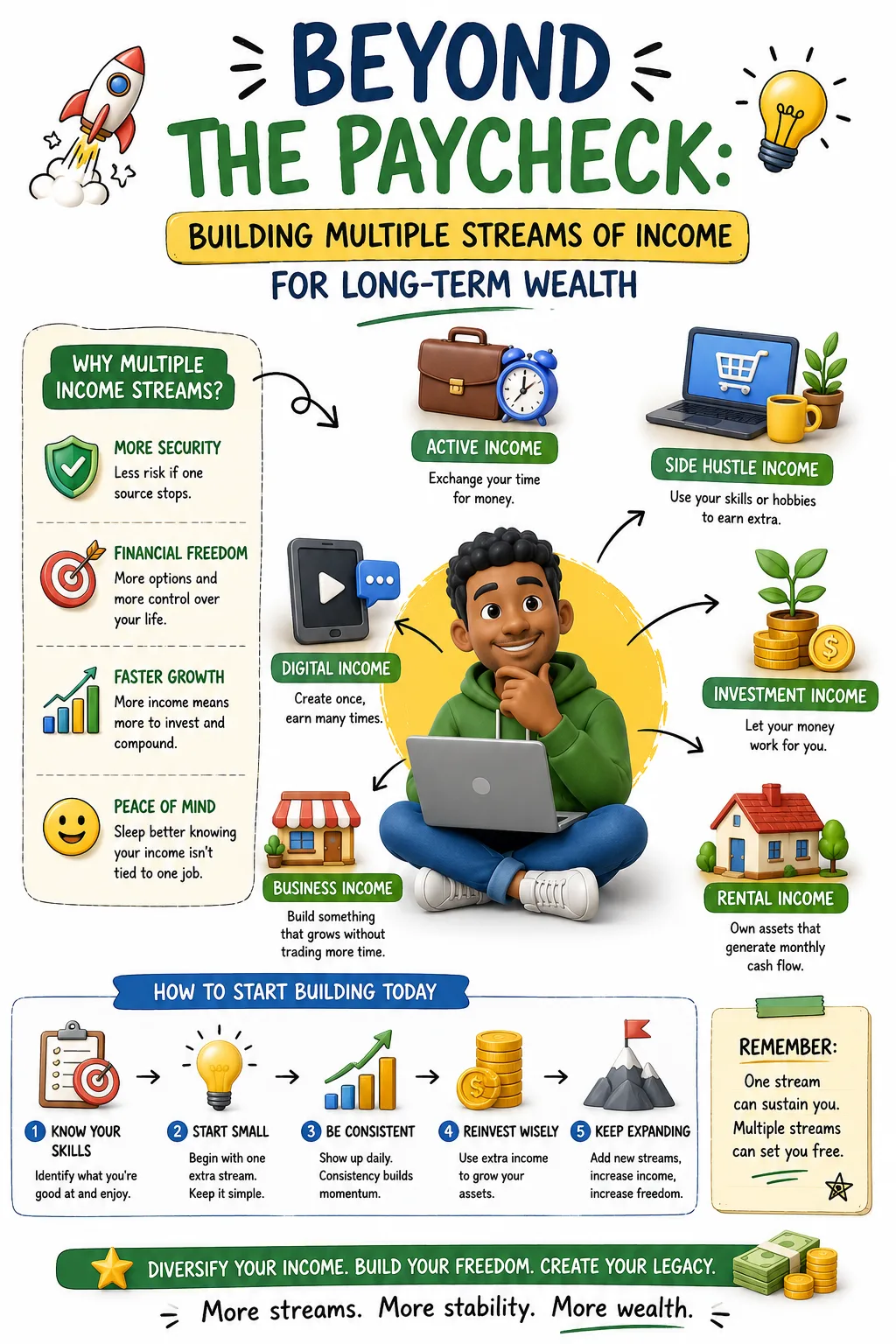
At first, many creators earn active income. They trade time for money through services, coaching, consulting, editing, design, writing, tutoring, or production work. This is useful, but it can become exhausting.
The next step is productization. Productization means turning repeated work into a repeatable offer. If clients ask the same questions, create a paid guide. If coaching follows the same steps, create a group program. If design clients need similar resources, create templates. If consulting calls reveal common problems, create a workshop.
Productization turns knowledge into assets.
The creator can then build scalable income streams: digital products, courses, memberships, licensing, affiliate systems, automated workshops, books, and community models. Scalable does not mean effortless. It means income is less directly limited by hours worked.
The strongest creator businesses often combine both. Services provide high-ticket income and audience insight. Products provide scale. Sponsorships provide brand revenue. Subscriptions provide recurring stability. Ads provide platform income. Together, they create resilience.
Build a Creator Balance Sheet
Most creators track followers. Serious creators track assets.
A creator balance sheet includes audience assets, content assets, intellectual property, products, customer relationships, cash reserves, equipment, systems, brand equity, and partnerships.
Audience assets include email subscribers, community members, podcast listeners, YouTube subscribers, website visitors, and social followers. Content assets include evergreen videos, articles, guides, podcasts, newsletters, and search-ranking pages that continue attracting people over time. Product assets include courses, templates, books, workshops, and membership libraries. Intellectual property includes frameworks, methods, trademarks, scripts, designs, and original formats.
When viewed this way, content creation becomes more than posting. It becomes asset building.
A viral post may disappear in a week. An evergreen tutorial may bring traffic for years. A strong email list may generate launches repeatedly. A trusted brand may create opportunities long after individual posts fade.
The wealth-building creator asks, “What am I building that will still have value next year?”
Evergreen Content and Compounding
Some content is temporary. It responds to trends, news, memes, or current conversations. Temporary content can create reach, but it often fades quickly.
Evergreen content remains useful for months or years. Tutorials, explanations, product comparisons, beginner lessons, checklists, case studies, and foundational educational pieces can continue attracting audiences long after publication.
Evergreen content is powerful because it compounds. One useful article may attract search traffic over time. One strong YouTube tutorial may bring viewers for years. One downloadable template may continue selling. One clear podcast episode may be discovered by new listeners repeatedly.
A creator who produces only trending content must keep running to stay visible. A creator who builds evergreen assets creates a library that works while they sleep.
The best strategy often combines both. Trend content captures current attention. Evergreen content builds long-term discovery. Personal content builds relationship. Offer content drives revenue.
The Role of Personal Brand
A personal brand is not a logo or a color scheme. It is the reputation attached to your name. It is what people expect from you before you enter the room.
In content creation, personal brand reduces friction. When people know what you stand for, they are more likely to follow, trust, share, and buy. A strong brand communicates expertise, values, tone, and audience promise.
Personal brand is built through repeated signals. What topics do you discuss? What problems do you solve? What stories do you tell? What standards do you hold? What do you refuse to promote? How do you treat your audience? How consistent is your quality?
A creator with a strong personal brand can move across platforms more easily. If one platform declines, the audience may follow because the relationship is with the creator, not only the app.
Brand is also pricing power. A trusted creator can charge more than an unknown provider because buyers feel reduced risk. They believe the creator will deliver.
Professionalism Attracts Money
Creators often underestimate professionalism. Brands, clients, and customers pay more when the creator is reliable.
Professionalism means responding clearly, meeting deadlines, using contracts, sending invoices, disclosing paid partnerships, delivering promised work, tracking performance, respecting the audience, and maintaining quality standards.
A creator with a smaller audience but strong professionalism may earn more than a larger creator who is disorganized. Brands do not only buy reach. They buy execution. Clients do not only buy talent. They buy reliability.
Professional creators prepare media kits. They know their audience demographics. They track engagement. They have rate cards or pricing logic. They understand usage rights. They review contracts. They protect their creative boundaries.
Money flows more easily to creators who are easy to work with.
Financial Management for Creators
Making money is only the first step. Keeping and growing it requires financial management.
Creator income can be irregular. One month may bring sponsorships, product sales, and affiliate commissions. Another month may be quiet. Without planning, irregular income creates stress and poor decisions.
Creators should separate business and personal finances. They should track income by stream, record expenses, set aside money for taxes, maintain emergency reserves, and understand profit margins. Equipment, software, contractors, advertising, travel, subscriptions, internet, and production costs can reduce income quickly.
A creator should know which activities produce profit, not just revenue. A launch that makes a large amount but requires high ad spend, refunds, contractors, and stress may not be as profitable as it appears. A simple digital product with modest revenue but high margins may be more valuable than a flashy campaign.
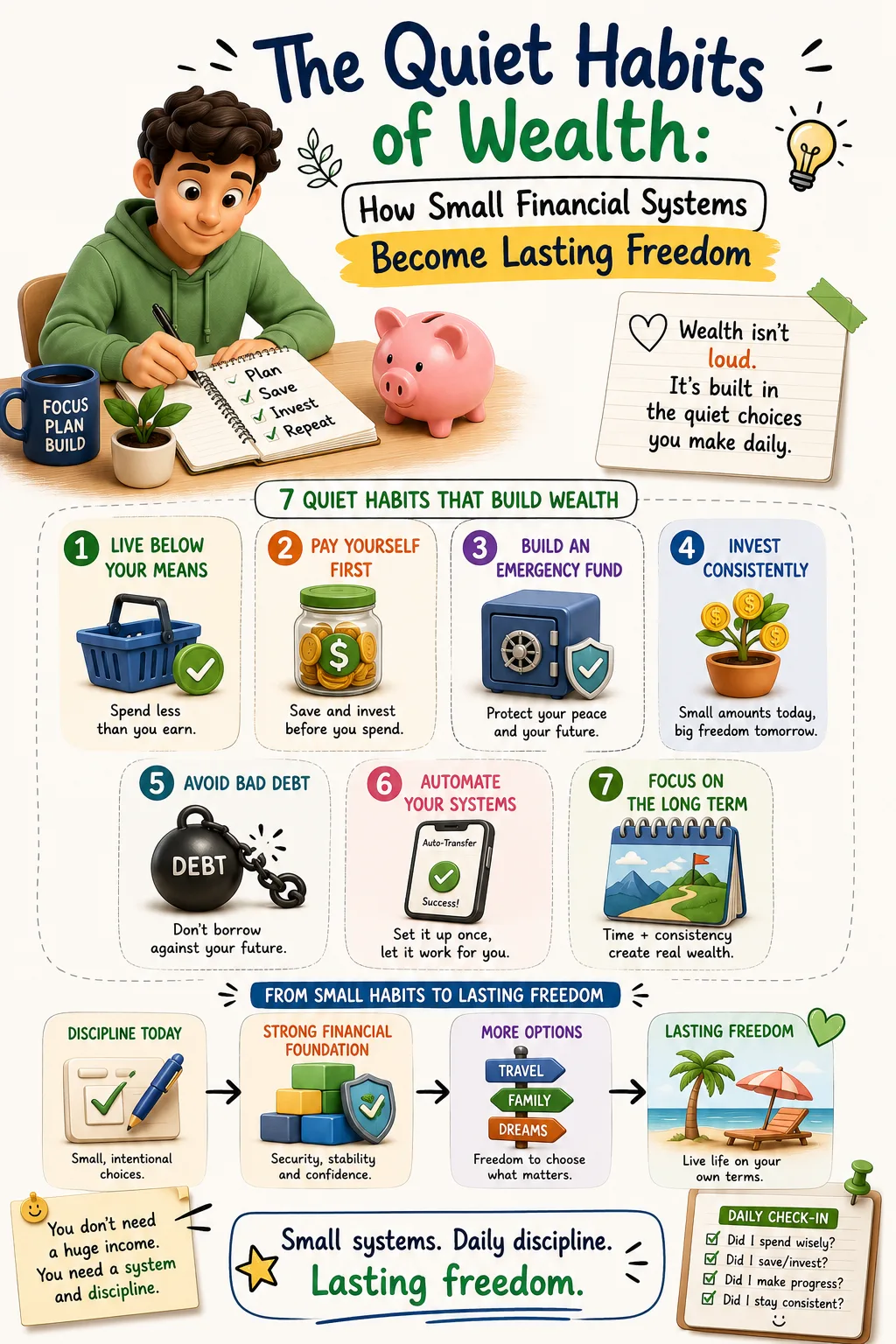
Creators should also avoid lifestyle inflation. Early success can tempt creators to upgrade equipment, rent studios, hire too quickly, or spend to look successful. Business spending should support strategy, not ego.
The goal is not only to earn from content. The goal is to turn creator income into savings, investments, assets, and financial freedom.
Legal and Ethical Foundations
Content creation has legal responsibilities. Creators should understand disclosure rules, copyright, contracts, tax obligations, privacy, platform policies, and consumer protection.
Disclose sponsorships and affiliate relationships clearly. Do not use copyrighted music, images, footage, or written work without permission or proper licensing. Read brand contracts carefully, especially clauses about exclusivity, usage rights, payment timelines, revisions, and content ownership. Avoid making false claims about products, income, health, finance, or results.
Creators in financial, health, legal, or professional niches should be especially careful. Educational content should not pretend to be personalized advice when it is not. Risk disclosures matter. Honesty protects both the audience and the creator.
Ethical creators may grow more slowly than hype-driven creators, but they build more durable trust.
Common Mistakes That Keep Creators Broke
The first mistake is chasing followers instead of building a business. Followers are useful, but they are not revenue unless connected to trust and offers.
The second mistake is depending on one platform. A platform can change rules, reduce reach, or suspend monetization. Diversification matters.
The third mistake is creating without a niche. Random content attracts random attention. Random attention is hard to monetize.
The fourth mistake is selling too late. Some creators wait for a perfect audience size and miss years of learning. A small offer can teach the market early.
The fifth mistake is selling too aggressively. If every interaction feels like a pitch, trust weakens.
The sixth mistake is underpricing. Creators who solve valuable problems should not charge as if their work has no value.
The seventh mistake is ignoring email and owned channels. Social followers are useful, but direct audience relationships are stronger.
The eighth mistake is copying successful creators without understanding their strategy. What works for a comedy creator may not work for a finance educator. What works for a celebrity may not work for a beginner.
The ninth mistake is failing to track money. Revenue without accounting can create tax problems, cash shortages, and false confidence.
The tenth mistake is burning out. Content creation rewards consistency, but consistency requires sustainable systems.
A Practical 12-Month Creator Income Plan
The first three months should focus on positioning and consistency. Choose a niche, define the audience, publish regularly, study what resonates, and begin collecting email addresses. Do not worry about perfection. Build the habit and clarify the message.
Months four to six should focus on trust and a first offer. Create deeper content. Talk to audience members. Learn their problems. Offer a simple service, workshop, template, consultation, or affiliate recommendation that genuinely helps. The goal is to earn first income and gather feedback.
Months seven to nine should focus on improving monetization. Refine the offer. Build a basic landing page. Create an email sequence. Develop a media kit if sponsorships make sense. Repurpose strong content across platforms. Track revenue sources.
Months ten to twelve should focus on systems. Create an evergreen content library. Improve production workflow. Reinvest in tools or contractors only where they save time or increase quality. Build a second income stream. Review finances. Set goals for the next year.
This path is not glamorous, but it is realistic. A creator does not need to become famous in the first year. They need to build skills, audience trust, and proof that money can be made ethically.
How Different Creators Can Monetize
A finance creator can monetize through budgeting templates, investment education workshops, affiliate partnerships with financial tools, sponsorships, newsletters, consulting, and books. They must be careful with compliance, disclosures, and avoiding personalized advice when not qualified.
A fitness creator can monetize through workout plans, coaching, memberships, supplements, apparel, equipment partnerships, challenges, and retreats. Trust depends on realistic claims and safe guidance.
A food creator can monetize through recipe ebooks, meal plans, brand partnerships, kitchen tools, cooking classes, YouTube ads, and sponsored content. Evergreen search content can be especially useful.
A career creator can monetize through CV reviews, interview coaching, salary negotiation workshops, LinkedIn profile services, job-search templates, and corporate training.
A beauty creator can monetize through affiliate links, brand sponsorships, product lines, tutorials, consultations, live shopping, and courses for aspiring makeup artists.
A business creator can monetize through consulting, templates, paid communities, newsletters, software partnerships, courses, books, and speaking.
A comedy or entertainment creator can monetize through ads, sponsorships, live events, merchandise, fan memberships, licensing, acting opportunities, and brand collaborations.
Each niche has money. The creator must match the monetization model to the audience’s reason for paying.
The Small Audience Advantage
Beginners often believe they need a huge audience to make money. This belief delays action. Large audiences help, but small audiences can monetize if they are focused.
A creator with 2,000 followers who helps freelancers price their services may sell a workshop. A creator with 1,000 email subscribers interested in exam preparation may sell study guides. A creator with 500 local business owners following them may sell consulting. A creator with 300 serious fitness followers may sell coaching.
The smaller the audience, the more specific the offer should be. Broad entertainment often needs scale. Specific problem-solving can earn earlier.
Small creators also have an advantage: closeness. They can reply to comments, conduct calls, learn customer language, and build deep trust. This closeness can produce better products than guessing from a distance.
Do not despise a small audience. Serve it well.
When to Quit a Job for Content Creation
Content creation can become a full-time business, but quitting too early is dangerous. A salary can fund patience. It allows a creator to build without forcing desperate monetization.
Before quitting, a creator should have consistent income, emergency savings, clear revenue streams, basic accounting, growth strategy, and proof that income is not dependent on one lucky month. They should understand taxes, healthcare, insurance, and business expenses.
A good sign is when creator income has covered essential expenses for several months and there is a plan for growth. Another sign is when the job is limiting income opportunities that already exist, not merely a dream of opportunities.
Quitting should be a business decision, not an emotional reaction to workplace frustration.
Turning Creator Income Into Wealth
Content creation can produce income, but income is not wealth. Wealth is built when income becomes assets.
A creator should use profits to build emergency reserves, pay down expensive debt, invest in productive tools, buy financial assets, contribute to retirement accounts where available, build business systems, and create intellectual property. The creator should avoid spending every good month as if it will repeat forever.
The creator’s long-term wealth may come from several assets: an audience, a brand, a product library, a customer list, a website, a newsletter, a community, financial investments, business equity, and intellectual property.
The strongest creators are not only paid for posting. They become owners of systems.
They own content libraries that attract attention. They own email lists that drive sales. They own products that generate margin. They own brands that attract partnerships. They own investments funded by creator profits.
This is the difference between being popular and becoming wealthy.
The Mindset of a Wealth-Building Creator
A wealth-building creator thinks differently from a trend-chasing creator.
They value trust more than virality. They build owned channels. They treat content as an asset. They study their audience. They create offers that solve real problems. They track money. They reinvest. They protect their reputation. They understand that one viral post can create attention, but a strong system creates income.
They also accept patience. Content creation looks fast from the outside because people notice the breakthrough, not the years of practice behind it. The visible success may be one viral video. The invisible foundation is hundreds of posts, failed experiments, audience conversations, improved skills, and repeated refinement.
A creator business is built the same way many forms of wealth are built: slowly at first, then more visibly as assets compound.
The Final Lesson
Making money through content creation is not about posting randomly until luck arrives. It is about building a value machine.
The machine begins with a clear audience. It grows through consistent content. It deepens through trust. It monetizes through aligned offers. It strengthens through owned channels. It becomes durable through systems, ethics, financial discipline, and reinvestment.
Views can create opportunity, but trust creates money. Followers can create visibility, but offers create revenue. Platforms can create reach, but ownership creates resilience.
The creator who understands this can use content for more than attention. They can use it to build cash flow, business equity, intellectual property, and long-term wealth.
Content is not the business by itself. Content is the bridge between value and people. When that bridge is built with clarity, consistency, and integrity, it can carry far more than likes. It can carry income, ownership, and financial freedom.
 Article
 Article
 Article
 Article
 Article
 Article
 Article
 Article