The First Saver’s Edge: Best High-Yield Savings Accounts for Beginners
A high-yield savings account is one of the simplest financial upgrades a beginner can make. It does not require market timing, stock selection, complex tax strategy, or a large starting balance. It asks for something more basic and more powerful: put idle cash where it can earn a competitive return while remaining safe, liquid, and easy to access.
That simplicity is why high-yield savings accounts matter. Many people begin their financial lives with checking accounts that pay little or nothing, traditional savings accounts that barely move, or cash left scattered across payment apps and unused balances. The money is technically available, but it is not working. A high-yield savings account changes that relationship. It turns short-term cash from a passive holding into a productive financial tool.
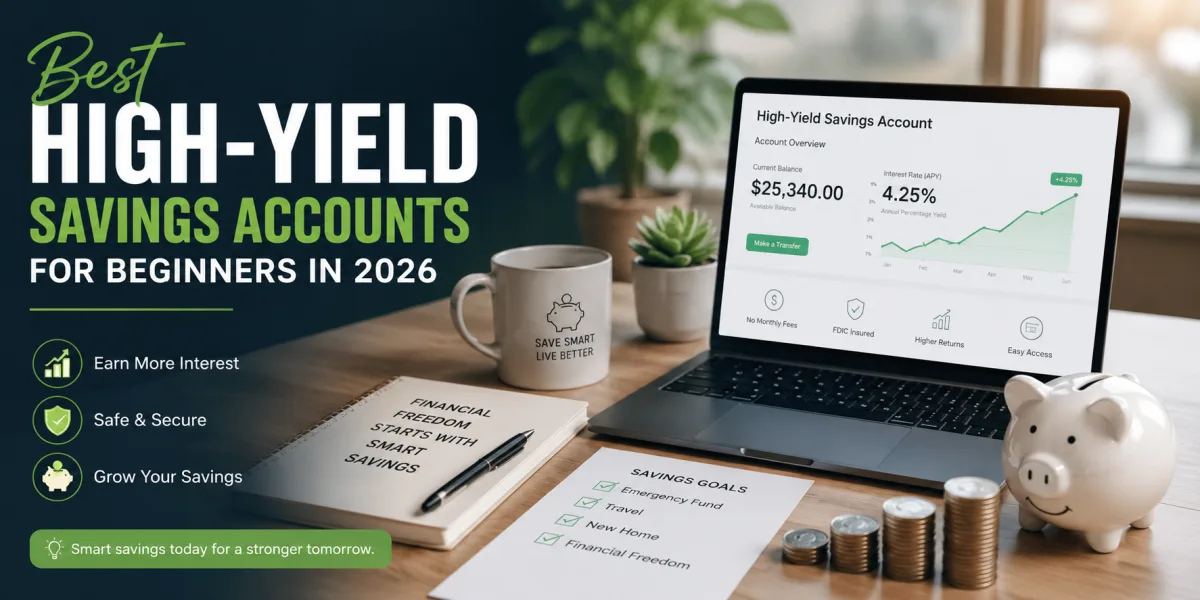
The difference can be meaningful. As of July 2026, several leading high-yield savings accounts offer annual percentage yields around 4 percent or more, while the national average savings rate remains far lower. Recent rate roundups from major financial publications show top high-yield savings accounts ranging from about 4.00 percent to more than 4.25 percent APY, with some offers reaching higher under specific balance or account conditions.
For beginners, however, the “best” account is not always the account with the highest advertised rate. A beginner-friendly account should be easy to open, easy to understand, insured, low-fee, flexible, and suitable for emergency savings. A slightly lower APY at a reliable bank with no confusing hurdles may be better than a higher APY that requires a large balance, monthly activity rules, limited eligibility, or promotional conditions that disappear quickly.
The first savings account should build confidence, not confusion. It should help a new saver develop the habit of separating money, watching interest accumulate, and treating cash reserves as the foundation of financial independence.
What a High-Yield Savings Account Actually Does
A high-yield savings account is a deposit account that pays a higher interest rate than a typical savings account. Most are offered by online banks, digital divisions of established banks, credit unions, or financial institutions that operate with lower branch costs. Because these institutions may spend less on physical infrastructure, they can often pass some of that advantage to depositors in the form of higher yields.
The yield is expressed as APY, or annual percentage yield. The Consumer Financial Protection Bureau defines annual percentage yield as a measure of the total amount of interest paid on an account based on the interest rate and the frequency of compounding. That distinction matters because APY reflects the effect of compounding, not just the stated interest rate.
Compounding means interest earns interest. If a saver deposits $1,000 into an account paying 4.00 percent APY and leaves it untouched for a year, the account earns roughly $40 before taxes, assuming the rate stays constant. That may not sound dramatic, but the principle is more important than the first-year dollar amount. The saver has moved from idle cash to interest-bearing cash. Over time, as balances rise, the benefit becomes more visible.
A high-yield savings account is not an investment account. It is not designed to beat the stock market or fund long-term retirement by itself. It is designed for cash that must remain safe and available: emergency funds, short-term goals, tax reserves, down payment savings, travel funds, tuition reserves, insurance deductibles, or money waiting to be invested later.
The central advantage is balance. A good high-yield savings account gives a beginner three things at once: safety, liquidity, and income. Safety means the money is protected by deposit insurance when held at an insured institution. Liquidity means the money can be accessed without selling investments or waiting for maturity. Income means the account earns more than the negligible yield of many traditional savings accounts.
Why Beginners Should Start with High-Yield Savings Before Investing
Many beginners are drawn first to investing because investing feels more exciting. Stocks move. Crypto moves. Real estate stories sound dramatic. A savings account feels quiet by comparison. But the quietness is the point. Before someone can invest well, they need cash stability.
An emergency fund prevents small disruptions from becoming expensive debt. A car repair, medical bill, temporary income gap, broken phone, insurance deductible, or urgent travel need can push a household into credit card debt if there is no cash buffer. Once high-interest debt enters the picture, the saver’s future income becomes committed to yesterday’s surprise.
A high-yield savings account creates a financial shock absorber. It does not make emergencies pleasant, but it makes them less destructive. The beginner who has $1,000 in a separate account is in a different position from the beginner who must borrow $1,000 at a high interest rate. The first person has inconvenience. The second person has a new liability.
This is why the first stage of wealth building is often not about chasing maximum return. It is about building resilience. A saver with no emergency fund may be forced to sell investments at the wrong time, miss payments, take costly loans, or use credit cards under pressure. A saver with cash reserves has more choices.
High-yield savings accounts are also useful because they teach financial separation. Money in checking tends to disappear into daily spending. Money in a separate savings account gains a purpose. A beginner can name the account “Emergency Fund,” “First Apartment,” “Tax Money,” or “Car Replacement.” That mental accounting is not trivial. It creates friction between intention and impulse.
What Makes a Savings Account Beginner-Friendly
A beginner-friendly high-yield savings account has more than a strong APY. It has a structure that helps someone save consistently without being punished for small balances, ordinary mistakes, or lack of banking experience.
The first requirement is deposit insurance. For banks, the Federal Deposit Insurance Corporation states that the standard deposit insurance limit is $250,000 per depositor, per FDIC-insured bank, per ownership category. That means a single depositor with money in an FDIC-insured bank is generally protected up to that limit in the relevant ownership category.
Credit unions may be insured by the National Credit Union Administration rather than the FDIC. The practical goal is the same: the beginner should make sure the institution is federally insured before depositing meaningful savings. High yield is not worth sacrificing basic safety.
The second requirement is no monthly maintenance fee. A savings account is supposed to help money grow. A $5 monthly fee may sound small, but it can erase interest on modest balances. Beginners often start with $100, $500, or $1,000. An account that charges recurring fees unless a balance threshold is met is less suitable for someone building from scratch.
The third requirement is a low or no minimum opening deposit. Some excellent accounts require only $0 or $1 to open. Others require $100, $500, $1,000, or more. A minimum deposit is not automatically bad, but beginners should not delay saving because they think they need a large amount to begin.
The fourth requirement is easy transfers. A savings account should connect smoothly to an existing checking account. Beginners need the ability to move money in for savings and out for legitimate emergencies. If transfers are slow, confusing, or expensive, the account becomes less useful.
The fifth requirement is clarity. The best beginner accounts make the APY, fees, limits, and access rules easy to understand. Accounts with complicated tiers, temporary boosts, balance caps, activity requirements, or bundled products may be fine for experienced savers, but beginners should usually favor clean design.
The Best Account Types for Beginners in 2026
The best high-yield savings account for a beginner depends on the saver’s goal. A person building a first emergency fund has different needs from someone saving for a down payment. A person who wants a full-service bank has different needs from someone who already has checking elsewhere and only wants a separate savings vault. Rather than crown one universal winner, it is more useful to identify the account types that work best for beginners.
Best for Simplicity: No-Fee Online High-Yield Savings Accounts
For most beginners, the best starting point is a no-fee online high-yield savings account with no minimum balance requirement and FDIC or NCUA insurance. These accounts usually offer a competitive APY, straightforward transfers, and a clean digital interface.
Examples often appearing in current high-yield savings rankings include accounts from large online or digital banking brands such as Synchrony, Ally, Capital One, American Express, Discover, and similar institutions, depending on the month’s rates and terms. Forbes Advisor’s July 2026 list highlights Synchrony as a strong high-yield savings option for emergency funds, noting its competitive rate, few fees or minimums, and ATM access, while other rankings continue to feature major online banks and digital savings products.
The beginner advantage is ease. These accounts are designed for broad consumer use. They usually do not require complex qualification rules. They work well for emergency funds, short-term goals, and people who want to separate savings from spending without learning an entirely new financial system.
The trade-off is that online banks may not have physical branches. For many beginners, that is not a serious drawback. Most savings activity involves transfers, not branch visits. But anyone who regularly deposits cash or wants in-person service should consider whether a branch-based institution or hybrid bank is more appropriate.
Best for Rate Seekers: Competitive Online Banks and Specialty Savings Accounts
Some beginners want the highest rate they can reasonably obtain. That can be worthwhile, especially for larger balances. Current rankings from Bankrate, NerdWallet, and Investopedia show several institutions offering yields around 4 percent or above in July 2026, including accounts such as Forbright Bank, CIT Bank, Climate First Bank, and OMB Bank, though rates, eligibility, and conditions can change quickly.
Rate-focused accounts can be attractive, but beginners should read the details. Some top-rate accounts have minimum deposit requirements. Some use tiers, meaning the best APY applies only to certain balances. Some rates are guaranteed only for a limited time. Some institutions may be less familiar, requiring extra care to verify insurance coverage and account terms.
The right mindset is disciplined comparison. A higher APY is valuable only if the account remains safe, liquid, and low-cost. A beginner should not move money every few weeks for a tiny rate difference. Chasing yield too aggressively can turn saving into a hobby of constant account switching. The purpose of the account is to build wealth habits, not to create administrative clutter.
Best for Full-Service Beginners: Large Banks with Competitive Digital Savings
Some beginners prefer to keep checking, savings, credit cards, and customer service under one recognizable institution. Large banks and established financial brands may not always offer the absolute highest APY, but they can provide convenience, strong technology, familiar interfaces, and broad customer support.
Accounts from major names such as Capital One, American Express, and similar institutions often appear in high-yield savings discussions because they combine competitive yields with brand familiarity and digital ease. The Wall Street Journal’s July 2026 high-yield savings coverage includes large consumer names among accounts noted for strong digital platforms and all-in-one access.
This category may be best for a beginner who values simplicity over squeezing out every last basis point. A savings account that someone actually uses is better than a theoretically superior account they find intimidating. Behavioral fit matters.
Best for Goal-Based Saving: Accounts with Buckets or Sub-Accounts
Beginners often struggle because all money looks the same when it sits in one balance. Goal-based savings features solve that problem by letting users divide money into buckets, vaults, envelopes, or sub-accounts. One bucket can be for emergencies. Another can be for travel. Another can be for annual insurance premiums. Another can be for holiday spending.
This structure is powerful because it turns saving into a set of visible priorities. Instead of asking, “How much do I have?” the saver asks, “What is this money for?” That question reduces accidental spending.
Accounts with strong goal-setting tools may be especially useful for beginners who are paid biweekly or monthly and need to prepare for irregular expenses. Many financial problems do not come from total lack of income. They come from failing to reserve money for predictable but non-monthly costs. A high-yield savings account with buckets can make those costs visible before they become emergencies.
Best for Cash Access: High-Yield Savings with ATM or Linked Checking Options
Some savers want high yield but also want easier access to cash. This can be useful for emergency funds, though too much access can weaken the savings habit. Accounts that offer ATM access, a linked checking account, or fast transfers may be appealing.
Synchrony is one example frequently noted for combining a high-yield savings account with ATM access, according to Forbes Advisor’s July 2026 savings account coverage.
The beginner should decide what kind of access is healthy. Emergency savings should not be so hard to reach that a real emergency becomes stressful. But it should not be so easy to reach that every weekend purchase becomes an “emergency.” The best setup creates enough friction to protect the money and enough access to make the account useful.
Best for Small Starting Balances: No-Minimum Accounts
Beginners often postpone saving because they think the starting amount is too small. That is a mistake. A savings habit built with $25 can become a savings habit that later handles $250 or $2,500. The account should welcome small beginnings.
No-minimum high-yield savings accounts are ideal for students, first-time workers, young professionals, gig workers, new immigrants building a U.S. banking footprint, or anyone restarting after financial difficulty. The point is not to impress the bank with a large deposit. The point is to create a place where surplus cash goes automatically.
A beginner with $100 in a high-yield savings account has already crossed an important line. They have separated future money from spending money. That behavioral line is the beginning of financial control.
How to Compare High-Yield Savings Accounts
Beginners should compare high-yield savings accounts using a simple hierarchy. Safety first. Fees second. Access third. Yield fourth. Features fifth. This order may seem surprising because most account rankings lead with APY. But APY is only valuable after the account clears the basic safety and usability tests.
Safety means checking whether the bank is FDIC-insured or the credit union is federally insured. It also means being cautious with financial technology platforms that partner with banks. Some fintech products are legitimate, but beginners should understand where the money is actually held, what institution provides insurance, and whether funds are covered in the same way as a direct deposit account.
Fees include monthly maintenance fees, excessive transaction fees, wire fees, paper statement fees, account closure fees, and other charges. The best beginner savings account should not punish a saver for being early in the journey.
Access includes transfer speed, mobile app quality, customer service, withdrawal methods, and account linking. If money takes several days to transfer, that may be acceptable for a vacation fund but less ideal for an emergency fund. If customer service is difficult to reach, that may matter when something goes wrong.
Yield matters after the foundation is solid. A difference between 0.01 percent and 4.00 percent is enormous. A difference between 4.00 percent and 4.15 percent is much less important for a beginner with a small balance. On $1,000, a 0.15 percentage point difference is roughly $1.50 per year before taxes if rates remain constant. That is not worth choosing a confusing or inconvenient account.
Features include savings buckets, automatic transfers, recurring deposits, roundups, alerts, budgeting tools, joint account access, and integration with checking. These features can help behavior, but they should not distract from the core purpose: safe, liquid, interest-bearing savings.
The Rate Trap: Why the Highest APY Is Not Always Best
High-yield savings articles often rank accounts by APY. That is understandable because rates are easy to compare. But beginners should be careful. The highest advertised APY can come with fine print.
Some accounts cap the balance eligible for the highest rate. For example, an account may advertise an exceptional APY but apply it only to the first $5,000. That can still be useful for beginners building a first emergency fund, but it is not the same as earning that rate on all balances. The Wall Street Journal’s July 2026 coverage notes GO2bank among the highest advertised APY accounts, with the top yield applying on balances up to a stated limit.
Other accounts require monthly deposits, debit card transactions, linked accounts, or specific account activity. These requirements may be manageable, but they turn a savings account into a task list. Beginners should ask whether the extra yield is worth the complexity.
Promotional rates are another issue. A bank may offer a temporarily high APY to attract deposits, then reduce the rate later. Savings account rates are variable, which means they can change. That is normal. The danger is choosing an account only for a promotional number without understanding how the rate may behave after the promotion ends.
The better approach is to choose an account with consistently competitive rates, low friction, and transparent terms. A beginner does not need to win the national rate contest every month. A beginner needs to build a reliable savings system.
How Much Interest Can a Beginner Actually Earn?
The value of a high-yield savings account becomes clearer with numbers. Assume a beginner saves $100 per month into an account paying 4.00 percent APY. After one year, the saver contributes $1,200. The interest may be modest, but the account balance is higher than it would be in a non-interest-bearing account. More important, the saver has built a repeatable system.
Now imagine the same saver eventually reaches $5,000. At 4.00 percent APY, that balance earns roughly $200 over a year before taxes if the rate remains stable. At 0.40 percent, it earns about $20. The difference is not abstract. It is a utility bill, a grocery trip, part of an insurance premium, or extra progress toward a goal.
With $10,000, the difference grows further. At 4.00 percent, the account earns about $400 before taxes in a year. At 0.40 percent, it earns about $40. The saver did not take stock market risk to earn the difference. They simply placed cash in a better account.
That said, beginners should avoid exaggerating what a savings account can do. A high-yield savings account protects and grows cash modestly. It does not replace investing for long-term goals. Inflation can reduce purchasing power over time. Taxes may apply to interest income. Rates can fall. The account is a foundation, not the entire wealth plan.
High-Yield Savings Versus Checking
Checking accounts are designed for transactions. Paychecks come in. Bills go out. Debit cards, transfers, rent, subscriptions, groceries, and daily spending flow through checking. A checking account needs accessibility, not necessarily high yield.
A savings account is designed for money that should not be spent casually. That separation is useful. If all money stays in checking, the balance can feel larger than it really is because some of it may be needed later for insurance, taxes, repairs, or emergencies. Savings gives future obligations a home.
Beginners should usually keep enough in checking to cover near-term bills and a small cushion. The rest of short-term cash can move to high-yield savings. The exact amount depends on income timing and bill schedule. Someone paid weekly may need a smaller checking cushion than someone paid monthly. Someone with irregular income may need a larger cushion.
The most effective setup is often automatic. When income arrives, a set amount transfers to high-yield savings. The saver does not wait to see what is left at the end of the month. Waiting rarely works because spending expands into available cash. Automation reverses the pattern by saving first.
High-Yield Savings Versus Certificates of Deposit
Certificates of deposit, or CDs, can offer attractive yields, but they work differently from savings accounts. A CD usually locks money for a specific term. In exchange, the bank may offer a fixed rate. Withdrawing early can trigger a penalty.
For beginners, CDs can be useful for money with a known timeline. If a saver knows they will not need a portion of cash for six months or one year, a CD may provide rate certainty. But emergency money usually belongs in a savings account because emergencies do not respect maturity dates.
The first emergency fund should be liquid. Once a beginner has a comfortable savings base, they may consider dividing cash between high-yield savings and short-term CDs. But the first job is availability. A slightly higher CD yield is not helpful if the saver must pay a penalty or cannot access funds quickly during a real emergency.
High-Yield Savings Versus Money Market Accounts
Money market accounts are another deposit option. They may offer competitive yields and sometimes provide check-writing or debit access. Like savings accounts, money market accounts may be federally insured when held at an insured institution. They can be useful for savers who want a blend of yield and access.
The distinction between high-yield savings and money market accounts has become less rigid over time. Some high-yield savings accounts offer features once associated with money markets, while some money market accounts operate much like savings accounts. Beginners should compare the specific account rather than rely on the label.
The same rules apply: check insurance, fees, minimums, APY, access, and restrictions. A money market account with a high minimum balance may not be ideal for a beginner. A high-yield savings account with no minimum may be simpler. The best choice is the one that supports the saver’s actual behavior.
How Much Should Beginners Keep in High-Yield Savings?
The first target is a starter emergency fund. For many beginners, $500 to $1,000 is a meaningful first milestone. It can cover small emergencies without credit cards. It also creates psychological proof that saving is possible.
The next target is one month of essential expenses. This means rent or mortgage, utilities, groceries, transportation, insurance, minimum debt payments, and basic communication costs. One month of expenses gives the saver breathing room if income is delayed or an unexpected bill appears.
The long-term emergency target is often three to six months of essential expenses. The right number depends on job stability, income variability, family obligations, health needs, housing security, and risk tolerance. A single person with stable employment may be comfortable with three months. A self-employed parent with variable income may want six months or more.
High-yield savings can also hold sinking funds. A sinking fund is money set aside for a known future cost. Car insurance, holiday gifts, annual subscriptions, school expenses, property taxes, travel, home repairs, and medical deductibles are not true surprises. They are irregular expenses. Saving for them monthly prevents them from becoming debt.
A beginner may eventually hold multiple categories in high-yield savings: emergency fund, annual bills, short-term goals, and cash awaiting investment. The key is not to confuse all cash with emergency cash. A vacation fund is not an emergency fund. A tax fund is not spending money. A bucketed account or simple spreadsheet can help keep purposes clear.
How to Open a High-Yield Savings Account
Opening a high-yield savings account is usually straightforward. The bank will ask for identifying information such as name, address, date of birth, Social Security number or taxpayer identification number, contact details, and sometimes employment information. The institution must verify identity under banking rules.
The applicant will then link an external bank account or fund the account through an initial transfer. Some accounts allow mobile check deposit, direct deposit, wire transfer, or mailed checks. Beginners should start with a modest transfer if they are testing a new institution, then increase once they are comfortable with the interface and transfer process.
After opening the account, set up security immediately. Use a strong unique password. Turn on multifactor authentication. Add account alerts for transfers, withdrawals, and login activity. Keep contact information current. Banking safety is not only about deposit insurance; it is also about protecting account access.
Then automate deposits. A beginner might start with $25 per paycheck, $50 per month, or 10 percent of each paycheck. The exact number matters less than the consistency. As income rises or debts fall, the automatic transfer can increase.
The Beginner’s Mistakes to Avoid
The first mistake is leaving money in a low-yield account out of inertia. Many people keep savings at the same bank where they opened their first checking account years ago. Familiarity feels safe, but it can be costly when the account pays almost nothing.
The second mistake is chasing the highest rate without reading the terms. A top APY is attractive, but the beginner must understand minimums, caps, eligibility, fees, and rate variability.
The third mistake is treating savings as spending money with a different label. A high-yield savings account should have rules. Emergencies, planned goals, and known obligations are valid uses. Impulse purchases are not.
The fourth mistake is failing to account for taxes. Interest from savings accounts is generally taxable. The bank may issue a tax form if interest reaches reporting thresholds, but even smaller amounts may still be taxable. Beginners should not be surprised when interest income appears during tax season.
The fifth mistake is holding too much long-term money in cash. Once emergency savings and short-term goals are funded, extra money may need a long-term investment plan. Cash is safe in nominal terms, but it may not grow enough to build retirement wealth over decades.
How Beginners Should Think About Safety
Safety begins with federal deposit insurance, but it does not end there. Beginners should also verify the institution’s name, avoid lookalike websites, use secure networks, and be cautious with unsolicited offers. A high advertised APY from an unknown source should be investigated carefully.
Use official bank websites or reputable financial comparison pages as starting points. Confirm that the bank is insured. Read account disclosures. Check whether the account is offered directly by a bank or through a platform. If a fintech platform is involved, understand the relationship between the platform and the insured bank.
Scams often exploit rate anxiety. When savers see high yields in the market, fraudulent actors may advertise unrealistic rates to collect personal information or deposits. Beginners should remember that legitimate financial institutions disclose terms clearly and do not require unusual payment methods to open ordinary savings accounts.
Another part of safety is emotional safety: do not place emergency money in volatile assets. Money needed for rent, medical expenses, car repairs, or near-term goals should not be exposed to market swings. A high-yield savings account may not be exciting, but emergency money is not supposed to be exciting. It is supposed to be there.
Which Beginner Account Should You Choose?
A beginner who wants the simplest path should choose a no-fee, no-minimum, FDIC-insured online savings account from a reputable institution with a consistently competitive APY. This is the best default for a first emergency fund.
A beginner who already banks with a major institution and values convenience may choose a competitive savings account from a familiar brand, even if the APY is slightly below the top rate. The account must still be low-fee and insured.
A beginner with a larger starting balance may compare top-rate accounts more carefully, especially if a higher APY applies to the full balance and the terms are clean. Rate differences become more meaningful as balances grow.
A beginner who struggles with spending should prioritize an account with goal buckets, automation, and some separation from checking. The best account is the one that protects money from impulse.
A beginner who regularly needs cash access should consider an account with ATM access or a linked checking option, while still keeping enough friction to prevent casual withdrawals.
Current account rankings can help identify candidates, but the final decision should be personal. July 2026 lists from Bankrate, NerdWallet, Forbes Advisor, Investopedia, and the Wall Street Journal show a competitive market with several banks offering yields around 4 percent or more, but rates and terms can change.
A Simple Beginner Shortlist
For a first emergency fund, look first at established online savings accounts with no monthly fees, no minimum balance requirement, FDIC insurance, automatic transfers, and a competitive APY. Accounts commonly associated with this category include major online banks and digital banking brands that appear regularly in high-yield savings rankings.
For a higher-rate search, compare top current offers from institutions listed by reputable financial publications. As of mid-July 2026, recent rankings highlight accounts such as Forbright Bank, CIT Bank, Climate First Bank, OMB Bank, Synchrony, and other competitive providers, depending on methodology and account conditions.
For convenience, consider a recognized brand with strong digital access and integrated banking features. These accounts may not always sit at the very top of rate tables, but they can be easier for beginners to trust and manage.
For goal-based saving, choose an account that allows multiple savings buckets or sub-accounts. This feature can be more valuable than a tiny difference in APY because it improves behavior.
For cash access, look for ATM options, fast transfer ability, or linked checking. Keep in mind that too much convenience can weaken savings discipline.
The Habit Matters More Than the Account
The financial industry often sells products as if the product alone creates progress. In reality, the account is only the container. The habit fills it.
A beginner who saves $50 every payday into a solid high-yield savings account will often do better than someone who spends months searching for the perfect account and never begins. The perfect account is less important than the first automatic transfer.
The habit should be visible. Watch the balance grow. Track interest monthly. Name the goal. Increase contributions when possible. Use the account for real emergencies, then rebuild it. This cycle teaches trust in your own financial system.
Over time, the account becomes more than a place to store money. It becomes evidence. Evidence that you can keep promises to yourself. Evidence that not every unexpected expense must become debt. Evidence that financial security is built in small repeated actions before it becomes a large balance.
From First Savings to Wealth Building
A high-yield savings account is not the final destination. It is the first layer. Once a beginner has emergency savings, the next layers may include debt repayment, retirement investing, brokerage investing, insurance planning, career growth, and eventually asset ownership.
But those later layers are stronger when built on cash stability. Without savings, investing can become fragile. Without savings, debt repayment can be interrupted by every surprise. Without savings, even a good income can feel unstable.
The beginner who opens a high-yield savings account is making a quiet but important decision: future needs deserve a place in the present budget. That decision changes everything. It shifts money from reaction to preparation.
The best high-yield savings account for beginners is the one that is safe, simple, low-cost, competitive, and easy to use consistently. Choose carefully, but do not let comparison become procrastination. A strong account can help. A strong habit will do more.
 Article
 Article
 Article
 Article
 Article
 Article
 Article
 Article