
The Lean Launch: How to Start an Online Business with Little Money
Starting an online business with little money is possible, but only if the word “business” is taken seriously. A business is not a logo, a website, a social media account, a course purchase, or a motivational idea written in a notebook. A business is a system that creates value for a customer and receives money in return.
That distinction matters because beginners often spend their limited capital on appearances before they have proof of demand. They buy branding packages before speaking to customers. They pay for websites before testing the offer. They order inventory before knowing whether anyone wants the product. They subscribe to software before making a sale. They confuse preparation with progress.
The lean way is different. Start with the smallest version of a real offer. Find a real customer. Solve a real problem. Collect real payment. Then improve.
An online business does not need to begin with a large budget because many of the most valuable business assets are not expensive at the beginning. Knowledge, reliability, judgment, communication, consistency, and audience understanding can matter more than startup capital. A person with a laptop, internet connection, useful skill, and disciplined sales process can often begin faster than someone waiting for a perfect launch.
The U.S. Small Business Administration’s startup guidance begins with practical fundamentals such as conducting market research, writing a business plan, funding the business, choosing a structure, registering the business, and handling tax responsibilities. Those steps are not glamorous, but they reflect the real work of turning an idea into an operating enterprise.
The online opportunity is real. The U.S. Census Bureau reported that first-quarter 2026 retail e-commerce sales were estimated at $300.2 billion, representing 15.6 percent of total retail sales. That does not mean every online store will succeed, but it does show that digital buying behavior is deeply established.
Still, the internet rewards clarity more than enthusiasm. The question is not, “How do I make money online?” That question is too broad. The better question is, “What specific problem can I solve for a specific customer at a price that produces profit?”
That question is the beginning of an online business.
Start with the Right Definition of “Little Money”
Little money does not mean no cost, no risk, or no responsibility. It means the business must be built around constraints. Constraints can be useful because they force discipline. When capital is limited, you cannot afford to hide behind unnecessary complexity. You must focus on the few actions that matter most: choosing a customer, creating an offer, reaching buyers, delivering value, collecting payment, and improving the process.
For one person, little money may mean $100. For another, it may mean $500 or $1,000. The exact number matters less than the principle: spend only on what helps you get or serve customers. Every early expense should pass a test. Does this directly help me validate demand, make sales, deliver the product or service, comply with basic legal and tax obligations, or protect the business? If not, delay it.
This discipline protects beginners from the illusion of entrepreneurship. It is easy to feel productive while designing business cards, choosing brand colors, buying premium software, planning content calendars, or researching business names. Those activities may eventually matter. They do not matter as much as finding someone willing to pay.
The first stage of an online business is not optimization. It is proof.
The Best Low-Cost Online Businesses Start with Services
The lowest-cost online businesses are usually service businesses because they sell skill, labor, judgment, or time rather than inventory. A service business can often begin with little more than a simple offer, a way to communicate, a payment method, and proof that you can deliver.
Examples include virtual assistance, freelance writing, tutoring, bookkeeping, social media management, website setup, email marketing, graphic design, online coaching, research services, customer support, podcast editing, resume writing, translation, video editing, data cleanup, and consulting.
Service businesses are not always passive, but they are often the most practical starting point. They create cash flow quickly. They teach what customers actually want. They require fewer upfront costs than product businesses. They can later become more scalable through templates, systems, subcontractors, courses, digital products, or retainers.
A beginner who wants to sell an online course about budgeting may struggle to sell because there is no audience or proof. But that same beginner could start by offering one-on-one budget setup sessions, learn the common problems people face, collect testimonials, refine a method, and later turn that method into a digital product. The service creates the knowledge that makes the product stronger.
This is one of the most important low-capital business principles: start close to the customer. The closer you are to the customer, the faster you learn what they value.
Choose a Customer Before Choosing a Product
Many online business ideas fail because they begin with the seller’s excitement rather than the buyer’s problem. A person says, “I want to start a store,” “I want to sell templates,” “I want to create a course,” or “I want to become a coach.” Those ideas may work, but only if a real customer sees a reason to pay.
Start by defining the customer. Who exactly are you trying to help? New parents? Local real estate agents? Fitness coaches? Small law firms? Etsy sellers? Busy executives? Students preparing for exams? Freelancers who hate bookkeeping? Restaurants that need better social media? Job seekers who need resumes? Seniors who need technology help?
The narrower the customer, the easier it becomes to design an offer. “I help small businesses” is vague. “I help independent therapists set up simple websites and online booking pages” is clearer. “I help busy parents create weekly meal plans under a grocery budget” is clearer. “I help real estate agents turn listing details into social media posts and email newsletters” is clearer.
A narrow customer does not limit opportunity at the beginning. It makes communication easier. People buy faster when they feel the offer was made for them.
Validate Before You Build
Validation means proving that customers want the offer before spending heavily to create it. This is especially important when money is limited.
There are several low-cost ways to validate. You can speak with potential customers. You can offer a simple paid pilot. You can pre-sell a service. You can post a specific offer to a relevant community. You can run a small landing page with an email signup. You can manually deliver the service before automating it. You can ask people what they currently pay for and what frustrates them about existing options.
The strongest validation is payment. Compliments are not validation. Likes are not validation. Friends saying “great idea” are not validation. A stranger paying money is validation. A second stranger paying money is stronger validation. A customer returning or referring someone else is stronger still.
Beginners often avoid selling early because selling creates the possibility of rejection. So they build instead. Building feels safe. But building without selling can become expensive avoidance. The market may reject the offer after the money is already spent.
A lean online business asks for the truth early.
Pick a Business Model That Fits Your Budget
Not all online businesses are equally suitable for low startup capital. Some require inventory, advertising, product development, legal review, manufacturing, shipping, customer support infrastructure, or long lead times. Others can begin almost immediately.
Freelance Services
Freelance services are one of the best low-cost starting points. You sell a defined outcome to clients. Examples include writing, editing, bookkeeping, design, video editing, website updates, research, marketing support, customer service, or administrative help.
The advantage is speed. You can start with a simple portfolio and direct outreach. The disadvantage is that income depends on client work. Over time, you can improve by raising rates, creating packages, building retainers, or hiring subcontractors.
Online Tutoring or Coaching
Tutoring and coaching can begin with minimal cost if you have expertise people value. Academic tutoring, language instruction, test preparation, career coaching, fitness coaching, music lessons, and business coaching can be delivered through video calls.
The advantage is high margin. The challenge is trust. Customers need proof that you can help. Testimonials, credentials, case studies, sample lessons, and clear outcomes matter.
Digital Products
Digital products include templates, ebooks, worksheets, Notion dashboards, spreadsheets, design assets, stock photos, online courses, presets, prompts, and downloadable guides. They can scale because one product can be sold many times.
The challenge is demand. Many beginners create digital products before building an audience or understanding customer pain. A digital product works best when it solves a specific problem for a specific buyer.
Affiliate Marketing
Affiliate marketing earns commissions by recommending products or services. It can be low-cost, but it is rarely fast. It usually requires content, trust, traffic, and careful disclosure.
The mistake is treating affiliate marketing as easy passive income. Without audience trust, it produces little. With trust and useful content, it can become a meaningful income stream.
E-Commerce
E-commerce includes selling physical products through your own site, marketplaces, print-on-demand, dropshipping, handmade goods, or curated products. It can be profitable, but it often requires more capital than beginners expect.
Inventory, returns, shipping, payment processing, customer service, advertising, platform fees, product photography, and supplier issues can all consume money. Print-on-demand and dropshipping reduce inventory risk, but they do not eliminate competition or customer acquisition challenges.
If you start e-commerce with little money, begin with a small test. Sell one product, one bundle, or one niche category. Avoid buying bulk inventory until demand is proven.
Content Business
A content business earns through ads, sponsorships, affiliate commissions, memberships, products, services, or paid newsletters. It can be started cheaply, but it often takes time before revenue appears.
Content is a long game. It works best when paired with a service or product offer early. Instead of waiting for a blog or channel to become large enough for ads, use content to attract clients, leads, or email subscribers.
Build the Smallest Sellable Offer
A low-cost online business should begin with the smallest sellable offer. This is not the smallest idea. It is the smallest version of your idea that a customer would actually pay for.
If you want to start a web design business, the smallest sellable offer might be a one-page website setup for local service businesses. If you want to sell business templates, the smallest sellable offer might be a single invoice tracker for freelancers. If you want to become a social media manager, the smallest sellable offer might be a two-week content calendar and caption package. If you want to coach job seekers, the smallest sellable offer might be a resume review and LinkedIn profile audit.
The offer should be easy to understand. A confused customer does not buy. State who it is for, what problem it solves, what is included, how long it takes, and what result the customer can expect.
A strong beginner offer might look like this: “I help independent consultants clean up their LinkedIn profiles in 48 hours so their services are clearer to potential clients. The package includes headline rewrite, About section rewrite, featured section suggestions, and three post ideas.”
That is more sellable than “I help with branding.”
Price for Proof, Then Raise
Pricing is difficult at the beginning because there is little proof. Underpricing can attract low-quality clients and create burnout. Overpricing without credibility can make sales difficult. The solution is to price for proof, then raise as results improve.
For the first few clients, you may offer a founding rate. Make it clear that the price is temporary. In exchange, ask for feedback, a testimonial, permission to use the work in your portfolio, or a referral if the client is satisfied.
Do not work for free indefinitely. Free work can be useful only if it produces a concrete asset: a case study, testimonial, portfolio sample, or relationship with a real buyer. Free work without a strategy is unpaid labor.
As soon as you have proof, package the service. Packages are easier to sell than open-ended hourly work because customers understand the outcome. A “$300 website audit” is clearer than “$30 per hour consulting.” A “$150 resume rewrite” is clearer than “writing help.” A “$500 monthly bookkeeping cleanup” is clearer than “admin support.”
Pricing should eventually reflect value, not only time. If your work helps a client save ten hours, win customers, avoid errors, or look more professional, the price should account for that benefit.
Create a Simple Online Presence
You do not need an expensive website to begin. You need enough online presence to prove legitimacy and explain the offer.
A simple landing page can include who you help, what you offer, examples of work, testimonials if available, pricing or starting price, contact form, and a clear call to action. A one-page site is enough for many service businesses. Some beginners can start with a LinkedIn profile, portfolio page, marketplace profile, or simple booking page.
The mistake is spending weeks building a complex website before speaking to customers. A website does not sell by existing. It sells when the offer is clear and the right people see it.
Use low-cost tools first. A custom brand identity, premium theme, advanced automation system, and complex funnel can wait. The first version should be functional, credible, and easy to update.
Find Customers Without Spending Heavily on Ads
Paid advertising can work, but it is dangerous for beginners with little money. Ads amplify what already works. If your offer, pricing, audience, and sales process are unproven, ads can drain cash quickly.
Start with low-cost customer acquisition.
Direct outreach is one method. Identify people or businesses who clearly need your offer. Send a brief, specific message. Do not spam. Show that you understand their situation. Offer a relevant next step.
Referrals are another method. Tell friends, colleagues, former coworkers, classmates, community members, and professional contacts exactly what you do and who you help. Vague announcements rarely work. Specific asks do.
Content can also attract customers. Share useful posts, short videos, tutorials, checklists, examples, case studies, or before-and-after breakdowns. The goal is not to become famous. The goal is to become trusted by a specific audience.
Online communities can work if approached respectfully. Participate before pitching. Answer questions. Be useful. Follow group rules. People notice competence.
Marketplaces can provide early demand. Freelance platforms, Etsy, Gumroad, Teachers Pay Teachers, Shopify, Amazon, Upwork, Fiverr, Contra, LinkedIn, and niche job boards can all help depending on the business. Marketplaces bring traffic, but they also bring competition and fees. Use them as one channel, not your entire strategy.
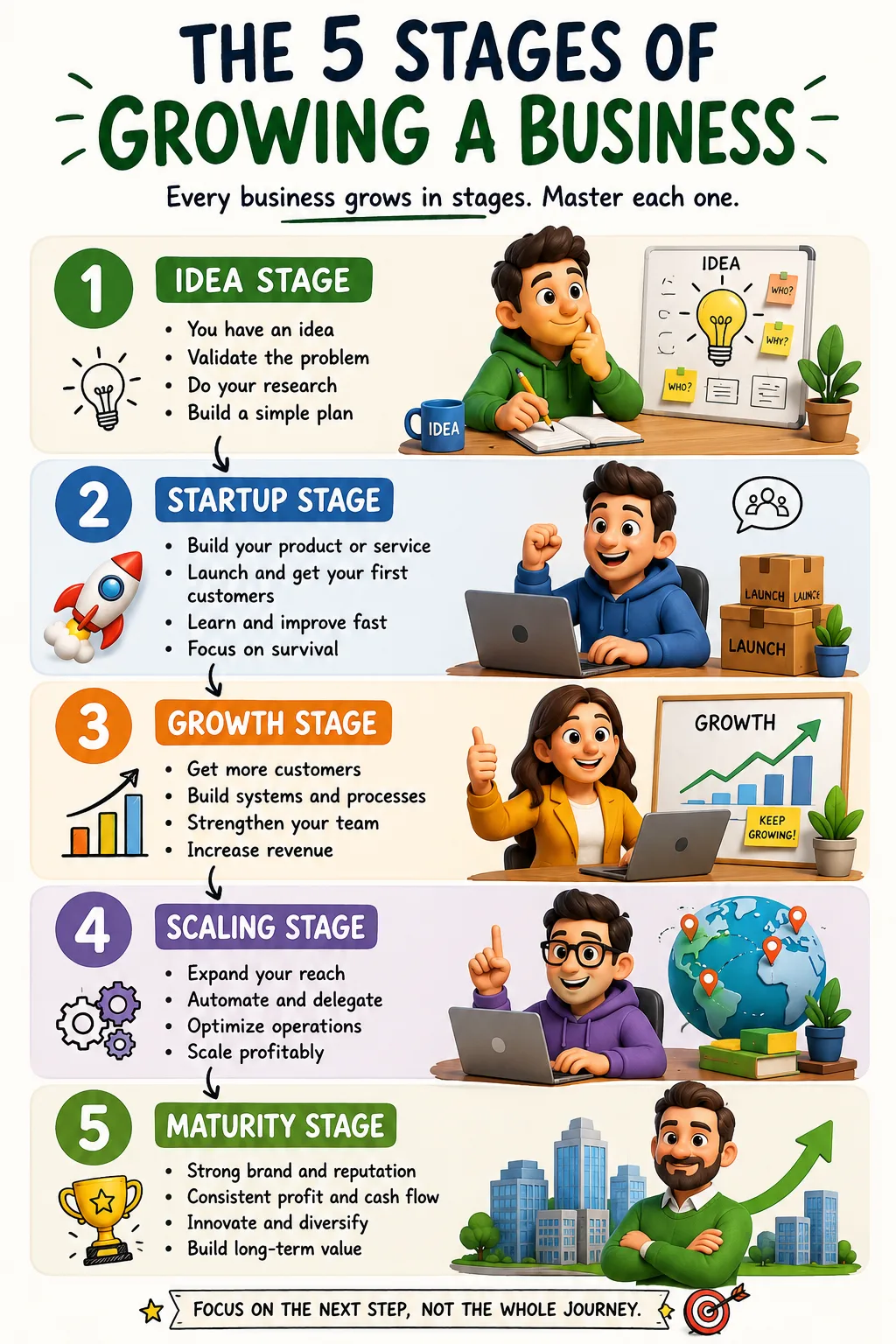
Sell Before You Scale
Scaling is attractive because it sounds like wealth. But scaling too early can destroy a small business. A bad offer scaled with ads becomes an expensive bad offer. A weak operation scaled with more customers becomes a reputation problem. A confusing product scaled to a larger audience becomes larger confusion.
Sell first. Deliver manually. Learn what customers ask. Notice what they misunderstand. Track what takes too long. Identify which customers are profitable and which are draining. Improve the offer. Then scale.
This manual stage is not inefficiency. It is research. You are learning the business from the inside.
Once the offer works, scaling can mean raising prices, creating templates, automating onboarding, hiring contractors, building a product version, creating a course, adding recurring services, or expanding to a second customer segment. Scaling should follow evidence.
Keep Startup Costs Ruthlessly Low
A low-budget online business should avoid unnecessary fixed costs. Fixed costs are dangerous because they must be paid whether sales happen or not.
Delay office space. Delay premium software. Delay expensive branding. Delay inventory. Delay paid ads. Delay complex legal structures unless needed. Delay hiring until the work is proven. Delay any purchase that exists mostly to make the business feel more official.
Spend on essentials. These may include domain name, basic website hosting, payment processing, simple accounting software, required licenses, business email, a scheduling tool, or tools needed to deliver the service. Even then, start lean.
A useful early budget might include a domain, simple website or landing page, business email, basic accounting setup, and perhaps one specialized tool needed for delivery. Many online businesses can begin for under a few hundred dollars if the founder is willing to do the early work personally.
Money saved at the beginning becomes runway. Runway gives you time to learn.
Understand Legal and Tax Basics
A small online business is still a business. It may create tax obligations, recordkeeping responsibilities, local registration requirements, licensing needs, sales tax issues, contracts, privacy considerations, and intellectual property questions.
The IRS Self-Employed Individuals Tax Center explains that self-employed individuals generally use Schedule C to report income or loss from a business operated as a sole proprietor, including gig work, and may need to make estimated tax payments.
This matters because many new online business owners treat all incoming money as spendable. It is not. Some belongs to taxes. Freelancers and sole proprietors may owe income tax and self-employment tax. Depending on the business, state and local taxes may also apply.
Set aside a percentage of revenue for taxes from the beginning. Keep business income and expenses separate. Save receipts. Track mileage if relevant. Record software costs, payment processing fees, contractor payments, supplies, education, and other legitimate business expenses. Good records reduce stress and help you understand profitability.
You do not necessarily need an LLC on day one, but you should understand your liability exposure. A low-risk freelance writing business is different from selling supplements, giving financial advice, handling sensitive data, or offering health-related services. Higher-risk businesses may need stronger legal structure, contracts, insurance, disclaimers, or professional guidance.
Do not let legal complexity stop you from starting. Do not ignore it either. Handle the basics early, then improve as the business grows.
Protect Yourself from Business Opportunity Scams
People who want to start online businesses are frequently targeted by scams. The promise is usually speed: guaranteed income, automated profits, secret systems, risk-free opportunities, done-for-you stores, coaching packages, or investment-like returns from a business model that requires little effort.
The Federal Trade Commission warns that business opportunity sellers may be subject to rules requiring them to provide specific information so buyers can evaluate risks before purchasing a work-at-home program or business opportunity.
The FTC also cautions consumers to steer clear of anyone promising guaranteed job placement or risk-free business opportunities, noting that scammers exploit people looking for income through business or job opportunities.
Be skeptical of any opportunity that requires large upfront payment before you understand how money is earned. Be cautious with programs that focus more on recruiting others than selling real products or services. Avoid anyone who refuses to disclose costs, risks, refund rules, or realistic earnings. Do not assume screenshots of income are proof. Do not borrow money to buy a business opportunity you do not understand.
A real business can be explained plainly. Who is the customer? What do they buy? Why do they buy it? What does it cost to deliver? How do customers find it? What is the profit after expenses? If those questions cannot be answered, pause.
Build Cash Flow Before Building Brand
Brand matters, but cash flow matters first. A brand becomes valuable when it stands for a consistent promise in the customer’s mind. At the beginning, that promise is built through delivery, not aesthetics.
Many small online businesses spend too much time looking established and not enough time becoming useful. They want the perfect name, logo, color palette, tagline, and website. Those things can help later. They do not replace customers.
The early brand should be simple: clear offer, reliable delivery, honest communication, and visible proof. If customers know what you do, trust you to do it, and receive value when they pay, the brand is already forming.
As revenue grows, invest in stronger branding. At that point, you will know who your customers are, what language they use, what they value, and which offers are profitable. Branding based on real customer learning is stronger than branding based on guesses.
Use Content as a Trust Engine
Content is one of the most affordable ways to build an online business, but only if it is connected to a clear offer. Posting randomly across platforms can become unpaid entertainment. Strategic content educates the right audience and moves them toward trust.
A service provider can publish short posts explaining common mistakes, before-and-after examples, checklists, case studies, or answers to frequent questions. A tutor can post mini-lessons. A designer can show redesign breakdowns. A bookkeeper can explain common small-business money errors. A web developer can show how a better website improves inquiries.
The purpose is not to go viral. Viral attention is often broad and shallow. A small business needs relevant attention. One post seen by the right twenty potential clients may be more valuable than a viral post seen by people who will never buy.
Choose one or two channels first. LinkedIn may work for B2B services. Instagram or TikTok may work for visual, coaching, fitness, beauty, food, or lifestyle businesses. YouTube may work for tutorials. Pinterest may work for templates, design, recipes, crafts, and evergreen content. Search-based blogging may work for topics people research before buying.
Consistency matters, but clarity matters more. Content should make the customer think, “This person understands my problem.”
Create an Email List Early
An email list is one of the most valuable low-cost assets an online business can build. Social platforms can change algorithms, restrict accounts, or reduce reach. An email list gives you a more direct relationship with people who have chosen to hear from you.
You do not need a complex newsletter at the start. Offer a simple reason to subscribe: a checklist, mini-guide, template, audit, discount, lesson series, or useful weekly tip. The offer should relate directly to your business.
For example, a resume writer might offer a “10-point resume checklist.” A bookkeeper might offer a “monthly finance checklist for freelancers.” A meal planning business might offer “five budget dinners under $15.” A web designer might offer a “homepage audit checklist.”
The email list should not be treated as a dumping ground for promotions. Send useful material. Teach. Share examples. Invite replies. Present offers clearly when appropriate. Trust grows through repeated value.
Make the First Sale Manually
Automation is useful later. At the beginning, manual selling is often better because it teaches you what buyers care about.
Have conversations. Ask what the customer is trying to solve. Listen for the exact words they use. Notice objections. Ask what they have tried before. Ask what would make the solution worth paying for. These conversations become the raw material for better offers, better copy, better pricing, and better products.
The first sale may come from someone you already know. That is acceptable. The second may come from a referral. The third may come from a post, marketplace profile, or direct message. Do not dismiss small beginnings. Businesses are built one transaction at a time.
After every sale, ask: How did this customer find me? What convinced them? What almost stopped them? What did delivery require? Would I want ten more customers like this? What should change before the next sale?
This feedback loop is how a small online business matures.
Focus on Profit, Not Revenue Screenshots
Online business culture often celebrates revenue. Revenue is important, but profit is what strengthens your life. A business can show impressive sales and still lose money if advertising, software, contractors, refunds, shipping, platform fees, taxes, and owner time are ignored.
Track gross revenue, direct costs, fixed costs, taxes set aside, owner pay, and profit. If you sell a digital product for $30 through a platform that charges fees and you spend money on ads, the true profit may be much lower than the sale price. If you sell a physical product, inventory, packaging, returns, payment processing, and shipping errors can eat margins.
Service businesses can also misread profit if unpaid time is ignored. A $500 project that takes 25 hours of work, five hours of revisions, and ten hours of client communication is not as profitable as it looks. Measure effective hourly rate.
A good online business should eventually pay the owner, cover taxes, fund growth, and produce profit. If it cannot do that, it is not yet a healthy business.
When to Reinvest
Once the business earns money, reinvestment becomes the next decision. Reinvest too little and growth may stall. Reinvest too much and the business may never improve your personal finances.
Early reinvestment should focus on bottlenecks. If customer acquisition is the bottleneck, invest in better outreach, content, search optimization, or sales training. If delivery is the bottleneck, invest in templates, tools, contractors, or process improvement. If credibility is the bottleneck, invest in a better portfolio, testimonials, case studies, or a professional website. If skill is the bottleneck, invest in targeted education.
Avoid vanity reinvestment. A more beautiful logo is not urgent if no one understands the offer. Expensive software is not urgent if a spreadsheet works. A paid mastermind is not urgent if you have not made basic sales calls.
Reinvestment should make the business easier to sell, deliver, or scale.
Turn One-Time Work into Recurring Income
Recurring income creates stability. Many online businesses begin with one-time projects, but the strongest small businesses find ways to create repeat purchases or retainers.
A writer can offer monthly newsletters. A designer can offer ongoing social media graphics. A bookkeeper can offer monthly reconciliation. A web designer can offer maintenance. A tutor can sell weekly sessions. A virtual assistant can offer monthly support packages. A consultant can offer quarterly audits. A template seller can create a membership library.
Recurring income does not need to be complex. It only needs to solve a recurring problem. Businesses have recurring problems: content, finances, customer support, admin, leads, reporting, updates, and communication.
Recurring revenue also makes planning easier. If you know that $1,500 is already booked next month, you can make better decisions than if every month starts at zero.
When to Move from Service to Product
Many low-cost online entrepreneurs eventually want products because products can scale beyond hourly work. This is reasonable, but timing matters.
A product should be built from repeated evidence. If several clients ask the same question, need the same template, struggle with the same process, or cannot afford your full service, a product may make sense. The product becomes a lower-cost version of your expertise.
For example, a consultant who helps freelancers organize finances might create a budget spreadsheet. A social media manager might sell caption templates. A web designer might sell homepage wireframes. A tutor might sell exam practice packs. A coach might sell a mini-course based on the most common first-stage problem.
The product should not be a random idea. It should be a documented solution to a problem you have seen repeatedly.
Services teach. Products scale. The strongest path often uses both.
Manage Time Like Capital
When money is limited, time becomes the main investment. But time can be wasted just as easily as cash.
Set a weekly business schedule. Divide time into sales, delivery, improvement, and administration. Sales activities include outreach, proposals, content, calls, and follow-ups. Delivery includes doing the work customers paid for. Improvement includes refining the offer, building templates, learning targeted skills, or improving systems. Administration includes invoicing, bookkeeping, taxes, and customer records.
Beginners often spend too much time on improvement and administration before sales exist. A healthy early schedule should prioritize customer contact. If no one is seeing the offer, the business cannot grow.
Track time honestly. If you spend ten hours creating content and zero hours making offers, do not be surprised when sales are slow. If you spend weeks learning but never ask for payment, you are still a student, not yet a business owner.
Build Trust with Proof
Online businesses live or die by trust. Customers cannot always meet you in person. They need signals that you are credible.
Proof can include testimonials, portfolio samples, case studies, screenshots of results, credentials, certifications, before-and-after examples, client logos, media mentions, public reviews, guarantees, transparent policies, clear communication, and professional presentation.
At the beginning, proof may be limited. Create it deliberately. Do a small paid pilot. Ask for feedback. Document the process. Turn results into a case study. Show samples. Explain your method. Publish useful content.
Trust is built through specificity. “I can help your business grow” is weak. “I helped a local photographer reduce booking email back-and-forth by setting up a three-email inquiry sequence and booking form” is stronger.
Specific proof makes the invisible visible.
Avoid the Myth of Passive Income at the Start
Many people start online businesses because they want passive income. Passive income is attractive, but beginners should be careful. Most income that becomes passive later is active at the beginning.
A digital product requires research, creation, testing, marketing, customer support, updates, and traffic. An affiliate site requires content, trust, search visibility, compliance, and maintenance. A course requires expertise, audience, production, sales, and student support. A software product requires development, support, security, and improvement.
There is nothing wrong with wanting scalable income. The problem is expecting passivity before value has been built. First create active proof. Then systematize. Then automate. Then scale.
The path is usually not passive from day one. It is active work that gradually becomes leveraged.
A 30-Day Lean Launch Plan
In the first week, choose one customer and one problem. Do not choose a broad market. Choose a specific person or business type. Write down what they struggle with, what they currently do, what the problem costs them, and why they might pay for help.
In the second week, create a small offer. Keep it simple. Define the outcome, deliverables, timeline, price, and who it is for. Create a basic page, profile, or document explaining it. Prepare one sample or example if needed.
In the third week, contact potential customers. Send direct messages, emails, or personal notes. Post useful content where the customer spends time. Ask for conversations. Offer a founding rate to the first few buyers. Track responses and objections.
In the fourth week, deliver the first sale or revise the offer based on feedback. If nobody buys, do not immediately abandon the business. Diagnose. Was the customer wrong? Was the problem not painful? Was the offer unclear? Was the price mismatched? Did too few people see it? Did you avoid asking directly?
The goal of the first 30 days is not to build an empire. The goal is to get market feedback. A single paying customer is more valuable than a perfect business plan with no buyers.
A 90-Day Growth Plan
After the first month, focus on repeatability. Refine the offer based on what customers actually wanted. Create a simple onboarding process. Build templates to reduce delivery time. Ask satisfied customers for testimonials and referrals.
In month two, increase outreach and content. Publish examples. Share lessons. Make the offer visible. Contact more prospects. Test one or two channels rather than spreading across every platform.
In month three, improve pricing and packaging. If the offer is working, raise the price for new customers. Consider a recurring version. Create a simple email list. Track revenue, expenses, profit, and effective hourly rate.
By the end of 90 days, the business should have answered several questions. Who buys? Why do they buy? What do they value? What is hard to deliver? What produces profit? Which channel brings leads? What should be repeated? What should be stopped?
That information is the real foundation.
When to Quit, Pivot, or Persist
Not every idea works. Discipline includes knowing when to change direction. But many beginners quit too early because they mistake silence for failure when they simply have not reached enough people.
Persist if customers show interest, conversations are positive, the problem is real, and the issue is mostly visibility or trust. Improve proof and outreach.
Pivot if the customer likes part of the offer but not the whole thing. Maybe they want a smaller service, a different format, a faster result, or a lower-risk starting point.
Quit if the problem is not painful, customers will not pay, delivery is unprofitable, the market is too hard to reach, or the business depends on behavior people claim they want but never buy.
The purpose of a lean launch is not to force an idea to work. It is to find the truth before spending too much money.
The Real Advantage of Starting Small
Starting with little money can feel like a disadvantage. In some ways, it is. You cannot hire a large team, run major ad campaigns, or absorb many mistakes. But a small start also has advantages. It forces you to stay close to customers. It prevents waste. It makes profit matter early. It teaches resourcefulness. It reduces the risk of building something expensive that nobody wants.
Many strong businesses begin as small services, side projects, or experiments. The founder learns what people need, earns cash, improves the offer, builds reputation, and reinvests carefully. Growth comes from evidence, not fantasy.
An online business can eventually become a major asset. It can create income beyond a job. It can fund investments. It can become a sellable brand. It can create flexibility. It can support family goals. It can become a path to financial independence.
But it starts with a humble transaction: one customer paying for one solution.
The Wealth Lesson
Starting an online business with little money is not about avoiding work. It is about replacing capital with clarity, skill, and discipline.
You do not need to buy every tool. You need to solve a real problem. You do not need a perfect brand. You need a clear offer. You do not need a massive audience. You need the right customers to understand why they should trust you. You do not need to scale immediately. You need to sell, deliver, learn, and improve.
The internet has lowered the cost of entry, but it has not eliminated the laws of business. Customers still pay for value. Trust still matters. Profit still matters. Cash flow still matters. Reputation still matters.
Begin with a service if you can. Validate before building. Keep costs low. Protect yourself from scams. Track taxes and profit. Create proof. Build recurring income. Reinvest where it removes bottlenecks. Let the business mature from a small offer into a real asset.
The first version may be simple. That is not a weakness. A simple online business that earns real money is stronger than a beautiful online business that never sells.
 Article
 Article
 Article
 Article
 Article
 Article
 Article
 Article