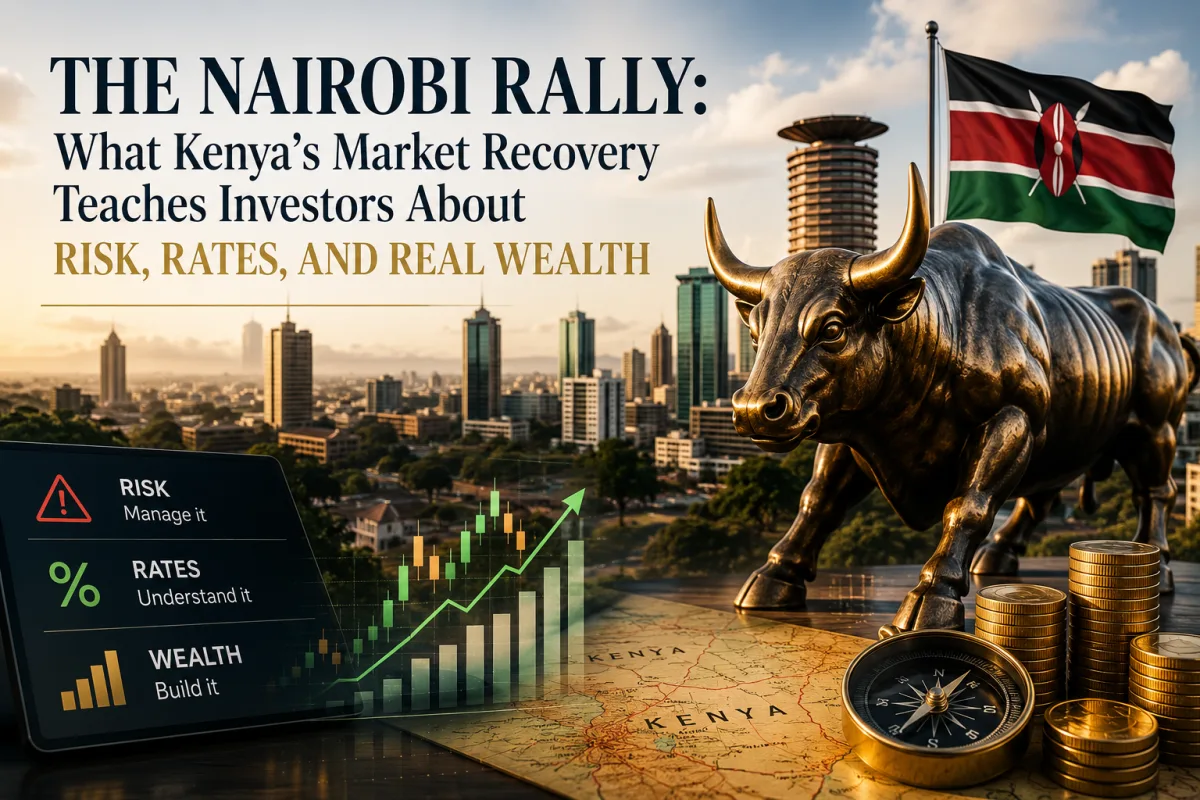
The Nairobi Rally: What Kenya’s Market Recovery Teaches Investors About Risk, Rates, and Real Wealth
A stock market rally can change the national mood faster than almost any economic statistic.
When share prices rise, investors feel richer. Pension funds look healthier. Brokerage accounts become easier to open. Business headlines turn optimistic. Companies that were ignored a year earlier suddenly become symbols of opportunity. The market begins to feel less like a place of risk and more like a place where wealth is being created in public.
Kenya is experiencing that kind of moment again.
Recent market coverage has pointed to renewed strength at the Nairobi Securities Exchange, stronger performance by listed companies, increased gains for major shareholders, continued activity in government financing, and a broader effort to modernize Kenya’s capital markets infrastructure. Business Daily Africa reported that wealthy investors booked approximately Sh39.51 billion in paper gains from the NSE rally over the past 12 months, while another report noted that dollar investors in blue-chip NSE stocks earned an 18.8% return in the first half of the year as a stable shilling protected them from currency losses.
That is not a small development. For years, many Kenyan investors have treated the stock market with caution, frustration, or outright indifference. Memories of weak liquidity, poor corporate governance in some counters, foreign investor exits, currency pressure, and long periods of underperformance have shaped public sentiment. In such an environment, a strong rally does more than raise prices. It revives belief.
But belief is not the same as analysis.
A rising market can reward patience, but it can also seduce investors into forgetting risk. The same rally that creates wealth for disciplined long-term owners can tempt latecomers into buying without understanding earnings, interest rates, dividends, debt, liquidity, valuation, or sector concentration. A market recovery is an opportunity to learn, not merely a signal to chase.
The Nairobi rally should therefore be read as more than a market event. It is a lesson in how capital markets work. It shows how interest rates influence valuations, how banks shape investor confidence, how public debt affects private capital, how regulation expands or limits trust, and how long-term wealth depends on owning productive assets rather than reacting to headlines.
Why the NSE Rally Matters
The Nairobi Securities Exchange is not just a trading venue. It is one of the most visible mirrors of Kenya’s formal economy. Banks, telecom companies, insurers, manufacturers, investment firms, agricultural companies, and infrastructure-linked businesses are represented in the listed market. When the NSE rises meaningfully, it often reflects a change in expectations about profits, interest rates, currency stability, liquidity, and investor appetite.
A rally also matters because markets are forward-looking. Share prices do not wait for every economic problem to disappear. They move when investors begin to believe that the future will be better than the past, or at least less painful than previously feared.
That distinction is important. A stock market can rise even when households still feel pressure from living costs. It can rise while businesses remain cautious. It can rise while public debt remains a concern. Markets do not measure comfort. They measure expectations, liquidity, and risk appetite.
Kenya’s recent rally appears to be driven by several overlapping forces: improved sentiment toward equities, relative currency stability, attractive valuations after prior market weakness, strong performance from banking stocks, expectations around interest-rate normalization, and renewed attention from investors seeking total return.
For long-term investors, the rally is encouraging because it reminds the public that equities can create wealth. But it should also remind investors that markets are cyclical. The time to build a sound investment philosophy is not after prices have already moved. It is before excitement becomes the dominant emotion.
The Wealth Effect: Paper Gains and Real Discipline
When reports show that major investors have gained billions from rising share prices, the public often sees the glamour of the stock market. Wealth appears to have been created almost effortlessly. A large shareholder owns shares, the market rises, and their net worth increases by billions.
But the visible gain hides the invisible discipline.
Large shareholders who benefit from market rallies often endured long periods when those same shares were unpopular, illiquid, or undervalued. They held ownership through uncertainty. They tolerated volatility. They understood that wealth in equities is rarely created in a straight line.
This is one of the most misunderstood aspects of investing. The public notices the gain when it is reported. It rarely notices the patience that made the gain possible.
Paper gains are not the same as realized profits. A shareholder whose stake rises by Sh10 billion has not necessarily received Sh10 billion in cash. The value exists because the market is willing to price the ownership stake higher. If the shares are sold, the gain may be realized. If the market falls, part of the gain may disappear. If liquidity is limited, selling a large stake may itself affect the price.
This does not make paper wealth meaningless. Market value matters. It affects borrowing power, investor confidence, corporate actions, and personal net worth. But it should be understood properly. Equity wealth is dynamic. It rises and falls with business performance, market sentiment, and liquidity.
The lesson for ordinary investors is not to envy large shareholders. The lesson is to understand ownership. Wealth in the stock market comes from owning assets whose value can grow over time. That growth may appear suddenly in headlines, but it is usually built over years of business performance, retained earnings, dividends, reinvestment, and patience.
Why Interest Rates Sit at the Center of the Story
Interest rates are one of the most powerful forces in any capital market. They influence how investors value stocks, how companies finance growth, how banks price loans, how households borrow, and how governments service debt.
When interest rates are high, equities face competition. An investor can earn attractive returns from Treasury bills, bonds, or bank deposits without taking stock market risk. High rates also increase borrowing costs for companies, reduce consumer spending power, and lower the present value of future corporate earnings. All else equal, high rates tend to pressure equity valuations.
When interest rates begin to stabilize or fall, the equation changes. Bonds and deposits may become less attractive relative to equities. Corporate borrowing costs may ease. Investors may become more willing to take risk. Valuation multiples may expand. Companies with strong earnings can attract renewed attention.
This is why market participants watch inflation, fuel prices, central bank policy, and government borrowing closely. In Kenya, fuel prices matter because they affect transport costs, electricity costs, imported inflation, household budgets, and business margins. Inflation affects the Central Bank of Kenya’s policy stance. The policy stance affects short-term rates. Short-term rates influence bond yields, bank lending rates, and investor preferences.
The World Bank recently projected Kenya’s economy to grow 4.3% in 2026 and 4.4% in 2027, while noting positives such as a stable exchange rate, easing monetary policy, strong agricultural harvests, and improved private-sector credit, alongside risks from elevated fuel and commodity prices, climate shocks, and political uncertainty ahead of the 2027 elections.
For investors, the lesson is clear: stock market performance cannot be separated from the cost of money. A company may be well-managed, but if interest rates are high, its valuation may be compressed. A bank may be profitable, but if credit risk rises, earnings quality may suffer. A government bond may offer high yield, but if debt-service costs crowd out private-sector growth, the broader economy may feel pressure.
The Banking Sector as Kenya’s Market Barometer
Kenyan banking stocks often carry more weight than their market capitalization alone suggests. They are not just listed companies. They are economic indicators.
Banks sit at the center of savings, credit, payments, trade finance, government securities, mortgages, business loans, and household borrowing. When banks perform well, investors often read it as a sign that the economy remains functional and profitable. When banks struggle, market sentiment can weaken quickly.
Bank profitability is shaped by several forces: net interest margins, loan growth, non-performing loans, deposit costs, government securities yields, operating efficiency, fees, digital banking income, and capital adequacy. In Kenya, banks also play a major role in financing government debt, which links the sector closely to fiscal conditions.
A strong banking sector can support the stock market in several ways. Banks may pay attractive dividends. They may report resilient earnings. They may benefit from diversified income streams. They may serve as a gateway for both local and foreign investors seeking exposure to the Kenyan economy.
But banking strength must be analyzed carefully. High profits may come from productive private-sector lending, or they may come from heavy exposure to government securities. Loan growth may signal economic confidence, or it may signal rising credit risk if underwriting standards weaken. Falling deposit rates may support margins, but they may also affect savers seeking income.
For investors, banking stocks require more than dividend yield analysis. A bank’s dividend is only as strong as its capital position, asset quality, earnings durability, and regulatory standing. A high payout can be attractive, but not if loan losses are rising or capital buffers are weakening.
Dividends and the Kenyan Investor Mindset
Dividend-paying stocks have a special appeal in Kenya because many investors value cash returns. A dividend feels practical. It can supplement income, support retirement planning, or validate the decision to own shares. In a market where capital gains can be volatile, dividends provide a visible reward for patience.
But dividend investing requires discipline.
A dividend should never be judged only by its size. Investors must ask whether the company can sustain the payout. Does the business generate enough free cash flow? Is the payout ratio reasonable? Are earnings stable? Is the balance sheet strong? Does management have a history of treating minority shareholders fairly? Is the dividend growing, stagnant, or vulnerable?
Kenyan banking stocks, telecom shares, and selected mature companies may attract dividend-focused investors. But no dividend should be treated as guaranteed. Dividends are paid from business performance and board decisions. They can rise, fall, or disappear.
The right mindset is ownership. A shareholder should not ask merely, “What dividend will I receive?” The better question is, “What kind of business am I buying, and can it keep creating value after paying me?”
This is especially important after a market rally. When prices rise, dividend yields may fall because the denominator—the share price—has increased. Some investors then search for higher-yielding counters without analyzing why those yields are high. That is how dividend traps form.
Government Debt and the Capital Market Equation
Kenya’s capital markets cannot be understood without discussing government financing.
The government is one of the largest borrowers in the economy. Treasury bills and bonds provide investors with income, banks with assets, pension funds with long-term instruments, and the government with financing. A deep government securities market can help develop a broader capital market by creating yield curves, liquidity, benchmarks, and institutional participation.
But government borrowing also creates trade-offs.
When the government borrows heavily domestically, it can absorb liquidity that might otherwise support private-sector lending. High government yields can make risk-free or lower-risk instruments more attractive than equities. Banks may prefer lending to the government rather than lending to businesses, especially if private credit risk is elevated. This can slow private-sector expansion.
Debt-service costs also matter. If a large share of government revenue goes toward interest payments, fiscal flexibility declines. The government may face pressure to raise taxes, reduce spending, refinance obligations, or seek external support. These choices can affect businesses, households, and investors.
This does not mean government debt is automatically harmful. Borrowing can finance infrastructure, development, and essential public services. The issue is sustainability. Debt must be managed in a way that supports growth rather than crowding it out.
For investors, public debt is not an abstract policy debate. It influences interest rates, bank balance sheets, currency stability, tax expectations, and market confidence. A stock market rally built on improved sentiment can weaken if fiscal concerns intensify.
Currency Stability and Dollar Returns
Foreign investors care about more than local share price returns. They care about returns after currency movements.
If a stock rises 20% in Kenyan shillings but the shilling depreciates sharply against the dollar, a foreign investor’s dollar return may be much lower. If the currency remains stable, local equity gains translate more effectively into foreign currency returns. This is why the report of nearly 19% half-year dollar returns for NSE blue-chip investors matters. It suggests that equity gains were not erased by currency losses during that period.
Currency stability can attract foreign portfolio investors because it reduces one layer of uncertainty. It can also support local confidence by easing pressure on imported goods, external debt servicing, and inflation expectations.
But currency stability should not be taken for granted. Exchange rates are influenced by exports, imports, remittances, tourism, external borrowing, foreign direct investment, interest-rate differentials, reserves, and global risk appetite. A country that imports more than it exports must continually manage external balances.
For Kenyan investors, the shilling matters even when investing locally. Currency weakness can raise import costs, affect inflation, influence interest rates, and change corporate margins. Companies with foreign currency debt or import-heavy cost structures may be exposed. Exporters may benefit from a weaker currency, but only if they can maintain volumes and margins.
The Coming Carbon Exchange and the Future of Market Infrastructure
One of the most important long-term developments in Kenya’s capital markets is the planned expansion of carbon market infrastructure. Business Daily Africa reported that regulators plan to open Kenya’s carbon exchange in early 2027, following the establishment of the National Carbon Registry in February 2026.
The carbon market story matters because it shows how capital markets are expanding beyond traditional stocks and bonds. A carbon exchange could create a regulated marketplace for trading carbon credits, connecting climate projects, investors, corporations, and international buyers.
Kenya has natural advantages in this area. The country has renewable energy potential, conservation assets, forestry projects, rangelands, and community-based environmental initiatives. If properly regulated, carbon markets could attract climate finance, support local communities, and create new investment channels.
But carbon markets are also complex. Globally, they have faced concerns around double counting, weak verification, community benefit-sharing, inflated claims, and inconsistent standards. Kenya’s National Carbon Registry is designed to strengthen transparency, track credits, and improve credibility. The Associated Press reported that the registry aims to prevent double counting, strengthen credibility, and support Kenya’s access to climate finance.
For investors, the lesson is that market infrastructure matters. Trust is not built by opportunity alone. It is built by rules, transparency, enforcement, credible data, and fair participation. A carbon exchange could become an important part of Kenya’s financial future, but only if it avoids the credibility problems that have hurt carbon markets elsewhere.
Regulation Is Not a Side Issue
Capital markets depend on trust. Investors must believe that financial statements are reliable, brokers are supervised, issuers are accountable, funds are regulated, and fraud is punished. Without trust, savings remain in cash, land, informal schemes, or offshore assets.
This is why regulatory reform by the Capital Markets Authority matters. Licensing additional participants, warning against unrealistic return promises, expanding market infrastructure, and improving investor protection are not merely bureaucratic actions. They shape the willingness of households and institutions to invest.
Kenya has seen repeated examples of investors being drawn into schemes promising unusually high returns. These schemes often exploit financial anxiety and low investment literacy. They promise certainty where none exists. They use the language of investment while avoiding the discipline of regulated markets.
A stronger capital market requires both regulation and education. Regulators can license, supervise, and enforce. But investors must also learn to question return promises. Any investment offering high returns with little or no risk deserves skepticism. Risk does not disappear because a promoter uses confident language.
Private Debt and Alternative Financing
Another important trend is the growing discussion around private debt and alternative financing. When bank lending becomes expensive or restrictive, companies may seek financing from private credit funds, institutional investors, or structured debt arrangements.
Private debt can help fill financing gaps. It can provide companies with capital for expansion, acquisitions, working capital, or refinancing. It can offer investors income opportunities beyond listed bonds and bank deposits.
But private debt also requires careful risk assessment. Unlike publicly traded bonds, private debt may be less liquid and less transparent. Investors must understand borrower quality, collateral, covenants, repayment capacity, interest-rate terms, and default risk.
For Kenya, the development of private debt markets could broaden capital access, especially for companies that are too large for ordinary bank loans but not ready for public bond issuance. It could also deepen institutional investment options. But growth must be matched by strong legal frameworks, disclosure standards, and investor sophistication.
What Retail Investors Should Learn From the Rally
The first lesson is that markets reward preparation more than excitement. Investors who bought quality assets during pessimistic periods are usually better positioned when rallies arrive. Waiting until the headlines become optimistic can lead to buying after much of the easy gain has already occurred.
The second lesson is that valuation matters. A company can be excellent and still become expensive. A rally may improve confidence, but it can also reduce future expected returns if prices move ahead of earnings. Investors should compare share prices with earnings, dividends, book value, cash flow, growth prospects, and industry risks.
The third lesson is that diversification matters. A portfolio concentrated only in banks, or only in large blue chips, or only in high-dividend counters may perform well in one environment and poorly in another. Diversification across sectors, asset classes, and time horizons helps reduce dependence on a single theme.
The fourth lesson is that liquidity matters. Some NSE counters may be difficult to buy or sell in meaningful amounts. A quoted price is not always the same as an executable price for a large position. Retail investors should understand trading volumes and bid-ask spreads before assuming they can exit easily.
The fifth lesson is that patience matters. Equity investing is not a salary. Returns do not arrive on a fixed schedule. A good business can remain undervalued for years before sentiment changes. A weak business can rally temporarily before fundamentals catch up. Investors need both analysis and temperament.
How to Evaluate an NSE-Listed Company
A disciplined investor should begin with the business model. What does the company do? How does it earn money? Who are its customers? What costs matter most? Is the company exposed to regulation, imports, currency movements, commodity prices, or credit cycles?
Next, study revenue and profit trends. Are sales growing? Are margins stable? Is profit growth driven by core operations or one-off gains? Does the company generate cash, or are profits trapped in receivables and working capital?
Then examine the balance sheet. How much debt does the company carry? Is debt short-term or long-term? Is it denominated in shillings or foreign currency? Does the company have enough cash and working capital? Are interest costs rising?
After that, review dividends. Is the dividend covered by earnings and cash flow? Has the company maintained or grown dividends over time? Is the payout ratio sustainable? Does management communicate a clear policy?
Then consider governance. Are financial reports timely and clear? Does management respect minority shareholders? Has the company had governance controversies? Are related-party transactions transparent? Does the board appear independent and competent?
Finally, assess valuation. Compare the price with earnings, book value, dividends, cash flow, and growth prospects. A low price-to-earnings ratio may signal opportunity, but it may also reflect weak growth or poor governance. A high valuation may be justified by quality, but only if future performance supports it.
The Role of Bonds in a Kenyan Investor’s Portfolio
Kenyan investors often compare equities with Treasury bills and bonds. This is rational. Government securities can offer income, relative safety, and predictable cash flows. For many investors, especially conservative savers, bonds are a core asset.
But bonds and stocks serve different purposes. Bonds provide contractual income and capital preservation if held responsibly and if the issuer remains solvent. Stocks provide ownership, growth potential, dividends, and inflation protection, but with greater volatility.
When interest rates are high, bonds can look more attractive than stocks. When rates fall, existing bonds may gain value, but new bond yields may decline. Equities may become more appealing if corporate earnings remain strong and valuations are reasonable.
A mature investor does not ask whether stocks are always better than bonds or bonds are always better than stocks. The better question is how each asset fits the investor’s goals. A retiree may need income stability. A young professional may need long-term growth. A business owner may need liquidity. A pension fund may need duration matching. Asset allocation should follow purpose.
The Risk of Mistaking Market Recovery for Economic Perfection
A rising stock market does not mean every economic problem has been solved.
Kenya still faces fiscal pressure, external vulnerability, household cost-of-living concerns, climate risks, youth unemployment, infrastructure needs, and political uncertainty. The World Bank’s recent growth projection highlighted both supportive factors and risks, including elevated fuel and commodity prices and potential political uncertainty ahead of the 2027 elections.
Investors must hold two ideas at once. Kenya’s capital markets may offer real opportunities. Kenya’s economy still carries meaningful risks. These statements are not contradictory. They are the normal condition of investing.
Markets often recover before the public mood does. That can create opportunity. But if investors ignore structural risks, they may overpay for optimism.
The Long-Term Case for Capital Markets
Kenya needs deeper capital markets.
A strong capital market helps companies raise long-term funding. It gives households alternatives to land, cash, and informal schemes. It supports pension fund growth. It improves price discovery. It allows entrepreneurs, governments, and institutions to access capital more efficiently. It can attract foreign investment and strengthen financial resilience.
But deeper markets require more than rallies. They require listings, liquidity, transparency, investor education, regulatory consistency, product innovation, and credible enforcement. They require companies that treat public shareholders as partners, not afterthoughts. They require investors who understand risk, not just return.
The planned carbon exchange, the continued development of debt markets, the modernization of regulation, and the renewed performance of the NSE all point toward a broader possibility: Kenya can build a more sophisticated investment culture.
That culture will not be built by speculation alone. It will be built by informed ownership.
The Wealth Lesson Behind the Headlines
The headlines say investors have gained billions. The deeper lesson is that wealth belongs to owners.
Owners of shares benefit when businesses become more valuable. Owners of bonds benefit when borrowers honor obligations. Owners of productive assets benefit when capital is allocated wisely. Those who only consume headlines often arrive late, chase returns, and exit in fear.
The Nairobi rally should encourage investors, but it should not make them careless. It should remind them that markets can reward patience, but only when patience is paired with judgment. It should remind them that rising prices are not a substitute for earnings. It should remind them that dividends are not guaranteed. It should remind them that interest rates, debt, currency, regulation, and governance all matter.
For the Kenyan investor, the opportunity is not simply to participate in the next rally. The opportunity is to become more financially literate, more disciplined, and more ownership-minded.
A strong market can create wealth. A strong investor can keep it.
What Investors Should Watch Next
Several signals will determine whether the current market momentum becomes a durable wealth-building cycle.
First, corporate earnings must support share price gains. If bank profits, telecom earnings, insurer performance, and industrial recovery remain strong, the rally will have a firmer foundation. If prices rise faster than earnings, valuations may become stretched.
Second, interest rates must remain manageable. Lower or stable rates can support equities, but renewed inflation pressure could reverse that support.
Third, fiscal policy must remain credible. Government financing choices affect bond yields, bank liquidity, private credit, and investor confidence.
Fourth, foreign investor participation should be watched carefully. Foreign flows can improve liquidity and valuations, but they can also reverse quickly when global risk appetite changes.
Fifth, regulatory execution will matter. The success of new products, market participants, private debt structures, and carbon trading depends on trust.
Finally, investors should watch dividends. Sustainable dividend growth from profitable companies can deepen confidence in equities and attract long-term capital.
The Investor’s Final Test
Before buying into any market rally, an investor should be able to answer basic questions.
What am I buying? Why is it valuable? What cash flows support that value? What risks could reduce those cash flows? Am I buying because the price is reasonable or because the headline is exciting? How will this investment behave if interest rates rise, the shilling weakens, earnings disappoint, or foreign investors sell? Does this asset fit my goals, time horizon, and risk tolerance?
If those questions cannot be answered, the investor is not investing. The investor is reacting.
Kenya’s market recovery is important. It deserves attention. It may create opportunities for patient investors who understand business value, income, growth, and risk. But the rally itself is not the destination. It is an invitation to think more deeply about wealth.
Markets rise and fall. Headlines come and go. Interest rates change. Currencies move. Governments borrow. Regulators reform. Companies grow, struggle, recover, or decline.
The disciplined investor studies all of it without being ruled by any single headline.
That is how market participation becomes wealth building.
 Article
 Article
 Article
 Article
 Article
 Article
 Article
 Article