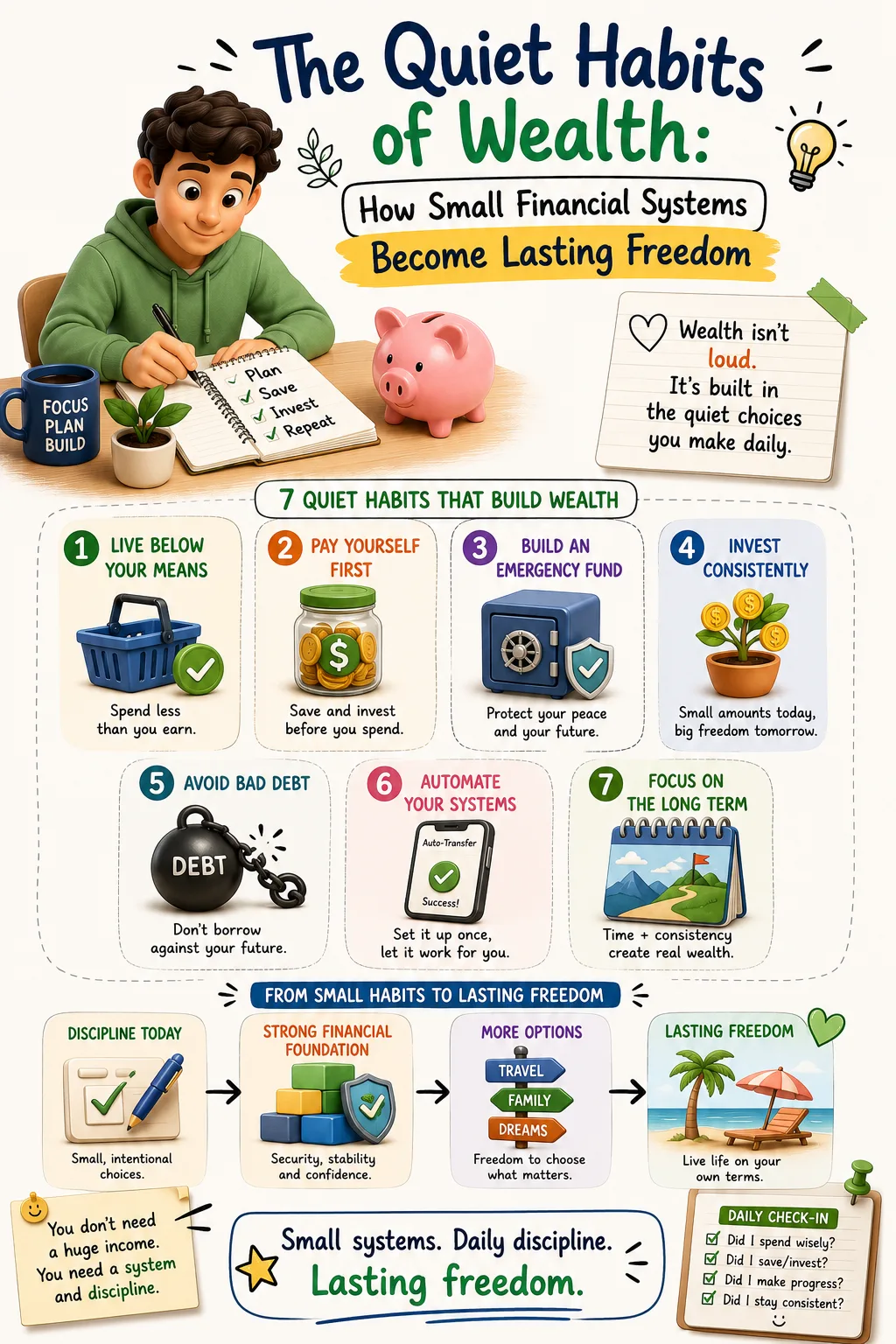
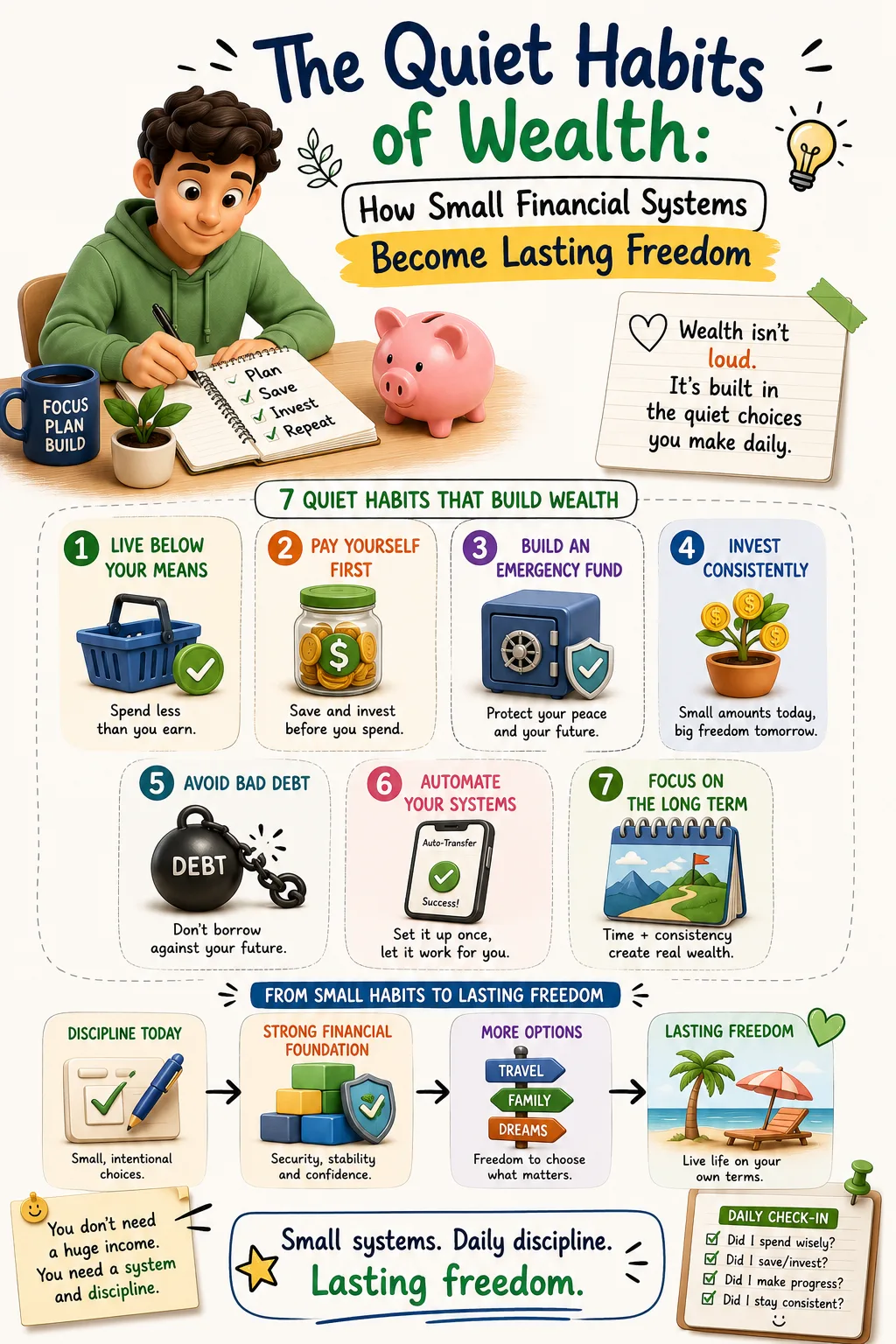
The Quiet Habits of Wealth: How Small Financial Systems Become Lasting Freedom
Wealth is often imagined as a dramatic event. A business sale. A lucky investment. A large inheritance. A sudden promotion. A winning trade. A property deal that changes everything. These moments do happen, and they can alter a financial life quickly. But for most people, wealth is not built through one spectacular decision. It is built quietly, through habits repeated long after their excitement has faded.
The most powerful financial habits rarely look impressive in the beginning. Automating a small savings transfer does not feel life-changing. Spending less than you earn does not attract applause. Avoiding high-interest debt is not glamorous. Tracking expenses can feel ordinary. Investing consistently may seem slow. Reviewing your finances once a month does not create a viral story. Patience and discipline are almost invisible.
Yet these quiet habits are often the difference between a person who earns money and a person who builds wealth. Income is only the starting point. Wealth begins when income is directed, protected, multiplied, and allowed to compound over time.
The challenge is that modern financial culture rewards noise. It celebrates the spectacular and ignores the systematic. It glamorizes sudden success and underestimates slow progress. It gives more attention to the person who claims to have doubled their money in a week than to the person who invested steadily for twenty years. It turns wealth into a performance rather than a process.
But real financial security is not usually created by chasing the loudest opportunity. It is created by building a financial life that can survive ordinary expenses, unexpected shocks, market cycles, career changes, and human emotion. That kind of wealth does not depend on constant excitement. It depends on structure.
Ten habits sit at the center of that structure: automate savings, live below your means, invest consistently, educate yourself about money, avoid high-interest debt, track spending, build income capacity, set financial goals, review your finances regularly, and practice patience and discipline. These habits are simple to understand but difficult to live. Their power is not in complexity. Their power is in repetition.
The important point is that these habits are not separate tricks. They work together. Automated savings creates consistency. Living below your means creates surplus. Tracking spending reveals where that surplus is leaking. Avoiding high-interest debt protects future income. Investing consistently turns surplus into ownership. Financial education improves decisions. Goals give direction. Reviews keep the plan honest. Income growth expands the system. Patience gives the whole process enough time to work.
Wealth is not built by knowing these ideas. Many people know them. Wealth is built by turning them into default behavior.
Habit One: Automate Your Savings Before Willpower Gets Involved
Automation is one of the most underrated tools in personal finance because it accepts a truth many people resist: human willpower is inconsistent. People make strong financial promises when they are calm, motivated, or newly paid. Then life happens. Bills arrive. Friends invite them out. Family needs support. Stress creates emotional spending. A sale feels urgent. A small purchase seems harmless. By the end of the month, the promise to save has been pushed into the future again.
Automation solves this by removing the monthly debate. Instead of asking, “How much should I save after spending?” it asks, “How much should be moved before spending begins?” That order matters. Money left in a spending account feels available even when it has an invisible purpose. The larger the balance, the easier it is to justify purchases. Automation protects money from the illusion of availability.
Paying yourself first does not mean rewarding yourself with consumption before paying bills. It means treating your future as a real financial obligation. Rent is paid because housing matters. Utilities are paid because electricity and water matter. Debt payments are made because lenders demand them. Savings should also be treated as a claim on income, not as a polite request that can be ignored whenever the month becomes inconvenient.
The first automated transfer does not need to be large. A small amount saved reliably is better than an ambitious amount saved occasionally. The habit is the foundation. As income rises or expenses fall, the amount can increase. Many people wait until they feel they have enough money to save, but saving often becomes possible because the system is created, not because life becomes perfectly easy.
Automation also reduces emotional friction. A person who manually transfers money every month must repeatedly choose the future over the present. That choice is valuable, but it is tiring. Automation turns a good decision into infrastructure. The person makes the decision once, then the system repeats it.
This is especially useful for emergency savings, retirement contributions, investment accounts, sinking funds, and long-term goals. A sinking fund is money set aside gradually for a known future expense, such as insurance premiums, school fees, home repairs, annual subscriptions, holidays, or professional exams. Without sinking funds, predictable expenses can feel like emergencies. With automation, they become planned events.
Automation should be designed carefully. If the transfer is too aggressive, you may repeatedly move money back into checking, which weakens the habit. Start with an amount that creates progress without forcing constant reversal. The goal is not to impress yourself with a perfect plan. The goal is to create a sustainable one.
Automation is quiet, but it is powerful because it changes the default. Without automation, spending is automatic and saving is manual. With automation, saving becomes automatic and spending must adjust. That reversal is one of the first signs of a serious financial system.
Habit Two: Live Below Your Means Without Living Below Your Values
Living below your means is one of the oldest principles in personal finance, and it remains one of the most important. It simply means spending less than you earn. But simplicity should not be confused with ease. The modern economy is designed to absorb income. Every raise, bonus, promotion, business win, or new contract arrives into a world ready to turn it into spending.
The phrase “living below your means” is often misunderstood. It does not require misery, deprivation, or refusing every pleasure. It means creating a gap between income and expenses so that part of today’s income can strengthen tomorrow. That gap is the raw material of wealth. Without it, there is no emergency fund, no investing, no debt acceleration, no opportunity fund, and no freedom from the next paycheck.
A person can earn a high income and still fail to live below their means. If every increase in income leads to a larger home, a more expensive car, more subscriptions, more dining out, more travel, more luxury purchases, and more debt, the financial position may not improve. The person’s lifestyle becomes more impressive, but their balance sheet remains fragile.
A person can also earn a modest income and live below their means with discipline, although low income creates real limits. There is a point where the issue is not overspending but insufficient earnings. Still, wherever possible, the habit of creating surplus matters. Even a small surplus teaches money to serve a purpose beyond immediate consumption.
The most sustainable version of living below your means is not about cutting everything. It is about alignment. Spend on what genuinely matters to you. Reduce or eliminate what does not. A budget filled with mindless restrictions is hard to maintain. A budget built around values is more durable.
For one person, a modest home and reliable transport may matter more than expensive dining. For another, travel may be deeply meaningful, while luxury clothing is not. Someone else may value education, health, family support, or business investment. The goal is not to copy another person’s frugality. The goal is to make sure spending reflects your priorities rather than advertising, comparison, boredom, or social pressure.
Lifestyle inflation is the enemy of this habit. It usually begins innocently. A better salary makes better things feel reasonable. Some upgrades are worthwhile. A safer neighborhood, healthier food, better tools for work, or reliable childcare can improve life meaningfully. The danger is automatic upgrading: every financial improvement immediately becomes a permanent expense.
A useful rule is to save or invest a portion of every raise before increasing lifestyle. This protects progress. If your income rises and your savings rate rises with it, wealth building accelerates. If income rises and expenses rise by the same amount, your financial stress may simply become more expensive.
Living below your means gives you options. It allows you to handle emergencies, leave toxic work, invest during downturns, help family sustainably, pursue education, start a business, or rest without immediate panic. The benefit is not only mathematical. It is psychological. A person with margin breathes differently.
Habit Three: Invest Consistently and Let Time Do Its Work
Saving protects money. Investing grows it. A complete financial life needs both.
Many people delay investing because they believe they need a large amount to start, perfect knowledge, ideal timing, or certainty about the future. These beliefs are understandable, but they can become costly. The most valuable asset in investing is often time, and time is lost while waiting for perfect conditions.
Consistent investing is powerful because it turns regular income into ownership. Instead of letting every paycheck disappear into expenses, a portion is used to acquire assets that may grow, produce income, or both. Over time, these assets can become a second financial engine beside labor.
Investing also introduces the power of compounding. Compounding occurs when returns begin generating their own returns. At first, the effect can seem slow. A small investment balance produces small growth. But over years and decades, reinvested returns can become increasingly meaningful. The investor’s job is not to force compounding overnight. The job is to give it enough capital, enough time, and enough discipline.
Consistency matters because markets are unpredictable in the short term. Prices rise and fall. Headlines change. Economic data shifts. Interest rates move. Elections happen. Companies disappoint. Investors become excited and fearful. Trying to invest only at the perfect moment is extremely difficult. A consistent approach reduces the pressure to predict every movement.
For many long-term investors, regular contributions to diversified investments can be more effective than emotional attempts to jump in and out of markets. This does not mean every investment is safe or every product is suitable. It means the habit of regular investing, when paired with diversification, appropriate risk, and a long time horizon, can build wealth steadily.
The best investment plan depends on age, goals, risk tolerance, income stability, tax rules, available products, and country-specific options. Common vehicles may include retirement accounts, pension plans, mutual funds, exchange-traded funds, index funds, government securities, bonds, real estate, or business equity. The product matters, but the principle is larger: own assets that can increase your financial strength over time.
New investors should be cautious of hype. Fast returns attract attention, but wealth built through speculation can disappear just as quickly. If an investment cannot be explained clearly, if the risks are hidden, if returns are promised as guaranteed without credible backing, or if pressure is used to force quick action, caution is warranted.
Investing consistently does not mean investing blindly. It means creating a disciplined process. Understand what you own. Know the fees. Know the risks. Know the time horizon. Know how the investment fits your broader financial plan. Avoid concentrating all wealth in one risky idea simply because it is exciting.
There is also an emotional side to investing. Long-term investors must learn to tolerate volatility. A falling market can make even a sound plan feel wrong. A rising market can make risky behavior feel intelligent. Discipline means remembering why the plan exists and not allowing short-term emotion to control long-term strategy.
The quiet investor often looks boring in the early years. They are not chasing every trend. They are not constantly bragging about trades. They are buying, holding, contributing, learning, and reviewing. Over time, that boring behavior can become extraordinary.
Habit Four: Educate Yourself About Money Before the Market Educates You Expensively
Financial education is not a luxury. It is self-defense.
Every adult lives inside a financial system whether they understand it or not. Salaries, taxes, rent, debt, interest rates, insurance, inflation, investments, pensions, contracts, fees, and financial products affect daily life. A person who does not understand money is still making financial decisions. They are simply making them with less protection.
Financial ignorance is expensive because mistakes compound. A high-interest loan taken casually can consume future income. A poor investment can destroy savings. A misunderstood insurance policy can fail when needed. An unplanned tax obligation can create stress. A salary increase can be wasted through lifestyle inflation. A retirement opportunity can be missed for years.
Financial education does not mean becoming an economist, accountant, or investment analyst. It means understanding enough to make informed decisions. Everyone should know how to read a payslip, build a budget, calculate debt costs, compare financial products, understand compound interest, recognize scams, evaluate insurance basics, invest according to time horizon, and track net worth.
Learning about money also improves confidence. Many people avoid financial decisions because the language feels intimidating. They hear terms like asset allocation, inflation, interest, equity, bond yield, risk tolerance, deductible, credit utilization, amortization, and diversification, then assume finance is too complicated. But most practical money concepts become understandable when explained clearly and applied to real life.
The danger is not only lack of education. It is bad education. Social media has made financial information abundant, but abundance is not the same as wisdom. Some advice is designed to educate. Some is designed to sell. Some is designed to provoke. Some is based on one person’s lucky outcome rather than sound principles. Some is incomplete because it ignores risk, taxes, fees, or personal circumstances.
A serious learner asks questions. Who benefits if I follow this advice? Is the person explaining the downside? Is the recommendation suitable for my goals? Is it based on evidence, experience, or hype? Does it promise quick wealth without trade-offs? Does it encourage borrowing, concentration, or urgency?
Financial education should lead to better behavior, not endless consumption of content. Reading about budgeting is useful only if a budget is created. Learning about investing matters only if it leads to an appropriate investment plan. Understanding debt matters only if borrowing choices improve. Knowledge becomes wealth when it changes decisions.
A useful approach is to study one financial area at a time. Start with budgeting and cash flow. Then debt. Then emergency funds. Then investing basics. Then retirement. Then insurance. Then taxes. Then estate planning or business finance if relevant. Trying to master everything at once can create confusion. Building knowledge gradually mirrors the way wealth itself is built.
Habit Five: Avoid High-Interest Debt Because It Compounds Against You
Debt is not automatically bad. Borrowing can help buy a home, fund education, build a business, or handle necessary expenses when used carefully. But high-interest consumer debt is one of the most destructive forces in personal finance. It turns compounding into an enemy.
When you invest, compounding can work for you. When you carry expensive debt, compounding works against you. Interest charges grow the amount owed, and future income becomes committed to past spending. The borrower is not only paying for what they bought. They are paying for the privilege of having bought it before they could afford it.
Credit cards, payday loans, expensive mobile loans, overdrafts, retail financing, and informal high-interest borrowing can create a cycle that is hard to escape. The monthly payment may look manageable at first, but the total cost can be far higher than expected. Minimum payments can keep a borrower in debt for years. Late fees and penalties can worsen the burden.
The danger is especially high when debt is used for consumption that does not increase in value. Meals are eaten. Clothes wear out. Devices depreciate. Vacations end. The debt remains. This mismatch creates financial drag: temporary pleasure financed by long-term obligation.
A wealth-building habit treats high-interest debt as an emergency, not a normal lifestyle tool. The first step is to stop adding new debt where possible. The second is to list every balance, interest rate, minimum payment, and due date. The third is to choose a repayment strategy.
The debt avalanche method prioritizes the highest-interest debt first while maintaining minimum payments on all others. This usually saves the most money. The debt snowball method prioritizes the smallest balance first to create psychological momentum. The mathematically best method is not always the behaviorally best method. The most effective method is the one that gets followed consistently, though extremely high-interest debt should receive urgent attention.
Paying off high-interest debt often produces a powerful return because every interest charge avoided improves your financial position. If a debt charges a very high rate, eliminating it can be more valuable than chasing uncertain investment returns. This is why debt repayment and investing must be balanced intelligently.
Some people try to invest aggressively while carrying expensive debt. This can make sense only in limited circumstances. If the debt cost is high and guaranteed while investment returns are uncertain, the borrower may be taking unnecessary risk. A more stable sequence is to build a starter emergency fund, attack high-interest debt, then increase investing as debt pressure falls.
Debt freedom also creates emotional relief. A salary feels different when less of it belongs to lenders. Choices expand. Stress declines. The future becomes less crowded by the past.
Habit Six: Track Your Spending Because Unseen Money Cannot Be Managed
Many people do not overspend through one dramatic purchase. They overspend through hundreds of small leaks. A convenience meal here. A subscription there. A delivery fee. A ride. A sale item. A small transfer to someone else. A digital purchase. A quick snack. Individually, each expense seems harmless. Together, they can absorb the money that was supposed to become savings, investments, or debt repayment.
Tracking spending brings the invisible into view. It shows where money actually goes, not where memory claims it went. This distinction matters because people often underestimate variable spending. Fixed bills are easy to remember. Rent, loan payments, insurance, and subscriptions are visible. But flexible spending can disappear into vague categories like “miscellaneous” or “life.”
The purpose of tracking is not shame. Shame makes people avoid their numbers. The purpose is clarity. A spending record reveals patterns, and patterns create choices. If dining out is higher than expected, you can decide whether it is worth it. If transport costs are rising, you can look for alternatives. If subscriptions are unused, you can cancel them. If family support is unpredictable, you can set a monthly limit. If impulse purchases cluster around stress, you can address the trigger rather than only the spending.
There are several ways to track spending. Some people use budgeting apps. Others use spreadsheets. Some prefer bank statements. Some use envelopes or separate accounts. The best method is the one you will actually use. A simple system followed consistently is better than a sophisticated system abandoned after two weeks.
Tracking should lead to categorization. Essential expenses include housing, food, transport, utilities, healthcare, and basic communication. Financial progress includes savings, investing, and debt repayment. Lifestyle spending includes entertainment, restaurants, shopping, travel, hobbies, and upgrades. Giving or family support may be its own category. Once spending is categorized, the financial story becomes clearer.
The first month of tracking can be uncomfortable. Many people discover that their assumptions were wrong. This should not be treated as failure. It is information. A budget built without tracking is often based on hope. A budget built after tracking is based on reality.
Tracking also strengthens future planning. If you know your real monthly expenses, you can calculate an emergency fund target. You can decide how much rent is affordable. You can determine whether a car payment would create pressure. You can set savings goals that match actual cash flow. You can identify whether the problem is spending, income, debt, or all three.
What gets tracked tends to improve because attention changes behavior. A person who tracks food spending may naturally cook more. A person who tracks subscriptions may cancel unused services. A person who tracks debt may become more motivated to repay it. Awareness is not the whole solution, but it is often the beginning of one.
Habit Seven: Build Income Streams Without Turning Your Life Into Chaos
Multiple income streams are often presented as a requirement for wealth. The idea is appealing: do not depend on one source of money. Build salary income, business income, investment income, rental income, freelance income, royalties, dividends, interest, and digital income. In principle, diversified income can increase resilience and accelerate wealth.
But this habit needs nuance. Many people build wealth with one strong career and disciplined investing. A doctor, engineer, teacher, executive, civil servant, accountant, skilled tradesperson, or manager can build substantial wealth without running several side businesses, provided they save, invest, avoid destructive debt, and manage lifestyle inflation. Multiple income streams are helpful, but they are not automatically superior to one excellent income stream used well.
The more useful goal is to increase income capacity and reduce dependence on a single fragile source over time. This can happen in several ways.
The first income stream is usually active income from work. Improving this stream may be the highest-return opportunity early in life. A raise, promotion, certification, better employer, stronger negotiation, or shift to a higher-value field can produce more income than a small side hustle. Many people chase additional income before fully developing their primary earning power.
The second stream may come from investments. Dividends, interest, capital growth, pension contributions, and retirement accounts may begin small but can grow over time. This is the quietest form of multiple income because it does not always require extra labor after the initial contribution and ongoing management.
The third stream may come from a side business or freelance work. This can be powerful when it uses existing skills, solves real problems, and has a clear market. But side income should be evaluated honestly. Some side hustles consume time, energy, and money without producing meaningful profit. Revenue is not the same as income. A person must account for expenses, taxes, time, stress, and opportunity cost.
The fourth stream may come from assets such as rental property, intellectual property, business equity, or royalties. These can build wealth, but they require knowledge and risk management. Rental property involves maintenance, vacancies, financing, legal obligations, and tenant risk. A business involves customers, competition, cash flow, and execution. Royalties and intellectual property require creation, distribution, and demand.
The danger of the multiple-income message is that it can make people feel inadequate for having a job. There is nothing wrong with employment. A stable salary can be the foundation that funds investments, skills, and future ownership. The goal is not to be busy for the sake of appearing ambitious. The goal is to build durable financial strength.
A good sequence is to stabilize your primary income, control expenses, build emergency savings, eliminate expensive debt, invest consistently, then explore additional income where it fits your skills and goals. If a side project damages your health, main career, relationships, or financial stability without meaningful upside, it may not be worth it.
Income diversification should create freedom, not exhaustion.
Habit Eight: Set Financial Goals So Money Has a Destination
Money without goals is easily captured by impulse. A salary arrives, bills are paid, spending happens, and whatever remains disappears into vague intentions. Goals give money a job.
A financial goal turns a desire into a measurable target. “I want to save more” is weak because it has no amount, deadline, or plan. “I want to build an emergency fund equal to three months of essential expenses within eighteen months” is stronger. It tells you what to do next.
Goals can be short-term, medium-term, or long-term. Short-term goals may include building a starter emergency fund, paying off a small loan, saving for insurance premiums, buying work tools, or covering moving costs. Medium-term goals may include further education, a home deposit, a business fund, a car purchase, family support, or relocation. Long-term goals may include retirement, financial independence, children’s education, property ownership, or building an investment portfolio.
Good financial goals are specific, realistic, and connected to values. A goal borrowed from someone else may not motivate you. Some people want home ownership. Others value flexibility and prefer investing in liquid assets. Some want to support parents. Others want to build a business. Some want early retirement. Others want meaningful work with financial stability. Goals should reflect the life you are actually trying to build.
Goals also create trade-off clarity. If you are saving for a home deposit, a major vacation has context. If you are paying off debt, a luxury purchase is not just a purchase; it is a delay. If you are building a business fund, every unnecessary expense competes with future ownership. This does not mean you can never spend. It means spending decisions become conscious.
Financial goals should be broken into monthly actions. A target without a contribution plan is only a wish. If the goal is 120,000 in one year, the monthly requirement is 10,000. If that amount is unrealistic, the timeline, target, or income strategy must change. Numbers force honesty.
Goals should also be reviewed as life changes. A new job, marriage, child, illness, relocation, debt, inflation, or family responsibility can change priorities. Adjusting a goal is not failure. Refusing to adjust when reality changes is the greater mistake.
The most powerful goals combine protection and growth. Protection goals include emergency savings, insurance, debt reduction, and stable housing. Growth goals include investing, skill development, business capital, and retirement. A person who focuses only on protection may become safe but stagnant. A person who focuses only on growth may become ambitious but fragile. Wealth requires both.
Habit Nine: Review Your Finances Regularly Before Small Problems Become Large Ones
A financial plan is not something you create once and forget. Life changes too often. Prices rise. Income changes. Goals shift. Investments fluctuate. Debt balances move. Family needs appear. Tax rules change. Insurance policies expire. Subscriptions multiply. Without review, a financial plan can become outdated quietly.
Regular financial reviews create accountability. They show whether your habits are working. They also catch problems early. A missed payment, rising debt balance, unused subscription, underfunded goal, excessive spending category, or investment mismatch is easier to fix when noticed quickly.
A monthly review can be simple. Check income received. Review spending categories. Confirm bills were paid. Update debt balances. Record savings and investment contributions. Compare actual spending with the budget. Review progress toward goals. Note any upcoming irregular expenses. Decide one improvement for the next month.
A quarterly review can go deeper. Calculate net worth. Review investment allocation. Check emergency fund progress. Evaluate insurance coverage. Review career income goals. Assess whether side income is worth the time. Revisit family support commitments. Look for expense categories that have drifted upward.
An annual review can address larger questions. Did your net worth increase? Did debt decline? Did investments grow? Did income rise? Did lifestyle inflation absorb progress? Are your goals still relevant? Are you adequately insured? Are retirement contributions sufficient? What financial mistake repeated this year? What habit produced the most progress?
Reviews should be honest but not cruel. The point is not to punish yourself for every imperfection. The point is to stay awake. Many financial problems grow because people avoid looking. Avoidance gives small issues time to become expensive.
Reviewing finances also builds confidence. Numbers become less frightening when they are familiar. A person who checks finances regularly is less likely to be shocked by account balances or debt totals. Familiarity reduces anxiety and improves decision-making.
This habit also improves relationships when money is shared. Couples, business partners, or family members who review finances together can reduce misunderstandings. Money conflict often grows in silence. Regular conversations create transparency and shared priorities.
Wealth building is a long journey. Reviews are the checkpoints that keep the journey from drifting.
Habit Ten: Practice Patience and Discipline When Nothing Exciting Is Happening
Patience and discipline are the least glamorous wealth habits and perhaps the most important. Most financial strategies fail not because the principles are unknown, but because people abandon them too soon.
Investing consistently works best over time, but people become impatient when growth is slow. Debt repayment works, but people become discouraged when balances fall gradually. Saving works, but people become frustrated when emergencies interrupt progress. Skill development works, but people quit when results are not immediate. Living below your means works, but people get tired of restraint when others appear to be enjoying more.
Patience is the ability to let good decisions mature. Discipline is the ability to keep making those decisions when motivation fades. Together, they create compounding behavior.
Financial impatience is dangerous because it makes shortcuts attractive. If steady investing feels too slow, speculative trading may look tempting. If career growth feels too slow, a questionable business scheme may appear exciting. If saving feels boring, borrowing may feel like progress. If debt repayment feels frustrating, ignoring debt may feel easier.
Many financial disasters begin with the desire to move faster than reality allows. The person wants wealth without time, returns without risk, income without skill, business success without customers, or luxury without assets. Patience protects against these traps.
Discipline also protects against emotional cycles. When markets rise, discipline prevents overconfidence. When markets fall, discipline prevents panic. When income increases, discipline prevents lifestyle inflation. When stress rises, discipline prevents emotional spending. When peers spend more, discipline protects your own plan.
This does not mean never changing strategy. Discipline is not stubbornness. A plan should change when facts change. If an investment is unsuitable, adjust it. If a budget is unrealistic, revise it. If a career path has limited opportunity, improve skills or move. Patience should not become passivity. The goal is steady progress, not blind endurance.
The hardest part of wealth building is that the early signs are modest. The first emergency fund may cover only a small expense. The first investment contributions may produce tiny returns. The first debt payments may barely move the balance. The first skill-building efforts may not immediately raise income. But quiet progress accumulates. The visible breakthrough often appears long after the invisible habits began.
The Missing Habit: Build an Emergency Fund
Any serious list of wealth-building habits should include emergency savings. It is the bridge between living below your means and investing consistently. Without an emergency fund, every unexpected expense can force borrowing, disrupt investments, or create panic.
An emergency fund is not designed to make you rich. It is designed to keep you from becoming financially weaker when life behaves normally, which means unpredictably. Medical expenses, job loss, family emergencies, delayed payments, home repairs, transport problems, and urgent travel needs are not rare events. They are part of life.
A starter emergency fund is the first target. This may be a small fixed amount or one month of essential expenses. The purpose is to handle minor shocks without debt. Over time, the fund can grow toward three to six months of essential living expenses, depending on income stability, dependents, health, industry risk, and personal responsibilities.
The emergency fund should be accessible, safe, and separate from daily spending money. It should not be invested in volatile assets. It should not be mixed with vacation savings or shopping money. It should have one job: protection.
Some people resist holding cash because they want every amount invested. But investing without emergency savings can force bad decisions. If markets fall and an emergency occurs, you may have to sell at a loss. If you cannot access investments quickly, you may borrow expensively. The emergency fund protects the investment plan by giving it time to recover from volatility.
Emergency savings also reduces fear. A person with even a modest buffer can make decisions with more calm. They are less likely to accept predatory loans, panic over small setbacks, or stay trapped by immediate cash pressure. Financial peace often begins with a separate account that says, “If something goes wrong, I have options.”
A Practical Order for Building Wealth
The ten habits are strongest when placed in a practical sequence. While personal circumstances vary, a sensible order begins with cash flow. Spend less than you earn where possible. Track spending so you know where money goes. Create a budget that reflects real life, not fantasy.
Next, build a starter emergency fund. Even a small buffer can prevent new debt. After that, attack high-interest debt. Expensive debt drains future income and often produces a guaranteed financial cost greater than many likely investment returns.
Once the most dangerous debt is controlled, automate saving and investing. Automation turns intention into behavior. Contribute to retirement accounts, pension plans, or long-term investments according to your options. If employer matching is available, it may deserve early priority because it increases the value of your contribution.
Then expand the emergency fund toward several months of essential expenses. This creates resilience. Continue investing for long-term goals. Improve financial knowledge so decisions become better over time. Develop skills and income capacity. Explore additional income streams if they fit your life and do not create chaos. Set clear goals, review progress regularly, and practice patience.
This sequence is not rigid. Life may require adjustment. Someone with unstable work may need a larger emergency fund before aggressive investing. Someone with extremely expensive debt may need urgent repayment. Someone with employer retirement matching may contribute enough to receive the match while also building savings. Someone supporting family may need a separate family support category.
The point is not to obey a formula. The point is to understand the logic: stabilize first, protect against shocks, stop financial bleeding, automate progress, build assets, increase income, and review consistently.
Why Quiet Habits Beat Loud Opportunities
Financial culture often prefers loud opportunities because they promise speed. A quiet habit says, “Invest every month for decades.” A loud opportunity says, “This could change your life by Friday.” A quiet habit says, “Avoid high-interest debt.” A loud opportunity says, “Use leverage to multiply returns.” A quiet habit says, “Track spending.” A loud opportunity says, “Income is unlimited, so spending does not matter.”
Some opportunities are real. Entrepreneurship, investing, property, career moves, and calculated risks can create significant wealth. The problem is that opportunities are most useful to people with stable foundations. A person with emergency savings, low debt, financial knowledge, and consistent investing can evaluate opportunity from strength. A person with no buffer and high debt may be forced into desperate decisions.
Quiet habits create the conditions for intelligent risk. They do not eliminate ambition. They make ambition safer. A business owner with cash reserves can survive slow months. An investor with no high-interest debt can remain patient. A worker with savings can negotiate or change jobs. A family with insurance and emergency funds can withstand shocks better.
Loud opportunities often attract people who feel behind. That emotional state is dangerous. Feeling behind can make unrealistic promises appealing. Quiet habits may feel too slow, but they are often the safest path out of fragility.
The Role of Identity in Wealth Building
Financial habits become easier when they are tied to identity. A person who says, “I am trying to save” may behave differently from a person who says, “I am someone who pays myself first.” A person who says, “I should invest” may behave differently from a person who says, “I am an owner in progress.”
Identity shapes default behavior. If you see yourself as someone who manages money carefully, tracking expenses feels consistent with who you are. If you see yourself as someone building assets, investing becomes normal. If you see yourself as someone who avoids waste, lifestyle inflation becomes less tempting. If you see yourself as someone who learns, financial education becomes part of life rather than a temporary project.
This identity should not become arrogance. Wealth-building habits do not make anyone morally superior. They simply make progress more likely. The purpose of identity is not to look down on others. It is to strengthen commitment when choices become difficult.
The early stage is especially important because the results are not yet visible. Identity fills the gap between action and outcome. Before the investment account is large, the person is already acting like an investor. Before debt is gone, they are acting like someone becoming debt-free. Before wealth is visible, they are practicing the habits that make wealth possible.
Common Mistakes That Weaken These Habits
One common mistake is saving without a purpose. Money accumulates, then gets spent because it has no assigned job. Every savings category should have a name: emergency fund, home deposit, education, investment capital, insurance, taxes, family support, or travel. Named money is harder to misuse.
Another mistake is investing before building basic stability. Investing is important, but money needed for rent, food, debt payments, or near-term emergencies should not be placed into volatile assets. A strong financial plan separates short-term safety from long-term growth.
A third mistake is ignoring debt while chasing returns. If high-interest debt is growing, investment gains may not compensate for the cost. Debt repayment may be the most powerful investment available.
A fourth mistake is confusing multiple income streams with multiple distractions. More income is helpful only if it is profitable, sustainable, and aligned with your goals. A side hustle that drains time and produces little net income may not be wealth building. It may simply be busyness.
A fifth mistake is reviewing finances only after a crisis. Reviews should be preventive. Waiting until money is missing, debt is overwhelming, or investments have collapsed makes correction harder.
A sixth mistake is expecting motivation to carry the plan. Motivation rises and falls. Systems must carry what motivation cannot.
How These Habits Work at Different Income Levels
For low-income earners, the habits must be adapted with compassion and realism. Spending less than you earn may be difficult when essentials consume most income. The focus may need to be on tracking, avoiding predatory debt, building even a small emergency fund, accessing benefits or support, improving skills, and seeking higher income. Small savings still matter, but income growth may be essential.
For middle-income earners, the biggest opportunity is often controlling lifestyle inflation. There may be enough income to build wealth, but only if spending is managed intentionally. Automating savings, investing consistently, and avoiding unnecessary debt can create strong progress over time.
For high-income earners, the danger is overconfidence. A large salary can hide weak habits. Expensive housing, vehicles, private schooling, luxury travel, family expectations, and debt can consume even impressive income. High earners should use their advantage to build assets aggressively, not merely upgrade lifestyle.
The principles remain the same, but the emphasis changes. Low income may require survival and income expansion. Middle income may require discipline and prioritization. High income may require restraint and strategic asset building.
How to Start This Month
The best time to build wealth habits is not when life becomes perfect. It is this month, with the numbers you have. Begin by calculating net income. Then list essential expenses. Track every expense for thirty days. Create a starter budget based on reality. Open or identify a separate place for emergency savings. Automate a transfer, even if small. List all debts and interest rates. Choose one high-interest debt to attack. Set one financial goal with a target amount and deadline. Schedule a monthly review.
If you already have these basics, move to the next level. Increase investment contributions. Review insurance. Build a larger emergency fund. Improve your skill development plan. Negotiate income. Clean up unused subscriptions. Rebalance investments if needed. Create sinking funds for irregular expenses. Track net worth quarterly.
Do not try to transform everything in one week. Overhauling too much at once can create fatigue. Choose the next right habit and make it automatic. Then add another. Wealth is built through layers.
The Long Reward of Quiet Discipline
The reward for these habits is not only a larger account balance. It is a different relationship with money. Bills become less frightening. Emergencies become manageable. Debt loses its grip. Investing becomes normal. Career decisions become less desperate. Family support becomes more sustainable. Opportunities can be evaluated without panic. The future begins to feel less like a threat.
Financial freedom is often misunderstood as unlimited luxury. For many people, its first form is simply breathing room. The ability to pay a surprise bill. The ability to sleep without calculating whether money will last until payday. The ability to say no to bad debt. The ability to invest while others panic. The ability to make choices from strength rather than fear.
Quiet habits create that breathing room. They may not impress anyone in the beginning. They may not produce dramatic stories. But they change the direction of a financial life.
Automate savings so progress happens before emotion interferes. Live below your means so income creates surplus. Invest consistently so surplus becomes ownership. Educate yourself so mistakes become less expensive. Avoid high-interest debt so the future is not chained to the past. Track spending so money is visible. Build income capacity so the system has more fuel. Set goals so money has a destination. Review finances so the plan stays alive. Practice patience and discipline so time can do what time does best.
Wealth is rarely quiet at the end. It can create visible options: homes, businesses, travel, generosity, independence, and comfort. But it is usually quiet in the making. It is built in automatic transfers, unglamorous budgets, avoided debts, steady investments, monthly reviews, and decisions no one else sees.
The habits are simple. The discipline is difficult. The reward is lasting.
 Article
 Article
 Article
 Article
 Article
 Article
 Article
 Article