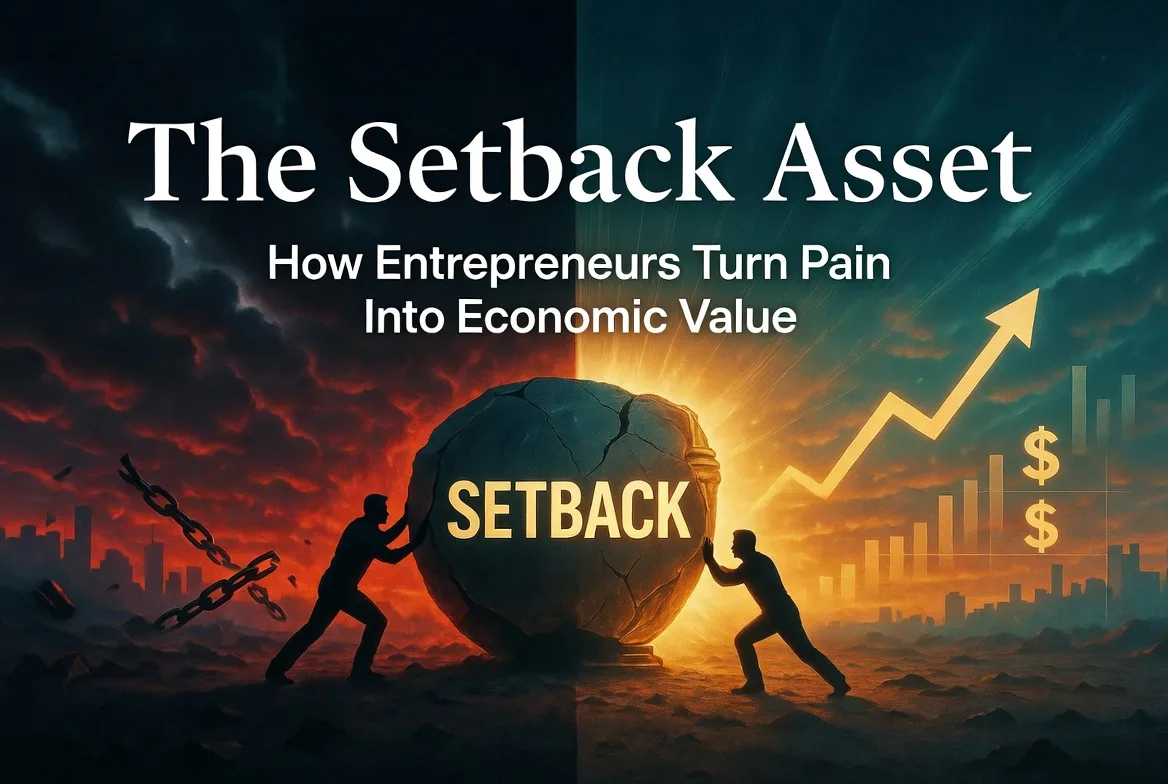
The Setback Asset: How Entrepreneurs Turn Pain Into Economic Value
Every entrepreneur eventually learns that business is not built only from ambition. It is also built from friction. A problem refuses to disappear. A system fails at the worst possible moment. A family crisis exposes a gap in the market. A health scare reveals how poorly existing solutions serve real people. A financial loss teaches the cost of trust without verification. A career collapse forces a person to rebuild with sharper eyes. A painful experience becomes more than a memory. It becomes research.
This is one of the most misunderstood sources of entrepreneurship. People often imagine business ideas arriving as flashes of inspiration. A founder sees a trend, studies a market, writes a plan, raises money, and launches. That version exists, but many durable businesses begin less elegantly. They begin with a person saying, “This should not be so hard.” They begin with frustration, grief, confusion, embarrassment, fear, or loss. They begin when someone discovers a problem so personally that ignoring it becomes impossible.
A setback, by itself, is not an asset. Pain does not automatically create wisdom. Failure does not automatically create skill. Trauma does not automatically create a business. Many people suffer and never build companies from it, nor should they have to. The romantic idea that every hardship exists to produce success can become cruel. Some pain is simply pain.
But when a person has enough distance, support, clarity, and discipline, a setback can become valuable information. It can reveal what customers truly experience. It can expose emotional details that market research misses. It can show where existing providers are careless, expensive, slow, confusing, or indifferent. It can create conviction strong enough to endure the difficult early years of building a company.
The financial lesson is not that entrepreneurs should seek suffering. The lesson is that lived experience can become economic value when it is converted into a product, service, process, brand, or platform that helps others solve a real problem. The transformation is not emotional alone. It is operational. The founder must move from personal pain to customer insight, from customer insight to a business model, from a business model to execution, and from execution to systems that can survive beyond the founder’s original story.
The Difference Between a Story and a Business
Founder stories are powerful. They help customers understand why a company exists. They help employees connect with the mission. They help investors understand conviction. They make a brand human. A founder who has lived the problem can speak with unusual credibility.
Yet a story is not a business model. A moving origin story may attract attention, but attention does not pay suppliers, salaries, taxes, rent, software bills, or loan repayments unless it becomes revenue. The founder must be careful not to confuse sympathy with demand. People may admire the journey without buying the product. They may share the story without becoming customers. They may applaud resilience without believing the solution is worth paying for.
The first test of a setback-born business is whether the problem exists beyond the founder. Was the pain personal only, or is it shared by a market? Are there enough people with the same problem? Do they recognize it? Are they willing to pay for a solution? Who currently serves them? Why are current solutions inadequate? What would make the new solution meaningfully better?
This distinction protects founders from building companies around unresolved emotion rather than verified demand. A personal experience can create insight, but the market still decides whether that insight has commercial value. The founder’s pain may open the door. Customer willingness to pay keeps the door open.
Why Lived Experience Can Be a Competitive Advantage
Many markets are poorly served because the people designing solutions are too far from the problem. They understand spreadsheets, categories, and customer segments, but not the lived texture of the issue. They may know that a customer needs mental health support, financial protection, recovery tools, elder care, cybersecurity, mobility assistance, career rebuilding, or emergency services. But they may not know what it feels like to be the person trying to access help while afraid, exhausted, ashamed, confused, or under pressure.
Lived experience can reveal hidden details. It can show that customers need simpler language, faster response times, more privacy, smaller payments, human reassurance, better onboarding, after-hours access, culturally sensitive communication, or fewer forms. It can reveal that the official problem is not the only problem. A person facing illness may also need financial planning. A victim of fraud may need emotional support as well as technical help. A family dealing with loss may need administrative guidance, not just condolences. A worker facing burnout may need income protection, not only advice to rest.
This is where a founder’s worst moment can become strategic insight. They have felt the customer’s urgency. They know which parts of the existing system fail. They understand the language customers use when they are not being studied. They can design for reality rather than theory.
But lived experience must be broadened. The founder should not assume every customer is exactly like them. Their experience is a starting point, not the entire market. They still need interviews, testing, feedback, data, and humility. The strongest setback-born businesses combine emotional truth with disciplined research.
The Founder’s Pain Must Become Customer Clarity
The transition from pain to business begins with translation. The founder must translate “what happened to me” into “what problem exists in the market.” This sounds simple, but it is emotionally demanding. Personal experiences are messy. Businesses require clarity.
For example, a founder who lost money to a scam may initially feel anger toward fraudsters. That anger is understandable, but anger alone is not a product. The business question is sharper: Which customers are most vulnerable to scams? At what point do they need protection? What warning signals can be detected? What education is missing? What tools can reduce harm? Who will pay for those tools: individuals, banks, employers, insurers, families, platforms, or institutions?
A founder who experienced a health collapse may feel betrayed by their previous lifestyle, workplace, or medical system. The business question is: What specific support would have changed the outcome? Is the opportunity coaching, diagnostics, software, workplace training, monitoring, community, insurance navigation, or recovery planning? Which customers have both need and budget?
A founder affected by war, displacement, or disaster may understand disruption more deeply than most. The business question is: What system can help people or companies remain functional under extreme uncertainty? Is the opportunity logistics, finance, communication, remote operations, mental resilience, housing, security, education, or rebuilding services?
The founder must turn emotion into a problem statement. A good problem statement is specific. It names the customer, the pain, the current alternative, the cost of inaction, and the desired outcome. Without that clarity, the business risks becoming a tribute to the founder’s experience rather than a solution customers can use.
The Danger of Mission Without Margin
Setback-born businesses often carry strong missions. That is one of their strengths. A founder who has experienced the problem may care deeply about serving customers well. They may be willing to work long hours, educate the market, and improve the product because the issue matters personally.
Mission can sustain motivation, but it cannot replace margin. A business without margin becomes dependent on donations, investor patience, founder sacrifice, or debt. If the company cannot earn enough to pay its costs and reinvest, it may fail before helping the people it was created to serve.
This is especially important in businesses born from painful experiences because founders may undercharge out of empathy. They know customers are suffering. They want the solution to be accessible. They may feel guilty charging properly. Yet underpricing can weaken the business and eventually harm customers if the company cannot survive.
The financial discipline is to design affordability without destroying sustainability. That may mean tiered pricing, institutional buyers, subscriptions, insurance partnerships, employer-paid models, group services, licensing, grants for low-income users, or cross-subsidized offerings. The founder must ask who benefits, who pays, and how the business remains viable over time.
A mission-driven company that ignores economics may become another failed promise. A mission-driven company with strong unit economics can keep serving for years.
Turning Credibility Into Trust
A founder who has lived the problem often has natural credibility. Customers may feel seen. They may believe the founder understands what outsiders miss. This can reduce the trust barrier, especially in sensitive categories such as health, grief, financial recovery, trauma, security, disability, caregiving, addiction, or career rebuilding.
But credibility must become trust through delivery. Customers do not stay because the founder has a moving story. They stay because the product works, the service is reliable, the pricing is fair, the communication is clear, and the company respects them.
Trust is built through operational details. Are customer inquiries answered quickly? Are promises realistic? Are outcomes explained honestly? Are refunds handled properly? Are testimonials used ethically? Is customer data protected? Are staff trained to handle sensitive situations? Does the company admit limitations? Does it refer customers elsewhere when it cannot help?
In setback-born businesses, trust can be fragile because customers may be vulnerable. They may be dealing with loss, fear, debt, illness, stress, or uncertainty. The company must avoid exploiting pain through exaggerated claims. It must not use the founder’s story to create emotional pressure. The highest form of trust comes when the business combines empathy with professionalism.
The Founder Is Not the Customer Forever
In the beginning, the founder’s personal experience may guide product design. Over time, the company must learn from many customers. The founder’s pain cannot remain the only source of truth.
This is a difficult shift. Founders can become attached to their original interpretation of the problem. They may resist feedback that conflicts with their experience. They may assume customers need what the founder needed. They may build features that honour the founder’s story but fail to solve the wider market’s problem.
Growth requires humility. The founder must ask: What are customers actually doing? Where do they drop off? What do they misunderstand? What do they value enough to pay for? Which features are ignored? Which complaints repeat? Which customer segment is best served? Which segment drains resources? What problem are we truly solving now?
A setback can start the business, but customer evidence must shape it. The company that remains trapped in the founder’s original pain may fail to evolve. The company that listens carefully can become larger than the founding moment.
Resilience Is Not a Business Strategy
Entrepreneurial culture often praises resilience. Founders are told to keep going, push through, endure rejection, and turn pain into power. There is truth in this. Business requires stamina. But resilience alone is not a strategy.
A founder can be resilient and still run out of cash. They can be resilient and still misprice the product. They can be resilient and still ignore customer feedback. They can be resilient and still hire poorly. They can be resilient and still build something nobody wants. They can be resilient and still burn out.
The most useful form of resilience is not endless endurance. It is adaptive resilience. It asks what the setback teaches, what must change, and which systems reduce the chance of repeating the same damage. In business, resilience should lead to better planning, sharper decision-making, stronger cash reserves, clearer contracts, improved risk management, and more honest measurement.
Founders who build from adversity must be especially careful not to glorify suffering. A company should not depend on the founder remaining in crisis mode. The goal is not to survive chaos forever. The goal is to build a business disciplined enough that chaos becomes less destructive.
The Financial Architecture of a Setback-Born Business
Every business needs financial architecture, but setback-born businesses need it urgently because emotion can distort financial decisions. The founder may move too quickly because the mission feels urgent. They may spend too much on branding before proving demand. They may hire friends who understand the story but lack the skill. They may accept unfavourable partnerships because they want reach. They may avoid charging properly because the audience is vulnerable. They may use personal savings longer than is wise because the work feels meaningful.
Financial architecture means creating rules before pressure rises. The business should know its startup costs, monthly operating costs, break-even point, gross margin, customer acquisition cost, expected payback period, cash runway, pricing model, and funding plan. It should separate personal money from business money. It should track revenue and profit, not only impact. It should budget for professional advice where needed. It should avoid building fixed costs faster than recurring revenue.
Cash flow is especially important. A mission can attract attention before it attracts payment. Media coverage, social engagement, and community support can create the impression of momentum, but suppliers require cash. Employees require pay. Software bills arrive. Taxes accumulate. The founder must be honest about whether the business is financially healthy or merely emotionally compelling.
The Product Must Reduce Pain, Not Display It
There is a subtle risk in businesses built from painful stories: the company may keep returning to the pain because the pain attracts attention. The founder’s worst moment becomes part of the brand narrative. It is repeated in interviews, pitches, social posts, sales pages, investor decks, and speeches. At first, this helps people understand the mission. Over time, it can trap the founder in a permanent performance of the crisis.
A healthy business eventually shifts the spotlight from the founder’s pain to the customer’s outcome. The founder’s story explains why the company began. The product proves why it deserves to continue.
Customers do not want to live inside the founder’s trauma. They want help. They want protection, recovery, clarity, convenience, confidence, savings, safety, dignity, or progress. The business should measure success by the customer’s improved life, not by the emotional intensity of the origin story.
This shift also protects the founder. Repeatedly monetizing the worst moment of one’s life can become emotionally costly. A founder needs boundaries around how much they share, when they share it, and whether the business can stand without constant personal disclosure. The strongest brands can honour the founder’s story without requiring the founder to reopen it daily.
Opportunity Often Hides in Broken Systems
Many setback-born businesses emerge because a system failed. A healthcare system was too slow. A financial system was too confusing. A security system was too weak. A workplace system ignored human limits. A legal system felt inaccessible. A support system disappeared after the crisis. A customer-service system treated people like case numbers.
Broken systems create entrepreneurial opportunity because they produce repeated frustration. If many people encounter the same failure, a business may be able to offer a better path. The opportunity may not be the crisis itself, but the gap around it: navigation, education, prevention, coordination, documentation, access, follow-up, financing, emotional support, or accountability.
For example, a person who struggled to manage a family member’s care may discover that the market needs better caregiving coordination. A person who faced a cybersecurity breach may discover that small businesses need simple digital protection. A person who lost income during illness may discover that freelancers need better financial safety nets. A person who experienced burnout may discover that founders need operational systems that protect health.
The founder’s advantage is that they know where the official solution ended and the real problem continued.
From One Pain Point to a Platform
Some of the strongest companies begin by solving one painful problem extremely well, then expand into a broader platform. The first product gives the business focus. The platform creates scale.
A founder might begin with a simple tool for scam prevention, then expand into identity protection, family alerts, business cybersecurity education, and insurance partnerships. Another might begin with recovery coaching after burnout, then develop diagnostics, employer programs, training modules, and software. Another might begin with emergency support for a specific crisis, then build a marketplace, subscription service, or institutional solution.
The key is sequence. Founders often make the mistake of trying to solve every related problem at once because their lived experience revealed many gaps. But early-stage businesses have limited time, money, and attention. They must earn the right to expand. The first product should be narrow enough to execute well and valuable enough to prove demand.
Expansion should follow customer pull, not founder overwhelm. If customers repeatedly ask for adjacent help and the business has the capability to serve them profitably, expansion may make sense. If expansion is driven mainly by the founder’s desire to fix everything, the company may lose focus.
The Role of Community
Setback-born businesses often attract communities, not just customers. People who share a difficult experience may want connection, validation, and practical guidance. Community can strengthen trust and create powerful feedback loops. It can also become a valuable distribution channel.
But community must be handled carefully. A community built around sensitive issues needs moderation, boundaries, privacy, and ethical leadership. The business must decide whether the community is free, paid, member-led, expert-led, or connected to a product. It must protect members from misinformation, exploitation, harassment, and emotional overdependence.
Financially, community can support subscriptions, events, education, referrals, product development, and retention. But it can also become labour-intensive. Founders should not assume community is free growth. Moderation, content, support, technology, and trust-building require resources. The company must design a model that supports both the members and the business.
Pricing a Solution Born From Pain
Pricing is difficult in any business. It becomes more difficult when the product addresses a painful or personal problem. Founders may worry that charging is exploitative. Customers may compare the price with their emotional urgency rather than ordinary market alternatives. Investors may push for margins. The founder may want access and sustainability at the same time.
The best pricing begins with value. What problem is being solved? What does the problem currently cost the customer in money, time, stress, lost opportunity, risk, or harm? What alternatives exist? Who has the budget? How often will the customer need the solution? Is the buyer the user, an institution, an employer, an insurer, a family member, or a public agency?
In some categories, the individual user may need the service but lack ability to pay. That does not mean the business cannot work; it means the business model must identify a payer with aligned incentives. Employers may pay for employee wellbeing tools. Insurers may pay for prevention. Families may pay for elder-care coordination. Financial institutions may pay for fraud reduction. Governments or nonprofits may subsidize access. Schools may pay for student support. The founder must think beyond direct-to-consumer pricing if the customer’s need and budget do not match.
Compassion and commercial discipline are not enemies. A business that prices intelligently can serve more people for longer.
When Personal Conviction Becomes Overconfidence
Founders who have lived the problem often possess strong conviction. This helps them persist when outsiders doubt the opportunity. But conviction can become overconfidence. The founder may believe they understand the market so deeply that they stop testing assumptions. They may dismiss criticism as lack of empathy. They may believe the mission guarantees eventual success. They may interpret every obstacle as proof they must push harder rather than evidence they need to adjust.
This is dangerous. Personal experience gives insight, not immunity from error. The founder still needs market validation, financial controls, legal compliance, operational discipline, and customer feedback. They still need to know when to pivot, pause, or abandon a feature. They still need advisers who can challenge them honestly.
A useful rule is to separate conviction about the problem from flexibility about the solution. The founder may be certain the problem matters. They should remain open to discovering the best way to solve it.
The Importance of Founder Recovery
A founder who builds from a worst moment may still be healing. This matters. Starting a business is stressful even in ordinary circumstances. It can become especially intense when the business keeps the founder close to the source of pain. Customer stories may trigger memories. Public speaking may require revisiting difficult details. Investor rejection may feel personal. Slow growth may feel like the world is dismissing the problem.
Founder recovery is not separate from company performance. A founder who has not built emotional support may make reactive decisions. They may overwork to prove meaning. They may rescue every customer personally. They may avoid delegation because the issue feels too important. They may burn out while trying to help others avoid harm.
Every founder needs support, but setback-born founders may need deliberate boundaries. Therapy, coaching, peer groups, advisory boards, rest periods, and clear role definitions can protect both the person and the company. The founder must remember that they are not obligated to sacrifice themselves indefinitely because the mission matters.
Building Systems Around Empathy
Empathy is often the founding strength of these businesses. The founder understands the customer’s fear, confusion, or frustration. But empathy must become systems. Otherwise, the company depends too heavily on the founder’s personal involvement.
Systems can include customer scripts, onboarding processes, service standards, escalation rules, training manuals, quality checks, privacy policies, refund rules, response-time targets, and product roadmaps. These tools do not make the company less human. They help the company deliver humane service consistently.
A business that relies only on founder empathy cannot scale. A business that turns empathy into process can serve many more people without losing its soul.
The Investor’s View of Adversity-Based Businesses
Investors may be attracted to founders with strong personal stories because they signal commitment. But sophisticated investors will still examine market size, unit economics, defensibility, distribution, retention, team quality, regulatory risk, and scalability. A compelling story can open the meeting. It cannot replace the numbers.
Founders seeking capital should be prepared to explain the business clearly without relying solely on emotion. What is the customer acquisition strategy? What is the gross margin? What is the sales cycle? What is the retention rate? What proof exists that customers will pay? What makes the company defensible? What milestones will funding achieve? What risks could prevent scale?
The founder’s personal experience should support the investment case, not carry it alone. The best pitch connects lived insight to market opportunity and execution capability.
Wealth Is Built When Insight Becomes an Asset
There is a wealth principle beneath this entire discussion: insight becomes valuable when it is turned into an asset. A painful lesson sitting only in memory may shape a person’s life, but it does not automatically create financial value. The entrepreneur creates value by packaging insight into something that can be sold, licensed, subscribed to, invested in, or scaled.
An asset may be software, curriculum, intellectual property, a service method, a trusted brand, a community, a data set, a distribution network, a product line, a certification program, or a repeatable operating process. The asset should not depend entirely on the founder’s daily emotional labour. It should be capable of producing value through systems.
This is where many founders struggle. They become powerful storytellers and passionate service providers, but they do not build assets. They remain the product. Every sale depends on their presence. Every customer wants their personal attention. Every partnership requires their story. This can produce income, but it may not produce freedom.
The founder’s long-term task is to move from personal experience to institutional capability. The company should gradually become able to solve the problem even when the founder is not in every conversation.
Turning Setbacks Into a Practical Business Framework
An entrepreneur trying to build from a difficult experience can use a simple framework.
First, name the problem clearly. Avoid broad statements such as “people need support” or “the system is broken.” Be specific. Who is struggling, when, and why?
Second, validate beyond your own experience. Speak with potential customers. Look for repeated patterns. Ask what they currently do, what they have tried, what they paid for, what failed, and what outcome they value most.
Third, define the buyer. The person with the pain may not be the person with the budget. Identify who pays and why.
Fourth, build a narrow solution. Solve one painful problem well before expanding.
Fifth, price for sustainability. Empathy should influence design, but the business must be able to survive.
Sixth, protect trust. Use honest claims, strong privacy practices, clear communication, and appropriate human support.
Seventh, measure outcomes. Track whether customers receive the promised value.
Eighth, build systems. Convert founder knowledge into processes that staff, partners, or technology can deliver consistently.
Ninth, separate identity from company performance. The business may need to pivot without invalidating the founder’s experience.
Tenth, convert income into wealth. Use business profit to build reserves, reinvest intelligently, and acquire assets beyond the company.
The Risk of Building From Revenge
Some businesses begin as a response to being wronged. A founder may have been cheated, ignored, underestimated, mistreated, rejected, or harmed by an institution. The desire to prove others wrong can create energy. But revenge is a poor long-term fuel.
Revenge keeps the founder emotionally tied to the past. It may lead to impulsive decisions, public hostility, or obsession with competitors. It can distort strategy because the founder is building against someone rather than for customers. The business becomes a battlefield instead of an enterprise.
The healthier transformation is from revenge to service. The founder may begin with anger, but the company should mature into a solution. The question should become: How do we help customers avoid this harm? How do we build something better? How do we create economic value from prevention, protection, education, or recovery?
Anger can light the match. It should not run the company.
Why Timing Matters
Not every setback should immediately become a business. Sometimes the founder needs time to heal, learn, stabilize finances, or understand the market. Building too soon can lead to decisions made from urgency rather than clarity.
Timing also matters commercially. A market may not be ready. Technology may not yet support the solution. Customers may not recognize the problem. Regulation may be unclear. Distribution may be too expensive. The founder’s experience may be real, but the business opportunity may require patience.
A wise founder distinguishes between emotional urgency and strategic readiness. They may begin by researching, writing, advising, volunteering, consulting, or building a small prototype before committing fully. This allows learning without risking everything too early.
The Role of Partnerships
Setback-born founders often have deep problem insight but may lack technical, financial, operational, legal, or distribution expertise. Partnerships can fill these gaps. A founder with lived experience in healthcare may need a medical adviser, software developer, compliance expert, and institutional sales partner. A founder focused on financial protection may need cybersecurity experts, lawyers, banks, or insurers. A founder addressing workplace burnout may need psychologists, HR specialists, and enterprise sales expertise.
The right partners turn insight into capability. The wrong partners can exploit the founder’s story, dilute the mission, or create conflict. Founders should use written agreements, clear roles, equity discipline, and proper due diligence. Shared passion is not enough. Partnerships require aligned incentives and complementary competence.
Protecting the Founder’s Story
A founder’s story can become part of company intellectual and emotional capital. It should be handled intentionally. The founder should decide which details are public, which are private, and which are shared only in trusted settings. They should not feel pressured by marketers, investors, or media to disclose more than is healthy.
Once a story becomes public, it can be repeated, interpreted, challenged, or reduced to a headline. The founder should retain control where possible. They should frame the story around learning and service, not spectacle. They should avoid making claims they are not comfortable defending. They should remember that privacy can coexist with authenticity.
From Survival Income to Wealth Creation
Many founders begin by needing income. They sell services, take consulting work, accept speaking engagements, coach clients, or build custom solutions. This can be necessary. But survival income should eventually move toward scalable value.
A service business can become a methodology. A methodology can become training. Training can become certification. Certification can become licensing. Custom consulting can become software. One-on-one support can become group programs. A personal story can become a trusted brand. A trusted brand can become partnerships. The goal is not always to build a huge company. The goal is to avoid being trapped in a model where every dollar requires the founder’s direct emotional and time input.
Wealth building requires surplus. Surplus requires margins. Margins require pricing, systems, and focus. A setback may give the founder purpose, but wealth comes from converting that purpose into a financially durable structure.
What Employees Need From Mission-Driven Founders
Employees who join a setback-born business may be attracted by mission. They may want to help solve a meaningful problem. But mission-driven workplaces can become unhealthy if boundaries are weak. Employees may be expected to sacrifice because the cause matters. They may absorb customer pain without enough support. They may work long hours because the founder’s urgency sets the emotional temperature.
A responsible founder builds a mission that does not exploit employees. Clear roles, fair pay, reasonable workload, training, psychological safety, and operational discipline matter. A company created to reduce pain should not create unnecessary pain internally.
Culture is part of the product. If employees are burned out, customers will eventually feel it. If staff are supported, the company can serve more consistently.
The Quiet Discipline Behind Inspirational Stories
Public stories of founders turning worst moments into businesses often emphasize courage. Courage matters. But the hidden discipline matters more. Behind every sustainable company are decisions that rarely fit into inspirational headlines: bookkeeping, compliance, pricing, hiring, firing, customer support, product testing, legal review, supplier negotiation, cash-flow management, and difficult prioritization.
This is why aspiring entrepreneurs should study more than the dramatic origin. The origin may inspire, but the operating discipline teaches. How did the founder validate demand? How did they fund the early stage? How did they choose the first customer segment? How did they avoid overbuilding? How did they price? How did they handle emotional fatigue? How did they move beyond personal story? How did they build a team?
In business, inspiration starts the engine. Discipline keeps it running.
The Wealth Mindset of Post-Setback Entrepreneurship
A setback can produce two opposite money mindsets. One is scarcity: the founder becomes fearful, reactive, and desperate to avoid pain at all costs. The other is stewardship: the founder becomes more deliberate, more aware of risk, and more committed to building systems that protect people.
The stewardship mindset is more useful. It asks how money can create safety, resilience, access, and options. It treats profit not as greed, but as fuel for continuity. It values reserves because reserves prevent panic. It values insurance because protection matters. It values contracts because clarity prevents conflict. It values diversification because no single income stream is invincible. It values ownership because ownership turns effort into long-term power.
A founder who has suffered may understand the importance of buffers more deeply than others. The business should reflect that wisdom. It should not run permanently on the edge.
The Bigger Lesson for Investors and Consumers
Consumers should appreciate founders with lived experience, but still evaluate the product. Does it work? Is it priced fairly? Are claims honest? Is data protected? Are qualifications clear? Is the company transparent about limitations? Emotional connection should not replace due diligence.
Investors should recognize that personal adversity can create exceptional founder-market fit, but it must be paired with execution. The founder’s story may indicate insight and resilience. It does not guarantee scalability, profitability, or governance.
Aspiring entrepreneurs should look at their own difficult experiences with care. Not every wound needs to become a company. But every hard-earned lesson can become a source of wisdom. Sometimes that wisdom leads to a business. Sometimes it leads to better financial decisions, stronger boundaries, smarter career choices, or more compassionate leadership.
The Setback Asset
The phrase “setback asset” may sound contradictory. A setback feels like loss. An asset creates value. The bridge between them is transformation. A setback becomes an asset only when it produces insight that can be applied, shared, systemized, and used to improve outcomes for others.
This transformation requires more than resilience. It requires patience, self-awareness, market validation, financial discipline, ethical storytelling, and operational excellence. The founder must honour the experience without being trapped by it. They must serve customers without exploiting vulnerability. They must build a mission without ignoring margins. They must convert pain into process, and process into value.
That is the real lesson behind founders who build from their worst moments. Their businesses are not proof that pain is good. They are proof that people can sometimes extract meaning, insight, and economic value from circumstances they never would have chosen.
For anyone building wealth, the principle is powerful. Your past may contain more information than you think. The problems you understand deeply may reveal opportunities others overlook. The frustrations you survived may help you design better solutions. But the market rewards more than personal history. It rewards usefulness, trust, execution, and sustainability.
A worst moment can begin a business. It cannot run one. The founder must do that through numbers, systems, people, product, customer care, and disciplined reinvestment. When those pieces come together, a setback can become more than a story. It can become an enterprise. And in the best cases, that enterprise can turn one person’s hard lesson into protection, clarity, and value for many others.
 Article
 Article
 Article
 Article
 Article
 Article
 Article
 Article