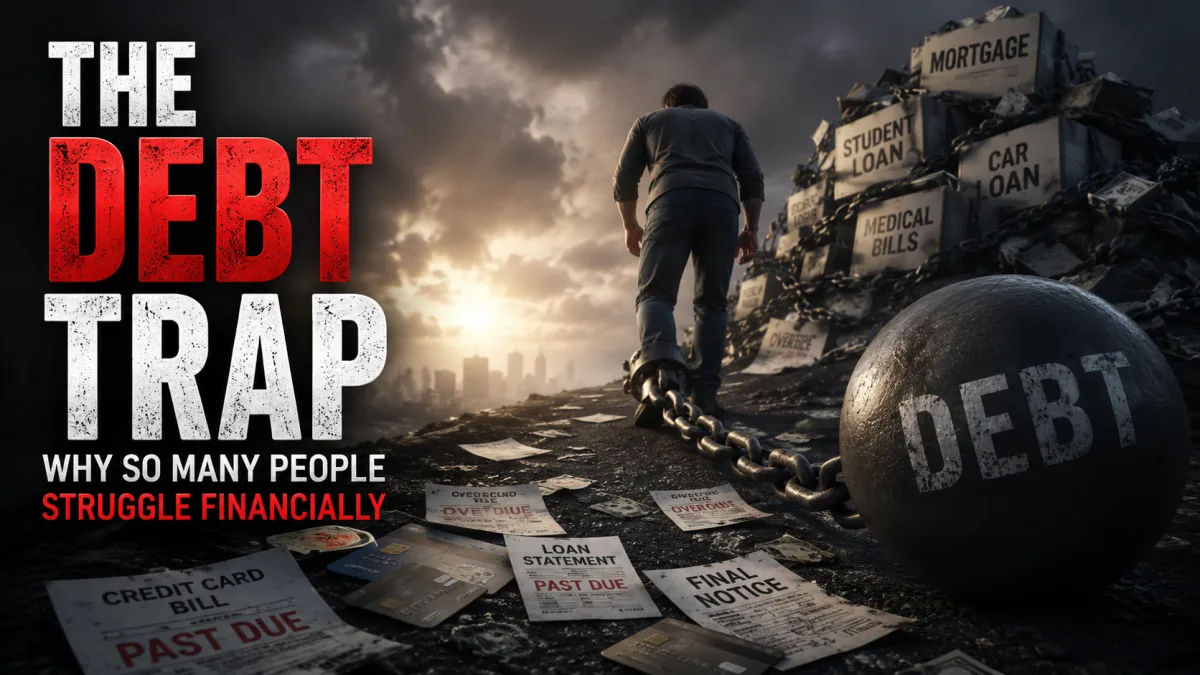
The Complete Guide to Debt Management: How to Eliminate Debt and Build Long-Term Wealth
Introduction
Debt is one of the most powerful financial tools ever created. It has helped individuals purchase homes, businesses expand operations, governments build infrastructure, and entire economies accelerate growth. Yet debt is also one of the leading causes of financial stress, bankruptcy, and wealth destruction. Understanding how debt works is not merely a financial skill. It is a life skill.
Every day millions of people make payments on mortgages, student loans, vehicle loans, personal loans, and credit cards. Many understand the payment itself but few understand the system behind the payment. They know money leaves their account each month, yet they may not understand how interest accumulates, how lenders assess risk, or how borrowing affects long-term wealth creation.
The result is that debt often becomes an invisible force shaping financial outcomes. Two people can earn the same income and have dramatically different financial futures based entirely on how they manage debt. One person may use debt strategically to acquire appreciating assets and increase net worth. Another may use debt to finance consumption and become trapped in a cycle of repayments that limits future opportunities.
Financial freedom is not determined solely by income. Many high-income earners struggle financially because of excessive debt obligations. At the same time, many moderate-income earners build substantial wealth by managing debt effectively and directing resources toward productive assets.
This guide explores debt from every angle. You will learn how debt evolved throughout history, why it exists in modern economies, how interest works, the psychology behind borrowing, strategies for debt elimination, and the steps required to transition from debt repayment to wealth building. The objective is not simply to reduce debt but to develop a complete understanding of how debt fits into a long-term financial plan.
Understanding the Nature of Debt
Debt is an agreement between two parties. One party provides money today while the other agrees to repay that money in the future, usually with additional compensation in the form of interest. This arrangement creates opportunities for both parties. Borrowers gain immediate access to capital while lenders earn a return on their funds.
Debt exists because time has value. Most people would prefer to access resources today rather than wait years to save enough money. A family purchasing a home may not want to spend twenty years saving before becoming homeowners. A business owner may not want to postpone expansion until sufficient profits accumulate. Debt bridges the gap between current needs and future earning capacity.
However, debt introduces obligations. Every borrowed dollar creates a future responsibility. The borrower must generate enough income to satisfy repayment terms regardless of changing economic conditions. This obligation is what makes debt both useful and potentially dangerous.
Historically, debt has played a critical role in economic development. Ancient civilizations used debt agreements to facilitate trade and agricultural production. Merchants borrowed resources to finance trade expeditions. Farmers borrowed seeds and livestock to increase output. Over time these arrangements evolved into sophisticated banking systems capable of supporting complex economies.
Modern debt markets are enormous. Governments issue bonds to finance public projects. Corporations borrow to expand operations and invest in innovation. Households borrow to purchase homes, vehicles, and education. Collectively these activities drive economic growth by allowing resources to be deployed efficiently.
Despite these benefits, debt can become problematic when borrowing exceeds repayment capacity. Excessive debt reduces flexibility, increases financial risk, and limits future opportunities. Understanding this balance is essential for effective debt management.
Why Debt Is Neither Good Nor Bad
Many financial discussions classify debt as either good or bad. While this distinction can be useful, it oversimplifies reality. Debt itself is neutral. What matters is how it is used and whether it contributes to long-term financial objectives.
Productive debt supports activities that generate future value. A business loan used to expand operations may increase profits. A mortgage used to purchase a reasonably priced property may help build equity. Education financing that significantly increases earning potential may produce returns that exceed borrowing costs.
Destructive debt finances consumption without generating future economic benefits. High-interest credit card balances used for discretionary spending often fall into this category. Borrowing to purchase rapidly depreciating assets can create financial strain without improving long-term financial outcomes.
Consider two individuals who each borrow $50,000. The first uses the funds to start a business that generates recurring income. The second uses the funds for luxury consumption. Five years later the first individual may own an appreciating asset while the second is left with debt obligations and little to show for them.
The difference is not the debt itself. The difference is what the debt was used to acquire.

