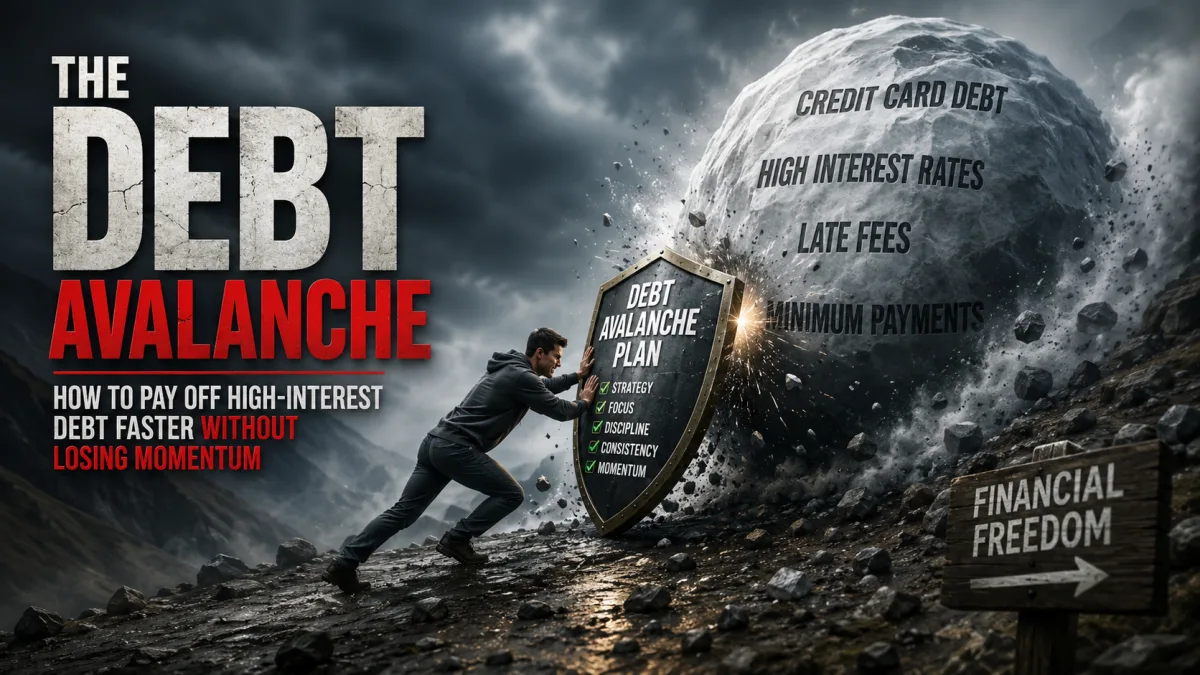
The Debt Avalanche: How to Pay Off High-Interest Debt Faster Without Losing Momentum
Debt becomes most dangerous when it grows faster than your ability to escape it. A balance that once seemed manageable begins to expand under interest charges. Minimum payments keep the account current but barely reduce the amount owed. A credit card purchase from months ago still appears on the statement. A personal loan feels heavier than expected. The borrower is paying every month, yet the debt remains stubbornly alive.
This is the financial reality the debt avalanche method was designed to attack.
The debt avalanche is a repayment strategy that focuses extra money on the debt with the highest interest rate first while maintaining minimum payments on all other debts. Once the highest-interest debt is paid off, the money that was going toward it rolls into the next-highest-interest debt. The process continues until every targeted debt is eliminated.
The logic is simple: the most expensive debt should be destroyed first.
High-interest debt acts like a leak in a household’s financial system. The longer it remains, the more money escapes through interest. The debt avalanche method plugs the largest leak first. It does not prioritize the smallest balance, the most annoying account, or the loan that feels emotionally satisfying to close. It prioritizes mathematical cost.
That discipline can save a borrower substantial money over time. It can also shorten the repayment journey because less of each payment is wasted on interest and more goes toward principal. For people carrying credit card balances, payday-style loans, high-rate personal loans, or other expensive debt, the avalanche method can be one of the most powerful debt repayment strategies available.
But the debt avalanche is more than a spreadsheet technique. To work in real life, it must be paired with cash flow control, emergency planning, behavior change, and a repayment system that a person can sustain through stress. Debt is rarely just a math problem. It is also a pressure problem, a habit problem, a timing problem, and sometimes an income problem.
The purpose of the avalanche method is not merely to pay off accounts. It is to stop high-interest debt from controlling future income. Every dollar no longer lost to interest becomes a dollar that can strengthen savings, build investments, fund goals, and restore financial flexibility.
Why High-Interest Debt Is So Expensive
Not all debt carries the same financial weight. A low-rate mortgage, a reasonable student loan, and a high-interest credit card do not affect a household in the same way. The interest rate determines how aggressively the debt works against the borrower.
High-interest debt is costly because interest compounds against the person who owes money. Instead of earning returns on assets, the borrower pays returns to the lender. When the rate is high, the balance can become difficult to reduce unless payments are meaningfully above the minimum.
Credit cards are the clearest example. Many credit cards charge interest rates that can make repayment slow and expensive when balances are carried month to month. The minimum payment may keep the account in good standing, but it is often designed to stretch repayment over a long period. That means the borrower may send money every month while the principal falls only gradually.
This creates a discouraging cycle. The borrower feels responsible because they are making payments, but the balance barely moves. Interest charges absorb a large share of the payment. If new purchases continue, the balance may not fall at all. In some cases, it rises.
The emotional cost can be just as serious as the financial cost. High-interest debt creates a feeling of running in place. It can make income feel smaller than it is because a portion of every paycheck has already been claimed by past spending. It can also delay wealth building because money that could have been invested is instead sent to creditors.
The debt avalanche method responds to this problem by asking one central question: which debt is costing the most per dollar owed?
The answer is the debt with the highest interest rate. That is the first target.
How the Debt Avalanche Method Works
The debt avalanche method follows a clear sequence.
First, list every debt included in the repayment plan. This may include credit cards, personal loans, medical debt, private student loans, auto loans, buy-now-pay-later balances, and other consumer debts. Mortgages are often treated separately because they usually have longer terms and lower rates, but the decision depends on the household’s full financial picture.
Second, record the balance, interest rate, minimum payment, due date, and lender for each debt. The interest rate is the most important number for the avalanche method because it determines the repayment order.
Third, rank the debts from highest interest rate to lowest interest rate. The highest-rate debt becomes the first avalanche target.
Fourth, continue making minimum payments on every debt. This step is essential. The avalanche method does not ignore lower-priority debts. Missing payments can create fees, damage credit, and increase stress. Every account must remain current.
Fifth, send every extra dollar available for debt repayment to the highest-interest debt. This extra payment attacks principal. The faster the principal falls, the less future interest accrues.
Sixth, when the first debt is paid off, take the entire amount that was going toward it and apply it to the next-highest-interest debt. This creates momentum. The payment grows larger as each account disappears.
Finally, repeat the process until the targeted debts are gone.
The name “avalanche” captures the momentum of the method. At the beginning, progress may feel slow because several minimum payments still compete for cash flow. But as each debt is eliminated, the freed-up payment rolls downhill into the next debt. The repayment force becomes larger over time.
A Simple Debt Avalanche Example
Imagine a borrower has four debts:
A credit card with a $4,000 balance at 27% interest.
A store card with a $1,200 balance at 31% interest.
A personal loan with a $6,500 balance at 13% interest.
An auto loan with a $9,000 balance at 7% interest.
Using the debt avalanche method, the borrower would not begin with the largest balance. They would not begin with the auto loan. They would not begin with the credit card simply because it feels more familiar. They would begin with the store card because it has the highest interest rate at 31%.
The borrower would make minimum payments on all four debts, then send every extra repayment dollar to the store card. Once the store card is gone, they would redirect that payment to the credit card at 27%. After the credit card is gone, they would attack the personal loan at 13%. The auto loan at 7% would come last.
This order may feel counterintuitive because the store card has the smallest balance. In this case, the avalanche method and the desire for a quick win happen to align. But if the highest-interest debt had been the largest balance, the avalanche would still target it first. The interest rate controls the order.
The benefit is that the borrower reduces the most expensive debt as quickly as possible. Every month the 31% balance survives, it extracts more interest. Eliminating it first stops the highest-cost damage.
Why the Avalanche Method Can Beat the Minimum Payment Trap
Minimum payments are useful because they keep accounts current. But they are often a poor wealth-building strategy. If a borrower pays only the minimum on high-interest debt, repayment can take much longer than expected and cost far more than the original balance suggests.
The minimum payment trap works because the payment is usually a small portion of the outstanding balance. When the balance is large and the interest rate is high, a meaningful part of the payment goes to interest rather than principal. The debt declines slowly. If the borrower continues using the card, the repayment progress can disappear.
The avalanche method changes the structure. Instead of spreading extra money thinly across every debt, it concentrates force on one target. This matters because concentrated principal reduction lowers future interest on that specific debt. The borrower is not just paying more. They are paying more where it has the greatest mathematical impact.
Think of high-interest debt as a set of fires. Minimum payments keep the fires from spreading into penalties and default. The avalanche method sends the largest bucket of water to the hottest fire. Once that fire is out, the same bucket moves to the next one.
Without concentration, repayment can feel scattered. A little extra goes here, a little extra goes there, and no balance changes enough to create a breakthrough. With the avalanche method, the borrower has one main target. That clarity can improve both financial results and emotional focus.
Debt Avalanche Versus Debt Snowball
The debt avalanche method is often compared with the debt snowball method. Both can work. The difference is priority.
The avalanche method ranks debts by interest rate, from highest to lowest. It is designed to save the most money on interest.
The snowball method ranks debts by balance, from smallest to largest. It is designed to create quick emotional wins by closing accounts faster.
For example, suppose a borrower has a $500 medical bill at 0% interest and a $5,000 credit card balance at 28% interest. The snowball method would likely pay off the $500 medical bill first because it is the smallest balance. The avalanche method would attack the 28% credit card first because it is the most expensive debt.
Mathematically, the avalanche method usually has the advantage when interest rates differ significantly. Paying off the highest-rate debt first reduces total interest costs. But personal finance is not only mathematics. Some borrowers need the motivation of fast account closures. If the snowball method keeps someone engaged while the avalanche method feels too slow, the snowball may work better behaviorally.
The strongest strategy is the one a person can complete. But when a borrower is motivated, organized, and serious about reducing interest, the avalanche method is often the more efficient choice.
There is also a hybrid approach. A borrower may pay off one very small balance first to create breathing room, then switch to the avalanche method. This can be useful if a tiny debt is creating mental clutter or if eliminating it frees up a payment quickly. The key is to avoid using emotional preference as an excuse to ignore very expensive debt for too long.
Step One: Stop Adding New High-Interest Debt
The avalanche method cannot work if new debt keeps falling onto the mountain. Before the repayment plan becomes powerful, the borrower must stop adding new high-interest balances.
This does not require a perfect life. Unexpected expenses happen. Income can be irregular. Emergencies can force hard decisions. But the borrower needs a clear rule: the accounts being paid off should not continue funding ordinary lifestyle spending.
For credit card debt, this may mean temporarily removing saved card information from shopping websites, leaving cards at home, switching recurring charges to a debit card, or using cash for certain spending categories. The goal is not punishment. The goal is to stop the balance from growing while repayment begins.
This step can be uncomfortable because credit cards often become a pressure valve for cash flow problems. If groceries, fuel, school costs, or medical expenses are regularly going onto a card because income is not covering the month, the issue is larger than repayment order. The household may need a spending reset, income increase, bill negotiation, or temporary hardship plan.
Avalanche repayment is most effective when paired with a no-new-debt rule. Otherwise, extra payments reduce the balance while new charges rebuild it. That creates the illusion of progress without actual escape.
Step Two: Build a Small Emergency Buffer
Some people want to send every spare dollar to debt immediately. That urgency is understandable, especially when interest rates are high. But without any emergency buffer, a single surprise expense can push the borrower back into debt.
A small emergency fund acts as a shock absorber. It does not need to be large at the beginning. Even a modest cushion can prevent a car repair, school expense, medical copay, or urgent travel need from becoming a new credit card balance.
The right amount depends on the household. Someone with stable income, low expenses, and family support may need less at the start. Someone with children, an older car, variable income, or limited support may need more. The goal is not to fully fund every possible emergency before debt repayment. The goal is to create enough cash protection that the avalanche plan is not constantly interrupted.
This is one of the most important psychological benefits of an emergency buffer. It helps the borrower trust the plan. Without cash reserves, every unexpected event feels like failure. With a buffer, the borrower can handle small disruptions and continue attacking debt.
Step Three: Create a Complete Debt Inventory
A debt avalanche plan requires accurate information. Guessing is not enough. The borrower needs a full debt inventory.
For each debt, record the lender, account type, current balance, annual percentage rate, minimum payment, due date, promotional rate expiration, fees, and whether the rate is fixed or variable. This information can usually be found on statements, online account dashboards, or loan documents.
Promotional rates deserve special attention. A credit card may have a temporary 0% balance transfer rate that later jumps sharply. A buy-now-pay-later plan may become expensive if not paid within a certain period. A deferred-interest offer may charge back interest if the balance is not cleared in time. These details can affect the avalanche order.
The borrower should also identify whether any debts are secured by collateral. Auto loans, for example, are tied to a vehicle. Secured debts can carry different consequences if unpaid. The avalanche method still uses interest rate as its main guide, but practical risk matters too. Keeping essential transportation or housing stable may affect payment decisions.
A complete debt inventory turns anxiety into facts. Instead of a vague feeling of being overwhelmed, the borrower has a map. A map does not eliminate the journey, but it shows where to begin.
Step Four: Rank Debts by Interest Rate
Once the debt inventory is complete, rank the debts from highest interest rate to lowest interest rate. This is the heart of the avalanche method.
If two debts have similar interest rates, the borrower can use balance size, payment size, or emotional preference as a tiebreaker. For example, if one card has a 24.99% rate and another has a 25.24% rate, the mathematical difference may be small. Paying the smaller balance first might create a quick win without sacrificing much efficiency. But if one debt is at 29% and another is at 8%, the high-rate debt deserves priority.
Variable rates should be monitored because they can change. If a loan’s rate rises, it may move higher in the avalanche order. The repayment plan should be reviewed regularly, especially when interest rates, promotional terms, or balances change.
It is helpful to create a simple table or spreadsheet. The borrower should be able to see the order at a glance. The first target should be obvious. The next target should already be identified. Clarity reduces decision fatigue.
Step Five: Decide How Much Extra You Can Pay
The avalanche method depends on extra payment power. Minimum payments maintain the debt. Extra payments destroy it.
To find extra payment money, review monthly cash flow. Start with net income, then subtract essential expenses, minimum debt payments, savings needs, and planned irregular expenses. The remaining amount is potential avalanche fuel.
This step must be realistic. A repayment plan that requires impossible sacrifice will break. The borrower should cut waste, but not pretend life will cost nothing. Food, transportation, basic clothing, school needs, medical costs, and household supplies must be funded. Irregular expenses should be anticipated. If they are ignored, they will later reappear as debt.
Some borrowers can free up money by canceling unused subscriptions, reducing dining out, negotiating bills, selling unused items, pausing expensive habits, or choosing lower-cost entertainment for a season. Others may need income changes, such as overtime, freelance work, extra shifts, tutoring, delivery work, seasonal work, or selling a skill. The best option depends on age, schedule, health, family responsibilities, and local opportunities.
The important principle is that the extra payment should be assigned before the month begins. If the borrower waits to see what is left over, there may be nothing left. Debt repayment works best when treated as a priority payment, not a leftover wish.
Step Six: Automate the Minimums, Manually Attack the Target
A strong avalanche system separates maintenance from attack.
Minimum payments should be automated whenever possible to avoid late fees and missed due dates. Automation protects the borrower from forgetfulness, stress, and timing mistakes. However, the borrower should still review statements to confirm payments processed correctly and to watch for rate changes or fees.
The extra avalanche payment can be manual or automated depending on the borrower’s style. Some people like making the extra payment manually because it feels active and motivating. Others prefer automation because it removes temptation. Both can work.
One effective approach is to schedule minimum payments automatically, then make the extra payment to the target debt immediately after each paycheck. This prevents the money from being absorbed by everyday spending. It also creates a rhythm: income arrives, the target debt is attacked, and the rest of the budget adjusts around the plan.
Payment timing can matter. Paying earlier in the billing cycle may reduce average daily balances on credit cards, which can reduce interest. Even small timing improvements can help when rates are high.
Step Seven: Roll Payments Forward
The avalanche method gains strength when paid-off debt payments are rolled forward. This is the step that many people miss.
When the first target debt is eliminated, the borrower may feel tempted to spend the freed-up payment. That temptation is understandable. The budget finally has breathing room. But if the goal is rapid debt elimination, the freed payment should move to the next debt.
For example, suppose the borrower was paying a $75 minimum and an extra $250 to the highest-interest card, for a total of $325. Once that card is paid off, the full $325 should be added to the payment on the next-highest-interest debt, along with that debt’s existing minimum payment. The repayment force grows.
This rolling payment effect is what makes the avalanche feel faster over time. The first payoff may take patience. The second may move faster. Later debts can fall more quickly because the borrower is now directing larger payments at each target.
Rolling payments forward also prevents lifestyle inflation from reclaiming cash flow too early. The borrower has already learned to live without that money. Keeping it inside the repayment system preserves momentum.
How to Stay Motivated When the Highest-Interest Debt Is Large
The main weakness of the avalanche method is motivational. If the highest-interest debt also has a large balance, the first payoff may take a long time. The borrower may feel as if nothing is happening.
To solve this, progress must be measured in more than account closures. The borrower should track principal reduction, interest saved, percentage of the target debt eliminated, total debt reduction, and months removed from the repayment timeline.
Visual tracking can help. A chart, spreadsheet, notebook, or debt payoff thermometer can make invisible progress visible. Each payment should be recorded. Watching the balance fall can reinforce the effort.
Milestones are also important. Instead of waiting until a $10,000 debt is fully gone, celebrate every $1,000 reduction, every 10% paid off, or every month without new debt. The celebration does not need to be expensive. It can be a special meal at home, a low-cost outing, or simply a written acknowledgment of progress.
The borrower should also calculate daily interest at the beginning of the plan. This can be motivating. If a debt is costing several dollars per day in interest, every principal payment reduces that daily burden. The borrower is not just lowering a balance. They are buying back future income.
When Balance Transfers Can Support the Avalanche
A balance transfer can sometimes improve a debt avalanche plan by moving high-interest credit card debt to a lower promotional rate. This can allow more of each payment to reduce principal.
But balance transfers are not magic. They often come with transfer fees, promotional deadlines, qualification requirements, and future rate increases. A borrower must calculate whether the interest savings exceed the fee and whether the balance can realistically be paid before the promotional period ends.
There is also a behavioral risk. Some people transfer a balance, feel relief, and then begin using the original card again. This creates more debt instead of less. A balance transfer should be paired with a strict no-new-debt rule and a repayment schedule.
Used carefully, a balance transfer can reduce the interest rate on the avalanche target and accelerate repayment. Used carelessly, it can reshuffle debt while allowing the total amount owed to grow.
When Debt Consolidation Can Help
Debt consolidation means combining multiple debts into one new loan or repayment product. This may help if the new loan has a lower interest rate, a fixed payoff schedule, and a payment the borrower can afford.
Consolidation can simplify repayment. Instead of several due dates and interest rates, the borrower may have one payment. It can also reduce interest if high-rate credit card balances are replaced with a lower-rate personal loan.
But consolidation has risks. A lower monthly payment may come from a longer repayment term, which can increase total interest even if the rate is lower. Fees may reduce the benefit. Some borrowers consolidate credit cards, then run up the cards again. The result is a personal loan plus new card balances.
Debt consolidation should be judged by three questions. Does it lower the true cost of repayment? Does it create a clear payoff date? Does it prevent new debt rather than enable it?
If the answer to all three is yes, consolidation can support the avalanche strategy. If not, it may only make the debt look cleaner while leaving the underlying problem unsolved.
Negotiating Interest Rates and Hardship Options
Borrowers sometimes assume the interest rate is fixed and untouchable. In some cases, it is. In other cases, lenders may be willing to reduce rates, offer hardship plans, waive fees, or provide temporary payment adjustments.
A borrower with a history of on-time payments can call credit card issuers and ask for a lower rate. The answer may be no, but the call can be worth making. Even a modest rate reduction can help when the balance is large.
If the borrower is struggling to make payments, hardship options may be available. These can include reduced interest, temporary payment plans, or other arrangements. The terms vary widely. Some programs may affect credit access or account status, so the borrower should ask clear questions before agreeing.
Negotiation is not a substitute for repayment discipline, but it can reduce friction. The lower the rate, the more powerful each payment becomes.
The Role of Budgeting in the Avalanche Method
The avalanche method is a debt strategy, but budgeting is the engine that funds it. Without a working budget, the plan becomes a wish.
A useful budget does not need to be complicated. It needs to answer four questions. What income is expected? What bills are due? What irregular expenses are coming? How much will go toward the avalanche target?
The most common budgeting mistake is ignoring nonmonthly expenses. Car repairs, school fees, holidays, insurance premiums, medical needs, clothing, and home maintenance may not occur every month, but they are real. If the budget does not set money aside for them, they will eventually land on a credit card.
A strong debt repayment budget includes sinking funds for predictable irregular expenses. This prevents the borrower from mistaking temporary cash for available cash. It also protects the avalanche payment from being reversed by future surprises.
Budgeting should be firm but humane. A plan with no room for small enjoyment may fail. A plan with too much flexibility may not reduce debt. The right balance allows progress without creating burnout.
What to Do With Windfalls
Windfalls can accelerate the debt avalanche. Tax refunds, bonuses, gifts, overtime checks, side income, refunds, rebates, and proceeds from selling unused items can all be directed toward the highest-interest debt.
The best approach is to decide the rule before the windfall arrives. For example, a borrower may commit to sending 80% of any windfall to debt and keeping 20% for a planned need or modest enjoyment. Another borrower may send 100% of smaller windfalls to debt until the first target is gone.
Precommitment matters because windfalls create temptation. Money that arrives outside the normal paycheck can feel like free money. But when high-interest debt exists, a windfall is an opportunity to erase future interest.
A single large payment can change the repayment timeline dramatically. It can also provide emotional momentum, especially when it pushes a target debt close to zero.
How the Avalanche Method Improves Cash Flow Over Time
At the beginning of the avalanche, cash flow may feel tight. The borrower is making minimum payments plus extra payments. The reward is not immediate comfort. The reward is future freedom.
As debts disappear, required minimum payments fall. If the borrower continues rolling payments forward, the total repayment amount stays high until the plan is complete. But once all targeted debts are gone, the household cash flow changes significantly.
Money that once belonged to creditors becomes available for other goals. This is the turning point. The borrower can build a larger emergency fund, invest for retirement, save for a home, fund education, replace a vehicle with cash, start a business, or simply reduce financial stress.
This is why debt payoff is a wealth-building strategy. Paying off high-interest debt does not just clean up the past. It frees future income. It changes the direction of cash flow from interest payments to asset building.
Credit Scores and the Avalanche Method
Debt repayment can affect credit scores in several ways. Making on-time payments supports credit health. Reducing credit card balances can lower credit utilization, which may help scores. Paying off installment loans can affect the credit mix or account activity, but reducing debt generally strengthens the borrower’s financial position.
The avalanche method should not be driven solely by credit score concerns. The primary goal is reducing high-interest debt. However, keeping all accounts current is essential. A single missed payment can create damage that outweighs some benefits of aggressive repayment.
Borrowers should also be careful when closing credit cards after payoff. Closing an account can reduce available credit and potentially affect utilization. Some people prefer to keep paid-off cards open with no balance, especially if there is no annual fee. Others close accounts to remove temptation. The right choice depends on behavior and risk.
A strong credit score is useful, but it should serve financial stability rather than encourage more borrowing. The goal is not to create room for new high-interest debt. The goal is to regain control.
When the Avalanche Method May Not Be the Best First Move
The avalanche method is powerful, but it is not always the immediate priority. Certain situations require a different first step.
If a borrower is behind on essential bills, the first priority is stabilizing housing, utilities, food, transportation, and basic safety. Aggressive debt repayment should not come before survival needs.
If an account is in collections or legal action is underway, the borrower may need specific advice about rights, settlement options, documentation, or legal consequences. The highest interest rate may not be the only factor.
If income is too low to cover minimum payments, the avalanche method alone cannot solve the problem. The borrower may need hardship plans, credit counseling, income support, expense reduction, or other interventions.
If the borrower has no emergency buffer, a brief pause to build a small cushion may prevent repeated setbacks.
If a debt has a promotional deadline that could trigger high deferred interest, it may need special priority even if its current rate is low.
The avalanche method is a tool. Good financial judgment means using the tool in the right context.
How to Avoid Burnout During Debt Repayment
Debt repayment can become exhausting if the borrower treats life as an emergency for too long. Intensity helps, but burnout can cause the entire plan to collapse.
A sustainable avalanche plan should include a realistic timeline, modest personal spending, and regular progress reviews. The borrower should know why the sacrifice matters. Paying off debt is not only about reducing numbers. It is about creating options.
It can help to name the future use of freed-up payments. For example, “When this debt is gone, this payment will build my emergency fund.” Or, “When these cards are paid off, this money will begin investing.” This turns repayment into a bridge rather than a punishment.
Support also matters. A household should agree on the plan if multiple people share finances. Friends and family do not need every detail, but it can help to explain that spending is being reduced for a financial goal. Without communication, social pressure can weaken the plan.
Debt repayment is not about shame. Many people carry debt because of emergencies, low income, medical costs, family obligations, job loss, rising prices, or decisions they would make differently now. Shame drains energy. A plan restores direction.
After the Debt Is Gone
The most dangerous moment in a debt payoff journey can be the moment it succeeds. When the final targeted debt is gone, the borrower suddenly has freed-up cash flow. Without a plan, that money can disappear into lifestyle spending.
The next step should be decided before the last payment is made. The former debt payment can be redirected toward a full emergency fund, retirement investing, a home down payment, education savings, business capital, or other wealth-building goals.
This is how debt management becomes wealth building. The same discipline used to eliminate debt can now be used to acquire assets. The monthly payment that once went to a credit card can become an investment contribution. The money that once paid interest can begin earning returns.
This transition is powerful because the borrower has already developed the habit of living without that portion of income. Redirecting it quickly prevents lifestyle inflation from taking over.
Debt freedom is not the finish line. It is the release of financial energy. What happens next determines whether the household merely escapes debt or begins building lasting wealth.
A Practical Debt Avalanche Checklist
Start by listing every debt with its balance, interest rate, minimum payment, due date, and special terms.
Stop adding new high-interest debt while the repayment plan is active.
Build a small emergency buffer to prevent minor surprises from becoming new balances.
Rank debts from highest interest rate to lowest interest rate.
Automate minimum payments on every account to avoid late fees and credit damage.
Choose a realistic extra payment amount and send it to the highest-interest debt first.
Use windfalls, side income, and spending cuts to accelerate the first target.
After each payoff, roll the old payment into the next-highest-interest debt.
Track progress monthly by balance reduction, interest saved, and total debt eliminated.
Once all targeted debts are gone, redirect the payment toward savings and investing.
The Deeper Lesson of the Debt Avalanche
The debt avalanche method works because it respects a basic financial truth: interest rate matters. A dollar owed at a high rate is more urgent than a dollar owed at a low rate. The faster expensive debt is eliminated, the less power lenders have over future income.
But the deeper lesson is about control. High-interest debt often makes people feel as if their money belongs to the past. Paychecks arrive already burdened by previous purchases, previous emergencies, previous shortfalls, and previous decisions. The avalanche method creates a path out of that pattern.
It gives every extra dollar a clear assignment. It turns scattered repayment into focused repayment. It replaces panic with order. It allows the borrower to see which debt is most dangerous and attack it first.
The method requires patience, especially when the first balance is large. It requires honesty, because the full debt inventory may be uncomfortable to face. It requires discipline, because new debt must stop entering the system. It requires resilience, because life will not pause while repayment happens.
Yet the reward is significant. Less interest. Faster payoff. Stronger cash flow. Better financial choices. A future no longer shaped by the most expensive debts of the past.
For anyone carrying high-interest balances, the avalanche method offers a clear starting point: find the debt with the highest rate, protect every other account with minimum payments, and send focused force at the most expensive balance until it disappears.
Then roll the payment forward.
Then do it again.
Over time, the avalanche grows. What begins as one extra payment becomes a repayment system. What begins as a debt strategy becomes a financial reset. And when the last high-interest balance is gone, the same cash flow that once served lenders can finally begin serving the borrower’s future.

