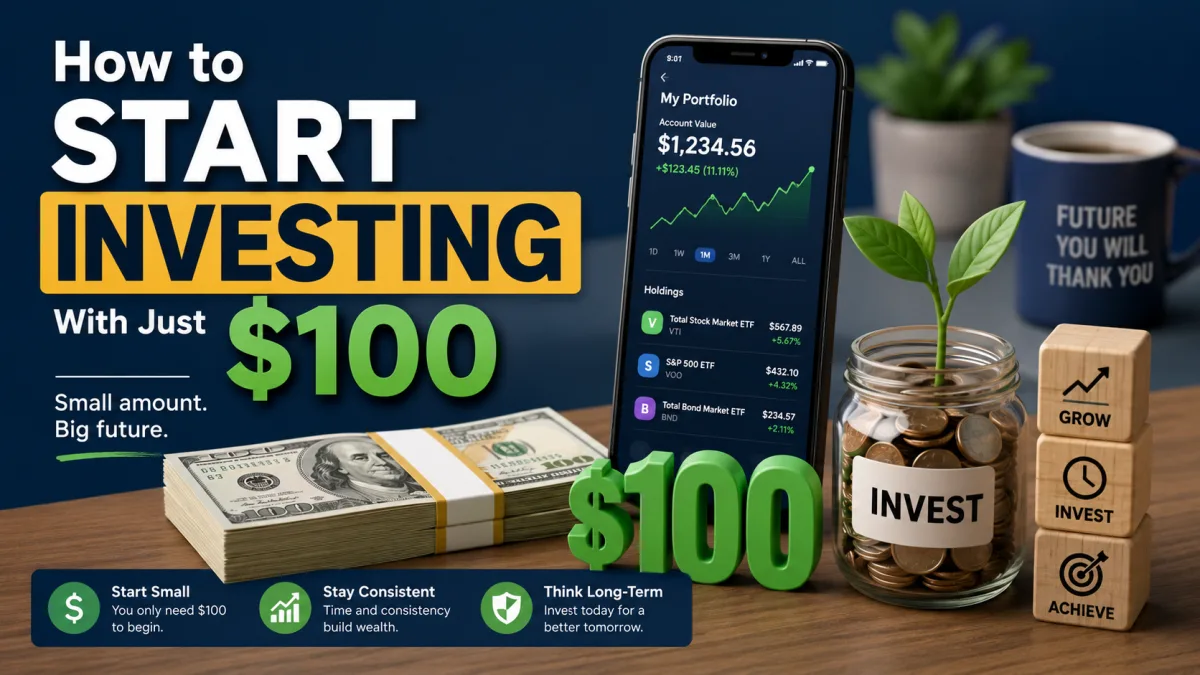
The First $100: How Small Investors Begin Building Real Wealth
Most people do not fail to build wealth because they lack ambition.
They fail because they wait for the perfect starting point.
They wait until they earn more. They wait until the economy feels safer. They wait until they understand every investment term. They wait until they have thousands of dollars sitting untouched. They wait until life becomes less expensive, less busy, less uncertain, and less complicated.
That waiting can last for years.
The truth is that many wealth-building journeys do not begin with a large inheritance, a six-figure salary, a business exit, or a sudden financial breakthrough. They begin with a small amount of money treated seriously.
Sometimes that amount is $100.
One hundred dollars will not make anyone rich overnight. It will not replace a paycheck. It will not create instant passive income. It will not protect a family from every financial emergency. But it can do something extremely important: it can turn someone from a spectator into an owner.
That shift matters.
A person who saves $100 and spends it has consumed money. A person who invests $100 has assigned money a new job. The money is no longer sitting idle or disappearing into short-term purchases. It has been placed into an asset with the potential to grow, produce income, or participate in long-term economic progress.
This is how investing begins for many ordinary people. Not with glamour. Not with perfection. Not with certainty. With a decision.
The decision says: I may not have much today, but I am going to start building ownership anyway.
Why $100 Matters More Than It Looks
On paper, $100 may look too small to matter.
It may be less than a restaurant dinner for a family. It may be less than a pair of shoes. It may disappear quickly through subscriptions, delivery fees, impulse purchases, or weekend spending. Because it feels small, many people do not respect it.
That is the mistake.
Money becomes powerful when it is directed. One hundred dollars spent casually is gone. One hundred dollars invested thoughtfully becomes a seed. The seed may be small, but it can create a habit, and habits are the real beginning of wealth.
Small investing amounts teach lessons that large amounts cannot teach safely. A beginner investing $100 learns how to open an account, choose an investment, place an order, watch prices move, manage emotions, read statements, understand fees, and think long term. These lessons are valuable because investing is not only about math. It is also about behavior.
Someone who cannot manage $100 with discipline is unlikely to manage $10,000 wisely. Larger numbers magnify habits. They do not automatically improve them.
This is why starting small is not embarrassing. It is intelligent. Small beginnings allow investors to learn while the financial risk is still manageable. The goal is not to impress anyone with the size of the first investment. The goal is to build the identity of a person who invests.
Once that identity is formed, the amount can grow.
The Real Purpose of a First Investment
The first investment is not mainly about returns.
That may sound strange because most people think investing begins with the question, “How much money can I make?” But for a beginner, the better first question is, “What habit am I building?”
Your first $100 may rise in value. It may fall in value. It may barely move for months. None of those outcomes tells the whole story. The deeper value of the first investment is that it teaches you to act.
Investing is a long-term discipline. It rewards people who can contribute consistently, stay patient, avoid panic, control greed, and keep learning. Those traits are not built by reading about investing forever. They are built by participating carefully.
The first $100 helps make investing real. Before that moment, investing may feel abstract. It is something other people do. It belongs to financial news, wealthy families, retirement accounts, or people who seem more sophisticated. Once you invest, the market is no longer a distant concept. You are involved.
That involvement changes how you learn. A person with money invested usually pays closer attention. They begin asking better questions. What do I own? Why did the price change? How long should I hold this? What are the fees? Should I add more? What happens during a downturn?
Those questions are the beginning of financial education.
Before You Invest: Protect Your Foundation
Starting with $100 is useful, but investing should not ignore financial reality.
The money you invest should not be money you need for rent, food, transportation, school expenses, medical needs, or urgent bills. Investing involves risk. Values can fall. Markets can be unpredictable in the short term. If you invest money that must be used immediately, you may be forced to sell at the wrong time.
This is why a basic financial foundation matters before investing heavily.
The first layer is cash for emergencies. It does not have to be perfect at the beginning. A small emergency fund is better than none. Even a few hundred dollars set aside can prevent a minor problem from becoming a debt problem.
Emergency savings protect investments because they reduce the need to sell during stress. If your car needs repair, your phone breaks, your hours are reduced, or an unexpected expense appears, cash gives you options. Without cash, you may have to liquidate investments or use expensive debt.
The second layer is debt awareness. High-interest debt can work against wealth faster than many investments can grow. If someone is carrying expensive credit card debt, payday loans, or other costly balances, paying down that debt may be the strongest financial move available.
This does not mean a person must be debt-free before investing a small amount for learning purposes. But it does mean they should not ignore debt while chasing investment returns. A person paying very high interest on debt is already facing a guaranteed financial drag.
The third layer is stable cash flow. You need to know how money enters and leaves your life. Without that awareness, investing becomes random. A basic budget shows whether you can invest $100 once, $25 a month, $100 a month, or more over time.
The foundation does not need to be perfect. It needs to be honest.
Set a Clear Goal Before Choosing an Investment
Money needs a purpose.
If you invest without a goal, every market movement feels confusing. A small decline may feel like failure. A quick gain may tempt you to gamble. A social media trend may pull you away from your original plan because there was no original plan.
A goal creates discipline.
Your goal might be retirement. It might be financial independence. It might be building long-term wealth. It might be learning how markets work. It might be creating future passive income. It might be building a portfolio that gives you more choices later in life.
The goal does not have to be complicated. But it should be clear enough to guide decisions.
If your goal is long-term wealth, you may focus on diversified investments that can compound for years. If your goal is to buy something in six months, investing in volatile assets may not be appropriate. If your goal is education, starting with a small diversified fund may teach more than chasing a risky stock.
Every investment should answer three questions.
First, what is this money for?
Second, when might I need it?
Third, how much risk can I handle without making emotional decisions?
The answers help determine whether the money belongs in investments, savings, debt repayment, or another financial priority.
Understand What $100 Can and Cannot Do
A $100 investment can start a wealth-building habit. It cannot replace a full financial plan.
This distinction matters because beginners often swing between two extremes. Some believe $100 is too small to matter, so they never start. Others believe one small investment should produce dramatic results, so they become disappointed when growth is slow.
The mature view is different.
One hundred dollars is meaningful because it creates momentum. It introduces ownership. It gives compounding something to work with. It helps form discipline. But the real power appears when $100 becomes part of a repeated system.
One $100 investment is a beginning. One hundred dollars every month is a habit. One hundred dollars every month for years is a wealth-building engine.
The first investment should be seen as the opening move, not the entire game.
This prevents both arrogance and discouragement. You do not need to exaggerate what $100 can do. You also do not need to dismiss it. Small amounts become powerful when they are connected to time, consistency, and intelligent investment choices.
Beginner-Friendly Investment Options
A beginner with $100 should usually focus on simplicity, diversification, and low costs.
The goal is not to find the most exciting investment. The goal is to avoid unnecessary mistakes while building a foundation. Some investments are difficult to understand, expensive to trade, highly speculative, or too concentrated. A new investor should be careful with anything that requires perfect timing or specialized knowledge.
ETFs
Exchange-traded funds, commonly called ETFs, are often useful for beginners because they allow investors to buy a basket of investments through a single purchase.
An ETF may hold dozens, hundreds, or even thousands of securities. Some track broad stock markets. Others focus on bonds, sectors, countries, dividends, or specific strategies. For a beginner, broad and diversified ETFs are usually easier to understand than narrow, specialized ones.
The advantage of an ETF is that it can spread risk. Instead of putting the entire $100 into one company, an investor can own small pieces of many companies through one fund. If one company performs poorly, the entire investment is not necessarily destroyed.
ETFs also tend to be accessible. Many investment platforms allow investors to buy them easily, and some allow fractional ETF purchases. That means $100 can be invested even if one full share costs more than $100.
The key is to understand what the ETF owns. A beginner should not buy an ETF simply because it has performed well recently or has a popular name. The investor should know whether the ETF holds stocks, bonds, a specific sector, or a broad market.
Index Funds
Index funds are designed to track a market index rather than rely on a manager trying to pick winners.
A broad stock index fund may hold many companies across different industries. The investor does not need to predict which single company will dominate. Instead, they participate in the performance of the broader market represented by the index.
This approach is attractive because it is simple and often low-cost. It also fits the reality that many people are not skilled at selecting individual stocks. Index investing accepts that owning a broad slice of the market may be more reliable than trying to constantly outguess it.
For beginners, index funds can reduce decision fatigue. Instead of studying dozens of individual companies, the investor can focus on contribution habits, asset allocation, fees, and time horizon.
Index funds are not risk-free. They can fall during market downturns. A broad stock index fund can still decline sharply when the stock market declines. But for long-term investors, diversified index funds are often a practical place to begin learning.
Fractional Shares
Fractional shares allow investors to buy part of a share instead of a full share.
This matters because some well-known stocks or funds may trade at prices above $100. Without fractional shares, a beginner might be unable to buy them. With fractional shares, an investor can put a smaller amount to work.
Fractional shares make investing more accessible, but accessibility does not remove risk. Buying a fraction of an expensive stock is still buying that stock. If the company falls, the fractional share falls too.
Beginners should not use fractional shares as an excuse to chase famous companies blindly. The question remains the same: does this investment fit the plan?
Fractional shares are a tool. They are useful when they help investors diversify and invest consistently. They are dangerous when they make speculative buying feel harmless.
Retirement Accounts
Depending on location and employment situation, some investors may be able to start through retirement accounts.
Employer-sponsored plans, individual retirement accounts, pension-linked accounts, or tax-advantaged investment accounts can offer important benefits. Some employers may even match contributions, which can significantly improve the value of saving and investing.
The rules vary by country, employer, and account type. But the principle is consistent: the account structure can matter almost as much as the investment itself.
A beginner should learn which accounts are available and whether any offer tax benefits, employer contributions, or long-term advantages. A $100 investment inside the right account may be more powerful than the same amount placed without considering account options.
A Simple Way to Invest the First $100
The simplest path for many beginners is not complicated.
First, confirm that the $100 is not needed for immediate expenses. If it is needed soon, keep it in cash. Short-term money should not be exposed to market risk.
Second, choose a reputable investment platform. Look for clear fees, strong security, accessible customer support, educational resources, and the ability to buy diversified investments with small amounts.
Third, open the appropriate account. This might be a brokerage account, a retirement account, or another investment account depending on your situation.
Fourth, choose a diversified, low-cost investment that matches your goal. Many beginners consider broad ETFs or index funds because they provide diversification and simplicity.
Fifth, invest the $100 and record why you made the choice. Writing down your reasoning is powerful. It prevents future confusion and helps you learn from your own decisions.
Sixth, set a plan for the next contribution. The first $100 matters, but the second, third, and tenth contributions matter too.
This process may sound ordinary. That is the point. Sustainable investing should not feel like a lottery ticket. It should feel like building a system.
Why Automation Changes the Game
Discipline is easier when it is designed into your life.
Many people intend to invest regularly but forget, hesitate, or spend the money first. Automation solves part of that problem by making investing happen on a schedule.
An automatic monthly contribution turns investing into a default behavior. Instead of deciding every month whether to invest, the money moves according to the plan. This reduces emotional interference.
Automation is especially useful for small investors because the habit matters more than the initial amount. Investing $25, $50, or $100 consistently can build confidence and momentum. Over time, contributions can increase as income grows or expenses fall.
Automation also helps investors avoid the trap of waiting for perfect timing. Market timing is difficult even for professionals. A beginner trying to buy only at the perfect moment may end up not investing at all.
Regular contributions accept uncertainty. Some purchases will happen when prices are high. Others will happen when prices are low. The investor does not need to predict every movement. They need to stay consistent.
This is how ordinary income can become long-term ownership.
The Power of Compounding
Compounding is the process by which returns begin generating additional returns.
At first, compounding can seem unimpressive. A small account may not grow dramatically in the early months. This is where many beginners lose interest. They expected visible progress and instead see small changes.
But compounding needs time.
Imagine planting a tree. In the beginning, most of the work is invisible. Roots are forming. The structure is developing. The tree may look small from the surface, but the foundation is growing. Later, the growth becomes more obvious.
Investing can work the same way. In the early years, contributions may matter more than investment returns. Later, if the portfolio grows, the returns can become larger because they are earned on a bigger base.
This is why starting early is valuable. Time allows compounding to operate. A small investment made today has more years to grow than a larger investment made much later.
Compounding rewards investors who leave money invested, reinvest earnings, avoid unnecessary withdrawals, and continue contributing through different market conditions.
The enemy of compounding is interruption. Panic selling interrupts it. Constant withdrawals interrupt it. Chasing hype interrupts it. Giving up because progress feels slow interrupts it.
The beginner’s job is to protect the compounding process before it looks impressive.
A $100 Investment Is Not About Getting Rich Fast
Fast-money thinking is one of the easiest ways for beginners to lose money.
It usually begins with impatience. A person starts with a small amount and wants it to become large quickly. They see people online claiming huge profits. They hear stories about stocks, crypto assets, options trades, or speculative investments that multiplied in value. They begin to feel that slow investing is boring.
This mindset is dangerous.
There is a difference between investing and gambling. Investing is based on ownership, value, cash flow, diversification, time, and risk management. Gambling behavior is based on excitement, prediction, emotion, and the hope of quick reward.
A beginner with $100 may think the amount is so small that taking extreme risk does not matter. But the habit formed matters. If the first investing experience is built around speculation, the person may learn the wrong lesson. They may begin to associate investing with thrill-seeking rather than wealth building.
That can become expensive later when the amounts are larger.
The first $100 should teach discipline, not addiction to excitement. It should teach ownership, not chasing. It should teach patience, not panic.
Real investing is often quiet. It does not always provide a dramatic story. But it can create durable progress.
Common Mistakes to Avoid
Investing Money You Cannot Afford to Lose
One of the worst beginner mistakes is investing money that should remain safe.
If the $100 is needed for a bill due next week, it should not be invested in the stock market. If losing access to the money would create stress, debt, or instability, the money belongs in savings.
Investing is for money that can remain invested long enough to handle volatility. Short-term needs require short-term safety.
Putting Everything Into One Stock
Many beginners are attracted to individual stocks because they recognize company names. Recognition is not the same as analysis.
A famous company can still be a poor investment at the wrong price. A successful brand can still face slowing growth, competition, regulation, management problems, or changing consumer behavior.
Putting the entire $100 into one company may feel simple, but it increases concentration risk. A diversified fund may be less exciting, but it can reduce dependence on a single outcome.
Chasing Social Media Hype
Social media can be useful for learning, but it can also amplify bad financial behavior.
Many posts are designed to create urgency, envy, or fear of missing out. They may show profits without showing losses. They may promote assets without explaining risks. They may make investing look easier than it is.
A beginner should be careful with any investment idea that depends mainly on hype. Good investing does not require panic. If someone pressures you to act immediately, slow down.
Checking Prices Constantly
Daily price checking can make investing feel more stressful than it needs to be.
Markets move constantly. A long-term investor does not need to react to every movement. Watching prices too closely can create emotional decisions. A small decline may feel like danger. A small gain may create overconfidence.
Reviewing investments periodically is healthy. Obsessing over every change is not.
Ignoring Fees
Fees reduce returns.
Some fees are obvious. Others are hidden inside funds or trading activity. Beginners should learn to look for expense ratios, account fees, transaction costs, advisory fees, and other charges.
A small fee may not seem important on $100, but the habit of ignoring fees can become costly as the portfolio grows.
How to Keep Learning Without Getting Overwhelmed
Financial education is essential, but beginners can easily become overwhelmed.
There is always another term to learn, another strategy to study, another expert with an opinion, another market prediction, another account type, another asset class. Too much information can lead to paralysis.
The solution is to learn in layers.
Start with the basics: saving, debt, budgeting, emergency funds, diversification, compounding, fees, and risk. Then learn about account types, taxes, asset allocation, index funds, bonds, real estate, and retirement planning. Later, if needed, study more advanced topics.
You do not need to understand everything before investing your first $100. You need to understand enough to avoid reckless decisions.
A good learning rule is simple: never invest in something you cannot explain in plain language.
If you cannot explain what it is, how it makes money, why it can lose money, what it costs, and why it belongs in your plan, you are not ready to buy it.
The Role of Patience
Patience is not passive.
In investing, patience is an active discipline. It means staying committed to a sound plan while resisting the urge to interfere unnecessarily.
Patient investors are not lazy. They still review their accounts. They still learn. They still adjust when life changes. But they do not confuse movement with progress.
Many beginners believe successful investors are constantly doing something. Buying, selling, switching, predicting, reacting. In reality, much of successful investing involves doing fewer things well.
Contribute regularly. Stay diversified. Keep costs reasonable. Avoid emotional trades. Let time work.
This may feel too simple, but simple does not mean easy. The difficulty is emotional. It is hard to keep investing when markets are down. It is hard to avoid chasing when others seem to be making quick money. It is hard to stay patient when progress feels slow.
Patience is what allows the plan to survive those moments.
What Happens If You Keep Investing?
The first $100 is only the start.
If you invest $100 once and never invest again, the result will depend entirely on that single amount and how it performs. But if you continue investing regularly, the story changes.
Monthly contributions build momentum. Each contribution adds more ownership. Each year creates more opportunity for compounding. Over time, the account may begin to feel less like an experiment and more like a financial asset.
The numbers do not need to be dramatic at first. A beginner might start with $100, then add $25 a month. Later, they may increase to $50, $100, or more. Raises, side income, debt payoff, or better budgeting can create room for larger contributions.
The habit grows with the investor.
This is one of the most overlooked truths in personal finance: people rarely build wealth from one decision. They build wealth from repeated decisions that point in the same direction.
One workout does not create fitness. One healthy meal does not create health. One investment does not create wealth. But repeated action changes outcomes.
Consistency turns the first $100 into the beginning of a system.
How to Increase From $100 Over Time
Starting small is wise. Staying intentional is better.
Once the first investment is made, the next question becomes how to grow the habit. The answer is not always to invest more immediately. Sometimes the best next move is to strengthen savings, reduce debt, or improve income.
But when the foundation allows it, contribution increases can accelerate progress.
A simple approach is to increase investments when income increases. If you receive a raise, bonus, gift, refund, or side income, consider directing part of it toward investments before lifestyle spending absorbs it.
Another approach is to invest money that becomes available after debt payments end. When a loan is paid off, the old payment can be redirected toward savings and investing.
A third approach is expense review. Subscriptions, impulse spending, delivery costs, unused memberships, and convenience purchases can quietly consume money that could become ownership.
The goal is not to eliminate joy from life. The goal is to make sure present spending does not completely crowd out future freedom.
When Not to Invest the $100
Sometimes the best investment decision is to wait.
If you have no food security, no emergency cash, overdue essential bills, or high-interest debt growing rapidly, investing may not be the first priority. Financial stability comes before investment ambition.
If the $100 will be needed within days or weeks, keep it liquid. If losing access to it would force borrowing, keep it safe. If you do not understand the investment at all, pause and learn first.
There is no shame in preparing before investing. The mistake is not caution. The mistake is using caution as an excuse forever.
A strong investor knows when to act and when to protect the foundation.
Beginner Investing Rules for the First $100
Start early, but start wisely.
Time is one of the greatest advantages an investor can have. The earlier money is invested, the more time it has to compound. But early investing should still be thoughtful. Do not confuse urgency with recklessness.
Stay consistent.
The first $100 matters because it begins the habit. The habit becomes powerful when repeated. Consistency is more important than perfect timing.
Diversify.
Avoid putting your entire financial hope into one company, one trend, or one prediction. Diversification helps protect beginners from the damage of being wrong in one place.
Keep costs low.
Fees may look small, but they reduce long-term returns. Understand what you are paying.
Think in years, not days.
Investing is not measured by daily excitement. It is measured by long-term progress.
Keep learning.
Financial education compounds too. The more you learn, the better your decisions can become.
The Mindset Shift: From Consumer to Owner
The deepest value of investing $100 is not only financial. It is psychological.
It changes how you see money.
A consumer asks, “What can this buy me today?”
An owner asks, “What can this become over time?”
Both questions have a place. Life is not only about saving and investing. Money should also support comfort, generosity, experiences, and enjoyment. But wealth requires that some money be directed toward ownership rather than consumption.
This shift is the beginning of financial maturity.
When you invest, you begin to understand that money has productive potential. It can buy assets. Assets can create returns. Returns can buy more assets. Over time, this cycle can reduce dependence on labor alone.
That is the quiet power of ownership.
The goal is not to look rich. The goal is to become financially stronger.
Final Thoughts
Starting with $100 is better than waiting for the perfect amount.
Many people never begin because they underestimate small steps. They believe investing only matters when the amount is large. But wealth is often built by people who learn to take small amounts seriously before large amounts arrive.
Your first $100 will not solve every financial problem. It will not create instant freedom. It will not remove the need for income, savings, budgeting, insurance, or wise debt management.
But it can start something important.
It can start the habit of ownership. It can start the process of learning. It can start the discipline of consistency. It can start the relationship between your present choices and your future freedom.
Do not wait until you feel like an expert. Do not wait until the amount feels impressive. Do not wait until every condition is perfect.
Build the foundation. Choose carefully. Invest simply. Stay consistent. Keep learning.
The first $100 matters because it proves you have begun.
And beginning is the step most people postpone for too long.

