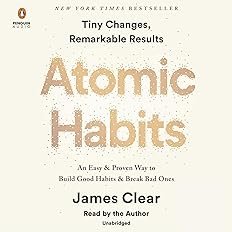
Atomic Habits by James Clear: The Financial and Business Lessons That Could Change Your Life
Discover the powerful money and business lessons hidden in Atomic Habits by James Clear. Learn how tiny daily habits can build lasting wealth and entrepreneurial success.
Wealth Is Built by
Systems, Not Willpower
James Clear's Atomic Habits — the science-backed framework for building the habits that compound into extraordinary financial results over time.
You don't rise to the level of your goals. You fall to the level of your systems. And if your system for managing money, investing, and building wealth is built on willpower — you will lose every time.
James Clear wrote Atomic Habits to solve the exact problem that most wealth advice ignores: the gap between knowing what to do and actually doing it, consistently, for years. You know you should invest regularly. You know you should track your spending. You know you should develop your skills and grow your income. The question is: why don't you?
The answer, Clear argues, has nothing to do with motivation or discipline. It has everything to do with the design of your environment and your habits. And that can be changed — deliberately, systematically, and permanently.
Published in 2018, Atomic Habits has sold over 25 million copies in 60+ languages, sits at 4.8 stars across 147,000 Amazon reviews, and remains in the Top 5 Amazon bestsellers years after publication. This is my full review of what it teaches, why it matters for wealth builders, and who needs to read it.
The Central Idea: The Power of 1%
The book opens with a mathematical argument that is simultaneously obvious and staggering. If you improve by just 1% every day, you will be 37 times better by the end of the year. If you decline by 1% every day, you'll fall to nearly zero. The same compounding that grows your investments grows your habits — in both directions.
This is why Atomic Habits matters as a wealth book. Every small financial habit — automating a savings transfer, reviewing your budget weekly, investing a fixed amount monthly, spending 20 minutes learning about a market — compounds into a dramatically different financial reality over 5, 10, or 20 years. The difference is not one big decision. It's thousands of tiny ones, repeated consistently.
Every action you take is a vote for the type of person you wish to become. No single instance will transform your beliefs, but as the votes build up, so does the evidence of your new identity.
— James Clear, Atomic HabitsThe Habit Loop — How Habits Actually Work
Before Clear's four laws, he explains the neurological loop underlying every habit. Understanding this loop is what lets you engineer habits deliberately rather than hoping motivation carries you.
The Four-Stage Habit Loop
The genius of Clear's framework is that each of the four laws of behavior change maps directly onto one of these stages. Build a good habit by making each stage work for you. Break a bad habit by inverting the same laws.
The Four Laws of Behavior Change
This is the core of the book — a practical, science-backed system for building any habit you want and eliminating any habit that's holding you back.
Make It Obvious
To build: design your environmentThe most powerful driver of behavior is your environment — what you see, what's available, and what's easy. Want to invest consistently? Set up an automatic transfer on payday so the decision is never required. Want to track your finances? Leave your notebook on your desk. Habit formation begins with making the right behavior visible and automatic.
To break: make it invisible — remove the cue from your environment entirely.Make It Attractive
To build: pair it with something you enjoyWe do what we find rewarding in anticipation. To build financial habits, pair them with positive associations — listen to your favorite podcast only while reviewing your budget, or treat your monthly investment as a ritual you look forward to. Clear calls this temptation bundling — linking a habit you need to build with an activity you already enjoy.
To break: make it unattractive — reframe it as something that harms your future self.Make It Easy
To build: reduce friction ruthlesslyThe greatest enemy of good habits is friction. The more steps between you and the behavior, the less likely you are to do it. Clear's Two-Minute Rule is transformative: any habit can begin with a version that takes under two minutes. Open your investment app. Read one page. Transfer $5. The key is to show up — the amount matters less than the repetition in the beginning.
To break: make it difficult — add friction between you and the bad behavior.Make It Satisfying
To build: create immediate rewardsThe human brain is wired for immediate gratification. But most financial habits — saving, investing, avoiding debt — are rewarded only in the long term. Clear's solution: create an immediate reward for long-term habits. Track your streak visually. Celebrate small wins. Use a habit tracker — the simple act of marking an X on a calendar creates a satisfying feedback loop that makes you want to continue.
To break: make it unsatisfying — add an immediate cost to bad behavior.Get Atomic Habits — James Clear
The #1 New York Times bestseller with 25 million copies sold. Available in Kindle, Paperback, Hardcover, and free Audiobook with Audible trial.
Affiliate disclosure: As an Amazon Associate, Wealth Insights Global earns a small commission at no extra cost to you.
Identity-Based Habits — The Missing Piece
Most habit advice focuses on outcomes: I want to save $10,000. I want to invest monthly. But Clear argues that outcome-based habits are fragile — because the motivation fades as the goal recedes into the future.
The most durable habits are identity-based. Instead of asking "what do I want to achieve?", ask: "who do I want to become?" And then act like that person — one small vote at a time.
From "I'm trying to save money" to "I am someone who invests first."
Every time you automate an investment, review your portfolio, or choose to buy an asset instead of a liability, you cast a vote for the identity of a wealth builder. Over time, those votes accumulate into an unshakeable belief — and that belief makes the habits automatic. You don't have to decide whether to invest. It's simply what people like you do.
Applying Atomic Habits to Your Financial Life
Here's how the four laws apply directly to the most important financial habits — and how to use them to design a wealth-building system that runs on autopilot.
| Financial Habit | Law Applied | How to Apply It |
|---|---|---|
| Investing monthly | Make It Easy | Automate transfers on payday — remove the decision entirely |
| Tracking spending | Make It Obvious | Leave your budget app open on your phone's home screen |
| Learning about investing | Make It Attractive | Only listen to your favorite playlist while reading finance content |
| Avoiding impulse spending | Make It Difficult | Delete saved card details from shopping apps; add a 24-hour rule |
| Building a side income | Make It Satisfying | Track revenue milestones visually; celebrate each new income stream |
| Reviewing net worth monthly | Make It Obvious | Schedule it on your calendar like a business meeting — make it a ritual |
You do not rise to the level of your goals. You fall to the level of your systems. Your goal is your desired outcome. Your system is the collection of daily habits that will get you there.
— James Clear, Atomic HabitsWho Should Read This Book?
- Anyone who knows what to do financially but doesn't do it
- Entrepreneurs building daily work and investment routines
- People who start financial habits but can't sustain them
- Anyone who relies on motivation or willpower to manage money
- Investors who want to make wealth-building automatic
- Young professionals establishing financial systems early
- Anyone who has broken a bad financial habit and relapsed
- Leaders building productive habits in their teams or families
Honest Pros & Cons
What Works
- The most practical habit framework ever written
- Grounded in behavioral science, not motivation culture
- The Four Laws are immediately applicable to any goal
- Identity-based habits are a genuinely transformative insight
- Exceptionally clear writing — every chapter is actionable
- Applies equally to finance, health, business, and relationships
Limitations
- Not specifically a finance book — requires application to wealth
- Some readers may find the framework too simple for complex goals
- Doesn't address systemic financial barriers or economic inequality
- Works best when combined with books that set the financial direction
- Heavy on repetition in the second half for some readers
My Final Verdict
The Operating System Every Wealth Builder Needs
Think of the books in this series as a wealth library: Rich Dad Poor Dad gives you the mindset, The Psychology of Money explains your behavioral blind spots, Think and Grow Rich gives you the philosophy of achievement, and The Millionaire Fastlane shows you the entrepreneurial vehicle.
Atomic Habits is the operating system that runs underneath all of them. It answers the question none of the others fully address: how do I actually make these changes stick? How do I build the daily practices that compound into extraordinary outcomes over time?
At under $13, this is not just a book — it is a practical, tested system for transforming every area of your life, including your finances. If there is one book on this list you give to someone who says they struggle with consistency, this is it.
Atomic Habits — James Clear
The #1 New York Times Bestseller. 25 million copies sold. Rated 4.8 stars across 147,000+ reviews. Currently #4 on Amazon Charts. Ships internationally — delivery to Nairobi available.
Affiliate disclosure: As an Amazon Associate, Wealth Insights Global earns a small commission at no additional cost to you. We only recommend books we genuinely believe in.
What's Your Reaction?