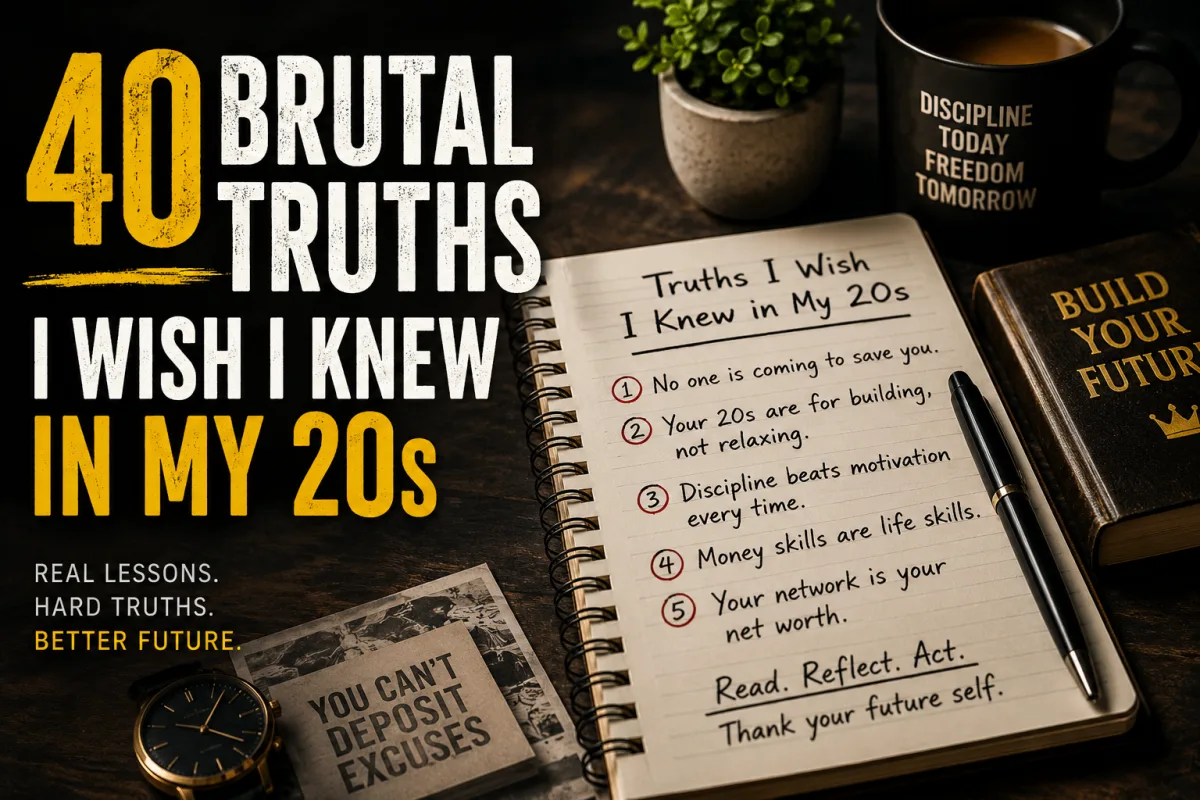
40 Brutal Truths I Wish I Knew in My 20s
Your 20s are often sold as the decade of freedom.
You are told to explore, enjoy yourself, take risks, find your identity, chase dreams, make memories, and not worry too much because you are still young. There is truth in that. Youth should not feel like a prison sentence. A person in their 20s should learn, travel where possible, make friends, test ideas, build confidence, and discover what kind of life they want.
But there is another truth that rarely gets enough attention: your 20s are not a practice life.
The decisions you make in that decade may not feel permanent while you are making them, but many of them compound quietly. The skills you build, the debt you accept, the habits you normalize, the people you allow close, the standards you set, the money you waste, the opportunities you delay, and the risks you ignore can follow you far longer than expected.
Time is forgiving when used well. It is expensive when wasted.
This does not mean your life is ruined if you made mistakes in your 20s. Many people rebuild in their 30s, 40s, 50s, and beyond. Human beings can recover from poor choices, bad relationships, financial losses, career confusion, and painful seasons. But recovery has a cost. It costs time, energy, humility, money, and emotional strength. Wisdom learned early is cheaper than wisdom learned through damage.
The purpose of these 40 truths is not to make young people afraid. It is to make them awake.
There are things most people do not understand until rent is due, debt collectors call, friendships fade, parents age, health changes, careers stall, inflation bites, and the applause of social life becomes quieter. There are lessons you can only ignore for so long before life starts charging interest.
Here are 40 brutal truths many people wish they had known in their 20s.
1. Time Is Your Greatest Asset, But Only If You Use It
Being young feels like having unlimited time. That feeling is deceptive.
Time is powerful because it allows habits, skills, investments, relationships, and reputation to compound. A small discipline practiced for ten years becomes a visible advantage. A small investment made consistently can become meaningful. A skill developed early can raise income for decades. A reputation built carefully can open doors that money cannot buy.
But unused time does not store itself for later. You cannot waste five years and retrieve them at 35 with the same energy, flexibility, and low responsibility you had at 25. Life becomes more complex. Bills grow. Family responsibilities increase. Health requires more attention. Career choices narrow. Recovering lost ground becomes possible, but harder.
The brutal truth is that youth only becomes an advantage when it is invested. If it is only consumed, it becomes nostalgia.
2. Your Income Matters More Than Your Motivation
Motivation feels good, but income pays bills.
Many people in their 20s spend years consuming motivational content while avoiding the practical work of increasing earning power. They listen to speeches, save quotes, talk about dreams, and imagine future success. But their skills remain average, their network remains weak, and their income remains fragile.
Motivation can start movement, but it cannot replace market value. The economy rewards people who can solve problems, produce results, sell, build, manage, lead, analyze, create, repair, organize, or communicate in ways others value. If your income is low, one of your first responsibilities is to increase your ability to earn.
This does not mean chasing money blindly. It means respecting the role income plays in freedom. A person with higher earning power has more room to save, invest, help family, leave bad environments, recover from emergencies, and choose better options.
Dreams require funding. Build the capacity to fund them.
3. Saving Is Not Optional
Saving money in your 20s can feel impossible. Rent is high. Food is expensive. Transport costs money. Social life is tempting. Family may need help. Income may be unstable. There is always a reason to spend everything.
But if you normalize spending every dollar you earn, you train yourself to live permanently on the edge.
Saving is not only about the amount. It is about the habit. A person who saves from a small income is learning control. That control can scale when income grows. A person who saves nothing because the amount feels too small may still save nothing later, even with a larger salary, because lifestyle expands faster than discipline.
Savings create breathing room. They prevent every emergency from becoming a crisis. They give you the courage to make better decisions. They reduce desperation. They allow you to take calculated risks instead of reckless ones.
You do not need to become joyless. But you do need to stop treating your future as someone else’s responsibility.
4. Debt Can Steal Years Before You Notice
Debt feels small when you take it. It feels heavier when it becomes a monthly obligation.
In your 20s, debt often arrives disguised as convenience, lifestyle, education, business ambition, family pressure, romance, or status. Some debt may be productive when it increases earning power or helps acquire an asset under sensible terms. But consumer debt used to finance appearances can become a long-term trap.
The danger of debt is not only interest. It is reduced freedom. Every payment you owe tomorrow limits what tomorrow’s income can do. Money that could have built savings, funded investment, supported a business, or created peace is already promised to yesterday’s spending.
Credit cards, payday loans, personal loans, unpaid bills, buy-now-pay-later purchases, and informal borrowing can quietly turn your future into a repayment schedule.
The brutal truth is simple: debt lets you look richer than you are while making you poorer than you feel.
5. Your Friends Influence Your Financial Future
Friendship is not only emotional. It is economic.
The people around you shape what feels normal. If your friends spend every weekend beyond their means, you may begin to think financial irresponsibility is ordinary. If they mock ambition, you may hide yours. If they worship luxury without discussing assets, you may confuse consumption with success. If they gamble, borrow, gossip, complain, and avoid responsibility, their habits can slowly become your atmosphere.
This does not mean abandoning people because they earn less money. Character matters more than income. A disciplined friend with modest resources can be a better influence than a wealthy friend with destructive values.
The question is whether your circle makes you wiser, stronger, more honest, more disciplined, and more courageous.
Your friends do not need to be perfect. But if everyone around you is allergic to growth, you will spend too much energy defending your desire to improve.
6. Love Does Not Cancel Financial Incompatibility
Romance can make serious problems look small.
In your 20s, you may fall in love with someone’s beauty, charm, humor, confidence, ambition, or attention. Those things matter, but they are not enough to build a stable life. Money habits reveal values. How a person earns, spends, saves, borrows, gives, plans, hides, and reacts under pressure will eventually enter the relationship.
Financial incompatibility does not mean one person is rich and the other is poor. It means the two people have conflicting attitudes toward responsibility, risk, honesty, debt, lifestyle, family obligations, and long-term planning.
One person wants to build. The other wants to spend everything now. One person values transparency. The other hides debts. One person wants discipline. The other sees discipline as control. One person wants to invest. The other wants to impress strangers.
Love may start the relationship, but financial maturity helps protect it.
7. Your Body Is Not Invincible
In your 20s, your body may forgive disrespect quickly. Poor sleep, fast food, alcohol, stress, no exercise, and long working hours may seem harmless because recovery is still fast.
But the bill often arrives later.
Health is a wealth asset. Energy affects income. Focus affects performance. Strength affects confidence. Sleep affects decisions. Mental health affects relationships. A body neglected for years can limit the freedom money is supposed to create.
There is no financial success so impressive that it makes chronic preventable misery attractive. What is the point of building wealth if you destroy the body required to enjoy and steward it?
The brutal truth is that health habits compound too. You are not only building a bank account. You are building the body you will live in for the rest of your life.
8. Confidence Without Competence Is Expensive
Your 20s can make confidence look like success.
Some people speak boldly, post aggressively, dress well, use business language, and sound certain about things they have never actually done. Confidence can open doors, but competence keeps them open.
The market eventually tests everyone.
Can you deliver? Can you manage pressure? Can you solve the problem? Can you communicate clearly? Can you handle money? Can you lead people? Can you admit mistakes? Can you improve? Can you produce results when nobody is clapping?
False confidence may get attention, but it also creates exposure. When people trust you with responsibility and discover there is no substance behind the image, your reputation suffers.
Build confidence, but anchor it in competence. Learn deeply. Practice seriously. Ask questions. Get feedback. Earn your authority.
9. Your Reputation Is Being Built Before You Feel Important
Many young people treat early opportunities casually because the stakes seem small. They arrive late, miss deadlines, ignore messages, deliver poor work, gossip, lie, make excuses, or disappear when things become difficult.
They assume nobody important is watching.
Someone usually is.
Reputation forms quietly. People remember reliability. They remember attitude. They remember whether you handled small responsibilities with seriousness. They remember whether you were honest when mistakes happened. They remember whether you made their life easier or harder.
Years later, opportunities may come through people who met you before you had status. A former colleague becomes a hiring manager. A client refers you. A classmate starts a company. A supervisor recommends you. Or they do not, because they remember how you behaved.
The brutal truth is that your reputation starts before your big break.
10. Being Busy Is Not the Same as Making Progress
Busyness can become a socially acceptable form of avoidance.
You can be busy answering messages, attending meetings, posting online, watching tutorials, helping everyone, reorganizing plans, talking about goals, and still not move closer to a better life.
Progress requires direction. It asks whether your actions are increasing income, improving skill, reducing debt, building savings, strengthening health, deepening relationships, or creating assets. Activity without direction produces exhaustion, not advancement.
In your 20s, you must learn to separate motion from movement. Motion feels productive. Movement changes outcomes.
A focused hour on a valuable skill may matter more than a whole day of scattered activity. One serious conversation may matter more than fifty casual messages. One investment in your future may matter more than another weekend of pretending.
Do not worship busyness. Measure results.
11. Nobody Is Coming to Save You
This truth can sound harsh, but it is also liberating.
Nobody is coming to manage your money, build your discipline, protect your health, choose your friends, improve your skills, repair your credit, apply for opportunities, leave your toxic relationship, or force you to become responsible.
People may help you. Mentors may guide you. Family may support you. Friends may encourage you. Employers may give opportunities. But your life cannot be outsourced.
Waiting for rescue keeps many people stuck. They wait for the economy to improve, for someone to discover them, for a partner to fix their finances, for parents to solve the problem, for luck to arrive, for motivation to return.
Responsibility begins when you stop waiting for life to become easy before you act.
The sooner you accept ownership, the sooner your life becomes more manageable.
12. Your Parents Are Aging Faster Than You Think
In your 20s, parents can still feel permanent. Even if they are older, part of you may still see them as the people who have always been there.
Then time begins to show.
Their energy changes. Their health changes. Their financial needs may change. Their emotional needs may change. The relationship may shift from being taken care of to becoming part of the care structure.
This has financial implications. In many families, young adults eventually support parents, siblings, or extended relatives. If you ignore this possibility, it can arrive as a shock. You may need to budget for family support, medical emergencies, housing needs, or retirement gaps.
This does not mean sacrificing your entire future. It means planning with open eyes.
Have difficult conversations where appropriate. Understand your family’s financial reality. Build your own stability. Set boundaries. Love is stronger when supported by planning.
13. Expensive Taste Without Assets Is a Trap
There is nothing wrong with enjoying quality. The problem begins when your taste grows faster than your income and assets.
In your 20s, status can be seductive. The right phone, clothes, apartment, car, restaurants, vacations, and social events can make you feel successful before you actually are. But if the image is funded by debt or by spending everything you earn, it becomes a trap.
Expensive taste is dangerous because it normalizes high consumption early. Once your lifestyle adjusts upward, reducing it feels like failure. You become emotionally attached to costs that weaken your financial future.
The wealthier path is to build assets before upgrading everything. Let investments, savings, business income, and career growth support lifestyle improvement gradually.
The brutal truth is that looking successful can delay becoming successful.
14. Skills Pay More Than Opinions
Everybody has opinions. Fewer people have valuable skills.
In your 20s, it is easy to talk more than you build. You may have opinions about politics, business, wealth, relationships, success, leadership, and society. Some may be valid. But opinions rarely pay unless attached to expertise, communication, influence, or action.
The market pays for skills. Writing. Selling. Coding. Teaching. Designing. Managing. Repairing. Analyzing. Negotiating. Leading. Accounting. Creating. Operating. Advising. Building.
Strong opinions can make you feel intelligent. Strong skills make you useful.
Developing skill requires humility because you must be bad before you become good. You must practice. You must receive criticism. You must compare your work with higher standards. You must repeat boring fundamentals.
The brutal truth is that being right in conversation is less valuable than being capable in reality.
15. Your Degree Is Not a Lifetime Guarantee
Education matters, but it is not a permanent shield against economic change.
A degree can open doors, signal discipline, teach valuable concepts, and qualify you for certain professions. But after the door opens, performance matters. Adaptability matters. Communication matters. Technology matters. Results matter.
Many young people believe finishing school is the end of learning. It is not. It is the beginning of being tested by the market.
Industries change. Tools change. Employers change. Customer expectations change. A person who stops learning at graduation may become outdated faster than they expect.
The brutal truth is that your education is a foundation, not a finish line.
16. You Must Learn How Money Works
Many people reach adulthood without understanding money.
They know how to earn a paycheck, but not how to budget. They know how to spend, but not how to invest. They know how to borrow, but not how interest works. They know how to complain about prices, but not how inflation affects purchasing power. They know how to desire wealth, but not how assets create it.
This ignorance is expensive.
Financial education should not be optional in your 20s. You need to understand income, expenses, savings, debt, taxes, insurance, investing, retirement, emergency funds, cash flow, and net worth. You do not need to become a financial expert overnight. But you do need to stop being passive about the force that shapes so many choices.
Money is not everything, but money affects almost everything: housing, health, education, options, family, safety, time, and dignity.
The brutal truth is that if you do not learn how money works, you will work for money longer than necessary.
17. Small Habits Become Big Consequences
Most lives are not destroyed by one dramatic decision. They are shaped by repeated small ones.
Sleeping late every night. Eating poorly. Spending impulsively. Avoiding hard conversations. Ignoring bills. Procrastinating. Arriving late. Skipping exercise. Watching hours of content. Saying yes to everything. Failing to follow through.
Each action may seem harmless once. The danger is repetition.
Habits compound quietly until they become identity. A person who repeatedly avoids responsibility begins to see themselves as someone who cannot handle pressure. A person who repeatedly keeps promises begins to trust themselves. That self-trust is powerful.
Your 20s are a habit-building decade. Do not only ask what you want. Ask what your daily behavior is training you to become.
18. Discipline Gives You More Freedom, Not Less
Many young people resist discipline because they think it will make life smaller.
In reality, discipline expands options.
Financial discipline gives you savings. Physical discipline gives you energy. Career discipline gives you competence. Emotional discipline protects relationships. Time discipline creates progress. Learning discipline increases earning power.
Lack of discipline feels free in the moment but expensive later. Spending without limits feels free until debt arrives. Eating without restraint feels free until health suffers. Avoiding work feels free until opportunities disappear. Saying whatever you feel feels free until trust is broken.
Discipline is not punishment. It is self-respect expressed through behavior.
The brutal truth is that people who cannot control themselves are easily controlled by circumstances.
19. The People You Impress Today May Not Matter Tomorrow
Much of youthful spending is not about enjoyment. It is about being seen.
You buy things to impress people whose names may disappear from your life in five years. You attend events you cannot afford. You dress beyond your budget. You eat at places that strain your finances. You post experiences designed more for audience reaction than personal meaning.
Then time passes. The crowd changes. The applause fades. The money is gone.
Status spending is dangerous because it trades future options for temporary approval. The people you are trying to impress may not be able to help you when the consequences arrive.
The brutal truth is that admiration from the wrong people can be financially destructive.
20. Work Ethic Beats Talent When Talent Is Undisciplined
Talent is a gift, but it is not a plan.
Many talented people underperform because they rely on natural ability too long. They avoid structure. They resist feedback. They assume they can always catch up. They dislike boring practice. They want recognition without repetition.
Meanwhile, a less naturally gifted person who works consistently can pass them.
Work ethic matters because most valuable outcomes require persistence beyond excitement. Careers are built through repeated delivery. Businesses grow through repeated problem-solving. Wealth grows through repeated investment. Health improves through repeated habits.
The brutal truth is that talent may start ahead, but discipline decides who keeps moving.
21. Learn to Sell Before You Need to Sell
Selling is one of the most misunderstood life skills.
People think sales is only for salespeople. It is not. You sell ideas in meetings. You sell your value in interviews. You sell trust to clients. You sell vision to investors. You sell cooperation to teammates. You sell standards to yourself.
If you cannot communicate value, you may be underpaid even when you are talented.
Learning to sell does not mean becoming manipulative. Ethical selling means understanding needs, explaining value, handling objections, and helping people make decisions. It requires listening, confidence, clarity, and emotional intelligence.
In your 20s, sales skill can change your income trajectory. It can help you negotiate better pay, win clients, build a business, attract opportunities, and present your ideas with authority.
The brutal truth is that many people are not broke because they lack value. They are broke because they cannot communicate it.
22. Learn to Say No Early
Every yes has a cost.
When you say yes to every party, request, favor, distraction, relationship, emergency, and opportunity, you may be saying no to sleep, savings, study, health, focus, peace, and your own goals.
In your 20s, boundaries can feel selfish. You may fear disappointing people. You may want to be liked. You may believe good people are always available. But a life without boundaries becomes a life managed by other people’s urgency.
Saying no is not cruelty. It is prioritization.
The brutal truth is that people who cannot say no often become exhausted servants of other people’s plans.
23. Your Career Will Not Manage Itself
Many people treat their career like something that happens to them.
They accept whatever role appears, stay too long without growth, avoid difficult conversations, fail to track achievements, neglect networking, and wait for managers to notice their value.
A career requires management. You need to understand your industry, develop relevant skills, build relationships, document accomplishments, seek feedback, negotiate pay, and recognize when an environment has no path forward.
This does not mean changing jobs recklessly. It means being intentional.
The brutal truth is that loyalty to an employer does not guarantee loyalty to your future. You must advocate for your own growth.
24. Comfort Can Become a Cage
Comfort is not evil. Everyone needs rest, stability, and peace. But comfort becomes dangerous when it keeps you in a life that is too small.
A comfortable job with no growth. A comfortable relationship with no respect. A comfortable routine with no ambition. A comfortable circle with no challenge. A comfortable habit that slowly damages health.
Your 20s should include some discomfort. Not chaos. Not self-destruction. Productive discomfort. The discomfort of learning, training, saving, apologizing, applying, pitching, moving, studying, practicing, and being a beginner.
The brutal truth is that the life you want may require leaving the life that feels easiest right now.
25. You Are Not Too Young to Invest
Many people delay investing because they feel they do not have enough money.
They imagine investing is only for people with large incomes. But investing early is powerful because time does much of the heavy lifting. Even small amounts invested consistently can build the habit and create long-term momentum.
Before investing, you should understand your debts, emergency fund, risk tolerance, goals, and local financial options. You should avoid scams and get educated. But do not use the need for education as an excuse for permanent delay.
Investing is not only about becoming rich quickly. It is about becoming an owner. Owners participate in growth. Consumers only spend.
The brutal truth is that the earlier you begin learning to invest wisely, the less you may need to depend only on labor later.
26. Not Every Opportunity Is Yours
Your 20s can be filled with opportunities that look urgent.
Start this business. Join this investment. Move to this city. Date this person. Take this job. Buy this course. Follow this trend. Partner with this friend. Launch this idea.
Some opportunities are real. Others are distractions wearing expensive clothes.
Wisdom is not only recognizing good things. It is recognizing which good things fit your season, capacity, values, and goals. An opportunity that works for someone else may damage you if you lack the skill, capital, time, or temperament to handle it.
The brutal truth is that saying yes to the wrong opportunity can cost more than missing it.
27. Learn the Difference Between Risk and Recklessness
People often confuse risk-taking with wisdom.
Starting a business can be a risk. Quitting your job with no savings, no plan, no customers, and no skill is recklessness. Investing is a risk. Putting all your money into something you do not understand because strangers online are excited is recklessness. Moving to a new city can be a risk. Running from responsibility with no preparation is recklessness.
Good risk is studied. It has upside, downside, contingency plans, and a reason. Recklessness is emotion pretending to be courage.
Your 20s are a good time to take risks because you may have more flexibility. But flexibility should not be wasted on stupidity.
The brutal truth is that courage without preparation can become expensive drama.
28. Your Attention Is Being Sold
Your attention is one of the most valuable assets you control.
Companies, platforms, creators, advertisers, news outlets, games, and social media apps are competing for it constantly. If they capture your attention, they can influence your desires, spending, mood, beliefs, and time.
In your 20s, losing control of attention can quietly damage your life. Hours disappear into scrolling. Comparison increases. Focus weakens. Sleep suffers. Goals become vague. You consume the lives of others instead of building your own.
Attention is the gateway to skill, discipline, learning, relationships, and wealth. What you repeatedly focus on shapes what you become.
The brutal truth is that if you do not control your attention, someone else will monetize it.
29. You Need More Than One Income Stream, But Not Too Early
Multiple income streams are powerful, but beginners often misunderstand the concept.
They try to build five income streams before mastering one. They start freelancing, trading, dropshipping, content creation, coaching, and affiliate marketing at the same time. The result is scattered effort and weak results.
The first goal is not many streams. The first goal is one strong stream.
Build a reliable income source first. Strengthen your main career or business. Increase skill. Create savings. Then add a second stream that fits your strengths. Over time, income can expand into investments, digital products, consulting, rental income, royalties, or business ownership.
The brutal truth is that multiple weak streams do not create freedom. They create confusion.
30. Avoid Building a Life You Need to Escape From
Many people spend their 20s creating obligations that trap their 30s.
They choose expensive lifestyles, unhealthy relationships, unnecessary debt, poor career paths, and social identities that become difficult to maintain. Then they reach a point where they want freedom but cannot easily move.
A life you need to escape from is built slowly. One compromise at a time. One ignored warning at a time. One debt at a time. One year of avoidance at a time.
Freedom is easier to protect than recover.
The brutal truth is that many future crises are built from present decisions you already know are unwise.
31. Emotional Control Is a Financial Skill
Money mistakes are often emotional before they are mathematical.
You spend because you feel insecure. You lend because you feel guilty. You borrow because you feel impatient. You invest because you feel greedy. You sell because you feel afraid. You stay in a bad job because you fear rejection. You avoid budgeting because you fear the truth.
Emotional control does not mean becoming cold. It means not allowing temporary feelings to make permanent financial decisions.
A person who can pause before acting has an advantage. They can think, compare options, ask for advice, sleep on a decision, and choose from principle rather than impulse.
The brutal truth is that unmanaged emotions can destroy income faster than low intelligence.
32. Learn to Apologize and Repair Quickly
Pride is expensive.
In your 20s, you will make mistakes. You will disappoint people. You will speak poorly. You will misjudge situations. You will fail at something. You will hurt someone unintentionally. The question is not whether mistakes happen. The question is how quickly you repair.
A sincere apology can protect relationships, reputation, and peace. Refusing to apologize can turn small issues into permanent damage.
This matters financially too. Business is built on trust. Careers are built on relationships. Partnerships require humility. Leadership requires accountability.
The brutal truth is that people who cannot admit wrong often lose opportunities they could have repaired.
33. Learn Basic Business Even If You Never Start One
Business knowledge is useful even for employees.
You should understand revenue, profit, cash flow, customers, pricing, margins, sales, marketing, operations, taxes, payroll, competition, and risk. These concepts help you understand how companies make decisions and how your work connects to value.
Employees who understand business often become more valuable because they think beyond tasks. They ask how their work affects customers, costs, revenue, efficiency, and growth.
Business knowledge also protects you from bad opportunities. You can recognize when an investment makes no sense, when a partnership is poorly structured, when a side hustle has weak margins, or when a job role has no strategic importance.
The brutal truth is that financial adulthood requires understanding how value moves.
34. You Cannot Outearn Bad Character Forever
Some people make money while behaving badly. That can make character look optional.
It is not.
Dishonesty, arrogance, laziness, cruelty, manipulation, irresponsibility, and greed eventually create costs. They damage trust. They attract poor relationships. They invite conflict. They weaken leadership. They destroy partnerships. They make success unstable.
Money can hide character flaws for a season. It cannot erase their consequences.
The brutal truth is that who you become while chasing success determines what success will cost you.
35. Peace Is More Valuable Than Approval
Approval is addictive in your 20s.
You may want parents to approve, friends to admire, partners to desire, strangers to like, and society to validate your choices. Some approval is meaningful, especially from people who love you wisely. But chasing approval from everyone creates misery.
Peace comes from alignment. It comes from knowing your values, honoring your responsibilities, choosing your path, and living with integrity. Approval comes and goes. Peace is built.
Financial decisions made for approval are often dangerous. Careers chosen to impress. Weddings funded to satisfy spectators. Homes rented to signal success. Cars bought to look important. Lifestyles maintained to avoid judgment.
The brutal truth is that many people sacrifice peace to impress people who are not responsible for the consequences.
36. Your 20s Are for Building Proof
Potential is exciting, but proof is persuasive.
In your 20s, people may praise your potential. They may say you are smart, gifted, talented, creative, or capable. That encouragement is valuable, but potential alone does not pay much for long.
Build proof.
Proof can be a portfolio, certifications, testimonials, savings history, completed projects, promotions, case studies, investments, published work, business results, leadership experience, or strong references. Proof turns claims into evidence.
The brutal truth is that the world becomes less interested in what you could do and more interested in what you have done.
37. Life Gets More Expensive
Many young people underestimate how expensive adulthood becomes.
At first, money may only need to cover personal expenses. Later, it may need to cover housing, healthcare, children, aging parents, insurance, taxes, business costs, emergencies, education, travel, repairs, and retirement planning.
Inflation also changes what money can buy. A salary that feels comfortable today may feel tight later if income does not grow and spending is not managed.
This is why increasing earning power and building assets early matters. You are not only paying for today. You are preparing for a more expensive future.
The brutal truth is that life rarely becomes cheaper as responsibilities grow.
38. Ownership Beats Consumption
Consumers fund other people’s wealth. Owners participate in wealth creation.
This does not mean you should never consume. Everyone needs food, shelter, clothing, tools, transport, education, and enjoyment. The issue is whether consumption absorbs everything.
If every dollar you earn goes to rent, fashion, devices, restaurants, entertainment, subscriptions, travel, and appearances, your money is building other people’s assets while leaving you with receipts.
Ownership changes the equation. Stocks, businesses, real estate, intellectual property, digital products, retirement accounts, and productive tools can preserve or produce value. The earlier you begin thinking like an owner, the sooner your income can become more than spending fuel.
The brutal truth is that wealth is built by converting income into assets, not by converting income into admiration.
39. You Will Not Always Feel Ready
Readiness is often overrated.
You may not feel ready to apply for the role, start the project, publish the work, pitch the client, invest the first small amount, have the difficult conversation, leave the wrong relationship, or build the business.
Preparation matters, but waiting for perfect confidence can become avoidance. Many important decisions require action before comfort arrives.
The key is not to be reckless. It is to take informed steps. Learn enough to begin. Start small. Get feedback. Improve. Repeat.
The brutal truth is that confidence often comes after action, not before it.
40. The Life You Want Requires a Different Version of You
This is the hardest truth.
Most people want a better life without becoming a different person. They want wealth without discipline, love without maturity, health without restraint, success without sacrifice, peace without boundaries, and freedom without responsibility.
But every higher level of life requires a higher level of character, skill, and self-control.
If you want more money, you may need better financial habits and higher-value skills. If you want a healthier relationship, you may need emotional maturity and clearer standards. If you want a better career, you may need courage, competence, and consistency. If you want freedom, you may need to stop worshiping comfort.
The brutal truth is that your current habits are perfectly designed to produce your current life.
To change the outcome, you must change the inputs.
The Point Is Not Regret
Reading these truths can make a person look backward with discomfort. Maybe you wasted time. Maybe you borrowed too much. Maybe you stayed too long in the wrong relationship. Maybe you ignored your health. Maybe you tried to impress people. Maybe you avoided learning money. Maybe you allowed fear to make decisions.
Regret can teach, but it should not become your home.
The purpose of wisdom is not self-punishment. It is correction. If you are still in your 20s, you have time to adjust. If you are past your 20s, you still have time to rebuild. The best moment to learn some lessons was earlier. The next best moment is now.
Do not romanticize struggle if wisdom can prevent it. Do not delay maturity because immaturity is popular. Do not spend your youth only collecting memories while neglecting the foundation that will support your future.
Enjoy your life, but build it too.
Laugh, travel, love, experiment, and dream. But also save, invest, learn, work, protect your health, choose relationships carefully, and build skills that make you valuable. Freedom is not created by pretending consequences do not exist. Freedom is created by making decisions that your future self will thank you for.
Your 20s are not the whole story.
But they are a powerful chapter.
Use them well.
 Article
 Article
 Article
 Article
 Article
 Article
 Article
 Article