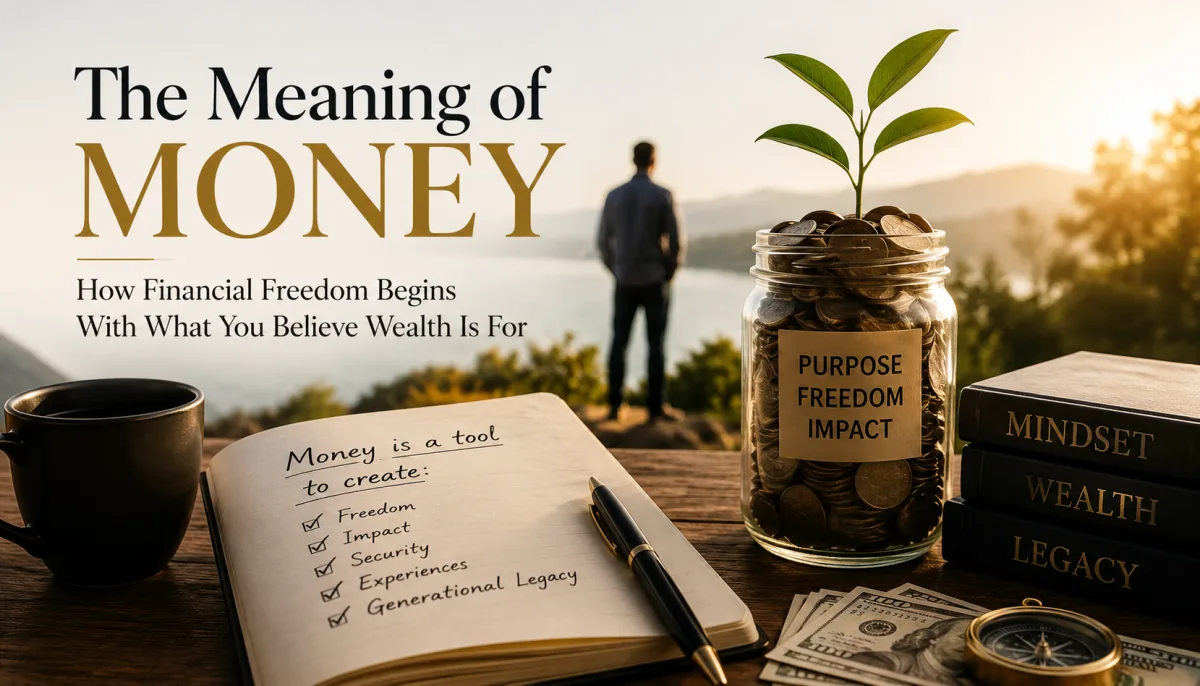
The Meaning of Money: How Financial Freedom Begins With What You Believe Wealth Is For
Money is never just money.
It carries memory, pressure, hope, fear, pride, shame, ambition, security, and identity. For one person, money means survival because childhood was shaped by scarcity. For another, it means status because society taught them that success must be visible. For another, it means freedom because they have spent years feeling trapped by salaries, debts, obligations, and limited choices. For another, money means generosity, dignity, protection, power, opportunity, or peace.
This is why two people can earn the same income and live completely different financial lives. One builds wealth quietly. Another spends to prove they are doing well. One saves because money represents safety. Another avoids looking at their bank balance because money triggers anxiety. One invests because they see money as a tool. Another hoards cash because they fear losing it. The numbers matter, but the meaning behind the numbers often matters more.
Financial freedom begins long before a person becomes wealthy. It begins when they understand what money means to them and whether that meaning is helping or harming their future.
If money means only consumption, it will disappear quickly. If money means only status, it will be spent to impress people. If money means fear, it may be hidden but never used productively. If money means control, opportunity, and ownership, it can become a foundation for freedom.
The journey to financial freedom is not simply about earning more. Many people earn more and remain financially trapped. It is not only about saving more. Some people save but never invest or grow. It is not only about investing more. Some people invest without purpose and panic when markets move. Financial freedom is the result of aligning income, habits, assets, protection, mindset, and purpose.
The most important question is not, “How much money do I have?” The deeper question is, “What role is money playing in my life?”
Money as Survival
For many people, the first meaning of money is survival. Money pays rent. It buys food. It keeps the lights on. It pays school fees, medical bills, transport, insurance, and daily needs. Without enough money, life becomes stressful because every expense feels like a threat.
When money means survival, financial decisions are often made under pressure. The goal is not growth. The goal is getting through the week, the month, or the next emergency. A person in survival mode may borrow repeatedly, delay bills, negotiate with creditors, avoid calls, depend on friends, or use one loan to pay another. Their financial life becomes reactive.
Survival mode is exhausting because it leaves little room for strategy. A person cannot think deeply about investing when they are worried about dinner. They cannot plan retirement when rent is overdue. They cannot build wealth calmly when one medical bill can collapse the household.
This is why financial freedom must begin with stability. Stability is not wealth, but it is the ground on which wealth can be built. Before chasing advanced investments, a person must create breathing room. They must understand income, control spending, reduce harmful debt, build emergency savings, and stop living entirely at the edge of crisis.
There is no shame in beginning from survival. Many wealthy people began there. The danger is accepting survival as a permanent identity. The first step toward freedom is believing that money can become more than a tool for getting by.
Money as Security
Once survival is under control, money begins to mean security. Security is the feeling that one unexpected event will not destroy everything. It is the confidence that if income is delayed, a bill arrives, a child gets sick, or a job ends, there is a cushion.
Security changes how a person thinks. Without security, every decision is urgent. With security, decisions can become thoughtful. A person with emergency savings does not need to borrow at any cost. A family with insurance does not need to sell assets immediately after a crisis. A business owner with reserves can survive a slow month. A worker with savings can negotiate better because desperation is lower.
Security is one of the most underrated forms of wealth. It may not impress anyone. It may not be visible on social media. It may not produce admiration. But it produces peace.
Many people skip this stage because they want to appear successful quickly. They buy status before security. They upgrade lifestyle before building reserves. They take loans for image while having no emergency fund. This creates financial fragility. The outside looks successful, but the inside is vulnerable.
True financial freedom requires the opposite. Build invisible strength before visible comfort. Save before showing. Protect before upgrading. Create a cushion before chasing applause.
Money as Status
One of the most dangerous meanings of money is status. When money means status, spending becomes performance. People buy things not only because they need them, but because they want to communicate success, taste, class, or arrival.
Status spending is not always obvious. It may appear as a car that consumes too much income, clothes bought for approval, a house chosen to impress, ceremonies funded beyond capacity, expensive school choices made for image, vacations taken for social proof, or gadgets upgraded before financial stability exists.
The problem is not enjoyment. Money should support a good life. The problem is when spending becomes a language of insecurity. If a person needs every purchase to prove worth, money will never be enough. There will always be someone with a newer car, bigger house, better phone, more luxurious holiday, or more visible lifestyle.
Status is a moving target. Wealth built on comparison is never peaceful.
Financial freedom requires a person to separate wealth from appearance. Some people who look rich are deeply indebted. Some people who look ordinary are quietly building assets. The financial world is full of illusions because spending is visible while ownership is often hidden.
A person pursuing freedom must ask: am I buying this because it improves my life, or because I want to be seen differently? Am I spending from strength or insecurity? Is this purchase aligned with my values, or is it a response to comparison?
The moment you stop using money to impress people, you free a large portion of your income for building real wealth.
Money as Power
Money is power, but not always in the loud way people imagine. It is power because it gives options. It allows a person to choose where to live, what work to accept, how to respond to emergencies, what opportunities to pursue, and how much control others have over their life.
A person with no savings has limited power in the workplace. They may tolerate mistreatment because they cannot afford to leave. A person with heavy debt has limited power over income because part of tomorrow’s salary already belongs to yesterday’s spending. A person with no assets has limited power over the future because all needs depend on active work.
Financial freedom is partly the process of taking power back.
This does not mean becoming arrogant, selfish, or obsessed with money. It means building enough financial strength to make choices from wisdom rather than desperation. It means having the ability to say no. No to exploitative work. No to unnecessary debt. No to social pressure. No to financial dependence that weakens dignity. No to spending that does not serve your life.
Money gives power when it is organized. Scattered money disappears. Organized money becomes savings, investments, insurance, business capital, education, property, retirement funds, and income-producing assets.
Power does not come from earning alone. It comes from converting income into control.
Money as Freedom
For many people, the highest meaning of money is freedom. Freedom does not always mean quitting work, living luxuriously, or never caring about bills again. At its core, financial freedom means having enough control over money that money no longer controls every decision.
Financial freedom may mean being debt-free. It may mean having six months of expenses saved. It may mean owning a home. It may mean having investments that cover basic needs. It may mean being able to leave a toxic job. It may mean retiring comfortably. It may mean giving children better opportunities. It may mean supporting parents without destroying one’s own future. It may mean choosing meaningful work over survival work.
Freedom is personal. That is why copying someone else’s financial dream can be dangerous. One person may want to travel the world. Another may want land and a quiet home. One may want to build a business empire. Another may want a stable job, strong pension, and peaceful family life. One may want early retirement. Another may want work they love and never fully retire.
The journey begins by defining what freedom means to you, not what it looks like online.
A vague dream cannot become a plan. “I want to be financially free” is a starting emotion. A stronger statement is: “I want investments that cover my basic living expenses by age 50.” Or: “I want to clear all consumer debt in three years.” Or: “I want to build enough assets to educate my children without borrowing.” Or: “I want to own income-generating property and reduce dependence on salary.”
Freedom becomes reachable when it becomes specific.
The Financial Freedom Journey Is Built in Stages
Financial freedom is not one leap. It is a journey through stages. Understanding these stages helps people avoid discouragement. A person who is still building emergency savings should not feel like a failure because they do not yet own multiple assets. A person paying off debt should not compare themselves with someone already investing heavily. Each stage has its work.
Stage One: Awareness
The first stage is awareness. This is where a person stops avoiding their financial reality. They look honestly at income, expenses, debts, assets, habits, and beliefs. Awareness can be uncomfortable because it removes excuses. But it is also empowering because what is measured can be changed.
Many people do not know where their money goes. They know they earn, spend, borrow, and repay, but they do not see the pattern clearly. Awareness reveals the truth. It shows whether income is being consumed by rent, debt, transport, lifestyle, family obligations, impulse purchases, or poor planning.
Awareness also reveals emotional triggers. Some people spend when stressed. Some lend money because they fear disappointing others. Some avoid investing because they fear loss. Some borrow because they want to maintain an image. Some never save because they believe money will always be insufficient.
Financial freedom begins when honesty becomes stronger than avoidance.
Stage Two: Control
The second stage is control. Control means directing money intentionally rather than wondering where it went. This stage includes budgeting, expense tracking, debt reduction, emergency savings, and separating needs from wants.
A budget is not a punishment. It is a plan for freedom. It tells money where to go before pressure, emotion, and impulse take over. A good budget does not remove enjoyment. It makes enjoyment sustainable because essential goals are funded first.
Control also means reducing financial leaks. Small repeated expenses can quietly consume wealth. Unused subscriptions, frequent eating out, impulse shopping, unnecessary loan fees, avoidable penalties, and status spending can drain income before it becomes capital.
The goal of control is not to live miserably. The goal is to stop financing a life that does not match your deeper priorities.
Stage Three: Protection
The third stage is protection. Once money is under control, it must be defended. Life is unpredictable. Illness, job loss, accidents, business shocks, family emergencies, and economic downturns can disrupt even the best plans.
Protection includes emergency funds, insurance, legal documentation, diversified income, and responsible debt management. It also includes protecting oneself from scams, bad partnerships, reckless guarantees, and emotional financial decisions.
Many people focus on growth before protection. They invest aggressively while having no emergency fund. They start businesses while ignoring insurance. They lend money without agreements. They guarantee loans without understanding exposure. They build assets but fail to protect them legally.
Unprotected wealth can disappear quickly. Financial freedom requires both growth and defense.
Stage Four: Accumulation
The fourth stage is accumulation. This is where income begins to turn into assets. The person saves consistently, invests regularly, builds retirement funds, buys productive assets, increases SACCO deposits or share capital where appropriate, participates in money market funds, government securities, ETFs, mutual funds, real estate, businesses, or other suitable investments.
Accumulation is often slow at first. The early years may feel unimpressive because the portfolio is small. But this is where discipline matters most. Wealth is built by repeated actions that look ordinary in the moment.
Every deposit, investment contribution, debt repayment, and reinvested return is a brick. One brick does not look like a house. Many bricks, placed consistently, become shelter.
Stage Five: Expansion
The fifth stage is expansion. This is where assets begin to create more opportunities. Investment income grows. Business profits are reinvested. Rental income supports further savings. Dividends buy more units. Skills increase earning power. Networks improve opportunity access.
Expansion requires wisdom because success can create overconfidence. Some people reach this stage and begin taking reckless risks. They borrow too heavily, enter businesses they do not understand, invest in schemes, or expand lifestyle too quickly.
The goal is sustainable growth. Expansion should strengthen freedom, not create new forms of bondage.
Stage Six: Independence
The sixth stage is independence. This is where assets and systems cover a meaningful portion of life. The person is no longer fully dependent on one income source. They may still work, but work is no longer the only pillar holding everything up.
Independence may begin partially. Investment income may cover utilities. Rental income may cover school fees. A side business may cover groceries. Dividends may cover insurance. Treasury bond coupons may support retirement expenses. Over time, more expenses are covered by assets rather than active labor.
This is the heart of financial freedom: income from ownership replacing dependence on effort alone.
Financial Freedom Is Not the Same as Being Rich
Being rich and being financially free are related, but they are not identical. A person can have a high income and still lack freedom. If expenses, debt, and obligations consume everything, the person remains trapped. A person can also have a modest lifestyle and substantial freedom because their needs are controlled and assets cover them.
Freedom is measured by the relationship between assets and expenses. The lower your essential expenses and the higher your reliable asset income, the closer you are to freedom.
This is why lifestyle design matters. Someone who needs a very expensive lifestyle to feel successful must build a much larger asset base to become free. Someone who enjoys a simpler life may reach freedom earlier because the target is lower.
The goal is not poverty disguised as discipline. The goal is intentional living. Spend on what genuinely matters. Cut what is only performance. Invest the difference.
Financial freedom is not about having everything. It is about having enough of what matters and owning your time, choices, and peace.
Your Beliefs About Money Shape Your Results
Every person carries money beliefs. Some are spoken. Many are inherited silently.
A child who grows up hearing “money is always a problem” may become anxious around finances. A child who sees money used for control may associate wealth with manipulation. A child who grows up in a home where money is never discussed may become an adult who avoids financial conversations. A child who sees parents invest, save, and plan may develop confidence early.
Common beliefs include: money is hard to get, rich people are greedy, I am bad with money, investing is only for experts, debt is normal, I must help everyone even if I suffer, enjoying money is wrong, saving is impossible, or more income will solve everything.
Some beliefs protect us. Others limit us.
The journey to financial freedom requires examining these beliefs. If you believe you are naturally bad with money, you may not try to improve. If you believe investing is only for wealthy people, you may delay for years. If you believe love must always be proven financially, you may give beyond your capacity. If you believe money is only for spending, you may never build assets.
Changing financial behavior often requires changing financial identity. Instead of saying, “I am bad with money,” say, “I am learning to manage money wisely.” Instead of saying, “I can never save,” say, “I am building the habit of paying myself first.” Instead of saying, “Investing is not for people like me,” say, “I can learn one step at a time.”
Identity drives behavior. Behavior drives results.
The Role of Income
Income matters. It is difficult to build wealth without earning enough to cover needs and create surplus. Anyone who says income does not matter is ignoring reality. The larger the gap between income and expenses, the faster wealth can grow.
But income alone does not guarantee freedom. Many people increase income and increase spending at the same speed. Promotions become car loans. Bonuses become consumption. Business profits become lifestyle upgrades. Salary increases disappear into larger houses, new obligations, and social pressure.
This is lifestyle inflation. It is one of the great enemies of financial freedom.
A wise person increases the gap between income and expenses as income grows. When earnings rise, they increase savings, investments, debt repayments, and asset purchases before upgrading lifestyle. They enjoy life, but not at the cost of freedom.
Income is the engine. Discipline is the steering. Assets are the destination.
To grow income, a person may improve skills, negotiate salary, change jobs, start a side business, create content, invest in education, build professional networks, or solve more valuable problems. The market rewards value. Increasing earning power is one of the strongest wealth-building moves, especially in the early journey.
But every increase in income must be given a purpose. Otherwise, it will vanish.
The Role of Saving
Saving is the first visible sign that a person is taking control of money. It means not every shilling, dollar, pound, or rand is assigned to consumption. Some of today’s income is reserved for tomorrow’s strength.
Saving builds emergency funds, opportunity funds, investment capital, and confidence. It also builds self-trust. A person who saves consistently proves to themselves that they can keep promises to their future.
But saving alone is not enough for long-term financial freedom. Inflation can reduce purchasing power. Cash can be too easy to spend. A person can save for years and still not build meaningful wealth if the money never moves into productive assets.
Saving is the bridge from income to investing. It creates the capital that can later buy assets.
The best saving system is automatic. Save before spending. Treat savings as a non-negotiable bill paid to your future self. If you wait to save what remains, little may remain. If you save first, spending adjusts around what is left.
Financial freedom requires paying your future before paying lifestyle.
The Role of Debt
Debt can either delay freedom or accelerate it. The difference lies in purpose, cost, and repayment ability.
Destructive debt finances consumption that does not create lasting value. It includes borrowing for lifestyle, impulse purchases, status goods, repeated emergencies caused by poor planning, or expenses that should have been saved for. This type of debt makes future income serve past consumption.
Productive debt can help acquire assets, grow businesses, increase earning power, or reduce long-term costs. A loan used carefully to buy income-generating equipment, acquire land after proper due diligence, finance useful education, or build rental property may improve net worth over time.
Debt must be treated with respect. Even productive debt can become dangerous if the numbers are wrong. Interest, fees, repayment pressure, income instability, and unexpected delays can turn a good idea into stress.
Financial freedom requires reducing bad debt aggressively and using good debt cautiously. The goal is not to fear all borrowing. The goal is to ensure debt serves wealth rather than lifestyle illusion.
The Role of Investing
Investing is how money begins to work beyond your direct labor. Savings preserve. Investments grow. Assets create income, appreciation, or both.
Investing may include money market funds, Treasury bills, Treasury bonds, SACCOs, mutual funds, ETFs, shares, real estate, businesses, pensions, retirement accounts, farming assets, intellectual property, or other productive vehicles. The right investment depends on knowledge, goals, risk tolerance, time horizon, and local opportunities.
The purpose of investing is not excitement. It is ownership. Investors build claims on productive assets. Over time, these assets may produce dividends, interest, rent, profits, capital gains, or increased value.
Beginners should start with understanding, not hype. They should know what they are buying, how returns are generated, what risks exist, how they can exit, what fees apply, and how the investment fits the plan.
Financial freedom is built when investments begin to cover expenses. At first, the amount may be small. Interest may cover airtime. Dividends may cover one bill. Rental income may cover utilities. Business profits may cover groceries. Over time, more needs are funded by assets.
This is the shift from working for money to money working for you.
The Role of Ownership
Ownership is the center of wealth. People who build financial freedom usually own assets. They own businesses, shares, bonds, funds, property, intellectual property, savings pools, or systems that produce value.
Consumers spend money. Owners use money to acquire claims on future value.
This does not mean never consuming. Life must be lived. But the balance matters. If all income goes to consumption, no ownership is created. If part of income consistently buys assets, wealth begins to form.
Ownership also changes identity. A person who owns investments begins to pay attention to interest rates, business profits, dividends, inflation, markets, and policy. They become more financially aware because they have something at stake. This awareness improves decision-making over time.
The journey to financial freedom is the journey from earning only through effort to earning through ownership.
Freedom Requires Boundaries
Many people fail financially not because they lack income, but because they lack boundaries. They cannot say no to family requests, social pressure, lifestyle expectations, business ideas, loan guarantees, or emotional spending.
Generosity is good. Community matters. Supporting family can be honorable. But generosity without boundaries can destroy the giver. You cannot build financial freedom if every surplus is automatically claimed by other people’s emergencies, expectations, or poor planning.
Boundaries do not mean selfishness. They mean sustainability. You can help better when you are stable. You can support others longer when your own financial foundation is strong.
A person pursuing financial freedom may need rules. A monthly family support budget. A rule against guaranteeing loans casually. A rule against lending money needed for bills. A rule that major financial help must be planned, not demanded. A rule that giving should not require destructive debt.
Money without boundaries becomes public property. Freedom requires stewardship.
Financial Freedom and Peace
Many people think financial freedom is about luxury, but often it is about peace. Peace when bills arrive. Peace when a child needs support. Peace when the car breaks down. Peace when work becomes difficult. Peace when old age approaches. Peace when you sleep because money is not constantly chasing you.
This kind of peace is built slowly. It comes from knowing you have a plan. It comes from fewer debts. It comes from savings. It comes from assets. It comes from living below your means. It comes from insurance. It comes from honest conversations. It comes from refusing financial drama.
Peace is not the absence of all problems. Even financially free people face uncertainty. Markets fall. Businesses struggle. Health changes. Families face challenges. But financial preparation reduces panic.
The goal is not to eliminate life’s storms. The goal is to build a stronger house.
Financial Freedom Is Also Emotional Freedom
Money affects emotions deeply. It can create anxiety, resentment, envy, pride, guilt, fear, or confidence. A person may have enough money mathematically but still feel unsafe emotionally. Another may earn modestly but feel peaceful because their life is aligned and controlled.
Emotional freedom means money no longer controls your self-worth. You do not feel superior because you have more or inferior because you have less. You do not spend to hide insecurity. You do not panic every time others appear ahead. You do not measure your life only by possessions.
This emotional freedom is essential because comparison can destroy financial progress. Social media shows outcomes without context. You see the car, not the loan. The vacation, not the credit card. The house, not the stress. The business success, not the losses. The lifestyle, not the inheritance, debt, or hidden support.
A financially mature person learns to run their own race. They respect others’ success without using it as a weapon against themselves. They understand that wealth has seasons. They focus on their plan.
Freedom from comparison is one of the greatest forms of financial freedom.
Creating Your Personal Financial Freedom Statement
Because money means different things to different people, every person should create a personal financial freedom statement. This is a clear sentence or paragraph that defines what you are building and why.
For example: “Financial freedom means having enough assets and savings to support my family, make work optional by age 55, and live without destructive debt.”
Another person may write: “Financial freedom means owning my home, educating my children without panic borrowing, supporting my parents sustainably, and having investments that cover basic expenses.”
Another may write: “Financial freedom means having the choice to do meaningful work, travel modestly, give generously, and never stay in harmful situations because I lack money.”
This statement matters because it protects you from distraction. When you know what you are building, you can say no more easily. You can reject investments that do not fit. You can avoid lifestyle pressure that does not serve the mission. You can measure progress honestly.
Without a personal definition of freedom, society will sell you one.
A Practical Financial Freedom Plan
A practical journey begins with clarity. Calculate your net worth by listing assets and liabilities. Assets are what you own that have value. Liabilities are what you owe. Net worth is the difference. This number may be uncomfortable at first, but it is the starting line.
Next, track income and expenses. Know how much comes in and where it goes. Do this for at least one to three months. Patterns will appear. Some expenses will be necessary. Others will reveal leakage.
Then build a starter emergency fund. Even a small reserve can reduce panic. After that, reduce high-cost debt. Expensive debt often grows faster than safe investments, making repayment one of the best financial moves.
Once the foundation is stable, increase savings and begin investing according to your goals. Short-term goals need safer, liquid instruments. Long-term goals can include growth assets. Retirement requires consistent contributions. Family responsibilities require protection. Business goals require capital planning.
Review progress regularly. Monthly reviews help with spending. Quarterly reviews help with goals. Annual reviews help with net worth, investments, insurance, taxes, and long-term direction.
The plan does not need to be perfect. It needs to be followed and improved.
The Importance of Time
Time is a powerful wealth-building force. The earlier a person starts saving and investing, the more time compounding has to work. But even if someone starts late, time still matters. Starting today is better than waiting for perfect conditions.
Many people delay because they feel behind. They think, “I should have started earlier.” That may be true, but regret does not build wealth. Action does.
Financial freedom is not reserved only for those who began young. A person can make significant progress at any age by increasing income, reducing waste, paying down debt, investing consistently, and making wise decisions. The strategy may differ depending on age, but the principles remain.
Do not let a late start become an excuse for no start.
The Role of Discipline
Discipline is choosing what you want most over what you want now. It is not always enjoyable, but it is freeing.
Discipline is saving before spending. It is paying debts when no one applauds. It is investing during boring months. It is refusing unnecessary loans. It is saying no to pressure. It is reading financial documents. It is asking questions before investing. It is living below your means even when income rises.
Discipline does not mean never enjoying money. A joyless financial life is hard to sustain. But enjoyment must be planned, not reckless. Spend on what matters, but do not sacrifice freedom for temporary pleasure.
Freedom is built by thousands of disciplined decisions that no one sees.
The Role of Purpose
Money without purpose can become empty. A person may accumulate wealth and still feel dissatisfied if they do not know what the wealth is for.
Purpose gives money direction. It may be family security, education, health, generosity, entrepreneurship, community development, faith, creativity, independence, or peace. Purpose turns money from a scoreboard into a tool.
When money has purpose, financial sacrifices become easier. Saving is not deprivation; it is building security. Investing is not complexity; it is buying future freedom. Budgeting is not restriction; it is alignment. Debt repayment is not punishment; it is reclaiming income.
Purpose also protects against greed. Financial freedom should not make a person a servant of money. It should make money a servant of life.
What Money Should Not Mean
Money should not mean your worth as a human being. People have dignity before they have wealth. A low bank balance does not make someone inferior. A high bank balance does not make someone wise or moral.
Money should not mean endless comparison. There will always be someone richer. Chasing others’ lifestyles can turn life into a race with no finish line.
Money should not mean fear forever. Caution is useful, but fear can prevent growth. A person who is too afraid to invest, learn, or take wise risks may remain stuck.
Money should not mean control over others. Wealth used to manipulate destroys relationships.
Money should not mean consumption without thought. Spending can bring comfort and joy, but careless consumption weakens freedom.
Money should not mean avoiding life. Some people become so focused on saving that they never enjoy the present. Financial wisdom requires balance between today’s life and tomorrow’s security.
What Money Can Become
Money can become safety. It can become time. It can become education. It can become healthcare. It can become land, business, investments, retirement income, and opportunity. It can become generosity without self-destruction. It can become dignity in old age. It can become the ability to choose.
Money can also become a mirror. It shows habits, values, fears, and priorities. Where money goes repeatedly reveals what a person truly values, not what they claim to value.
If money constantly goes to debt, the past is controlling the present. If it goes to assets, the present is building the future. If it goes to status, insecurity may be directing choices. If it goes to protection and investment, wisdom may be growing.
Money becomes what you train it to become.
A Simple Example of the Journey
Consider a young professional who begins with little savings, some consumer debt, and no investment knowledge. At first, money means pressure. Salary comes in and disappears. Emergencies are handled through loans. Lifestyle decisions are influenced by friends.
One day, they decide to become honest. They list debts, track expenses, and realize that small leaks are consuming income. They create a budget and build a small emergency fund. They stop borrowing for lifestyle. They clear expensive debt. Money begins to mean control.
Next, they increase savings through a SACCO or money market fund. They learn about Treasury bills, mutual funds, ETFs, or other suitable investments. They begin investing monthly. Dividends and interest are reinvested. Money begins to mean growth.
As income rises, they avoid upgrading everything. They buy assets, improve skills, and protect their family with insurance. Eventually, investment income covers some expenses. They are not fully free yet, but they are no longer financially helpless. Money begins to mean choice.
Years later, assets cover a meaningful portion of life. Work becomes less desperate. Decisions become more values-based. The journey was not built in one dramatic moment. It was built through repeated alignment.
This is how financial freedom usually happens: gradually, then visibly.
The Final Lesson
Money means different things at different stages of life. At first, it may mean survival. Then security. Then opportunity. Then ownership. Then freedom. The goal is not to worship money, but to understand it deeply enough to use it well.
Financial freedom is not only a number. It is a relationship with money that gives you control, peace, and choice. It is the ability to meet needs without panic, support others without destroying yourself, work without desperation, spend without guilt, invest without confusion, and live without constant financial fear.
The journey begins with a simple but powerful question: what does money mean to me?
If money means status, you may spend your life performing. If money means fear, you may never use it wisely. If money means only survival, you may remain trapped in reaction. But if money means a tool for freedom, stewardship, ownership, and purpose, every financial decision can become part of a larger journey.
Financial freedom is not reached by accident. It is built through awareness, control, protection, accumulation, expansion, and ownership. It is built when income becomes capital, capital becomes assets, assets create income, and income supports a life of purpose.
Money is powerful, but it should not be your master. It should be a servant of the life you are intentionally building.
That is where the financial freedom journey truly begins.
 Article
 Article
 Article
 Article
 Article
 Article
 Article
 Article