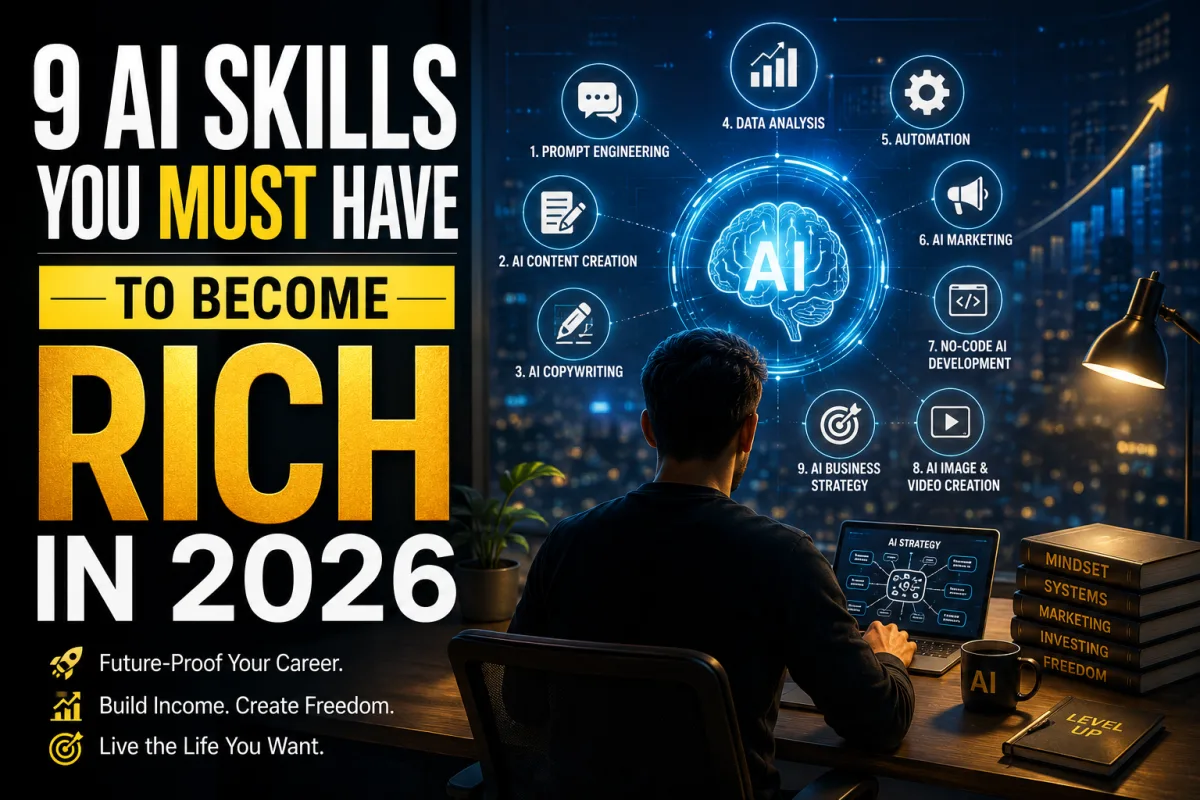
Nine AI Skills That Can Build Real Wealth in 2026
Wealth has always followed leverage. The person who could produce more with less effort, reach more customers with the same hours, make better decisions with clearer information, or own systems that worked without constant manual labor usually had an advantage over the person who relied only on time and effort.
Artificial intelligence is the newest form of leverage, but it is not magic. It does not automatically make anyone rich. A person can have access to the best AI tools in the world and still use them for shallow shortcuts, generic content, low-value automation, or distractions that create no durable economic value. The financial opportunity is not in touching AI. It is in knowing how to use AI to solve expensive problems.
That distinction matters because 2026 is no longer the early curiosity phase. Companies have moved from experimentation to implementation. McKinsey’s 2025 global survey found that 71 percent of respondents said their organizations regularly used generative AI in at least one business function, up from 65 percent in early 2024. Yet only a smaller share had redesigned workflows deeply enough to capture meaningful value, showing that the prize is not merely tool adoption but business redesign.
The labor market is sending the same message. The World Economic Forum’s Future of Jobs Report 2025 identified AI and big data as the fastest-growing skills, with technology literacy, cybersecurity, creative thinking, resilience, curiosity, and lifelong learning also rising in importance through 2030. PwC’s 2025 Global AI Jobs Barometer found that workers with AI skills earned an average wage premium of 56 percent, based on analysis of close to a billion job ads and thousands of company financial reports.
Those numbers do not mean everyone who learns AI becomes wealthy. They mean the market is already pricing AI capability as scarce and valuable. The people who benefit most will not simply be prompt writers. They will be operators, strategists, builders, analysts, creators, managers, and entrepreneurs who understand how to turn AI into higher-value work.
The nine skills below are not gimmicks. They are wealth-building capabilities. They can help an employee become harder to replace, a freelancer command higher fees, a founder build a leaner company, an investor evaluate opportunities faster, and a professional turn knowledge into scalable assets. The common thread is leverage: using machines to multiply human judgment rather than replace it.
1. AI Literacy: Knowing What AI Can Do, What It Cannot Do, and Where the Money Is
The first AI skill is not coding, prompting, or automation. It is literacy. AI literacy means understanding the basic capabilities, limits, risks, and economic uses of artificial intelligence well enough to make sound decisions with it.
This is the skill that separates serious users from casual users. A casual user asks AI to write a social media caption. A literate user asks where AI can reduce costs, increase revenue, speed up research, improve customer experience, detect risk, produce training material, analyze sales calls, support decision-making, or create a new product line.
Financially, AI literacy matters because every major technology boom creates two groups. The first group uses the technology as a toy. The second group uses it as infrastructure. During the early internet era, many people used the web to browse, chat, and consume entertainment. Others built search engines, payment systems, marketplaces, newsletters, software companies, online schools, media brands, and digital distribution networks. The difference was not access. The difference was commercial imagination.
AI literacy gives you that imagination. It helps you see where intelligence work is trapped inside slow human processes. A law firm may have associates spending hours reviewing contracts. A small business may have a founder manually answering the same customer questions. A real estate investor may read dozens of market reports without a system for extracting the key signals. A doctor’s office may lose time summarizing notes. A consultant may spend too much time turning interviews into deliverables. These are not just tasks. They are profit leaks.
The literate AI user learns to ask better business questions. What work is repetitive but still requires judgment? What information is valuable but hard to organize? What decisions are delayed because analysis takes too long? What knowledge exists inside the company but is not easily searchable? What customer experience could be improved if response time fell from days to minutes?
This is where wealth begins. Not with the tool, but with the ability to identify valuable use cases.
AI literacy also protects you from overconfidence. AI systems can produce plausible errors. They may misunderstand context, invent facts, reflect biased data, or fail when the task requires real-world accountability. The wealthy AI user does not blindly trust outputs. They build verification steps. They understand that AI is powerful at pattern recognition, drafting, summarizing, classification, simulation, and idea generation, but weaker when consequences are high and source verification is poor.
The practical application is simple. Learn the categories of AI work: language models, image models, voice tools, data analysis tools, coding assistants, workflow automation, retrieval systems, and agents. Then map them to money-making functions: sales, marketing, operations, finance, product development, customer service, compliance, education, and research.
A person who understands AI at this level can walk into almost any business and see opportunity. That is a wealth-building advantage because most people are still asking, “What can this tool do?” The better question is, “Where does this business lose money because intelligence is too slow, too expensive, or too inconsistent?”
2. Prompt Strategy: Turning Vague Requests Into Valuable Outputs
Prompting is often misunderstood. It is not about memorizing magic phrases. It is the skill of translating intent into clear instructions that produce useful work.
A weak prompt says, “Write me a business plan.” A strong prompt defines the market, customer, pricing model, constraints, assumptions, risks, format, decision criteria, and desired level of detail. The better prompt does not merely ask for an answer. It designs the thinking process.
This matters financially because most AI output is only as valuable as the instruction behind it. Poor prompting produces generic work. Generic work is cheap. Strategic prompting produces analysis, options, drafts, comparisons, simulations, and decisions that can save time or create revenue.
The wealth-building version of prompting has three layers. The first layer is context. AI performs better when it knows the audience, objective, constraints, background, and definition of success. The second layer is structure. Good prompts specify the format of the answer, the steps to follow, the criteria to weigh, and the assumptions to make explicit. The third layer is iteration. Strong AI users rarely accept the first answer. They refine, challenge, compare, and improve.
Consider a financial advisor creating educational material for clients. A weak AI user asks for “an article about retirement.” The result will likely be bland. A stronger user asks AI to explain retirement income risk to a 52-year-old business owner with irregular income, significant home equity, and anxiety about market downturns. The output can then be refined into a client-ready document, a seminar script, a checklist, and a newsletter. One prompt becomes multiple business assets.
Prompt strategy is also useful in negotiation, sales, and decision-making. A salesperson can ask AI to analyze objections from a transcript and identify where trust was lost. A founder can ask AI to compare pricing models under different customer acquisition costs. A job seeker can ask AI to tailor a resume to a role, then simulate interview questions based on the company’s priorities. An investor can ask AI to summarize a company’s annual report, identify risk factors, and generate questions for deeper research.
The key is to prompt for judgment, not just text. Ask AI to compare. Ask it to identify trade-offs. Ask it to show assumptions. Ask it to stress-test. Ask it to argue the opposite side. Ask it to separate facts from interpretations. Ask it to list what information is missing before making a recommendation.
Prompt strategy becomes especially valuable when paired with domain expertise. A tax professional who knows what to ask will get better results than a novice. A real estate operator can use AI to evaluate neighborhoods more intelligently than someone who does not understand cap rates, zoning, tenant quality, or financing. A marketer who understands positioning can prompt AI toward sharper campaigns than someone chasing generic slogans.
The practical lesson is that prompting is not a replacement for expertise. It is a multiplier of expertise. The more clearly you think, the more valuable AI becomes.
3. AI-Assisted Research: Finding Signals Before Others See Them
Research has always been a wealth skill. Investors research companies. Entrepreneurs research markets. Professionals research clients. Executives research competitors. Creators research audiences. The person who understands a market before others can act before prices, wages, or opportunities adjust.
AI changes research by compressing the time between question and insight. It can summarize reports, compare documents, extract themes, analyze customer reviews, scan transcripts, organize notes, and identify patterns across large bodies of information. Used well, AI-assisted research helps individuals operate with the information capacity of a larger team.
This matters in 2026 because information abundance is no longer an advantage. Everyone has access to information. The advantage is filtering. The person who can separate signal from noise faster can make better decisions, avoid bad opportunities, and move sooner on good ones.
Imagine a freelance consultant evaluating whether to specialize in AI adoption for dental clinics, logistics companies, or accounting firms. Without AI, the research process may take weeks. With AI-assisted research, the consultant can analyze industry reports, review job postings, summarize pain points from forums and customer reviews, compare software adoption patterns, and identify where budgets are likely to exist. The result is not perfect truth, but a much sharper starting point.
AI-assisted research also helps investors. A stock investor can use AI to summarize earnings calls, compare management commentary across quarters, organize risk factors, and create a watchlist of issues to investigate. A real estate investor can compare local employment trends, rent growth, insurance costs, school ratings, migration patterns, and zoning changes. A small business buyer can analyze customer concentration, recurring revenue, owner dependency, and operational risks before making an offer.
The skill is not simply asking AI to summarize. Summaries can be dangerously comforting. The deeper skill is research design. You need to know what sources matter, what questions to ask, what data to distrust, and how to verify claims. AI can accelerate the process, but it should not become the source of truth by itself.
A strong research workflow includes five steps. First, define the decision. Second, gather credible source material. Third, ask AI to extract the most relevant facts and uncertainties. Fourth, compare multiple sources and look for contradictions. Fifth, turn the findings into a decision, hypothesis, or action plan.
For example, a professional considering a career pivot into AI product management should not simply ask, “Is AI product management a good career?” A better process would examine job postings, salary data, required skills, company investment trends, and the person’s existing strengths. AI can help organize that research, but the human still decides whether the path fits their risk tolerance, interests, and financial goals.
Research skill creates wealth because it improves timing and reduces avoidable mistakes. Many people lose money because they buy into trends late, accept surface-level claims, or fail to understand risk. AI-assisted research gives disciplined users a way to see more, faster. In markets, careers, and business, that can be worth more than speed alone.
4. Automation Thinking: Building Systems That Save Time and Scale Output
The wealthy do not simply work harder. They build systems. Automation thinking is the ability to identify repeatable work and design a process where AI, software, and human judgment each do the right part.
This skill is different from using AI once. Automation thinking asks, “How can this useful action happen repeatedly, reliably, and with less manual effort?”
That question is powerful because wealth often comes from repeatability. A freelancer who manually writes every proposal has a job. A freelancer who builds an AI-assisted proposal system has leverage. A small business owner who personally answers every inquiry has a bottleneck. A business owner who builds a customer response workflow has scale. A creator who starts from scratch every week has pressure. A creator who builds a research, drafting, editing, publishing, and repurposing system has an asset.
Automation does not mean removing humans from everything. The best systems preserve human judgment where it matters and remove manual friction where it does not. For example, AI can draft a response to a customer complaint, but a human may approve sensitive replies. AI can categorize invoices, but a finance manager reviews exceptions. AI can summarize sales calls, but the salesperson decides the follow-up strategy.
Microsoft’s 2025 Work Trend Index described a shift toward organizations built around human-AI collaboration, with leaders rethinking strategy and operations as AI becomes embedded in work. The report found that 82 percent of leaders said the year was pivotal for rethinking core aspects of strategy and operations. This is exactly the environment where automation thinkers become valuable.
The financial upside of automation appears in several forms. Employees who automate internal processes become more valuable because they save the company time. Freelancers who automate delivery can serve more clients without reducing quality. Entrepreneurs who automate operations can grow revenue without hiring too quickly. Investors who automate research dashboards can monitor more opportunities with less stress.
One practical example is a local service business. A plumbing company may receive calls, emails, and website inquiries every day. Many questions are repetitive: pricing ranges, service areas, emergency availability, appointment times, warranty policies, and maintenance advice. An automation thinker can design a workflow where inquiries are captured, categorized, answered with approved language, routed to the right person, and logged into a customer relationship system. The owner saves hours, response time improves, and missed leads decline.
Another example is a professional services firm. Consultants often spend large amounts of time turning meeting notes into proposals, timelines, summaries, and follow-up emails. AI can transcribe calls, extract decisions, draft next steps, create project plans, and update internal documents. The consultant still owns the relationship and judgment, but the administrative drag falls sharply.
The richest automation opportunities are usually boring. They are not flashy demos. They are invoice routing, lead qualification, report generation, onboarding, internal knowledge search, compliance checklists, scheduling, document review, and customer support. Boring processes become valuable when they happen thousands of times.
To develop automation thinking, start with your own week. List the tasks you repeat. Identify which ones involve gathering information, transforming information, sending information, classifying information, or checking information. These are often AI-friendly. Then ask which tasks are costly because they consume time, delay revenue, or create errors. Those should be automated first.
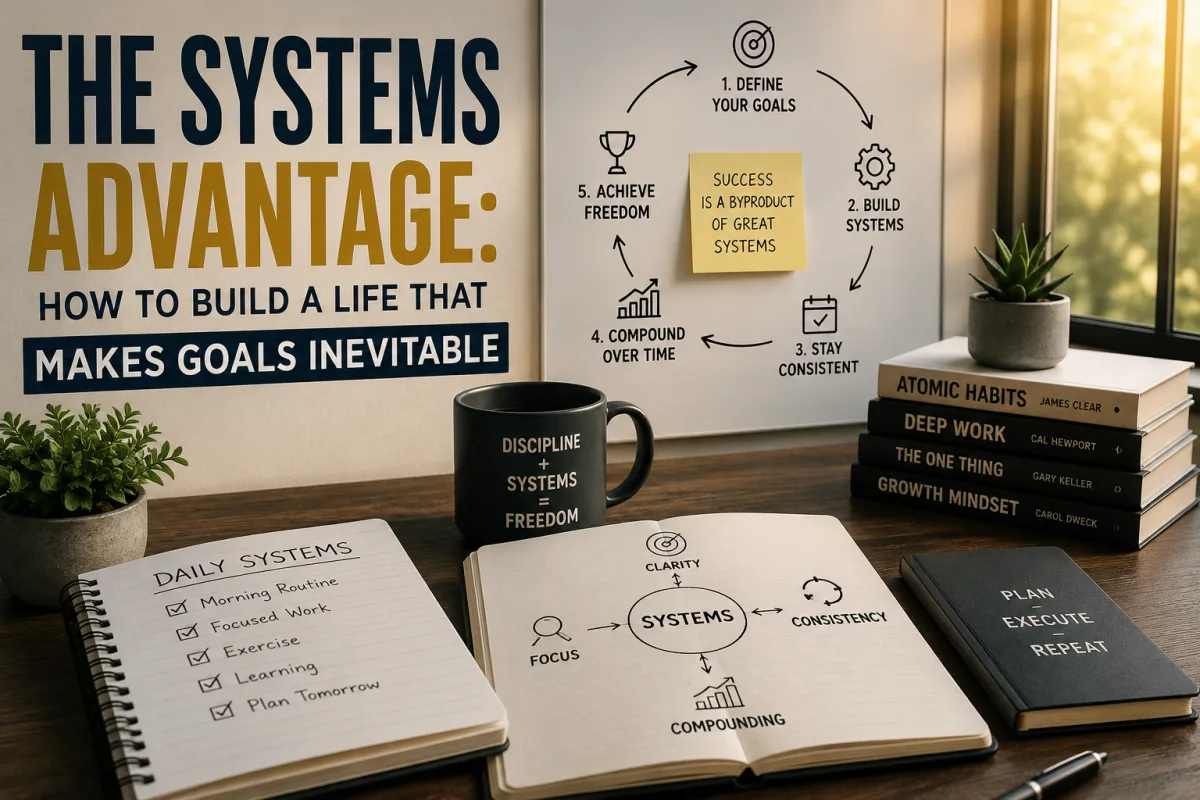
Automation thinking builds wealth because it converts time into systems. Time is finite. Systems can compound.
5. Data Judgment: Using AI to Make Better Decisions, Not Just Better Documents
Many people use AI to create words. Fewer use it to improve decisions. Data judgment is the ability to collect, interpret, question, and apply data with the help of AI.
This skill is becoming essential because AI makes analysis more accessible. A person no longer needs to be a professional data scientist to explore sales trends, customer behavior, spending patterns, inventory movement, website performance, or investment scenarios. AI tools can help clean data, explain formulas, generate charts, identify outliers, and suggest interpretations.
Yet easier analysis does not automatically mean better decisions. Poor data judgment can make people confidently wrong. If the data is incomplete, biased, outdated, or misunderstood, AI may produce a polished mistake. The wealth-building skill is knowing how to ask better questions of data.
Data judgment begins with business logic. What are we trying to improve? Revenue? Profit margin? Retention? Conversion rate? Cash flow? Risk? Time saved? Customer satisfaction? Without a clear objective, analysis becomes decoration.
Consider an online store. A shallow AI user may ask for a sales summary. A stronger operator asks which products have rising demand but weak margins, which customer segments repeat purchase most often, which marketing channels produce profitable buyers rather than cheap clicks, and which inventory decisions are tying up cash. The second person is using AI to think like an owner.
The same applies to personal finance. AI can help categorize expenses, compare savings rates, forecast debt payoff timelines, and model investment contributions. But the real value comes from judgment. A person may discover that income is not the main issue; lifestyle inflation is. Another may find that debt repayment is less about interest rates and more about irregular cash flow. Another may realize that a side business has revenue but no true profit after time, taxes, and software costs.
Data judgment also improves career decisions. A worker can analyze job postings to see which skills appear repeatedly in higher-paying roles. A freelancer can review past projects to identify which clients are most profitable. A salesperson can analyze closed deals to identify which industries convert fastest. A creator can evaluate which content attracts serious buyers rather than passive viewers.
AI and big data are at the top of the World Economic Forum’s fastest-growing skills list because companies increasingly need people who can turn information into action. But the most valuable employees will not be those who merely generate dashboards. They will be those who connect data to decisions.
A simple framework helps. Start with a question. Gather relevant data. Ask AI to find patterns. Ask it to identify possible explanations. Ask what could be misleading. Ask what additional data would improve confidence. Then choose an action and measure the result.
The final step matters most. Data is not valuable until it changes behavior. If analysis does not influence pricing, hiring, investing, saving, marketing, operations, or risk management, it has not created wealth.
Data judgment is a quiet skill. It does not always look impressive from the outside. But over time, better decisions compound. A person who repeatedly allocates money, time, and effort more intelligently can build a significant advantage.
6. AI Product Building: Turning Expertise Into Tools, Services, and Assets
The most direct path from AI skill to wealth is ownership. Employees can earn more with AI. Freelancers can charge more with AI. But owners can build assets with AI.
AI product building is the skill of turning a problem, process, or expertise into something that can be sold repeatedly. That product may be software, a workflow, a digital service, a training program, a template system, a research dashboard, a chatbot, an internal tool, or a specialized AI assistant.
This matters because AI lowers the cost of building. In the past, creating software required a larger technical team, more capital, and longer development cycles. Today, coding assistants, no-code platforms, AI design tools, and automation platforms allow smaller teams to create useful products faster. The barrier has not disappeared, but it has moved. The hard part is no longer only building. It is choosing the right problem.
Many people make the mistake of building AI products around novelty. They ask, “What cool thing can AI do?” Wealth builders ask, “What painful problem will someone pay to solve?”
The best AI products often serve narrow markets. A general AI writing tool competes with giants. A specialized tool that helps independent insurance agents summarize policy comparisons, prepare renewal emails, and explain premium changes may have a clearer customer. A generic chatbot is forgettable. A support assistant trained for a specific type of e-commerce return policy may save measurable time. A broad financial planning app is hard to differentiate. A cash-flow forecasting tool for self-employed consultants may solve a specific pain.
AI product building also includes productized services. Not every wealth-building AI product needs to be software. A consultant might create an AI-assisted market research package for local businesses. A career coach might build a resume, interview, and salary negotiation system for healthcare professionals. A real estate analyst might sell monthly market intelligence reports generated through an AI-supported research workflow. A teacher might create a personalized study system for exam candidates.
The principle is simple: use AI to reduce delivery cost while maintaining or increasing value. If a service previously took ten hours and AI helps deliver it in four without lowering quality, profit margin expands. If a product can be sold repeatedly after the initial build, income becomes less tied to hours.
AI product building requires several sub-skills. You need customer discovery to understand the problem. You need workflow design to decide what AI should do. You need quality control to prevent errors. You need positioning to explain the value. You need pricing to capture a fair share of the value created. You need distribution to reach buyers.
The money is rarely in the model itself. Most people will not build the next foundational AI company. The money is in applying AI to real industries where people already spend money: healthcare administration, legal operations, insurance, logistics, education, accounting, sales, compliance, construction, recruiting, and financial services.
Historically, large fortunes have often formed when a new technology becomes usable by non-specialists. Personal computers created software entrepreneurs. The internet created online retailers, publishers, marketplaces, and service businesses. Smartphones created app companies, creator businesses, and on-demand platforms. AI may create a similar wave of small, specialized, high-margin products built by people who understand a customer better than a large corporation does.
The practical starting point is to inventory your own expertise. What do people ask you for help with? What process do you understand better than most? What documents, decisions, or workflows repeat in your industry? What expensive mistake do beginners make? What information is hard to interpret? Those questions can reveal product opportunities.
AI product building is not a shortcut to wealth. It is a way to convert knowledge into ownership. That is why it belongs near the center of any serious AI wealth strategy.
7. AI Content and Distribution: Building Trust at Scale
Content is not wealth by itself. Millions of posts, videos, newsletters, and podcasts create little financial return. But content that builds trust with the right audience can become a powerful business asset.
AI content and distribution skill is the ability to use AI to research, produce, refine, repurpose, and distribute valuable ideas without becoming generic. This is harder than it sounds because AI has made average content abundant. When average content becomes abundant, trust becomes more valuable.
The wealthy content operator does not use AI to flood the internet. They use AI to sharpen insight, increase consistency, and multiply distribution. The goal is not more noise. The goal is more useful presence.
For professionals, this skill can change career economics. A financial planner who explains retirement mistakes clearly can attract better clients. A real estate agent who publishes local market analysis can become the trusted authority in a neighborhood. A cybersecurity consultant who breaks down AI-related risks for executives can create demand before sales conversations begin. A tax expert who explains complex rules in plain language can build a high-value audience.
AI can support every stage of this process. It can help identify audience questions, summarize research, create interview questions, turn long-form material into short posts, adapt a webinar into an article, convert a client conversation into a checklist, and analyze which topics produce engagement from serious prospects.
But the human must provide judgment, experience, and taste. AI can imitate authority, but it cannot replace lived credibility. The strongest content comes from real examples, specific observations, original frameworks, and honest trade-offs. A person who has actually helped clients manage debt, build portfolios, negotiate salaries, or grow businesses will produce better AI-assisted content than someone who relies entirely on generic output.
Distribution is the second half of the skill. Many smart people create valuable material that nobody sees. AI can help design a distribution system: newsletter sequences, search-friendly articles, LinkedIn posts, scripts for short videos, lead magnets, webinar outlines, and follow-up emails. The business value comes from connecting useful ideas to a clear audience repeatedly.
Content also creates compounding returns. A sales call ends when the call ends. A strong article, video, or report can work for years. It can attract clients, educate prospects, support referrals, strengthen credibility, and reduce the time needed to explain basic concepts. When built strategically, content becomes a trust asset.
The danger is producing content without a business model. Attention alone does not create wealth unless it connects to products, services, partnerships, subscriptions, or owned assets. A person can have a large audience and weak income if the audience has no buying intent or the creator has no clear offer. A smaller audience of decision-makers can be far more valuable than a large audience of passive spectators.
To build this skill, start with one clear audience and one clear economic problem. For example: helping young physicians manage high income and student debt, helping small manufacturers adopt AI without wasting money, helping first-time landlords understand cash flow, or helping mid-career professionals negotiate higher compensation. Then use AI to build a content engine around the questions that audience already has.
AI content and distribution can build wealth because it reduces the cost of trust-building. It allows knowledgeable people to teach at scale. In a market flooded with generic output, the person who combines AI efficiency with real expertise can stand out more, not less.
8. Agent Management: Directing Digital Labor Instead of Doing Every Task Yourself
One of the most important AI shifts for 2026 is the move from simple chatbots to agents. An AI agent is a system that can pursue a goal through multiple steps, use tools, retrieve information, take actions, and report results. The practical meaning is that workers will increasingly manage digital labor rather than perform every task manually.
Microsoft’s 2026 Work Trend Index described the growing importance of agents, human agency, and organizational factors in determining AI impact, noting that culture, manager support, and talent practices accounted for twice the reported AI impact of individual factors. That finding points to a larger truth: the winners will not only be people who use AI personally, but people who know how to organize AI-assisted work.
Agent management is the skill of assigning, supervising, evaluating, and improving AI-driven workflows. It resembles management more than typing. You define the goal, set constraints, provide resources, monitor progress, inspect outputs, correct errors, and decide when human intervention is necessary.
This skill has major wealth implications because management leverage has always been valuable. A person who can coordinate ten people can produce more than a person working alone. AI agents introduce a new form of coordination: managing digital assistants that can research, draft, classify, test, schedule, summarize, monitor, and execute routine steps.
For an entrepreneur, agent management may mean running a lean company with fewer employees. One agent monitors competitor pricing. Another drafts customer support responses. Another prepares weekly performance reports. Another creates first drafts of marketing assets. Another flags overdue invoices. The founder still makes key decisions, but the business operates with more capacity.
For an employee, agent management may mean becoming the person who can redesign a department’s workflow. A marketing manager may coordinate agents for campaign research, ad variation testing, customer segmentation, and performance reporting. An operations manager may use agents to track vendor issues, summarize exceptions, and prepare decision briefs. A recruiter may use agents to organize candidate pipelines while preserving human judgment in interviews and selection.
Agent management requires caution. Poorly supervised agents can create errors at scale. They can send the wrong message, misclassify data, expose sensitive information, or take actions based on weak assumptions. The more autonomous the system, the more important governance becomes.
A good agent manager sets boundaries. What can the agent do without approval? What requires review? What data can it access? What actions are prohibited? How are outputs logged? How are mistakes detected? Who is accountable?
This is why agent management combines technical fluency with leadership. You do not need to be a machine learning engineer to benefit. But you do need enough understanding to design safe workflows and enough judgment to know where automation should stop.
One practical method is to begin with “human-in-the-loop” agents. Let the agent gather information, prepare options, draft messages, or identify exceptions, but require human approval before external action. Over time, as reliability improves, the workflow can become more automated in low-risk areas.
The wealth-building opportunity is significant because many organizations will buy tools but lack people who can integrate them into work. The valuable person will be the translator between business goals and AI execution. They will know how to turn a messy process into a managed system.
In earlier eras, ambitious professionals learned to manage teams, budgets, and projects. In 2026, they also need to learn how to manage digital labor. The person who can direct both humans and AI will have a broader span of leverage than the person who can only complete assigned tasks.
9. AI Risk, Ethics, and Governance: Becoming Trusted With High-Stakes Technology
The final wealth-building AI skill is often overlooked because it sounds defensive. But in serious markets, trust is profitable. AI risk, ethics, and governance is the ability to use AI responsibly, protect sensitive information, reduce errors, comply with rules, and design systems that people can trust.
As AI becomes embedded in finance, healthcare, law, hiring, education, insurance, and government, the consequences of mistakes increase. A bad product description is annoying. A flawed credit decision, medical summary, legal filing, investment recommendation, or hiring screen can cause real harm. Organizations need people who can help them capture AI benefits without creating unacceptable risk.
This skill is especially valuable because adoption has moved faster than preparedness. The 2026 Artificial Intelligence Index Report noted a widening gap between AI’s rapid advancement and the ability of governance frameworks, evaluation methods, education systems, and data infrastructure to keep pace. That gap creates opportunity for professionals who understand both AI capability and institutional responsibility.
AI governance includes several practical areas. Data privacy is one. What information can be entered into an AI system? Customer records, financial data, medical histories, legal documents, and trade secrets require care. Accuracy is another. How are AI outputs verified? Bias is another. Does the system treat groups unfairly or reinforce flawed assumptions? Accountability is another. Who is responsible when an AI-assisted decision causes harm?
These questions are not theoretical. They affect purchasing decisions. A company may want AI tools, but legal, compliance, security, and executive teams need confidence before adoption. The professional who can build policies, evaluate vendors, design approval processes, train staff, and monitor risk becomes valuable.
This is also a strong entrepreneurial opportunity. Small and mid-sized businesses often lack AI governance expertise. They may use AI informally without clear rules. A consultant who can create practical AI usage policies, employee training, data handling standards, vendor evaluation checklists, and risk review processes can solve a growing problem.
AI risk skill is also useful for individuals. A creator should know when AI-generated claims require verification. A financial professional should avoid feeding confidential client data into unsafe tools. A job applicant should understand that AI-assisted resumes must remain truthful. An entrepreneur should know that automating customer communication without oversight can damage trust.
Trust compounds slowly and collapses quickly. In the AI economy, people who protect trust will have an advantage over people who chase speed at any cost.
This skill pairs well with cybersecurity. The World Economic Forum identified networks and cybersecurity among the fastest-growing skills alongside AI and big data. As AI tools gain access to more systems, the boundary between AI adoption and security becomes more important. Professionals who understand both will be positioned for high-value roles.
AI governance may not sound as exciting as building an app or automating a business, but it is likely to become one of the most durable skill categories. Every serious organization eventually asks the same question: “Can we trust this system?” The person who can help answer that question becomes part of the decision-making layer.
How These Skills Translate Into Wealth
Learning AI skills is not the same as building wealth. Skills must be converted into income, ownership, or asset growth. The conversion path matters.
There are five main ways these nine skills can create financial results.
The first is higher earning power. Employees who can use AI to produce better work, save time, improve decisions, and lead adoption may qualify for promotions, raises, bonuses, or stronger job opportunities. PwC’s finding of an AI wage premium shows that the market is already rewarding AI capability, though individual outcomes depend on industry, role, geography, and execution.
The second is freelancing and consulting income. Businesses need help applying AI to real problems. A person who can build automation workflows, create AI-assisted content systems, improve reporting, train teams, or design governance policies can sell those services. The key is to price based on value, not hours. If your system saves a company 20 hours per week or helps recover lost revenue, the service is worth more than the time it took to build.
The third is business ownership. AI makes it easier to start lean businesses by reducing the cost of research, content, customer support, operations, and product development. A solo operator can now do work that previously required a small staff. This does not eliminate competition, but it lowers the cost of experimentation.
The fourth is asset creation. AI can help turn knowledge into digital products, courses, paid newsletters, templates, software tools, research reports, and intellectual property. These assets may produce income beyond direct labor. Not all will succeed, but the ability to build and test them has become more accessible.
The fifth is better capital allocation. AI-assisted research and data judgment can help individuals make more informed career, business, and investment decisions. Avoiding one bad investment, one weak business model, or one poorly timed career move can be as valuable as finding a new income source.
The common theme is value creation. AI skills do not create wealth because they are fashionable. They create wealth when they help you solve problems people care about enough to pay for.
The Difference Between AI Users and AI Wealth Builders
By 2026, basic AI use will not be rare. Many people will be able to generate text, summarize documents, create images, or ask a chatbot for ideas. Basic use will become like basic spreadsheet use: helpful, expected, but not enough by itself to create exceptional income.
AI wealth builders behave differently.
They connect AI to a business model. They ask how a skill increases revenue, reduces cost, improves retention, speeds delivery, reduces risk, or creates an asset. They do not confuse activity with value.
They build workflows, not one-off outputs. A one-time AI answer may save minutes. A workflow can save hundreds of hours. The wealthy thinker looks for repeatable systems.
They bring domain expertise. AI is most powerful when paired with knowledge of an industry, customer, or problem. A generic AI user competes with everyone. A domain expert using AI competes in a narrower, more profitable lane.
They verify. Trust is part of value. The person who can produce fast work that is also accurate, compliant, and useful will beat the person who produces fast work that creates cleanup costs.
They aim for ownership. Income matters, but ownership changes the wealth equation. A salary can rise with AI skill, but assets can compound. The best strategy is often to use AI first to increase earning power, then use that income and knowledge to build or buy assets.
A Practical 90-Day Plan to Build AI Wealth Skills
Ambition without practice does little. The fastest way to develop AI skill is to build useful things around real problems.
During the first 30 days, focus on literacy and prompting. Use AI daily for research, drafting, analysis, and planning. Learn how different tools handle text, data, images, audio, automation, and coding. Practice giving context, constraints, examples, and evaluation criteria. Take one work task and improve it with AI. The goal is not mastery. The goal is fluency.
During days 31 to 60, build a workflow. Choose a repetitive process in your work or personal finances. It might be weekly reporting, client follow-up, content production, expense review, lead research, meeting summaries, or proposal creation. Document the old process. Redesign it with AI support. Measure time saved, quality improved, or errors reduced. This creates proof.
During days 61 to 90, connect the skill to money. If you are an employee, turn your workflow into a case study and show how it improved results. If you are a freelancer, package the workflow as a service. If you are an entrepreneur, use it to lower delivery costs or improve customer experience. If you are building an asset, turn the workflow into a template, tool, training, or productized offer.
This plan works because it avoids passive learning. Watching tutorials can help, but wealth skills form through application. The market rewards proof: saved time, increased sales, better decisions, reduced risk, stronger content, faster delivery, and improved margins.
The Human Skills Still Matter
The rise of AI does not make human skills irrelevant. It makes the best human skills more important. The World Economic Forum’s 2025 report emphasized not only AI and big data, but also creative thinking, resilience, flexibility, curiosity, and lifelong learning. These are not soft extras. They are economic defenses.
AI can generate options, but humans choose direction. AI can draft language, but humans build trust. AI can analyze patterns, but humans understand consequences. AI can automate tasks, but humans decide what should be automated. AI can accelerate work, but humans set values, priorities, and strategy.
The people most at risk are not those without advanced technical degrees. The people most at risk are those who refuse to adapt, rely only on routine execution, or fail to connect their work to measurable value.
The people best positioned are those who combine AI fluency with judgment, communication, ethics, industry knowledge, and ownership thinking. That combination is rare. Rare combinations create pricing power.
The Real Opportunity in 2026
The central financial question is not whether AI will create wealth. It already is. The better question is who will capture it.
Some of the wealth will go to large technology companies that build models, infrastructure, chips, and platforms. Some will go to enterprises that use AI to improve margins. Some will go to investors who correctly identify durable winners. But a meaningful share can also go to individuals who learn how to apply AI inside careers, businesses, and assets.
For most people, the path will not be overnight riches. It will be a sequence: learn the tools, solve a real problem, build proof, increase income, create systems, acquire ownership, and compound the gains.
The nine skills are connected. AI literacy helps you see opportunities. Prompt strategy helps you get better outputs. Research helps you understand markets. Automation thinking helps you save time. Data judgment helps you make better decisions. Product building helps you create assets. Content and distribution help you build trust. Agent management helps you scale execution. Governance helps you protect value.
Together, they form a modern wealth toolkit.
AI will not reward everyone equally. It will reward people who can think clearly, learn quickly, build systems, solve valuable problems, and act like owners. In 2026, that may be one of the clearest dividing lines between people who merely use new technology and people who turn it into lasting financial advantage.
 Article
 Article
 Article
 Article
 Article
 Article
 Article
 Article