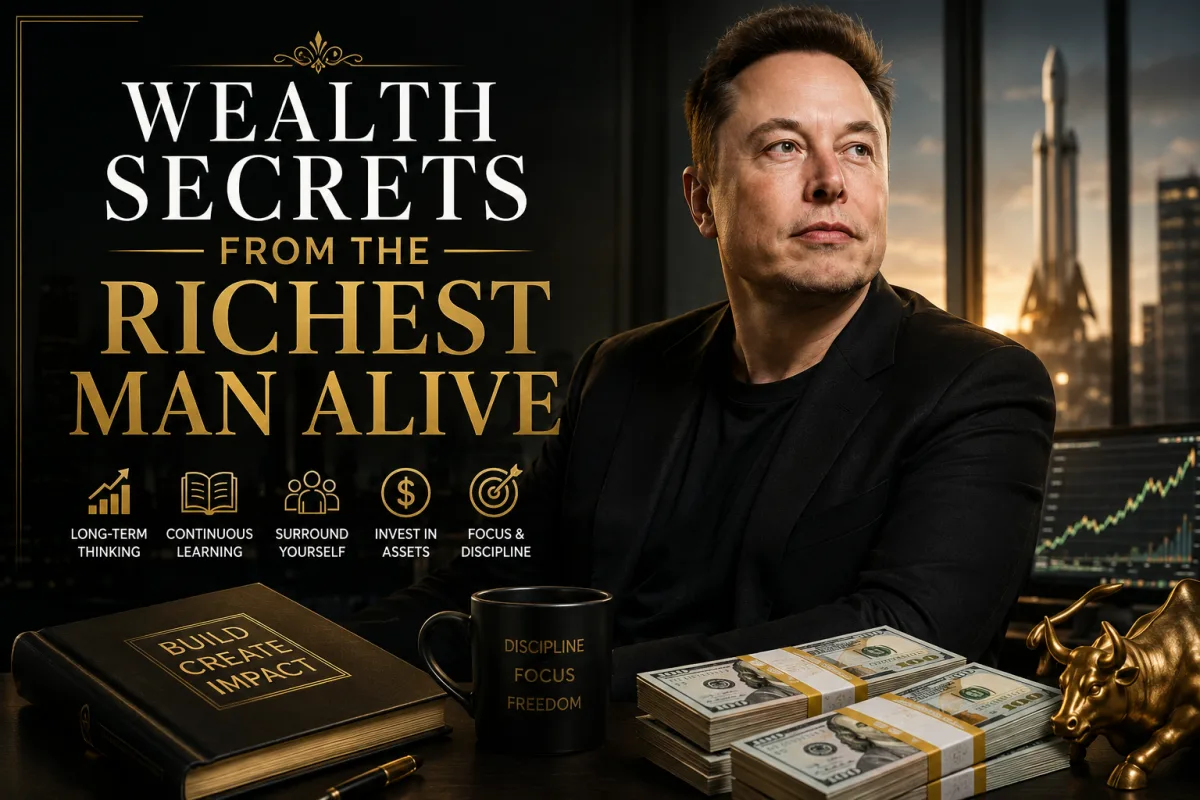
Wealth Secrets From the Richest Man Alive
The richest people in the world rarely become wealthy by thinking about money the way most people are taught to think about money.
Most households are trained to focus on income. Get a better job. Earn a higher salary. Save what remains. Avoid obvious mistakes. Retire someday. This advice is not useless. For many families, stable income, disciplined saving, and responsible spending are the foundation of financial security. But financial security and extreme wealth are created by different forces.
The richest man alive does not represent an ordinary financial path. His fortune is not the result of a high salary, a generous pension, or decades of careful budgeting alone. It is the result of ownership, concentration, risk-taking, leverage, timing, reinvestment, and control over assets capable of enormous growth.
That distinction matters. The lesson is not that everyone should copy the life of a billionaire. Most people should not. Extreme wealth often comes with extreme volatility, public pressure, legal complexity, operational stress, and risk levels unsuitable for ordinary households. The point is not imitation. The point is education.
When studied carefully, the wealth of the richest people reveals principles that can be applied at more modest levels. A person may never build a rocket company, electric vehicle manufacturer, artificial intelligence firm, global payments business, or communications platform. But that person can still learn the deeper logic behind wealth creation: own assets, solve valuable problems, use capital intelligently, think long term, avoid fragile debt, protect optionality, and understand that money follows value creation at scale.
Elon Musk’s fortune is especially instructive because it shows how modern wealth differs from old-fashioned cash accumulation. His wealth has been tied largely to ownership stakes in companies, not to a pile of idle money. That means his net worth can rise dramatically when markets value those companies highly and fall sharply when sentiment changes. It is wealth measured through ownership, not stored as currency under a mattress.
This is one of the first lessons: the richest people do not simply have money. They own things that other people believe will be more valuable in the future.
Secret One: Income Is Not the Main Engine of Great Wealth
For most people, income feels like the center of the financial universe. It determines the house they can rent or buy, the car they can drive, the school fees they can pay, the vacations they can take, and the level of comfort they can maintain. Income is immediate, visible, and emotionally powerful.
But income is not the same as wealth.
Income is money flowing in. Wealth is ownership accumulated over time. A person can have high income and low wealth if most of the money is spent. A person can have modest income and steadily growing wealth if income is consistently converted into assets. This difference explains why some high earners remain financially fragile while some disciplined owners become financially independent.
The richest people understand that income has limits. There are only so many hours in a day. Even highly paid professionals eventually run into the ceiling of their own labor. A surgeon, lawyer, consultant, or executive may earn an impressive amount, but that income usually depends on continued work. Stop working, and the income may stop or decline.
Ownership changes the equation. If you own part of a business, productive real estate, intellectual property, or financial assets, value can grow beyond the hours you personally work. Ownership allows other people’s labor, technology, systems, capital, and market demand to contribute to your wealth.
The richest man alive did not become the richest primarily by collecting a paycheck. His fortune came from ownership in companies whose perceived value grew enormously. This is the same broad principle behind many large fortunes. Founders, early investors, and major shareholders become wealthy because they own equity before the world fully recognizes the value of the enterprise.
This lesson applies at every level. A household may not own a major corporation, but it can own diversified stock funds. A professional may not launch a global company, but they can build equity in a small business. A worker may not control a technology platform, but they can use retirement accounts to become a fractional owner of many productive businesses. A family may not buy skyscrapers, but it can gradually acquire assets that appreciate or produce income.
The central question is not simply, “How can I earn more?” It is, “How can I turn income into ownership?”
That question separates consumers from wealth builders.
Secret Two: The Wealthy Seek Scale
Scale is one of the most powerful forces in wealth creation.
A small service business may generate a good living for its owner. A local restaurant may support a family. A consulting practice may produce strong income. These can be excellent financial vehicles. But the largest fortunes usually come from businesses that can scale beyond the direct labor of the founder.
Scale means that a product, service, platform, or system can reach far more people without costs rising at the same pace. Software can scale. Manufacturing can scale if demand and production capacity expand. Networks can scale. Brands can scale. Financial platforms can scale. Intellectual property can scale. Infrastructure can scale when built correctly.
The richest people often become rich because they participate in assets with enormous scale. Their wealth grows not because they personally serve one customer at a time, but because the businesses they own can serve millions of customers, attract global capital, and build markets around large problems.
Electric vehicles, rockets, satellite internet, digital payments, artificial intelligence, cloud computing, online retail, luxury goods, semiconductors, and software platforms are all examples of sectors where scale can produce extraordinary wealth. These industries may differ, but they share an important trait: when the model works, growth can be enormous.
For ordinary investors and entrepreneurs, the lesson is to look for scale in realistic ways. A small business owner can ask whether systems, employees, digital tools, licensing, subscriptions, or partnerships can allow the business to grow beyond personal effort. An employee can ask whether their skills apply only to one employer or can scale into consulting, teaching, products, equity compensation, or leadership. An investor can ask whether the companies they own have room to grow without constantly needing proportional increases in cost.
Scale does not guarantee success. Many scalable businesses fail because they burn cash, misread demand, face competition, or collapse under poor execution. But when scale combines with real demand, strong execution, and ownership, the wealth effect can be dramatic.
A person selling hours will usually face an income ceiling. A person owning scalable assets may participate in upside far beyond their daily labor.
Secret Three: Concentration Builds Fortunes, Diversification Preserves Them
One of the uncomfortable truths about wealth is that many great fortunes are created through concentration.
A founder owns a large stake in one company. A real estate family concentrates in one city or asset class. A technology investor backs a small number of companies that become enormous. A business owner has most of their net worth tied to the enterprise they built. Concentration can create extraordinary wealth because large gains on a major position transform net worth.
But concentration is dangerous.
The same force that creates wealth can destroy it. A concentrated position in a failing business, declining industry, overleveraged property, or speculative asset can wipe out years of progress. Concentration increases both upside and downside. It is a sharp tool, not a universal prescription.
This is why the wealthy often face a transition problem. The behavior that created the fortune may not be the same behavior needed to preserve it. Building wealth may require bold concentration. Preserving wealth often requires diversification, liquidity, tax planning, insurance, governance, and restraint.
The richest man alive illustrates the power of concentration because much of his wealth has been tied to the changing value of major ownership stakes. When those companies rise in value, the fortune expands. When market values fall, paper wealth can decline quickly. That volatility is part of concentrated ownership.
For ordinary investors, the lesson is not to put all money into one stock, one startup, one property, or one trend. The lesson is to understand where concentration is appropriate and where it is reckless.
Concentration may be unavoidable for entrepreneurs. If you build a business, much of your wealth may be tied to it. That risk can be worthwhile if you have knowledge, control, and a plan. But your emergency savings, retirement assets, insurance, and household stability should not all depend on the same risk.
Diversification is often criticized because it reduces the chance of spectacular gains. That criticism is partly true. A diversified portfolio will rarely match the return of the single best-performing asset. But diversification also reduces the chance that one mistake destroys your financial life.
The wise approach is to recognize the stage you are in. If you are building a business, concentration may be part of the journey. If you are managing family security, diversification becomes more important. If you are investing for retirement, broad ownership of productive assets may matter more than chasing one dramatic winner.
The wealthy understand that concentration and diversification are not enemies. They are tools used for different purposes.
Secret Four: Risk Is Not Avoided; It Is Chosen
Most people talk about risk as if it is something to avoid. The wealthy often think about risk as something to select, price, manage, and survive.
Every financial path contains risk. Holding cash carries inflation risk. Owning stocks carries market risk. Starting a business carries failure risk. Keeping a job carries employer risk. Buying property carries maintenance, tenant, interest rate, and liquidity risk. Avoiding investment carries the risk of never building enough wealth.
The question is not whether risk exists. The question is which risks you are taking, whether you understand them, and whether the potential reward justifies them.
The richest entrepreneurs often take risks that look irrational from the outside. They may invest their own capital, borrow against assets, work for years without certainty, enter difficult industries, challenge incumbents, and endure public criticism. But in the best cases, those risks are not random. They are connected to a thesis about the future.
A good risk has several qualities. It has meaningful upside. It can be studied. It has a reason for existing. It does not rely entirely on luck. It can be survived if the outcome is poor. It is taken by someone with enough knowledge, control, or edge to justify the attempt.
A bad risk is different. It is poorly understood, emotionally driven, overleveraged, dependent on hype, and capable of causing ruin. Many people mistake gambling for entrepreneurship and speculation for investing. They see the billionaire who took big risks but ignore the thousands of people who took foolish risks and disappeared from view.
The lesson is not “take more risk.” The lesson is “take better risk.”
For a young professional, better risk may mean investing in education, relocating for a stronger opportunity, starting a side business, or accepting short-term discomfort for long-term earning power. For an investor, better risk may mean owning diversified equities for decades rather than chasing daily trades. For a business owner, better risk may mean expanding only when cash flow, demand, and systems support expansion.
The wealthy do not eliminate uncertainty. They build the capacity to benefit from uncertainty without being destroyed by it.
Secret Five: Reinvestment Is More Powerful Than Consumption
The wealthy often understand something that many high earners ignore: money spent is gone, but money reinvested can multiply.
Consumption provides immediate satisfaction. Reinvestment builds future capacity. The difference becomes enormous over time.
When a business generates cash, the owner can extract it for lifestyle or reinvest it into growth. Reinvestment may fund better equipment, stronger talent, research, marketing, systems, acquisitions, or product development. If reinvestment produces high returns, the enterprise becomes more valuable.
This principle is central to many large fortunes. The wealthiest founders often delay maximum personal consumption while capital is still useful inside the business. They may live well, but they understand that removing too much capital too early can weaken the machine that creates wealth.
Households face the same choice in smaller form. A bonus can become a vacation, or it can reduce high-interest debt. A raise can become a larger car payment, or it can increase investments. A profitable side business can fund lifestyle upgrades, or it can purchase tools, advertising, training, and systems that expand future income.
The goal is not to avoid all enjoyment. Money should support life. But the timing of consumption matters. Early dollars invested can be more valuable than later dollars because they have more time to compound. Early business profits reinvested wisely can create future income streams. Early debt reduction can free cash flow for years.
The wealthy often become wealthy because they repeatedly choose productive use of capital over immediate display. They understand that every dollar has potential energy. It can be consumed once or deployed to create more dollars.
This is one reason appearances are misleading. The person who looks rich may be consuming capital. The person quietly building assets may be creating future wealth. Luxury is visible. Reinvestment is often invisible.
The invisible choice often matters more.
Secret Six: Control Creates Opportunity
Control is one of the most valuable forms of financial power.
An employee may have income but limited control over strategy, pricing, hiring, products, capital allocation, or ownership value. A shareholder in a public company owns part of the business but usually has little influence. A founder or controlling owner, by contrast, can shape decisions directly.
The richest people often own assets where control matters. They can allocate capital, hire leaders, change strategy, pursue new markets, sell divisions, raise funds, or reinvest aggressively. Control allows vision to become action.
Control does not guarantee success. Poor control can be destructive. A founder can make mistakes, ignore warnings, misallocate capital, or damage a company through overconfidence. But when control is paired with insight and execution, it can be powerful.
For ordinary people, control can be built in stages. You may not control the economy, but you can control your savings rate. You may not control market returns, but you can control diversification and costs. You may not control your employer, but you can control skill development, networking, and career options. You may not control tax law, but you can control planning and recordkeeping.
Entrepreneurship is often attractive because it increases control over income sources and asset creation. But control also brings responsibility. A business owner controls decisions, but also bears payroll pressure, customer risk, competition, regulation, and financial uncertainty.
The deeper lesson is to seek control where it improves outcomes and avoid false control where it creates unnecessary risk. Day trading may feel like control because the investor is constantly acting, but frequent action does not guarantee better results. Owning a well-structured business may involve fewer daily market decisions but greater influence over long-term value.
Control is not about doing everything yourself. It is about designing a financial life where your decisions have meaningful impact.
Secret Seven: The Rich Understand Optionality
Optionality means having choices.
Money creates optionality when it allows a person to wait, negotiate, invest, move, hire help, withstand setbacks, or pursue opportunities. The ultra-wealthy often protect optionality because they know that the future is uncertain and opportunity rarely arrives on a perfect schedule.
Liquidity is one form of optionality. A person with cash reserves can survive a job loss, buy assets during downturns, leave a bad situation, or avoid taking desperate loans. A person with no reserves must often accept poor terms because they have no room to maneuver.
Skills are another form of optionality. A person with valuable skills can change employers, start a business, consult, teach, or adapt to industry shifts. A person with narrow or outdated skills has fewer options.
Reputation is optionality. Trusted people receive opportunities that are not publicly advertised. Relationships are optionality. A strong network can provide information, capital, introductions, and support. Low debt is optionality. Heavy fixed obligations reduce freedom.
The richest entrepreneurs often use optionality aggressively. They build companies that open doors to adjacent markets. A payments company may lead to capital for a space company. A vehicle company may lead to battery technology, software, energy storage, charging infrastructure, robotics, or artificial intelligence. One asset becomes a platform for new options.
For households, the practical lesson is to avoid financial structures that eliminate choices. Excessive debt, lifestyle inflation, lack of savings, weak skills, and damaged reputation all reduce optionality. They make life brittle.
Wealth is not only the ability to buy things. It is the ability to choose.
Secret Eight: Vision Attracts Capital
Capital does not flow only to existing profits. It also flows to credible visions of future value.
This is especially true in technology, infrastructure, and high-growth industries. Investors may fund companies that are not yet highly profitable if they believe the company can dominate a large future market. That belief can become a powerful financial force. It can lower the cost of capital, attract talent, increase media attention, and create strategic momentum.
The richest man alive has often been associated with ambitious visions: electric transportation, reusable rockets, human settlement beyond Earth, artificial intelligence, satellite connectivity, and large-scale technological transformation. Whether one admires or criticizes the execution, the wealth lesson is clear: big markets reward those who can organize capital and talent around a compelling future.
Vision alone is not enough. Many people have grand ideas. Few build organizations capable of execution. A vision without operational discipline becomes fantasy. A vision with capital, talent, engineering, distribution, and persistence can become enterprise value.
For entrepreneurs, this means storytelling matters, but only when connected to substance. Investors, employees, lenders, customers, and partners need to understand why the work matters and why the opportunity is large. A clear mission can attract resources that a small, cautious plan may never receive.
For individuals, vision also matters. A person with a clear financial vision is more likely to make disciplined choices. Saving for “the future” is vague. Saving to buy freedom from debt, build a business, create family stability, retire with dignity, or fund a child’s education is more powerful.
Capital follows clarity. People are more willing to sacrifice today when tomorrow has a shape.
Secret Nine: Wealth Is Often Built in Uncomfortable Industries
Many people look for easy opportunities. The greatest fortunes are often built in difficult places.
Hard industries have barriers. They require capital, specialized knowledge, regulation, engineering, logistics, patience, and resilience. They scare away casual competitors. If a company succeeds in a hard industry, the reward can be substantial because the difficulty itself becomes protection.
Automotive manufacturing is hard. Space launch is hard. Energy infrastructure is hard. Artificial intelligence is hard. Large-scale manufacturing, supply chains, battery production, robotics, and satellite networks all require levels of execution far beyond a simple consumer product.
Hard problems can create wealth because solving them produces real value. A business that makes something difficult cheaper, faster, safer, cleaner, more reliable, or more accessible can reshape an industry.
This lesson applies beyond billion-dollar companies. In ordinary careers and businesses, the most valuable work is often difficult, technical, inconvenient, or emotionally demanding. People who solve hard problems can command better compensation, stronger loyalty, and more durable opportunities.
A plumber who becomes excellent at complex commercial systems may build a stronger business than someone chasing easy jobs. A nurse who develops specialized expertise may gain career leverage. A software engineer who understands difficult infrastructure may have more opportunities than someone with shallow skills. A small business owner who handles a painful customer problem reliably may build a loyal market.
Easy money attracts crowds. Crowds reduce returns. Difficult value creation has fewer competitors.
The wealthy often go where the problem is large, the solution is hard, and the reward for success is meaningful.
Secret Ten: Leverage Must Serve Production, Not Vanity
Leverage means using something beyond your own immediate resources to increase results. It can include debt, employees, technology, media, code, capital markets, brand, or other people’s expertise.
The wealthy use leverage constantly. A company uses employees to scale beyond the founder’s labor. A real estate investor uses debt to control a larger asset. A software company uses code to serve millions. A public figure uses media attention to shape demand. An investor uses capital markets to own businesses across the world.
Leverage is not automatically good. It magnifies outcomes. Good leverage expands productive capacity. Bad leverage magnifies fragility.
Debt used to buy a depreciating luxury item is usually weak leverage. Debt used to acquire or improve a productive asset may be intelligent if the cash flows and risks are sound. Hiring people without systems can create chaos. Hiring people into a profitable, repeatable process can create scale. Public attention without substance can create hype. Public attention attached to real execution can attract talent and capital.
The richest man alive shows several kinds of leverage: technological leverage through engineering, financial leverage through capital markets, human leverage through teams, narrative leverage through public communication, and ownership leverage through equity stakes. The combination can create extraordinary value, but it also creates volatility and scrutiny.
For households, leverage should be used carefully. A mortgage can help a family own a home, but too much mortgage can trap the family. A business loan can expand profits, but only if demand and margins support repayment. Education can be leverage if it increases earning power, but expensive education without economic return can become a burden.
The test is simple: does this leverage increase productive capacity, or does it merely increase appearance?
Wealthy people often borrow, hire, invest, and delegate. But the best of them do so to build assets, not simply to look successful.
Secret Eleven: Time Horizon Changes Everything
Short-term thinkers see volatility. Long-term owners see development.
The richest fortunes are often built over many years of uncertainty. Early stages may look messy. Companies may lose money, face criticism, miss deadlines, dilute shareholders, fight competitors, and survive near-death moments. From the outside, it can appear irrational. From the inside, the builder is often trying to reach a future state that does not yet exist.
A long time horizon allows decisions that short-term thinking cannot tolerate. It allows reinvestment instead of immediate profit maximization. It allows research and development. It allows infrastructure. It allows brand building. It allows patience through market cycles.
But long-term thinking should not become an excuse for ignoring reality. Some failing projects claim to be long-term while destroying capital. The difference lies in progress. A long-term vision should still show evidence of learning, execution, customer demand, technical improvement, or strategic advantage.
For individual investors, time horizon is one of the greatest advantages available. You may not have billionaire capital, but you may have decades. Decades allow compounding to work. They allow market downturns to become buying opportunities. They allow skills to mature. They allow businesses to develop.
The challenge is emotional. Long-term thinking sounds easy until prices fall, friends get rich quickly, media headlines create fear, or patience feels unrewarded. The investor who can remain disciplined while others react emotionally has an advantage.
Time does not rescue bad decisions automatically. But good decisions often need time to reveal their power.
Secret Twelve: The Richest People Sell the Future
Every great company sells something more than a product. It sells a version of the future.
A car company may sell transportation, but it may also sell a future of energy transition, software-driven mobility, and technological status. A space company may sell launch services, but it may also sell a future of lower-cost access to orbit. A technology platform may sell tools, but it may also sell a future of connection, productivity, or intelligence.
This matters because markets value expected future cash flows. When investors believe a company may dominate a large future market, they may value it far beyond current profits. That expectation can make founders and shareholders extremely wealthy.
The danger is that the future can be oversold. History is full of companies that promised transformation and delivered disappointment. Investors must distinguish between vision backed by execution and vision used as decoration.
For entrepreneurs, the lesson is that people need to understand the future you are building. Customers must see why your product matters. Employees must see why the mission deserves effort. Investors must see why the market is large enough to justify risk.
For personal finance, the same idea becomes more intimate. You are always funding some version of your future. Every purchase, investment, debt, career move, and habit is a vote for the life you are building. The question is whether your money is financing freedom or financing pressure.
The wealthy are often skilled at connecting present sacrifice to future possibility. That connection gives discipline emotional strength.
Secret Thirteen: Public Wealth Is Not the Same as Spendable Cash
One of the most misunderstood aspects of billionaire wealth is liquidity.
When headlines describe a billionaire’s net worth, much of that wealth is usually tied to ownership stakes. It is not necessarily cash in a bank account. If the value of those stakes rises, net worth rises. If the value falls, net worth falls. The person may be extraordinarily wealthy, but the wealth is still linked to market prices, private valuations, restrictions, taxes, borrowing arrangements, and investor perception.
This distinction matters because many people imagine wealth as a vault of spendable money. In reality, large fortunes are often structured around assets. Selling those assets may trigger taxes, reduce control, signal weakness, or affect market confidence. Borrowing against assets may provide liquidity, but it adds risk if asset values decline.
The practical lesson is that net worth and cash flow are different. A household may own a valuable home but struggle with monthly bills. A business owner may have a profitable company but limited personal liquidity. An investor may have retirement assets but little emergency cash.
Financial strength requires both assets and liquidity. Assets build long-term wealth. Liquidity protects short-term stability. Confusing the two can create stress.
The wealthy often manage this through credit lines, cash reserves, asset sales, dividends, compensation, tax planning, and entity structures. Ordinary households can apply the principle by maintaining emergency funds, avoiding overconcentration in illiquid assets, and planning for taxes before they arrive.
Wealth on paper is powerful. Liquidity in crisis is protective. A strong financial life needs both.
Secret Fourteen: Reputation Can Become Capital
Reputation is not just social. It is economic.
People with strong reputations can raise capital more easily, attract talent, build partnerships, negotiate better terms, and recover from setbacks faster. People with damaged reputations face higher friction. Others demand more proof, more protection, or higher returns to compensate for perceived risk.
The richest entrepreneurs often operate in a world where reputation and capital interact constantly. Investors may fund them because of past success. Employees may join because they believe in the mission. Customers may buy because the brand carries meaning. Media attention may amplify both achievements and mistakes.
Reputation is leverage, but it is unstable if not supported by delivery. A reputation for boldness can attract attention. A reputation for execution attracts serious capital. The difference is important.
For ordinary professionals, reputation compounds quietly. Being reliable, honest, competent, calm under pressure, and generous with knowledge can create opportunities over years. Employers remember. Clients remember. Partners remember. Communities remember.
A good reputation can lead to better jobs, referrals, investment opportunities, partnerships, and support during difficulty. A poor reputation can close doors before you know they existed.
Wealth builders should treat reputation as an asset. That means keeping promises, communicating clearly, avoiding unnecessary conflict, documenting agreements, and refusing short-term gains that damage long-term trust.
Money can be rebuilt. Trust is harder.
Secret Fifteen: They Hire Talent Rather Than Trying to Know Everything
No one builds great wealth alone.
Behind every major fortune is a network of engineers, operators, attorneys, accountants, investors, managers, advisors, employees, suppliers, customers, and partners. The public may focus on one individual, but enterprise value is built by teams.
The wealthy often understand the power of talent. They seek people who know what they do not know. They pay for expertise in law, tax, operations, finance, technology, design, manufacturing, marketing, and leadership. Talent allows vision to become reality.
Trying to save money by avoiding expertise can become expensive. Poor legal documents, weak tax planning, bad hiring, sloppy accounting, and uninformed investment decisions can destroy far more wealth than professional advice would have cost.
This does not mean blindly trusting advisors. The wealthy still need enough knowledge to ask intelligent questions. Delegation without oversight can become dangerous. But refusing to delegate can also limit growth.
For households, the same principle applies. A person may need a tax professional, estate attorney, insurance advisor, financial planner, career coach, or business mentor at different stages. The key is to seek qualified help where mistakes would be costly.
There is a difference between an expense and an investment in better judgment. The wealthy often pay to reduce error, increase speed, and access specialized knowledge.
Secret Sixteen: They Understand Incentives
In finance, incentives explain behavior.
Before buying a product, ask who profits. Before accepting advice, ask how the advisor is paid. Before entering a partnership, ask what each party gains and what each party risks. Before investing in a company, ask whether management benefits from long-term value creation or short-term appearances.
The wealthy often study incentives because misaligned incentives are expensive. A salesperson may recommend what pays the highest commission. A manager may chase short-term metrics. A founder may maintain control in ways that benefit vision or harm governance. A lender may encourage borrowing because lending generates fees.
Understanding incentives does not require cynicism. It requires maturity. People respond to rewards. Systems produce behavior. Contracts matter.
For ordinary investors, this habit can prevent many mistakes. It can reveal why a financial product is being promoted, why a loan is structured a certain way, why an investment opportunity sounds urgent, or why a partner wants specific terms.
When incentives are aligned, everyone benefits from the same outcome. When incentives are misaligned, one person may profit while another carries the risk.
The rich often negotiate incentives before money changes hands. Everyone else should learn to do the same.
Secret Seventeen: They Turn Attention Into Economic Power
Attention is one of the defining currencies of the modern economy.
A person or company that commands attention can influence markets, attract talent, sell products, raise capital, and shape public conversation. Attention does not automatically create durable wealth, but it can become a powerful amplifier when attached to real assets.
The richest man alive is not only a business figure. He is also a media figure. Public communication has played a role in shaping awareness around his companies, ideas, products, and controversies. This creates both advantage and risk. Attention can attract customers and investors, but it can also magnify mistakes.
For entrepreneurs, attention can reduce marketing costs and accelerate trust. A strong personal brand can open doors. A useful audience can become a distribution channel. But attention without substance is fragile. It can produce noise rather than wealth.
For professionals, attention may mean becoming known for expertise. Writing, speaking, teaching, publishing, networking, and building a portfolio of work can create opportunities that private competence alone may not generate.
The lesson is not to chase fame. Fame can be costly and distracting. The lesson is to understand that visibility, when paired with credibility, can become economic leverage.
Be known for something valuable. That is the practical form of attention wealth.
Secret Eighteen: They Do Not Wait for Permission
Many people delay action because they are waiting for approval, certainty, credentials, perfect timing, or universal support. Builders of great wealth often move before consensus forms.
This does not mean acting recklessly. It means understanding that transformative opportunities rarely arrive with full permission from society. New industries are often doubted. New products are mocked. New markets appear uncertain. Incumbents resist change.
The wealthiest entrepreneurs often act on conviction before the majority agrees. If they are right, early action becomes an advantage. If they are wrong, the cost can be severe.
For ordinary people, not waiting for permission may mean starting to invest before feeling like an expert, launching a small business before every detail is perfect, applying for better opportunities before feeling fully ready, or learning financial skills without being invited into elite circles.
Permission is expensive when it becomes procrastination.
The key is to take intelligent first steps. Start small where possible. Test ideas. Learn quickly. Limit downside. Build evidence. Increase commitment as understanding improves.
Wealth often rewards those who act before comfort arrives.
Secret Nineteen: They Survive Criticism and Volatility
Large ambitions attract criticism. Public wealth attracts scrutiny. Market volatility attracts fear.
The richest people often endure cycles of praise and condemnation. Their companies may be celebrated one year and doubted the next. Their net worth may rise or fall by amounts larger than entire fortunes. Their decisions may be analyzed, criticized, misunderstood, or exaggerated.
This emotional volatility is part of concentrated wealth and public entrepreneurship. It is not suitable for everyone. But it teaches an important lesson: building anything meaningful requires tolerance for discomfort.
Many people abandon good financial plans because of temporary discomfort. They stop investing during downturns. They quit businesses too early. They avoid negotiation because rejection feels unpleasant. They refuse to learn investing because the language feels intimidating.
Wealth building requires emotional endurance. Not blind stubbornness, but endurance guided by evidence. There are times to change course. There are also times to continue through noise.
The ability to distinguish signal from noise is a major financial skill. Signal is information that changes the long-term thesis. Noise is emotion, headlines, gossip, or short-term fluctuation. The wealthy who endure learn to separate the two.
For investors, this may mean staying disciplined during market declines. For entrepreneurs, it may mean listening to customer feedback but ignoring uninformed ridicule. For professionals, it may mean accepting temporary discomfort while building a more valuable career.
Volatility is not always a warning. Sometimes it is the price of admission.
Secret Twenty: Wealth Must Eventually Become a System
Extreme wealth cannot be managed casually.
As assets grow, complexity grows. Taxes become more important. Legal structures matter. Insurance matters. Estate planning matters. Governance matters. Liquidity matters. Debt terms matter. Family communication matters. Philanthropy may matter. Public reputation may matter.
A person can build wealth through bold action, but preserving it requires systems. Without systems, complexity becomes a threat.
The ultra-wealthy often use teams, entities, trusts, advisors, audits, reporting, investment policies, and governance structures. These systems exist because memory and instinct are not enough. Large wealth needs administration.
Ordinary households also benefit from systems. Automatic investing, scheduled financial reviews, written goals, estate documents, insurance reviews, debt plans, organized records, and clear family communication can prevent costly mistakes.
A system reduces dependence on mood. You do not need to feel motivated every month to invest if contributions are automatic. You do not need to remember every bill if cash flow is organized. You do not need to guess about heirs if estate documents are updated.
The wealthy do not rely only on brilliance. They rely on structure.
What the Average Person Should Not Copy
Studying the richest man alive does not mean copying every behavior associated with extreme wealth.
Most people should not concentrate nearly all their net worth in one volatile company. Most should not borrow heavily against uncertain assets. Most should not treat public attention as a substitute for financial fundamentals. Most should not assume that boldness alone creates wealth. Most should not ignore the value of diversification, stable cash flow, health, relationships, or peace.
Billionaire stories are survivorship stories. The public sees the person who took enormous risks and won. It sees less of those who took similar risks and failed. This creates a dangerous illusion: that extreme risk is always rewarded. It is not.
The correct lesson is more balanced. Learn from the principles, not the personality. Learn ownership, scale, reinvestment, long-term thinking, talent leverage, and risk selection. Do not confuse volatility with genius or confidence with certainty.
Financial wisdom requires adapting lessons to your own life. A household with children, debt, limited savings, and ordinary income should prioritize stability before speculation. An entrepreneur should protect personal finances while building the business. An investor should understand their temperament before choosing a strategy.
The goal is not to become a smaller version of someone else. The goal is to become a wiser steward of your own capital.
The Practical Wealth Code
The deepest secrets of the wealthy are not really secrets. They are principles hidden in plain sight.
Own assets. Do not rely only on income. Seek scale where possible. Reinvest before overconsuming. Use leverage carefully. Build skills that increase control. Protect liquidity. Understand incentives. Take risks that are intelligent, not impulsive. Think in decades. Build reputation. Hire expertise. Create systems. Preserve optionality. Avoid financial structures that can destroy you.
These principles can be applied by a billionaire, a business owner, a salaried professional, a young investor, or a family trying to escape financial pressure. The numbers differ. The logic remains.
Wealth is not built only by earning more. It is built by converting effort into ownership, ownership into compounding, compounding into freedom, and freedom into purpose.
The richest man alive may represent an extreme version of this process, but the underlying lessons are available to anyone willing to study them carefully. You do not need to build rockets to think like an owner. You do not need billions to respect capital allocation. You do not need fame to build reputation. You do not need a global company to reinvest intelligently.
The path begins with a shift in identity. Stop seeing money only as something to spend. Start seeing it as something to deploy. Stop measuring success only by income. Start measuring it by assets, options, resilience, and time. Stop chasing the appearance of wealth. Start building the structure of wealth.
That is the real wealth secret.
The richest people own the future before the future is obvious. The rest of us may not own it at the same scale, but we can still claim a piece of it through disciplined investing, productive skills, smart risk-taking, and long-term thinking.
Wealth does not begin with a fortune. It begins with a different way of seeing money.
 Article
 Article
 Article
 Article
 Article
 Article
 Article
 Article