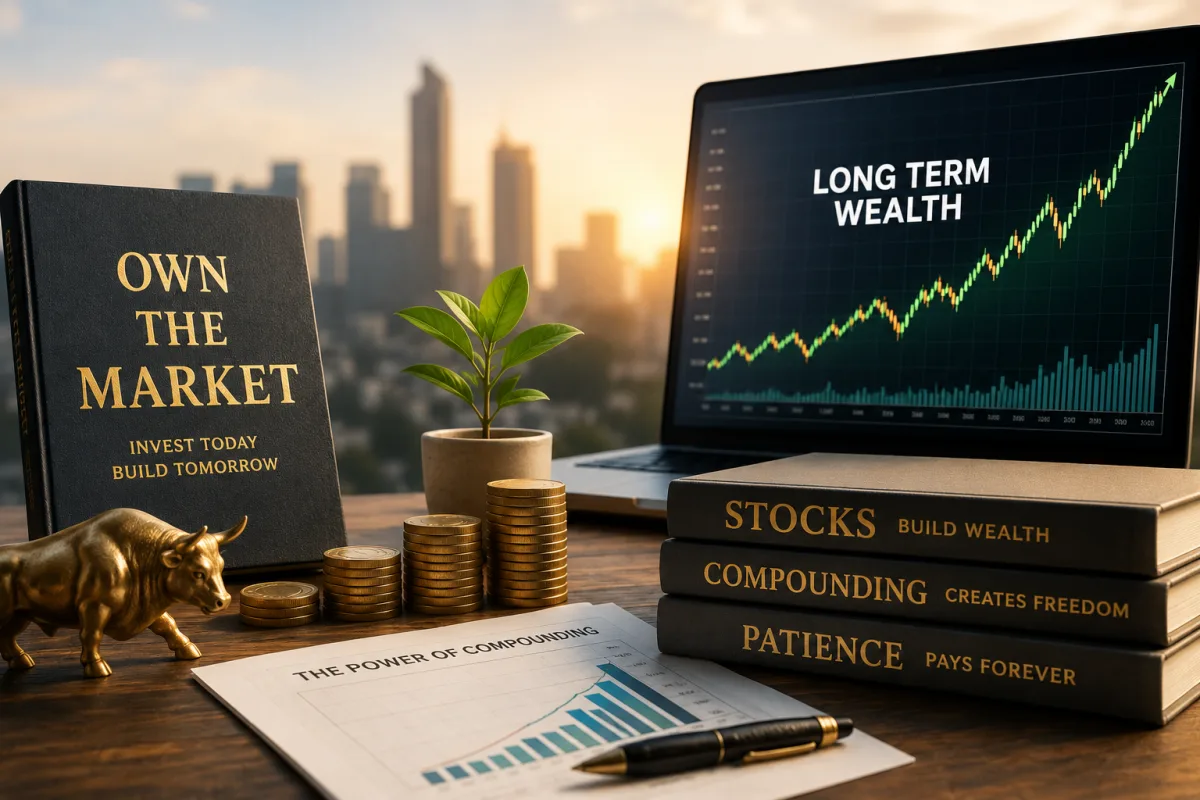
Owning the Market: How Stock Investing Builds Wealth Over Time
The stock market is one of the most misunderstood wealth-building tools in modern finance.
To some people, it looks like a casino: prices flashing across screens, traders shouting opinions, fortunes rising and falling by the hour. To others, it appears to be a private club reserved for wealthy professionals, fund managers, analysts, and people who understand complicated financial language. For many households, the market feels distant, risky, and intimidating.
Yet beneath the noise is a much simpler idea.
When you invest in stocks, you are buying ownership in businesses.
That single idea changes the way the stock market should be understood. A share of stock is not just a symbol on a trading app. It is not merely a price that moves up and down. It represents a claim, however small, on a company’s future profits, assets, growth, and economic activity. Stock investing gives ordinary people the chance to participate in the success of businesses that sell products, provide services, build technology, manufacture goods, operate infrastructure, lend money, distribute food, manage logistics, entertain audiences, and solve problems at scale.
The market may look chaotic from day to day, but long-term stock investing is rooted in ownership. Ownership is one of the oldest wealth-building principles in history. Workers earn income by selling time and skill. Owners build wealth by holding assets that can produce value even when they are not personally working. Stocks allow investors to become partial owners of businesses without having to start, manage, or operate those businesses themselves.
This does not mean stock investing is easy. It does not mean returns are guaranteed. It does not mean every company is worth owning. It does not mean prices cannot fall sharply. The stock market can be volatile, emotional, humbling, and unforgiving to those who approach it without discipline.
But for investors who understand its purpose, respect its risks, and think in years rather than days, the stock market can become one of the most powerful engines of long-term wealth.
The Stock Market Is a System of Ownership
A stock market exists because businesses need capital and investors want opportunity.
When a company grows, it may need money to hire employees, build factories, expand distribution, develop products, enter new markets, or strengthen its balance sheet. One way to raise money is by selling ownership shares to investors. Once those shares trade publicly, investors can buy and sell them through stock exchanges.
For the company, public markets can provide access to large pools of capital. For investors, public markets provide access to ownership in businesses that would otherwise be difficult to reach.
This is a remarkable financial development. A schoolteacher, nurse, engineer, driver, entrepreneur, or office worker can own shares in major companies through a retirement account or brokerage account. They may not sit in boardrooms, manage employees, or design products, but they can still participate financially in corporate growth.
That is the democratic power of public markets.
At the same time, the market is not charity. It does not reward investors simply because they participate. It rewards ownership under conditions of uncertainty. Companies compete. Some succeed. Some decline. Some become dominant for decades. Others disappear. Industries change. Technology disrupts business models. Consumer behavior shifts. Interest rates rise and fall. Governments regulate. Recessions occur. Markets respond not only to current profits, but to expectations about the future.
This is why stock prices move.
A stock price reflects what buyers and sellers are willing to accept at a specific moment. That price may be influenced by earnings, growth, interest rates, inflation, investor sentiment, news, fear, excitement, liquidity, and speculation. Over short periods, prices can move far more dramatically than the underlying value of a business. Over long periods, business performance matters more.
This difference between price and value is central to intelligent investing.
Price is what the market says today. Value is what the business may be worth based on its ability to generate future cash flows. Sometimes price is reasonable. Sometimes it is too high. Sometimes it is too low. Investors who cannot distinguish between price movement and business ownership are more likely to panic when prices fall or become reckless when prices rise.
The stock market is a voting machine in the short run and a weighing machine over time. In the short run, investors vote with emotion, expectations, and liquidity. Over time, businesses are weighed by earnings, cash flow, competitive strength, capital allocation, and durability.
Why Stocks Can Build Wealth
Stocks can build wealth because successful businesses can grow their profits over time.
A company that sells more products, improves margins, raises prices responsibly, expands into new markets, develops better technology, or allocates capital wisely may become more valuable. Shareholders benefit when the value of the business rises. They may also benefit through dividends, which are cash payments distributed from company profits.
There are three broad ways stock investors can make money.
The first is capital appreciation. This happens when the price of a stock rises above the investor’s purchase price. If an investor buys a share for $50 and later sells it for $80, the gain is $30 before taxes and costs. Capital appreciation is often what people think of first when they imagine stock market wealth.
The second is dividends. Some companies distribute part of their profits to shareholders. Dividends can provide income, and when reinvested, they can purchase more shares. Over time, reinvested dividends can become a powerful contributor to total returns.
The third is compounding. Compounding occurs when returns generate additional returns. An investor who reinvests dividends and allows gains to remain invested gives the portfolio more capital to grow from. The longer this process continues, the more powerful it can become.
Compounding is the quiet force behind much of long-term investing. It is also the reason patience matters so much. In the early years, growth may seem unimpressive. Contributions may matter more than investment returns. But as the portfolio grows, returns can begin to contribute more meaningfully. Eventually, the assets may start doing more of the work.
This is why time is one of the investor’s greatest advantages.
An investor who begins early does not need every investment to be extraordinary. They need consistency, diversification, reasonable costs, emotional discipline, and enough time for compounding to operate. A late start can still succeed, but it usually requires larger contributions, higher income, stricter discipline, or more modest goals.
Stock market investing rewards time in a way that many people underestimate. The market can be disappointing over months and powerful over decades. The investor’s challenge is to survive the disappointing periods long enough to benefit from the powerful ones.
Investing Is Not the Same as Trading
One reason people fear the stock market is that they confuse investing with trading.
Trading focuses on shorter-term price movement. A trader may buy and sell based on charts, momentum, news events, earnings announcements, market patterns, or technical signals. Some traders are skilled and disciplined. Many are not. Trading requires time, risk control, emotional strength, and the ability to accept frequent losses.
Investing is different.
Investing focuses on long-term ownership. An investor buys assets because they believe those assets can produce value over time. The investor is less concerned with predicting tomorrow’s price and more concerned with whether the underlying asset can grow, generate income, or support long-term goals.
The distinction matters because the behaviors required are different.
A trader may need speed. An investor needs patience. A trader may need to react quickly. An investor often benefits from doing nothing. A trader may measure success over days or weeks. An investor measures progress over years. A trader often depends on timing. An investor depends more on ownership, diversification, and compounding.
Problems arise when people say they are investing but behave like traders. They buy a stock because it is rising quickly. They sell because it falls for a few days. They chase headlines. They follow social media excitement. They switch strategies every month. They confuse activity with intelligence.
Long-term investing is not passive in the sense of being careless. It requires study, planning, and review. But it does not require constant motion. In many cases, the most successful decision is to hold a well-designed portfolio through discomfort.
The stock market transfers wealth from the impatient to the patient when impatient investors sell valuable assets during fear and patient investors continue accumulating ownership at better prices.
The Emotional Challenge of Stock Investing
The mathematics of investing are easier than the psychology.
Most people can understand the basic principles: invest regularly, diversify, keep costs reasonable, avoid panic, and think long term. The difficulty is practicing those principles while real money is moving up and down.
When markets rise, greed becomes persuasive. Investors begin to believe gains are easy. They may take more risk, borrow to invest, concentrate in popular stocks, or abandon diversification. Rising markets make people feel smarter than they are.
When markets fall, fear becomes persuasive. Investors begin to imagine that losses will never stop. They may sell good assets at low prices, stop contributing, or wait for certainty before returning. Falling markets make people forget why they invested in the first place.
Both emotions are dangerous.
Greed encourages investors to overpay. Fear encourages them to sell too cheaply. Together, they create the classic cycle of buying high and selling low.
A disciplined investor builds guardrails before emotions take over. Those guardrails may include automatic contributions, a written investment policy, diversified funds, asset allocation targets, emergency reserves, and rules for rebalancing. The purpose is not to eliminate emotion. No investor does that completely. The purpose is to prevent emotion from becoming strategy.
It is also useful to expect volatility before it happens. A stock portfolio will decline at times. Some declines will be modest. Others will be severe. A long-term investor should not interpret every decline as a sign of failure. Declines are part of the cost of seeking higher long-term returns.
This is easy to say when markets are calm and hard to remember when headlines are frightening. That is why preparation matters. Investors who know in advance that volatility is normal are less likely to treat it as a surprise.
Diversification: The Investor’s Protection Against Being Wrong
No investor can know the future with certainty.
A company that looks strong today may weaken. A promising industry may disappoint. A popular stock may become overpriced. A dominant business may face regulation, technological disruption, management failure, or changing customer behavior. Even excellent companies can produce poor investment returns if purchased at excessive prices.
Diversification is the recognition that the future is uncertain.
Instead of depending on one company, one industry, one country, or one investment theme, diversified investors spread their money across many holdings. This reduces the damage caused by any single failure. Diversification does not eliminate risk, but it can make risk more survivable.
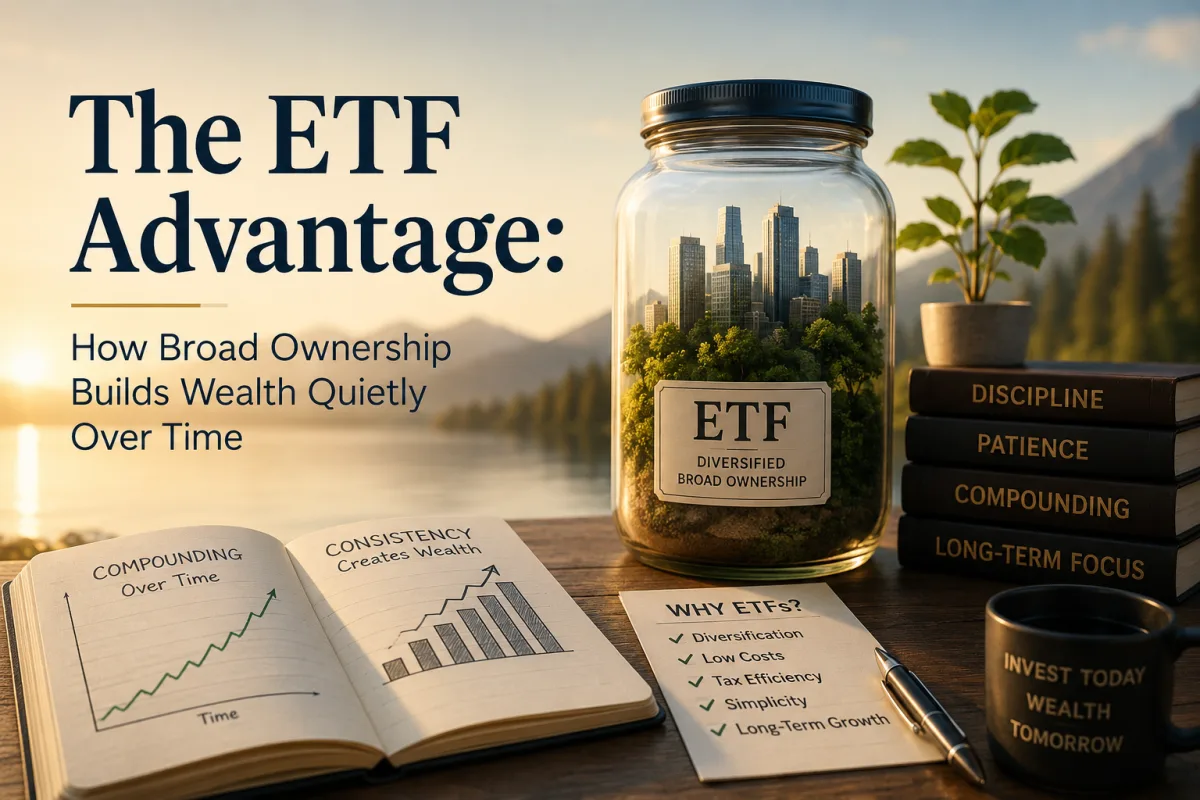
For many investors, broad index funds or diversified mutual funds provide an efficient way to diversify. A single fund may hold hundreds or thousands of companies. This allows investors to participate in broad market growth without having to choose individual winners.
Individual stock investing can still play a role for some people, especially those with the time and skill to study businesses. But concentrated stock picking is harder than it appears. It requires understanding financial statements, competitive advantage, valuation, management quality, balance sheets, industry structure, and risk. It also requires emotional tolerance for underperformance.
Diversification is sometimes criticized because it limits the upside of owning one extraordinary winner. That criticism is partly true. A concentrated investor who chooses correctly can achieve exceptional results. But concentration also magnifies mistakes. A household’s long-term financial security should not depend entirely on being right about a small number of predictions.
Diversification is humility expressed through portfolio design.
It says: “I believe in long-term growth, but I do not know exactly which company, sector, or country will lead the future.”
That humility can protect wealth.
Risk Is More Than Price Movement
Many people define investment risk as the chance that prices will fall. Price declines are one form of risk, but they are not the only one.
For a long-term investor, risk also includes the possibility of permanent capital loss, inflation erosion, poor diversification, excessive fees, emotional selling, inadequate liquidity, tax mistakes, fraud, overconcentration, and investing without understanding the asset.
A temporary decline in a diversified portfolio may be uncomfortable but survivable. A permanent loss caused by owning a failing company, using excessive leverage, or falling for a scam can be far more damaging.
Risk also depends on time horizon.
Money needed next month should not be invested in stocks. Money needed for a house deposit in one year may not belong in volatile equities. Money intended for retirement decades away can usually tolerate more fluctuation. The same investment can be reasonable for one goal and reckless for another.
This is why financial planning should come before investing.
Before choosing stocks or funds, investors should understand their goals, time horizon, income stability, emergency reserves, debt level, tax situation, and emotional tolerance. The best portfolio is not the one with the highest theoretical return. It is the one the investor can hold through real life.
Risk capacity and risk tolerance are different. Risk capacity is the financial ability to take risk. Risk tolerance is the emotional ability to endure it. A young investor with stable income and decades until retirement may have high risk capacity. But if that investor panics during every decline, their risk tolerance may be lower. A retiree may have strong emotional tolerance but lower risk capacity because withdrawals are near or already happening.
Good investing respects both.
The Role of Index Funds
One of the most important developments for ordinary investors has been the rise of low-cost index funds.
An index fund is designed to track a market index rather than select individual stocks through active management. For example, a broad market index fund may seek to hold a representative basket of publicly traded companies. Instead of trying to beat the market, the fund aims to capture the market’s return, minus costs.
This approach is powerful because costs matter. Every fee paid to a fund manager, broker, platform, or advisor is money that does not remain invested for the shareholder. Over short periods, small fees may seem insignificant. Over decades, they can create a meaningful difference because fees compound too, but against the investor.
Index funds also reduce the need to identify winning companies in advance. Since they hold many companies, investors benefit from the fact that a small number of exceptional businesses can drive a large portion of market returns. The investor does not need to know ahead of time which companies will become extraordinary. Broad ownership allows participation.
This does not mean index funds are risk-free. They still fall when markets fall. They can become heavily weighted toward expensive sectors. They do not protect investors from emotional mistakes. They may include companies an investor would not choose individually. But for many households, low-cost diversified funds offer a practical, transparent, and efficient route into stock ownership.
The simplicity of index investing is one of its strengths. It allows investors to focus less on prediction and more on behavior: saving consistently, staying invested, rebalancing periodically, and aligning investments with goals.
Individual Stocks: Opportunity and Responsibility
Buying individual stocks can be intellectually rewarding and financially profitable, but it carries responsibilities that many beginners underestimate.
When you buy an individual company, you are making a specific judgment. You are saying that this business is worth owning at this price. That judgment should be based on more than popularity or recent performance.
A thoughtful stock investor studies how the company makes money. What products or services does it sell? Who are its customers? What gives it an advantage? How strong is its balance sheet? Does it generate cash? Are profits growing? Is management disciplined with capital? How much debt does the company carry? What threats could weaken it? Is the current stock price reasonable compared with the company’s future prospects?
These questions matter because a good company is not always a good investment. Price matters. A wonderful business purchased at an excessive valuation may produce disappointing returns. A troubled business purchased cheaply may still be a poor investment if the trouble worsens. The relationship between quality, price, and expectations is essential.
Individual stock investing also requires emotional discipline. A stock can fall sharply even when the long-term thesis remains intact. Another can rise quickly and tempt investors to believe risk has disappeared. Owning individual companies requires the ability to update views without reacting to every price movement.
For most people, individual stocks should not replace a diversified foundation. A core portfolio of diversified funds can provide broad exposure, while a smaller portion may be used for individual companies if the investor has the interest, knowledge, and risk tolerance. This structure allows learning and participation without placing the entire financial future on a few decisions.
Dividends and the Discipline of Cash Flow
Dividend investing appeals to many investors because it makes ownership tangible. Receiving cash from a company can feel more concrete than watching a stock price move. Dividends remind investors that stocks represent businesses capable of distributing profits.
Dividend-paying companies are often mature businesses with established cash flows. Some investors use dividends to support retirement income. Others reinvest them to buy more shares. Over time, reinvestment can create a powerful compounding effect.
But dividends should not be romanticized.
A high dividend yield can be a warning sign if the payout is unsustainable. A company may pay a large dividend while its business deteriorates, its debt rises, or its future investment needs are ignored. Investors who chase yield without studying quality can suffer both income cuts and capital losses.
Dividends are one way companies return capital to shareholders, but not the only way. Some companies reinvest profits into growth. Others buy back shares. Some do a combination. The best approach depends on the company’s opportunities and capital discipline.
For investors, the key question is not simply whether a stock pays a dividend. The better question is whether the company can create value over time and whether its use of capital supports shareholder wealth.
Market Timing Is Harder Than It Looks
Many investors believe they can improve returns by moving in and out of the market at the right times. In theory, this sounds attractive. Sell before declines. Buy before recoveries. Avoid pain. Capture gains.
In practice, market timing is extremely difficult.
The problem is that investors must be right twice: when to exit and when to re-enter. Selling during fear may feel safe, but if the market recovers quickly, the investor may miss gains. Waiting for certainty often means waiting until prices are already higher. Markets frequently begin recovering before economic headlines improve.
Market timing also creates emotional traps. Once an investor sells, they may need a clear signal to return. But markets rarely provide clarity. They move through uncertainty. The investor may sit in cash while prices rise, then re-enter only after confidence returns and valuations are less attractive.
This does not mean investors should never adjust portfolios. Rebalancing, changing asset allocation as goals approach, raising cash for near-term needs, and selling unsuitable investments are all valid. But these decisions should be based on planning, not prediction.
A disciplined long-term investor does not need to capture every market high or avoid every market low. The goal is to participate in long-term wealth creation while managing risk intelligently.
Dollar-Cost Averaging and the Power of Routine
Dollar-cost averaging means investing a fixed amount at regular intervals regardless of market conditions. When prices are high, the fixed contribution buys fewer shares. When prices are low, it buys more shares. Over time, this can reduce the emotional pressure of choosing the perfect entry point.
For workers investing through retirement plans or automatic brokerage contributions, dollar-cost averaging often happens naturally. Money is invested every paycheck or every month. This routine turns investing into a habit rather than an event.
The greatest benefit may be psychological. Investors who automate contributions are less likely to stop and start based on headlines. They continue buying during downturns, which can feel uncomfortable but may improve long-term outcomes if markets recover.
Dollar-cost averaging does not guarantee profits or prevent losses. A market can continue falling after contributions are made. A lump-sum investment may outperform if markets rise immediately. But for many people, the best investing strategy is not the one that is mathematically perfect in hindsight. It is the one they can actually follow.
Routine is powerful because wealth building depends on repetition. One investment may not change a life. Hundreds of investments made consistently over many years can.
Asset Allocation: The Architecture of a Portfolio
Asset allocation is the mix of investments in a portfolio. It may include stocks, bonds, cash, real estate, and other assets. For stock market investors, asset allocation determines how much of the portfolio is exposed to equities and how much is held in more conservative investments.
This decision matters more than many investors realize.
A portfolio with 100 percent stocks may offer higher long-term growth potential, but it can experience severe declines. A portfolio with a mix of stocks and bonds may grow more slowly but provide greater stability. A portfolio with too much cash may feel safe but lose purchasing power to inflation over time.
The right allocation depends on goals, time horizon, income stability, withdrawal needs, and temperament. A young investor saving for retirement may hold a larger stock allocation because they have time to recover from downturns. A retiree drawing income may need more stability because selling stocks during a market decline can damage the portfolio.
Asset allocation should not be chosen casually. It should be designed to support the investor’s financial life. An aggressive allocation that causes panic selling is not truly aggressive; it is fragile. A conservative allocation that cannot meet long-term goals may provide emotional comfort while creating future risk.
The best allocation is one that balances growth and endurance.
Rebalancing: Maintaining Discipline Over Time
As markets move, a portfolio can drift away from its intended allocation.
If stocks perform strongly, they may become a larger percentage of the portfolio than planned. If stocks decline, they may become a smaller percentage. Rebalancing is the process of bringing the portfolio back to its target mix.
For example, an investor may choose a portfolio of 70 percent stocks and 30 percent bonds. After a strong stock market rally, the portfolio may become 80 percent stocks. Rebalancing would involve selling some stocks or directing new contributions toward bonds. After a major stock decline, the portfolio may become 60 percent stocks. Rebalancing may involve buying more stocks at lower prices.
Rebalancing enforces discipline. It encourages investors to trim assets after strong gains and add to assets after declines. This can feel uncomfortable because it often means doing the opposite of what emotion suggests.
Rebalancing does not need to happen constantly. Many investors review annually or when allocations move beyond a set range. The purpose is to maintain risk control, not to micromanage every movement.
Taxes, Accounts, and the Importance of Structure
Investment returns are not only shaped by what you buy. They are also shaped by where and how you hold investments.
Taxes can reduce returns if ignored. Dividends, interest, capital gains, and withdrawals may be taxed differently depending on the account type and local rules. Tax-advantaged retirement accounts, pension arrangements, education accounts, and other structures can help investors keep more of their returns working for them.
The details vary by country, and investors should understand the rules that apply to their situation. But the broader principle is universal: structure matters.
An investor who frequently trades in a taxable account may create tax bills that reduce compounding. An investor who uses tax-advantaged accounts wisely may improve long-term outcomes. An investor who holds the right assets in the wrong accounts may lose efficiency. An investor who ignores beneficiary designations may create problems for heirs.
Good investing is not only about selecting assets. It is about building a financial system around those assets.
That system includes account selection, contribution strategy, tax awareness, recordkeeping, estate planning, and withdrawal planning. These elements may not be exciting, but they help convert investment returns into usable wealth.
Common Mistakes New Stock Investors Make
New investors often make predictable mistakes. These mistakes are understandable, but they can be expensive.
Chasing recent winners
A stock or fund that has performed well recently may continue performing well, but recent performance alone is not a strategy. By the time an investment becomes popular, expectations may already be high. Buying only what has just risen can lead investors to overpay.
Selling during fear
Market declines are uncomfortable, but panic selling can turn temporary declines into permanent losses. Investors should know before buying how they intend to respond when prices fall.
Ignoring fees
Fees reduce returns. High fund expenses, trading costs, advisory fees, and platform charges can quietly weaken compounding. Investors should understand what they are paying and what value they receive.
Overconcentrating
Putting too much money into one stock, employer, sector, or theme can create unnecessary risk. Concentration can produce large gains, but it can also produce devastating losses.
Investing money needed soon
Stocks are not suitable for every goal. Money needed in the near future should generally be protected from market volatility.
Following hype
Social media, financial television, and online communities can create urgency. Hype often makes investors feel they must act immediately. Good investing rarely requires panic.
Confusing a product with a plan
A stock, fund, or app is not a financial plan. A plan connects investments to goals, time horizons, risk tolerance, taxes, liquidity, and family needs.
The Right Way to Begin
Beginning stock market investing does not require knowing everything. It requires enough knowledge to avoid obvious mistakes and enough humility to keep learning.
The first step is financial stability. Before investing aggressively, a household should understand its cash flow, build some emergency savings, manage high-interest debt, and protect against major risks. Investing while living one emergency away from forced selling can create stress and poor decisions.
The next step is defining the goal. Is the money for retirement, education, a home, financial independence, or long-term wealth building? The goal determines the time horizon. The time horizon influences the investment mix.
Then comes account selection. Depending on local rules, investors may have access to employer retirement plans, individual retirement accounts, pension schemes, tax-free savings accounts, taxable brokerage accounts, or education accounts. The best choice depends on tax treatment, flexibility, fees, and purpose.
After that, investors can choose a portfolio structure. For many beginners, a diversified low-cost fund or set of funds may be more appropriate than individual stock picking. This allows participation in the market while reducing the risk of one-company mistakes.
Finally, the investor should create a contribution habit. A modest amount invested consistently can be more effective than waiting for a large lump sum that never arrives. The habit matters because investing is not a one-time decision. It is a repeated commitment to future ownership.
Stock Investing and Wealth Inequality
The stock market has played a major role in wealth creation, but access to its benefits has not been equal.
Households with surplus income can invest more easily than households struggling to meet basic needs. People with stable employment, financial education, retirement plan access, and family support often begin earlier. Those facing high debt, low wages, medical expenses, unstable housing, or family obligations may have less room to participate.
This reality matters. It is too simplistic to tell everyone to invest without acknowledging the constraints many people face.
Still, understanding the stock market remains important because ownership is central to wealth. When only a small portion of society owns productive assets, the benefits of economic growth flow unevenly. Broader financial education can help more households participate when they have the capacity to do so.
For some families, the first step may not be buying stocks. It may be stabilizing income, reducing debt, building emergency savings, or gaining access to employer retirement contributions. For others, it may be learning that investing is possible with small amounts and does not require wealth to begin.
The stock market alone cannot solve inequality, but asset ownership can help households move from pure consumption toward participation in economic growth.
What Long-Term Investors Should Remember
The stock market will always produce reasons to worry.
There will be recessions, elections, wars, inflation scares, banking stress, currency concerns, corporate scandals, bubbles, crashes, technological disruption, and policy changes. Every era feels uniquely uncertain to the people living through it.
Long-term investors do not succeed because they find a period without uncertainty. They succeed because they build plans that can operate through uncertainty.
This requires perspective. A market decline is not pleasant, but it may also create future opportunity. A booming market feels rewarding, but it may also increase risk if valuations become stretched. A disappointing year does not define a lifetime plan. A strong year does not make an investor invincible.
The investor’s job is not to predict every turn. The job is to remain aligned with principles that have historically supported wealth: ownership, diversification, patience, cost control, risk management, and disciplined contributions.
These principles do not remove discomfort. They provide a way to act wisely despite discomfort.
The Stock Market as a Wealth-Building Partner
The stock market should not be viewed as a machine that makes people rich automatically. It is better understood as a long-term wealth-building partner. Like any partner, it can be rewarding, frustrating, unpredictable, and demanding.
It demands patience because results are uneven. It demands humility because the future is uncertain. It demands discipline because emotion can be expensive. It demands education because not every opportunity is wise. It demands endurance because compounding needs time.
But it also offers something powerful: access to ownership.
Through stocks, investors can participate in the profits and growth of businesses across industries and economies. They can convert part of their labor income into assets. They can build a portfolio that works even when they are not actively working. They can give compounding a place to operate.
This is why stock investing belongs in serious conversations about wealth building. Not because it is easy. Not because it is risk-free. Not because it provides quick riches. But because ownership of productive assets has long been one of the clearest paths from income dependence toward financial strength.
The stock market rewards those who approach it with the right expectations.
Do not expect every year to be positive. Do not expect every investment to succeed. Do not expect headlines to become calm. Do not expect emotion to disappear. Do not expect wealth to arrive overnight.
Expect volatility. Expect uncertainty. Expect mistakes. Expect cycles. Expect patience to be tested.
Then build a plan that can survive those realities.
Invest regularly. Diversify broadly. Keep costs low. Match risk to your goals. Avoid money needed soon. Rebalance when necessary. Learn continuously. Protect your financial foundation. Resist hype. Think like an owner.
The stock market is not just a place where prices move. It is a place where ownership changes hands. The investor who understands that distinction has already taken an important step.
Because wealth is not built by watching prices alone.
It is built by owning value, allowing time to work, and staying disciplined long enough for the power of compounding to reveal itself.
 Article
 Article
 Article
 Article
 Article
 Article
 Article
 Article