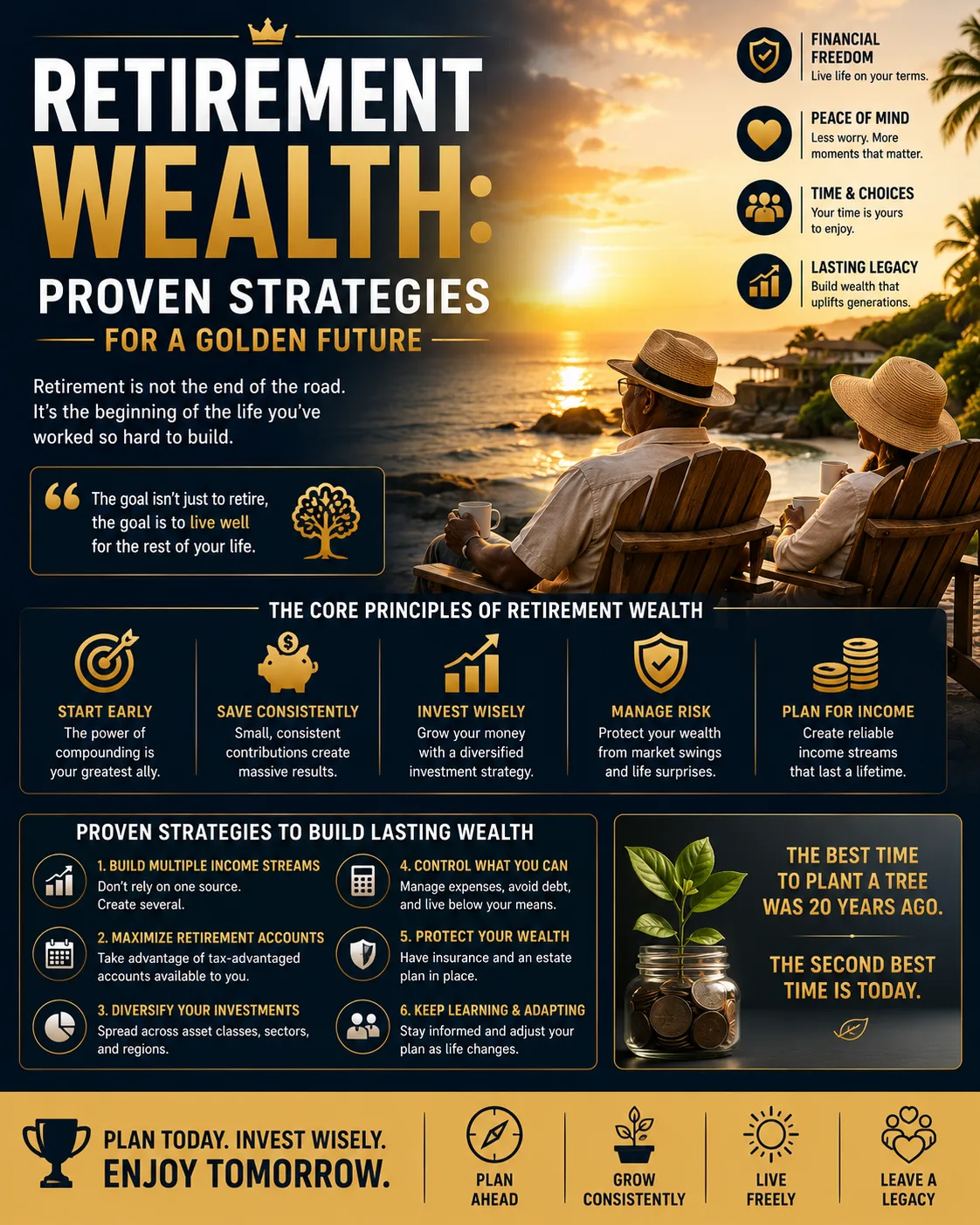
Retirement Wealth: Proven Strategies for a Golden Future
Retirement is often discussed as though it were a birthday. At 55, 60, or 65, the working life supposedly ends and a quieter chapter begins. That view is comforting, but incomplete. Retirement is not primarily an age. It is a financial condition.
A person is not truly ready for retirement simply because they have reached a certain year of life. They are ready when their assets, pensions, savings, income streams, and lifestyle choices can support them without the constant need to trade time for money. The real retirement question is not, “How old will I be?” It is, “Can my financial life sustain the dignity, independence, health, and freedom I want?”
For many Kenyan households, that question has become more urgent. Family structures are changing. Urban living costs have risen. Children may be willing to support ageing parents, but they are also navigating rent, school fees, healthcare, business risk, unemployment, and their own financial obligations. The traditional assumption that retirement will be funded by adult children is increasingly fragile.
At the same time, people are living longer. A longer life is a blessing, but it also extends the number of years that must be financed after active employment slows down or stops. A retirement that lasts 20, 25, or even 30 years is not a short rest after work. It is a full financial season that needs its own income strategy.
Kenya’s retirement system gives savers several tools: the National Social Security Fund, employer-sponsored pension arrangements, and individual pension plans regulated within the retirement benefits framework. The Retirement Benefits Authority maintains records of registered retirement schemes and individual pension plans, and Kenya’s tax rules provide incentives for qualifying pension contributions.
Yet tools alone do not create retirement wealth. A pension account is not a strategy. An NSSF contribution is not a complete plan. A monthly deduction from payroll is not the same as financial independence. Retirement wealth is built when a person understands the system, saves consistently, invests wisely, protects purchasing power, manages risk, and makes deliberate decisions long before retirement becomes urgent.
The most useful way to think about retirement is through the idea of the crossover point. This is the point where income from assets can meet or exceed living expenses. When investment income, pension income, rental income, business distributions, annuity income, or other durable cash flows can cover the cost of living, work becomes a choice rather than a necessity.
That does not mean everyone must stop working. Many people continue working in retirement because they enjoy purpose, community, influence, or entrepreneurship. The difference is that financially independent work is chosen. Forced work in old age is different. It is often driven by fear, obligation, or the painful discovery that years of earning did not become years of ownership.
The difference between earning money and building retirement wealth
Income creates the opportunity to build wealth, but income itself is not wealth. A person can earn a high salary for decades and still arrive at retirement with little more than memories, obligations, and a lifestyle they can no longer afford. Another person with a modest income can retire with greater security because they converted part of every shilling into assets.
This distinction matters because retirement exposes the weakness of income without ownership. During active working years, salary can hide many financial problems. It pays rent, school fees, food, transport, insurance, leisure, social obligations, and debt. As long as salary continues, a household may appear stable. But when employment income stops, the structure is tested.
If the working years produced assets, retirement has a foundation. If the working years produced only consumption, retirement becomes dependent on relatives, charity, government support, or continued labour.
Retirement wealth is not built by hoping for a large final payout. It is built by repeated conversion: salary into savings, savings into investments, investments into income, and income into long-term independence. The earlier that conversion begins, the more time can assist the investor.
Time is one of the most powerful retirement assets because it allows compounding to operate. Compounding is the process by which investment returns generate their own returns. A contribution made in one’s twenties has decades to grow, recover from market cycles, and benefit from reinvested earnings. A contribution made five years before retirement is still valuable, but it carries a much heavier burden because time is limited.
This is why early retirement planning is not just motivational advice. It is mathematics. A young saver does not need to be wealthy to begin. They need consistency, patience, and a system that prevents today’s spending from consuming tomorrow’s freedom.
Kenya’s three main retirement pillars
A practical retirement plan in Kenya usually combines three broad pillars: government-sponsored retirement savings, employer-sponsored schemes, and individual pension plans. Each pillar has a role. None should be misunderstood as a complete solution on its own.
1. Government-sponsored retirement savings through NSSF
The National Social Security Fund is Kenya’s foundational retirement savings arrangement for workers. It creates a basic layer of social security by requiring contributions from employees and employers. NSSF is important because it formalizes retirement saving and ensures that at least some money is being set aside during a person’s working life.
The newer NSSF contribution structure is built around pensionable earnings and tiered contributions, with employee and employer contributions calculated as a percentage of earnings within set limits. NSSF published Year 4 contribution-rate guidance in February 2026, reflecting the continuing implementation of the revised contribution framework.
NSSF should be respected, but it should not be overestimated. For many households, statutory retirement contributions alone are unlikely to finance the full lifestyle they want after work. The cost of housing, food, medical care, transport, family support, and emergencies can exceed what a basic statutory benefit can comfortably provide.
The wise approach is to view NSSF as a foundation, not the entire house. It is the first layer of retirement protection. A serious retirement plan then adds employer schemes, individual pension savings, and investment assets.
2. Employer-sponsored retirement schemes
Many formal employers operate occupational pension or provident arrangements. These schemes can be powerful because contributions may come from both the employee and employer. Employer matching is especially valuable. When an employer contributes alongside the employee, the worker is receiving additional compensation that is directed toward future wealth.
A worker who ignores an employer pension match is effectively declining part of their remuneration. The money may not arrive in the current bank account, but it belongs to the employee’s future financial life. Over a long career, employer contributions can become a major share of retirement wealth.
Employer schemes also encourage discipline. Contributions are deducted before the employee has the chance to spend the money. This matters because retirement saving is not only a financial challenge; it is a behavioural challenge. Many people intend to save what remains after spending, but little remains. Payroll deduction reverses the order. Saving happens first. Lifestyle adjusts afterward.
Still, employer schemes require attention. Members should understand their contribution rate, the employer’s contribution rate, vesting rules, fund options, fees, statements, withdrawal rules, and portability if they change jobs. A pension statement should not be treated like a mysterious document. It is a financial report on one of the most important assets a worker may ever own.
3. Individual pension plans
Individual pension plans are especially important for self-employed professionals, entrepreneurs, informal-sector earners, consultants, small business owners, and employees whose workplace benefits are limited. They allow individuals to create a retirement savings structure independent of an employer.
The Retirement Benefits Authority has highlighted registered individual pension plans as a way to save for retirement, and as of recent RBA listings there are registered individual pension plans available within Kenya’s regulated retirement benefits environment.
Individual pension plans are valuable because they introduce flexibility. A self-employed person may not have a predictable monthly salary, but they can still build retirement wealth through scheduled contributions, periodic lump sums, or contributions that rise as income improves. A consultant can save after receiving client payments. A business owner can build a pension even when no employer exists to do it for them.
For many Kenyans, the individual pension plan is the missing bridge between earning and long-term security. It turns irregular income into structured future capital. It also helps separate retirement savings from business cash, family requests, and everyday spending temptations.
However, savers should examine each product carefully. “Guaranteed” language should be understood precisely. Some pension products may include capital protection features, insurance-backed guarantees, or conservative investment structures, but investment performance, liquidity, fees, and risk depend on the specific provider and product design. Regulation provides oversight, but it does not make every outcome identical.
The tax advantage of retirement saving
One of the strongest reasons to use registered retirement schemes is tax efficiency. Kenya’s retirement savings rules allow qualifying contributions to registered pension or provident arrangements to reduce taxable income within specified limits. The Tax Laws Amendment Act, 2024 increased the tax-deductible retirement contribution limit from KSh 240,000 per year to KSh 360,000 per year, equivalent to KSh 30,000 per month, according to RBA commentary on the amendment.
This tax treatment changes the economics of saving. A person who contributes through a qualifying registered scheme is not merely setting aside money for the future. They may also reduce current taxable income, subject to the applicable rules and limits. That means the government is effectively encouraging retirement saving through the tax code.
Tax incentives should not be the only reason to save, but they are powerful. If two people save the same gross amount and one uses a tax-advantaged structure while the other saves only after tax in an ordinary account, their long-term results may differ substantially. Taxes reduce the capital available for compounding. Reducing tax drag can leave more money invested for longer.
There are also tax provisions relevant to retirement benefits and pension income. The Kenya Revenue Authority states that certain retirement amounts and pension income may be tax-free up to specified limits, and that monthly or lump-sum pension granted to a person aged 65 or older is exempt from tax.
These rules matter, but they should be applied carefully. Tax law changes. Personal circumstances differ. The tax outcome may depend on the scheme type, age, residency, withdrawal form, contribution history, and current legislation. A serious retirement plan should include periodic review with a qualified tax or pension professional, especially for high earners, business owners, expatriates, and people approaching retirement.
The crossover point: turning retirement into a number
Many people delay retirement planning because the subject feels vague. They know they should save, but they do not know how much is enough. The crossover point brings clarity.
The crossover point is the moment when income from assets equals or exceeds living expenses. It is not based on age. It is based on cash flow.
Suppose a household spends KSh 500,000 per year. If its retirement portfolio could reliably generate KSh 500,000 per year after accounting for inflation, taxes, and risk, the household has reached a basic form of financial independence. If the portfolio produces less, the household must rely on employment income, business income, family support, or draw down capital.
A simple formula often used in retirement planning is:
Required portfolio = Annual expenses ÷ expected withdrawal rate
If annual expenses are KSh 500,000 and the assumed withdrawal rate is 4 percent, the required portfolio would be KSh 12.5 million. This is calculated by dividing KSh 500,000 by 0.04.
The formula is useful because it connects retirement planning to lifestyle. A person who needs KSh 1.2 million per year requires a different capital base from a person who needs KSh 500,000. Retirement is not one universal number. It is a relationship between spending and durable income.
Yet the formula must be handled with caution. A 4 percent assumption is not a guarantee. It may refer to a withdrawal rate, an expected return, or a simplified planning rule, but each interpretation carries risk. Investment returns are uncertain. Inflation changes purchasing power. Markets do not move in straight lines. A portfolio may produce strong average returns over time while still suffering losses early in retirement.
This is why the crossover point should be treated as a planning tool, not a promise. It helps you estimate the scale of capital required. It does not remove the need for diversification, risk management, inflation protection, and periodic review.
Why inflation is the silent retirement tax
Inflation is one of the most dangerous retirement risks because it works quietly. It does not send a bill. It does not announce itself as a loss. It simply reduces what money can buy.
A retiree who needs KSh 80,000 per month today may need far more in 15 or 20 years to maintain the same lifestyle. Food, rent, medicine, transport, electricity, domestic help, insurance premiums, and family obligations can all rise. Even modest inflation compounds over time.
If prices rise by an average of 6 percent per year, the cost of living roughly doubles in about 12 years. That means a retirement income that feels comfortable at 60 may feel strained at 72 if it does not grow. This is the central problem of retirement income planning: the retiree needs stability, but their expenses are not stable.
Keeping all retirement money in cash may feel safe, but cash can be unsafe over long periods if inflation erodes its purchasing power. A bank balance that does not grow faster than the cost of living becomes less powerful every year.
This is why retirement wealth must include some form of growth. Equities, real estate, inflation-linked income, business ownership, and diversified investment funds can help preserve purchasing power, although each carries risk. The goal is not to chase high returns blindly. The goal is to build a portfolio that can survive both market volatility and rising prices.
Inflation also changes how retirees should think about withdrawals. A fixed shilling withdrawal may become inadequate over time. An inflation-adjusted withdrawal may protect lifestyle but place more pressure on the portfolio. A flexible withdrawal strategy may be more realistic: spending more in strong markets, tightening discretionary spending in weak markets, and keeping essential expenses protected.
Longevity risk: the blessing of a long life and the burden of funding it
Longevity risk is the risk of outliving one’s money. It is one of the central challenges of retirement planning.
A person retiring at 60 may live into their eighties or nineties. That is not an extreme planning scenario. It is increasingly possible. A retirement plan that assumes money only needs to last ten years may fail badly if the retiree lives for thirty.
Longevity risk is difficult because it creates a planning dilemma. Spend too aggressively, and money may run out. Spend too cautiously, and the retiree may live with unnecessary fear, denying themselves comfort despite having saved diligently. The art of retirement planning lies in balancing prudence with quality of life.
Healthcare is a major part of longevity risk. Medical expenses often rise with age. Chronic illness, specialist treatment, medication, mobility support, home care, and hospital visits can place heavy pressure on retirement income. A retiree may have enough money for food and housing but not enough for serious healthcare shocks.
This is why retirement planning should not focus only on monthly living expenses. It should include medical cover, emergency reserves, long-term care possibilities, and family discussions about caregiving. A dignified retirement is not just about paying bills. It is about protecting choice when health changes.
Longevity also affects asset allocation. A 60-year-old retiree may still need growth assets because the money may need to last for decades. Becoming too conservative too early can create another risk: the portfolio may not grow enough to keep up with inflation and long retirement horizons.
Asset allocation: the engine room of retirement wealth
Asset allocation is the process of dividing money across different types of investments. It determines how much exposure a person has to growth, income, safety, and liquidity.
A simple retirement portfolio may include equities, bonds, cash, pension funds, real estate, money market funds, and perhaps business interests. Each asset class serves a different role.
Equities offer growth potential. They represent ownership in companies. Over long periods, well-diversified equity exposure can help investors participate in economic growth, corporate profits, innovation, and productivity. But equities can decline sharply. They require patience and emotional discipline.
Bonds and fixed-income instruments can provide income and reduce volatility. They may be useful as retirement approaches because they can help stabilize a portfolio. But bonds are not risk-free. Interest-rate changes, inflation, credit risk, and issuer quality matter.
Cash and money market instruments provide liquidity. They are essential for emergencies, near-term expenses, and psychological comfort. But excessive cash can lose purchasing power over time if returns do not keep up with inflation.
Real estate can provide rental income and potential capital appreciation. For many Kenyans, property is emotionally attractive because it is tangible. But property also carries risks: vacancy, maintenance, legal disputes, concentration risk, illiquidity, taxes, and poor location choices. A rental property is not passive if it requires constant management.
Pension funds provide structure, tax advantages, regulation, and long-term discipline. They can be excellent vehicles for retirement saving, but savers must understand fees, investment options, withdrawal rules, and provider strength.
The correct mix depends on age, income stability, risk tolerance, family responsibilities, health, time horizon, existing assets, and retirement goals. A 28-year-old professional can usually tolerate more growth exposure than a 62-year-old retiree who needs monthly income. But even this rule should not be applied mechanically. A 62-year-old with substantial assets and low expenses may accept more growth risk than a 45-year-old with heavy debt and unstable income.
How asset allocation should change with age
Age-based investing is useful because time horizon affects risk capacity. Younger investors have more years to recover from market declines. They can contribute through downturns, buy assets at lower prices, and allow compounding to work. Older investors have less time to recover and may need to draw income from the portfolio soon.
In early career years, the priority is accumulation. The investor should focus on building the savings habit, increasing income, avoiding destructive debt, and owning growth assets. Volatility is uncomfortable, but it can be an ally for disciplined long-term investors who continue buying during downturns.
In mid-career years, the priority shifts toward acceleration and protection. Income may be higher, but responsibilities may also be heavier: children, housing, business expansion, family support, and education expenses. This is the stage where many people earn the most but also leak the most money. A mid-career professional should increase retirement contributions, diversify investments, protect against major risks, and avoid lifestyle inflation that permanently raises retirement costs.
In the final decade before retirement, the priority becomes transition. The investor should reduce avoidable risk, clarify expected expenses, review pension balances, estimate retirement income, pay down high-cost debt, strengthen emergency reserves, and shift part of the portfolio toward assets that can support withdrawals.
In retirement, the priority becomes sustainability. The portfolio must provide income, preserve capital, manage inflation, and avoid panic selling during downturns. This requires a thoughtful balance between liquidity, income, and growth.
The biggest mistake is making sudden emotional changes. A person who invests aggressively for decades and then sells everything after a market decline near retirement can damage years of progress. Asset allocation should change deliberately, not in response to fear.
Sequence-of-returns risk: why timing matters in retirement
Average returns can be misleading. Two investors may earn the same long-term average return but experience very different outcomes depending on when gains and losses occur.
This is called sequence-of-returns risk. It is especially dangerous near retirement and during the early retirement years.
Consider two retirees with similar portfolios. One retires just before a strong market period. Their portfolio rises early, giving withdrawals a larger base. The other retires just before a major downturn. They must withdraw money while assets are depressed. Even if markets later recover, the second retiree may have sold too many units at low prices. Their portfolio may never fully catch up.
This is why retirees need more than a return assumption. They need a withdrawal strategy. They need cash reserves, income buffers, diversified assets, and flexibility. A retiree who can cover one or two years of essential expenses without selling growth assets during a downturn may be better positioned than one who must liquidate equities every month regardless of market conditions.
Sequence risk also explains why the final years before retirement are so important. A large loss at 35 is painful but recoverable. A large loss at 63 can change retirement plans. This does not mean older investors should avoid all risk. It means risk must be organized intelligently.
The role of emergency savings in retirement planning
Emergency savings are often discussed as a working-age priority, but they are equally important in retirement. A retiree without an emergency fund may be forced to sell investments at a bad time, borrow at high cost, or rely on family during a crisis.
During working years, an emergency fund protects income disruption. In retirement, it protects the portfolio. It gives the retiree time to respond rather than react.
A practical retirement emergency fund may include several layers. The first layer is immediate cash for one to three months of expenses. The second layer is highly liquid savings or money market funds for larger needs. The third layer may include short-term fixed-income instruments that can be accessed without destroying the long-term investment plan.
The right amount depends on the retiree’s health, dependants, insurance cover, income stability, and asset liquidity. A retiree with rental income, pension income, medical cover, and low expenses may need less cash than a retiree with irregular income and significant family obligations.
Emergency savings are not designed to maximize returns. They are designed to prevent forced mistakes. Their value is strategic.
Retirement planning for self-employed Kenyans
Self-employed individuals face a unique retirement challenge. They do not have an employer automatically deducting contributions. They may not receive employer matching. Their income may fluctuate. Their business may consume most available cash.
Yet self-employed people may have the greatest need for structured retirement planning because their financial lives are often tied to business risk. A business can do well for years and then face a downturn, regulatory change, competition, illness of the owner, or cash-flow disruption. If the owner has not separated personal retirement assets from business capital, retirement security may be exposed.
The first rule for self-employed retirement planning is separation. Business money, household money, tax money, emergency money, and retirement money should not live in one undifferentiated pool. When everything sits in the same account, urgent business needs often defeat long-term saving.
The second rule is automation where possible. Even if income is irregular, the self-employed person can create a minimum monthly pension contribution and then add top-ups after profitable months. The minimum keeps the habit alive. The top-ups accelerate progress.
The third rule is diversification beyond the business. Many entrepreneurs believe their business is their retirement plan. Sometimes it is. Often it is not. A business may be difficult to sell. It may depend heavily on the founder. It may not command the valuation the owner expects. It may require ongoing involvement. A retirement plan should not rely entirely on finding a buyer at the perfect time.
Individual pension plans can help self-employed Kenyans create a disciplined retirement structure. Tax-deductible contribution limits can make these plans even more attractive when properly used within the rules.
The danger of relying on children as a retirement plan
Many African families are built on mutual support. Parents educate children. Children later support parents. This intergenerational bond is meaningful and should not be dismissed. But it should not be the only retirement plan.
Depending entirely on children creates financial pressure on both generations. Adult children may be building their own households, paying school fees, servicing mortgages, supporting siblings, managing business risk, or dealing with unstable employment. Even when they are willing to help, their capacity may be limited.
It can also create emotional strain. Parents may feel guilty asking. Children may feel overwhelmed. Financial dependence can alter family relationships, reduce dignity, and create conflict among siblings over who contributes more.
A stronger model is shared resilience. Parents build retirement assets. Children offer love, companionship, advice, and support where needed. Family remains important, but it is not forced to carry the full financial weight of old age.
Retirement planning is therefore an act of family protection. It reduces the likelihood that children must choose between their parents’ needs and their own children’s future.
Debt and retirement: the burden that follows you home
Debt is not always bad. A mortgage used to acquire a productive or appreciating asset may be reasonable. Business credit can help finance growth. Education loans may increase earning power. But debt becomes dangerous when it consumes future income without creating lasting value.
Entering retirement with heavy consumer debt is one of the fastest ways to weaken financial independence. Loan repayments reduce cash flow. Interest transfers wealth from the retiree to lenders. Debt also reduces flexibility. A retiree with no debt can adjust spending more easily during difficult periods. A retiree with fixed repayments has less room to manoeuvre.
High-cost debt should usually be addressed before aggressive investing outside structured retirement contributions. It rarely makes sense to chase uncertain returns while paying expensive interest on consumer loans. The guaranteed saving from eliminating high-interest debt can be more valuable than speculative investment gains.
In the decade before retirement, debt review should become a major priority. The household should identify all loans, interest rates, repayment schedules, collateral, and consequences of default. The goal is not necessarily to eliminate every form of debt, but to enter retirement with manageable obligations and a clear cash-flow plan.
Debt also affects psychological freedom. A person who owns their home, has modest expenses, and carries no high-cost debt may need a smaller retirement portfolio than someone with the same income but heavy obligations. Retirement wealth is not only about assets. It is also about the absence of financial drains.
Healthcare: the expense many retirement plans underestimate
A retirement plan that ignores healthcare is incomplete. Medical costs can change everything. A household may plan carefully for food, housing, utilities, and transport, only to be destabilized by chronic illness, surgery, medication, or long-term treatment.
Healthcare planning should begin before retirement. Waiting until illness appears can make cover more expensive or unavailable. Retirees should understand their medical insurance options, exclusions, waiting periods, outpatient limits, inpatient limits, chronic disease cover, and the role of public and private healthcare systems.
They should also build a medical reserve. Insurance helps, but it may not cover everything. Transport to hospitals, caregivers, special diets, home modifications, medical equipment, and uncovered drugs can still create costs.
Preventive health is also financial planning. Exercise, nutrition, regular check-ups, stress management, and early treatment can reduce the probability of costly complications. Not every illness can be prevented, but health decisions compound like money decisions.
Families should also discuss caregiving early. Who will make decisions if a parent becomes seriously ill? Where will they live? How will costs be shared? What documents are needed? Silence can make medical crises more expensive and emotionally chaotic.
Safe withdrawal strategies: how to spend without destroying the portfolio
Accumulating retirement wealth is only half the challenge. The other half is converting that wealth into income.
A retiree may have several income sources: pension payments, NSSF benefits, rental income, dividends, interest, annuity payments, business income, or withdrawals from investment accounts. The task is to coordinate these sources so that money lasts.
The simplest withdrawal rule is a fixed percentage of the portfolio each year. For example, a retiree may withdraw 4 percent annually. This provides discipline, but it can be too rigid if markets perform poorly or inflation rises sharply.
Another approach is essential-versus-discretionary spending. Essential expenses such as food, housing, utilities, medical cover, and basic transport are protected by stable income sources and cash reserves. Discretionary expenses such as travel, gifts, upgrades, and luxury spending vary depending on portfolio performance.
A third approach is the bucket strategy. The retiree keeps near-term spending in cash or low-risk instruments, medium-term spending in conservative income assets, and long-term growth money in equities or other growth investments. This helps reduce the need to sell volatile assets during downturns.
No withdrawal strategy is perfect. The best strategy is one the retiree understands and can follow. It should be reviewed annually, especially after major market moves, health events, inflation shocks, or family changes.
Rebalancing: the discipline that keeps risk under control
Rebalancing means adjusting a portfolio back toward its intended asset allocation. If equities rise strongly, they may become a larger share of the portfolio than planned. If they fall sharply, they may become too small. Rebalancing forces the investor to manage risk systematically.
For example, suppose a retiree wants 50 percent in growth assets and 50 percent in conservative assets. After a strong market rally, growth assets may rise to 65 percent. The portfolio now carries more risk than intended. Rebalancing may involve selling some growth assets and adding to conservative assets.
After a market decline, the opposite may occur. Growth assets may fall to 35 percent. Rebalancing may involve buying growth assets at lower prices. This is emotionally difficult, but it is one of the ways disciplined investors avoid chasing performance.
Rebalancing is not about predicting markets. It is about maintaining the risk level appropriate for the investor’s life stage and goals. It can be done annually, semi-annually, or when allocations drift beyond set limits.
Without rebalancing, a portfolio can become accidentally risky or accidentally too conservative. Retirement planning should avoid accidental outcomes.
Behavioural risk: the investor is often the weakest link
Many retirement plans fail not because the mathematics was wrong, but because behaviour broke the plan.
People panic during market declines. They chase investments after prices have already risen. They withdraw pension savings prematurely. They borrow against long-term assets for short-term consumption. They compare themselves with neighbours. They confuse speculation with investing. They postpone saving because retirement feels far away.
Behavioural risk is real. A technically sound portfolio can be destroyed by emotional decisions.
The best defence is structure. Automatic contributions reduce procrastination. Written investment policies reduce panic. Diversification reduces regret. Emergency funds reduce forced selling. Pension rules reduce impulsive withdrawals. Financial education reduces susceptibility to hype.
Investors should also beware of promises that sound too smooth. Any investment offering high returns, low risk, quick access, and guaranteed outcomes deserves scrutiny. Retirement money should not be placed into schemes that cannot be explained clearly. Complexity is not sophistication. Sometimes it is camouflage.
The older the investor, the more costly a major mistake becomes. A 30-year-old may recover from a bad investment. A 65-year-old may not. Retirement capital should be treated with seriousness because it represents decades of labour stored for future survival.
Real estate and retirement: useful asset or expensive illusion?
Property occupies a special place in Kenyan wealth culture. Land and houses are seen as evidence of progress, security, and status. Real estate can indeed be an excellent retirement asset when bought well, financed prudently, managed properly, and integrated into a broader plan.
A rental property can provide income. A fully paid home can reduce retirement expenses. Land in a developing area may appreciate. Property can also act as a hedge against inflation if rents and values rise over time.
But property can also create illusions. A person may own land that produces no income, cannot be sold quickly, and requires ongoing costs. They may own rental units with vacancies, difficult tenants, repairs, legal disputes, or poor yields. They may hold property that looks valuable on paper but cannot finance monthly retirement expenses.
The key question is not, “Do I own property?” It is, “What role does this property play in my retirement plan?”
A home that eliminates rent plays a defensive role. A rental apartment with reliable tenants plays an income role. Land held for resale plays a capital appreciation role. A family plot with emotional value may play no financial role at all.
Retirees should avoid being asset-rich but cash-poor. A large property portfolio with little liquidity can become stressful when medical bills or living expenses require cash. Real estate should be balanced with liquid investments, pensions, and income-producing assets.
International diversification and currency risk
Retirement planning should also consider currency risk. A Kenyan retiree spends mostly in shillings, but some costs may be influenced by global prices: fuel, medicine, imported goods, education support for family abroad, travel, and certain medical treatments. Currency movements can affect purchasing power.
International diversification can help reduce exposure to a single economy, currency, or market. Global equities, offshore funds, regional investments, and foreign-currency assets may provide broader opportunity. However, international investing introduces its own risks: currency volatility, tax complexity, fees, regulation, access, and product quality.
The point is not that every retiree needs offshore investments. The point is that concentration should be recognized. A person whose job, business, property, pension, and savings are all tied to one local economy may be more exposed than they realize.
As wealth grows, diversification becomes more important. The goal is resilience. A retirement plan should not depend on one employer, one property, one business, one currency, one pension provider, or one asset class.
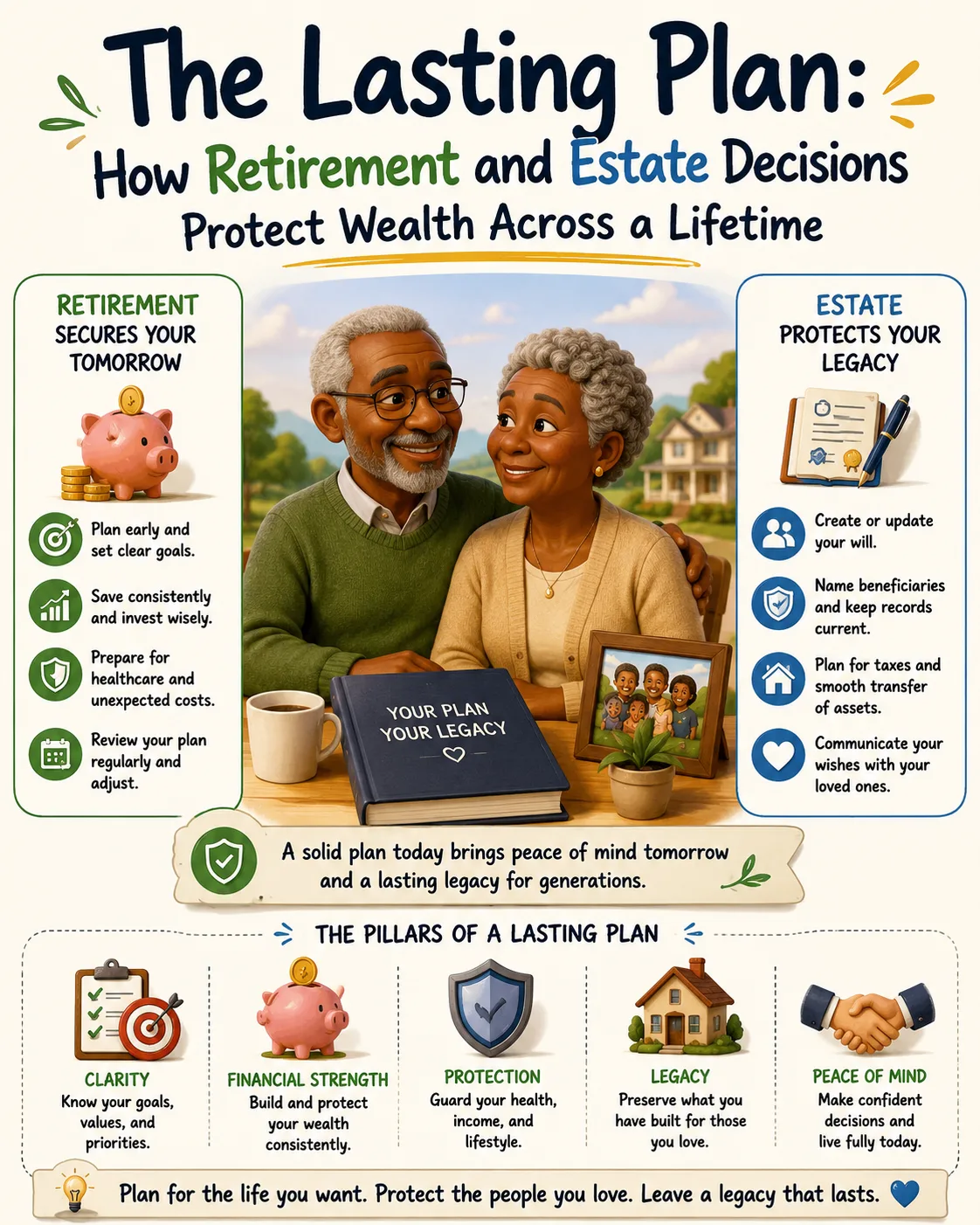
Estate planning: retirement wealth should outlive confusion
Retirement planning is incomplete without estate planning. Assets that are carefully accumulated can be damaged by unclear succession, family disputes, missing documents, or poor record-keeping.
Estate planning is not only for the very wealthy. Anyone with land, a house, pension benefits, insurance, bank accounts, SACCO savings, business shares, investment accounts, or dependants should think about transfer, control, and documentation.
A basic estate plan may include a valid will, updated beneficiary nominations, organized asset records, insurance details, pension documents, title documents, business agreements, and trusted contacts. It should also include conversations with family members where appropriate.
The purpose is not to invite conflict. It is to reduce conflict. When intentions are unclear, families may fight at the worst possible time. When documents are missing, assets may remain idle. When beneficiaries are outdated, money may go to unintended people.
Retirement wealth should provide dignity during life and order after death. A person who plans well protects both themselves and those they leave behind.
How much should different age groups save?
There is no single savings rate that fits everyone. A person starting at 25 can reach retirement security with a lower percentage than someone starting at 45. A person with employer matching has an advantage over someone saving alone. A person with low expenses needs less capital than someone with an expensive lifestyle.
Still, practical benchmarks can help.
In the twenties, the most important goal is habit formation. Saving 10 to 15 percent of income toward long-term goals is a strong start if possible. The investor should focus on increasing earning power, avoiding destructive debt, and building early exposure to growth assets.
In the thirties, retirement saving should become more deliberate. A target of 15 to 20 percent of income may be appropriate for many households, especially as income rises. This is also the stage to use employer schemes fully, consider individual pension plans, and begin serious investment diversification.
In the forties, catch-up discipline becomes important. Many people in this age group face school fees, housing costs, family obligations, and lifestyle pressure. Yet retirement is no longer distant. Saving 20 percent or more may be necessary if earlier saving was limited.
In the fifties, retirement planning becomes urgent. The household should calculate expected expenses, estimate pension income, reduce debt, increase contributions, and avoid speculative mistakes. Large risks taken to compensate for late planning can backfire.
In the sixties and beyond, the focus shifts from accumulation to income design. The retiree should protect essential spending, maintain liquidity, manage healthcare risk, and preserve enough growth exposure to fight inflation.
The best savings rate is the one that connects to a real retirement target. A person should not save randomly. They should estimate annual expenses, expected pension income, investment assets, retirement age, health risks, and desired lifestyle. Then the savings rate can be adjusted to close the gap.
A practical retirement wealth framework
A strong retirement plan can be built around seven questions.
First, what does your current lifestyle cost? Many people do not know. They guess. Retirement planning begins with tracking actual expenses. Housing, food, transport, utilities, insurance, school fees, family support, debt, giving, leisure, and medical costs should be visible.
Second, what lifestyle do you want in retirement? Some expenses may fall, such as commuting or work clothing. Others may rise, such as healthcare, travel, or support for dependants. Retirement expenses should be estimated realistically, not romantically.
Third, what guaranteed or structured income will you have? This includes NSSF, employer pensions, annuities, rental income, and any other reliable income sources. The word reliable matters. A business that may or may not produce income should not be treated the same as a contractual pension payment.
Fourth, what is the gap between expected income and expected expenses? This gap determines the investment portfolio required. If expenses are KSh 1 million per year and reliable income is KSh 400,000, the portfolio must support the remaining KSh 600,000, adjusted for inflation and risk.
Fifth, how much must you save and invest to close the gap? This depends on current age, current assets, expected returns, contribution rate, retirement age, and inflation. A retirement calculator can help, but assumptions should be conservative.
Sixth, what risks could disrupt the plan? Inflation, illness, job loss, business failure, market decline, family emergencies, debt, and policy changes should be considered.
Seventh, how often will you review the plan? Retirement planning is not a one-time event. It should be reviewed annually and after major life changes.
Common retirement mistakes
The first mistake is starting too late. Late starters must save more, take more difficult decisions, or accept a lower retirement lifestyle. Delay is expensive because lost time cannot be recovered fully.
The second mistake is assuming children will handle everything. Family support is valuable, but dependence without a plan can create hardship for both generations.
The third mistake is underestimating inflation. A retirement income that looks adequate today may be inadequate later if it does not grow.
The fourth mistake is confusing property ownership with retirement income. Land that produces no cash flow cannot pay monthly bills unless sold or developed.
The fifth mistake is ignoring healthcare. Medical costs can destroy a fragile retirement plan.
The sixth mistake is taking excessive investment risk near retirement. Chasing high returns late in life can lead to permanent losses.
The seventh mistake is becoming too conservative too early. Avoiding all growth assets can expose retirees to inflation and longevity risk.
The eighth mistake is failing to read pension statements. Pension members should understand contributions, balances, fees, beneficiaries, and investment performance.
The ninth mistake is withdrawing retirement savings prematurely. Money removed early loses future compounding and may be consumed before it can serve its intended purpose.
The tenth mistake is having no estate plan. Poor documentation can turn retirement wealth into family conflict.
The golden future is built before it is needed
A secure retirement is not created at retirement. It is created through thousands of decisions made before retirement: the decision to save before spending, to invest instead of only consume, to use tax-advantaged pension structures, to avoid destructive debt, to protect health, to diversify, to review progress, and to think beyond the next salary.
Kenya’s retirement system provides important building blocks. NSSF creates a foundational layer. Employer schemes can add powerful contributions and discipline. Individual pension plans offer flexibility, especially for self-employed people and workers without strong employer benefits. Tax incentives can improve the reward for saving. Investment assets can help build growth and income.
But the ultimate responsibility remains personal. A retirement system can assist, but it cannot replace deliberate planning. A pension provider can administer money, but it cannot decide your lifestyle. An employer can contribute, but it cannot guarantee your discipline. The government can provide incentives, but it cannot force financial wisdom.
The central retirement lesson is simple: convert income into ownership while time is still on your side.
Ownership gives options. It allows a person to retire with dignity, support family without becoming dependent, handle medical costs with less fear, and choose work for meaning rather than survival. It turns old age from a financial emergency into a planned season of life.
Retirement wealth is not reserved for the already rich. It is built by people who understand that every working year has two jobs. The first is to finance today. The second is to buy freedom for tomorrow.
The golden future belongs to those who prepare for it before it arrives.
 Article
 Article
 Article
 Article
 Article
 Article
 Article
 Article