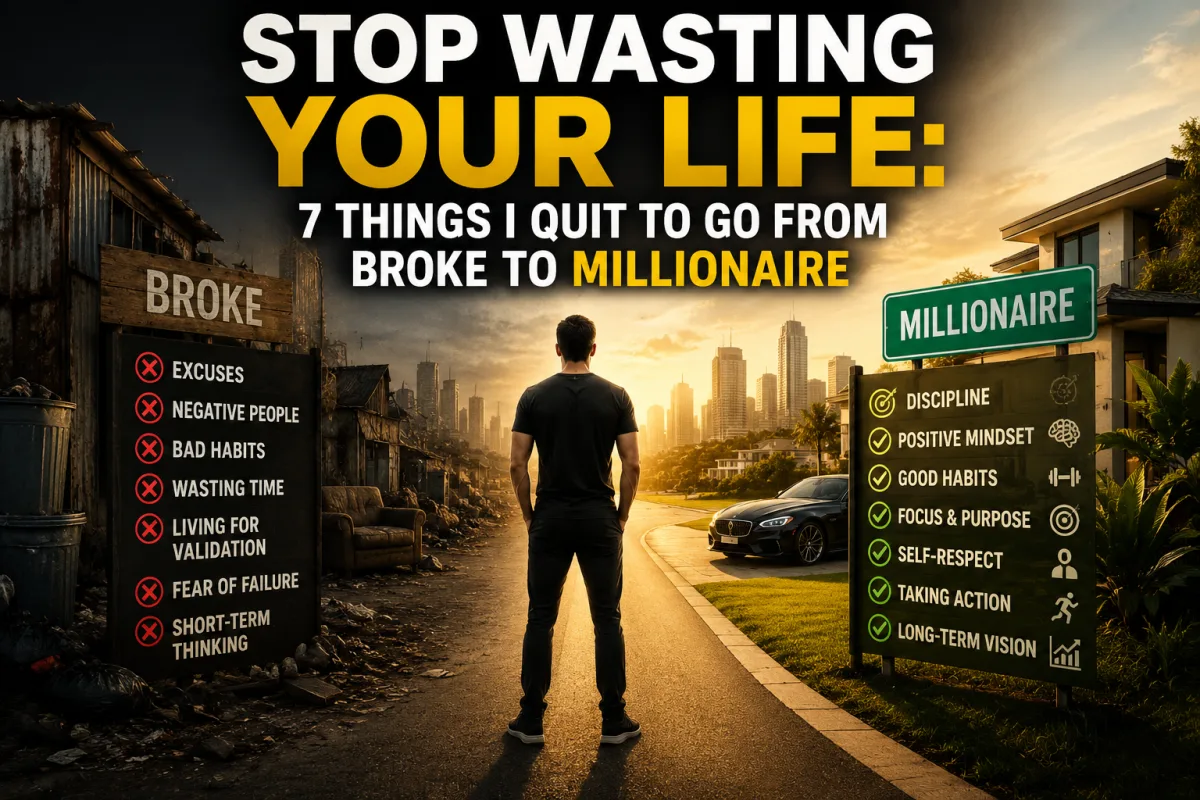
Stop Wasting Your Life: 7 Things I Quit to Go From Broke to Millionaire
Most people think wealth begins with addition.
They believe they need to add a higher income, add a new business, add an investment strategy, add a mentor, add a side hustle, add a productivity system, add a better network, add another book, add another course, or add another opportunity.
Sometimes that is true. Growth often requires new skills, better information, stronger relationships, and more productive work. But for many people, the first step toward wealth is not addition. It is subtraction.
You cannot build a serious financial life while carrying habits that quietly destroy your income, attention, confidence, and discipline. You cannot become wealthy if your time is leaking, your money is leaking, your relationships are draining you, your ego is making expensive decisions, and your mind is addicted to excuses. Before money can multiply, waste has to stop.
This is why many people remain broke even after earning more. Their problem is not only income. Their problem is capacity. More money enters the same undisciplined system and disappears through larger spending, bigger obligations, poor decisions, and emotional reactions. They add income but never subtract the habits that consume it.
Going from broke to millionaire is rarely a single dramatic leap. It is more often a long process of quitting the things that keep you financially weak and replacing them with behaviors that create ownership. You stop wasting money. You stop wasting attention. You stop wasting years. You stop wasting your best energy trying to impress people who do not carry the consequences of your choices.
The word “millionaire” can sound glamorous, but the path is usually less glamorous than people imagine. It is built through boring repetition: earning, saving, investing, learning, selling, negotiating, delaying gratification, managing risk, and refusing to let temporary emotions control permanent decisions.
The transformation begins when you stop treating your life like something that will fix itself later.
Here are seven things to quit if you want to stop wasting your life and build real wealth.
1. Quit Living for Approval
The fastest way to waste your life is to let other people’s opinions become your financial plan.
Many people are not broke because they lack intelligence. They are broke because they are addicted to being seen a certain way. They buy things to look successful before they are secure. They choose careers to satisfy family expectations. They rent apartments they cannot comfortably afford because they want to appear elevated. They attend events they do not value because they fear being left out. They upgrade phones, clothes, cars, vacations, and lifestyle markers because they want approval from people who may not even respect them.
Approval is one of the most expensive addictions because it disguises itself as normal living.
At first, it feels harmless. You buy a nicer outfit because everyone else looks polished. You take a trip because your friends are going. You move into a more expensive area because you want to signal progress. You borrow money for a celebration because people expect it. You say yes to social spending because you do not want to seem broke.
Then the pattern grows. You begin making financial decisions based on how they will be perceived rather than what they will cost. You become more concerned with being admired than being free. You may look impressive in public while privately living one emergency away from panic.
The problem with living for approval is that the audience never pays the bill.
The people impressed by your lifestyle will not always help you when debt becomes heavy. They will not replace your savings when an emergency arrives. They will not fund your retirement because you looked fashionable in your 20s or 30s. They will not restore the years you spent trying to appear wealthier than you were.
Wealth requires a different relationship with status. A person serious about building wealth must be willing to look ordinary while doing extraordinary financial work in private. They must be willing to drive a modest car while investing. They must be willing to live below their means while assets grow. They must be willing to say no to social pressure, even when that no makes them look less exciting.
This is difficult because status is emotional. People do not only buy products. They buy identity. They buy belonging. They buy proof that they are not falling behind. They buy evidence that life is improving.
But there is a difference between real improvement and visible consumption.
Real improvement is debt decreasing. Savings increasing. Skills strengthening. Income rising. Investments growing. Health improving. Relationships becoming healthier. Options expanding. Peace increasing. Visible consumption may accompany success later, but it should not replace the foundation.
When you quit living for approval, you reclaim financial oxygen. You begin asking better questions. Does this purchase serve my future or my ego? Am I buying this because I value it or because I want to be seen with it? Will this decision create freedom or create pressure? Would I still want this if nobody saw it?
Those questions change your life because they move you from performance to ownership.
A broke person chasing approval spends money to feel rich. A wealth builder uses money to become free.
2. Quit Spending Your Future to Comfort Your Present
Many people do not realize they are selling their future one impulse at a time.
Every time you spend money you should have saved, borrow for something you do not need, ignore a bill, delay investing, or use tomorrow’s income to fund today’s emotion, you are making a trade. You are buying present comfort with future pressure.
Sometimes spending is necessary. Life costs money. Food, housing, transportation, healthcare, education, family obligations, and basic dignity require resources. The issue is not responsible spending. The issue is emotional spending disguised as need.
Emotional spending often appears after stress, boredom, insecurity, loneliness, anger, or comparison. You feel overwhelmed, so you buy something. You feel behind, so you upgrade something. You feel unseen, so you spend to create a moment. You feel tired, so convenience becomes the budget. You feel anxious, so you avoid checking your account and keep spending anyway.
The purchase may bring temporary relief, but the pressure returns. Then another purchase is needed. The cycle continues until your income becomes a servant of your feelings.
This pattern keeps people broke because it destroys margin. Margin is the space between income and expenses. Without margin, you cannot save. Without savings, emergencies become debt. Without savings and investment, income never becomes wealth. Without wealth, you remain dependent on continuous labor.
The brutal truth is that many people do not need a more complicated budget. They need to stop using money as therapy.
Financial discipline begins when you separate feelings from instructions. A feeling can be acknowledged without being obeyed. You can feel stressed without shopping. You can feel left out without overspending. You can feel ambitious without buying status symbols. You can feel tired without outsourcing every inconvenience. You can feel uncertain without gambling on risky schemes.
This does not mean never enjoying life. Enjoyment matters. A financial life built only on deprivation can become emotionally unsustainable. But enjoyment should be chosen, planned, and affordable. It should not destroy your stability.
A strong wealth habit is to pay your future first. When income arrives, assign money to savings, investment, debt reduction, and essential obligations before lifestyle spending expands. This reverses the normal pattern. Most people spend first and save whatever remains. Wealth builders save and invest first, then spend within the remaining structure.
The difference is enormous over time.
If you spend first, your future receives leftovers. If you invest first, your future becomes a priority.
Quitting present comfort does not mean becoming miserable. It means refusing to let temporary emotions consume permanent opportunity. The future version of you deserves more than apology. They deserve preparation.
3. Quit Confusing Motion With Progress
One of the most dangerous forms of life-wasting is being constantly busy but rarely effective.
Modern life makes motion easy. You can answer messages, attend meetings, watch tutorials, save motivational posts, reorganize your desk, research business ideas, scroll through financial advice, discuss goals, make vision boards, and still avoid the work that would actually change your life.
Motion feels productive because it creates activity. Progress is different because it creates evidence.
Evidence is money saved. Debt reduced. A skill improved. A client won. A product launched. A workout completed. A proposal sent. A difficult conversation handled. An investment made. A system built. A habit repeated. A measurable result achieved.
People who remain broke often have a lot of motion. They are always planning something, considering something, researching something, waiting for the right moment, thinking about starting, or talking about what they will do when conditions improve. The activity gives them the emotional reward of ambition without the discomfort of execution.
The internet makes this worse because learning can become a form of procrastination. You can watch hundreds of videos about wealth without building wealth. You can consume business content daily without selling anything. You can study investing for years without opening an investment account. You can learn productivity systems without producing meaningful work.
Knowledge is valuable only when it changes behavior.
To stop confusing motion with progress, you need clearer measurements. Do not ask, “Was I busy today?” Ask, “What moved?” Did income increase? Did skill improve? Did an asset grow? Did debt fall? Did a relationship strengthen? Did health improve? Did a project advance? Did I do the uncomfortable thing I have been avoiding?
Wealth building requires output. Not just intention. Not just identity. Not just information.
A person who wants to become financially strong must identify the few actions that matter and repeat them relentlessly. Increase earning power. Spend less than you earn. Build emergency reserves. Pay down destructive debt. Invest consistently. Learn valuable skills. Build relationships. Create assets. Protect your health. Avoid foolish risks.
Most financial progress is not mysterious. It is ignored because it is not entertaining.
The person who makes one serious sales call per day may outperform the person who spends all day studying sales theory. The person who invests consistently may outperform the person who keeps waiting for perfect timing. The person who improves one high-value skill deeply may outperform the person who samples ten trends casually.
Progress is not loud. It is cumulative.
Quit worshiping busyness. Start demanding evidence from your effort.
4. Quit Hanging Around People Who Normalize Failure
Your environment can either raise your standards or slowly lower them.
Many people underestimate how much their circle affects their financial life. They think they are independent thinkers, but humans are social creatures. We absorb norms from the people around us. What they celebrate, excuse, mock, fear, and pursue begins to shape what we believe is acceptable.
If your closest circle normalizes debt, you may stop seeing debt as urgent. If they mock discipline, you may hide your ambition. If they gamble, overspend, complain, and blame everyone else, those patterns begin to feel ordinary. If they never discuss skills, ownership, health, books, business, faith, purpose, investing, or responsibility, you may begin to neglect those areas too.
This does not mean you should abandon people because they are struggling. Everyone has seasons of difficulty. Good friends support each other through hardship. The issue is not whether someone is currently rich or poor. The issue is whether they are committed to growth or committed to excuses.
There is a major difference between a person who is broke but learning, and a person who is broke but proud of irresponsibility. There is a difference between a friend who faces hardship with humility and one who turns every failure into someone else’s fault. There is a difference between someone who lacks money and someone who lacks accountability.
The people around you should not make success feel like betrayal.
When you begin changing your life, some relationships will become uncomfortable. If you stop wasting money, some people may call you boring. If you stop partying every weekend, some may say you have changed. If you start reading, investing, exercising, or building a business, some may accuse you of thinking you are better than them.
Growth often reveals which relationships were built on shared weakness rather than shared values.
You do not need to make a dramatic announcement. You do not need to insult anyone. You do not need to become arrogant. But you do need to protect your environment. Spend more time with people who make responsibility feel normal. Build relationships with people who discuss ideas, opportunities, discipline, faith, family, health, business, and wealth with seriousness. Find mentors. Join communities where your future is not treated like a joke.
Environment is not destiny, but it is pressure. Wise people choose pressure that points them upward.
Quit giving unlimited access to people who are comfortable wasting their own lives and resent you for trying to stop wasting yours.
5. Quit Avoiding Hard Conversations With Yourself
A person can stay broke for years by avoiding one honest conversation.
That conversation may be about money. How much do you actually earn? How much do you actually spend? How much debt do you owe? What is your net worth? What do your habits cost? How long can you survive without income? What would happen if an emergency arrived this month?
It may be about career. Are you growing or hiding? Are you underpaid because the market is unfair, or because your skills have not improved? Are you in the wrong industry? Are you avoiding applications because rejection scares you? Are you loyal to a company that has no serious plan for your growth?
It may be about business. Is your idea real, or just an identity you enjoy? Have you sold anything? Does the market want what you are building? Are you avoiding feedback because it may expose weakness? Are you calling yourself an entrepreneur while refusing the discipline entrepreneurship requires?
It may be about relationships. Are you surrounded by people who drain you? Are you staying in a romantic relationship that is damaging your peace, finances, or future? Are you supporting relatives in a way that creates dependence rather than growth? Are you using generosity to avoid guilt?
It may be about character. Are you lazy? Are you entitled? Are you dishonest with yourself? Are you addicted to comfort? Are you blaming society for problems that your habits are making worse? Are you waiting for rescue?
These questions are uncomfortable, but avoidance is more expensive.
Avoidance creates financial fog. In the fog, everything feels vague. You do not know your numbers, so you guess. You do not know your weaknesses, so you repeat them. You do not know your goals, so every distraction looks reasonable. You do not know your risks, so small problems become emergencies.
Clarity can hurt at first. Seeing the true state of your finances may be painful. Admitting wasted years may be painful. Recognizing your role in your problems may be painful. But pain with clarity is useful. It gives you something to repair.
The millionaire mindset is not constant confidence. It is honesty. Wealth builders tell the truth quickly because truth shortens the distance between problem and solution.
Start with a personal audit. Write down your income, expenses, debts, assets, habits, skills, relationships, and goals. Look at the facts without dramatizing them. The purpose is not shame. The purpose is direction.
Once you see clearly, you can act clearly.
6. Quit Selling Your Attention for Free
Your attention is one of the most valuable assets you own, and much of the modern economy is designed to take it from you.
Every platform, notification, headline, advertisement, short video, controversy, game, and endless feed competes for your mind. The goal is not your growth. The goal is your engagement. If your attention can be captured, your behavior can be influenced. You can be sold products, opinions, outrage, comparison, insecurity, entertainment, and distraction.
A distracted person is easier to keep broke.
They struggle to learn deeply because their focus is fragmented. They struggle to build because long projects feel boring. They struggle to save because advertising constantly creates desire. They struggle to think because their mind is filled with other people’s noise. They struggle to rest because stimulation follows them everywhere.
The tragedy is that many people give their best attention to strangers online and their weakest attention to their own life.
They can spend hours watching other people build businesses but cannot spend one focused hour building their own. They know celebrity drama, influencer updates, political arguments, sports debates, and viral trends, but they do not know their monthly expenses. They can analyze the lives of strangers but cannot analyze their own habits.
Attention determines direction. What you focus on repeatedly becomes what you move toward.
If your attention is always on consumption, you become a better consumer. If it is on comparison, you become more insecure. If it is on outrage, you become more reactive. If it is on learning, building, selling, investing, health, and relationships, your life begins to change.
Quitting attention waste does not mean disappearing from the world. It means becoming intentional. Use technology as a tool, not a master. Set limits. Remove unnecessary notifications. Schedule deep work. Protect mornings if possible. Replace some entertainment with learning. Replace some scrolling with exercise. Replace some arguments with execution.
The wealth gap is not only about money. It is also about attention. People who can focus long enough to build valuable things have an advantage in a distracted world.
Your life is built with your attention before it is built with your money.
7. Quit Waiting to Become the Person Your Goals Require
Many people want a better life while staying loyal to the version of themselves that created the current one.
They want wealth but keep broke habits. They want fitness but keep unhealthy routines. They want a strong marriage but avoid emotional maturity. They want a better career but avoid hard skill development. They want a business but refuse sales. They want freedom but keep choosing comfort.
This is one of the hardest truths in personal growth: your current habits are perfectly designed to produce your current life.
If you want a different outcome, something about your identity must change. Not your name, personality, or humanity. Your standards. Your routines. Your tolerance for excuses. Your relationship with discomfort. Your willingness to act before you feel ready.
Many people wait for a future version of themselves to become disciplined. They say they will save when they earn more, invest when they understand everything, work hard when the opportunity is perfect, get healthy when life slows down, start the business when confidence arrives, or become serious when circumstances improve.
That future version does not appear by magic. It is created by today’s decisions.
You become disciplined by practicing discipline while it is inconvenient. You become confident by keeping promises to yourself. You become financially responsible by managing the money you have now. You become skilled by tolerating the beginner stage. You become wealthy by thinking like an owner before you feel rich.
The person who waits for transformation before taking action has reversed the order. Action creates transformation.
This does not mean making reckless decisions. It means beginning. Begin saving a small amount. Begin learning the skill. Begin applying for better roles. Begin pitching clients. Begin exercising. Begin tracking money. Begin reading contracts. Begin having honest conversations. Begin investing carefully after learning the basics. Begin building the asset.
Small beginnings are not embarrassing. Permanent delay is.
To go from broke to wealthy, you must stop negotiating with the habits that keep you broke. At some point, you must decide that the old version of you has had enough authority.
The Wealth Shift: From Survival to Ownership
Quitting these seven things creates space. But space must be filled with a better system.
If you quit approval-seeking, replace it with values. Decide what actually matters: freedom, family, health, faith, contribution, ownership, peace, excellence, or legacy. Values make it easier to say no to status spending.
If you quit emotional spending, replace it with a money plan. Budget before income arrives. Save automatically. Build an emergency fund. Attack destructive debt. Create a simple investing habit. Give your money assignments before your emotions give it excuses.
If you quit confusing motion with progress, replace it with measurable goals. Track income, savings rate, debt reduction, skills practiced, sales conversations, workouts, published work, and assets acquired. Numbers bring honesty.
If you quit weak environments, replace them with growth environments. Find people who are serious about discipline, learning, business, investing, health, and character. Read better books. Listen to better conversations. Attend better rooms. Become the kind of person who belongs in them.
If you quit avoiding hard conversations, replace avoidance with review. Schedule time weekly or monthly to examine your finances, goals, habits, and relationships. Do not let your life drift for years without inspection.
If you quit attention waste, replace it with deep work. Build blocks of time for learning, creating, selling, planning, and exercise. Protect your mind like it is the workshop where your future is built, because it is.
If you quit waiting, replace delay with small daily action. Wealth is not built by one emotional declaration. It is built by repeated behavior that aligns with the person you are becoming.
The shift from broke to millionaire is not only financial. It is philosophical. You stop asking, “How can I afford this today?” and start asking, “What will this decision make possible tomorrow?”
You stop seeing income as money to spend and start seeing it as raw material. Some income supports life. Some protects you. Some buys back freedom. Some becomes assets. Some builds skills. Some creates businesses. Some supports family and generosity. Some funds enjoyment without guilt because the foundation is already being built.
This is the ownership mindset.
A consumer asks, “What can I buy?”
An owner asks, “What can I build, acquire, improve, or control that will create value over time?”
The difference between those questions can shape an entire life.
Why Quitting Is Hard
If these seven things are so damaging, why do people keep doing them?
Because destructive habits often provide immediate rewards. Approval feels good. Spending feels good. Busyness feels important. Weak environments feel familiar. Avoidance feels safe. Distraction feels entertaining. Waiting feels comfortable.
Wealth-building habits often provide delayed rewards. Saving may feel boring at first. Investing may feel slow. Skill development may feel frustrating. Saying no may feel lonely. Deep work may feel difficult. Honest self-review may feel uncomfortable.
The broke life often offers comfort now and pain later. The wealth-building life often requires discomfort now and freedom later.
This is the central trade.
Most people do not fail because they do not know what to do. They fail because the right thing is emotionally inconvenient. They know they should spend less, but saying no feels embarrassing. They know they should learn a skill, but scrolling feels easier. They know they should leave a draining circle, but loneliness scares them. They know they should track money, but the truth feels painful.
Financial growth requires emotional maturity. You must become capable of doing what serves your future even when it does not comfort your present.
That is why quitting is not weakness. Quitting the wrong things is strength. It is the decision to stop feeding the patterns that profit from your immaturity.
The Millionaire Path Is Usually Less Dramatic Than It Looks
People often imagine the millionaire path as a sudden event: a business breakthrough, a viral product, a lucky investment, a massive promotion, a big inheritance, or one perfect opportunity.
Those things can happen, but they are not the normal foundation of durable wealth.
Most sustainable wealth is built through a combination of earning power, controlled spending, consistent investing, asset ownership, smart risk, and time. A person increases income, avoids lifestyle inflation, saves aggressively, invests in productive assets, builds or buys businesses, improves skills, and allows compounding to work.
The path may include failures. Businesses may struggle. Investments may fluctuate. Jobs may change. Plans may need revision. But the person who has quit waste is more resilient because their life has margin.
Margin is one of the most underrated wealth advantages.
Financial margin lets you survive emergencies. Time margin lets you learn and build. Emotional margin lets you think clearly. Relationship margin protects peace. Health margin gives energy. Without margin, every problem becomes a crisis.
Quitting waste creates margin. Margin creates options. Options create power.
A person with no savings may be forced to stay in a bad job. A person with savings can negotiate, move, or take calculated risk. A person drowning in status expenses cannot invest. A person living below their means can buy assets. A person addicted to distraction cannot build deep skill. A person who controls attention can become highly valuable.
Millionaires are not all the same. Some are entrepreneurs. Some are employees. Some are investors. Some are creators. Some are professionals. Some are business owners. Some are quiet accumulators who never look rich. But many share a pattern: they direct more of their resources toward ownership and less toward waste.
What to Do Next
If you are broke, the first step is not shame. Shame can freeze you. The first step is clarity.
Write down your financial reality. Income. Expenses. Debt. Savings. Assets. Skills. Obligations. You cannot repair what you refuse to measure.
Then identify your biggest leak. For one person, it may be social spending. For another, it may be debt. For another, distraction. For another, a weak circle. For another, low income caused by weak skills. For another, emotional avoidance.
Do not try to fix everything in one emotional weekend. Choose the leak that is costing you the most and attack it seriously.
If spending is the leak, create a budget and automate savings. If debt is the leak, build a repayment plan and stop adding new debt. If income is the leak, choose one high-value skill and commit to improving it. If attention is the leak, set boundaries around technology. If relationships are the leak, reduce access to people who drain your future. If fear is the leak, take one small action daily toward the thing you avoid.
Then build the wealth basics.
Earn through value. Spend below your income. Save for emergencies. Eliminate destructive debt. Invest consistently in assets you understand. Increase your earning power. Protect your health. Build relationships with serious people. Use money to buy freedom, not applause.
This is not complicated, but it is demanding. The demand is what filters people.
Many will read advice and do nothing. Some will feel inspired for a day. A few will change their calendar, budget, habits, and relationships. Those few will look different in five years.
Stop Wasting Your Life
Wasting your life does not always look dramatic.
Sometimes it looks like scrolling for hours while your goals remain untouched. Sometimes it looks like spending money you cannot afford to impress people you do not trust. Sometimes it looks like staying in rooms where your ambition has to apologize. Sometimes it looks like avoiding your bank account because the truth is uncomfortable. Sometimes it looks like calling yourself busy while making no measurable progress. Sometimes it looks like waiting for confidence while years pass.
The tragedy is not that people lack potential. The tragedy is that many people spend their strongest years feeding habits that weaken them.
You do not need to be perfect to change. You need to become honest. You need to stop protecting the behaviors that are costing you your future. You need to stop negotiating with distractions, excuses, and status games. You need to decide that your life is worth more than temporary comfort.
Going from broke to millionaire is not only about money. It is about becoming the kind of person who can manage, multiply, and protect money. It is about building the discipline to keep what you earn, the wisdom to invest it, the humility to learn, the courage to sell, the patience to compound, and the maturity to ignore what does not serve your future.
Quit living for approval.
Quit spending your future to comfort your present.
Quit confusing motion with progress.
Quit hanging around people who normalize failure.
Quit avoiding hard conversations with yourself.
Quit selling your attention for free.
Quit waiting to become the person your goals require.
These are not small decisions. They are identity decisions.
Once you make them seriously, money starts behaving differently. Not because the world becomes easy, but because you become harder to distract, harder to manipulate, harder to discourage, and harder to keep broke.
Your life is not something to postpone.
Stop wasting it.
 Article
 Article
 Article
 Article
 Article
 Article
 Article
 Article