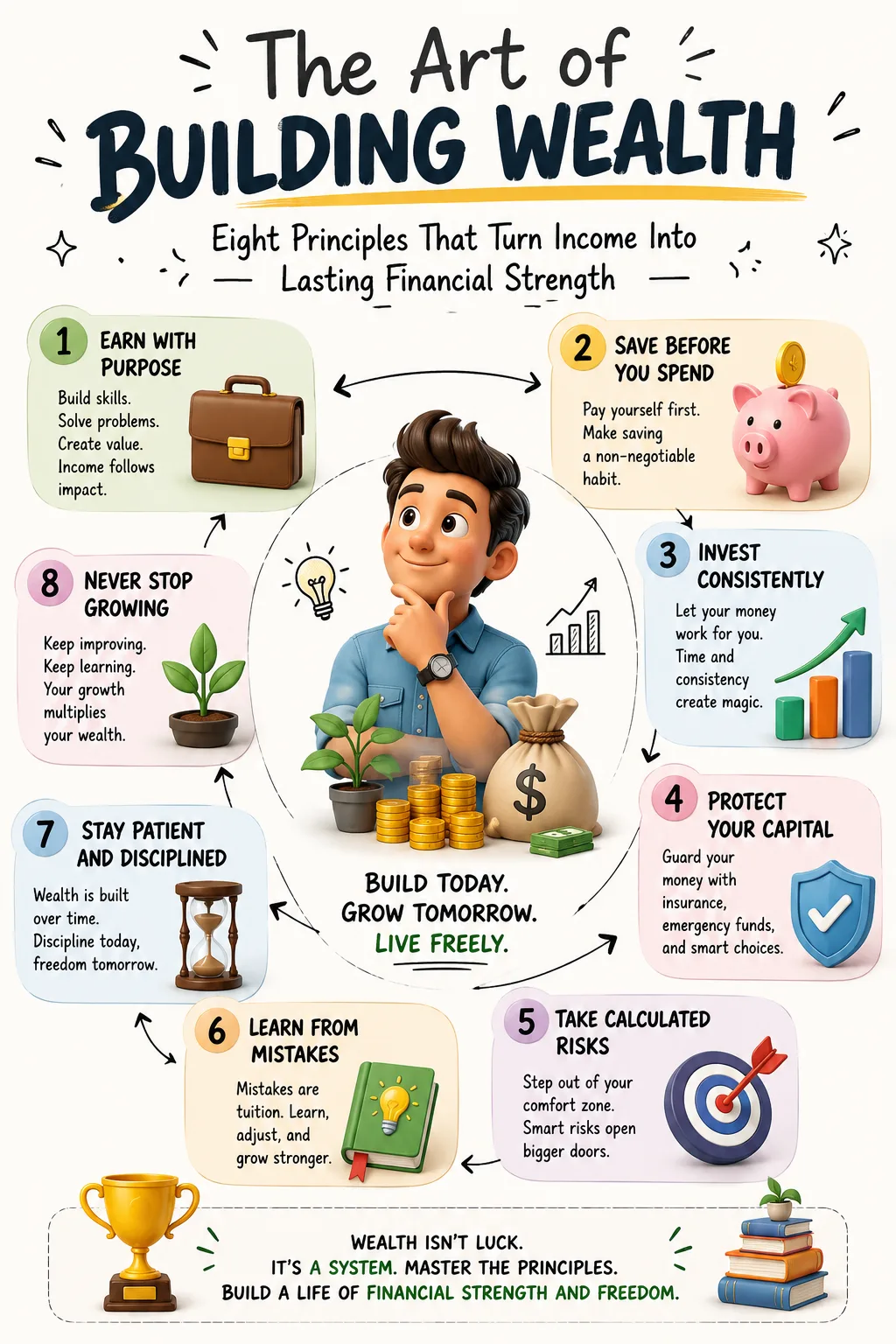
The Art of Building Wealth: Eight Principles That Turn Income Into Lasting Financial Strength
Building wealth is often presented as a secret.
Someone claims there is a hidden investment, a rare business model, a shortcut, a mindset trick, a tax loophole, a trading system, or a formula known only to the financially successful. This kind of promise is attractive because wealth can feel mysterious from the outside. People see the finished result: the property, the portfolio, the business, the freedom, the status, the choices. They do not see the years of saving, learning, risk control, delayed gratification, mistakes, market downturns, reinvested gains, disciplined spending, and quiet repetition.
Most durable wealth is less mysterious than it looks.
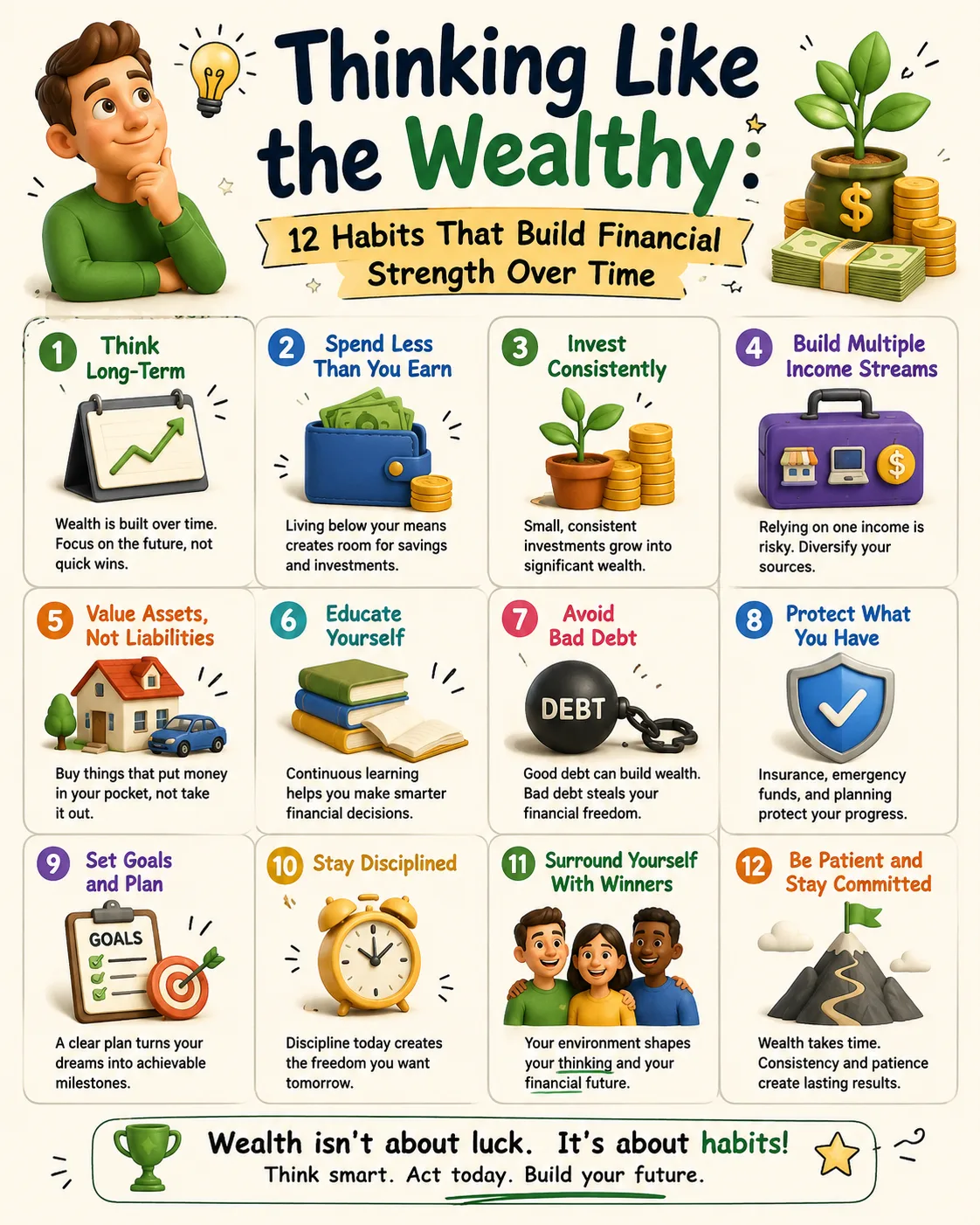
It is usually built through a system. Earn with purpose. Save before spending. Invest consistently. Protect capital. Take calculated risks. Learn from mistakes. Stay patient. Never stop growing.
These principles are simple enough to fit on an infographic, but they are not shallow. Each one contains a deeper financial discipline. Earning with purpose is not merely working harder; it is aligning income with skill, demand, and long-term opportunity. Saving before spending is not deprivation; it is assigning the future a claim on today’s income. Investing consistently is not gambling; it is converting surplus into ownership. Protecting capital is not fear; it is the recognition that compounding requires survival. Taking calculated risks is not recklessness; it is the willingness to pursue growth while respecting downside. Learning from mistakes is not self-criticism; it is the conversion of experience into judgment. Patience is not passivity; it is the discipline to let good decisions mature. Continuous growth is not hustle culture; it is the ongoing development of human capital, financial literacy, and adaptability.
Wealth is not guaranteed by these habits. That must be said clearly. Income opportunities, family background, education, geography, health, discrimination, inflation, tax policy, economic cycles, access to capital, and luck all influence outcomes. A person can make wise decisions and still face hardship. Another can make poor decisions and still inherit assets. The world is not perfectly fair, and financial education becomes dishonest when it pretends otherwise.
But habits still matter. Systems still matter. The direction of money still matters. The Federal Reserve’s Survey of Consumer Finances tracks household income, assets, liabilities, credit use, net worth, and other balance-sheet components, which is why it is more useful than appearances for understanding wealth. The 2022 Survey of Consumer Finances is the most recent completed survey listed by the Federal Reserve. The Consumer Financial Protection Bureau defines financial well-being as being able to meet current and ongoing obligations, feel secure about the future, and make choices that allow enjoyment of life. Those ideas reveal the heart of wealth building: the goal is not only to earn more money, but to create a financial life with resilience, ownership, and choice.
The art of building wealth is not one move. It is the coordination of many moves over time.
1. Earn With Purpose
Income is the raw material of wealth building.
Without income, saving is difficult. Without saving, investing is limited. Without investing or asset ownership, wealth accumulation slows. This does not mean income alone creates wealth. Many high earners remain financially fragile because spending, debt, taxes, lifestyle inflation, and poor investment behavior consume everything. But earning power matters because it determines how much fuel is available for the wealth-building engine.
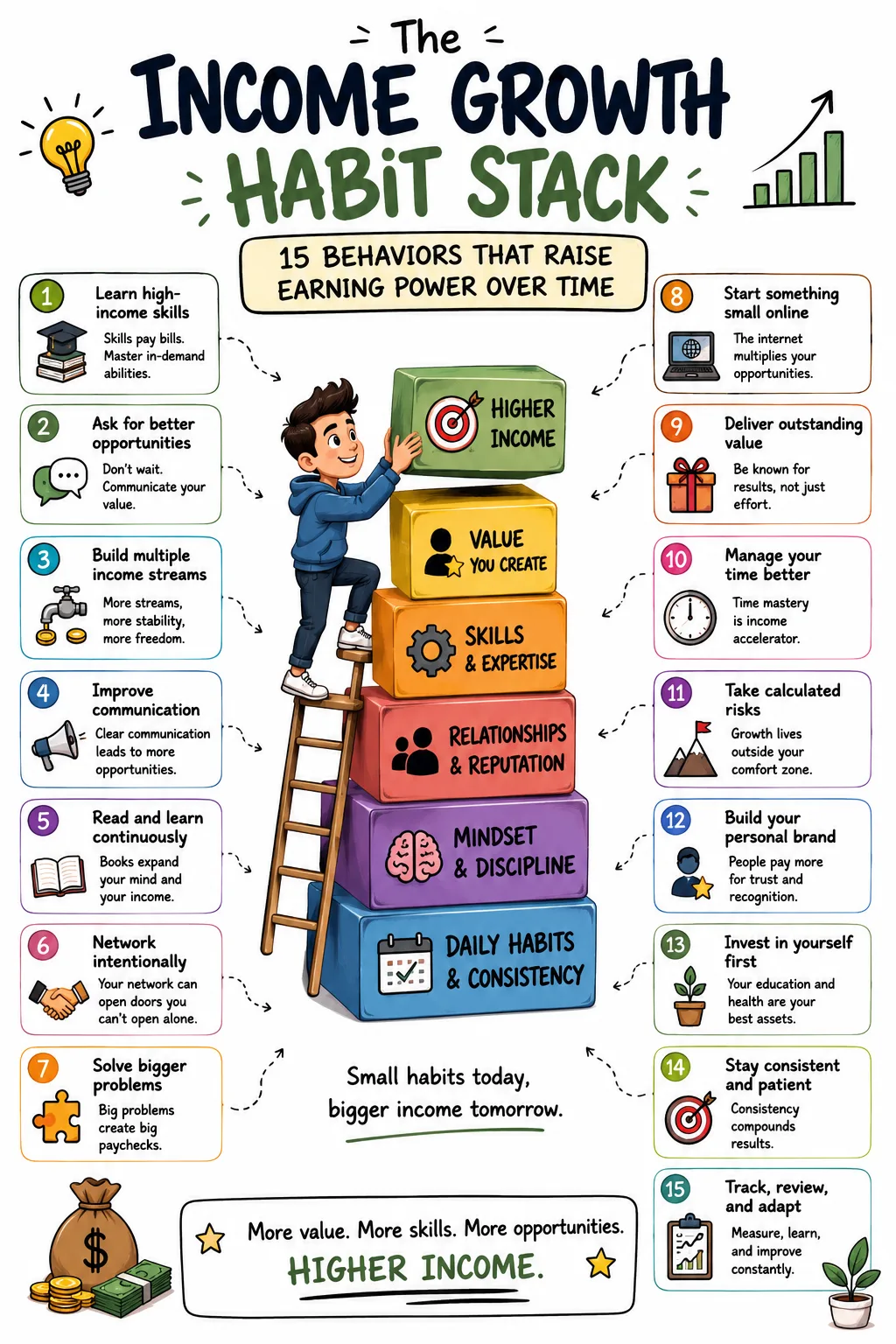
Earning with purpose means treating income as a strategic asset rather than merely a paycheck. It asks: where is my earning power going? Are my skills becoming more valuable? Am I in an industry with opportunity? Am I building credentials, relationships, or experience that can compound? Does my work create future options, or only cover current expenses? Can this income be converted into assets?
Purposeful earning is different from chasing the highest immediate salary at any cost. A person may accept a role because it develops valuable skills, opens doors, provides mentorship, offers equity, builds credibility, or leads to a stronger future position. Another person may leave a higher-paying but stagnant role for one with better long-term growth. A business owner may reinvest in capabilities that reduce short-term profit but increase long-term enterprise value.
The strongest income strategies usually connect skills with market demand. A person can work hard at something the market does not reward and remain underpaid. Another person can develop specialized skills in a high-demand field and increase earning power significantly. Purpose alone does not raise income. Purpose must be connected to usefulness, scarcity, execution, and buyers or employers willing to pay.
This is where human capital becomes central. Human capital includes knowledge, skills, health, experience, reputation, relationships, and judgment. It is often the first wealth-building asset a person owns. Before a portfolio is large, before a business has value, before real estate equity accumulates, the ability to earn is usually the foundation.
Earning with purpose may mean developing technical skills, leadership ability, sales competence, communication, financial literacy, negotiation, project management, or industry-specific expertise. It may mean moving closer to revenue, risk management, technology, healthcare, engineering, skilled trades, entrepreneurship, or other areas where demand is strong. It may mean building a side income, but only if the side income is profitable and does not become consumption disguised as ambition.
Purposeful earning also requires bargaining power. Creating value is not enough if the value is invisible or poorly negotiated. Employees need to document results, understand market compensation, and seek roles where their contribution is recognized. Freelancers need to price according to value, not fear. Business owners need to understand margins, customer demand, and cash flow. Investors need to understand how capital is rewarded for risk.
The goal is not to work endlessly. The goal is to make work increasingly productive. A person earning with purpose does not ask only, “How much can I make this year?” They ask, “How can today’s work increase tomorrow’s options?”
2. Save Before Spending
Saving before spending is one of the oldest and most powerful personal finance principles because it solves a behavioral problem.
Most people intend to save what remains after spending. The problem is that money left in the spending system tends to be spent. Needs appear. Wants appear. Social invitations appear. Subscriptions renew. Children require something. Stress creates impulse purchases. A higher bank balance creates the illusion of affordability. By the end of the month, the money that was supposed to become savings has disappeared into ordinary life.
Saving first reverses the order. When income arrives, a portion is immediately directed toward emergency reserves, retirement accounts, investment accounts, debt repayment, or specific goals. The future is paid before discretionary spending begins. This is sometimes called paying yourself first, but the phrase is deeper than a slogan. It means treating financial security as a non-negotiable obligation.
This principle becomes stronger when automated. Automatic transfers reduce the need for repeated decisions. Retirement payroll deductions, automatic savings transfers, and scheduled investment contributions all help protect long-term goals from short-term emotion. Vanguard’s principles for investing success emphasize clear goals, balance, low costs, and long-term discipline; automation supports that discipline by making the desired behavior easier to repeat.
Saving before spending does not require a large starting amount. For a household under pressure, the first step may be small: $10, $25, or $50 per payday. The amount matters, but the system matters first. The first saved dollar proves that income can be directed before it disappears.
Savings serve several purposes. Emergency savings protect against unexpected expenses and income disruptions. Sinking funds prepare for irregular but predictable costs such as insurance premiums, repairs, school expenses, holidays, taxes, or medical bills. Opportunity savings allow a person to move, invest, start a business, take training, or make a career transition. Long-term savings become investments that can compound.
The most important benefit of saving before spending is that it creates financial margin. Margin is the distance between income and obligation. A household with margin can adapt. A household without margin must react. Margin turns emergencies into inconveniences. It turns opportunities into decisions rather than fantasies. It turns income into control.
This principle also protects against lifestyle inflation. When income rises, spending naturally tries to rise with it. A raise becomes a better car, better apartment, more restaurants, premium subscriptions, larger holidays, and new expectations. Saving first captures part of the raise before lifestyle claims it.
Saving is not the destination. Money that is only saved and never invested may lose purchasing power over time due to inflation. But saving is the foundation. It provides stability, liquidity, and the surplus needed for investing.
Wealth begins when money is assigned before emotion spends it.
3. Invest Consistently
Saving protects. Investing grows.
A household that saves but never invests may become more stable in the short run but may struggle to build long-term wealth. Inflation can reduce the purchasing power of idle cash. Retirement, financial independence, education funding, and long-term asset growth often require exposure to productive assets. Investing is how surplus income becomes ownership.
Consistent investing is powerful because it turns wealth building into a habit rather than an occasional event. The investor does not need to predict the perfect moment. They contribute regularly, usually through retirement plans, brokerage accounts, pension systems, or other investment vehicles appropriate to their country and circumstances. Over time, those contributions can benefit from compounding, reinvested returns, and long investment horizons.
Consistency matters because markets are uncertain. Short-term price movements are difficult to predict. Investors who wait for perfect conditions may remain on the sidelines for years. Investors who act only when they feel confident may buy after markets have risen. Investors who stop during downturns may miss lower prices and eventual recoveries.
This does not mean investing blindly. The portfolio should be aligned with goals, time horizon, risk tolerance, liquidity needs, tax considerations, and personal circumstances. Money needed soon should not usually be exposed to the same volatility as money intended for retirement decades away. Emergency savings should not be confused with long-term investments.
For many households, diversified low-cost investing can provide a practical foundation. Vanguard’s research paper on investing success identifies four core principles: create clear goals, keep a balanced and diversified mix of investments, minimize costs, and maintain perspective and long-term discipline. These principles are not glamorous, but they are useful because they reduce dependence on prediction and emotion.
Consistent investing also creates an ownership mindset. A worker earns income from labor. An investor owns claims on businesses, bonds, real estate, or other assets. Over time, ownership can supplement labor. Dividends, interest, rental income, capital gains, business profits, and retirement withdrawals can gradually reduce dependence on a single paycheck.
The early stage of investing may feel slow. Contributions do most of the work. Market declines can be discouraging. The account balance may not yet feel impressive. But the early stage is where the base is built. Later compounding depends on earlier consistency.
Investing consistently is not about excitement. It is about participation. It is the decision to let part of today’s income become tomorrow’s assets.
4. Protect Your Capital
Building wealth is not only about making money. It is about avoiding losses that permanently damage the ability to compound.
Capital protection is sometimes misunderstood as excessive caution. In reality, it is a requirement for staying in the game. A person cannot compound capital that has been destroyed. A household cannot invest consistently if every emergency forces withdrawals. A business cannot grow if cash flow collapses under debt. An investor cannot recover easily from a concentrated loss that wipes out years of savings.
Capital protection begins with liquidity. Emergency savings protect against forced borrowing or forced selling. A household with cash reserves does not need to sell investments during a downturn to pay for a car repair or medical bill. Liquidity gives time to make better decisions.
Capital protection also includes diversification. Concentrated investments can create large gains, but they can also create permanent losses. A portfolio dominated by one company, one employer stock, one property, one cryptocurrency, one business, or one sector may be vulnerable to a single event. Diversification does not guarantee profit or prevent loss, but it reduces the chance that one failure destroys the entire plan.
Insurance is another form of capital protection. Health events, disability, death of a primary earner, lawsuits, property damage, accidents, or business liabilities can destroy wealth if not properly insured. Insurance should not be viewed only as an expense. It is a transfer of risks too large for the household to absorb alone.
Debt management is part of capital protection too. Excessive leverage can turn a temporary setback into a crisis. A loan that seems manageable during good times can become dangerous if income falls, interest rates rise, asset prices decline, or unexpected expenses occur. Borrowing should be evaluated by purpose, cost, repayment ability, and downside risk.
Protecting capital also means avoiding fraud, hype, and investments that cannot be understood. If an opportunity promises high returns with little risk, urgency, secrecy, or social pressure, caution is warranted. Many financial disasters begin when people suspend skepticism because they want the promise to be true.
The wealthy often think in terms of downside because they understand that survival creates opportunity. Cash, diversification, insurance, low leverage, and prudent risk sizing may not create exciting stories during good markets. Their value becomes obvious during bad ones.
Capital protection is not the enemy of growth. It is the condition that allows growth to continue.
5. Take Calculated Risks
A life with no risk is impossible.
Holding cash carries inflation risk. Investing carries market risk. Buying property carries liquidity and maintenance risk. Starting a business carries execution risk. Staying in one job carries income concentration risk. Changing careers carries uncertainty. Even doing nothing is a risk if the world changes around you.
The art of building wealth is not avoiding risk. It is choosing risks that are understandable, survivable, and appropriately rewarded.
Calculated risk begins with research. What is the opportunity? How does it create value? What must go right? What could go wrong? What is the maximum loss? How likely is that loss? What evidence supports the decision? How does the risk fit with current savings, debt, income, family obligations, and time horizon?
Calculated risk also requires position sizing. A wealthy investor may put a small portion of net worth into a speculative asset and remain secure if it fails. A middle-income household putting most savings into the same asset is taking a completely different risk. The investment may be identical, but the consequences are not.
Entrepreneurship provides a useful example. Starting a business can create significant wealth because equity can scale. But quitting a job with no savings, no customers, no market validation, and high fixed expenses is not the same as building a business carefully. A calculated entrepreneur may test demand, keep expenses low, build cash reserves, start part-time, secure early customers, understand margins, and leave employment only when the risk is more manageable.
Investing provides another example. A diversified stock portfolio held for decades is risky in the sense that it will fluctuate, but it may be appropriate for long-term goals. Borrowing heavily to speculate in one volatile asset is a different kind of risk. One risk is managed through time, diversification, and discipline. The other may be a bet the household cannot afford to lose.
Calculated risk also recognizes opportunity cost. Being too conservative can be costly. A young investor who avoids all growth assets may struggle to outpace inflation. A professional who never develops new skills may lose earning power. A household that refuses every reasonable opportunity may protect the present while limiting the future.
The goal is not to be fearless. Fear can contain useful information. The goal is to make fear specific. What exactly could go wrong? Can it be reduced? Can the risk be tested? Can the loss be survived?
Wealth builders do not win by taking every risk. They win by taking risks that serve a plan.
6. Learn From Mistakes
Every financial life contains mistakes.
Some people overspend. Some underinvest. Some panic sell. Some buy into hype. Some take on too much debt. Some trust the wrong person. Some choose the wrong business partner. Some stay in a low-growth job too long. Some fail to negotiate. Some ignore taxes. Some underinsure. Some concentrate too much wealth in one asset. Some delay saving for years because they think small amounts do not matter.
The mistake itself is not the final problem. The final problem is refusing to learn from it.
Learning from mistakes requires separating shame from analysis. Shame says, “I am bad with money.” Analysis says, “This decision had causes, consequences, and lessons.” Shame creates avoidance. Analysis creates improvement.
A useful financial review asks several questions. What did I believe at the time? What information did I ignore? Was I acting from fear, greed, pride, comparison, or urgency? Was the risk too large? Did I understand the cost? Did I have an exit plan? Did I confuse a good outcome with a good process or a bad outcome with a bad process? What rule would prevent this from happening again?
This last distinction is important. A good decision can produce a bad outcome because uncertainty exists. A bad decision can produce a good outcome because luck exists. Someone can make money through reckless speculation and learn the wrong lesson. Someone can lose money after careful analysis and abandon a sound strategy too early. Wealth builders try to improve process, not merely celebrate or regret outcomes.
Business owners know this well. A failed product may reveal weak demand, poor pricing, bad distribution, insufficient capital, or the wrong customer. Investors may learn about concentration, liquidity, valuation, costs, or temperament. Employees may learn that loyalty without negotiation can limit income. Households may learn that emergency funds are not optional after one unexpected bill creates debt.
The key is to make mistakes survivable. A small mistake can be tuition. A catastrophic mistake can become a decade-long burden. This is why risk management and learning belong together. Protect capital enough that mistakes can teach rather than destroy.
Experience alone does not create wisdom. Reflected experience does.
7. Stay Patient
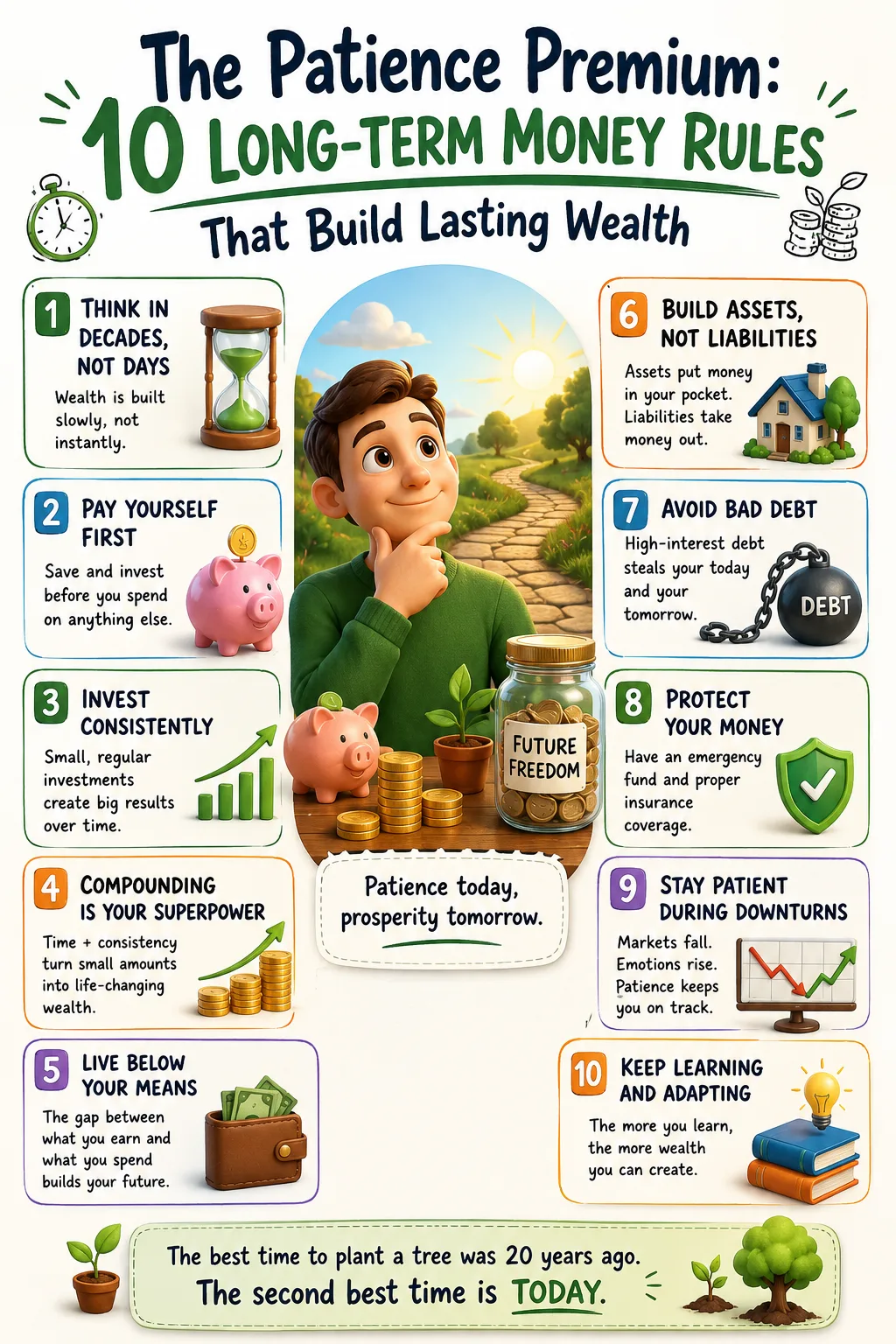
Patience is the emotional price of compounding.
Most wealth-building principles require time before they become visible. Saving feels slow at first. Investing feels uncertain. Debt repayment feels repetitive. Skill development may take years before income rises. Businesses may require long periods of testing before profits become stable. Real estate equity may accumulate gradually. Retirement accounts may seem small for a long time before compounding becomes noticeable.
This delay creates temptation. People want faster proof. They chase hot investments. They abandon long-term plans during downturns. They inflate lifestyle after small income gains. They quit skill-building too early. They compare their private progress with other people’s public highlights.
Patience does not mean doing nothing. It means continuing to do the right things when the results are not yet impressive.
For investors, patience means accepting volatility as part of long-term participation. Markets can decline sharply and recover unpredictably. Selling during fear may lock in losses and interrupt compounding. Staying patient is easier when the portfolio is diversified, costs are reasonable, and the money invested is not needed immediately.
For savers, patience means respecting small balances. The first $1,000 of emergency savings may feel modest, but it can prevent new debt. The first retirement contributions may feel small, but they start the habit. The first debt payoff may not change life instantly, but it frees future cash flow.
For professionals, patience means understanding that earning power can compound. Skills, reputation, networks, and judgment build gradually. A person who expects every effort to pay immediately may quit before the market recognizes their value.
Patience should not become passivity. Staying in a bad investment forever is not patience. Remaining in a dead-end job without a plan is not patience. Tolerating destructive debt is not patience. True patience is attached to a sound process. If the process is broken, adjustment is necessary.
The art is knowing the difference between slow progress and no progress.
Wealth rewards patience when patience is paired with disciplined action.
8. Never Stop Growing
Financial growth is connected to personal growth.
This does not mean endless hustle or constant self-optimization. Rest, health, family, and well-being matter. Growth without recovery becomes burnout. But over a lifetime, refusing to learn is financially dangerous. Economies change. Industries change. Technology changes. Tax rules change. Investment products change. Labor markets change. The skills that created income in one decade may not be enough in the next.
Continuous growth increases human capital. It may include technical training, leadership development, communication, sales, financial literacy, negotiation, entrepreneurship, digital tools, management, or industry expertise. It can also include emotional growth: better decision-making under stress, more patience, improved self-control, and the humility to seek advice.
Financial literacy is a central part of growth. The OECD/INFE toolkit measures financial literacy through knowledge, behavior, and attitudes and connects it with financial inclusion, resilience, and well-being. This is important because knowledge alone is not enough. A person may know debt is expensive and still borrow impulsively. They may know investing matters and still delay. Growth requires behavior change.
Continuous growth also protects against economic shocks. A worker with adaptable skills may recover faster from job loss. A business owner who learns new distribution channels may survive market changes. An investor who keeps learning may avoid outdated assumptions. A household that improves financial knowledge may make better decisions about debt, insurance, taxes, and retirement.
Growth should be strategic. Not every course, book, seminar, or certification produces value. Some self-improvement spending is consumption in disguise. The useful question is: will this increase capability, earning power, judgment, resilience, or opportunity?
Growth also includes building better systems. A person may grow by automating savings, improving recordkeeping, reviewing net worth, creating a budget, writing an investment policy, building a professional network, or learning to negotiate. These changes may not feel dramatic, but they improve the structure of the financial life.
Never stop growing does not mean never rest. It means never assume the current version of your skills, habits, and financial knowledge is the final version.
How the Eight Principles Work Together
The eight principles are strongest when combined.
Earning with purpose creates income. Saving before spending creates surplus. Investing consistently converts surplus into ownership. Protecting capital keeps the plan alive. Taking calculated risks creates upside. Learning from mistakes improves judgment. Patience allows compounding to work. Continuous growth increases future earning power and adaptability.
If one principle is missing, the system weakens. High income without saving becomes lifestyle inflation. Saving without investing may protect the short term but limit long-term growth. Investing without capital protection can lead to catastrophic loss. Risk-taking without research becomes gambling. Patience without review becomes stubbornness. Learning without action becomes entertainment. Growth without rest becomes burnout.
Wealth building is therefore less like a single ladder and more like an ecosystem. Income, spending, saving, investing, debt, insurance, taxes, skills, behavior, and time all interact. A strong financial life requires coordination.
This is why simplistic advice can be misleading. “Just earn more” ignores spending and investing. “Just save more” ignores income constraints. “Just invest” ignores emergency funds and debt. “Take risks” ignores downside. “Be patient” ignores the need to adjust bad plans. “Never stop growing” ignores health and rest.
The art is balance.
The Difference Between Wealth Building and Looking Wealthy
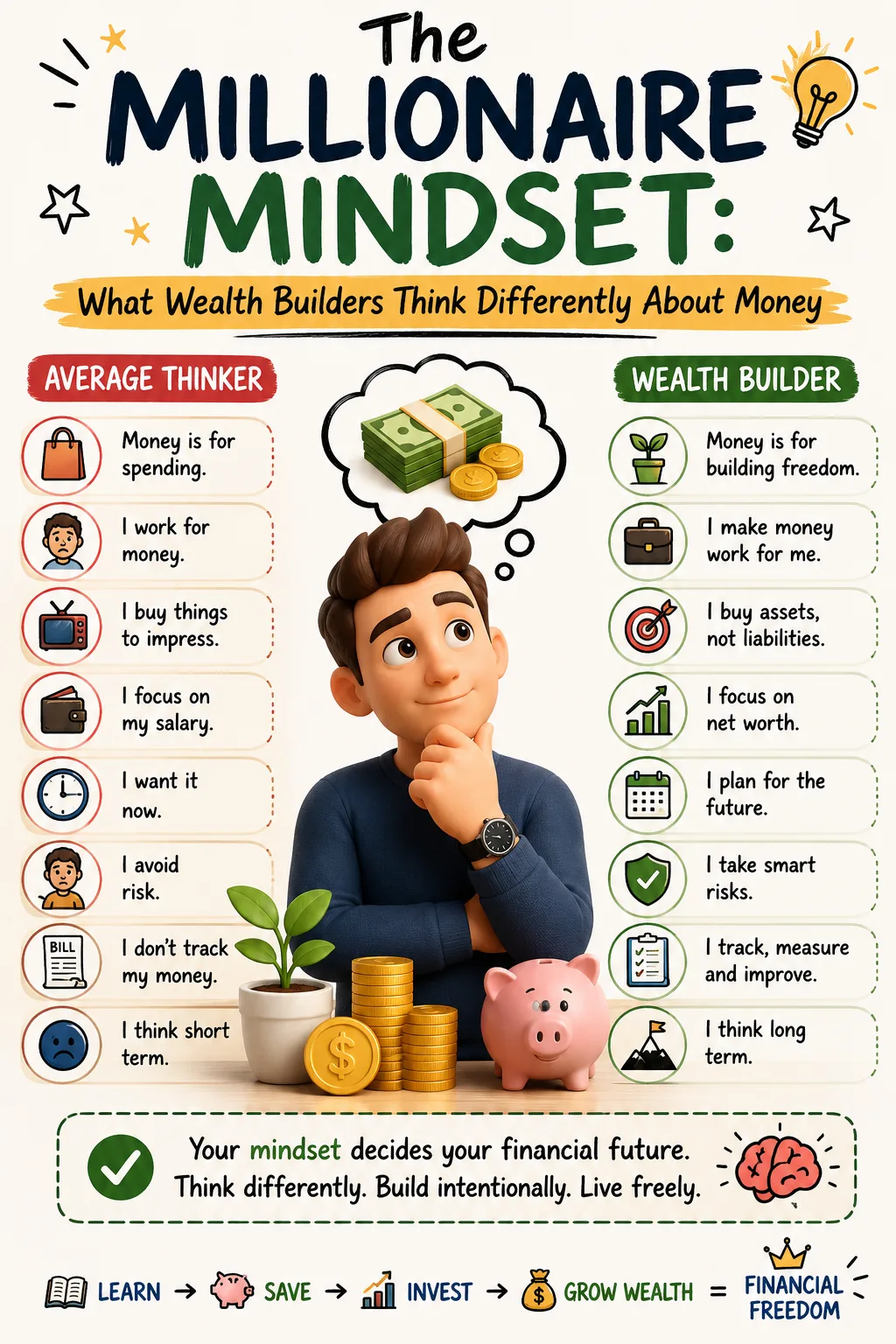
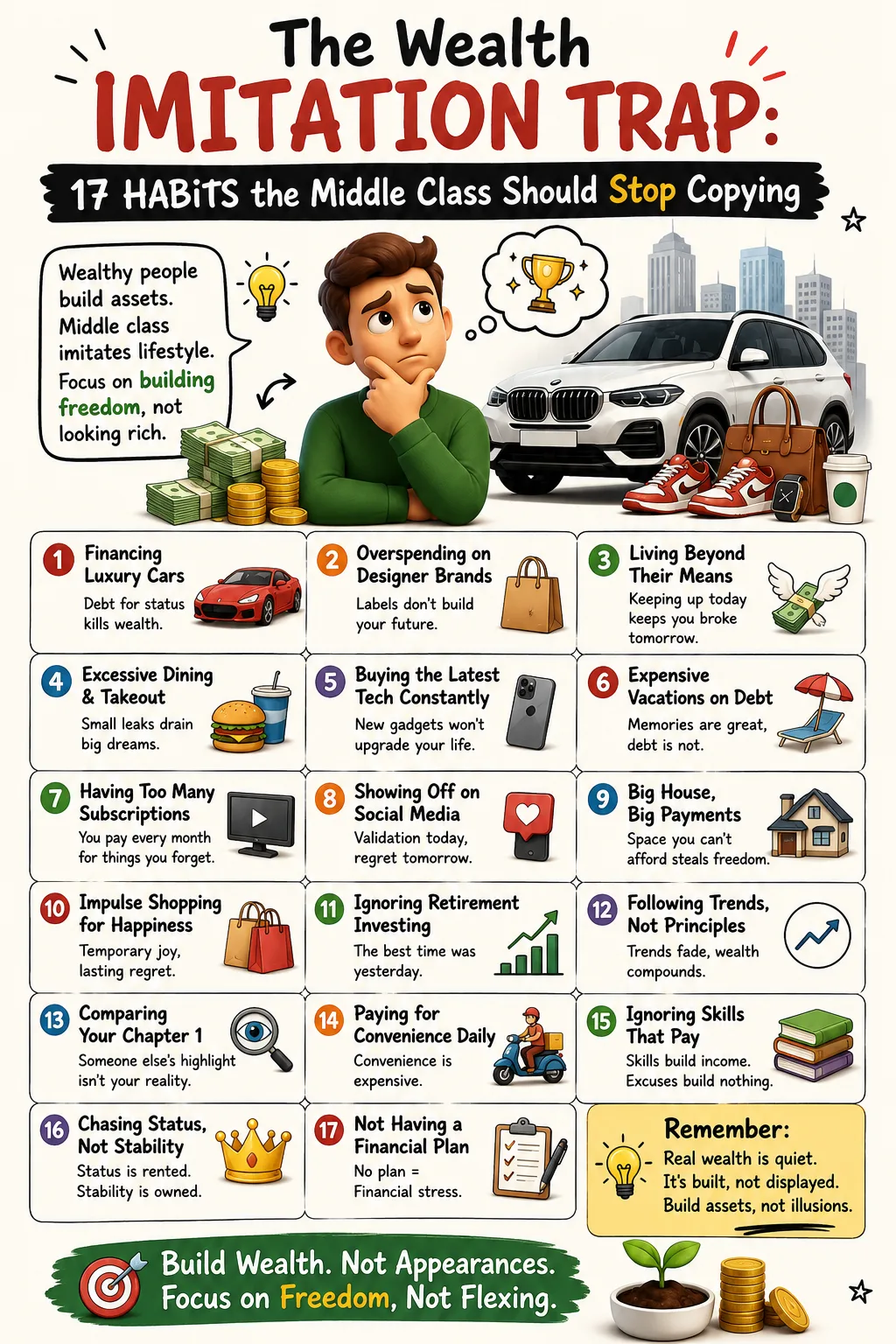
Looking wealthy is easy to finance. Building wealth is harder to sustain.
A person can lease a luxury car, buy designer goods on credit, take expensive holidays, live in an oversized home, and appear successful while carrying little net worth. Another person may drive a modest car, live below their means, invest quietly, and build substantial wealth without attracting attention.
The difference is ownership. Looking wealthy often sends money outward. Building wealth directs money toward assets, skills, resilience, and future options.
This distinction is especially important in a social media culture where consumption is more visible than financial structure. No one sees the emergency fund. No one sees the retirement contribution. No one sees the avoided debt. No one sees the insurance policy. No one sees the diversified portfolio unless it is disclosed. But everyone sees the visible purchase.
A mature wealth builder stops using appearances as the scorecard. They track net worth, savings rate, debt quality, emergency reserves, investment contributions, income growth, insurance coverage, and time freedom. These measures reveal financial strength more accurately than lifestyle signals.
Financial confidence built on appearance is fragile. Financial confidence built on assets is durable.
Why Wealth Building Is Harder Than It Sounds
The principles are simple. The execution is difficult because humans are emotional and life is unpredictable.
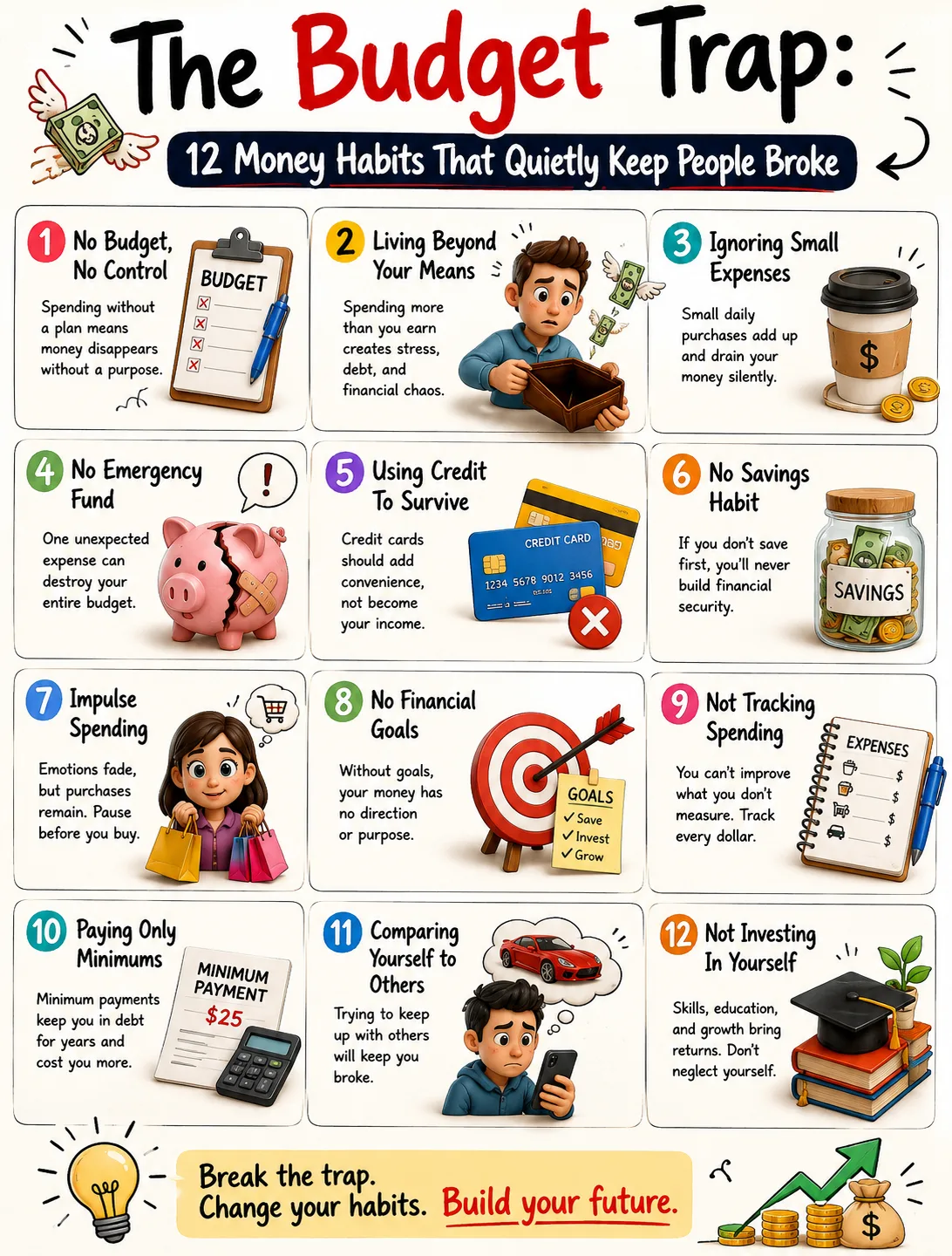
People overspend because they want comfort, belonging, relief, or recognition. They under-save because the future feels distant. They avoid investing because markets feel uncertain. They chase speculation because slow progress feels frustrating. They hold bad investments because admitting a mistake hurts. They avoid budgets because numbers create anxiety. They take on debt because the monthly payment looks manageable. They delay learning because daily life is already full.
External factors make execution harder. Low income limits savings capacity. High housing costs reduce surplus. Medical expenses can destroy plans. Caregiving responsibilities reduce work flexibility. Economic downturns affect employment and investment values. Inflation raises the cost of essentials. Discrimination can affect income, credit, housing, and opportunity. Access to education and capital is uneven.
A serious wealth philosophy must recognize these realities without surrendering to them. Some people need budgeting. Others need higher income. Some need debt restructuring. Others need financial counseling. Some need public support. Others need professional training, negotiation, or relocation. Some need to stop status spending. Others need to stop blaming themselves for structural constraints and focus on the next available step.
The right strategy depends on the real bottleneck.
Wealth building becomes more effective when advice moves from slogans to diagnosis.
A Practical Wealth-Building Sequence
A household trying to build wealth can begin with a practical sequence.
First, stabilize essentials. Food, housing, utilities, transportation, basic healthcare, and minimum debt obligations come before aggressive investing. A plan that ignores survival will fail.
Second, build a starter emergency fund. Even a small buffer can prevent new debt when minor emergencies happen. The first target may be one week of essential expenses, then one month, then three to six months or more depending on income stability and household needs.
Third, address high-interest debt. Expensive consumer debt can compound against the household and reduce future options. Paying it down may be one of the most powerful financial moves available.
Fourth, save before spending and automate the habit. The system should direct money toward savings and investments before discretionary spending begins.
Fifth, invest consistently for long-term goals. Use diversified investments aligned with time horizon and risk tolerance. Keep costs reasonable and avoid emotional trading.
Sixth, protect capital. Maintain insurance, diversify, avoid excessive leverage, and keep enough liquidity for emergencies.
Seventh, increase earning power. Build skills, seek better opportunities, negotiate, develop professional networks, and consider responsible income diversification.
Eighth, review and adjust. Life changes. Goals change. Markets change. The plan should be disciplined but not frozen.
This sequence is not universal, but it helps order priorities. Wealth building is easier when the foundation is not constantly breaking.
The Role of Financial Well-Being
Wealth should not be measured only by account balances.
Financial well-being includes the ability to meet obligations, feel secure, and make meaningful choices. A person with high income but constant stress, high debt, no savings, and little control may not feel financially well. A person with moderate income, manageable expenses, savings, investments, and flexibility may experience greater security.
This does not mean money does not matter. It matters greatly. But the purpose of building wealth is not merely to watch a number grow. The purpose is to create a life with less fear and more choice.
That choice may include career flexibility, retirement security, family support, education, business ownership, home stability, generosity, travel, healthcare options, or the ability to leave harmful situations. Wealth is most valuable when it expands human freedom.
This is why protecting capital, patience, and continuous growth matter as much as earning and investing. A large balance that can be destroyed by one event is fragile. A high income that requires constant stress may be unsustainable. A portfolio that causes panic during every downturn may not fit the investor. Wealth should support life, not consume it.
Common Mistakes That Interrupt Wealth Building
The first common mistake is confusing income with wealth. Income is money coming in. Wealth is what remains after assets and liabilities are measured. The Federal Reserve’s SCF data includes income, assets, debts, and net worth because these dimensions are related but not identical. A high earner with no assets may be less financially secure than a moderate earner with strong savings and investments.
The second mistake is lifestyle inflation. Every raise becomes a lifestyle upgrade. The household earns more but saves little more. The surplus that could have built wealth disappears into a more expensive version of the same financial stress.
The third mistake is investing without liquidity. A household with no emergency fund may be forced to sell investments during a downturn. Cash reserves protect long-term investments from short-term disruptions.
The fourth mistake is taking risks without understanding them. Speculation, leverage, concentration, and illiquidity can destroy capital when used carelessly.
The fifth mistake is avoiding all risk. Excessive caution can also be costly if long-term money never grows enough to outpace inflation or meet future goals.
The sixth mistake is treating financial education as optional. Ignorance is expensive in fees, taxes, debt, scams, panic selling, and missed opportunities.
The seventh mistake is failing to review. A plan suitable at 25 may not fit at 45. A portfolio suitable before children, business ownership, or retirement may need adjustment later.
The eighth mistake is giving up because progress feels slow. Wealth building often looks unimpressive before it becomes powerful.
Final Thought: Wealth Is Built by Repeating What Strengthens the Future
The art of building wealth is not about one perfect decision.
It is the art of repeatedly directing money, time, skill, and attention toward the future. Earn with purpose. Save before spending. Invest consistently. Protect your capital. Take calculated risks. Learn from mistakes. Stay patient. Never stop growing.
Each principle is simple. None is easy. Together, they create a system that can turn income into assets, assets into resilience, and resilience into freedom.
The caveats matter. Wealth is influenced by opportunity, education, health, family background, economic conditions, taxes, inflation, access to capital, and luck. These principles do not guarantee wealth, and they should not be used to blame people for hardship. But they remain among the most controllable behaviors available to individuals and households seeking stronger financial futures.
Building wealth is not only a financial act. It is a way of organizing life. It means choosing ownership over appearances, preparation over panic, discipline over impulse, calculated risk over recklessness, and patience over constant reaction.
The result may not be visible immediately. In the early years, wealth building can look ordinary: a transfer to savings, a contribution to a retirement account, a course completed, a debt reduced, a purchase delayed, a mistake reviewed, a portfolio left alone during volatility.
But repeated over time, ordinary actions become extraordinary outcomes.
That is the art: making the future stronger through decisions that may look small today.
 Article
 Article
 Article
 Article
 Article
 Article
 Article
 Article