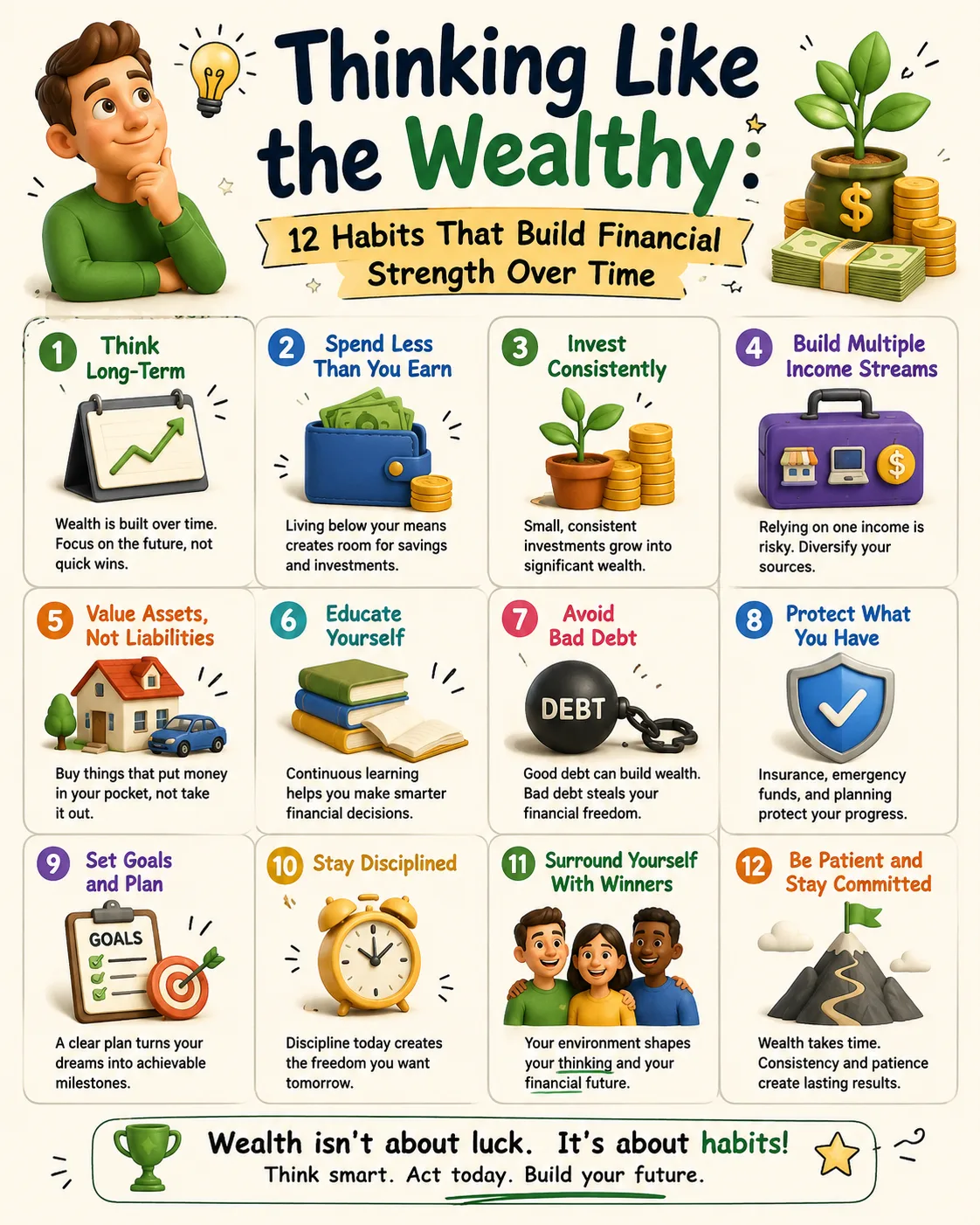
Thinking Like the Wealthy: 12 Habits That Build Financial Strength Over Time
Thinking like the wealthy does not mean copying the lifestyle of wealthy people.
That distinction matters. The visible side of wealth is easy to imitate: cars, houses, watches, holidays, restaurants, private schools, designer clothing, premium devices, and social status. The invisible side is harder to see: savings rates, investment portfolios, equity ownership, tax planning, insurance, cash reserves, low consumer debt, professional networks, disciplined habits, and years of patient decision-making.
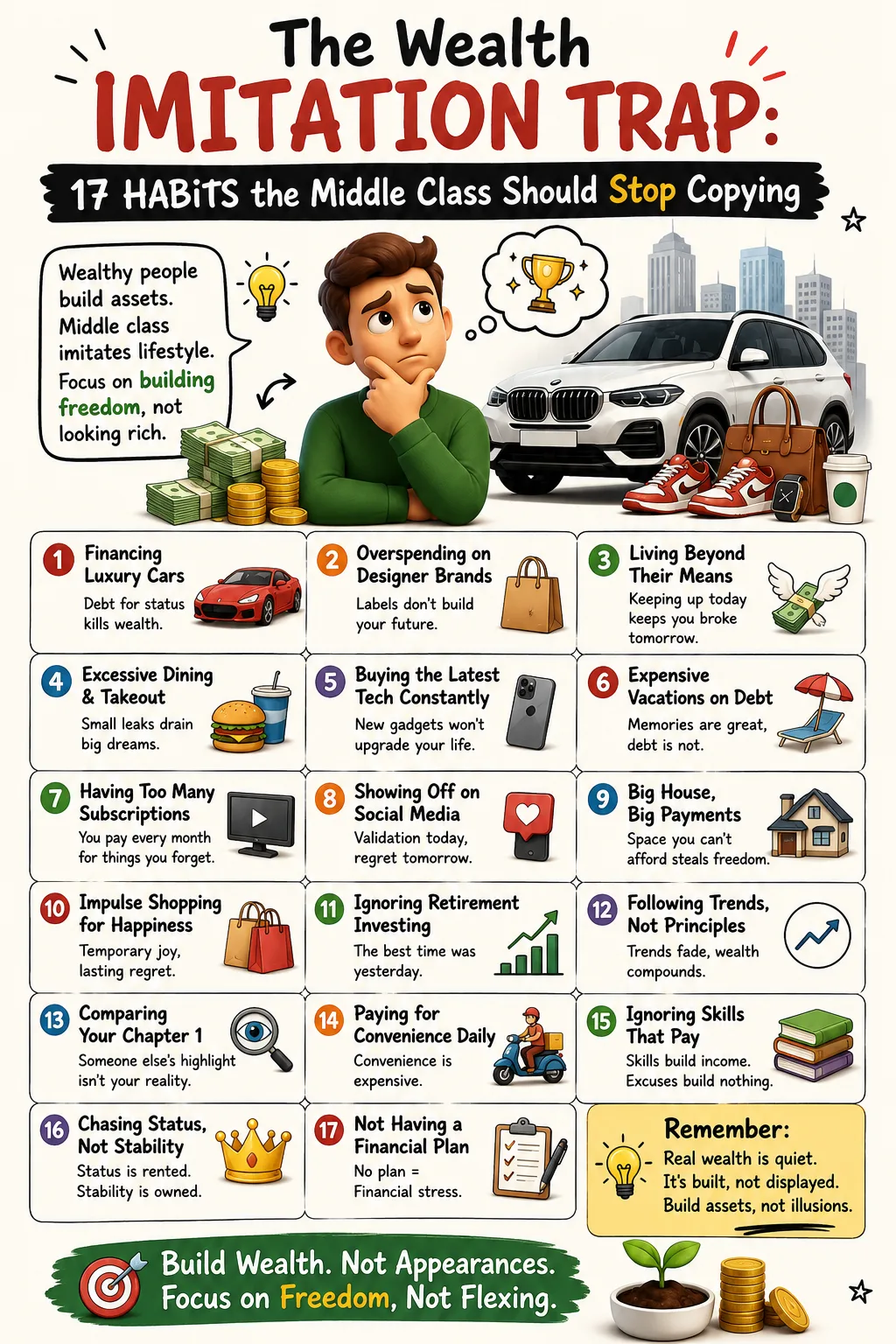
Many people try to look wealthy before they learn how wealth is actually built. They upgrade appearances while their assets remain thin. They finance status while delaying savings. They chase trends while ignoring strategy. They talk about opportunity while neglecting the daily systems that create financial stability.
The wealthy are not all alike. Some inherit money. Some build companies. Some invest for decades. Some live modestly. Some spend heavily. Some are financially disciplined. Others are not. There is no single personality type, morning routine, or secret belief that guarantees wealth.
But there are habits and mental models commonly associated with long-term financial success. They are not exclusive to wealthy people, and they do not guarantee millionaire status. They are better understood as evidence-based financial behaviors that improve the probability of building resilience, opportunity, and ownership over time.
The Federal Reserve’s Survey of Consumer Finances is useful because it focuses on household assets, liabilities, income, pensions, and net worth rather than visible lifestyle. The Federal Reserve lists the 2022 Survey of Consumer Finances as the most recent completed survey, and its data show how wealth is measured through balance sheets, not appearances. ([federalreserve.gov](https://www.federalreserve.gov/econres/scfindex.htm?utm_source=chatgpt.com)) The OECD describes financial literacy as a mix of awareness, knowledge, skills, attitudes, and behaviors that support informed financial decisions, resilience, and well-being. ([oecd.org](https://www.oecd.org/en/topics/sub-issues/financial-education.html?utm_source=chatgpt.com)) Together, those ideas point to a simple truth: wealth is not just what someone earns. It is what they understand, own, protect, and repeatedly do.
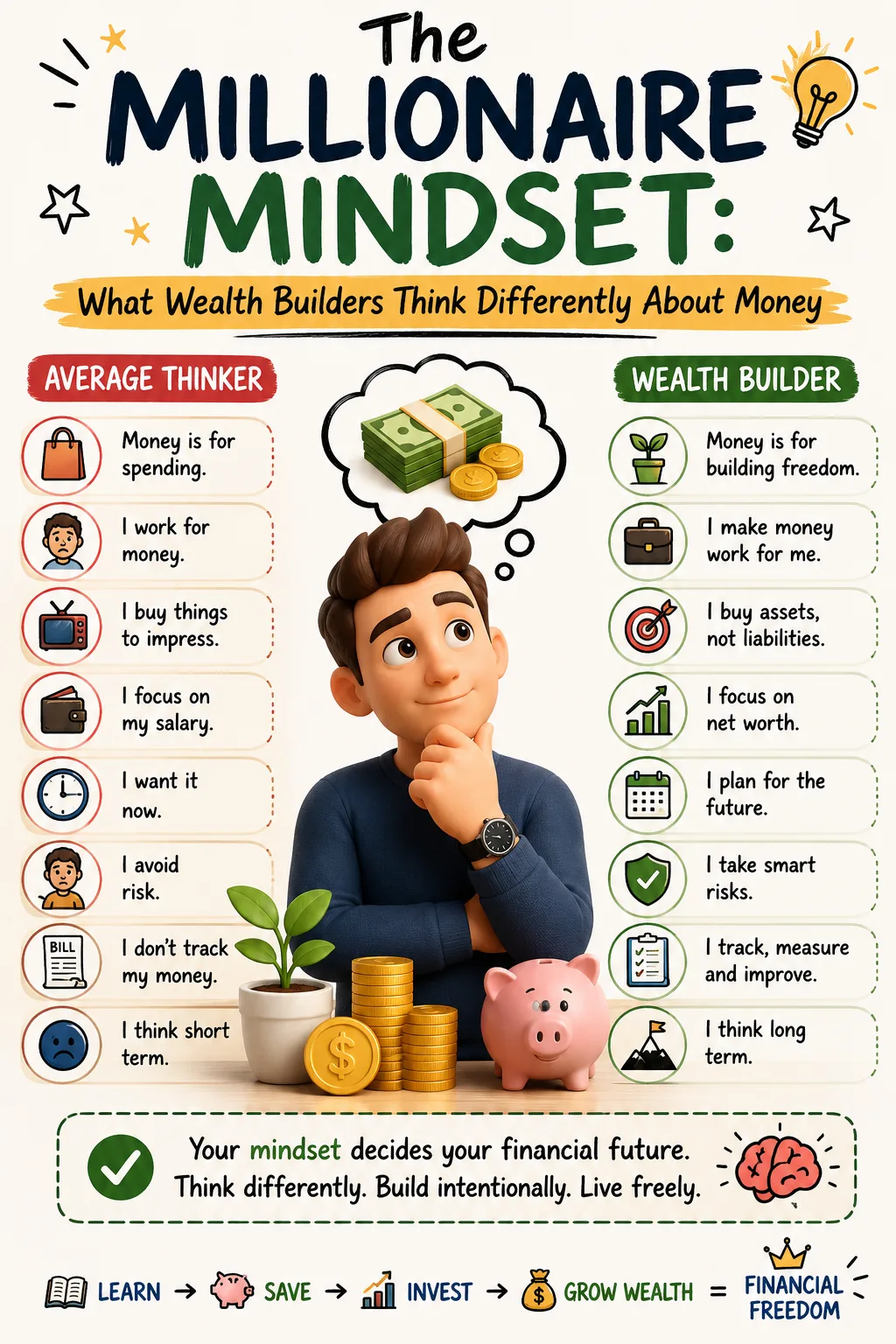
The following 12 signs are not mystical. They are practical. They show a shift from consumption to ownership, from impulse to strategy, from appearance to substance, and from short-term emotion to long-term discipline.
1. You Value Assets Over Appearances
The first sign of thinking like the wealthy is valuing assets more than appearances.
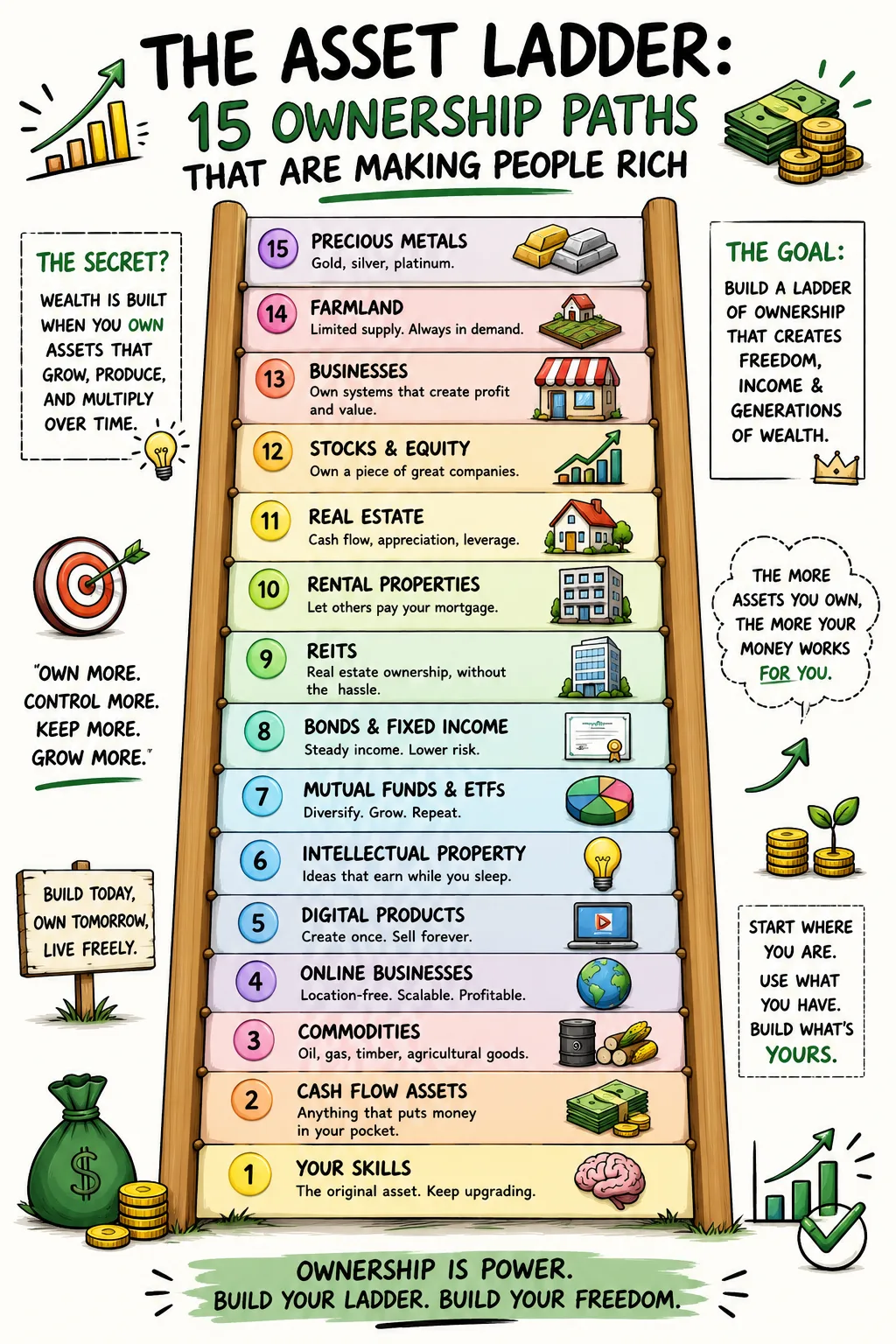
An asset is something that can store value, appreciate, produce income, reduce future costs, or increase economic opportunity. Stocks, retirement accounts, businesses, real estate, cash reserves, intellectual property, professional credentials, and productive equipment can all function as assets in the right context. Appearances are different. They may create pleasure, comfort, confidence, or status, but they do not necessarily strengthen the balance sheet.
This is where many financial lives divide. One person uses rising income to buy things that make success visible. Another uses rising income to buy assets that make success durable. At first, the first person may appear richer. The second may appear ordinary. Years later, the difference becomes harder to ignore.
Assets are often quiet. A diversified investment account does not attract attention in a room. A paid-off debt does not look glamorous. A growing retirement balance is invisible. Home equity is invisible unless someone sells or borrows against it. A profitable small business may not look impressive from the outside. Yet these are the structures that can create future freedom.
Appearances can be expensive because they invite comparison. A person buys a better car because peers have better cars. They move into a larger home because income has increased. They upgrade clothing, restaurants, travel, technology, and memberships because success should “look like something.” The danger is not enjoyment. The danger is letting status consume capital before capital has a chance to compound.
Thinking like the wealthy means asking a different question before spending: does this purchase strengthen my financial position, or only my image?
There is nothing wrong with beauty, comfort, or quality. Money should improve life. But wealth builders usually understand sequencing. Build assets first. Let the balance sheet become strong. Then lifestyle upgrades can be funded from strength rather than insecurity.
The person who values assets over appearances is not necessarily frugal in every category. They are intentional. They understand that visible wealth can be rented, financed, borrowed, or staged. Real wealth must be owned.
2. You Think Long-Term Daily
Long-term thinking is not something that happens once a year during retirement planning. It is a daily lens.
A long-term thinker sees today’s decision as part of a larger pattern. A purchase is not judged only by whether the money is available now. It is judged by what it prevents or enables later. A job decision is not judged only by this month’s salary. It is judged by skill development, reputation, flexibility, and future earning power. An investment is not judged only by recent performance. It is judged by goals, time horizon, risk, cost, and role in the portfolio.
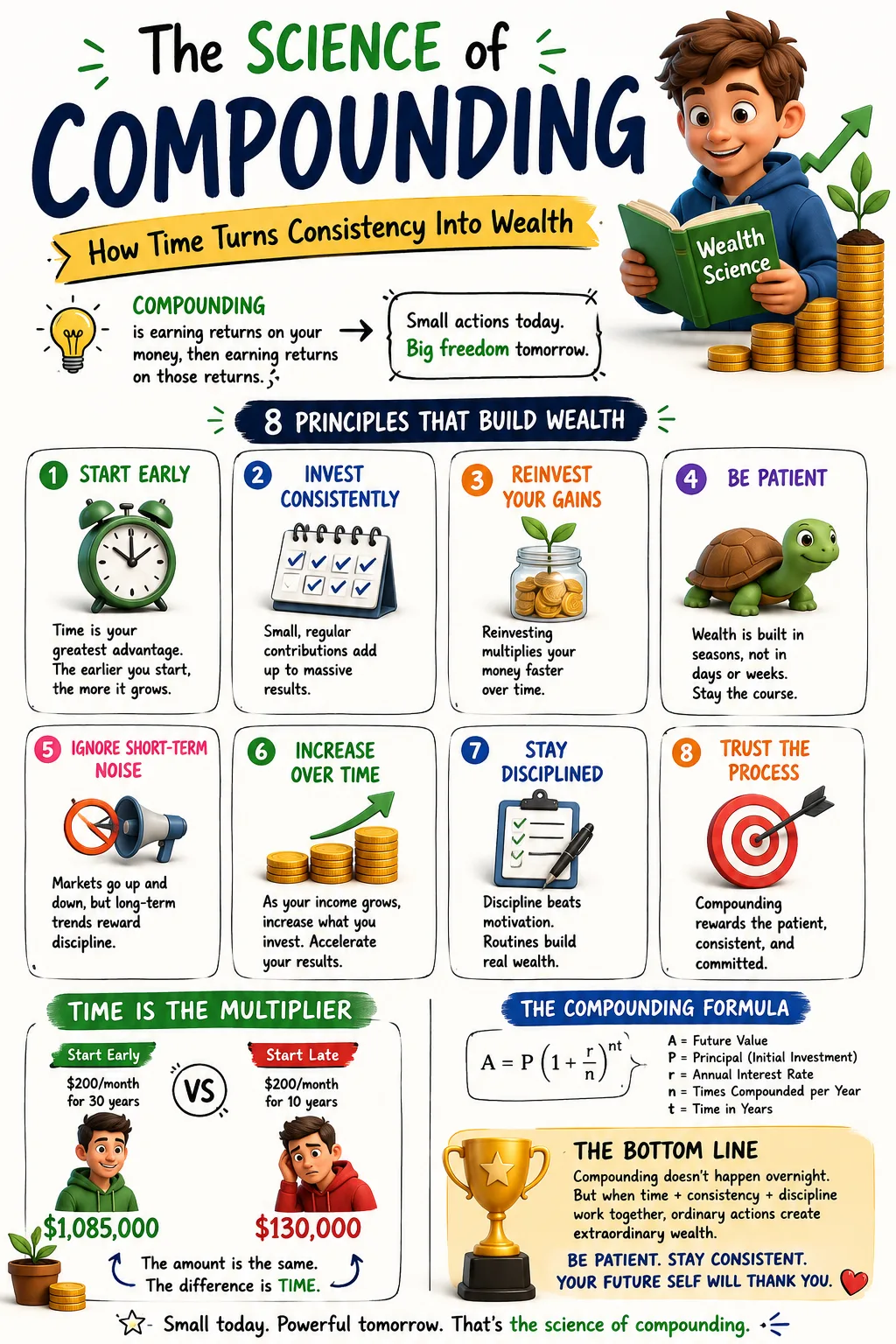
Long-term thinking is powerful because wealth usually accumulates over time. Time allows compounding to work. Time allows skills to deepen. Time allows reputation to build. Time allows debt to be reduced. Time allows small habits to become meaningful outcomes.
Vanguard’s investing principles emphasize clear goals, a balanced and diversified investment mix, minimizing costs, and maintaining long-term discipline. ([ownyourfuture.vanguard.com](https://ownyourfuture.vanguard.com/content/en/learn/financial-planning/vanguards-4-principles-for-investing-success.html?utm_source=chatgpt.com)) Those principles are not exciting in the short run, but they are central to durable investing. They remind investors that success often comes less from constant prediction and more from structure, patience, and behavior.
Daily long-term thinking might look simple. You increase retirement contributions after a raise. You avoid taking on a car payment that would delay investing. You choose training that increases earning power. You keep an emergency fund so you are not forced to sell investments during a downturn. You review whether your spending reflects the life you claim to want.
The challenge is that short-term rewards are immediate. Long-term rewards are abstract. A purchase today provides instant satisfaction. An investment contribution may not feel rewarding for years. Paying down debt does not create social applause. Building skills may be uncomfortable before it becomes profitable.
Long-term thinkers train themselves to value invisible progress. They understand that every month is not supposed to feel dramatic. The quiet months are where the foundation is built.
The wealthy mindset does not ask only, “Can I afford this today?” It asks, “What will this decision do to my options tomorrow?”
3. You Focus on Opportunities Without Ignoring Risk
Opportunity recognition is a wealth-building skill.
Some people see only obstacles. Others see problems that can be solved, skills that can be learned, markets that can be served, assets that can be acquired, and relationships that can be built. The ability to notice opportunity can change a career, business, or investment life.
But opportunity thinking must be paired with risk awareness. Not every opportunity is good. Not every trend is investable. Not every business idea has customers. Not every property is a good deal. Not every course increases income. Not every partnership is trustworthy. Not every risk is worth taking.
The wealthy mindset is not blind optimism. It is disciplined curiosity. It asks: what problem exists here? Who needs it solved? What would they pay? What resources are required? What could go wrong? What is the downside? Can the risk be tested on a small scale? What evidence would confirm or disprove the idea?
Entrepreneurs often need opportunity recognition because businesses begin by solving problems. Investors need it because capital must be allocated where future value may grow. Employees need it because careers improve when people identify needs inside organizations and become known for solving them.
The opportunity-focused person does not wait for perfect certainty. Perfect certainty rarely arrives. But they also do not gamble under the name of courage. They research, test, size the risk, and preserve the ability to recover if the outcome disappoints.
For ordinary households, opportunity may be practical rather than dramatic. A higher-paying certification. A transfer into a growing department. A side service with real demand. A chance to refinance expensive debt. A disciplined investment plan during a market downturn. A move to a lower-cost area with better income prospects. A business process that saves time and increases capacity.
Thinking like the wealthy means training the mind to ask, “Where is value being created, and how can I participate responsibly?”
4. You Avoid Unnecessary Debt
Debt is not automatically bad, but unnecessary debt is a major barrier to freedom.
High-interest consumer debt is especially damaging because it turns future income into payment for past consumption. Credit card balances, payday loans, expensive personal loans, and financing for depreciating status goods can reduce flexibility for years. The household may look comfortable, but the balance sheet becomes weaker.
The key word is unnecessary. Some debt can be productive when used carefully. An affordable mortgage can help a household build equity while securing housing. Education debt can be reasonable if the program meaningfully increases earning power and the cost is manageable. Business debt can support growth when cash flow, margins, and demand are understood. But even productive debt can become destructive if the amount is too large, the interest rate too high, or the assumptions too optimistic.
Thinking like the wealthy means evaluating debt by purpose, cost, risk, and repayment ability. What is the debt funding? Does it acquire an asset or merely fund consumption? What is the interest rate? What is the total cost? What happens if income falls? What happens if the asset does not perform? Does the debt increase future options or reduce them?
The wealthy often use debt strategically, but they usually have context: assets, liquidity, advisers, tax planning, diversified income, and stronger bargaining power. A middle-income household copying the debt behavior without the financial foundation may create danger rather than sophistication.
Avoiding unnecessary debt is not about fear. It is about preserving flexibility. Low fixed obligations make it easier to save, invest, change jobs, start a business, survive emergencies, and sleep well. Heavy debt narrows choices.
The strongest financial position is not always debt-free in every sense. It is debt-aware, debt-selective, and debt-disciplined.
5. You Protect Your Time Carefully
Money can be earned, lost, invested, borrowed, inherited, and rebuilt. Time can only be spent.
People who think seriously about wealth tend to become more protective of time because time is the container for earning, learning, building, resting, relationships, and decision-making. A poorly managed calendar can quietly become a poorly managed financial life.
Protecting time does not mean working every hour. That is often a path to burnout. It means understanding the economic and personal value of attention. Hours spent on low-value distraction may displace skill development, business building, exercise, rest, family, financial planning, or focused work. Hours spent in chaotic work may reduce the quality of decisions. Constant interruption can prevent deep progress.
Time protection has several forms. High earners often prioritize work that produces leverage: strategy, sales, leadership, product development, investing, negotiation, and skill building. Entrepreneurs build systems so the business does not depend on constant improvisation. Investors avoid obsessing over every market movement if it does not improve outcomes. Families create routines for bills, savings, and planning so money does not require daily stress.
Protecting time also means saying no. Every yes has an opportunity cost. A commitment that looks small can consume energy, attention, and schedule space. People who cannot say no often find their most valuable goals postponed by other people’s priorities.
There is also a financial side to time. A person may save money by doing everything themselves, but sometimes the hidden cost is lost earning capacity or exhaustion. Paying for childcare, tools, software, transportation reliability, or professional advice can be wise when it frees time for higher-value work or protects against costly mistakes.
The wealthy mindset asks: is this the best use of my attention, or is it merely the most urgent demand?
Time is not money in a simple sense. Time is more fundamental. Money decisions improve when time is used deliberately.
6. You Invest in Yourself Consistently
For most people, the first major asset is not a stock portfolio or real estate. It is earning power.
Earning power comes from human capital: knowledge, skills, health, experience, relationships, judgment, credentials, and reputation. The World Bank’s human capital work emphasizes the importance of investments in people and notes that skills are formed across homes, neighborhoods, and workplaces. ([worldbank.org](https://www.worldbank.org/en/publication/human-capital-report?utm_source=chatgpt.com)) This matters because income growth is rarely separate from personal and professional development.
Investing in yourself can include formal education, certifications, apprenticeships, technical skills, communication skills, leadership, financial literacy, sales ability, health, therapy, coaching, mentorship, language learning, or industry knowledge. The best self-investments increase capability, opportunity, resilience, or judgment.
But not every self-improvement purchase is an investment. Some courses, conferences, and programs are consumption disguised as ambition. A true investment should have a plausible return: higher income, better performance, stronger health, improved decision-making, expanded network, or reduced risk. The question is not whether the activity sounds impressive. The question is whether it changes capability or outcomes.
Self-investment is especially important because markets change. Technology, automation, regulation, customer expectations, and global competition can alter the value of skills. A person who stops learning may not notice their earning power weakening until opportunities become limited.
Current labor markets reward many forms of applied skill. Demand has grown in areas such as technology, healthcare, data, cybersecurity, clean energy, and skilled trades, though the right path depends on location, aptitude, and opportunity. The point is not that everyone should chase the same field. The point is that skill development should be connected to real demand.
Thinking like the wealthy means viewing self-development as capital formation. You are not merely spending money on education or time on practice. You are increasing the quality of the asset through which most financial opportunities first arrive: yourself.
7. You Learn From Failure Quickly
Failure is not automatically valuable. Repeated failure without reflection can become expensive. The value comes from feedback.
Wealth builders, entrepreneurs, investors, and high performers often experience setbacks. A business idea fails. A product does not sell. An investment declines. A promotion is missed. A negotiation goes badly. A customer leaves. A financial decision creates regret. The question is what happens next.
Some people respond to failure with denial. They blame everything outside themselves and learn nothing. Others respond with shame. They treat one mistake as proof that they are not capable. Both reactions are costly. Denial prevents responsibility. Shame prevents recovery.
The productive response is analysis. What assumption was wrong? Was the risk too large? Was the timing poor? Was the strategy flawed? Was the decision sound but the outcome unlucky? Was there enough research? Were emotions involved? Was the downside survivable? What should be changed next time?
This distinction between decision quality and outcome quality is important. A good decision can produce a bad outcome because uncertainty exists. A bad decision can produce a good outcome because luck exists. The goal is not to judge everything by the result alone. The goal is to improve the process.
Learning from failure quickly matters because time and capital are limited. A business owner who studies mistakes can adjust pricing, marketing, operations, or customer targeting. An investor who studies losses can improve diversification, position sizing, and due diligence. An employee who studies a missed opportunity can identify skill gaps or communication problems.
The wealthy mindset does not celebrate failure for its own sake. It contains failure. It extracts information. It avoids repeating the same mistake with larger stakes.
Failure becomes useful when it is survivable, studied, and converted into better judgment.
8. You Stay Disciplined With Money
Financial discipline is where intention becomes net worth.
Many people know what they should do with money. They should save, invest, avoid high-interest debt, track spending, insure major risks, and plan for the future. Knowledge alone is not enough. Discipline is the repeated behavior that turns knowledge into results.
Discipline appears in ordinary systems. Automatic savings. Monthly investment contributions. Spending reviews. Debt repayment schedules. Emergency fund targets. Retirement contributions. Written financial goals. Limits on lifestyle inflation. Regular review of insurance and estate documents. These habits may not feel exciting, but they create structure.
Financial discipline is especially important as income rises. A higher income can accelerate wealth, but it can also finance larger mistakes. Without discipline, raises become lifestyle upgrades, bonuses become consumption, and credit access becomes debt. The household earns more but owns little more.
Disciplined money management does not mean never spending. It means spending according to priorities rather than impulse. A person can enjoy life and still be financially disciplined if they save first, invest consistently, and avoid obligations that weaken the future.
The Federal Reserve’s SCF data distinguishes assets, liabilities, income, and net worth, which is why it is useful for understanding that earning and owning are different. ([federalreserve.gov](https://www.federalreserve.gov/econres/scf/dataviz/scf/chart/?utm_source=chatgpt.com)) Discipline is the bridge between the two. Income enters the household. Discipline decides whether it becomes assets, disappears into lifestyle, or is consumed by debt.
The wealthy mindset treats money as a tool with assignments. Some money protects. Some money invests. Some money pays obligations. Some money funds enjoyment. Some money supports generosity. Without assignments, money tends to follow emotion.
9. You Understand Delayed Gratification
Delayed gratification is the ability to accept a smaller discomfort today for a larger benefit later.
In personal finance, this skill appears everywhere. Saving requires not spending every dollar now. Investing requires patience before results are visible. Debt reduction requires choosing freedom over immediate consumption. Career development requires studying before earning more. Business building requires effort before profit. Retirement planning requires caring about a future self who may feel distant.
Delayed gratification should not be oversimplified. It is influenced by environment. People with stable income, safe housing, and supportive circumstances may find it easier to wait than people living under scarcity and stress. A household struggling to meet basic needs cannot always be expected to prioritize distant goals over immediate survival.
Still, when there is room to choose, delayed gratification is powerful. It creates the surplus required for wealth building. It interrupts impulse. It gives compounding time to work. It allows a person to buy assets before buying status.
One practical way to build delayed gratification is to create waiting rules. Wait 24 hours before small impulse purchases. Wait 30 days before major discretionary purchases. Save the full amount before buying nonessential items. Increase investments before upgrading lifestyle after a raise. These rules reduce the chance that temporary emotion will make permanent financial decisions.
Delayed gratification does not mean never enjoying money. It means choosing the right order. Future security first, sustainable enjoyment second. When that order is respected, pleasure becomes less stressful because it is not funded by financial self-sabotage.
The wealthy mindset understands that waiting is not the same as losing. Sometimes waiting is how ownership is purchased.
10. You Build Systems for Growth
Motivation starts financial change. Systems sustain it.
A person may feel motivated after reading a book, watching a video, paying off a debt, receiving a raise, or seeing someone else succeed. But motivation rises and falls. Systems keep operating when motivation fades.
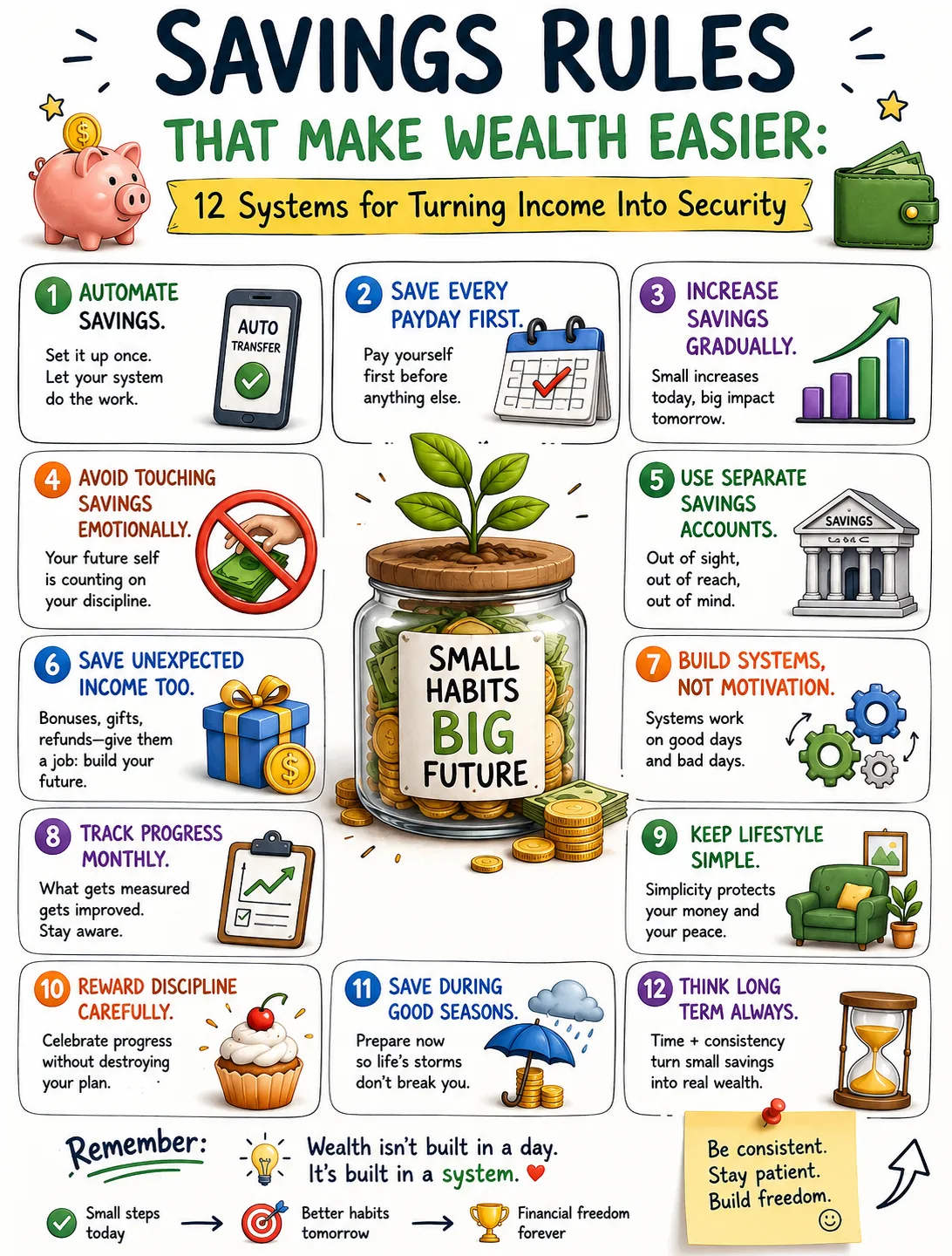
Systems are repeatable structures that make good behavior easier. Automatic transfers to savings. Automatic retirement contributions. Calendar reminders for financial reviews. Separate accounts for taxes, bills, emergency funds, and spending. Habit tracking for learning goals. Standard operating procedures in a business. Scheduled time for skill development. Rules for investment decisions. Checklists before major purchases.
Systems matter because humans are emotional and distracted. Behavioral finance has shown repeatedly that people make mistakes under fear, greed, overconfidence, and social pressure. A good system reduces the number of decisions that must be made in emotional moments.
For investing, a system might include target asset allocation, automatic contributions, periodic rebalancing, cost limits, and rules for when to change strategy. For debt repayment, it might include a payoff order, automated minimums, extra payments after payday, and a ban on new high-interest balances. For career growth, it might include weekly learning hours, quarterly networking, and annual salary research.
Businesses are built on systems too. A founder who does everything manually may earn income but struggle to scale. Standardized processes, documentation, delegation, customer relationship management, quality control, and financial reporting allow growth beyond improvisation.
The wealthy mindset does not rely on feeling inspired every day. It designs environments where progress becomes normal.
A system is a promise made by your calm self to protect your future self from your distracted self.
11. You Prioritize Financial Education
Financial education is one of the strongest defenses against avoidable mistakes.
A financially educated person does not need to know everything. They do not need to become a tax attorney, portfolio manager, economist, or accountant. But they should understand the basics: net worth, cash flow, compound growth, inflation, interest rates, credit, taxes, diversification, risk, insurance, retirement planning, and debt.
These concepts affect everyday decisions. Someone who understands compound interest may invest earlier. Someone who understands high-interest debt may avoid carrying credit card balances. Someone who understands diversification may avoid putting everything into one stock or trend. Someone who understands inflation may realize that cash is safe in nominal terms but not always safe in purchasing power. Someone who understands taxes may keep more of what they earn.
The OECD’s financial education work emphasizes that financial literacy combines knowledge, skills, attitudes, and behaviors, and that it supports financial resilience and well-being alongside access and consumer protection. ([oecd.org](https://www.oecd.org/en/topics/sub-issues/financial-education.html?utm_source=chatgpt.com)) That definition is important because reading alone is not enough. Financial education must become financial behavior.
Financial education also helps people evaluate advice. Much of what circulates online is incomplete, exaggerated, or designed to sell something. One person says all debt is bad. Another says debt is how the rich get richer. One promotes day trading. Another promotes extreme frugality. One promises passive income. Another encourages risky leverage. Without financial literacy, people may mistake confidence for credibility.
Good education gives people better questions. What is the risk? What is the fee? What is the tax impact? Is this diversified? How liquid is it? What happens if assumptions fail? Who benefits if I buy this? Does this fit my goals?
The wealthy mindset prioritizes education because ignorance is expensive. It is expensive in fees, taxes, bad loans, scams, panic selling, poor negotiation, and missed compounding.
12. You Stay Calm During Setbacks
Setbacks are guaranteed. Calm is not.
Markets decline. Jobs are lost. Businesses struggle. Bills arrive unexpectedly. Repairs happen. Health changes. Plans fail. Inflation rises. Interest rates move. Customers leave. Investments disappoint. Financial life is full of events that can trigger fear, anger, shame, or urgency.
Staying calm does not mean pretending problems are small. It means refusing to let panic become the decision-maker.
In investing, calm prevents panic selling during normal market volatility. A long-term investor who sells during fear may lock in losses and miss recovery. Calm does not mean never changing a portfolio. It means changing for reasons connected to goals, risk capacity, valuation, or life circumstances rather than headlines alone.
In personal finance, calm allows better triage. If income falls, the household can list essentials, contact creditors, reduce discretionary spending, use emergency savings, seek income options, and make a plan. Panic may lead to avoidance, high-cost borrowing, or rushed decisions.
In business, calm allows a founder to distinguish between a temporary setback and a broken model. It allows analysis of cash flow, customers, pricing, product-market fit, and costs.
Calm is easier when preparation exists. An emergency fund makes calm easier. Insurance makes calm easier. Diversification makes calm easier. Low debt makes calm easier. A written plan makes calm easier. Strong skills and networks make calm easier. Emotional regulation is not only a personality trait; it is supported by financial structure.
The wealthy mindset prepares before setbacks and reviews during setbacks. It asks: what has changed, what remains true, what options exist, and what decision will I be glad I made later?
Calm does not eliminate pain. It protects judgment.
Why These Habits Are Not Exclusive to Wealthy People
The title “thinking like the wealthy” can be useful, but it can also mislead.
These habits are not owned by the wealthy. Many people with modest incomes value assets, think long term, avoid unnecessary debt, protect time, invest in themselves, learn from failure, and stay disciplined. Some wealthy people do the opposite. They overspend, overborrow, speculate, ignore risk, and lose fortunes.
It is more accurate to say these are wealth-supporting habits. They increase the likelihood of financial progress, but they do not guarantee wealth. Outcomes still depend on income, opportunity, education, health, family obligations, economic conditions, geography, discrimination, inheritance, and luck.
This nuance matters because financial education should not become blame disguised as motivation. A person may do many things right and still face hardship. Another may make poor decisions and still benefit from inheritance or timing. The world is not perfectly meritocratic.
At the same time, acknowledging external factors does not make habits irrelevant. It makes habits more important where they can be applied. A household cannot control every economic force, but it can often improve financial literacy, track spending, reduce high-interest debt, build emergency savings, invest consistently, develop skills, and avoid lifestyle inflation. These actions may not solve every problem, but they improve resilience.
The mature view holds two truths together: wealth is shaped by systems and circumstances, and repeated personal behavior still matters.
The Difference Between Wealth Thinking and Rich-Looking Behavior
Rich-looking behavior seeks recognition. Wealth thinking seeks resilience.
Rich-looking behavior asks, “What will people think when they see this?” Wealth thinking asks, “What will this do to my net worth, cash flow, time, and options?” Rich-looking behavior often emphasizes consumption. Wealth thinking emphasizes ownership. Rich-looking behavior wants evidence now. Wealth thinking understands that the most powerful evidence may be invisible for years.
This difference is especially important in a social media culture where financial appearances can be manufactured. A rented car can look like success. A luxury holiday can be financed. A house can be overleveraged. A business can have revenue without profit. A person can be famous and broke. A person can be quiet and wealthy.
Wealth thinking does not reject enjoyment. It rejects confusion. It refuses to confuse spending with progress or attention with security.
The wealthy thinker can ask hard questions without shame. What is my net worth? What is my savings rate? How much high-interest debt do I carry? What assets am I building? How long could I survive without income? Are my investments diversified? Am I improving my earning power? Does my spending reflect my values or my insecurities?
These questions are not glamorous. They are liberating because they bring financial life back to reality.
How to Begin Thinking This Way
The first step is measurement. Calculate net worth by listing assets and liabilities. Track income and spending. Identify debt balances and interest rates. Review savings, investments, insurance, and emergency cash. Wealth thinking begins when vague feelings are replaced with numbers.
The second step is prioritization. Decide what matters most: emergency savings, debt reduction, investing, career development, homeownership, business building, retirement, education, or family support. Money without priorities is easily captured by impulse.
The third step is automation. Automate savings and investing where possible. Automate bill payments carefully. Schedule financial reviews. Use systems to reduce dependence on motivation.
The fourth step is skill development. Identify skills that can increase earning power or business value. Choose training based on market demand and practical return, not only inspiration.
The fifth step is debt discipline. Avoid high-interest consumer debt, pay down expensive balances, and evaluate new borrowing carefully. Debt should serve a plan, not a mood.
The sixth step is investment consistency. Build a diversified strategy aligned with goals and risk tolerance. Keep costs reasonable. Avoid trend chasing. Review periodically rather than emotionally.
The seventh step is emotional resilience. Expect setbacks. Prepare for them with cash reserves, insurance, diversification, and written plans. Calm is easier when the financial structure is strong.
These steps are not reserved for millionaires. They are how ordinary households begin building the habits that may eventually produce millionaire outcomes.
Final Thought: Wealth Thinking Is a Direction, Not a Label
Thinking like the wealthy is not about pretending to be rich. It is not about copying the spending patterns of people with larger balance sheets. It is not about believing that mindset alone can overcome every barrier. It is not about rejecting pleasure, comfort, or ambition.
It is about direction.
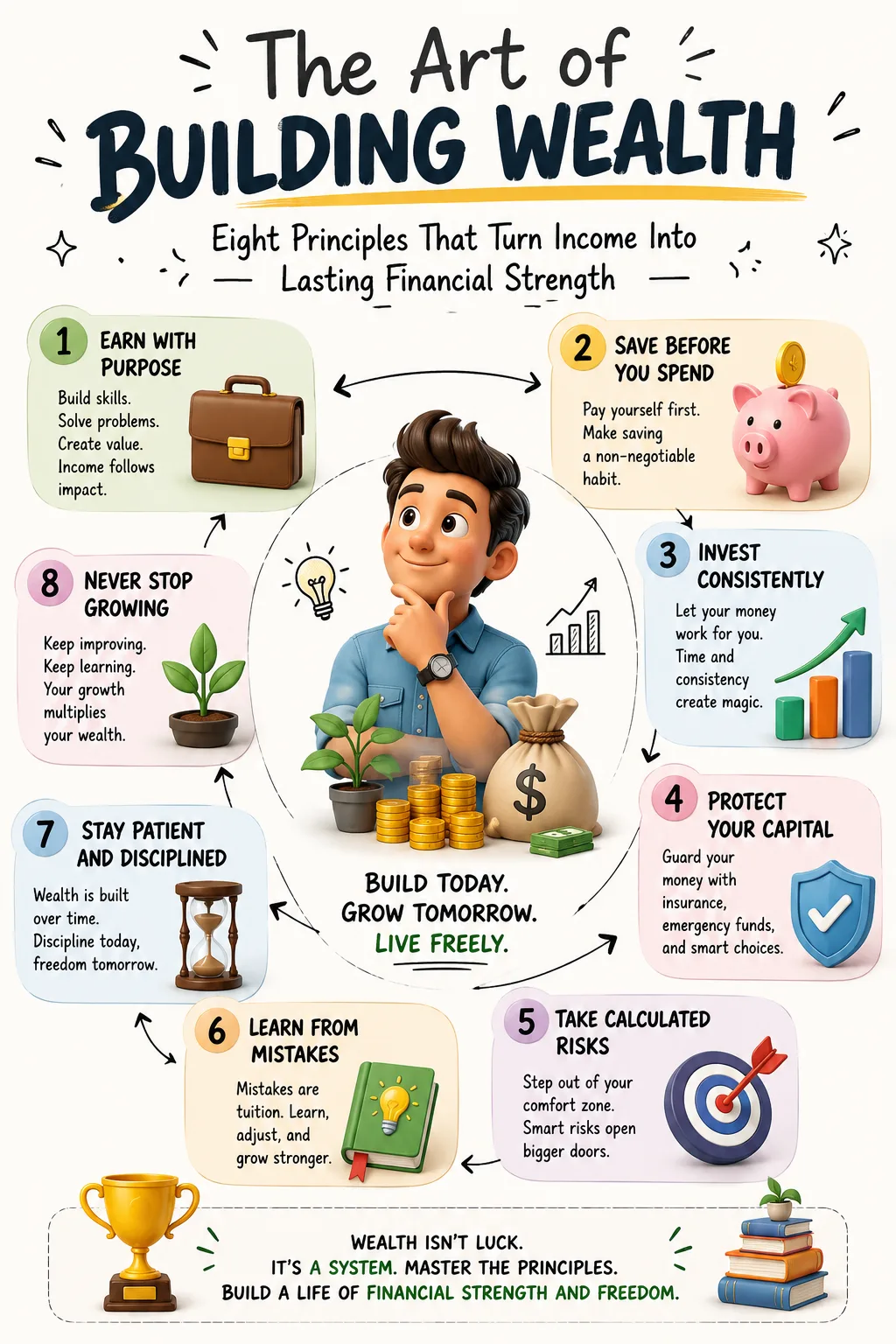
Value assets over appearances. Think long-term daily. Focus on opportunities while respecting risk. Avoid unnecessary debt. Protect your time. Invest in yourself. Learn from failure. Stay disciplined with money. Understand delayed gratification. Build systems for growth. Prioritize financial education. Stay calm during setbacks.
Each habit points money and attention toward greater resilience. None guarantees wealth. Together, they create a financial posture that is more likely to produce security, options, and ownership over time.
The most important shift is from performance to substance. Appearances ask to be noticed. Assets work quietly. Impulses demand satisfaction. Strategy waits. Motivation fades. Systems continue. Setbacks create panic for the unprepared. They create decisions for the prepared.
Wealth is not only built by earning more. It is built by repeatedly choosing what strengthens the future.
That is the real sign you are thinking like the wealthy: your daily decisions begin to serve your long-term freedom.
 Article
 Article
 Article
 Article
 Article
 Article
 Article
 Article