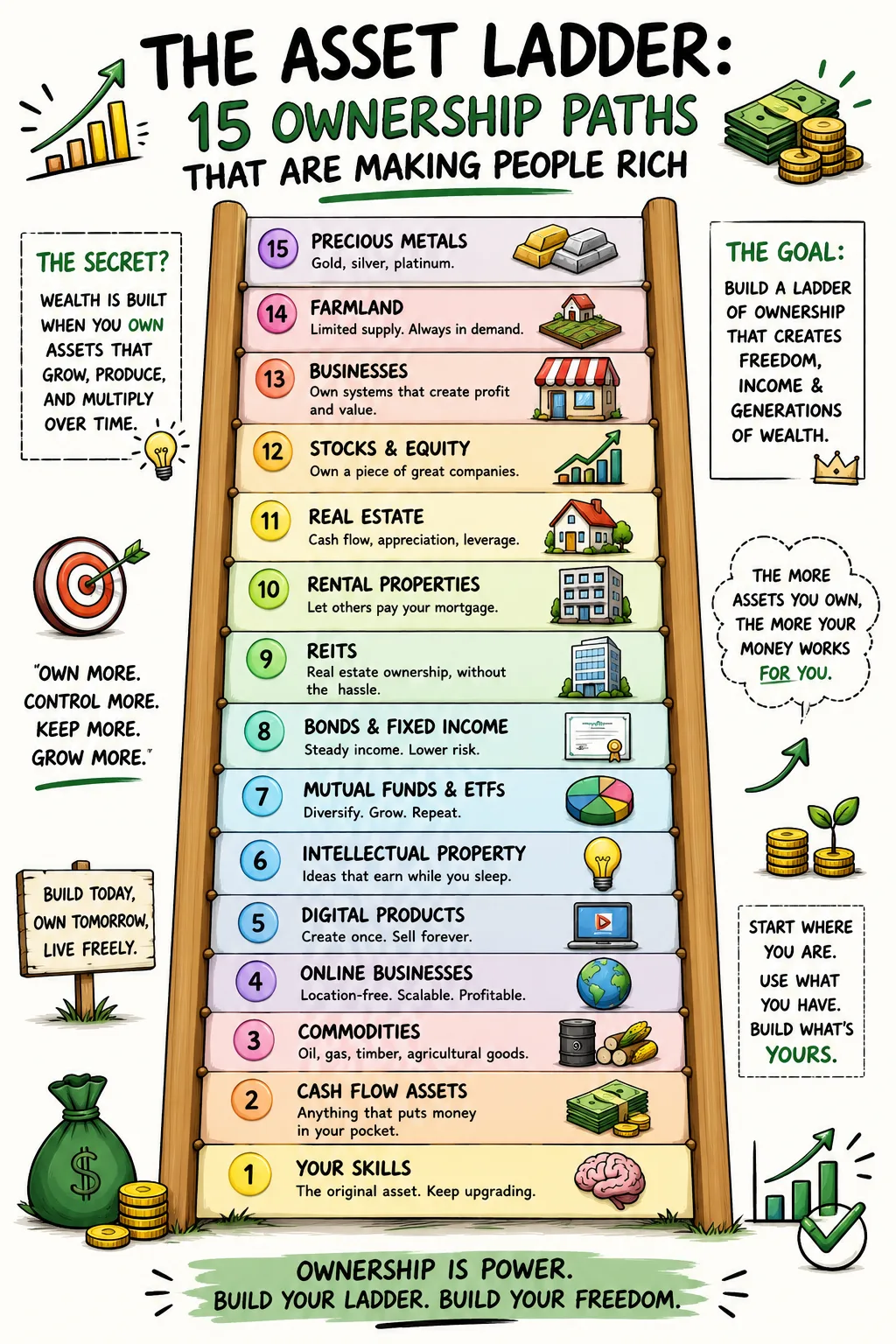
The Asset Ladder: 15 Ownership Paths That Are Making People Rich
Wealth rarely appears all at once. It is usually built through a long sequence of ownership decisions: the first index fund contribution, the first profitable business, the first rental property, the first stock dividend, the first royalty payment, the first asset that earns money while its owner sleeps.
That is the quiet difference between income and wealth. Income is earned. Wealth is owned.
A high salary can improve a person’s lifestyle, but it does not automatically make them wealthy. Many high earners remain financially fragile because their money leaves as quickly as it arrives. Wealth begins when money is converted into assets that can hold value, rise in value, or produce future cash flow.
An asset is not merely something expensive. A luxury car, designer watch, or large home can feel like wealth, but the true test is economic behavior. Does it generate income? Can it appreciate over time? Can it be sold for meaningful value? Does it strengthen the owner’s financial position? The assets that make people rich tend to answer yes to at least one of those questions, and the best ones often answer yes to several.
The strongest evidence across financial history points toward productive ownership. Businesses, public equities, real estate, and intellectual property have created significant fortunes because they are connected to economic output. They participate in profit, rent, innovation, pricing power, scarcity, or human demand. Speculative assets can create wealth too, but their results are less predictable because they often depend on someone else paying more later rather than on the asset itself producing cash.
This does not mean every investor should own every asset. A young professional building their first portfolio does not need farmland, venture capital, rare art, and commercial real estate. A retiree seeking dependable income may have little interest in cryptocurrency or startup equity. A business owner may already have so much risk tied to one company that diversification becomes more important than aggressive expansion.
The real lesson is not that one asset class is magical. The lesson is that wealth is built by understanding how different assets behave, then assembling them in a way that matches time horizon, risk tolerance, skill, capital, and temperament.
Why Assets Make People Rich
Every wealth-building asset works through one or more basic mechanisms: appreciation, cash flow, leverage, tax efficiency, scarcity, or scalability.
Appreciation occurs when an asset becomes more valuable over time. A stock rises because the underlying company grows earnings. A home appreciates because the land becomes more desirable or replacement costs rise. A business becomes more valuable because its revenue, brand, customer base, or systems improve.
Cash flow is money produced by the asset while the owner still owns it. Rental properties generate rent. Dividend stocks distribute profits. Bonds pay interest. A book can produce royalties. A website can earn advertising revenue. A business can generate profit.
Leverage allows an owner to control a larger asset with a smaller amount of capital. Real estate is the classic example: an investor may buy a property with a down payment and mortgage, then benefit from appreciation on the entire property value. Leverage can accelerate wealth, but it can also magnify losses. Debt turns small mistakes into large problems when cash flow weakens.
Tax efficiency matters because what an investor keeps is more important than what an investor earns. Different assets are taxed differently depending on the country, account type, holding period, income classification, and structure. Long-term capital gains, qualified dividends, depreciation, tax-deferred retirement accounts, and business deductions can materially affect after-tax returns.
Scarcity creates value when demand rises faster than supply. Land in a growing city, a premium domain name, a rare collectible, a patented invention, or shares in a dominant company can all benefit from scarcity. Scarcity alone is not enough; demand must be durable.
Scalability is the ability to grow without costs rising at the same pace. Software, digital products, media assets, marketplaces, and intellectual property can scale powerfully because one product can be sold many times. This is why technology businesses and digital assets have created enormous wealth in recent decades.
Most rich households do not rely on one mechanism. They combine them. A founder may own a business that grows in value and produces cash. A real estate investor may receive rent, use responsible leverage, benefit from tax deductions, and build equity over decades. A stock investor may receive dividends while the underlying company grows earnings and reinvests profits.
The following 15 assets are not equal in risk, accessibility, liquidity, or complexity. Some are suitable for beginners. Others are better suited for experienced investors, business owners, or accredited investors. What they share is the potential to turn money, knowledge, time, or creativity into ownership.
1. Public Stocks
Public stocks represent ownership shares in companies listed on public exchanges. When someone buys shares of Apple, Microsoft, Nvidia, Berkshire Hathaway, or thousands of other public companies, they are not merely buying a ticker symbol. They are buying a fractional claim on a business.
Stocks have created wealth because successful companies can increase revenue, expand margins, reinvest profits, pay dividends, buy back shares, and compound value over time. A shareholder benefits when the market assigns a higher value to those future profits or when the company distributes cash directly.
The long-term record of U.S. equities is one reason stocks remain central to wealth building. Historical S&P 500 return data beginning in the 1920s shows that U.S. large-cap stocks have delivered strong long-term total returns, though with painful declines along the way. The returns include both price changes and reinvested dividends, which is essential because dividends have historically contributed meaningfully to total return.
The power of public stocks is that they give ordinary investors access to extraordinary businesses. A person does not need to build a semiconductor company, global payments network, luxury brand, pharmaceutical company, or cloud computing platform from scratch. Through the stock market, they can become a small owner of many such businesses.
The weakness of public stocks is volatility. Stock prices move daily, often for reasons that have little to do with long-term business value. Interest rates, inflation fears, earnings disappointments, political events, investor sentiment, and liquidity conditions can all move markets. A great business can still be a poor investment if purchased at an extreme valuation. A broad market index can fall sharply during recessions, banking crises, wars, or speculative unwinds.
Public stocks build wealth best when investors think like owners rather than gamblers. The owner asks: Does this company have durable demand? Does it generate cash? Does it have competitive advantages? Is management allocating capital well? Is the valuation reasonable? The gambler asks only: Will the price go up soon?
For most people, the greatest advantage of stocks is not excitement. It is accessibility. With modern brokerage platforms and retirement accounts, investors can build diversified stock exposure with small recurring contributions. That makes public equities one of the most democratic ownership assets ever created.
2. Real Estate
Real estate has been making people rich for centuries because it combines utility, scarcity, income, and leverage. People need places to live, companies need places to operate, goods need places to be stored, and economic activity needs physical space.
Real estate wealth usually comes from four sources: appreciation, rental income, debt paydown, and tax advantages. A rental property can rise in value while tenants help pay the mortgage. Over time, the loan balance falls, rents may increase, and the owner’s equity grows. In some markets, land scarcity and population growth can make the appreciation component especially powerful.
Real estate is also one of the few asset classes where average individuals commonly use leverage. A buyer may control a property worth several hundred thousand dollars with a fraction of the purchase price. When the investment works, leverage can amplify returns. When it fails, leverage can create severe stress.
The popular image of real estate investing often ignores the operational burden. Tenants call. Roofs leak. Taxes rise. Insurance premiums increase. Vacancies happen. Local laws change. Financing costs move. A rental property is not truly passive in the same way that an index fund is passive. It is a business attached to a building.
That business can still be highly attractive. Real estate gives owners more control than public stocks. An investor can improve a property, raise rents through better management, refinance debt, change the tenant mix, add units, convert usage, or sell when market conditions are favorable. Skill matters.
Location matters even more. A mediocre property in a growing employment center may outperform a beautiful property in a declining area. Real estate is local. National averages can hide enormous differences between neighborhoods, cities, and property types.
Residential rentals, apartment buildings, warehouses, self-storage facilities, medical offices, data centers, student housing, and vacation rentals all behave differently. The wealth-building principle is the same: acquire property where long-term demand is stronger than supply, finance it prudently, maintain cash reserves, and avoid overpaying based on unrealistic assumptions.
3. Private Businesses
Private business ownership is one of the most powerful wealth creators because it offers something employees rarely receive: equity in the engine of profit.
A business can make its owner rich in three ways. First, it can produce annual profits. Second, it can increase in value as revenue, systems, brand, and customer relationships improve. Third, it can eventually be sold. A salaried employee earns from labor. A business owner can earn from labor, capital, systems, people, intellectual property, and market positioning.
This is why many high-net-worth individuals have meaningful business equity. The Federal Reserve’s Survey of Consumer Finances tracks household balance sheets and shows how ownership of assets such as businesses, stocks, retirement accounts, and real estate varies across the wealth distribution. Wealthier households tend to hold more business and financial assets, while middle-class wealth is often more concentrated in home equity.
Private businesses are not limited to technology startups. They include dental practices, plumbing companies, logistics firms, agencies, restaurants, accounting firms, laundromats, ecommerce brands, manufacturing companies, software firms, landscaping companies, childcare centers, and niche professional services.
The best private businesses often share several traits: repeat customers, strong margins, pricing power, low customer concentration, reliable demand, clear systems, and the ability to operate without the founder making every decision. A business that depends entirely on one person’s daily effort is closer to self-employment. A business that has systems, managers, recurring revenue, and transferable customer relationships becomes an asset.
The risks are substantial. Businesses fail. Customers leave. Competitors copy. Technology changes. Owners burn out. Cash flow can look strong until taxes, payroll, inventory, debt service, and reinvestment needs appear. Many founders are rich on paper long before they are liquid in reality.
The wealth-building advantage is control. A stock investor can analyze Apple but cannot directly improve Apple. A business owner can change pricing, refine marketing, hire better people, improve operations, launch products, cut waste, and build culture. The owner is not just allocating capital; the owner is shaping the asset.
That control is why private business can create life-changing wealth. It is also why it demands judgment, resilience, and emotional stamina. The same asset that can make an owner rich can also consume years of life if built without discipline.
4. Index Funds and ETFs
Index funds and exchange-traded funds, commonly called ETFs, are among the most important financial inventions for ordinary investors. They allow people to own broad baskets of securities at low cost without trying to pick individual winners.
An S&P 500 index fund owns shares of large U.S. companies. A total stock market fund owns thousands of companies. A global index fund may hold businesses across many countries. Bond ETFs can hold government bonds, corporate bonds, municipal bonds, or inflation-protected securities.
The central advantage is diversification. Instead of betting on one company, the investor owns many. Some will disappoint. Some will fail. Some will compound far beyond expectations. The index structure allows the portfolio to participate in broad economic growth while reducing the damage caused by any single company’s collapse.
Low fees are another major advantage. Every dollar paid in fees is a dollar that cannot compound for the investor. Over decades, small fee differences can become large wealth differences. This is one reason passive investing has grown dramatically.
Index investing also solves a behavioral problem. Many investors overestimate their ability to identify winning stocks, time the market, or select active managers. S&P Dow Jones Indices’ SPIVA research compares active funds against benchmarks and has repeatedly found that many active managers underperform over longer periods, though results vary by market, category, and time frame.
The simplicity of index funds does not make them risk-free. A stock index fund can fall sharply in a bear market. A bond fund can lose value when interest rates rise. An international fund can be affected by currency movements, political risk, and regional stagnation. Diversified does not mean immune.
Still, index funds are one of the cleanest ways to build wealth because they align with a principle that has worked for generations: own productive assets broadly, keep costs low, reinvest returns, and let time do much of the work.
5. Intellectual Property
Intellectual property is ownership of ideas, creative work, inventions, code, media, brands, and proprietary knowledge. It includes books, music, patents, software, trademarks, courses, designs, photography, research, databases, scripts, and licensing rights.
Intellectual property can make people rich because it separates value creation from hourly labor. A consultant paid by the hour must keep working to keep earning. An author, software creator, musician, inventor, or course creator can produce something once and earn from it many times.
A book can sell for years. A song can generate royalties across streaming platforms, films, advertisements, and performances. A patent can be licensed to manufacturers. A software tool can serve thousands of customers. A course can be sold globally. A trademarked brand can create pricing power.
The economics can be unusually attractive. Once the asset exists, the marginal cost of distribution may be low. Digital delivery makes this especially powerful. A downloadable template, online course, ebook, design file, or software license can be sold to one person or one hundred thousand people without recreating the product from scratch each time.
The hard part is demand. Most intellectual property earns little. The world is full of books no one reads, courses no one buys, patents no one licenses, and songs no one streams. Creation is not enough. The asset must solve a problem, entertain, educate, save time, reduce risk, signal status, or give buyers something they value.
Distribution is often the difference between dormant intellectual property and a wealth-building asset. A brilliant product hidden from the market has little economic value. A useful product with a strong audience, search visibility, partnerships, or licensing channels can compound for years.
Intellectual property rewards people who can turn knowledge into durable assets. A professional who answers the same client question repeatedly can build a course. A designer who recreates the same workflow can build templates. A developer who automates a painful task can build software. A researcher who organizes complex information can build a paid database or newsletter.
The wealth lesson is clear: expertise becomes more valuable when it is packaged into an asset that can travel without the creator.
6. Digital Businesses
Digital businesses are businesses built primarily on the internet. They include ecommerce stores, software-as-a-service companies, paid communities, online marketplaces, newsletters, media sites, digital agencies, mobile apps, creator brands, and subscription platforms.
They have made people rich because they can reach global markets with lower physical overhead than many traditional businesses. A small team can sell software worldwide. A niche newsletter can attract subscribers across continents. An ecommerce brand can test demand before building a large retail footprint. A marketplace can connect buyers and sellers without owning the inventory itself.
Digital businesses benefit from scalability. A software product may require heavy development upfront, but each new user does not necessarily require proportional cost. A digital course can be sold repeatedly. A membership community can add subscribers without opening new locations. A content site can earn advertising or affiliate income long after an article is published.
The strongest digital businesses usually own customer relationships. This is an underappreciated point. A business that depends entirely on a social media algorithm, one advertising channel, one marketplace, or one search ranking is more fragile than it looks. Platform risk is real. Algorithms change. Ad costs rise. Accounts get suspended. Competitors copy winning products.
Digital wealth is strongest when the business has multiple advantages: brand trust, email lists, direct traffic, recurring revenue, proprietary data, network effects, community, software functionality, or unique content. The internet makes starting easier, but it also makes competition global.
AI has expanded the opportunity set. Entrepreneurs can now use automation to write code, analyze customer data, produce media, improve support, personalize marketing, and build specialized tools faster than before. That does not eliminate competition; it raises the standard. When production becomes easier, trust, distribution, taste, and execution become more valuable.
A digital business is not automatically an asset. A social media account with no monetization, no customer list, and no durable brand may be attention rather than wealth. A digital business becomes an asset when it has revenue, systems, audience ownership, transferable operations, and a reason customers return.
7. Cryptocurrency
Cryptocurrency is one of the most controversial assets on the wealth ladder. Bitcoin, Ethereum, and other digital assets have produced extraordinary gains for some early investors, while many late or speculative buyers have suffered deep losses.
The wealth case for cryptocurrency usually rests on scarcity, decentralization, network adoption, and the possibility that digital assets become more integrated into the financial system. Bitcoin supporters often compare it to digital gold because its supply is programmatically limited. Ethereum supporters focus on programmable finance, applications, tokenization, and decentralized infrastructure.
The risk case is equally serious. Crypto assets can be extremely volatile. Prices can fall dramatically. Projects fail. Exchanges collapse. Tokens can be hacked, manipulated, or rendered obsolete. Regulatory treatment continues to evolve across jurisdictions. Custody mistakes can be irreversible. A forgotten password or compromised wallet can destroy wealth permanently.
Crypto is also filled with narrative risk. Many investors buy because prices are rising, not because they understand the asset. That is dangerous. An asset that can rise 500 percent can also fall 80 percent. Volatility is not a footnote; it is part of the asset class.
For disciplined investors, crypto may play a limited role as a high-risk allocation. For speculators using leverage, borrowed money, or concentrated bets, it can become financially destructive. The difference is not the asset alone. It is position sizing, custody, time horizon, and emotional control.
The deeper lesson is that not all assets that make people rich are reliable wealth-building foundations. Some create wealth through productive cash flow. Others create wealth through adoption and scarcity. Crypto belongs in the second category. It may make some people rich, but it can also make people poorer very quickly.
8. Dividend Stocks
Dividend stocks are shares of companies that distribute part of their profits to shareholders. They appeal to investors who want both ownership and income.
A dividend is not free money. When a company pays a dividend, it is transferring cash from the business to shareholders. The question is whether that cash distribution is sustainable and whether the company still has enough capital to grow. A high dividend yield can be attractive, but it can also be a warning sign if the market expects the dividend to be cut.
The best dividend companies tend to have durable cash flows, moderate debt, disciplined management, and products or services that remain in demand through economic cycles. Common dividend sectors include utilities, consumer staples, healthcare, financials, telecommunications, and mature industrial companies.
Dividend investing can build wealth in two ways. First, investors receive cash that can be spent or reinvested. Second, reinvested dividends can buy more shares, which may produce more dividends, creating a compounding loop. Over long periods, reinvestment can become powerful.
Dividend stocks are especially appealing to retirees, income-focused investors, and people building financial independence portfolios. The psychological benefit of receiving cash can help investors stay committed during volatile markets. Price declines feel different when the portfolio continues to pay income.
The danger is chasing yield. A stock yielding 9 percent may look better than one yielding 3 percent, but the higher yield may reflect distress. If earnings are falling, debt is high, or the payout ratio is unsustainable, the dividend may be cut. When that happens, investors can suffer both lost income and capital loss.
A strong dividend strategy focuses on quality, payout sustainability, balance sheet strength, and dividend growth rather than yield alone. Wealth comes not from the biggest promised payout, but from reliable cash flows that can endure.
9. REITs
Real estate investment trusts, or REITs, allow investors to own real estate through publicly traded or private vehicles. A REIT may own apartments, warehouses, hospitals, shopping centers, offices, data centers, cell towers, hotels, self-storage facilities, or other property types.
The appeal is simple: real estate exposure without directly buying and managing buildings. REIT investors can receive dividends, gain exposure to property markets, and buy or sell shares more easily than they could sell a physical property.
REITs can be powerful wealth-building assets because they combine real estate income with stock market liquidity. A person can invest in industrial warehouses, data centers, or apartment portfolios without arranging a mortgage, screening tenants, or managing repairs.
The structure also has income appeal. REITs are generally required to distribute much of their taxable income to shareholders, which is why they are often associated with dividends. The trade-off is that REITs may need to raise capital for growth because they retain less income than many corporations.
REIT performance depends heavily on property type, interest rates, debt structure, lease quality, and management. A data center REIT may benefit from cloud computing and AI infrastructure demand. An office REIT may struggle if remote work reduces demand for traditional office space. A retail REIT with high-quality tenants and locations may perform very differently from one exposed to declining malls.
Interest rates matter. When rates rise, REIT borrowing costs can increase and income investors may demand higher yields. That can pressure prices. When rates fall, REITs may become more attractive. This rate sensitivity does not make REITs bad; it makes them cyclical.
For investors who want real estate exposure but not direct property management, REITs can be a practical bridge between stocks and real estate. They are not substitutes for careful analysis, but they make institutional-quality property ownership more accessible.
10. Bonds and Fixed Income
Bonds rarely create dramatic wealth in the way startups, stocks, or real estate can. Their role is different. Bonds preserve capital, produce income, reduce volatility, and give investors liquidity during uncertain periods.
A bond is essentially a loan. Governments, municipalities, and corporations issue bonds to borrow money. Investors buy the bonds and receive interest payments, then principal repayment if the issuer remains solvent and the bond is held to maturity.
Government bonds are often used for safety and liquidity. Corporate bonds offer higher yields but come with credit risk. Municipal bonds may provide tax advantages in some jurisdictions. Treasury Inflation-Protected Securities are designed to adjust with inflation. Short-term bonds behave differently from long-term bonds because interest-rate sensitivity varies by maturity.
Fixed income can make people rich indirectly by helping them stay invested. A portfolio made entirely of stocks may have higher expected long-term returns, but not every investor can emotionally survive large drawdowns. Bonds can reduce volatility and provide cash for rebalancing during market declines.
The SEC’s investor education materials emphasize that asset allocation depends on time horizon and risk tolerance, and that diversification means spreading investments across categories such as stocks, bonds, and cash.
Bonds have risks. Inflation can erode purchasing power. Rising interest rates can reduce bond prices. Corporate defaults can impair principal. Long-duration bonds can be more volatile than many investors expect. A bond fund does not behave exactly like an individual bond held to maturity.
Still, fixed income remains essential for many wealth plans. A wealthy person is not only trying to grow money. They are trying to avoid ruin, fund obligations, meet expenses, and preserve optionality. Bonds help serve that purpose.
11. Farmland
Farmland is one of the oldest wealth assets in history. Before stock exchanges, venture capital, or digital businesses, land capable of producing food was a foundation of economic power.
The investment case for farmland is based on durable demand. People need food. Productive land is limited. Urbanization can reduce available agricultural land. Inflation can raise crop prices and land replacement values. Farmers may rent land from owners, creating income. Over long periods, high-quality farmland in strong agricultural regions can appreciate.
Farmland also behaves differently from stocks and traditional real estate. Its value is influenced by crop yields, commodity prices, soil quality, water access, climate conditions, government policy, interest rates, and local farming economics. This can make farmland a diversifier, but it also makes it specialized.
Direct farmland ownership is not simple. Investors must understand soil, drainage, water rights, tenants, equipment needs, crop economics, environmental risk, and local market dynamics. A beautiful piece of land is not automatically a good investment. Productivity matters.
There are also indirect ways to invest, including farmland funds, agricultural REITs, and private vehicles. These may lower operational burden but introduce fees, manager risk, liquidity limits, and structure complexity.
The wealth lesson of farmland is scarcity tied to necessity. Assets connected to basic human needs can hold enduring value. Yet even necessity does not eliminate risk. Drought, disease, poor management, leverage, and commodity cycles can all hurt returns.
12. Precious Metals
Gold and silver have attracted investors for thousands of years. They are scarce, durable, globally recognized, and independent of any single company’s earnings. For many people, precious metals represent protection rather than growth.
Gold does not generate rent, dividends, interest, or profits. Its value depends largely on scarcity, investor demand, currency confidence, central bank behavior, inflation expectations, jewelry demand, and fear. That makes it different from productive assets. A business can create more cash flow. A farm can produce crops. A rental property can collect rent. Gold simply remains gold.
This does not make it useless. Precious metals can serve as a hedge against extreme uncertainty, currency debasement fears, geopolitical stress, and loss of confidence in financial systems. Some investors hold a modest allocation as insurance.
The mistake is expecting gold to behave like a compounding asset. It may rise dramatically during certain periods, but it does not internally compound. There is no management team reinvesting retained earnings. There are no tenants paying rent. There is no product launch increasing revenue.
Silver has both investment and industrial demand, which can make it more volatile. It is used in electronics, solar panels, medical applications, and other industrial processes. That dual role can create different price behavior from gold.
Precious metals can help preserve wealth in certain environments, but they are not usually the primary engine that makes people rich. They are better understood as a store-of-value or diversification tool than as a wealth machine.
13. Collectibles
Collectibles include fine art, rare watches, classic cars, rare coins, sports memorabilia, wine, stamps, handbags, vintage instruments, and other scarce objects. Some have produced extraordinary gains. Many have not.
The wealth case for collectibles rests on scarcity, cultural value, status, provenance, and demand from wealthy buyers. A rare painting by a historically important artist can become more valuable as global wealth rises. A limited-production watch can appreciate if collector demand exceeds supply. A classic car can rise in value when nostalgia, design, rarity, and condition align.
Collectibles are emotionally appealing because they are tangible and enjoyable. An investor can hang art, wear a watch, drive a car, or display a rare object. That enjoyment can be real, but it can also cloud judgment.
The risks are significant. Collectibles are illiquid. Selling may require auctions, dealers, authentication, storage, insurance, and high transaction costs. Valuation is subjective. Trends change. Fakes exist. Condition matters intensely. A small defect can materially reduce value.
Collectibles also do not produce cash flow unless monetized through lending, exhibitions, leasing, or related business models. Most owners rely on appreciation. That makes them speculative compared with assets that generate income.
For wealthy collectors, collectibles can be part of a broader portfolio. For beginners trying to build financial independence, they should be approached carefully. Buying what one loves is different from investing. A collectible may bring joy, but joy should not be confused with predictable return.
14. Domain Names and Digital Assets
Domain names, websites, apps, newsletters, content libraries, social media properties, templates, databases, and online communities form a growing category of digital assets. Some produce income. Others appreciate because they control attention, traffic, brand identity, or digital real estate.
A premium domain name can be valuable because it is scarce and memorable. There is only one exact match for a powerful word or phrase in a major domain extension. Companies may pay significant sums for a domain that improves credibility, search visibility, or brand positioning.
Websites can be even more powerful when they generate cash flow. A site earning advertising income, affiliate commissions, subscription revenue, or product sales can be valued like a small business. Buyers often assess traffic quality, revenue stability, search rankings, email lists, content depth, and dependence on the owner.
Newsletters have become especially interesting digital assets. A trusted newsletter with loyal readers can sell sponsorships, paid subscriptions, courses, events, research, or advisory services. The asset is not just the email list; it is the relationship with the audience.
Mobile apps and software tools can generate recurring revenue if they solve a persistent problem. Even small apps can become valuable if they have loyal users, low churn, and efficient acquisition channels.
The risk is fragility. Search engine updates can reduce traffic. Social platforms can change rules. Affiliate programs can cut commissions. Users can churn. Technology can become outdated. Digital assets require maintenance, security, content refreshes, product improvement, and audience trust.
The wealth-building opportunity is that digital assets can often be created with more skill than capital. A person with writing ability, technical knowledge, design talent, marketing discipline, or niche expertise can build an asset from scratch. That is why this category matters. It expands ownership beyond people who already have large amounts of money.
15. Venture Capital and Startup Equity
Startup equity is ownership in young companies with high growth ambitions. It can create spectacular wealth when a small company becomes a major business. Early employees, founders, angel investors, and venture capital funds have built fortunes from companies that began as risky ideas.
The appeal is asymmetry. A startup investment can lose 100 percent of its value, but a successful one can return many times the original investment. A single major winner can offset many failures in a diversified venture portfolio.
The problem is that most startups do not become large successes. Failure is common because young companies face product risk, market risk, funding risk, hiring risk, competition, regulation, and execution risk. Even promising companies can fail if they run out of cash before reaching profitability.
Startup equity is also illiquid. Investors may wait years for an exit through acquisition, secondary sale, or public offering. Employees with stock options may face complex tax and exercise decisions. Paper wealth can vanish if valuations fall or preferences favor later investors.
Venture capital is not simply buying small companies and hoping. Professional investors assess market size, founder quality, product differentiation, growth rate, unit economics, customer love, competitive dynamics, and exit potential. Even then, outcomes are uncertain.
For most individuals, startup equity should be treated as a high-risk allocation rather than a core wealth foundation. Founders are different because their human capital and equity are tied together. They may accept concentration risk because building the company is their path to wealth.
Startup equity has made many people rich, but it is one of the least forgiving assets. It rewards patience, access, judgment, and diversification. It punishes hype, overconfidence, and poor liquidity planning.
Productive Assets Versus Speculative Assets
The 15 assets on this ladder are not equal. Some are productive. Some are semi-productive. Some are primarily speculative.
Productive assets generate income or economic output. Businesses sell products. Stocks represent companies that earn profits. Real estate collects rent. Farmland produces crops. Bonds pay interest. Intellectual property can generate royalties. Digital businesses can produce revenue.
Speculative assets rely more heavily on resale value. Precious metals, collectibles, some cryptocurrencies, and undeveloped digital assets may appreciate, but they often do not produce cash while held. Their owner depends on future demand.
This distinction matters because cash flow gives an investor more ways to win. If a rental property produces positive cash flow, the owner may benefit even if the market price is flat. If a dividend company continues growing earnings, shareholders may collect income while waiting for valuation to improve. If a business generates profit, the owner can reinvest, pay down debt, hire staff, or distribute cash.
A non-productive asset may still perform well, but the return depends more heavily on sentiment, scarcity, inflation fears, or buyer demand. That can work. It can also reverse suddenly.
Wealthy people often own both, but they tend to build their foundation on productive assets. Speculative assets may sit around the edges as hedges, passion investments, or asymmetric opportunities. The foundation is usually ownership of things that serve customers, house tenants, produce goods, distribute profits, or solve problems.
How to Evaluate Any Asset Before Buying
The first question is simple: how does this asset make money?
If the answer is unclear, the investor is probably speculating. That does not automatically make the investment wrong, but it should change position size and expectations.
The second question is whether the asset produces cash flow. Cash flow can protect an investor from being forced to sell at a bad time. It can fund maintenance, debt service, taxes, and reinvestment. Assets without cash flow require greater confidence in future resale value.
The third question is liquidity. Public stocks and ETFs can usually be sold quickly during market hours. Real estate may take months. Private businesses may take years to sell. Venture investments may not be sellable at all until an exit. Collectibles require the right buyer. Liquidity determines how easily wealth can become usable money.
The fourth question is control. A business owner has high control. A landlord has moderate control. A public stock investor has little direct control. A bondholder has contractual rights but limited upside. Control can increase opportunity, but it also increases responsibility.
The fifth question is leverage. Debt can improve returns when asset income and appreciation exceed borrowing costs. It can destroy wealth when cash flow falls or refinancing becomes difficult. Investors should stress-test assets under higher rates, lower income, vacancies, recessions, and slower growth.
The sixth question is tax treatment. Two investments with the same pre-tax return can produce different after-tax outcomes. Tax-advantaged accounts, depreciation, capital gains treatment, interest taxation, and business structures all matter.
The seventh question is skill requirement. Index funds require discipline more than specialized expertise. Direct real estate requires market knowledge and operational ability. Private business requires management. Venture investing requires access and portfolio construction. Collectibles require authentication and niche expertise.
The eighth question is concentration. A person whose job, home, and investment property all depend on one city has more concentration risk than they may realize. A founder whose net worth is mostly company equity may be wealthy but fragile. Diversification is not a lack of conviction; it is protection against being wrong once in a way that cannot be repaired.
The Role of Time in Wealth Creation
Assets need time. A stock portfolio needs time for earnings growth and reinvestment. Real estate needs time for debt paydown, rent growth, and appreciation. A business needs time to build brand, systems, and customer trust. Intellectual property needs time to find distribution. Farmland needs time for productivity and scarcity to matter.
Many investors fail because they expect long-term assets to solve short-term emotions. They buy stocks, then panic during volatility. They buy real estate, then underestimate repairs. They start a business, then quit before systems mature. They buy crypto, then confuse volatility with validation.
Time does not rescue every bad investment. A poor asset can remain poor for decades. But good assets often need patience to reveal their economics. Compounding is slow at first because the base is small. Later, the same percentage return creates much larger dollar results.
This is why early ownership matters. The first shares, first property, first product, or first business system may seem modest. The purpose is not immediate riches. The purpose is to start the compounding process.
How Wealthy People Combine Assets
High-net-worth individuals often own multiple asset classes because each serves a different purpose. Public stocks provide liquidity and participation in corporate growth. Real estate can provide income, leverage, and inflation sensitivity. Private businesses can create concentrated upside. Bonds can provide stability. Alternatives can diversify or hedge specific risks.
The Federal Reserve’s 2022 Survey of Consumer Finances remains the most recent full survey listed by the Federal Reserve, and it provides detailed information on family balance sheets, pensions, income, and wealth across household groups.
A wealthy household may have a portfolio that looks something like this: operating business equity for upside, index funds for broad market exposure, municipal bonds for tax-sensitive income, rental real estate for cash flow, retirement accounts for long-term compounding, and a small allocation to alternatives.
The exact mix depends on the person. A surgeon with stable income may build wealth through index funds and real estate. A software founder may have most wealth tied to company equity until a liquidity event. A retiree may prioritize bonds, dividend stocks, and income-producing real estate. A young investor may focus on diversified equities and skill-building before buying complex assets.
The key is intentionality. Random ownership creates random results. A thoughtful asset strategy considers purpose. Growth assets build future wealth. Income assets support lifestyle. Defensive assets reduce forced selling. Opportunistic assets create upside. Liquid assets preserve flexibility.
Common Mistakes That Prevent Assets From Building Wealth
The first mistake is buying liabilities and calling them assets. A personal residence may build equity over time, but it also consumes cash through taxes, insurance, repairs, interest, and maintenance. A luxury car may have resale value, but it usually depreciates and produces no income. Lifestyle assets can be worthwhile, but they should not be confused with investment assets.
The second mistake is chasing recent performance. Investors often buy whatever has recently made others rich. Technology stocks after a boom. Crypto after a surge. Real estate after a price spike. Collectibles after headlines. The problem is that high recent returns can pull future returns forward. Paying too much for any asset reduces the margin of safety.
The third mistake is ignoring cash flow. An asset can look profitable on paper while draining cash in reality. Real estate with negative cash flow, businesses with poor working capital, collectibles with high storage costs, and leveraged investments with rising interest expenses can all create pressure.
The fourth mistake is overleveraging. Debt is seductive because it accelerates ownership. It is dangerous because it reduces room for error. Many fortunes have been built with leverage, and many have been destroyed by it.
The fifth mistake is confusing complexity with sophistication. A simple portfolio of low-cost index funds can outperform elaborate strategies. A straightforward profitable business can be better than a fashionable startup with no economics. A plain rental property with strong tenants can be better than an exotic deal with optimistic projections.
The sixth mistake is neglecting liquidity. Wealth that cannot be accessed during emergencies is less useful than it appears. Investors need reserves, insurance, and liquid assets so they are not forced to sell long-term assets at the wrong time.
The seventh mistake is building wealth without protecting it. Asset protection, diversification, insurance, estate planning, cybersecurity, tax planning, and legal structure all matter as wealth grows. Making money and keeping money are related but different skills.
Practical Ways to Start Climbing the Asset Ladder
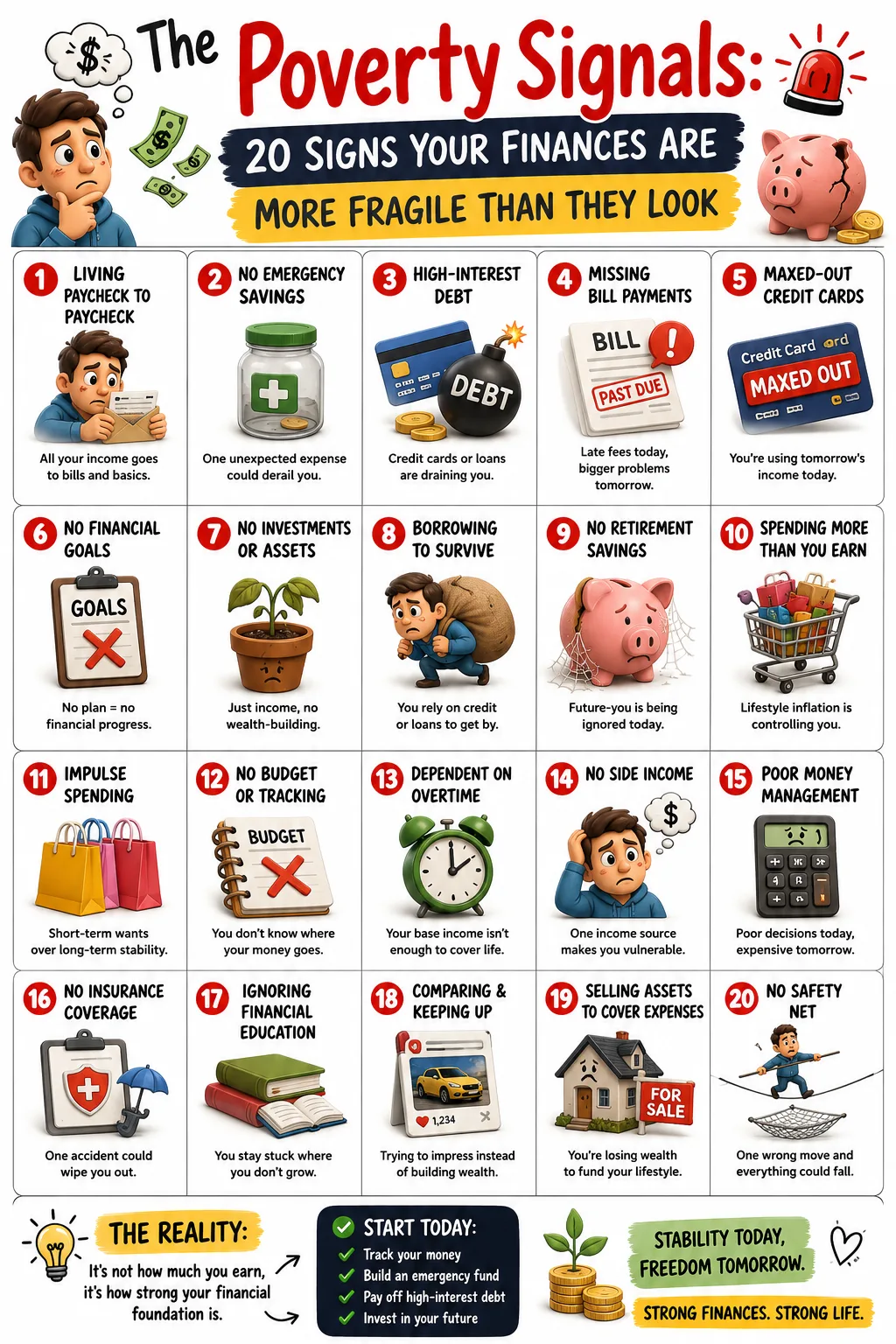
For beginners, the first step is usually not buying the most exotic asset. It is building financial stability. High-interest debt should be addressed. Emergency savings should be established. Spending should be controlled. Without a stable base, investing becomes fragile.
The next step is often broad ownership through retirement accounts, index funds, or diversified ETFs. These tools allow investors to begin compounding without needing to become experts in every company or asset class.
After that, investors can expand based on skill and interest. Someone interested in property can study local real estate markets, financing, rents, and maintenance costs. Someone with entrepreneurial ability can build a side business. Someone with expertise can create intellectual property. Someone with technical skills can build software or digital assets.
The best asset is often the one an investor can understand deeply enough to hold responsibly. A person who understands small businesses may have an edge acquiring one. A person who understands online audiences may build a digital asset. A person who understands public markets may focus on equities. Wealth grows when capital meets competence.
A practical asset-building sequence might look like this: eliminate destructive debt, build cash reserves, invest consistently in diversified funds, increase income through skills or business, acquire productive assets, reinvest cash flow, diversify across asset types, and protect the wealth that has been built.
There is no need to own all 15 assets. The goal is not collection. The goal is financial strength.
The Deeper Pattern Behind Riches
The assets making people rich are different on the surface. A share of stock looks nothing like a rental apartment. A patent looks nothing like farmland. A domain name looks nothing like a bond. A startup investment looks nothing like a dividend portfolio.
Yet the deeper pattern is consistent. Wealth comes from owning claims on future value.
A stock is a claim on future corporate profits. A rental property is a claim on future housing demand. A bond is a claim on future interest and principal payments. A business is a claim on future customer spending. Intellectual property is a claim on future royalties or sales. Farmland is a claim on future food production. A digital asset is a claim on future attention, traffic, or subscriptions.
The more durable, transferable, scalable, and cash-generating that claim is, the more powerful the asset tends to be.
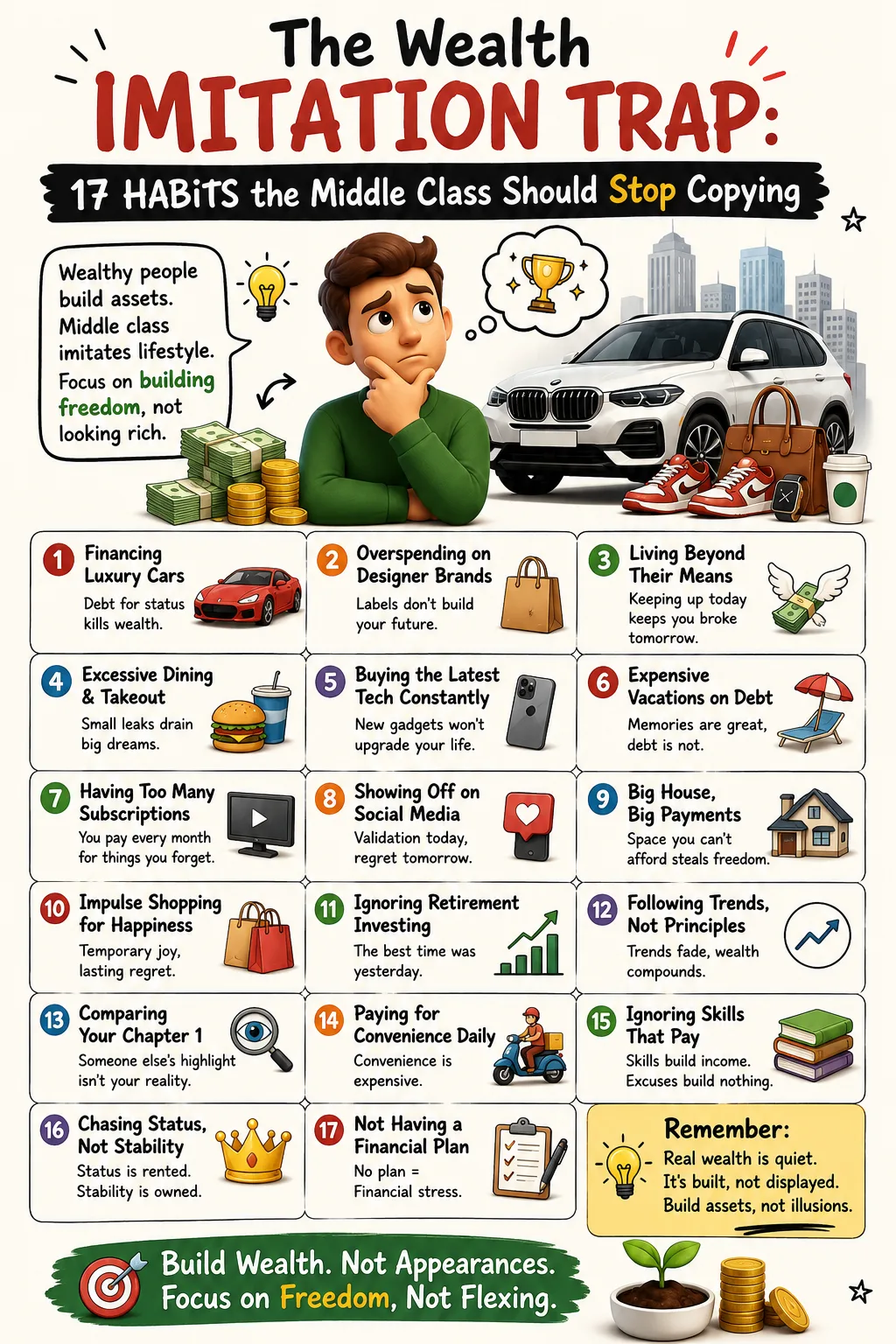
This is why ownership matters more than appearances. The person driving the expensive car may be wealthy, or they may simply have a large payment. The person quietly buying index funds, building a business, paying down rental debt, and creating intellectual property may look ordinary while constructing serious wealth.
Assets are financial seeds. Some grow slowly. Some fail. Some require constant tending. Some become trees that produce fruit for decades. The skill is learning which seeds are worth planting, how much capital to risk, how long to wait, and when to prune.
The rich are not rich because they know a secret list. They are rich because they understand the ownership game. They acquire productive assets. They avoid being forced sellers. They reinvest. They diversify. They protect downside. They allow time to work.
That is the asset ladder. It is not climbed in one leap. It is climbed one ownership decision at a time.
 Article
 Article
 Article
 Article
 Article
 Article
 Article
 Article