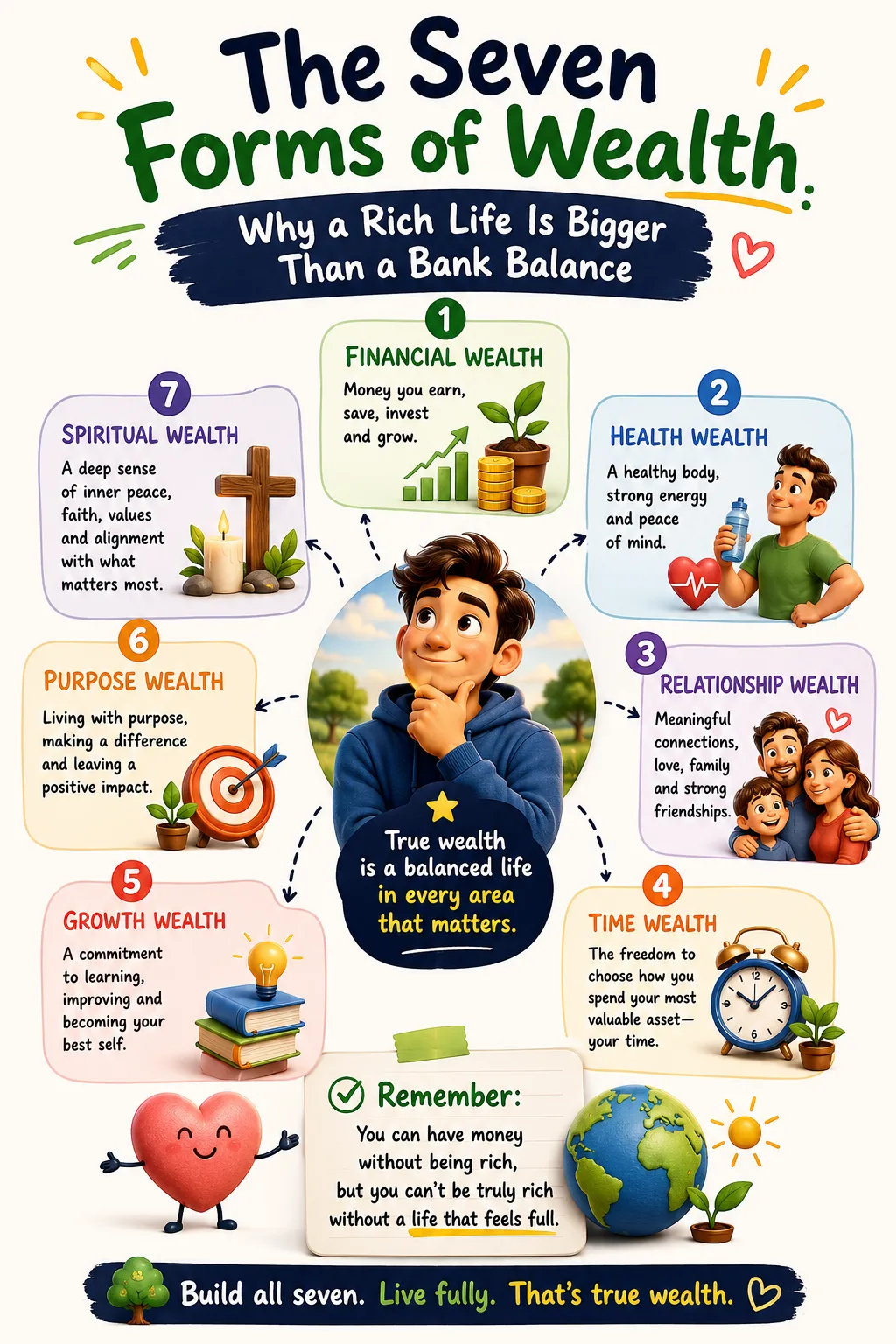
The Seven Forms of Wealth: Why a Rich Life Is Bigger Than a Bank Balance
Money is the easiest form of wealth to measure, which is why it often receives the most attention. You can count a bank balance. You can track investment returns. You can calculate net worth. You can compare salaries, property values, business profits, and retirement accounts. Financial wealth has numbers, statements, charts, and targets. It gives people a sense of progress because it can be quantified.
But a life can be financially rich and personally poor.
A person can have money and no health to enjoy it. They can have a large portfolio and no close relationships. They can have a respected title and no time of their own. They can have impressive assets and constant anxiety. They can have high income and no purpose beyond earning more. They can retire with enough money but no identity, curiosity, or emotional stability to make freedom meaningful.
This is the limitation of treating wealth as only a financial condition. Money matters deeply. It pays for shelter, healthcare, education, food, mobility, security, opportunity, and choice. It reduces many forms of stress. It protects families from preventable hardship. It allows people to plan instead of constantly react. Financial wealth is not shallow; it is foundational.
Yet money is not the whole architecture of a rich life. It is one pillar among several. True wealth is multidimensional. It includes financial security, supportive relationships, physical health, emotional resilience, intellectual growth, control over time, and a sense of purpose. These forms of wealth are connected. When one is neglected, the others often suffer. When they are cultivated together, life becomes not only more secure, but more livable.
This broader view of wealth is not an argument against ambition. It is an argument for wiser ambition. The goal is not to earn less, invest less, or become indifferent to financial progress. The goal is to build money in a way that supports the life you actually want, rather than sacrificing the entire life to grow the number.
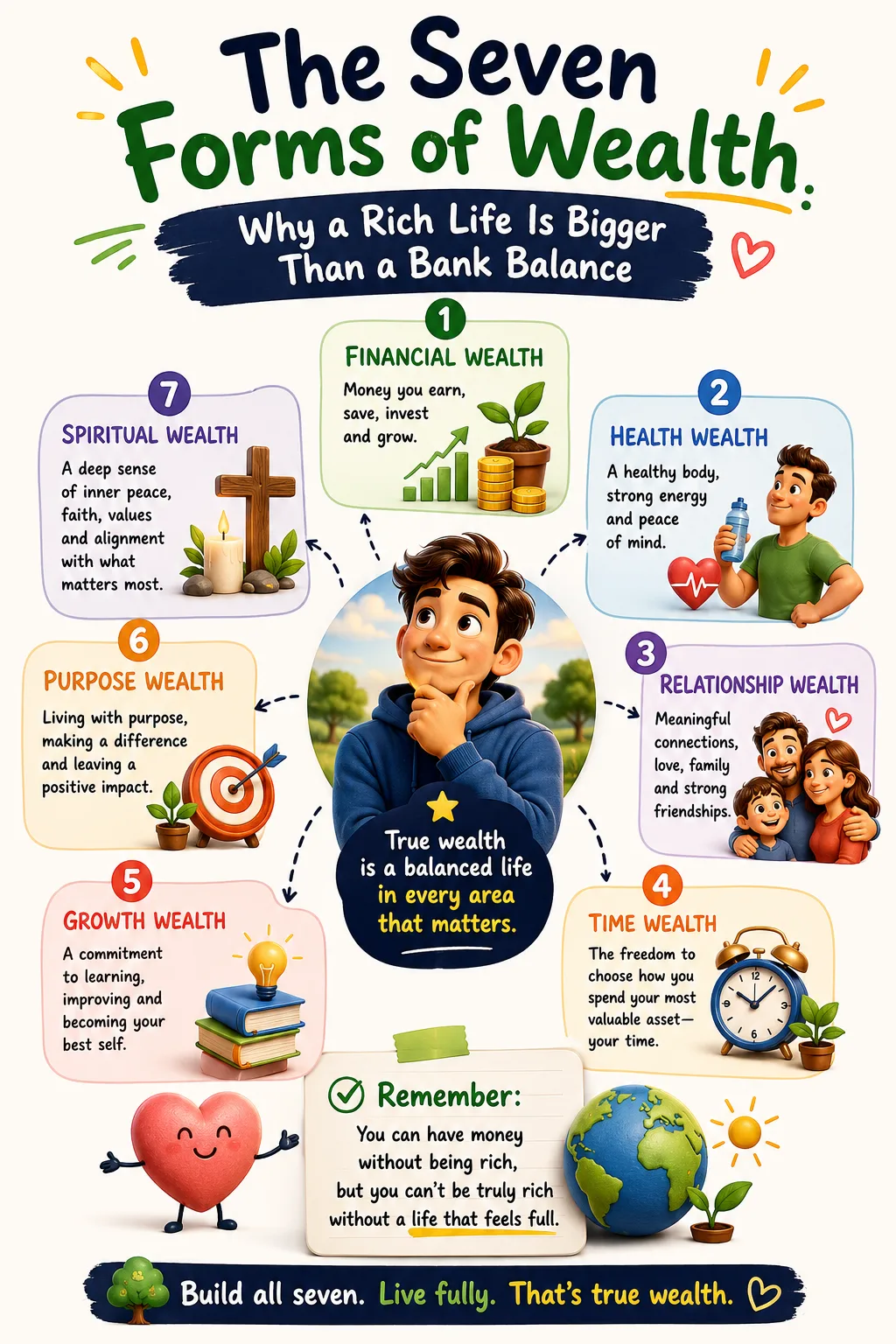
The seven forms of wealth are financial wealth, social wealth, physical wealth, emotional wealth, intellectual wealth, time wealth, and purpose wealth. Each one answers a different question. Can you meet your needs without being controlled by bills? Do you have relationships that nourish and support you? Does your body have the energy to carry your ambitions? Can your mind handle stress without breaking? Are you learning enough to remain capable and relevant? Do you have control over your schedule? Are your choices connected to values larger than consumption?
A truly wealthy life does not require perfection in all seven areas. Life is seasonal. At times, career demands may temporarily reduce time wealth. Health problems may challenge physical wealth. Family obligations may affect financial freedom. Emotional strain may require more attention than investing. But the framework matters because it prevents a dangerous mistake: winning in one dimension while quietly going bankrupt in another.
Financial Wealth: The Foundation of Practical Freedom
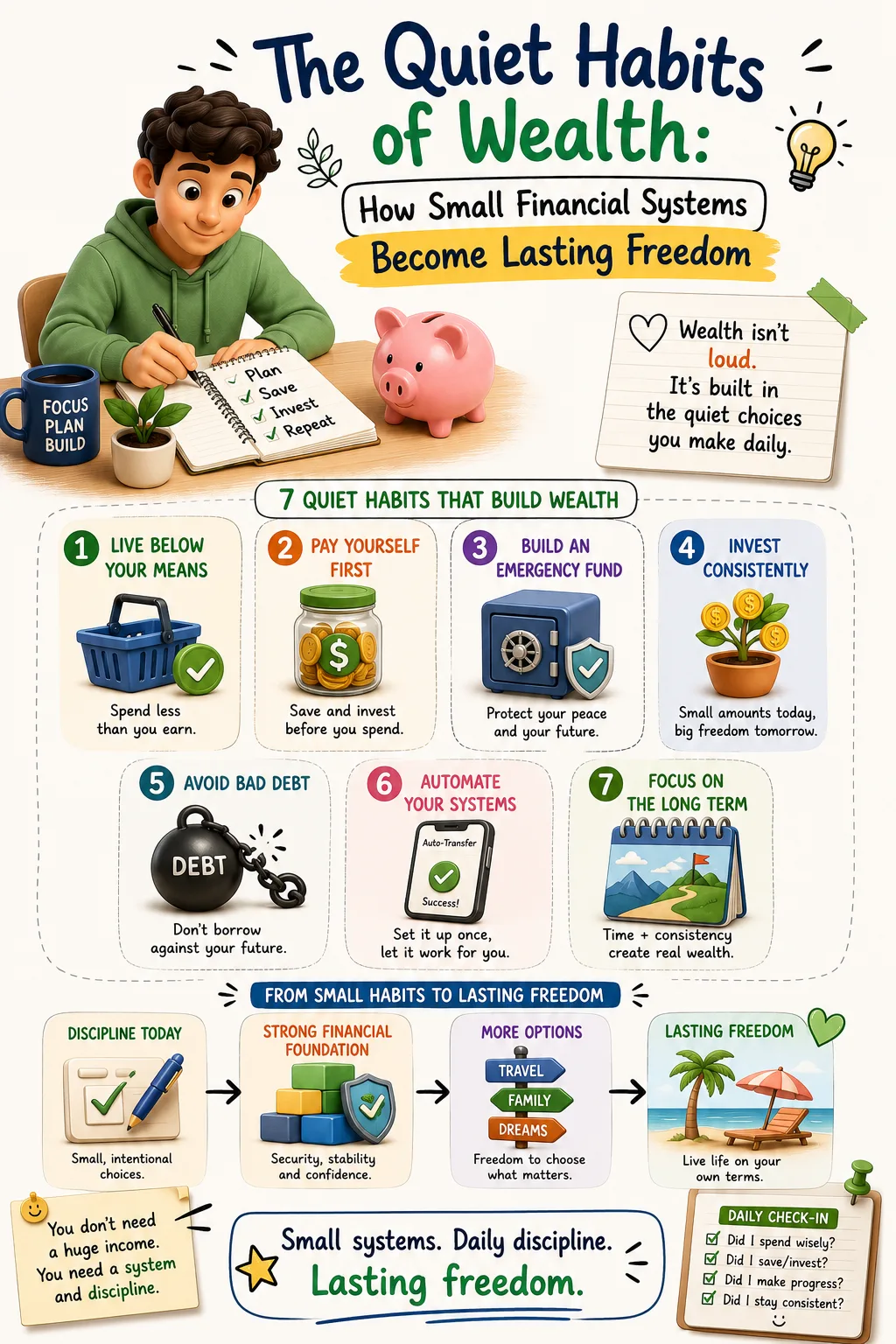
Financial wealth is the ability to fund your life without being constantly dictated by bills, debt, emergencies, or dependence on the next paycheck. It does not necessarily mean extreme luxury. It means having enough assets, income, savings, protection, and flexibility to make decisions from stability rather than panic.
At the most basic level, financial wealth begins with cash flow. You need enough income to cover essential expenses: housing, food, transport, utilities, healthcare, debt obligations, education, and family responsibilities. If expenses consistently exceed income, financial stress becomes unavoidable. Budgeting is not a cure for every income problem, but knowing where money goes is the first step toward control.
The next layer is emergency savings. A person with no emergency fund is financially exposed, even if they earn well. An unexpected medical bill, job loss, car repair, delayed payment, family crisis, or urgent travel need can force high-interest borrowing. Emergency savings create a buffer between life’s surprises and financial damage.
After stability comes debt management. High-interest debt is one of the strongest enemies of financial wealth because it turns future income into payment for past consumption. Credit cards, payday loans, expensive mobile loans, overdrafts, and consumer financing can quietly trap a household. Wealth grows more easily when income is not heavily claimed by lenders before it reaches the owner.
Then comes investing. Saving protects money; investing grows it. Long-term investments allow capital to participate in economic growth. Retirement accounts, pension plans, diversified funds, bonds, shares, real estate, and business ownership can all play a role depending on the person’s country, goals, risk tolerance, and knowledge. The purpose of investing is not to impress others with sophistication. It is to turn income into assets that can support future freedom.
The commonly discussed target of having retirement assets equal to 25 times annual expenses comes from the idea that a person may be able to withdraw roughly 4 percent of an investment portfolio per year in retirement. It is a useful planning shortcut, but it is not a universal law. Actual retirement needs depend on market returns, inflation, taxes, healthcare costs, life expectancy, spending flexibility, investment allocation, currency risk, and whether a person has other income sources such as pensions, rental income, business income, or government benefits.
Still, the 25-times-expenses concept teaches an important lesson: financial independence is driven not only by how much you earn, but by how much your life costs. Someone who needs 40,000 per year to live comfortably requires a smaller independence portfolio than someone who needs 150,000 per year. Lifestyle inflation raises the wealth target. Spending choices today shape freedom requirements tomorrow.
Financial wealth also includes protection. Insurance, estate planning, proper documentation, and risk management prevent one event from destroying years of progress. Health insurance, disability coverage, life insurance when dependents exist, property insurance, and liability protection can be as important as investments. A household that invests aggressively but ignores catastrophic risk may be building on a fragile foundation.
Financial wealth is not only about accumulation. It is about options. The option to leave a harmful job. The option to help family without collapsing. The option to handle emergencies calmly. The option to invest when opportunities appear. The option to rest. The option to choose meaningful work rather than any work. The option to say no.
But financial wealth has a trap: it can become endless. If the target keeps moving, no amount is enough. A person reaches one income level and immediately compares upward. They buy more, borrow more, desire more, and require more. The pursuit of money begins as a search for security and becomes a habit of permanent dissatisfaction.
The healthiest version of financial wealth asks, “How much is enough for the life I value?” That question does not eliminate ambition. It disciplines ambition. It connects money to purpose.
Social Wealth: The Relationship Ecosystem That Carries a Life
Social wealth is the quality of your relationships. It includes family bonds, friendships, marriage or partnership, community, professional networks, mentors, neighbors, and the people who would notice if you were struggling. It is the relationship ecosystem around your life.
This form of wealth is easy to underestimate because it does not appear on a balance sheet. Yet supportive relationships can be one of the strongest predictors of well-being. A person with trusted people around them has emotional support, practical help, perspective, accountability, companionship, and belonging. A person without meaningful relationships may have money and still feel poor in daily life.
Social wealth begins at home. Quality communication with the people closest to you is not a soft issue; it is a life infrastructure issue. Financial stress often enters relationships through silence, resentment, secrecy, or mismatched expectations. Partners may avoid discussing debt. Parents may not communicate limits with adult children. Siblings may make assumptions about support. Friends may create spending pressure. Without honest communication, money can damage even loving relationships.
Strong social wealth requires attention. Relationships do not stay healthy by accident. They need time, listening, forgiveness, presence, boundaries, and consistency. A person who sacrifices every relationship for career or income may later discover that success feels hollow without people to share it with.
Social wealth is not measured by the number of contacts in a phone or followers on a platform. It is measured by trust, depth, reliability, and mutual care. Ten thousand digital connections may not equal one friend who will sit with you during grief, challenge you when you are wrong, or help you think clearly when life becomes complicated.
Professional relationships also matter. Mentors, colleagues, clients, partners, and peers can shape earning potential, opportunities, reputation, and learning. Many career breakthroughs come through networks: someone recommends you, teaches you, introduces you, hires you, warns you, or opens a door. This does not mean relationships should be treated transactionally. The strongest networks are often built through genuine contribution before need.
Social wealth also includes boundaries. Some relationships are emotionally or financially draining. Generosity is valuable, but unlimited access to your time, money, and energy can erode your life. A financially responsible person may still become unstable if every request from family or friends becomes an obligation. Healthy social wealth is not people-pleasing. It is connection with wisdom.
One of the great mistakes of wealth building is assuming relationships can be repaired later. People may tell themselves they will focus on family after the business succeeds, after the promotion, after the house, after the investment milestone, after retirement. Sometimes that works. Often, distance grows quietly while ambition is busy.
Social wealth compounds like financial wealth. Small deposits matter: calls, meals, messages, honest conversations, shared rituals, showing up, remembering important events, apologizing quickly, celebrating others, listening without rushing to solve. These acts seem ordinary, but they create relational capital. When hardship comes, relational capital becomes visible.
A rich life needs people. Not endless people. Not perfect people. But real people. Social wealth reminds us that independence should not become isolation.
Physical Wealth: The Body That Allows You to Enjoy Success
Physical wealth is health, energy, mobility, strength, sleep, nutrition, and bodily resilience. It is the capacity to live inside your body without constant limitation. It is the ability to enjoy what you are building.
Money can buy healthcare, better food, safer housing, fitness support, and rest, but money cannot fully replace health once it has been severely damaged. A wealthy person with no energy, chronic pain, preventable illness, or stress-induced collapse may have achieved financial goals at a devastating cost.
Physical wealth supports every other form of wealth. Health affects earning capacity. It affects emotional regulation. It affects relationships. It affects time use. It affects intellectual performance. It affects retirement enjoyment. A strong body does not guarantee a good life, but a neglected body can make every part of life harder.
Modern work often encourages physical neglect. Many people sit for long hours, sleep too little, eat under stress, move rarely, and treat exhaustion as proof of dedication. Hustle culture can make burnout look honorable. But a career built by destroying health is not a strategy; it is a loan taken against the body. The repayment can be severe.
Physical wealth begins with basics: movement, sleep, nutrition, preventive care, hydration, sunlight, medical checkups, and reducing harmful habits. These are not glamorous, but they are powerful. Regular exercise does not only shape appearance; it supports cardiovascular health, strength, mood, energy, and long-term independence. Sleep is not laziness; it is recovery, memory, hormone regulation, and decision quality. Nutrition is not punishment; it is fuel.
Health also requires protection. Preventive care matters because small issues are easier to address before they become major ones. Insurance matters because medical costs can threaten financial stability. Rest matters because chronic stress has physical consequences. Safety matters because accidents can change a life instantly.
Physical wealth should be understood realistically. Not everyone has the same body, health history, disability status, medical access, or genetic risk. Some people face serious health challenges despite responsible habits. The point is not to moralize health or pretend every condition is controllable. The point is to protect the degree of health and energy available to you.
For ambitious people, physical wealth often requires saying no. No to constant late nights. No to endless work without movement. No to stress as a permanent identity. No to using food, alcohol, or stimulation as the only coping mechanisms. No to postponing every medical concern because work feels urgent.
One of the clearest signs of maturity is realizing that the body is not separate from success. It is the instrument through which success is experienced. Financial wealth can fund retirement, but physical wealth determines whether retirement can be enjoyed. Time wealth can create open days, but physical wealth determines whether you have the energy to use them. Social wealth can provide companionship, but physical wealth affects your ability to participate.
A body does not need to be perfect to be valuable. It needs care. Physical wealth is the daily practice of not sacrificing your future health for temporary productivity or appearance.
Emotional Wealth: The Capacity to Carry Success Without Being Crushed by Stress
Emotional wealth is mental health, self-awareness, resilience, emotional regulation, stress management, and inner stability. It is the ability to experience pressure without being permanently controlled by it. It is the ability to make decisions from clarity rather than fear, shame, envy, anger, or panic.
Financial success does not automatically create emotional wealth. In some cases, it exposes the absence of it. A person may earn more and become more anxious. They may accumulate assets and still fear losing everything. They may achieve status and become trapped by comparison. They may build a business and become unable to rest. They may receive praise and still feel inadequate.
Emotional wealth matters because money decisions are emotional decisions. Spending can be driven by insecurity. Debt can be driven by shame or the desire to appear successful. Investing can be distorted by fear and greed. Career choices can be shaped by approval-seeking. Family support can be complicated by guilt. Retirement can be delayed by identity fears. A person who does not understand their emotions may repeatedly sabotage their finances while believing the problem is purely mathematical.
Stress management is central to emotional wealth. Stress cannot be eliminated, but it must be managed. Chronic stress reduces decision quality. It narrows attention. It makes short-term relief more attractive. It can damage sleep, health, relationships, and work performance. A person under constant pressure may know the right financial decision and still choose the emotionally soothing one.
Work-life balance is not about equal hours in every area of life. It is about sustainability. There are seasons when work demands more. There are seasons when family, health, or recovery must take priority. Emotional wealth requires the honesty to recognize when a season has become a permanent imbalance.
Emotional wealth includes the ability to sit with discomfort. Saving money requires tolerating the discomfort of not buying everything now. Investing requires tolerating market volatility. Debt repayment requires facing past decisions. Career growth requires rejection and uncertainty. Relationships require difficult conversations. Purpose requires confronting whether your life matches your values. Without emotional resilience, wealth-building habits become fragile.
There is also an emotional danger in financial comparison. Seeing other people’s houses, cars, holidays, careers, weddings, businesses, or investment wins can create a sense of falling behind. Social media intensifies this because it displays outcomes without context. You see the purchase, not the debt. The vacation, not the stress. The promotion, not the sacrifice. The success, not the family support behind it. Emotional wealth protects you from letting someone else’s visible life set your financial agenda.
Building emotional wealth may include therapy, journaling, prayer, meditation, exercise, honest friendships, rest, boundaries, financial education, and learning to name feelings accurately. It may include healing from past scarcity, family money trauma, business failure, divorce, unemployment, debt shame, or childhood instability.
Emotional wealth does not mean constant happiness. It means emotional capacity. It means being able to feel fear without obeying it automatically. It means being able to feel desire without spending impulsively. It means being able to feel failure without making it your identity. It means being able to feel success without becoming arrogant or reckless.
A person with emotional wealth can build financial wealth more wisely because they are less likely to be ruled by panic, ego, or comparison. They can also enjoy financial wealth more fully because peace is not postponed until the next milestone.
Intellectual Wealth: The Skills and Knowledge That Keep You Relevant
Intellectual wealth is knowledge, skill, curiosity, judgment, creativity, and the ability to learn. It is one of the most important forms of wealth in a changing economy because earning power increasingly depends on adaptability.
A person’s financial life is shaped by what they know and what they can do. Skills influence income. Knowledge improves decisions. Curiosity reveals opportunities. Judgment helps avoid traps. Intellectual stagnation can quietly become financial risk.
In the past, some people could rely on one qualification, one employer, or one trade for an entire career. That still happens in some cases, but it is less guaranteed. Technology changes industries. Automation reshapes tasks. Consumer behavior shifts. Regulations evolve. Markets globalize. Skills that once commanded strong income can become less valuable. New skills can become highly rewarded.
Intellectual wealth allows a person to remain useful. It does not require chasing every trend. It requires disciplined learning. What problems are becoming more valuable in your field? What tools are becoming standard? What knowledge separates top earners from average earners? What skills are transferable if your industry changes? What financial concepts do you need to understand to protect what you earn?
Financial literacy is a core part of intellectual wealth. Understanding budgeting, interest, inflation, compounding, debt, investing, taxes, insurance, retirement planning, and risk management improves life outcomes. A person who earns well but lacks financial knowledge may still make expensive mistakes. They may buy unsuitable products, carry costly debt, underinsure risks, overpay fees, fall for scams, or delay investing for decades.
Intellectual wealth also includes career capital. This is the accumulation of skills, reputation, experience, and relationships that make your work more valuable. Career capital can produce promotions, business opportunities, consulting income, leadership roles, or entrepreneurial success. It is often built quietly through deliberate practice, reliability, feedback, and solving harder problems over time.
One of the best investments early in life is learning how to learn. Specific tools will change. Industries will change. But the person who can study, practice, adapt, and improve has a durable advantage. They are not limited to one version of themselves.
Intellectual wealth should not be confused with credentials alone. Degrees and certificates can matter, but knowledge that cannot be applied has limited value. The market rewards useful capability. A certificate may open a door, but competence keeps it open. Reading books, taking courses, attending seminars, and consuming educational content are helpful only when they change behavior and skill.
There is also a humility component. People with intellectual wealth know that they do not know everything. This makes them better investors, leaders, professionals, and decision-makers. Overconfidence is expensive. It causes people to underestimate risk, ignore experts, dismiss feedback, and repeat mistakes. Curiosity protects against arrogance.
Intellectual wealth compounds. The more you learn, the easier it becomes to connect ideas. Financial knowledge improves investing. Business knowledge improves income. Communication skills improve relationships. Health knowledge improves physical wealth. Emotional intelligence improves leadership. Time management improves productivity. Purpose clarifies what is worth learning.
A rich life requires a growing mind. Not because learning is fashionable, but because the world keeps changing and your future self depends on your ability to change with it.
Time Wealth: Control Over the One Asset That Cannot Be Replenished
Time wealth is control over your schedule, attention, and life rhythm. It is the ability to choose meaningful activities instead of having every hour dictated by survival, debt, work demands, commuting, disorganization, or other people’s priorities.
Time is the most democratic and unequal asset at the same time. Everyone experiences the same twenty-four-hour day, but not everyone controls those hours. A single parent working multiple jobs has less discretionary time than a financially independent investor. A high-income executive may earn more money but have less time autonomy than a modest earner with flexible work and low expenses. A person in debt may technically have free time but spend it under mental pressure.
Time wealth is one of the reasons financial wealth matters. Money can buy back time by reducing dependence on unwanted work, outsourcing certain tasks, living closer to work, accessing healthcare faster, creating retirement options, or allowing career flexibility. But money does not automatically create time wealth. Many high earners are time poor. Their lifestyles, obligations, ambitions, and identities keep them permanently busy.
Time wealth begins with awareness. Where does your time go? Which activities create value? Which are maintenance? Which are distraction? Which are obligations? Which are chosen? Many people track money but never track time, even though time is the resource that makes earning, relationships, health, learning, and purpose possible.
Work is often the largest claim on time. This does not make work bad. Meaningful work can provide income, identity, contribution, community, and growth. The problem is when work consumes so much time and energy that every other form of wealth deteriorates. If financial progress requires permanent exhaustion, the strategy may need reconsideration.
Time wealth also requires boundaries. Without boundaries, other people’s urgency becomes your schedule. Messages, meetings, requests, social obligations, family demands, and digital distractions can fragment attention. A person may be busy all day and still feel that no meaningful work or rest occurred.
Technology complicates time wealth. Devices create convenience, but they also create constant access. Work can follow people home. Social media can absorb hours. Entertainment can remove boredom but also reduce reflection. The issue is not technology itself; it is whether attention is being directed or harvested.
Financial decisions affect time wealth in powerful ways. A larger mortgage may require more years of work. A car loan may require overtime. Lifestyle inflation may reduce the option to take a lower-paying but healthier job. High fixed expenses can trap time because the income required to support them must continue. The true cost of a purchase is not only money. It is the time required to earn that money and the freedom surrendered to maintain the obligation.
Time wealth does not mean doing nothing. For many people, the goal is not endless leisure but meaningful control. Time to raise children. Time to care for health. Time to build a business. Time to study. Time to rest. Time to serve. Time to travel slowly. Time to think. Time to be present with people who matter.
Retirement is often imagined as the ultimate time wealth, but waiting until old age to experience any control over time is risky. Health may change. Relationships may change. Desires may change. A wiser approach is to build pockets of time wealth throughout life: protected evenings, rest days, sabbaticals if possible, flexible work, simplified expenses, deep work blocks, family rituals, and intentional use of leave.
Time wealth asks a hard question: are you building a life you only hope to enjoy later, or one that contains some freedom now?
Purpose Wealth: Living in Alignment With Values
The seventh form of wealth is often described as spiritual wealth or purpose wealth. It is the sense that your life is connected to meaning beyond money, status, and consumption. For some people, this is rooted in religious faith. For others, it is rooted in values, service, family, creativity, community, nature, justice, craftsmanship, learning, or contribution.
Purpose wealth is not about having a perfect life mission statement. It is about alignment. Do your daily choices reflect what you say matters? Does your work connect to something you respect? Does your spending support your values? Are your ambitions serving your life, or has your life become a servant of ambition?
Without purpose, financial success can become disorienting. A person may reach income goals and feel empty. They may achieve the title and wonder why it does not satisfy. They may buy the house, car, watch, or holiday and quickly need another symbol. They may become rich in options but poor in direction.
Purpose gives money a job. It clarifies why you want wealth. Security for your family. Freedom to choose your work. Education for your children. Care for aging parents. Support for causes you value. Time for creativity. The ability to build something useful. The ability to live with dignity. The ability to give. The ability to stop making decisions from fear.
Purpose wealth also protects against destructive comparison. If you know what matters to you, another person’s lifestyle becomes less threatening. Their luxury purchase does not automatically become your goal. Their career path does not automatically become your standard. Their timeline does not automatically define your failure. Purpose creates internal measurement.
This does not mean purpose eliminates ambition. It refines ambition. A person with purpose may work very hard, build significant wealth, and pursue excellence. The difference is that the pursuit is connected to meaning rather than endless validation.
Purpose wealth often grows through reflection, service, faith practices, solitude, journaling, meaningful conversation, creative work, community involvement, and honest assessment of mortality. The awareness that life is finite can sharpen priorities. Many people do not regret failing to buy more things. They regret neglecting relationships, health, courage, contribution, and time.
Purpose can also influence financial planning directly. A person who values family may prioritize life insurance, education savings, and flexible work. A person who values service may build giving into the budget. A person who values independence may keep expenses low and invest aggressively. A person who values creativity may design a financial runway to support artistic work. A person who values community may choose housing, work, or business decisions differently.
Purpose wealth should not become another pressure to perform. Not everyone wakes up with a grand calling. Sometimes purpose is found through responsibility: caring for children, doing honest work, supporting family, improving a community, mastering a craft, or becoming reliable. Purpose is often discovered by living attentively, not by waiting for a dramatic revelation.
A life without purpose may still be comfortable, but comfort alone is not the same as meaning. Purpose wealth is the dimension that asks what all the other wealth is for.
How the Seven Forms of Wealth Reinforce One Another
The seven forms of wealth are not isolated. They constantly interact.
Financial wealth can support physical wealth by paying for healthcare, nutritious food, safer housing, and time to exercise. Physical wealth can support financial wealth by improving energy, productivity, and career longevity. Emotional wealth can support investing by reducing panic and impulsive decisions. Intellectual wealth can support income growth by increasing skills. Social wealth can support emotional health and create opportunity. Time wealth can support relationships, learning, health, and purpose. Purpose wealth can guide financial decisions and reduce wasteful comparison.
The reverse is also true. Financial stress can damage emotional health and relationships. Poor health can reduce income and consume savings. Weak relationships can increase loneliness and stress. Lack of time can prevent exercise, learning, and family connection. Low emotional resilience can lead to overspending, avoidance, or poor risk decisions. Lack of purpose can turn money into an endless scoreboard.
This is why a one-dimensional wealth strategy is dangerous. A person who maximizes money while ignoring health may eventually spend wealth trying to recover what was sacrificed. A person who prioritizes relationships but ignores money may create preventable stress for the same people they love. A person who seeks purpose but neglects skill may struggle to fund that purpose. A person who protects time but ignores financial stability may lack resilience.
The goal is not equal attention to every dimension every day. The goal is periodic balance. Ask which form of wealth is currently underfunded. Are you financially progressing but physically exhausted? Socially connected but financially disorganized? Intellectually growing but emotionally strained? Purpose-driven but time poor? Time-rich but lacking direction?
This framework turns wealth into a life audit, not just a financial audit.
The Danger of Over-Optimizing Financial Wealth
Financial discipline is valuable, but it can become extreme. Some people become so focused on saving, investing, and reaching independence that they delay living indefinitely. They avoid every pleasure, underinvest in health, neglect friendships, refuse meaningful experiences, and measure every decision only by its impact on net worth.
This is not wealth. It is fear wearing the mask of discipline.
Money should create life options, not eliminate life itself. The purpose of financial wealth is not to die with the highest possible account balance. It is to support security, freedom, contribution, and dignity while life is still being lived.
There is wisdom in delayed gratification. There is also danger in permanent postponement. A person should save for the future, but not assume the future is guaranteed. A person should invest, but not refuse every meaningful present experience. A person should plan retirement, but not sacrifice every relationship along the way.
The right balance depends on income, obligations, age, health, and goals. But the question is universal: is your financial plan helping you live well, or has living well been postponed until a number is reached?
The Danger of Ignoring Financial Wealth
The opposite mistake is using multidimensional wealth as an excuse to ignore money. Some people say relationships, health, time, or purpose matter more than money, which can be true, but then neglect budgeting, saving, debt, insurance, and retirement planning. That neglect eventually threatens the very things they value.
Financial instability can strain relationships. It can limit healthcare. It can consume time through overwork. It can create emotional stress. It can reduce the ability to pursue purpose. Money is not everything, but lack of money can affect almost everything.
A mature view does not worship money or dismiss it. It gives money its proper role: a tool of security and choice. Financial wealth supports the other forms of wealth when managed wisely. It should neither dominate life nor be ignored.
Building Financial Wealth Without Losing the Other Six
The practical challenge is learning how to build financial wealth while protecting social, physical, emotional, intellectual, time, and purpose wealth.
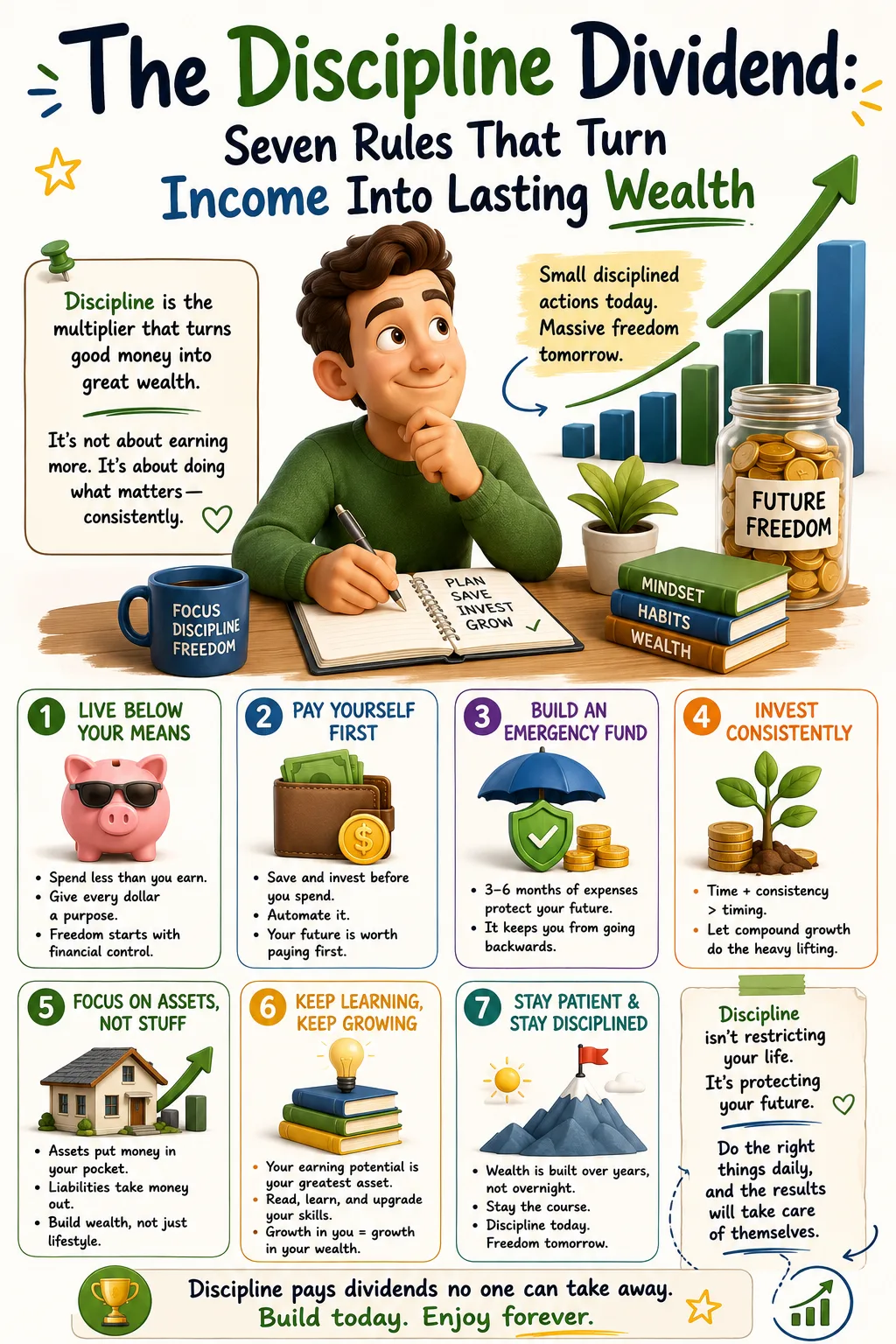
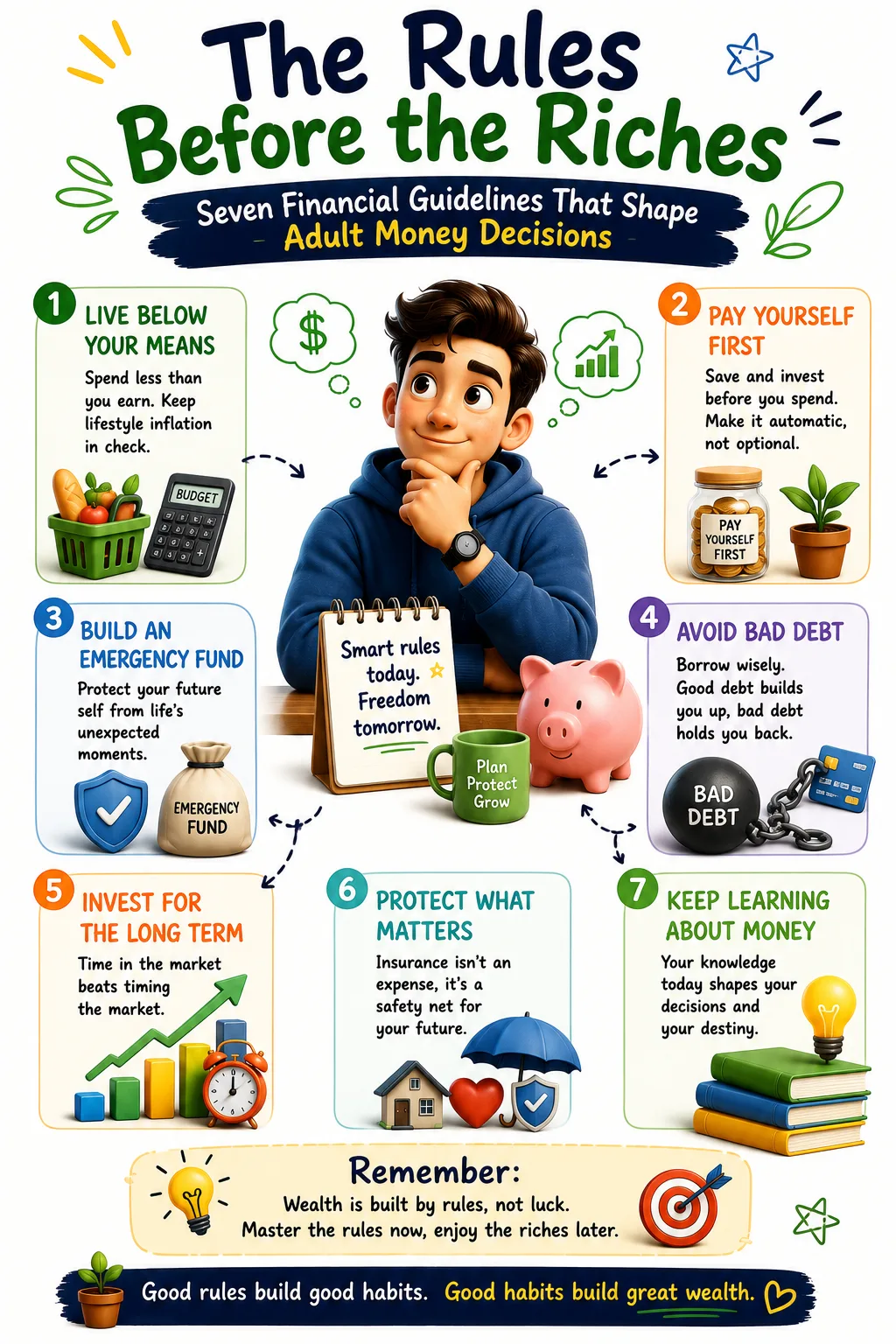
Start by defining enough. This does not mean limiting ambition. It means understanding what financial security looks like for your actual life. What are your essential expenses? How much emergency savings would give you breathing room? What debt must be eliminated? What retirement target is reasonable? What lifestyle is meaningful rather than performative?
Then automate financial progress. Saving and investing should not depend entirely on monthly motivation. Automatic transfers, retirement contributions, debt repayment schedules, and sinking funds make progress more consistent.
Protect health as a financial asset. Schedule exercise, sleep, medical checkups, and rest with the seriousness you give work meetings. The body is not an obstacle to productivity. It is the condition for it.
Protect relationships with time and attention. Put important people on the calendar before life fills every space with work. Communicate about money. Set boundaries. Practice presence.
Build emotional resilience. Notice the feelings behind spending, borrowing, investing, and working. Learn whether fear, shame, comparison, or insecurity are driving decisions. Seek support when needed.
Keep learning. Invest in skills that increase earning power and adaptability. Learn financial principles slowly and consistently. Intellectual wealth makes financial wealth more likely and less fragile.
Buy time intentionally. Avoid lifestyle choices that permanently consume freedom. Be cautious with debt and fixed expenses. Use money to remove low-value burdens where appropriate, but do not outsource meaning or responsibility.
Connect money to purpose. Give every major financial goal a reason. Retirement is not just a number; it is time sovereignty. Debt freedom is not just math; it is peace. Investing is not just return; it is future choice. Earning more is not just status; it is capacity.
A Personal Audit of the Seven Forms of Wealth
To use this framework, examine each category honestly.
Financial wealth: Do you know your income, expenses, debts, assets, and net worth? Do you have emergency savings? Are you investing for the future? Are your bills controlling every decision? Do you have a plan for retirement or financial independence?
Social wealth: Who are your closest relationships? Are they healthy? Do you communicate well at home? Are you investing time in people who matter? Are there relationships that need boundaries or repair?
Physical wealth: How is your energy? Are you sleeping enough? Are you moving regularly? Are you eating in a way that supports your life? Are you ignoring medical concerns? Is your work pattern sustainable for your body?
Emotional wealth: How do you handle stress? Are money decisions driven by fear, comparison, guilt, or avoidance? Do you have practices or support systems that help you regulate emotions? Are you able to rest without guilt?
Intellectual wealth: What are you learning? Are your skills becoming more valuable or less relevant? Do you understand the financial decisions you are making? Are you curious, adaptable, and willing to receive feedback?
Time wealth: How much of your schedule do you control? Are your expenses forcing you to trade more time than you want? Do you have time for health, relationships, learning, rest, and meaningful work? Are you busy by choice or by default?
Purpose wealth: What is your money for? What values guide your decisions? Are you living in alignment with those values? If your income doubled, would your life become more meaningful or merely more expensive?
This audit may reveal imbalance. That is not failure. It is information. The purpose is to identify the next area that needs attention.
Wealth Across Different Life Stages
The seven forms of wealth look different at different stages of life.
In early adulthood, financial wealth may be small, but intellectual wealth and earning potential can be developed aggressively. This is a powerful time to build skills, avoid destructive debt, establish saving habits, invest early, and form healthy relationship and health patterns. Time may feel abundant in some ways and constrained in others, especially for those working demanding jobs or supporting family.
In midlife, financial responsibilities often increase. Housing, children, aging parents, career pressure, business obligations, and retirement planning may all compete. This stage can challenge time, emotional, and physical wealth. The danger is becoming financially productive but personally depleted. Intentional boundaries become essential.
Near retirement, time wealth may become more visible, but physical and social wealth become especially important. A person who retires with money but no health, friendships, interests, or purpose may struggle. Retirement planning should include not only portfolio withdrawal rates but also identity, community, health, and meaningful activity.
In later life, purpose, relationships, health, and time often become more central. Financial security remains important, but the meaning of wealth may shift toward dignity, legacy, family, contribution, and peace.
No stage is purely financial. Every stage requires a mix.
When One Form of Wealth Must Temporarily Take Priority
Balance does not mean every form of wealth receives equal attention at every moment. Sometimes one area must take priority.
If debt is overwhelming, financial wealth may need urgent focus. If health is failing, physical wealth must move to the center. If a marriage or family relationship is breaking, social wealth requires attention. If burnout is severe, emotional and time wealth may become non-negotiable. If a career is becoming obsolete, intellectual wealth may need investment. If life feels hollow despite success, purpose wealth may require reflection.
The key is to recognize temporary priority without permanent neglect. A demanding work season may be acceptable. A demanding work decade that destroys health and family may not be. A period of aggressive saving may be wise. A lifetime of joyless hoarding may not be. A season of caregiving may reduce income. A plan may be needed to rebuild financial stability afterward.
Wealth is dynamic. It requires adjustment.
The Corrected Seven Types of Wealth
A clearer version of the seven types of wealth would list them this way: financial wealth, social wealth, physical wealth, emotional wealth, intellectual wealth, time wealth, and purpose or spiritual wealth.
Financial wealth provides security and choice. Social wealth provides belonging and support. Physical wealth provides energy and capacity. Emotional wealth provides resilience and peace. Intellectual wealth provides adaptability and earning power. Time wealth provides freedom of schedule and attention. Purpose wealth provides meaning and direction.
This corrected framework avoids the labeling mistake of repeating intellectual or time wealth and recognizes that the seventh category is not another form of schedule control. It is the deeper question of values, inner peace, and life purpose.
Some categories overlap, and that is not a weakness. Human life is not divided into clean departments. Emotional and purpose wealth influence each other. Physical and emotional wealth are connected. Financial and time wealth often reinforce each other. Intellectual wealth can increase financial wealth. Social wealth can improve emotional resilience. Overlap reflects reality.
What a Truly Wealthy Life Looks Like
A truly wealthy life is not necessarily the loudest life. It may not be the life with the largest house, most expensive car, most impressive title, or most visible luxury. It is a life with enough financial stability to reduce fear, enough health to participate fully, enough relationships to feel connected, enough emotional resilience to handle difficulty, enough knowledge to keep growing, enough time to choose meaningfully, and enough purpose to know why any of it matters.
That kind of wealth can look different for different people. For one person, it may mean a paid-off home, close family, good health, modest investments, and community service. For another, it may mean a thriving business, flexible schedule, strong marriage, disciplined fitness, and generous giving. For another, it may mean financial independence, travel, lifelong learning, and creative work. There is no single image.
The common thread is alignment. Money supports values. Work supports life rather than consuming it entirely. Health is protected. Relationships are nourished. Learning continues. Time is not completely surrendered. Purpose gives direction.
This is why the broad view of wealth is so valuable. It reminds us that the bank account is important, but it is not the whole story. It is possible to be rich in cash and poor in peace. It is possible to be wealthy in relationships and still need better financial discipline. It is possible to have time but lack purpose. It is possible to have knowledge but neglect health. The work of a rich life is to build across dimensions.
The Final Measure
At some point, every wealth strategy must answer a simple question: what is the money for?
If the answer is only more money, the target may never stop moving. If the answer is security, freedom, health, family, learning, contribution, time, and purpose, then money becomes a servant rather than a master.
Financial wealth remains essential. Bills are real. Retirement requires planning. Emergencies require cash. Investments matter. Debt must be managed. A person who ignores money may place every other form of wealth under pressure.
But money is not enough. A complete life also requires people, health, emotional strength, knowledge, time, and meaning. These are not luxuries to consider after becoming rich. They are part of wealth itself.
The wisest financial plan is therefore not only a plan to accumulate. It is a plan to live. Build the emergency fund. Invest for the future. Reduce debt. Grow income. Protect your health. Call the people who matter. Learn continuously. Guard your time. Ask what your life is serving. Align your spending with your values. Let wealth become wider than money.
A bank balance can tell you what you own. It cannot tell you whether your life is rich. The seven forms of wealth help answer the larger question.
 Article
 Article
 Article
 Article
 Article
 Article
 Article
 Article