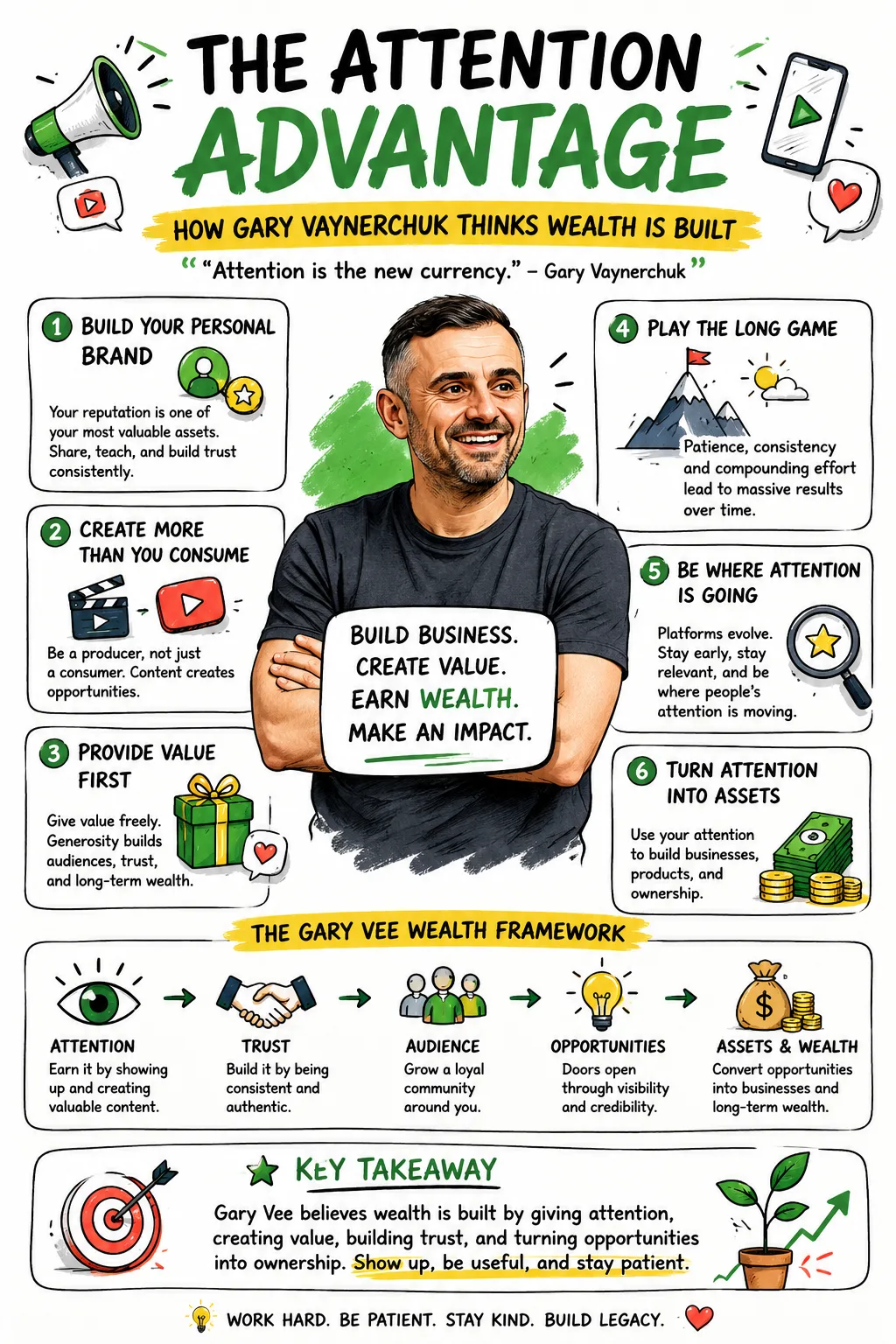
The Attention Advantage: How Gary Vaynerchuk Thinks Wealth Is Built
Gary Vaynerchuk’s philosophy of wealth begins with a simple observation: before money moves, attention moves.
People buy from businesses they notice. They trust people they have heard from repeatedly. They take meetings with names they recognize. They invest in founders who can communicate. They promote employees who create visible value. They follow brands that understand culture before culture becomes obvious.
For Vaynerchuk, wealth is not built only inside spreadsheets, investment accounts, or boardrooms. It is built in the marketplace of attention, where reputation, communication, timing, trust, and execution determine who gets the opportunity before anyone else sees it clearly.
This is why his message feels different from traditional personal finance advice. He does not primarily tell people to clip coupons, optimize retirement accounts, or study asset allocation. He talks about building businesses, creating content, developing a personal brand, caring about customers, working intensely when the opportunity is young, and being patient enough to let reputation compound.
His philosophy is entrepreneurial rather than purely investment-driven. He believes that people can create wealth by using modern media to build leverage around their skills, products, ideas, and judgment. A person who understands attention can reach customers without gatekeepers. A person who builds trust can convert an audience into opportunity. A person who executes consistently can learn faster than someone waiting for perfect conditions.
That philosophy reflects Vaynerchuk’s own story. He helped expand his family’s wine business by using e-commerce and online video before digital marketing became mainstream. He later co-founded VaynerMedia, built a large public personal brand, wrote business books, invested early in major technology companies, and became one of the most recognizable voices in entrepreneurship and social media marketing.
But his ideas should not be reduced to motivational clips or slogans. Beneath the intensity is a coherent wealth framework: create more than you consume, document what you know, build trust at scale, understand where attention is underpriced, serve customers deeply, reinvest in long-term assets, and remain patient while moving quickly every day.
There are risks. Building an audience does not guarantee income. Content creation is crowded and exhausting. Emerging assets can become speculative bubbles. Not everyone wants to become a public personality. Hard work can become unhealthy if it is confused with endless self-sacrifice.
Yet Vaynerchuk’s core insight remains important: in a digital economy, reputation can become capital. A trusted name can lower customer acquisition costs, open doors, attract partnerships, support pricing power, and create opportunities that do not appear on a traditional balance sheet.
To understand how to get rich according to Gary Vaynerchuk, the starting point is not money. It is value. Create value publicly. Earn attention ethically. Build trust patiently. Convert that trust into businesses, partnerships, investments, and ownership.
Wealth Begins With Creating Value
Vaynerchuk’s wealth philosophy is built on the belief that money follows value. The person who solves problems, teaches useful ideas, entertains an audience, improves a customer’s life, or helps a company grow is creating economic value. Wealth becomes possible when that value is captured through ownership, pricing, equity, brand equity, or long-term opportunity.
This is different from chasing money directly. Many people begin with the question, “How can I make more money?” Vaynerchuk’s framework asks a deeper question: “What value can I create that the market will reward?”
The distinction matters. A person chasing money may jump from trend to trend, copying whatever appears profitable. A person creating value studies the customer, the audience, the problem, and the gap between what people need and what the market currently offers. That person may still pursue profit aggressively, but profit becomes the result of usefulness rather than the substitute for it.
In practical terms, this means building skills that others value. Communication, sales, marketing, product development, leadership, storytelling, emotional intelligence, distribution, and customer service all become wealth skills. They allow a person to move ideas through the world. They help turn expertise into income.
Vaynerchuk often emphasizes that the modern economy rewards people who can communicate consistently and authentically. A chef can build a food brand. A mechanic can teach car maintenance. A financial educator can explain investing. A real estate agent can document local market knowledge. A lawyer can answer common legal questions in a compliant and educational way. A fitness coach can build trust by showing process, results, and philosophy.
The opportunity is not limited to influencers. It belongs to anyone who understands that expertise hidden from the market has less economic power than expertise made visible.
This is one of Vaynerchuk’s most important ideas: the internet allows people to make their competence discoverable. In the past, many professionals depended on local reputation, referrals, advertising budgets, or institutional gatekeepers. Today, a person can publish insight at almost no distribution cost. A single useful post can reach a potential customer, employer, investor, partner, or collaborator.
That does not mean everyone will become famous. Fame is not the goal. Relevance is the goal. A small but trusted audience in a profitable niche can be more valuable than a large audience with weak intent. A consultant with 5,000 followers in a specialized industry may build a strong business. A local contractor with helpful videos may become the obvious choice in a city. A recruiter who consistently shares thoughtful hiring advice may attract better clients.
Wealth, in this model, begins when value becomes visible and trust begins to compound.
The Personal Brand as a Modern Business Asset
Vaynerchuk is one of the strongest advocates of personal branding in modern business. To him, a personal brand is not a logo, slogan, or polished biography. It is the market’s accumulated perception of who you are, what you know, what you stand for, and whether you can be trusted.
This makes personal brand an asset, though not a traditional one. It may not appear on a personal balance sheet. It may not be easy to value. But it can create real economic outcomes. It can attract clients, increase career options, support business launches, reduce marketing costs, and create opportunities before a person asks for them.
A strong personal brand is built through repeated signals. What do you talk about? How do you treat people? Do you share useful knowledge? Do you follow through? Are you consistent? Are you generous with insight? Do people associate your name with competence, honesty, creativity, discipline, or taste?
Vaynerchuk’s view is that everyone already has a personal brand because everyone already has a reputation. The only question is whether that reputation is being shaped intentionally or passively.
For employees, personal brand can create career leverage. A professional who publishes thoughtful analysis in their field may become known beyond their immediate workplace. That visibility can attract recruiters, speaking invitations, consulting opportunities, or internal influence. A person does not need millions of followers to benefit. They need the right people to understand their value.
For entrepreneurs, personal brand can reduce friction. Customers are more likely to buy from people they trust. Investors are more likely to listen to founders who demonstrate insight. Potential employees may join companies led by people with visible conviction and credibility. Partnerships often begin when one person has been paying attention to another person’s work for years.
For investors, brand can become deal flow. A person known for understanding a niche may see opportunities earlier. Founders may bring them deals. Operators may share information. Communities may provide insight. Reputation can become a magnet for information and access.
The mistake is thinking personal branding means self-promotion without substance. Vaynerchuk’s stronger argument is that content should reveal value, not manufacture a false image. A personal brand built on exaggeration may create attention briefly, but weak trust eventually becomes expensive.
The best personal brands are grounded in truth. They show what a person knows, how they think, what they are learning, where they have experience, and how they help others. They do not require perfection. In fact, Vaynerchuk often encourages people to document the process rather than pretend to have all the answers.
That idea matters because it lowers the barrier to starting. Many people avoid publishing because they believe they are not expert enough. Vaynerchuk’s response is that people can share their journey honestly. A beginner can document learning. A practitioner can explain daily lessons. A founder can share decisions. A professional can answer common questions. The key is accuracy, humility, consistency, and usefulness.
Over time, this body of work becomes a reputation engine. It creates searchable proof of judgment. It allows strangers to build familiarity before they ever meet. It turns invisible expertise into public equity.
Create More Than You Consume
One of Vaynerchuk’s recurring themes is the shift from consumption to creation. Most people consume media, opinions, entertainment, and trends. Fewer people create something from what they know.
Creation is not only artistic. It includes building a product, writing a post, recording a video, designing a service, launching a business, making a guide, hosting a conversation, producing research, teaching a skill, or solving a customer problem. Creation turns attention outward. It asks what can be made, improved, explained, or delivered.
This mindset has financial consequences. Consumers spend money and attention. Creators build assets, skills, audiences, products, and relationships. A person who consumes restaurant videos may be entertained. A person who creates useful restaurant reviews may build a local food audience. A person who consumes business podcasts may learn. A person who applies those lessons publicly may attract clients or partners.
Vaynerchuk’s philosophy does not require eliminating consumption. Learning from books, interviews, markets, competitors, and culture is useful. The problem is passive consumption without production. When consumption becomes a substitute for action, it creates the feeling of progress without the evidence of progress.
Creation forces feedback. A product either sells or does not. A post either resonates or disappears. A service either solves the problem or disappoints. A pitch either gets interest or rejection. That feedback can be uncomfortable, but it accelerates learning.
This is one reason Vaynerchuk emphasizes execution. Ideas are abundant. Execution reveals reality. Many people protect their ideas by never testing them. Vaynerchuk’s approach is to put ideas into the market and learn from the response.
Creating consistently also builds a portfolio of attempts. One article, video, product, or offer may not change anything. But hundreds of attempts create data. The creator learns what people ask, what language works, what problems repeat, what formats fit, and where demand hides. This accumulated market intelligence becomes an advantage.
For wealth building, creation has another benefit: it can produce assets. A library of content can keep attracting attention. A digital course can sell repeatedly. A software tool can serve many users. A newsletter can become a media property. A service process can become an agency. A product line can become a brand. A community can become a business ecosystem.
Not every creation becomes an asset. Some work is disposable. Some content fades quickly. Some products fail. But a creator has more chances to build wealth than someone who only watches others create.
Vaynerchuk’s message is direct: stop being only the audience. Become the producer. The person who creates has a chance to own the upside.
Macro Patience, Micro Speed
One of Vaynerchuk’s most useful phrases is “macro patience, micro speed.” It captures the tension at the heart of his philosophy. Be patient with the long-term outcome, but move quickly on daily execution.
Many people reverse this. They want wealth quickly but move slowly on the work. They expect a business to succeed in months, but hesitate for weeks before publishing, selling, testing, calling, learning, or improving. They are impatient with results and passive with inputs.
Vaynerchuk argues for the opposite. Build the business, reputation, skill set, or audience over years. But today, move. Make the call. Publish the post. test the offer. Learn the platform. Follow up with the customer. Improve the product. Study the market. Do the unglamorous task.
This mindset is especially relevant because meaningful assets often take time. A personal brand compounds slowly. Trust accumulates through repeated proof. Businesses need years to refine products, operations, teams, and customer acquisition. Skills develop through repetition. Investment results often require patience. Reputation cannot be rushed without weakening its foundation.
Patience does not mean waiting passively. It means not demanding premature rewards from a process that needs time. A new creator may need months or years before content leads to meaningful income. A founder may need repeated product iterations before finding market fit. A young professional may need years of visible competence before becoming the obvious authority in a niche.
The danger of impatience is that it causes people to quit right before compounding begins. They publish for three weeks and stop. They launch a business and abandon it after the first slow quarter. They try a platform and leave before understanding it. They change strategies so often that no strategy has time to mature.
Vaynerchuk’s long-term patience is not sentimental. It is strategic. Reputation, audience, trust, and skill are compounding assets. Their early growth is often slow. Then, after enough consistent proof, opportunity can appear suddenly. The outside world may call it overnight success, but the underlying work usually took years.
Micro speed matters because patience without action becomes procrastination. Vaynerchuk’s daily urgency is about increasing the number of repetitions. More customer conversations create more insight. More content creates more data. More attempts create more chances for luck. More practice builds better skill.
The combination is powerful. A person who thinks in decades but acts today has an advantage over someone who dreams in decades and delays today.
The Role of Hard Work
Vaynerchuk is famous for emphasizing hard work, especially during the early stages of building a career or business. This part of his philosophy is often celebrated, criticized, and misunderstood.
His basic argument is that effort is one of the controllable variables. People cannot control timing, luck, family background, macroeconomic conditions, platform algorithms, or whether competitors appear. They can control how much they learn, create, sell, improve, and persist.
In the early stages, hard work can compensate for lack of capital. A founder without a large advertising budget can create content, send messages, build relationships, serve customers directly, and learn every part of the business. A young professional without status can out-prepare, out-communicate, and out-execute. A creator without an audience can publish consistently until the market begins to respond.
But hard work is not magic. Working long hours on the wrong thing does not create wealth. Effort must be paired with judgment. A person can be busy and still avoid the work that matters. They can spend hours perfecting a logo while neglecting sales. They can post constantly without improving the message. They can work obsessively in a business model with poor economics.
The useful version of Vaynerchuk’s message is not “work endlessly.” It is “do the real work required by the opportunity.” Real work may mean selling when selling feels uncomfortable. It may mean learning analytics. It may mean making better content. It may mean studying customers. It may mean firing a weak strategy. It may mean staying consistent after the excitement fades.
There is also a health dimension. Some critics associate hustle culture with burnout, anxiety, and unrealistic expectations. That criticism is valid when hard work becomes identity, performance, or self-punishment. Sustainable wealth building requires energy management, relationships, sleep, health, and emotional stability. A business that destroys the person building it has a hidden cost.
Vaynerchuk’s more mature message often includes self-awareness. Not everyone wants the same level of ambition. Not everyone should pursue the same scale. Some people want a local business, some want financial independence, some want creative autonomy, and some want a global enterprise. The required effort differs.
The practical lesson is to align effort with ambition. If the goal is extraordinary wealth through entrepreneurship, ordinary effort may not be enough. If the goal is a stable, meaningful, balanced life, the work should reflect that. Wealth is not only financial; it includes control over how life is lived.
Social Media as Business Infrastructure
Vaynerchuk understood earlier than many traditional business leaders that social media was not merely a place for entertainment. It was becoming business infrastructure.
Social platforms allow individuals and companies to publish, advertise, research, listen, test, recruit, sell, and build community. They reduce the cost of distribution. They allow small brands to compete for attention without owning television networks, retail shelves, or large advertising budgets. They turn communication into a daily operating function.
For Vaynerchuk, social media is not optional for most modern businesses because customers are already there. The question is not whether a business likes a platform. The question is whether the customer’s attention is on that platform and whether the business can communicate effectively there.
This is why he emphasizes tailoring content to each platform. A message that works on LinkedIn may not work on TikTok. A YouTube video may need depth, while a short-form video needs immediacy. A podcast rewards intimacy and time spent. Instagram may reward visual storytelling. X may reward real-time commentary. Platform culture matters.
The mistake many businesses make is treating social media as a broadcasting tool. They post announcements, promotions, and generic content, then wonder why no one cares. Vaynerchuk’s approach is more customer-centered. What does the audience want? What problem can be solved? What conversation is already happening? What format fits the environment? What value can be given before asking for a sale?
Social media also functions as market research. Comments, questions, shares, objections, and direct messages reveal what customers care about. A founder can test product ideas. A consultant can identify recurring pain points. A retailer can see which products create excitement. A professional can learn which explanations resonate.
This feedback loop can become a competitive advantage. Traditional market research is often slow and expensive. Social content can provide faster signals. It does not replace rigorous analysis, but it helps businesses listen in public.
For individuals, social media can become a career accelerator. A person who consistently shares smart, practical, credible insight can become known within an industry. That visibility can lead to employment offers, clients, partnerships, speaking opportunities, and investment access.
The risk is dependence on platforms one does not control. Algorithms change. Accounts can be restricted. Trends shift. Audiences migrate. A business built entirely on one platform is vulnerable. Vaynerchuk’s philosophy works best when social media is used to build deeper assets: email lists, customer relationships, brand trust, owned products, community, and reputation beyond any single app.
The platform is the rented stage. The brand, customer relationship, and business model are the durable assets.
Attention as an Undervalued Asset
Attention is one of Vaynerchuk’s central economic concepts. He often argues that entrepreneurs should study where attention is underpriced.
Underpriced attention exists when a channel can reach people at a cost below its true business value. In earlier eras, this may have been direct mail, radio, television, or search advertising. In Vaynerchuk’s career, it included early e-commerce, YouTube, Facebook, Twitter, Instagram, TikTok, podcasting, and other digital channels at different points in their development.
The logic is similar to investing. If the market underestimates an asset, early participants may benefit before prices rise. In advertising and brand building, the “asset” is attention. When a platform is young, competition may be lower, organic reach may be higher, and advertising costs may be cheaper. Those who learn the platform early can gain advantage.
This is why Vaynerchuk constantly watches emerging platforms. He is not interested in novelty for its own sake. He is looking for mismatches between where consumers spend time and where businesses spend money.
When businesses dismiss a platform because it looks unserious, young, confusing, or culturally unfamiliar, opportunity may open for those willing to learn. Many established companies once dismissed social media as a fad. Many professionals once dismissed short-form video as entertainment for teenagers. Many local businesses still underuse content despite customers searching for trust signals online.
Attention shifts before institutions admit it has shifted. Vaynerchuk’s wealth philosophy rewards people who notice early.
But attention alone is not enough. It must be converted into trust and business value. Viral content that attracts the wrong audience may produce little income. A large following with low credibility may not support a durable business. A brand that gains attention through controversy may damage long-term trust. The quality of attention matters.
The best attention is relevant, earned, and connected to a value proposition. A tax professional explaining common mistakes attracts people who may need tax help. A fitness coach demonstrating technique attracts people who may want coaching. A founder sharing product development may attract customers, employees, and investors interested in the mission.
Attention also has timing risk. By the time everyone agrees a platform matters, the arbitrage may be gone. Costs rise. Competition increases. Organic reach declines. The early mover advantage becomes harder to capture. This is why adaptability is central to Vaynerchuk’s philosophy. The entrepreneur must keep learning where attention is moving next.
In a practical sense, this means studying culture. What are people watching? What are they sharing? Where are communities forming? Which platforms are gaining time spent? Which formats are becoming natural to younger consumers? Which channels still offer disproportionate reach?
The person who understands attention understands distribution. The person who understands distribution has a major advantage in building wealth.
Customer Obsession and the Long Game of Trust
Vaynerchuk’s business philosophy is not only about attention. It is also about care. His book The Thank You Economy reflects a belief that businesses win by treating customers as relationships rather than transactions.
Customer obsession means listening closely, responding quickly, exceeding expectations, and thinking beyond the immediate sale. It means understanding that a disappointed customer can damage trust, while a delighted customer can become a long-term advocate.
This is especially important in a transparent digital economy. Customers can publish reviews, share experiences, compare alternatives, and publicly challenge brands. Poor service is more visible than it once was. So is exceptional service.
Vaynerchuk’s view is that businesses should use this transparency as an advantage. Care becomes scalable when companies communicate publicly and personally. A thoughtful response to a customer complaint can show thousands of observers what the company values. A generous solution can produce loyalty. A brand that listens can learn faster.
Customer obsession also supports wealth because trust reduces friction. A trusted business does not have to fight as hard for every sale. Customers return. Referrals increase. Price sensitivity may decline when buyers believe the company will deliver. Marketing becomes more efficient because reputation carries part of the message.
Short-term profit maximization can damage this compounding trust. A company may increase revenue temporarily by overpromising, cutting quality, hiding fees, or treating customers poorly. But the long-term cost can be high. Negative reputation increases acquisition costs and weakens brand equity.
Vaynerchuk often argues that giving value before asking for value creates long-term advantage. In content, this means teaching, entertaining, or helping before selling. In service, it means solving the customer’s problem even when it requires extra effort. In business strategy, it means understanding lifetime value rather than obsessing over one transaction.
This approach is not charity. It is long-term capitalism. A business that earns trust repeatedly can create more durable profit than one that extracts aggressively and burns relationships.
For individuals, customer obsession applies to careers too. An employee’s “customers” may be managers, colleagues, clients, or teams who depend on their work. A professional who consistently makes others’ lives easier builds reputation capital. That reputation can become promotions, referrals, client retention, and career optionality.
Wealth built on trust may be slower than wealth pursued through hype, but it is usually more durable.
Buying Undervalued Assets and Spotting Emerging Opportunities
Vaynerchuk’s investment thinking often centers on identifying undervalued attention, culture, and assets before they become obvious. His career includes examples such as domain names, early social platforms, startup investments, sports cards, and NFTs.
The broader principle is not that every emerging asset is wise. It is that markets often misprice new categories because most people do not understand them early. When the crowd dismisses something unfamiliar, a knowledgeable observer may find opportunity.
Domain names were once cheap relative to their later strategic value. Early social media audiences were easier to build before platforms matured. Early investments in successful technology companies could produce extraordinary returns. Collectibles can rise in value when culture, scarcity, and demand align.
But this is also one of the riskiest parts of Vaynerchuk’s philosophy. Emerging assets are volatile. Many fail. Hype can overwhelm fundamentals. Prices can rise because of speculation rather than durable value. Late entrants may buy near the top after early participants have already captured the upside.
NFTs provide a clear lesson. During periods of intense enthusiasm, some digital assets reached extraordinary prices. Some projects built communities and intellectual property. Many others collapsed, lost liquidity, or failed to deliver lasting value. The same pattern appears in many speculative markets: early opportunity attracts attention, attention attracts capital, capital attracts hype, and hype attracts inexperienced buyers.
Vaynerchuk’s principle is strongest when paired with expertise and risk control. Buying undervalued assets requires understanding why the market is wrong, what could cause recognition, how liquidity works, and how much capital one can afford to lose. It is not enough to buy something because it is new.
The safer application for most people is to look for undervalued skills and platforms rather than speculative assets. Learning a new platform early has limited downside. Building expertise in AI tools, short-form video, community management, digital sales, or niche content can create career and business upside without requiring large capital risk. Starting a small business experiment can teach valuable lessons even if it does not become huge.
Financial speculation should be sized carefully. The fact that an asset is culturally interesting does not make it financially sound. The fact that a famous entrepreneur is excited about a category does not remove risk. A disciplined investor separates curiosity from concentration.
Vaynerchuk’s deeper lesson is to pay attention before consensus. Wealth often rewards those who see change early and act intelligently.
Investing in Yourself
Vaynerchuk often emphasizes investing in yourself. This can sound like a motivational phrase, but it has practical meaning. A person’s skills, judgment, reputation, relationships, health, and adaptability determine their earning power over time.
Traditional investing focuses on assets outside the person: stocks, real estate, businesses, bonds, funds, and commodities. Self-investment focuses on the productive capacity of the person making decisions. For many people, especially early in life, this may be the highest-return investment available.
Learning sales can increase income for decades. Improving communication can create leadership opportunities. Developing emotional intelligence can make someone better at managing teams, customers, negotiations, and conflict. Learning marketing can help build businesses. Understanding finance can improve capital allocation. Building technical skills can open new industries.
Vaynerchuk’s philosophy places special weight on communication because communication turns knowledge into opportunity. The market cannot reward expertise it cannot see or understand. A person who can explain, persuade, teach, and connect has leverage.
Self-investment also includes self-awareness. Vaynerchuk frequently encourages people to understand their strengths rather than blindly copying others. Some people are strong on camera. Others are better writers. Some are operators. Others are strategists, sellers, designers, analysts, or community builders. Wealth building improves when people choose paths aligned with their natural abilities and values.
This does not mean avoiding weakness. It means knowing which weaknesses must be improved and which can be offset through partners, hiring, systems, or positioning. A founder who hates operations may need an operations partner. A brilliant technician may need sales training or a business-minded collaborator. A creator who dislikes public speaking may build through writing or audio instead of video.
Investing in yourself also requires staying adaptable. Technologies change. Platforms change. Consumer behavior changes. Industries change. A person who stops learning becomes vulnerable. Vaynerchuk’s emphasis on emerging platforms is partly an argument for lifelong learning. The market keeps moving; wealth builders must keep observing.
There is a compounding effect. Skills create income. Income funds investment. Reputation creates opportunity. Opportunity creates experience. Experience improves judgment. Better judgment creates better decisions. Over years, self-investment becomes financial investment.
Entrepreneurship Versus Investing
Vaynerchuk’s philosophy is more entrepreneurial than the philosophies of many traditional investors. He often focuses on building companies, brands, content engines, and cultural relevance rather than simply allocating capital into diversified portfolios.
This matters because entrepreneurship and investing build wealth differently. Investing usually begins with capital. Entrepreneurship can begin with skill, labor, insight, and customer understanding. An investor asks, “Where should I put money to earn a return?” An entrepreneur asks, “What can I build that creates value and becomes worth more than it costs?”
For people without large capital, entrepreneurship can be attractive because it offers a path to create equity from effort. A service business, media brand, digital product, or agency may require more time and skill than money in the early stages. The founder’s work creates the asset.
But entrepreneurship is concentrated risk. A founder may have most of their time, income, reputation, and capital tied to one venture. Failure rates can be high. Income may be unstable. The emotional burden can be significant.
Investing, especially through diversified public markets, can offer broader exposure and more passive compounding. It may not create the same explosive upside as founding a successful company, but it can be more accessible and less operationally demanding. A balanced wealth strategy may include both entrepreneurship and investing.
Vaynerchuk’s own path reflects this combination. He built operating businesses, expanded a family business, created a media presence, co-founded an agency, and invested in startups. His investing success was partly connected to his ability to understand consumer attention and technology trends. In other words, his entrepreneurial insight informed his capital allocation.
For readers, the lesson is to know which game they are playing. Building a business requires customer obsession, sales, operations, hiring, resilience, and market adaptation. Investing requires patience, analysis, risk management, diversification, and emotional discipline. Personal branding can support both, but it does not replace either.
A professional may use Vaynerchuk’s ideas to create more career leverage while investing steadily in traditional assets. A founder may use content to lower customer acquisition costs while building enterprise value. A creator may develop products and communities while also building long-term investments outside the business.
The strongest wealth builders do not confuse attention with wealth. They use attention to build assets.
The Creator Economy and the New Path to Ownership
The rise of the creator economy has made Vaynerchuk’s philosophy more relevant. Individuals can now build media channels, sell products, teach skills, create communities, license intellectual property, launch paid newsletters, offer consulting, and build brands around expertise.
This does not mean the path is easy. The creator economy is crowded. Algorithms are unpredictable. Audience growth can be slow. Monetization can be difficult. Many creators earn little or nothing despite consistent effort. Attention does not automatically become income.
But the economic structure is meaningful. Creators can own distribution in a way that was historically difficult. A writer can build an email list. A video creator can build a subscriber base. A teacher can sell courses. A niche expert can sell consulting. A community builder can launch memberships. A product founder can use content to attract customers without relying entirely on paid advertising.
The creator economy turns knowledge into a potential business asset. It rewards clarity, consistency, trust, and niche authority. It allows individuals to become small media companies, and in some cases, large ones.
Vaynerchuk’s advice to document rather than create is especially useful here. Many people believe content requires cinematic production or perfect originality. Documentation is different. It shares the process. A founder can document building a company. A designer can show decisions. A fitness coach can explain client transformations. A real estate investor can analyze deals. A teacher can answer recurring questions.
This approach creates content from work already being done. It also builds trust because audiences see the thinking behind the work.
AI has added a new layer to this opportunity. Tools can help creators draft, edit, research, design, analyze, and repurpose content. They can increase output and reduce friction. But AI also raises the bar for originality and trust. When generic content becomes cheap, authentic expertise becomes more valuable. Audiences will have more reason to ask: who is behind this, and why should I trust them?
That question brings the discussion back to personal brand. In a world of abundant content, credibility becomes scarce.
Where Vaynerchuk’s Philosophy Can Go Wrong
Vaynerchuk’s ideas are powerful, but applying them poorly can create frustration or financial risk.
The first risk is mistaking audience for business. A person may gain followers but have no clear offer, no customer problem, no pricing model, and no path to profit. Attention is useful only when connected to value creation and business design.
The second risk is burnout. Constant content production, platform pressure, comparison, and public performance can drain energy. A person trying to follow an extreme version of hustle culture may sacrifice health and relationships without building a durable asset. Sustainable execution matters more than dramatic intensity.
The third risk is trend chasing. Vaynerchuk’s ability to spot emerging opportunities can tempt people to jump into every new platform, asset, or cultural moment. But not every trend fits every person or business. Strategy requires choosing. The goal is not to be everywhere; it is to be where attention, capability, and customer relevance intersect.
The fourth risk is speculative investing. Emerging assets can produce large gains, but they can also collapse. Sports cards, NFTs, startup investments, and collectibles require specialized knowledge and risk tolerance. Most people should avoid putting essential savings into speculative categories they do not understand.
The fifth risk is performative authenticity. Because Vaynerchuk emphasizes authenticity, some people turn authenticity into a content strategy rather than a character trait. Audiences eventually sense the difference. Trust is built through consistent behavior, not merely personal storytelling.
The sixth risk is ignoring financial fundamentals. Entrepreneurship and branding can create income, but wealth still requires cash management, taxes, savings, investing, risk control, and ownership. A creator earning a high income can still end up financially fragile if they spend everything, fail to invest, or ignore business structure.
The strongest application of Vaynerchuk’s philosophy combines modern attention strategy with timeless financial discipline. Build a brand, but also build assets. Create content, but also create profit. Work hard, but also manage energy. Spot trends, but also control risk. Serve customers, but also understand margins.
How to Apply Gary Vaynerchuk’s Wealth Philosophy
A practical GaryVee-inspired wealth strategy begins with identifying what you can be known for. This does not need to be broad. In fact, narrow is often better. A person might become known for tax planning for freelancers, strength training for busy parents, affordable interior design, local real estate analysis, cybersecurity for small businesses, career advice for nurses, or financial education for young professionals.
The question is: where can you create repeated value for a specific audience?
Next, choose a content format that fits your strengths. Video is powerful, but it is not the only path. Writing, audio, newsletters, short posts, webinars, workshops, and visual guides can all work. The best format is one you can sustain while improving.
Then publish consistently with a service mindset. Teach what you know. Answer real questions. Share lessons. Explain mistakes. Highlight customers. Study the audience’s language. Avoid making every post a sales pitch. Trust compounds when people receive value before being asked to buy.
At the same time, develop a business model. What will the attention support? Consulting, products, services, courses, software, events, memberships, affiliate partnerships, employment opportunities, speaking, investing access, or a traditional business? Content without a business model may create visibility but not wealth.
Build owned channels as early as possible. Social platforms are valuable, but email lists, customer databases, websites, communities, and direct relationships provide more control. The goal is to use platforms to create durable connections.
Track the economics. How much time is content taking? Which topics attract the right audience? Which leads convert? Which offers are profitable? Which customers have long-term value? Which platforms produce meaningful conversations rather than vanity metrics?
Reinvest in capability. Improve production, sales, customer service, product quality, financial systems, and team support. As income grows, direct capital into durable assets, both inside and outside the business.
Practice patience. A reputation built over years can become more valuable than a campaign built for quick attention. The work may be slow at first. That does not mean it is failing. It may be compounding invisibly.
The Real Meaning of Getting Rich According to GaryVee
Gary Vaynerchuk’s definition of getting rich is not limited to accumulating money through investments. It is about building leverage around value, attention, trust, and ownership.
In his world, the person with the advantage is not always the person with the most capital today. It may be the person who understands where attention is moving, who can communicate clearly, who cares deeply about customers, who learns faster through execution, and who has the patience to build for years while others chase shortcuts.
His philosophy is optimistic because it argues that opportunity is more accessible than before. A person no longer needs permission from a media company to publish. A small business no longer needs a national advertising budget to reach customers. A professional no longer needs to wait quietly for recognition inside one institution. The tools for distribution are widely available.
But access does not guarantee success. The market still rewards quality, consistency, relevance, timing, and trust. The fact that anyone can publish means many will publish. The fact that anyone can start means many will compete. The difference comes from depth of value and durability of execution.
The most useful version of Vaynerchuk’s wealth philosophy can be summarized this way: become a producer, build a reputation, understand attention, serve customers, move quickly every day, stay patient for years, adapt before you are forced to, and turn trust into ownership.
That philosophy is not a substitute for financial planning. It does not eliminate the need to save, invest, manage risk, pay taxes, and build assets. But it adds something traditional personal finance often underemphasizes: the power of visibility and reputation in creating opportunity.
For the modern wealth builder, the lesson is clear. Money follows value, but value must be seen. Trust compounds, but only when it is earned repeatedly. Attention is powerful, but only when connected to service and strategy. Entrepreneurship can create wealth, but only when execution meets patience.
Gary Vaynerchuk’s message is ultimately not about being loud on the internet. It is about understanding the market as it is, not as it used to be. The marketplace rewards those who notice where people are looking, understand what they need, and show up consistently with something useful.
That is the attention advantage. It is not fame. It is not hype. It is the disciplined ability to turn communication into trust, trust into opportunity, and opportunity into ownership.
 Article
 Article
 Article
 Article
 Article
 Article
 Article
 Article