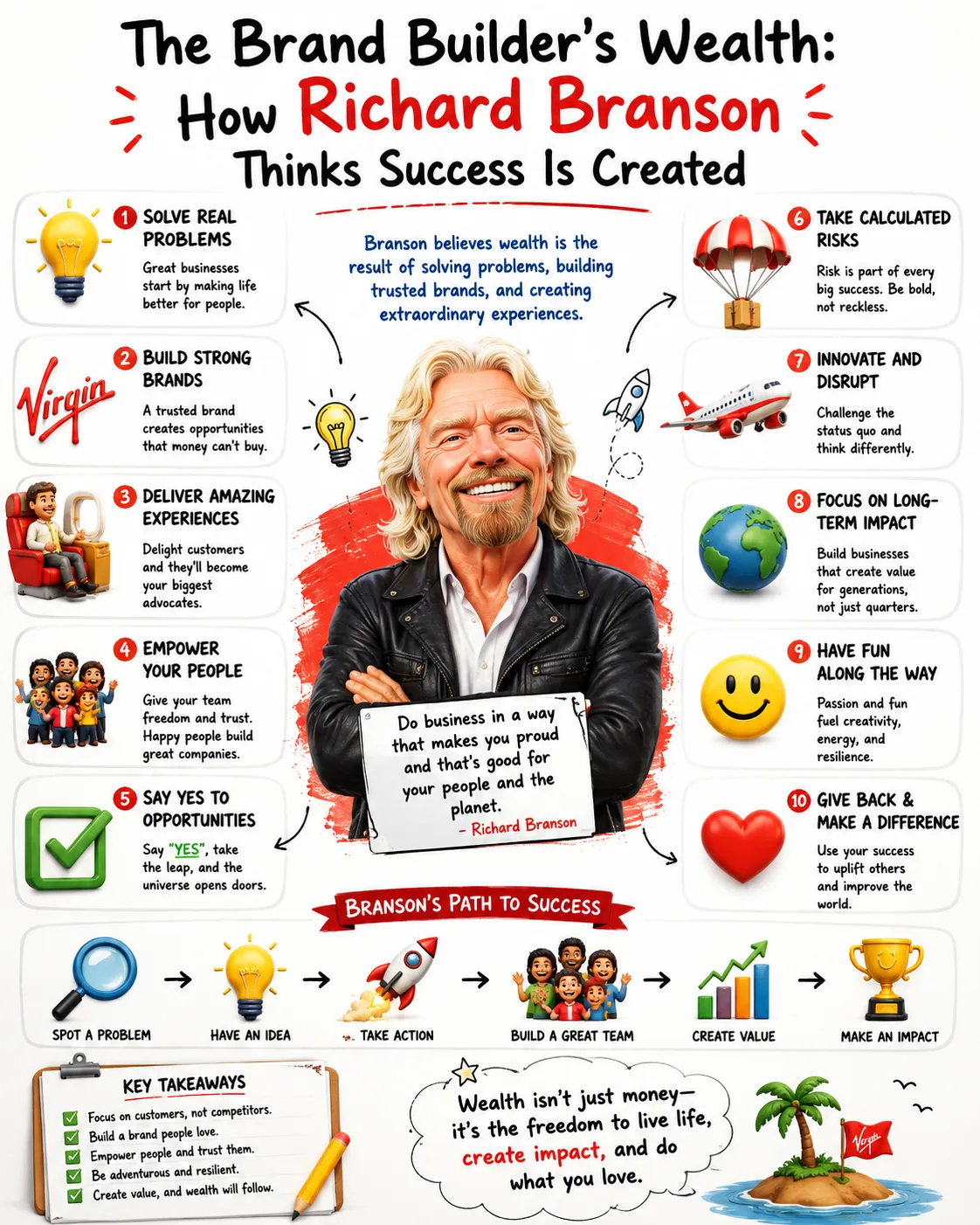
The Brand Builder’s Wealth: How Richard Branson Thinks Success Is Created
Richard Branson’s philosophy of wealth does not begin with a spreadsheet. It begins with a complaint.
A customer is frustrated. An industry feels stale. A service is too expensive, too complicated, too impersonal, or too arrogant. A large incumbent has stopped listening. People are paying for something they do not enjoy, because they believe there is no better alternative.
Branson built much of his career by noticing those moments. He did not usually invent entirely new categories from nothing. Instead, he entered industries where customers were poorly served and asked whether a more energetic, human, enjoyable, and trustworthy brand could do better.
That approach shaped the Virgin Group, one of the world’s most recognizable entrepreneurial brands. Virgin expanded across music, airlines, telecommunications, financial services, health, travel, and space tourism. Not every venture succeeded. Some failed publicly. Others became defining examples of challenger-brand strategy. But across Branson’s career, a consistent philosophy emerges: wealth is created by solving real customer problems, building a trusted brand, empowering people, taking calculated risks, and staying adaptable enough to keep moving when markets change.
His view of getting rich is different from the purely financial philosophies of investors who focus mainly on asset allocation, valuation, or compounding capital. Branson is an entrepreneur first. He sees wealth as the outcome of building companies that people want to work for, buy from, talk about, and trust. Financial success follows business usefulness.
This does not mean his approach is soft. Brand, customer experience, and culture may sound intangible, but they can become powerful economic assets. A trusted brand can lower the cost of entering new markets. Loyal customers can reduce the need for constant acquisition spending. Motivated employees can improve service quality. Strong relationships can open opportunities that a purely transactional business would never see.
Branson’s philosophy also carries risks. Expanding across many industries creates complexity. Brand alone cannot save a weak business model. Customer experience can be expensive to deliver. Entrepreneurial risk can produce real losses. A charismatic founder can help a brand grow, but overreliance on personality may create succession challenges.
Still, the core lesson remains valuable: wealth is often built by making business more human. Branson’s companies tried to turn boring, frustrating, or intimidating industries into experiences people could enjoy. He understood that customers do not merely buy products. They buy feelings, trust, simplicity, identity, and relief from frustration.
To understand how to get rich according to Richard Branson, the key is not to search for a single tactic. It is to understand his operating system: find a real problem, build a distinctive brand, put customers first, treat employees as the engine of the company, take informed risks, delegate aggressively, learn by doing, and make business meaningful enough that people want to join the journey.
Start With a Customer Problem
Branson’s wealth philosophy begins with solving real problems. He has often described business opportunities as emerging from frustration: a poor customer experience, a confusing process, an overpriced service, or an industry that has become comfortable because customers have few alternatives.
This is a practical starting point for entrepreneurship. Many people begin with the desire to make money, then search for a product to sell. Branson’s approach reverses the order. He begins with the customer’s pain. What is not working? What do people dislike? What could be simpler, friendlier, faster, more transparent, or more enjoyable?
A business that solves a meaningful problem has a stronger foundation than one built merely around the founder’s desire for income. Customers do not pay because an entrepreneur wants to be rich. They pay because something improves in their lives. A service saves time. A product reduces stress. A brand makes them feel understood. A company removes friction from an experience that used to feel unpleasant.
Branson’s entry into airlines illustrates this principle. Air travel was not a new industry. It was mature, capital-intensive, regulated, and dominated by large players. But many travelers found the experience impersonal and frustrating. Virgin Atlantic positioned itself as a challenger brand that could make flying feel more enjoyable, stylish, and customer-friendly. The opportunity was not simply transportation. The opportunity was a better experience inside an existing category.
This is a recurring Branson pattern. He looks for industries where customers are underserved emotionally as much as functionally. The product may work, but the experience feels cold. The service may exist, but the customer feels ignored. The market may be large, but incumbents behave as if customers have no choice.
For entrepreneurs, this creates a powerful lesson. You do not always need to invent a new market to build wealth. You can improve an existing one if customers are dissatisfied enough and incumbents are slow enough. The opportunity may be hidden in irritation.
But solving a customer problem requires more than noticing complaints. Complaints must be tested against economics. Are customers willing to pay for a better solution? Can the company deliver that solution profitably? Is the problem frequent enough, painful enough, and widespread enough to support a business? Can competitors copy the improvement quickly?
Branson’s philosophy is strongest when customer empathy is paired with commercial discipline. A better experience matters only if the business model can sustain it. A generous service promise that destroys margins may delight customers briefly but weaken the company. A successful entrepreneur must design an experience that customers love and the business can afford to deliver consistently.
The first question, though, remains simple: where are customers being treated worse than they deserve?
The Economic Power of Brand
Branson views brand as one of a company’s most valuable assets. For Virgin, brand was not merely a name attached to one product. It became a promise that could travel across categories.
Brand equity is the value created by recognition, trust, emotion, reputation, and expectation. When customers see a brand they trust, they make decisions differently. They may be more willing to try a new product, forgive a mistake, pay a premium, recommend the company, or choose it over a less familiar competitor.
This matters because trust reduces friction. A company with no reputation must persuade customers from zero. A company with a respected brand begins with familiarity. That familiarity can lower customer acquisition costs and accelerate market entry.
Virgin’s brand strategy was unusual because it stretched across industries. Music, airlines, mobile, financial services, hotels, gyms, and space tourism are not naturally connected by product category. What connected them was a brand personality: challenger, energetic, customer-focused, irreverent, accessible, and willing to take on established giants.
This kind of brand extension can create significant wealth when it works. A strong parent brand can lend credibility to new ventures. Customers who trust the brand in one area may be willing to consider it in another. Investors, partners, employees, and media may pay attention because the brand has a history of disruption.
But brand extension is dangerous if the promise becomes vague or overextended. A brand cannot simply enter any industry and expect loyalty. Each venture must deliver. If the customer experience disappoints, brand equity erodes. If too many ventures fail or feel unrelated, customers may become confused about what the brand stands for.
Branson’s approach shows that brand must be both consistent and adaptable. The products may differ, but the emotional promise should remain recognizable. Virgin’s best-known ventures often carried a sense of customer advocacy, fun, and challenge to incumbents. That consistency allowed the brand to stretch further than many traditional corporate brands.
For individual wealth builders and entrepreneurs, the lesson is that brand is not decoration. It is a business asset formed by every interaction. The website, product, customer service, pricing, packaging, employee behavior, founder communication, complaint handling, and public reputation all contribute to brand equity.
A strong brand answers several questions in the customer’s mind. Can I trust this company? Do I understand what it stands for? Will it treat me fairly? Does it make my life better? Do I feel good being associated with it?
Businesses that answer those questions well can create durable advantages. They are not just selling products; they are accumulating trust.
Customer Experience as a Wealth Strategy
Branson’s philosophy places customer experience at the center of long-term business success. He believes companies grow sustainably when customers feel valued, heard, and pleasantly surprised.
Customer experience is broader than customer service. Service is what happens when a customer needs help. Experience is the total impression created by every interaction: discovery, purchase, onboarding, use, support, billing, problem resolution, renewal, and memory. It includes the emotional residue left after dealing with the company.
A business can have a functional product and still create a poor experience. It can be difficult to contact. It can hide fees. It can use confusing language. It can make refunds painful. It can treat complaints as annoyances. It can design policies around internal convenience rather than customer reality.
Branson’s companies often tried to win by making customers feel that someone was finally on their side. This challenger mentality is especially powerful in industries where customers feel trapped. Airlines, banks, telecom providers, insurance companies, utilities, and healthcare services often create frustration because customers depend on them but do not always enjoy dealing with them.
A company that simplifies such an experience can build loyalty. A company that communicates clearly can stand out. A company that handles problems generously can turn a negative moment into trust. A company that makes customers feel respected can create emotional differentiation even when products are similar.
The financial impact of customer experience can be significant. Satisfied customers are more likely to return, recommend, and buy additional products. They may be less price-sensitive when they believe the experience is superior. They can become unpaid advocates. Their feedback can help the company improve faster.
However, customer experience must be designed carefully. A company cannot simply promise delight without understanding cost. Faster support requires staffing or technology. Generous policies require margin. Better environments require investment. Experience-driven businesses must understand which improvements customers truly value and which are expensive but irrelevant.
The best customer experience strategies focus on moments that matter. Where does the customer feel anxiety? Where do competitors create friction? Where does trust break down? Where can a small gesture create outsized goodwill? Where can technology make the process simpler without making it colder?
Branson’s wealth lesson is that customer experience is not a department. It is a competitive strategy. Companies that treat customers as transactions may maximize short-term revenue, but companies that treat customers as relationships can build long-term brand equity.
Take Calculated Risks
Richard Branson is often associated with risk. He launched companies in difficult industries, challenged large incumbents, attempted bold publicity stunts, and entered markets where failure was possible. But his philosophy is not reckless risk-taking. It is calculated risk-taking.
The difference matters. Reckless risk ignores downside. Calculated risk studies it. Reckless risk is driven by ego, excitement, or desperation. Calculated risk is driven by opportunity, preparation, and a clear understanding of what can go wrong.
Entrepreneurship always involves uncertainty. A new product may fail. Customers may not respond. Financing may disappear. Competitors may react aggressively. Regulations may change. Costs may exceed projections. Even well-planned ventures can struggle.
Branson’s approach accepts this reality rather than pretending risk can be eliminated. The entrepreneur’s task is to make risk intelligent. That means limiting downside where possible, protecting the core business, structuring deals carefully, surrounding oneself with skilled people, and learning quickly when reality does not match the plan.
One practical element of calculated risk is asymmetry. A good entrepreneurial risk offers meaningful upside while keeping the downside survivable. Branson has often emphasized protecting against catastrophic loss. A founder who risks everything on one untested idea may be brave, but they may also be financially fragile. A smarter structure allows experimentation without destroying the entire platform if the experiment fails.
This is important for ordinary entrepreneurs. The myth of business success often celebrates dramatic all-in bets. But many durable entrepreneurs are careful risk managers. They test demand before scaling. They negotiate terms. They keep reserves. They partner with experts. They enter markets gradually. They learn before committing too much capital.
Branson’s willingness to act decisively should not be confused with carelessness. He is bold, but his best-known successes came from combining boldness with brand, customer insight, publicity, partnerships, and team capability.
The wealth-building lesson is that risk cannot be avoided by anyone seeking significant entrepreneurial upside. It can only be understood, priced, reduced, shared, and managed. The person who avoids all risk may avoid opportunity. The person who ignores risk may lose everything. The wealth builder learns to stand between those extremes.
Employees Are the Business Engine
One of Branson’s most famous leadership ideas is that companies should take care of employees because employees take care of customers. This people-first approach is not merely moral; it is strategic.
Employees shape the customer’s lived experience of a brand. They answer calls, solve problems, build products, clean rooms, fly planes, write code, manage accounts, greet customers, handle emergencies, and represent the company in thousands of small moments. A brand promise means little if employees are disengaged, undertrained, fearful, or unsupported.
Branson’s philosophy recognizes that customer experience and employee experience are connected. A company that treats employees poorly may struggle to deliver warmth and creativity to customers. Workers who feel ignored are less likely to go beyond the minimum. Teams that feel trusted are more likely to solve problems intelligently.
Employee engagement can affect productivity, retention, innovation, and service quality. Hiring and training are expensive. Losing good people creates hidden costs. A strong culture can reduce turnover and preserve institutional knowledge. It can also attract talent that wants more than a paycheck.
Branson’s leadership style emphasizes trust, autonomy, and enjoyment. He often presents business as a human adventure rather than a mechanical process. That does not remove accountability. A business still needs standards, performance, and financial discipline. But it suggests that people perform better when they feel respected and empowered.
This is especially important in service businesses. A company can script interactions, but it cannot script genuine care. Employees need authority to make decisions. A frontline worker who cannot solve a customer’s problem without navigating layers of approval may watch trust disappear in real time. Empowered employees can protect the brand at the point of contact.
For entrepreneurs, this creates a clear lesson: culture is not a motivational poster. It is the operating environment that determines how people behave when the founder is not in the room. If employees are trusted, trained, and aligned with the brand promise, the company can scale service quality. If they are confused or mistreated, growth exposes the weakness.
Branson’s view of wealth is therefore deeply tied to leadership. A company becomes valuable not only because of its product, but because people inside the company care enough to deliver the promise repeatedly.
Delegate or Stay Small
Branson has long argued that entrepreneurs cannot build large companies by doing everything themselves. Delegation is essential to scale.
Many founders struggle with this. In the beginning, the founder may handle sales, product, customer service, hiring, operations, finance, marketing, and strategy. This is often necessary. Early businesses are messy and resource-constrained. But if the founder remains the bottleneck forever, the company cannot grow beyond the founder’s personal capacity.
Delegation is not simply assigning tasks. It is transferring responsibility, authority, and trust. It means hiring capable people, giving them clear goals, allowing them to make decisions, and holding them accountable for results.
Branson’s business empire required delegation because no individual could personally manage companies across so many industries. The Virgin model depended on teams, partnerships, executives, and operators who could run businesses under the broader brand umbrella.
This reveals a key wealth principle: entrepreneurs build wealth when they build systems that work through other people. A self-employed person may earn income through personal labor. A business owner creates value through teams, processes, brand, capital, and strategy. Delegation is the bridge between the two.
Founders who fail to delegate often do so for understandable reasons. They fear quality will decline. They believe no one cares as much as they do. They worry about losing control. They may enjoy being needed. But these fears can trap the business. Every decision returns to the founder. Employees stop taking initiative. Customers wait. Growth slows.
Effective delegation requires clarity. People need to know the mission, the standards, the decision rights, and the boundaries. They need access to information. They need feedback. They need room to learn. Delegation without support becomes abandonment. Delegation with trust and accountability becomes leverage.
For wealth builders, this lesson applies beyond business ownership. Investors delegate to managers. Executives delegate to teams. Families delegate financial tasks to professionals when needed. The ability to identify talent and trust capable people is a form of leverage.
Branson’s philosophy suggests that the founder’s role should evolve. At first, the founder does the work. Later, the founder builds the team that does the work. Eventually, the founder protects the vision, brand, culture, and strategic direction while others operate with excellence.
Without delegation, ambition remains limited by hours. With delegation, a company can become larger than its founder.
Learn by Doing
Branson often emphasizes experiential learning. He is known for valuing action, experimentation, and practical experience over excessive planning or formal credentials.
This does not mean knowledge is unimportant. It means some business lessons can only be learned in motion. Customers reveal what they value after seeing an offer. Employees reveal what systems are unclear when they try to use them. Markets reveal the truth after a product launches. Negotiations teach what theory cannot fully explain.
Many aspiring entrepreneurs wait for certainty. They want the perfect idea, complete plan, ideal timing, full funding, flawless website, and total confidence before starting. Branson’s philosophy challenges that hesitation. Start. Test. Listen. Improve.
Learning by doing accelerates feedback. A person who spends one year thinking about a business may have fewer insights than someone who spends three months selling a simple version to real customers. Action creates information.
However, learning by doing should not become an excuse for ignorance. Some industries require technical expertise, regulation, safety standards, capital planning, or legal compliance. An airline, healthcare company, financial service, or aerospace venture cannot be approached casually. The lesson is not to ignore preparation. The lesson is to avoid hiding behind preparation forever.
Entrepreneurial learning is iterative. Launch a version. Measure response. Identify friction. Improve the product. Adjust pricing. Strengthen operations. Listen to customers. Learn from employees. Study competitors. Repeat.
This process also builds resilience. A founder who expects everything to work immediately may quit quickly. A founder who expects to learn through mistakes can interpret setbacks more productively. Failure becomes information, not identity.
Branson’s career includes ventures that did not succeed as hoped. That is part of the entrepreneurial record. The important question is whether failure teaches enough to improve future judgment. In a diversified entrepreneurial career, not every venture must win if the winners are meaningful and the brand survives.
For individuals, learning by doing can mean starting a small service business, launching a product test, publishing content, building a prototype, freelancing, investing modestly in a skill, or taking on a leadership challenge. The point is to move from abstract ambition to real-world feedback.
Wealth is not built by planning alone. It is built by acting, learning, adjusting, and continuing.
Adaptability and the Willingness to Pivot
Branson’s philosophy places high value on adaptability. Markets change. Technologies shift. Consumer expectations evolve. Competitors appear. Regulations move. Capital conditions tighten. A business that refuses to adapt may become irrelevant even if it was once successful.
Adaptability is especially important for brands that enter multiple industries. Each market has different economics, customer expectations, operational requirements, and competitive dynamics. What works in music may not work in airlines. What works in airlines may not work in telecom. What works in consumer services may not work in space tourism.
Branson’s career shows a willingness to experiment. Some experiments worked. Others did not. The broader principle is that entrepreneurs should not become emotionally attached to outdated models. The goal is not to defend the original idea at all costs. The goal is to create value in changing conditions.
Adaptability begins with listening. Customers may reveal that the product is solving the wrong problem. Employees may see operational issues before executives do. Competitors may expose a weakness. Financial results may show that a beloved concept cannot scale profitably. Entrepreneurs must be willing to hear uncomfortable signals.
Pivoting does not mean changing direction constantly. A company that pivots every few weeks may lack strategy. Adaptability means holding the mission firmly while adjusting the method. If the mission is to improve customer experience in an industry, the product, pricing, distribution, or operations may evolve as the company learns.
Technology has made adaptability more important. Digital platforms can reshape customer acquisition. Reviews can alter reputation quickly. Automation can change cost structures. Artificial intelligence can transform service delivery, marketing, logistics, and product development. Companies that learn faster can gain advantage.
For wealth builders, adaptability also applies personally. Skills that created income in one decade may be less valuable in the next. Industries rise and fall. Professional identities can become traps. A person who keeps learning can move with opportunity. A person who refuses change may watch their advantage erode.
Branson’s wealth philosophy is optimistic, but not static. It assumes that opportunity exists for people willing to move, test, and reinvent.
Relationships Compound
Branson places significant value on relationships. Customers, employees, partners, investors, suppliers, communities, and media relationships all contribute to long-term business success.
Business is often described in financial terms, but relationships are part of the hidden infrastructure of wealth. A trusted partner may provide capital. A loyal customer may return for years. A respected employee may build a division. A strong supplier may offer flexibility during a crisis. A supportive community may defend the brand. A journalist may tell the company’s story. An investor may back the next venture because the last relationship was handled well.
Trust compounds when people have repeated positive experiences with a person or company. Over time, trust can reduce transaction costs. Deals move faster. Negotiations become easier. Problems are solved with less suspicion. Opportunities arrive earlier.
Branson’s personal style has often emphasized warmth, accessibility, and human connection. This matters because entrepreneurship is rarely a solo act. Founders need teams, customers, capital, advice, distribution, and goodwill. A reputation for fairness and energy can become an economic advantage.
Relationship-building should not be confused with networking as performance. Collecting contacts is not the same as earning trust. Relationships deepen when value is exchanged, promises are kept, and people feel respected before they are needed.
For entrepreneurs, long-term relationships are especially valuable during difficult periods. Every company faces problems: delays, service failures, financing gaps, strategic mistakes, public criticism, or market downturns. Stakeholders are more likely to remain patient if trust has been built before the crisis.
Customers may forgive a mistake if the company has a history of honesty. Employees may work through uncertainty if leadership has treated them well. Investors may provide support if management has communicated transparently. Partners may renegotiate terms if the relationship has been mutually beneficial.
Wealth built through relationships is less visible than wealth built through assets, but it can be just as important. Reputation opens doors that money alone cannot. Branson’s philosophy treats trust as a long-term investment.
Enjoy the Journey
Branson frequently emphasizes that business should be enjoyable and meaningful. This can sound unusual in a financial context, but it is central to his entrepreneurial philosophy.
Passion matters because building a business is difficult. There are setbacks, financial pressures, operational problems, critics, long hours, and uncertain outcomes. A founder motivated only by money may lose energy when the path becomes uncomfortable. A founder who finds meaning in the work may persist longer and lead better.
Enjoyment also affects culture. A company led with curiosity, energy, and humor can feel different from one led only by fear and financial targets. Employees may become more engaged when the mission feels human. Customers may sense when a brand genuinely wants to create a better experience.
This does not mean business should be treated casually. Fun without discipline becomes chaos. Passion without economics becomes an expensive hobby. Meaning without execution does not pay employees. Branson’s best lesson is not that entrepreneurs should ignore financial performance. It is that financial performance can improve when people care deeply about what they are building.
Enjoying the journey also helps entrepreneurs maintain perspective. Not every venture succeeds. Not every risk pays off. If the only acceptable outcome is financial victory, failure can become unbearable. If the journey includes learning, relationships, growth, and contribution, setbacks can still have value.
For wealth builders, this raises an important question: what kind of wealth is worth building? Some people accumulate money in ways that make their daily lives miserable. Others build businesses that reflect their values, talents, and curiosity. Branson’s philosophy clearly favors the second path.
Money is important. It provides options, security, and the ability to scale impact. But Branson often frames money as a result rather than the primary purpose. Serve customers, build teams, solve problems, take risks, and enjoy the process. Wealth follows when the business creates enough value.
The Virgin Model: Challenger Brand, Experience, and Extension
The Virgin Group offers a useful lens for understanding Branson’s wealth philosophy. Its model has often involved entering established industries with a distinctive brand promise and a customer-friendly identity.
This challenger-brand approach depends on contrast. The incumbent is large, bureaucratic, expensive, dull, or indifferent. The challenger is lively, accessible, fair, and customer-focused. The brand gains attention not only by offering a product, but by standing against a frustrating status quo.
Challenger brands can be powerful because they give customers a story. The customer is not just buying a ticket, phone plan, bank product, or service. They are choosing the company that appears to be on their side. They are participating in a small rebellion against the old way.
Branson’s public persona reinforced this strategy. He became part of the brand story: adventurous, informal, bold, and willing to challenge giants. Founder personality can be a major asset when it makes the brand memorable and human.
But the Virgin model also reveals the limits of brand-led diversification. Entering many industries requires operational excellence in each one. Airlines are different from gyms. Telecom is different from music. Financial services are different from hospitality. Space tourism is different from consumer retail. Brand can open the door, but operations must keep the promise.
This is why delegation, partnerships, and leadership teams are so important in Branson’s philosophy. A brand extension strategy requires people who understand each industry deeply. Without operational competence, brand trust can be damaged.
For entrepreneurs, the lesson is that a strong brand can support expansion, but expansion should be earned. The brand must have permission from customers to enter a new category. That permission comes from trust, relevance, and a credible ability to improve the experience.
A local business can apply the same idea at a smaller scale. A trusted fitness studio might expand into nutrition coaching. A respected accounting firm might offer financial education. A beloved café might launch packaged products. A software company might expand into adjacent workflow tools. The question is whether the brand promise naturally travels.
Brand extension works when customers believe the company can bring its strengths to the new category. It fails when expansion feels opportunistic or disconnected.
How Branson’s Philosophy Compares With Traditional Wealth Building
Traditional personal finance often emphasizes saving, investing, budgeting, diversification, debt management, and long-term compounding. Branson’s philosophy emphasizes entrepreneurship, brand, people, customer experience, and calculated risk.
These approaches are not enemies. They solve different problems. Traditional financial discipline helps individuals preserve and grow capital. Branson’s entrepreneurial philosophy explains how businesses create value that can become capital in the first place.
An entrepreneur who builds a valuable company still needs financial discipline. Revenue is not wealth if expenses consume everything. Brand attention is not wealth if the business has weak margins. Growth is not wealth if it requires endless capital and never produces returns. A founder still needs cash flow management, investment planning, tax awareness, and risk control.
At the same time, traditional savers can learn from Branson. Career and investment outcomes often improve when people think entrepreneurially. An employee who treats colleagues and clients well builds reputation capital. A professional who notices customer problems may discover a business opportunity. An investor who understands brand strength and customer loyalty may evaluate companies more deeply.
Branson’s philosophy adds a human dimension to wealth building. It reminds us that companies are not only financial machines. They are groups of people serving other people. The businesses that create lasting value often understand emotion, trust, culture, and experience as well as numbers.
The best wealth builders combine both sides. They create value through entrepreneurship or high-quality work, then preserve and compound that value through intelligent financial management.
Where Branson’s Approach Can Go Wrong
Branson’s approach is inspiring, but it can be misapplied.
The first risk is believing that passion is enough. Passion can fuel persistence, but it cannot replace market demand, operational competence, capital planning, or unit economics. A business must solve a problem customers will pay for at a price that supports profit.
The second risk is overextending the brand. A respected name can support expansion, but only if each new venture strengthens the promise. Too many unrelated or poorly executed ventures can dilute trust. Brand equity is valuable because it is fragile.
The third risk is underestimating complexity. Entering established industries may sound exciting, but incumbents often have advantages: capital, regulation, distribution, supplier relationships, data, and operational experience. A challenger must know exactly where it can win.
The fourth risk is confusing calculated risk with publicity-driven risk. Bold moves can attract attention, but attention does not guarantee profitability. Publicity should support strategy, not replace it.
The fifth risk is relying too heavily on founder charisma. A charismatic founder can humanize a brand and attract attention, but a durable company needs systems, leadership depth, governance, and succession planning. The business must eventually stand beyond the founder.
The sixth risk is ignoring margins in the pursuit of customer delight. Customers may love generous service, low prices, and premium experiences, but the company must fund them. Sustainable customer experience requires economic design.
Branson’s strongest lessons work best when paired with discipline: care deeply about customers, but know your costs. Empower employees, but set standards. Take risks, but protect the downside. Build a brand, but deliver operationally. Expand boldly, but make sure the promise travels.
A Practical Branson-Inspired Wealth Strategy
A practical wealth strategy inspired by Richard Branson begins with observation. Look for customer frustration in markets you understand. Where are people overpaying? Where is service poor? Where is the process confusing? Where do customers feel ignored? Where do incumbents rely on inertia rather than loyalty?
Next, identify whether the frustration is commercially meaningful. A good business opportunity sits at the intersection of pain, willingness to pay, and feasible delivery. Customers may complain about many things, but not all complaints support a profitable company.
Then design a better experience. This may involve speed, simplicity, transparency, warmth, convenience, pricing, design, support, or emotional connection. The improvement should be clear enough that customers can explain it to others.
Build the brand around a promise. What does the company stand for? Why should customers trust it? What emotional difference does it create? How should people feel after interacting with it? A brand is strongest when it reflects the actual customer experience, not just marketing language.
Hire and empower people who can deliver the promise. Customer experience depends on employees. Train them, trust them, listen to them, and give them authority to solve problems. Culture becomes the delivery system for the brand.
Take risk in stages. Test demand before scaling. Protect the downside. Use partnerships where appropriate. Avoid betting the entire enterprise on an unproven assumption. Risk should be meaningful enough to create upside but controlled enough to survive mistakes.
Delegate as soon as the business requires scale. The founder should not remain the bottleneck. Build systems, hire leaders, and create accountability. Wealth grows when the company becomes more capable than the founder alone.
Keep learning. Customer expectations change. Competitors respond. Technology creates new possibilities. A Branson-style entrepreneur remains curious and adaptable.
Finally, protect relationships. Treat customers, employees, partners, and investors as long-term stakeholders. Reputation compounds. A trusted entrepreneur can often recover from setbacks faster than one who burns relationships for short-term gain.
The Real Meaning of Getting Rich According to Richard Branson
Richard Branson’s philosophy of getting rich is not about extracting as much money as possible from customers. It is about building businesses that customers genuinely prefer, employees genuinely care about, and markets genuinely notice.
He sees wealth as the result of useful disruption. Find an industry where people are dissatisfied. Enter with a better experience. Build a brand that feels human. Hire people who believe in the mission. Treat customers well. Take risks intelligently. Learn from failure. Expand when trust gives you permission.
This philosophy is entrepreneurial, but it is also deeply relational. Branson’s wealth was built through people: customers who trusted the brand, employees who delivered the experience, partners who helped ventures scale, and communities that understood what Virgin represented.
The central lesson is that business is not only a numbers game. Numbers matter, but they are produced by human behavior. Customers return because they are satisfied. Employees perform because they are engaged. Partners collaborate because they trust. Brands grow because people remember how they felt.
For the individual wealth builder, Branson’s message is clear. Do not chase money in the abstract. Look for problems worth solving. Build something people enjoy. Protect your reputation. Empower others. Take bold but informed risks. Keep adapting. Make the journey meaningful enough that persistence becomes possible.
Wealth built this way may not be the fastest path. It may involve mistakes, reinvention, and public failure. But it can create something more durable than a single transaction: a trusted brand with the power to enter new markets, attract talent, and compound goodwill over time.
According to Richard Branson, getting rich is not simply about owning a business. It is about building a business people are glad exists.
 Article
 Article
 Article
 Article
 Article
 Article
 Article
 Article