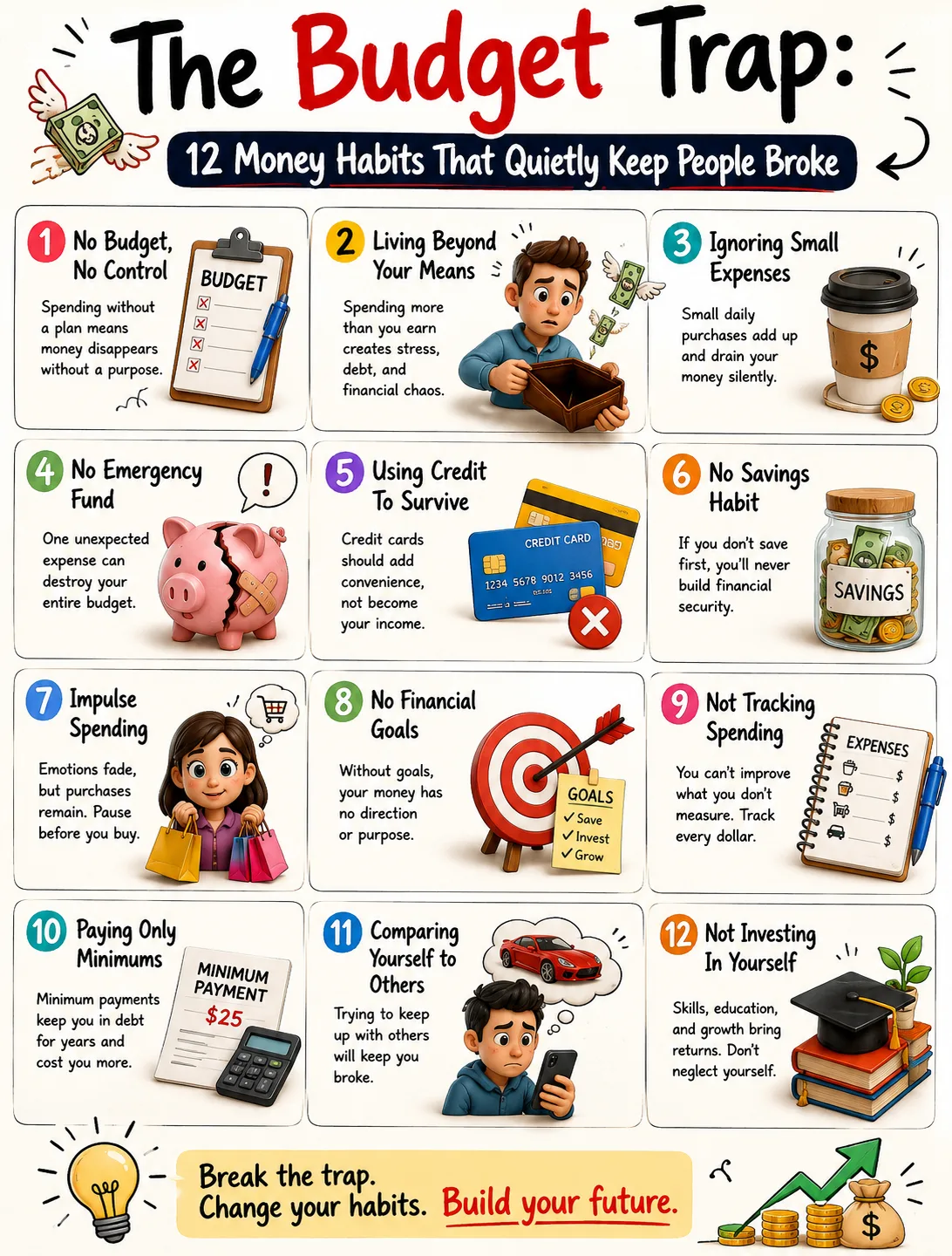
The Budget Trap: 12 Money Habits That Quietly Keep People Broke
Money problems rarely arrive all at once.
They usually build in small, almost invisible ways. A forgotten subscription. A credit card balance carried for one more month. A grocery bill that keeps rising without anyone noticing. A tax bill or insurance renewal that feels surprising, even though it arrives every year. A raise that should have created breathing room but somehow disappears into a more expensive lifestyle.
This is why budgeting is often misunderstood. Many people think of a budget as a restrictive document, a punishment for not earning enough, or a spreadsheet that only matters when money is already tight. In reality, a budget is something much more powerful. It is a decision-making system. It tells your money where to go before emotion, convenience, marketing, or habit decide for you.
At the same time, budgeting should not be treated as a magic cure for every financial struggle. Some households are not broke because they buy too many coffees or fail to color-code a spreadsheet. They are struggling because rent consumes too much income, medical bills arrive without warning, wages lag behind the cost of living, childcare is expensive, debt is already heavy, or work is unstable. Financial hardship is shaped by both personal decisions and economic conditions.
That distinction matters. A responsible conversation about budgeting should avoid blaming people for structural pressures they did not create. But it should also avoid pretending behavior does not matter. Even when income is limited, the way money is tracked, allocated, protected, and reviewed can determine whether a household stays permanently fragile or gradually builds stability.
The most damaging budgeting mistakes are not always dramatic. They often look normal. They feel reasonable in the moment. They hide behind phrases like “I’ll deal with it next month,” “It’s only a small purchase,” “I deserve this,” or “The bonus will cover it.” Over time, these habits create a financial pattern: income arrives, obligations consume it, wants compete with needs, debt fills the gap, and savings remain an afterthought.
The goal of budgeting is not to live cheaply forever. The goal is to live deliberately. A good budget helps a person protect necessities, fund priorities, prepare for surprises, reduce debt pressure, and eventually turn income into assets. Without that structure, even a decent salary can feel like a leaking bucket.
1. Guessing Expenses Instead of Tracking Them
The first budgeting mistake is also one of the most common: guessing where the money goes.
Most people know the large expenses. They can usually estimate rent or mortgage payments, car loans, insurance premiums, and utility bills. The trouble appears in the middle of the budget, where everyday spending becomes blurry. Groceries, takeout, fuel, rideshares, online shopping, subscriptions, convenience purchases, school costs, pharmacy visits, gifts, and small transfers can merge into one vague feeling: “I don’t know why I’m always short.”
Guessing creates false confidence. A person may believe they spend a reasonable amount on dining out because no single meal feels excessive. They may believe their grocery bill is stable because they shop at the same stores. They may believe subscriptions are minor because each charge is small. But a budget built on memory is usually a budget built on missing information.
Human beings are not naturally good at remembering frequent low-friction transactions. Modern spending makes the problem worse. Cash used to create a physical reminder. You could see money leaving your wallet. Digital payments are smoother. Cards, apps, one-click purchases, automatic renewals, and saved payment details reduce the emotional friction of spending. That convenience is useful, but it also makes expenses easier to underestimate.
Tracking corrects the illusion. It replaces impressions with evidence.
A household does not need a complicated system to begin. The first step is simply to capture reality. That can be done through a budgeting app, a bank export, a spreadsheet, a notebook, or weekly reviews of card statements. The method matters less than the habit. What matters is that spending is recorded accurately enough to reveal patterns.
Many people resist tracking because they fear what they will find. They worry it will feel restrictive or embarrassing. But tracking is not a moral judgment. It is financial visibility. A doctor cannot treat a condition without measuring symptoms. A business cannot manage cash flow without bookkeeping. A household cannot improve money management without knowing where money actually goes.
Once expenses are tracked, the budget becomes less emotional. Instead of saying, “I’m bad with money,” a person can say, “My grocery spending rose by 18 percent,” or “I spent more on convenience food than I realized,” or “Three annual subscriptions renewed in the same month.” Specific problems are easier to solve than vague anxiety.
Tracking also reveals which expenses are worth attention. Sometimes the problem is daily discretionary spending. Sometimes it is a car payment that is too large for the income. Sometimes it is debt interest. Sometimes it is housing. Sometimes it is irregular bills that were never included in the monthly plan. Without tracking, people often focus on the wrong enemy.
The practical lesson is simple: a budget based on guesses will eventually fail. Before trying to optimize money, measure it. Track every expense for at least one full month, preferably three. Categorize spending honestly. Do not edit the past to look better. The purpose is not perfection. The purpose is truth.
2. Budgeting Once and Never Reviewing Again
A budget is not a document you create once and then admire from a distance. It is a living plan. When life changes, the budget must change with it.
Many people build a budget during a moment of motivation. They list income, expenses, savings goals, and debt payments. For a few weeks, the plan feels empowering. Then real life interferes. A utility bill rises. Groceries cost more. A child needs school supplies. A car repair appears. A raise changes take-home pay. A subscription renews. A family member moves in. Interest rates change. Inflation alters the price of routine purchases.
If the budget is not reviewed, it becomes outdated. An outdated budget creates frustration because it asks a person to live according to numbers that no longer reflect reality.
This is one reason people give up on budgeting. They assume the budget failed because budgeting does not work. Often the real problem is that the budget was treated as a fixed promise instead of a flexible management tool. A good budget should be reviewed regularly, not because the person failed, but because conditions changed.
Businesses understand this. Companies create annual budgets, but they do not stop paying attention afterward. They compare actual results against projections, revise forecasts, adjust spending, and respond to changing conditions. Households need the same basic discipline, even if the numbers are smaller.
A monthly review is usually enough for most people. The review does not have to be long. It should answer a few practical questions. Did income match expectations? Which categories went over budget? Which categories came in under budget? Are any bills coming next month that are not part of the normal routine? Did savings happen as planned? Did debt balances decline? Are financial goals still realistic?
This review turns budgeting from a static plan into a feedback loop. Without review, the budget is a wish. With review, it becomes a system of correction.
Regular review also reduces shame. When people avoid looking at their finances, problems grow in the dark. A missed bill becomes a fee. A small balance becomes a larger balance. A forgotten expense becomes a crisis. Monthly reviews create a habit of facing the numbers early, when problems are still manageable.
The best review rhythm is predictable. Choose a specific date, such as the last Sunday of the month or the first evening after payday. Make the process simple enough to repeat. Check account balances. Compare spending against limits. Move money into sinking funds. Adjust next month’s categories. Celebrate progress, even if it is modest.
Budgeting once is planning. Budgeting repeatedly is management. Financial stability depends on management.
3. Spending First and Saving What Is Left
One of the most expensive habits in personal finance is saving only what remains after spending.
At first, this approach sounds reasonable. Pay the bills, buy what is needed, enjoy life, and save whatever is left at the end of the month. The problem is that money without a clear assignment tends to disappear. If savings are treated as optional leftovers, they must compete against every purchase, impulse, convenience, and emergency that appears before month-end.
Most months, there is little left.
The alternative is the “pay yourself first” approach. This means treating savings as a priority expense, not a residual outcome. When income arrives, a predetermined amount moves immediately into savings, investments, debt repayment, or another financial goal. Spending then happens with the remaining money.
This reverses the psychology of budgeting. Instead of asking, “Can I save after I spend?” the system says, “I have already saved, so what can I afford to spend?”
The power of paying yourself first comes from automation and default behavior. People often overestimate willpower and underestimate systems. A person may intend to transfer money into savings later, but later brings fatigue, obligations, temptation, and unexpected costs. An automatic transfer removes the decision from the emotional battlefield.
This habit is especially important because savings are not only about future wealth. They are also protection. Cash reserves reduce the need to borrow when something goes wrong. Investment contributions create ownership over time. Debt prepayments reduce interest expense. Emergency funds prevent temporary setbacks from becoming long-term financial damage.
For someone living paycheck to paycheck, paying yourself first may feel unrealistic. The starting amount can be small. The principle matters more than the initial size. Even a modest automatic transfer builds the identity and habit of saving. As debts decline or income rises, the amount can increase.
A common mistake is waiting to save until life feels easier. But life rarely becomes easier by accident. Without a savings structure, higher income often becomes higher spending. A raise turns into a better apartment, a newer car, more subscriptions, more dining out, or more generous shopping. This is lifestyle inflation: spending rises to absorb income growth before wealth can form.
Paying yourself first interrupts lifestyle inflation. It captures part of income before the lifestyle expands.
The practical rule is to automate savings as close to payday as possible. Put emergency savings in a separate account. Put long-term investment contributions on a recurring schedule. Create named accounts for major goals. Make the transfer happen before discretionary spending begins. The budget should not hope savings will happen. It should make savings difficult to avoid.
4. Ignoring Small Daily Purchases
Small purchases are dangerous not because each one is financially devastating, but because they rarely feel like decisions.
A drink here, a delivery fee there, an app purchase, a snack, a convenience-store stop, an extra streaming rental, a premium coffee, a rideshare taken because the weather is bad. None of these purchases may be irresponsible by itself. The problem is repetition. A small purchase repeated daily becomes a monthly expense. A monthly expense repeated for years becomes an opportunity cost.
This does not mean people should obsess over every cup of coffee. The popular idea that financial struggle is mostly caused by small luxuries is incomplete and often unfair. For many households, the largest pressures are housing, transportation, healthcare, childcare, taxes, insurance, and debt. Cutting a small treat will not solve a rent burden that is fundamentally too high.
But dismissing small purchases entirely is also a mistake. The truth is more balanced: small expenses matter when they are frequent, unconscious, and misaligned with priorities.
The issue is not the coffee. The issue is whether the coffee is part of a deliberate life or an unnoticed leak.
A person who enjoys a daily coffee, has no high-interest debt, saves consistently, and fits it into the budget may not need to change anything. Another person who is missing credit card payments while spending heavily on convenience purchases may need to examine the pattern. The same expense can be harmless in one budget and harmful in another.
Small purchases also matter because they reveal behavioral patterns. They often appear when people are tired, stressed, rushed, bored, or avoiding planning. A household that frequently buys takeout may not have a food problem as much as a schedule problem. A person who impulse-buys online at night may not have a shopping problem as much as an emotional regulation problem. A commuter who repeatedly uses rideshares may need a transportation plan, not just a spending lecture.
The solution is not necessarily elimination. It is intentional limits.
Create a category for small pleasures. Give it a number. Use cash, a separate card, or a weekly transfer if needed. When the category is funded, the spending is allowed. When it is empty, the decision becomes clearer. This approach protects enjoyment while preventing silent overspending.
Another useful method is the recurring-cost test. Multiply any frequent purchase by its monthly and annual cost. A $7 daily habit is roughly $210 a month and more than $2,500 a year. That does not automatically make it wrong. It simply makes it visible. Once visible, it can be compared with other priorities: emergency savings, debt repayment, investing, travel, education, or a down payment.
Small purchases should not become a source of guilt. They should become a source of information. The question is not, “Can I never enjoy anything?” The question is, “Are my small habits quietly voting against my larger goals?”
5. Confusing Wants With Needs
Budgeting becomes difficult when every expense feels necessary.
Modern life blurs the line between wants and needs. A smartphone may be necessary for work, banking, navigation, and communication. But the latest premium model may be a want. Transportation may be necessary. A vehicle with a payment that strains the household may be a want disguised as a need. Clothing is necessary. Constant wardrobe upgrades are not. Food is necessary. Frequent restaurant meals may be convenience, pleasure, or social spending.
This distinction is not always simple, and it should not be handled with arrogance. Needs vary by location, family structure, health, job requirements, and safety. A car may be optional in a dense city and essential in a rural area. Childcare may be unavoidable for working parents. Reliable internet may be necessary for students or remote workers. Medical costs can turn a budget upside down regardless of discipline.
Still, a functioning budget requires prioritization. If every expense is treated as equally important, then nothing is truly protected.
Needs are the expenses required to maintain basic stability: housing, utilities, essential food, healthcare, transportation, insurance, minimum debt payments, and necessary work or family obligations. Wants are expenses that improve comfort, status, convenience, entertainment, or preference. Many wants are valuable. Life should not be reduced to survival. But wants should not be allowed to crowd out needs, savings, or debt reduction.
Confusing wants with needs often happens through rationalization. A person says, “I need this,” when the more honest statement is, “I want this, and I do not want to feel guilty about wanting it.” The budget improves when language becomes precise. Wanting something is not a crime. But calling it a need gives it priority it may not deserve.
A useful exercise is to separate expenses into three groups: essential, important but flexible, and discretionary. Essential expenses protect stability. Important but flexible expenses support quality of life but can be adjusted. Discretionary expenses are optional and should be funded only after the higher priorities are covered.
This method is more realistic than a harsh needs-versus-wants split. Some expenses sit in the middle. A gym membership may be discretionary for one person and part of a health plan for another. A professional wardrobe may be necessary for a job but still adjustable in cost. A family celebration may not be essential in a survival sense, but it may matter deeply. Budgeting should leave room for human life, not just arithmetic.
The key is conscious tradeoff. If a want is worth the money, fund it openly. If it is not worth delaying savings, increasing debt, or creating stress, reduce it. The purpose of identifying wants is not to shame pleasure. It is to prevent lifestyle choices from pretending to be obligations.
6. Using Credit Cards to Fake Stability
Credit cards can be useful financial tools. They can provide convenience, fraud protection, rewards, purchase records, and help build credit history when used responsibly. The danger begins when credit cards are used to preserve the appearance of affordability after cash flow has already failed.
This is one of the most common ways people fake financial stability.
The checking account says no, but the credit limit says yes. The household cannot afford the purchase today, but the card allows the lifestyle to continue. The minimum payment looks manageable, so the balance feels less serious than it is. For a while, nothing appears broken. Bills are paid. Purchases continue. Social life remains intact. The problem is simply moved into the future, where interest makes it larger.
High-interest credit card debt is especially destructive because it converts past consumption into a recurring monthly obligation. A restaurant meal, clothing purchase, vacation, or emergency expense may be gone, but the balance remains. Interest charges then claim income that could have gone toward savings, investing, or debt reduction. The budget becomes crowded by decisions made months or years earlier.
Minimum payments create another trap. They keep the account current but often make repayment painfully slow. A person may feel responsible because they are making payments, yet the principal barely declines. This can create a cycle where credit cards become both the emergency fund and the lifestyle bridge.
The distinction between responsible and harmful credit card use is simple: responsible users pay the statement balance in full and on time. They use the card as a payment method, not as borrowed income. Harmful use begins when balances are carried because the household spent beyond available cash or lacked savings for irregular expenses.
Rewards can make this trap more seductive. Points, miles, and cash back feel like financial wins. But rewards are only valuable if the balance is paid in full. Paying high interest to earn small rewards is like buying a leaking bucket because the handle is attractive.
Credit card dependence often signals that the budget is missing something. It may be missing an emergency fund. It may be missing annual bill planning. It may be missing realistic spending limits. It may be missing income adequate to cover basic costs. The card is not always the root problem; sometimes it is the symptom. But if the symptom is ignored, it becomes a problem of its own.
A practical recovery plan starts with stopping the growth of the balance. That may require removing saved card details from shopping sites, switching discretionary categories to debit or cash, freezing the card temporarily, or creating a rule that credit cards are used only for budgeted purchases. Then choose a repayment method. The debt avalanche method targets the highest interest rate first. The debt snowball method targets the smallest balance first for motivation. The best method is the one that produces consistent repayment without new borrowing.
Credit cards should support a financial system, not replace one. If a person needs credit to get through ordinary months, the budget is sending a warning. The earlier that warning is taken seriously, the less expensive the lesson becomes.
7. Never Setting Spending Limits
A budget without spending limits is only a list of hopes.
Many people know they should “spend less” in certain categories. They want to spend less on dining out, shopping, entertainment, subscriptions, gifts, or convenience purchases. But “less” is not a number. Without a number, there is no boundary. Without a boundary, every purchase must be judged from scratch in the moment. That is exhausting, and exhausted people usually choose what feels easiest.
Spending limits reduce decision fatigue. They turn vague intention into a clear rule.
A dining-out limit of $250 a month is more useful than saying, “I should eat out less.” A clothing limit of $100 a month is more useful than saying, “I need to stop shopping so much.” A gift fund of $75 a month is more useful than hoping birthdays and holidays will somehow fit into the budget.
Limits are not meant to make life joyless. They are meant to protect priorities. When a category has a limit, spending can happen without constant guilt because the money has already been assigned. The limit creates permission and restraint at the same time.
The most effective limits are realistic. A person who currently spends $800 a month eating out may fail if they immediately set the category at $100. A better first step might be $600, then $450, then $350. Budgets fail when they are designed for an imaginary version of the person rather than the person who actually has to live with them.
Spending limits should also reflect values. A household that loves hosting family meals may choose to spend more on groceries and less on travel. A young professional building a career may spend more on transportation or professional clothing and less on entertainment. A parent may prioritize education expenses while limiting personal shopping. A good budget is not about copying someone else’s percentages. It is about aligning money with priorities.
Limits are especially important for categories with no natural stopping point. Rent has a due date and a fixed amount. A phone bill is usually predictable. But shopping, restaurants, hobbies, and entertainment can expand endlessly. These categories need boundaries because the market is designed to keep offering more.
Technology can help. Spending alerts, separate accounts, prepaid cards, cash envelopes, and budgeting apps can make limits visible. But the tool is secondary. The main principle is that every flexible category needs a maximum.
When a person exceeds a limit, the answer is not shame. The answer is review. Was the limit unrealistic? Was there an unusual event? Did emotional spending override the plan? Was another category underfunded? Each overage contains information. Over time, the limits become more accurate, and the household gains control.
Without limits, spending follows mood, pressure, and convenience. With limits, spending follows intention.
8. Budgeting Without Financial Goals
A budget without goals can feel like a diet without a reason.
It may restrict behavior, but it does not inspire commitment. This is why many people abandon budgeting after a few months. They cut expenses, track receipts, and say no to purchases, but they cannot clearly see what the sacrifice is building. Eventually, the budget feels like deprivation rather than direction.
Goals give a budget meaning.
An emergency fund is not just a savings account. It is the ability to handle a car repair without panic. Debt repayment is not just a lower balance. It is reclaiming income from lenders. Investing is not just a monthly transfer. It is buying future freedom. A home down payment is not just accumulated cash. It is a step toward stability or ownership. Education savings are not just numbers. They are opportunity.
When goals are specific, the budget becomes easier to follow because every tradeoff has a purpose. Skipping an impulse purchase is easier when the money is clearly connected to a vacation fund, emergency reserve, business launch, or debt-free date. Human motivation improves when the reward is visible.
Vague goals are less effective. “Save more money” is weak because it does not define how much, by when, or for what purpose. “Save $3,000 for an emergency fund by December” is stronger. “Pay off the $2,400 credit card balance in eight months” is stronger. “Invest 12 percent of income each month for retirement” is stronger. Specific goals convert desire into a plan.
Goals also help resolve conflict inside the budget. Without goals, every purchase competes on equal terms. With goals, priorities become clearer. A household that wants to eliminate high-interest debt may decide to delay a vacation. A person building an emergency fund may postpone upgrading a phone. A couple saving for a home may reduce dining out. These decisions still require discipline, but they are easier when connected to a larger outcome.
There should be a mix of short-term, medium-term, and long-term goals. Short-term goals create quick wins: a starter emergency fund, a paid-off small debt, a holiday fund, or one month of expenses saved. Medium-term goals may include a car replacement fund, home down payment, education costs, or business capital. Long-term goals include retirement, financial independence, investment portfolios, or debt-free homeownership.
A common budgeting mistake is focusing only on urgent goals. Emergencies and debt often deserve priority, but long-term wealth also needs a place in the budget. If investing is always postponed until life is perfect, it may never begin. Even small long-term contributions build the habit of ownership.
Goals should be reviewed as life changes. A single person’s budget may focus on mobility and career growth. A growing family may focus on housing, insurance, childcare, and education. Someone approaching retirement may focus on debt reduction, healthcare planning, and portfolio stability. The budget should evolve with the life it supports.
Money without goals becomes consumption by default. Money with goals becomes strategy.
9. Letting Emotions Control Purchases
Every budget eventually meets emotion.
Stress says, “Buy something. You deserve relief.” Boredom says, “Order something. Create excitement.” Insecurity says, “Upgrade. Keep up.” Loneliness says, “Go out, even if you cannot afford it.” Social comparison says, “Everyone else has more.” Fear of missing out says, “This deal will disappear.” Anger says, “I do not care anymore.”
Emotional spending is not a character flaw. It is a human response. Money is tied to identity, comfort, status, belonging, safety, and control. Marketers understand this. Many products are sold not only as objects but as feelings: confidence, beauty, success, freedom, sophistication, security, and social approval.
The danger is that emotions are temporary while financial consequences can last.
An impulse purchase may soothe stress for an hour and create debt for months. A luxury upgrade may create a feeling of success while weakening savings. A spontaneous trip may create memories but also delay an emergency fund. The problem is not pleasure. The problem is using spending as the default tool for emotional regulation.
Emotional spending often follows patterns. Some people spend when they are sad. Others spend when they are excited. Some spend after conflict. Others spend after comparing themselves with friends, coworkers, or social media personalities. Some spend at night when self-control is lower. Others spend after payday because the account balance feels temporarily abundant.
The first step is identifying triggers. Review recent purchases and ask, “What was I feeling before I bought this?” The answer may reveal more than the receipt. Stress, fatigue, boredom, celebration, resentment, and envy are common triggers. Once the pattern is visible, rules can be created.
One useful rule is the waiting period. For nonessential purchases above a certain amount, wait 24 hours, 72 hours, or one week. The waiting period does not ban the purchase. It separates desire from impulse. Many wants fade when given time.
Another rule is the wish list. Instead of buying immediately, place the item on a list with the date and price. Review the list later. If the item still matters and fits the budget, buy it intentionally. If it no longer matters, the list prevented waste.
A third rule is emotional substitution. If stress leads to spending, build non-spending responses: walking, calling a friend, exercising, journaling, cooking, reading, or doing a small organizing task. The goal is not to eliminate emotion. It is to stop making purchases the only available response.
Social comparison requires its own defense. Many people spend to match lifestyles they cannot see accurately. A friend’s vacation may be funded by credit card debt. A coworker’s new car may come with a painful loan. A social media image may hide financial stress. Comparing your full financial reality with someone else’s edited display is a reliable way to overspend.
A strong budget creates emotional boundaries. It allows planned enjoyment while protecting long-term goals from temporary moods. The question before a purchase should not be only, “Can I afford this?” It should also be, “What feeling am I trying to buy?”
10. Forgetting Annual Bills
Some expenses feel unexpected only because they are not monthly.
Insurance premiums, property taxes, vehicle registration, school fees, professional memberships, software renewals, holiday gifts, birthdays, medical deductibles, annual subscriptions, vacations, home maintenance, and car repairs can all disrupt a budget that only thinks in monthly terms.
This is one of the great weaknesses of simple budgeting. Many people compare monthly income with monthly bills and assume the difference is available for spending. Then an annual or irregular expense arrives and creates a shortfall. The household reaches for a credit card, drains savings, or skips another goal. The expense was predictable, but the budget did not prepare for it.
The solution is a sinking fund.
A sinking fund is money set aside gradually for a known future expense. If car insurance costs $1,200 once a year, the budget should set aside $100 a month. If holiday spending usually costs $900, the budget should set aside $75 a month. If vehicle maintenance averages $1,500 a year, the budget should reserve $125 a month. This turns irregular expenses into monthly obligations.
Sinking funds reduce financial drama. They prevent predictable bills from pretending to be emergencies. They also protect the emergency fund for true surprises, such as job loss, urgent medical costs, or major repairs that could not reasonably be predicted.
The first step is to make an annual expense calendar. Look back over the past year and list every nonmonthly cost. Include the month it usually arrives and the approximate amount. Then divide each amount by the number of months available before it is due. That monthly amount becomes part of the budget.
Some people keep sinking funds in one savings account and track categories separately. Others use multiple named accounts. Either method can work. The key is that the money is not treated as available spending. It already has a job.
Annual bills are especially dangerous when they cluster. A family may face school costs, insurance renewals, and holiday spending within a few months. Without planning, that cluster can create debt even if the household’s average income is adequate. A calendar reveals the pressure before it arrives.
Planning for annual bills also improves decision-making. When the true monthly cost of an annual expense is visible, affordability becomes clearer. A subscription that costs $240 a year is not just a once-a-year charge; it is $20 a month. A vacation that costs $3,600 is a $300 monthly goal if planned over a year. A car that needs regular maintenance is more expensive than its loan payment.
Good budgeting does not only ask, “What bills are due this month?” It asks, “What future expenses are already on their way?”
11. Living on Future Income
Future income is one of the most dangerous forms of financial comfort.
A person expects a raise, bonus, tax refund, commission check, inheritance, business deal, or new job. Before the money arrives, spending increases. A vacation is booked. A car is upgraded. Credit card balances grow because they will be paid off soon. A larger apartment feels reasonable because income is about to rise. The future becomes collateral for today’s choices.
Sometimes the money arrives. Sometimes it does not. The raise is smaller than expected. The bonus is delayed. The commission falls through. The tax refund is needed for something else. The new job takes longer to start. The business deal closes late. The economy changes. A health issue interrupts work. When expected income fails to materialize, the spending remains.
Budgeting based on future income increases fragility because it turns uncertainty into obligation.
Reliable income is money already received or contractually dependable. Expected income may be reasonable to plan for cautiously, but it should not support current spending that cannot be maintained without it. This is especially true for variable-income workers, freelancers, sales professionals, entrepreneurs, gig workers, and anyone dependent on bonuses or commissions.
Living on future income is not always obvious. It can appear as routine credit card use before payday. It can appear as financing purchases because a raise is coming. It can appear as buying a home at the top of affordability because career growth is assumed. It can appear as taking on subscriptions, car payments, or private school costs based on income that has not yet stabilized.
The safer principle is to budget on current reliable income and treat extra income as an opportunity, not a rescue plan.
When a bonus arrives, decide in advance how it will be used. A portion may go to taxes, debt repayment, emergency savings, investments, or a planned purchase. When a raise arrives, assign part of it to wealth-building before lifestyle expands. When a tax refund arrives, use it to strengthen the balance sheet rather than patching holes created by overspending.
Variable-income households need an even stronger system. One method is to build a baseline budget using conservative income. In higher-income months, surplus money fills a buffer account. In lower-income months, the buffer helps maintain stability. This reduces the emotional swings of irregular earnings.
Future income can be motivating, but it should not be spent before it becomes real. A budget that depends on tomorrow’s money is not stable. It is borrowing confidence from a future that may change.
12. Having No System for Your Money
The deepest budgeting mistake is not a single bad purchase. It is having no system at all.
Without a system, money management depends on memory, mood, and willpower. Bills are paid when remembered. Savings happen when there is extra. Debt repayment changes depending on stress. Spending limits exist vaguely in the mind. Financial goals are discussed but not funded. Irregular expenses surprise the household. Progress depends on motivation, and motivation is unreliable.
A system reduces the number of decisions required to behave wisely.
The best financial systems are simple, repeatable, and visible. They assign jobs to money before it is spent. They automate important actions. They separate funds for different purposes. They create review dates. They make problems easier to notice early.
A basic money system might include automatic bill payments, automatic savings transfers, a monthly budget review, separate accounts for emergency savings and sinking funds, spending alerts, a debt repayment schedule, and a clear rule for extra income. This does not require wealth. It requires structure.
Separate accounts can be especially useful because they reduce mental accounting errors. If all money sits in one checking account, the balance can create a false sense of affordability. A person may see $2,000 and feel safe, forgetting that rent, utilities, insurance, and groceries are still coming. When money is separated by purpose, the true available amount becomes clearer.
Automation is another powerful part of the system. Automatic transfers to savings, investments, and bills reduce reliance on repeated self-control. Automation should be monitored, not ignored, but it helps ensure that priorities happen even during busy or stressful periods.
A good system also includes rules. For example: credit cards are paid in full every month; nonessential purchases over a certain amount require a waiting period; bonuses are split between debt, savings, investing, and enjoyment; emergency savings are used only for true emergencies; subscriptions are reviewed quarterly; annual bills are funded monthly.
Rules make money decisions less personal in the moment. Instead of debating every purchase emotionally, the household can refer to the system. This reduces conflict for couples and reduces impulsiveness for individuals.
The system should be designed for real behavior. If someone hates spreadsheets, a spreadsheet-based budget may fail. If someone overspends on a credit card, a debit-based system may work better. If someone forgets bills, automation is essential. If someone spends impulsively from checking, separate accounts may help. The right system is the one that creates consistency.
Financial stability is not built by heroic effort once a year. It is built by small actions repeated automatically. A system turns those actions into defaults.
The Income Question: Budgeting Helps, but It Is Not the Whole Story
Any serious article about budgeting must address a difficult truth: not everyone is broke because of poor budgeting.
Income matters. Housing costs matter. Healthcare costs matter. Childcare costs matter. Debt burdens matter. Inflation matters. Job stability matters. Family obligations matter. A person earning too little relative to basic living costs can track every expense, review every category, and still struggle. Budgeting cannot turn an inadequate income into abundance by force of discipline alone.
This matters because financial education can become harmful when it implies that every money problem is a personal failure. That view is inaccurate and discouraging. A household facing high rent, medical bills, or unstable work may need income growth, public support, debt restructuring, career development, relocation, insurance help, or legal protection in addition to budgeting.
But it is also true that budgeting remains useful even when income is constrained. In fact, it may become more important. When money is tight, every dollar needs a clear job. The margin for error is smaller. A missed bill, overdraft fee, or impulse purchase can cause more damage. Budgeting cannot remove every hardship, but it can reduce avoidable damage and reveal the next best move.
For some households, the budget will show that spending behavior is the main issue. For others, it will show that income is insufficient. Both findings are valuable. A budget is not only a tool for cutting expenses. It is also a diagnostic instrument. It can reveal whether the problem is overspending, under-earning, high fixed costs, debt pressure, irregular income, or lack of emergency savings.
If the budget shows that necessities consume nearly all income, the solution may not be another round of small cuts. The solution may be negotiating bills, changing housing arrangements, seeking higher-paying work, adding income streams, applying for benefits, restructuring debt, or building skills that improve earning power. Expense control and income growth should not be treated as enemies. Strong personal finance often requires both.
The most effective financial plan asks two questions at the same time: “How can I use my current income better?” and “How can I increase or stabilize my income over time?”
Why Large Expenses Deserve Special Attention
Small expenses matter, but large expenses often determine the shape of a budget.
Housing, transportation, insurance, childcare, healthcare, taxes, and debt payments can consume most household income before discretionary spending begins. If these categories are too high, the budget will feel strained no matter how carefully small purchases are managed.
Housing is often the largest expense. A rent or mortgage payment that is too high relative to income can create constant pressure. The household may still be able to pay the bill, but savings become difficult, debt becomes harder to reduce, and emergencies become more dangerous. Housing decisions are emotional and practical. They involve safety, commute, schools, family needs, and stability. But they are also financial decisions with long-term consequences.
Transportation is another major category. A car payment is only part of the cost. Fuel, insurance, maintenance, registration, repairs, parking, and depreciation all matter. A vehicle that seems affordable based on the monthly payment may be expensive once the full cost is included.
Debt payments can also crowd out progress. Student loans, credit cards, personal loans, medical debt, and car loans reduce flexibility. The danger is not only the balance but the monthly obligation. Debt turns past decisions into present constraints.
This is why budgeting should combine small habit awareness with big category strategy. Cutting a few minor expenses may create breathing room, but changing a large fixed cost can transform the budget. Refinancing expensive debt, downsizing a vehicle, negotiating insurance, moving to a more affordable home when realistic, or changing childcare arrangements can have a larger impact than eliminating small pleasures.
That said, large expenses are harder to change quickly. A lease, mortgage, loan, or family obligation may not be adjustable overnight. Small expenses are often the immediate pressure valve, while large expenses are the strategic work. A strong budget addresses both.
Turning Budgeting From Restriction Into Wealth Building
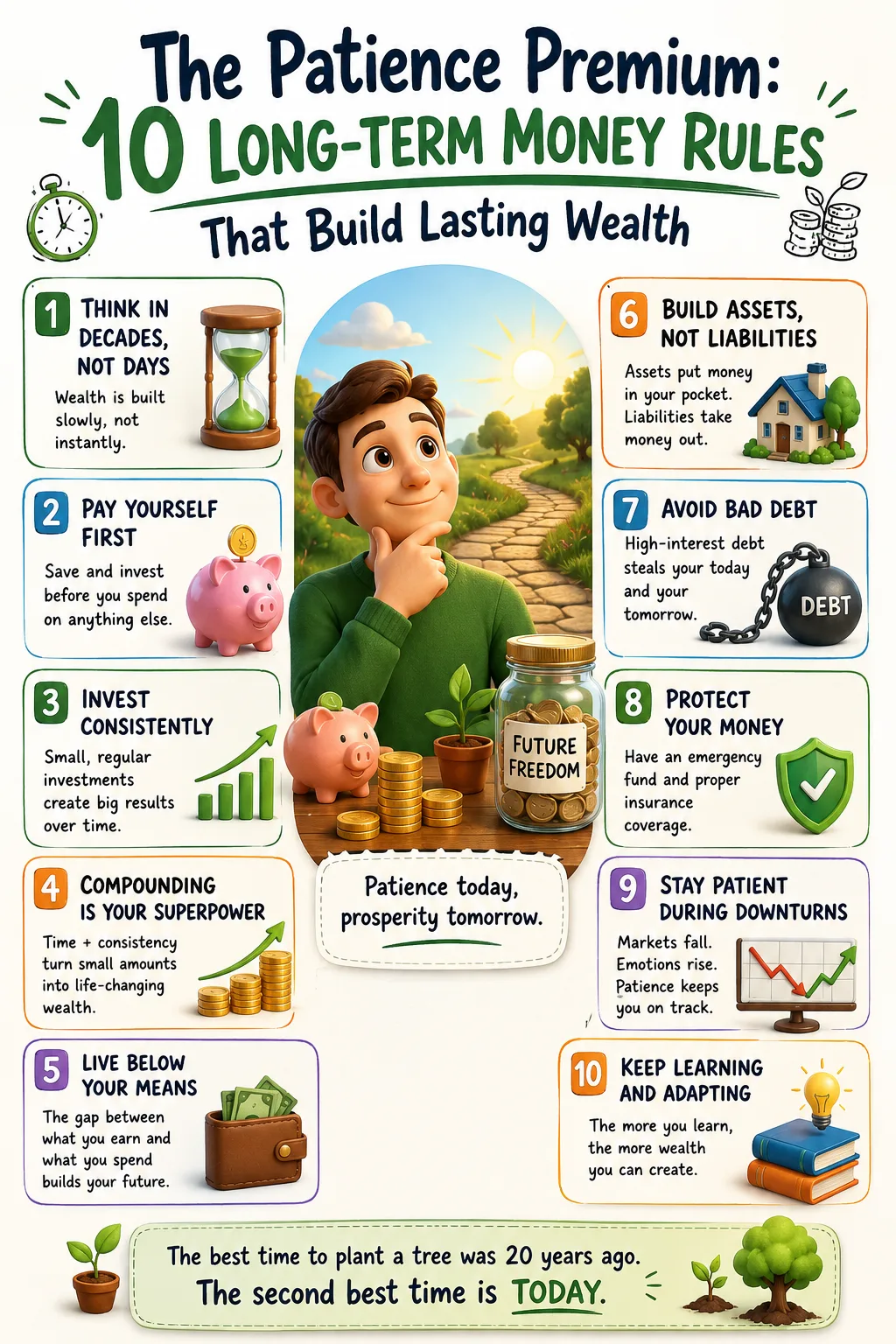
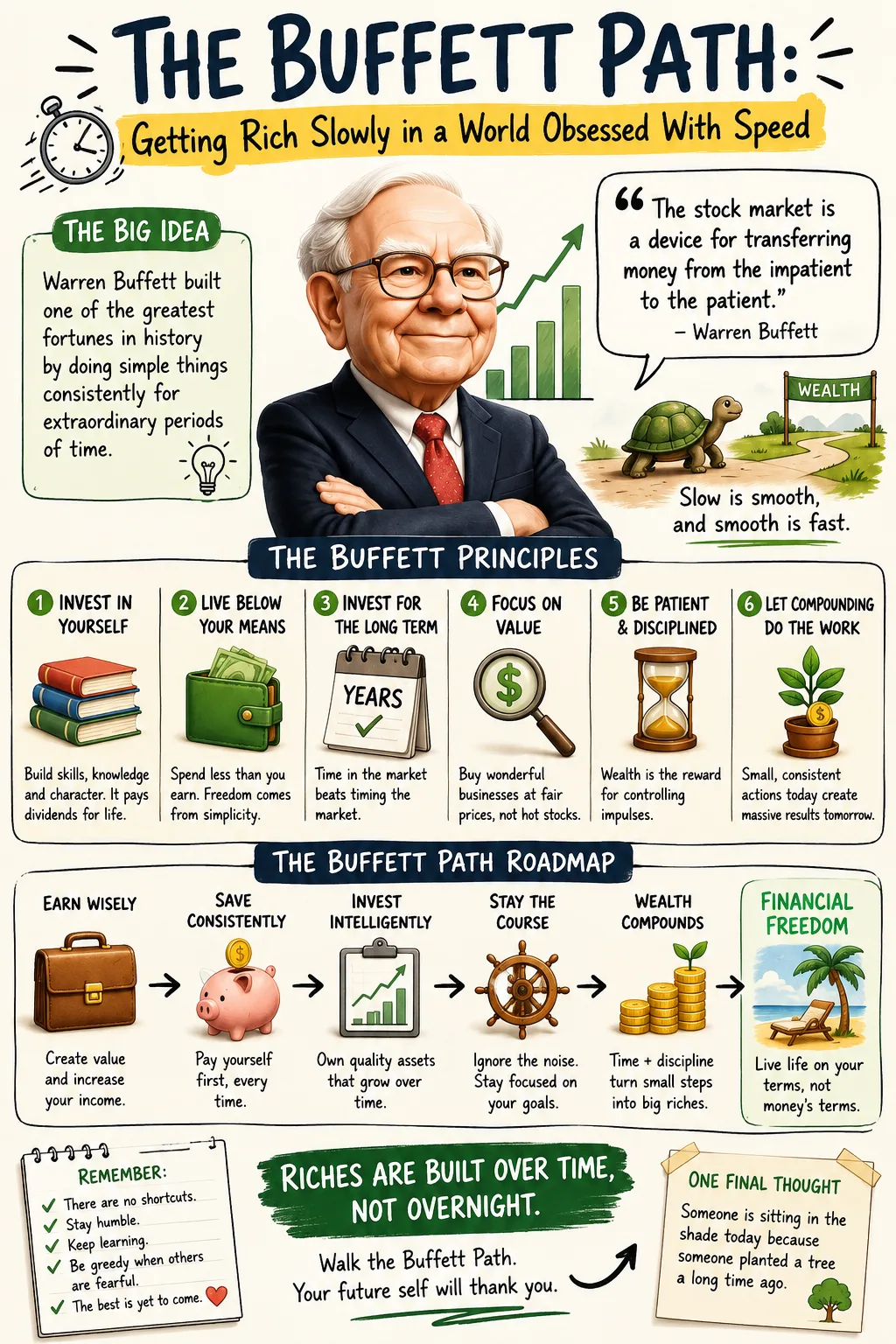
The best budget is not only a tool for avoiding being broke. It is a tool for building wealth.
At the survival level, a budget keeps bills paid and prevents chaos. At the stability level, it creates emergency savings and reduces debt. At the growth level, it funds investments, business ideas, education, homeownership, and long-term goals. The same habit that helps someone avoid overdrafts can eventually help them acquire assets.
This progression matters. Many people associate budgeting with scarcity because they first encounter it during stress. But budgeting is also how wealthy households, businesses, and investors allocate capital. The difference is that the categories change. Instead of only asking how to cover bills, a wealth-building budget asks how much income can be converted into ownership.
Ownership is the turning point. Savings protect against shocks, but assets create future income and appreciation. Investments, retirement accounts, businesses, rental property, intellectual property, and other productive assets can gradually reduce dependence on a paycheck. A budget creates the surplus that makes ownership possible.
This does not happen by accident. If surplus income is not assigned to wealth-building, consumption will usually claim it. That is why raises are so important. A raise can become a larger lifestyle, or it can become a larger investment contribution. It can increase comfort today, or it can buy freedom tomorrow. The best answer may include some of both, but the decision should be deliberate.
A wealth-building budget usually contains several layers. First, it protects essentials. Second, it builds an emergency reserve. Third, it eliminates high-interest debt. Fourth, it funds long-term investing. Fifth, it prepares for irregular expenses. Sixth, it allows guilt-free enjoyment within limits. This structure balances discipline with sustainability.
The budget should not be so strict that it collapses. A plan that allows no pleasure often leads to rebellion. Sustainable budgeting includes money for enjoyment, generosity, and rest. The goal is not to suppress life. The goal is to stop unplanned spending from stealing from planned priorities.
A Practical Framework for Fixing the 12 Mistakes
Fixing budgeting mistakes does not require a perfect system on the first attempt. It requires a sequence.
Start with visibility. Track every expense for at least one month. Use real numbers, not estimates. Categorize spending into essentials, flexible expenses, debt payments, savings, and discretionary purchases. This step creates the financial map.
Next, build a baseline budget using current reliable income. Do not include expected bonuses, raises, refunds, or uncertain income as if they are guaranteed. List fixed expenses first. Then include variable essentials such as groceries, fuel, and utilities. Add minimum debt payments. Add savings, even if the starting amount is small. Then assign limits to discretionary categories.
After that, identify irregular expenses. Build an annual expense calendar and create sinking funds. This single step can prevent many credit card balances because predictable costs stop arriving as surprises.
Then automate the most important actions. Automate savings transfers. Automate minimum bill payments where appropriate. Set payment reminders for anything that cannot be automated. Create alerts for low balances or high spending. Automation should not replace awareness, but it should reduce avoidable mistakes.
Next, attach goals to the budget. Choose one short-term goal, one medium-term goal, and one long-term goal. For example, a starter emergency fund, a credit card payoff plan, and a retirement contribution. Give each goal a monthly amount and a target date.
Then review monthly. Compare actual spending with the plan. Adjust categories. Look ahead for upcoming expenses. Track progress toward goals. A budget that is reviewed becomes stronger over time.
Finally, improve the larger financial picture. If the budget shows that income is too low or fixed expenses are too high, address those issues directly. Look for income growth, career moves, debt restructuring, bill negotiation, insurance review, or housing and transportation changes. Budgeting is the foundation, but wealth building often requires expanding the gap between income and expenses.
The Quiet Power of a Budget That Actually Works
A working budget does not need to be beautiful. It does not need complicated formulas, perfect categories, or hours of maintenance. It needs honesty, consistency, and a structure that fits real life.
The person who tracks expenses gains visibility. The person who reviews monthly gains control. The person who saves first gains momentum. The person who plans for annual bills avoids predictable crises. The person who sets limits reduces overspending. The person who understands emotional triggers protects money from mood. The person who builds a system reduces reliance on willpower.
These habits may not create instant wealth. They may not solve every income problem. They may not erase the pressure of rising living costs. But they change the direction of a household’s finances. They stop money from disappearing unnoticed. They make tradeoffs visible. They create room for savings, debt reduction, and eventually investment.
Being broke is not always the result of one mistake. More often, it is the result of many small leaks combined with large pressures and no system to manage either. Budgeting closes the leaks, reveals the pressures, and creates a plan for progress.
The real purpose of budgeting is not to say no to everything. It is to say yes to the right things first.
When money has no plan, it follows impulse. When money has a system, it can become security. With enough time, discipline, and income growth, it can become wealth.
 Article
 Article
 Article
 Article
 Article
 Article
 Article
 Article