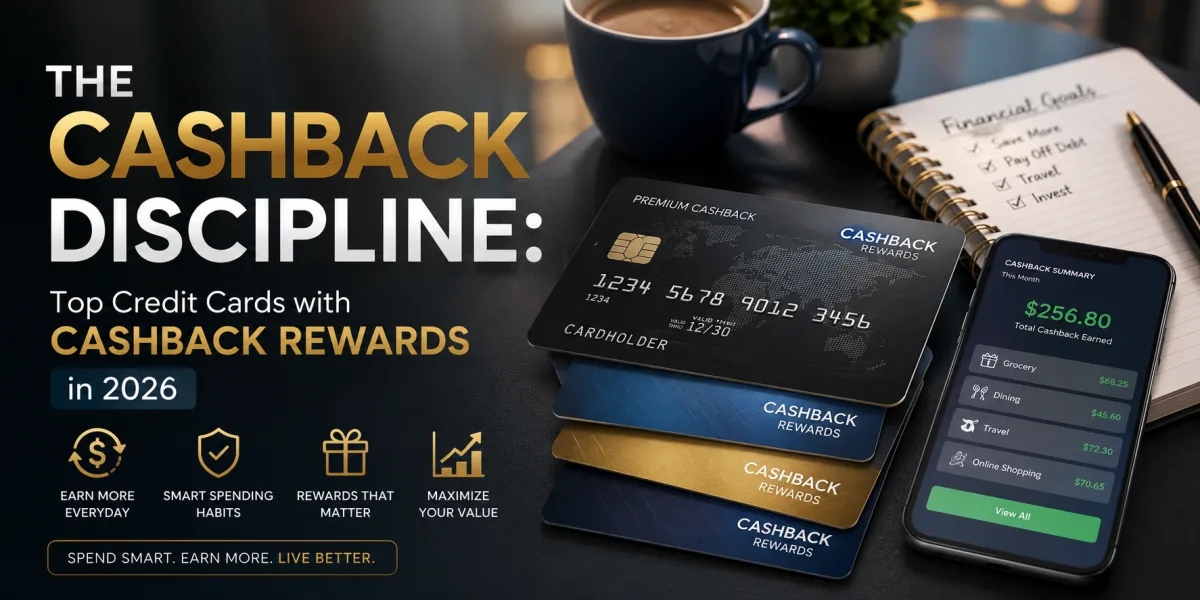
The Cashback Discipline: Top Credit Cards with Cashback Rewards in 2026
Cashback credit cards are built on a simple promise: spend money you were already going to spend and receive a portion of it back. The idea is easy to understand, which is why cashback cards remain popular with beginners, families, commuters, online shoppers, and people who prefer straightforward value over complicated points systems.
But the simplicity can be deceptive. A cashback credit card is only valuable when the rewards are collected without carrying expensive debt. The moment a cardholder pays interest, the math can change quickly. A card that returns 2 percent on purchases cannot compensate for revolving credit card interest that may be many times higher than the reward rate. The Consumer Financial Protection Bureau explains that credit card issuers generally calculate interest daily and that paying all or part of a balance sooner reduces the interest paid.
That is the first principle of cashback cards: rewards are not a wealth strategy unless the balance is paid in full. They are a rebate on disciplined spending, not a reason to spend more.
In 2026, the cashback market is highly competitive. Major issuers offer flat-rate cards, grocery cards, dining cards, gas cards, rotating-category cards, online shopping cards, secured cards, student cards, warehouse-club cards, and hybrid cards that earn cash-like rewards in the form of points. Recent 2026 rankings from Forbes Advisor, Bankrate, CreditCards.com, Investopedia, and other consumer finance publications continue to highlight the same broad theme: there is no single best cashback card for everyone. The best card depends on how a household actually spends.
A family with large grocery bills needs a different card than a single renter who spends heavily on dining and streaming. A commuter needs a different card than a remote worker. A beginner may need a no-annual-fee card with simple rewards, while a high-spending household may justify an annual fee if the grocery or gas rewards exceed the cost. A business owner may need a different structure entirely.
The best cashback card is not the one with the most impressive advertisement. It is the card that fits your spending, costs little or nothing to hold, is easy to manage, and never tempts you into paying interest for the privilege of earning rewards.
How Cashback Credit Cards Work
A cashback credit card returns a percentage of eligible purchases to the cardholder. The reward may appear as cash, a statement credit, a bank deposit, a check, gift cards, or points that can be redeemed for cash-like value. A card that earns 2 percent back on a $100 purchase gives the cardholder $2 in rewards, assuming the purchase qualifies and no limitations apply.
There are four main cashback structures.
The first is flat-rate cashback. These cards pay the same rewards rate on most purchases. A 2 percent flat-rate card is simple: groceries, gas, utilities, insurance, online purchases, dining, and general spending all earn the same rate unless excluded. Flat-rate cards are useful for people who do not want to manage categories or activate bonuses.
The second is bonus-category cashback. These cards pay a higher rate in specific categories such as groceries, gas, restaurants, streaming, transit, drugstores, travel portals, or online shopping. They may pay 3 percent, 4 percent, 5 percent, or 6 percent in selected categories and 1 percent elsewhere. These cards can be powerful when the bonus categories match real spending.
The third is rotating-category cashback. These cards usually offer high rewards in categories that change quarterly. A card may offer 5 percent back on up to a spending cap in categories such as grocery stores, gas stations, restaurants, Amazon, PayPal, wholesale clubs, home improvement stores, or streaming services. The trade-off is effort. Cardholders often must activate the categories and track quarterly limits.
The fourth is customizable cashback. These cards allow the cardholder to choose or automatically receive higher rewards in a preferred category. This can be useful for households whose spending changes throughout the year.
The most important term is not “cashback.” It is “eligible purchase.” Credit card reward programs have exclusions. Balance transfers, cash advances, fees, interest, money orders, person-to-person payments, gambling transactions, and certain quasi-cash transactions typically do not earn rewards. Some categories depend on how the merchant codes the transaction, not what the customer thinks they bought. A grocery purchase at a supermarket may qualify for grocery rewards, while groceries bought inside a superstore or warehouse club may not.
The Rule That Decides Whether Cashback Is Worth It
A cashback card is valuable only if the cardholder pays the statement balance in full and on time. This is not a moral rule. It is arithmetic.
Imagine a card earns 2 percent cashback. A cardholder spends $2,000 and earns $40. If the cardholder pays in full, the $40 is real value. If the cardholder carries the balance and pays interest, the reward can be erased quickly. Credit card interest rates remain high enough that even one or two months of revolving debt can overwhelm the cashback benefit. The Federal Reserve’s G.19 consumer credit release tracks consumer credit conditions, including revolving credit, and the May 2026 release showed revolving credit declining at an annual rate of 4.7 percent, underscoring how sensitive credit card borrowing can be to household behavior and rate conditions.
The cashback discipline is simple: use the card like a payment tool, not a borrowing tool. Charge only what you can pay from existing cash. Set autopay for the full statement balance if your cash flow is reliable. Track purchases during the month. Do not wait for the bill to discover what happened.
This is especially important because rewards can soften the pain of spending. A person may justify a purchase by saying, “At least I get cashback.” But 3 percent back means 97 percent still left your pocket. Cashback is not a discount unless the purchase was necessary, planned, and paid for without interest.
What Makes a Cashback Card Great in 2026
A strong cashback card should meet several tests.
First, the rewards rate should match actual spending. A 6 percent grocery card is excellent for a household that buys groceries at qualifying supermarkets. It is less useful for someone who eats out, shops at wholesale clubs, or buys most groceries through superstores that do not qualify.
Second, the annual fee must be justified. A no-annual-fee card is easier to recommend because the reward math starts positive. A card with an annual fee can still be excellent if the category rewards are high enough. The question is not whether the card has a fee. The question is whether your realistic annual rewards exceed the fee by enough to matter.
Third, the redemption rules should be simple. Cashback should be easy to redeem. Complicated thresholds, limited redemption windows, expiring rewards, or poor cash redemption value reduce usefulness.
Fourth, the card should fit your credit profile. Premium reward cards usually require good to excellent credit. Beginners, students, or people rebuilding credit may need a secured or starter card with lower limits and simpler rewards.
Fifth, the card should not encourage category-chasing behavior. If a card leads you to spend more in order to “maximize rewards,” it may be costing more than it returns.
Best Flat-Rate Cashback Cards in 2026
Flat-rate cards are the cleanest cashback option. They are especially useful for beginners, busy professionals, and households that do not want to track categories. A strong flat-rate card becomes the default card for everything that does not earn more on another card.
Wells Fargo Active Cash® Card
The Wells Fargo Active Cash® Card remains one of the most prominent flat-rate cashback cards in 2026. Wells Fargo’s current card page states that the card earns unlimited 2 percent cash rewards on purchases, offers a $0 annual fee, and includes a $200 cash rewards bonus after spending $500 in purchases in the first three months, subject to terms.
The appeal is straightforward. A 2 percent card with no annual fee is useful for nearly every household. It does not require quarterly activation. It does not force the cardholder to remember whether gas, groceries, or dining qualify this month. It is a strong baseline card.
This card is best for people who want simplicity and competitive everyday rewards. It is also useful as the “everything else” card in a multi-card strategy. If another card earns 5 percent on groceries but only 1 percent elsewhere, a flat 2 percent card can handle the rest of the household’s spending.
The weakness is that a flat-rate card may not maximize specific categories. A household spending heavily on groceries, dining, or gas may earn more by pairing the Active Cash with category cards. But for many people, the simplicity is worth more than the incremental reward difference.
Citi Double Cash® Card
The Citi Double Cash® Card is another major flat-rate contender. Citi states that the card earns unlimited 2 percent cash back on purchases: 1 percent when you buy and 1 percent as you pay, with no category enrollment, caps, or annual fee, subject to terms.
The structure rewards both spending and repayment. That is psychologically useful because it ties the full reward to paying the bill. A cardholder who values simple, uncapped earning may find it highly practical.
The Citi Double Cash is best for people who want a long-term, low-maintenance card. It is also a strong option for those who prefer Citi’s ecosystem or want a card that can later interact with Citi ThankYou rewards, depending on the cardholder’s broader setup.
The caution is that the second 1 percent is earned as purchases are paid. This should not matter to someone paying in full every month, but it reinforces the key principle: cashback works best when repayment is automatic and complete.
Best Everyday Cashback Card for Flexible Spending
Chase Freedom Unlimited®
The Chase Freedom Unlimited® is often described as a hybrid cashback card because it combines a base rewards rate with elevated categories. Forbes Advisor’s June 2026 credit card coverage highlighted it as a leading 1.5 percent cashback card, noting that it earns at least 1.5 percent back on every purchase and higher rewards in categories such as restaurants, drugstores, and Chase Travel.
This card is useful for consumers who want more than a simple 1.5 percent card but do not want to manage rotating categories. It rewards common spending areas while still offering a baseline rate on everything else.
The Chase Freedom Unlimited can also become more valuable for people who later use Chase’s broader travel rewards ecosystem. Cashback is earned as Chase Ultimate Rewards® points, which may have additional redemption possibilities when paired with eligible premium Chase cards. For a pure cashback user, however, the card should still be judged by its cash value, not by hypothetical travel strategies.
This card is best for people who spend regularly on dining and drugstores, want a no-annual-fee card, and may eventually want more flexible rewards. It is less ideal for someone who wants a pure 2 percent flat-rate card and does not care about bonus categories.
Best Rotating-Category Cashback Cards
Rotating-category cards can produce excellent returns, but they demand attention. They are best for organized cardholders who enjoy activating categories, tracking caps, and shifting spending strategically without overspending.
Chase Freedom Flex®
Chase’s cashback card page describes the Chase Freedom Flex as offering 5 percent cash back on up to $1,500 in combined purchases in bonus categories each quarter after activation, along with other bonus categories such as Chase Travel, dining, and drugstores, subject to terms.
The Freedom Flex can be powerful because 5 percent categories can cover common spending areas during the year. If a quarter includes grocery stores, gas stations, restaurants, or digital wallets, a disciplined cardholder can earn meaningful rewards quickly.
The limitation is the cap and activation requirement. A 5 percent rate on up to $1,500 per quarter means the maximum quarterly bonus-category cashback is $75 before considering other rewards. That is strong, but only if the spending is natural. Buying more simply to hit a category cap is backwards.
This card is best for people who like optimization and are willing to manage quarterly changes. It is not ideal for someone who wants one card and no homework.
Discover it® Cash Back
The Discover it® Cash Back card remains a familiar rotating-category option. CreditCards.com’s 2026 cashback coverage describes it as a solid pick because of its rotating 5 percent categories across practical spending areas, subject to activation and caps.
Discover’s appeal often comes from its beginner-friendly reputation, rotating category structure, and first-year Cashback Match feature for new cardmembers, depending on current terms. For someone early in their credit journey, Discover has historically been a common entry point, though approval always depends on the applicant’s credit profile and issuer criteria.
The same caution applies: rotating categories are valuable only when they align with spending you would have done anyway. The best use is to pair a rotating 5 percent card with a flat-rate card. Use the rotating card where it earns more; use the flat-rate card everywhere else.
Best Grocery Cashback Cards
Groceries are one of the most important cashback categories because they are recurring, necessary, and often large. A household that spends heavily at qualifying supermarkets can earn substantial rewards from the right card.
Blue Cash Preferred® Card from American Express
The Blue Cash Preferred® Card from American Express is one of the strongest grocery cashback cards available. American Express states that cardmembers can earn 6 percent cash back at U.S. supermarkets on up to $6,000 per year in purchases, then 1 percent, as well as 6 percent on select U.S. streaming subscriptions, 3 percent on transit, and 3 percent at U.S. gas stations, subject to terms.
This card is best for households with meaningful supermarket spending. The math can justify the annual fee if the cardholder uses the grocery category heavily. For example, a household spending $500 per month at qualifying U.S. supermarkets would reach $6,000 per year. At 6 percent, that produces $360 in grocery cashback before considering the annual fee and other categories. Even after a fee, the net value can be strong for the right household.
The card is less attractive if most grocery spending happens at warehouse clubs, superstores, discount stores, or merchants that do not code as U.S. supermarkets. It also requires awareness of the annual category cap.
This is a classic example of why card selection must follow spending behavior. The Blue Cash Preferred can be excellent for one family and mediocre for another.
Blue Cash Everyday® Card from American Express
The Blue Cash Everyday® Card is a no-annual-fee alternative for people who want grocery, gas, and online retail rewards without paying for the Preferred version. Recent coverage notes that the card offers 3 percent cash back at U.S. supermarkets, U.S. gas stations, and U.S. online retail purchases, each up to annual spending caps, subject to terms.
This card is useful for moderate spenders who may not spend enough at supermarkets to justify an annual fee. It also stands out for online retail, a category many cards do not reward as clearly.
The trade-off is that 3 percent is lower than 6 percent, but no annual fee makes the card easier to hold. For beginners, fee-free simplicity can be more important than maximum theoretical rewards.
Best Dining and Entertainment Cashback Card
Capital One Savor Cash Rewards Credit Card
The Capital One Savor Cash Rewards Credit Card is a strong card for food and entertainment spending. Capital One states that Savor earns unlimited 3 percent cash back at grocery stores, on dining, entertainment, and popular streaming services, 5 percent on hotels, vacation rentals, and rental cars booked through Capital One Travel, and 1 percent on other purchases, with a $0 annual fee, subject to terms.
This card is best for people whose spending clusters around dining, groceries, streaming, and entertainment. A younger professional, couple, or family that spends regularly on restaurants, groceries, streaming subscriptions, concerts, sporting events, or entertainment purchases may find the structure practical.
The key advantage is that the card covers several lifestyle categories without an annual fee. The risk is that entertainment and dining categories can encourage extra spending if the cardholder starts rationalizing purchases because of rewards. Three percent back is not a reason to eat out more often. It is a reward for dining you already planned.
Best Gas and Commuter Cashback Options
Gas rewards matter most for drivers with regular commutes, families with multiple vehicles, rideshare drivers, sales professionals, and people in areas with limited public transportation. But gas spending varies widely. A remote worker may not need a gas card. A commuter may benefit significantly.
Several cards provide strong gas rewards, including the Blue Cash Preferred and Blue Cash Everyday cards from American Express, which include U.S. gas station rewards, and warehouse-club cards such as the Costco Anywhere Visa® by Citi for eligible members. Kiplinger’s 2026 coverage notes that the Costco Anywhere Visa by Citi offers elevated rewards on Costco gas and competitive rewards at other gas stations and EV charging, while requiring Costco membership.
The Costco card can be valuable for people who already shop at Costco and buy gas there. But it is not a universal gas card because the membership cost, redemption structure, and Costco-centered value proposition matter. A person who does not shop at Costco should not join solely because of a credit card without doing the math.
For many consumers, the better gas strategy is to use a broader everyday card that also rewards groceries or dining. A dedicated gas card is most useful when fuel is a major, predictable expense.
Best Warehouse and Retail Cashback Cards
Retail-specific cashback cards can be valuable when the cardholder already spends heavily at that retailer. They can be dangerous when they create loyalty to a store that is not always the cheapest.
The Prime Visa is frequently noted in cashback rankings for Amazon and Whole Foods spending, particularly for Prime members. Investopedia’s 2026 Credit Card Awards named Prime Visa as a best retail card, highlighting its value for Amazon and Whole Foods purchases for eligible Prime members.
A retail card works best when it rewards unavoidable spending at a merchant you already use. If a household buys household goods, groceries, toiletries, electronics, and school supplies through Amazon, a Prime-focused card may produce meaningful value. If Amazon purchases are impulse-driven, the card may encourage overspending.
The same principle applies to warehouse clubs. A warehouse-club card can be excellent if the household already saves money by shopping there. It is less useful if bulk purchases lead to waste, overbuying, or higher total spending.
Best Cashback Cards for Beginners
Beginners should prioritize simplicity, no annual fee, clear redemption, and credit-building behavior. The best first cashback card is rarely the most complicated optimizer card. It is usually a card that can be paid in full, monitored easily, and held for years.
A beginner with good credit may start with a flat-rate card such as Wells Fargo Active Cash or Citi Double Cash, or a simple category card such as Chase Freedom Unlimited or Capital One Savor, depending on spending. A student may consider student cashback cards from major issuers. Someone rebuilding credit may need a secured cashback card.
Investopedia’s 2026 Credit Card Awards highlighted secured and student options in addition to mainstream cashback cards, including Bank of America Customized Cash Rewards Secured and Bank of America Customized Cash Rewards for Students in relevant categories.
The beginner’s goal is not to earn the most cashback in year one. The goal is to build a clean credit record. That means low utilization, on-time payments, full balance payoff, and no unnecessary applications. Cashback is secondary. Credit discipline is primary.
Best Cashback Card Pairings
One card can be enough. But many households improve rewards with a two-card setup.
The simplest pairing is a flat-rate 2 percent card plus a grocery or dining card. The flat-rate card handles everything that does not earn a bonus. The category card handles the household’s biggest recurring category.
For example, a family could use Blue Cash Preferred for qualifying U.S. supermarket purchases, U.S. gas stations, transit, and streaming, then use Wells Fargo Active Cash or Citi Double Cash for everything else. A dining-heavy household could use Capital One Savor for dining, entertainment, groceries, and streaming, then use a 2 percent card for non-bonus purchases.
An optimizer could use Chase Freedom Flex or Discover it Cash Back for rotating 5 percent categories, then use a flat-rate card for all other spending. This strategy can work well, but only if it remains organized.
The danger of multiple cards is complexity. More cards mean more due dates, more statements, more temptation, and more room for missed payments. A card strategy that earns an extra $80 per year but creates stress, late fees, or interest is not a good strategy.
How to Calculate the Real Value of a Cashback Card
To choose a card, estimate annual spending by category. Use bank statements, not guesses. Categories might include groceries, dining, gas, transit, streaming, drugstores, online shopping, utilities, insurance, travel, warehouse clubs, and general purchases.
Then calculate expected rewards. If you spend $6,000 per year at qualifying supermarkets and a card earns 6 percent on that spending, the gross reward is $360. If the card has a $95 annual fee, the net grocery reward is $265 before considering other categories. If a no-fee card earns 3 percent on the same $6,000, the reward is $180. In that example, the fee card may still win. But if you spend only $2,000 per year at qualifying supermarkets, 6 percent earns $120; after a $95 fee, the net is $25. A no-fee 3 percent card would earn $60. The no-fee card may be better.
This is the kind of arithmetic card advertisements do not do for you. They show maximum rewards. You must calculate realistic rewards.
Also subtract behavioral costs. Will the card lead you to spend more? Will you buy from a more expensive merchant to earn rewards? Will you carry a balance? Will you forget to activate categories? Will you redeem rewards at poor value? The best card on paper may not be the best card in real life.
Why Annual Fees Are Not Always Bad
Many people avoid annual fees automatically. That is understandable, especially for beginners. But an annual fee is not always a mistake. It is a price. The question is whether the benefits exceed the price.
A grocery card with a $95 annual fee can be worthwhile for a household that earns several hundred dollars more in rewards than a no-fee alternative. A card with travel credits can be worthwhile if the credits replace spending you would already do. A business cashback card with a fee can be worthwhile if business expenses are large and reimbursed by revenue.
The problem is when fees are justified by benefits the cardholder does not actually use. A statement credit for a service you would never buy is not worth its face value. A travel benefit is not valuable if you do not travel. A premium card is not profitable simply because it looks prestigious.
For most cashback users, the best annual-fee test is conservative: would this card still beat my best no-fee alternative after subtracting the fee and ignoring benefits I might not use? If the answer is yes, the fee may be justified. If the answer is no, choose the simpler card.
The Hidden Risk: Spending More to Earn More
Cashback cards are profitable for issuers because they influence behavior. They encourage card usage, strengthen customer loyalty, and generate interchange revenue from merchants. They may also produce interest and fee income when cardholders revolve balances or miss payments.
The consumer’s job is to capture rewards without becoming the profit center through debt.
A common mistake is reward-chasing. A cardholder sees 5 percent back on a category and increases spending to “take advantage” of it. But spending $500 unnecessarily to earn $25 is not a win. It is a $475 loss disguised as optimization.
Another mistake is using cashback to rationalize lifestyle inflation. Dining out feels cheaper because the card earns 3 percent. Online shopping feels smarter because the card earns rewards. Gas purchases feel less painful because cashback is coming. But rewards do not reverse spending. They only reduce it slightly.
The disciplined cardholder uses rewards on planned spending only. The card follows the budget. The budget does not follow the card.
Statement Credit, Bank Deposit, or Points: Which Redemption Is Best?
Cashback redemption methods vary. Some cards allow statement credits. Some allow direct deposit. Some issue checks. Some convert rewards into points. Some allow gift cards or shopping checkout redemptions.
The best redemption is usually the one that preserves full cash value and supports good financial behavior. Statement credits are simple because they reduce the card balance, though the cardholder should still pay the full statement amount due according to issuer rules. Direct deposit can be useful if the money is swept into savings or investments. Gift cards can be useful if they are discounted or used for planned spending, but they may encourage consumption.
Checkout redemption should be used carefully. Redeeming rewards at online checkout can make purchases feel painless. For disciplined shoppers, that may be fine. For impulse shoppers, it weakens the friction that protects money.
A strong system is to redeem cashback into a high-yield savings account, emergency fund, or investment account. This turns small rebates into visible progress. A household that earns $500 per year in cashback and saves it rather than spending it has converted rewards into financial resilience.
Credit Score Considerations
Applying for a cashback card can affect credit in several ways. A new application may create a hard inquiry. A new account can reduce the average age of credit. A higher total credit limit may reduce utilization if balances remain low. On-time payments can strengthen credit history over time.
The best card is useless if approval odds are poor or the application strategy is careless. Before applying, check your credit profile, current utilization, recent inquiries, and existing card limits. Many issuers offer prequalification tools that use a soft inquiry, though prequalification is not a guarantee of approval.
People with excellent credit can choose from the strongest cashback cards. People with good credit still have many options. People with fair or rebuilding credit may need to focus on secured cards, student cards, or credit-building products before pursuing premium rewards.
Avoid applying for multiple cards at once unless you have a clear reason and strong credit. Rewards are not worth damaging your credit profile through unnecessary applications.
Which Cashback Card Should You Choose?
Choose Wells Fargo Active Cash if you want a simple, no-annual-fee, unlimited 2 percent cashback card that can serve as a default for everyday purchases.
Choose Citi Double Cash if you want a no-annual-fee 2 percent structure and like the discipline of earning part of the reward as you pay.
Choose Chase Freedom Unlimited if you want a no-annual-fee everyday card with a base rate plus elevated rewards on common categories such as dining, drugstores, and Chase Travel.
Choose Chase Freedom Flex or Discover it Cash Back if you are organized enough to manage rotating 5 percent categories and want higher upside on changing quarterly spending.
Choose Blue Cash Preferred if you spend heavily at qualifying U.S. supermarkets and can justify the annual fee through grocery, streaming, gas, and transit rewards.
Choose Blue Cash Everyday if you want no annual fee and solid rewards on U.S. supermarkets, U.S. gas stations, and U.S. online retail purchases, subject to caps and terms.
Choose Capital One Savor if your spending centers on dining, groceries, entertainment, and streaming and you want a broad no-annual-fee lifestyle cashback card.
Choose Costco Anywhere Visa by Citi if you are already a Costco member, buy gas or EV charging regularly, and can use the card’s Costco-centered reward structure effectively.
Choose Prime Visa if you are already a Prime member and spend heavily at Amazon or Whole Foods, while making sure the card does not encourage unnecessary retail spending.
A Practical Ranking by Household Type
For the one-card beginner, a flat-rate no-fee card is often best. Wells Fargo Active Cash or Citi Double Cash can cover nearly all spending with minimal effort. The goal is to learn disciplined credit use before optimizing categories.
For the grocery-heavy family, Blue Cash Preferred deserves serious consideration if the household shops at qualifying U.S. supermarkets and spends enough to overcome the annual fee. A no-fee alternative such as Blue Cash Everyday may be better for moderate grocery spenders.
For the dining and entertainment spender, Capital One Savor is a strong fit because it covers dining, groceries, entertainment, and streaming without an annual fee.
For the optimizer, Chase Freedom Flex or Discover it Cash Back can add high quarterly category rewards, especially when paired with a flat-rate card.
For the warehouse-club loyalist, the Costco Anywhere Visa or a similar warehouse-focused card may be valuable if membership is already part of the household’s spending strategy.
For the Amazon-centered household, Prime Visa can be useful if the household already receives enough value from Prime membership and does not overspend because of convenience.
For the credit rebuilder, rewards should be secondary. A secured cashback card or starter card that reports to the major credit bureaus and supports on-time payment history is more important than maximizing rewards.
The Cashback System That Actually Builds Wealth
Cashback becomes meaningful when attached to a system. Without a system, rewards disappear into statement credits and casual spending. With a system, cashback becomes a small but steady source of financial progress.
Start by choosing one primary card. Use it only for budgeted expenses. Pay the statement balance in full. Redeem rewards monthly or quarterly. Send the cashback to a specific purpose: emergency savings, debt payoff, investment contributions, holiday sinking fund, travel fund, or insurance reserve.
Then review the card once or twice a year. Has your spending changed? Did the annual fee still make sense? Did you carry a balance? Did rewards cause overspending? Did a category cap limit value? Did another card become more suitable?
This review prevents inertia. Cashback cards change. Household spending changes. Issuer terms change. The right card in 2026 may not be the right card in 2028.
When Not to Use a Cashback Credit Card
A cashback card is not appropriate for everyone at every moment. If you are carrying high-interest credit card debt, the priority is repayment, not rewards. If you struggle with impulse spending, a credit card may increase spending compared with debit or cash. If you have irregular income and cannot reliably pay in full, rewards may be outweighed by interest risk.
There are also situations where a credit card fee may erase rewards. Some landlords, tax processors, tuition portals, utilities, and service providers charge processing fees for credit card payments. If the fee is 3 percent and the reward is 2 percent, the transaction loses money unless another benefit justifies it.
Cash advances should generally be avoided. They often carry fees, high APRs, and no grace period. Balance transfers are not cashback strategy; they are debt management tools and should be evaluated separately.
The Real Reward Is Control
Cashback cards can be useful, but they are not magic. They do not turn consumption into wealth. They return a small portion of spending to people who manage credit well.
The consumer who wins with cashback is not the one with the most cards. It is the one who knows their spending, pays in full, avoids fees, chooses rewards that match real life, and sends the cashback toward a purpose. That person turns a credit card from a temptation into a tool.
In 2026, the best cashback cards are more competitive than ever, but the old rule still governs the outcome: the card must serve the plan. A 2 percent flat-rate card can be excellent. A 6 percent grocery card can be excellent. A rotating 5 percent card can be excellent. A dining card can be excellent. Any of them can become expensive if they lead to debt.
Choose the card that fits your life, not the life advertised by the card issuer. Spend intentionally. Pay completely. Redeem deliberately. Let cashback become a quiet rebate on disciplined choices, not a permission slip for larger bills.
 Article
 Article
 Article
 Article
 Article
 Article
 Article
 Article